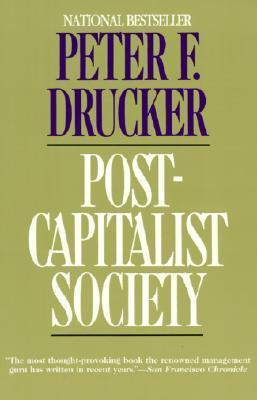
Business guru Peter Drucker provides an incisive analysis of the major world transformation taking place, from the Age of Capitalism to the Knowledge Society, and examines the radical affects it will have on society, politics, and business now and in the coming years. This searching and incisive analysis of the major world transformation now taking place shows how it will affect society,economics, business, and politics and explains how we are movingfrom a society based on capital, land, and labor to a society whoseprimary source is knowIedge and whose key structure is theorganization.
Peter Ferdinand Drucker was a writer, management consultant and university professor. His writing focused on management-related literature. Peter Drucker made famous the term knowledge worker and is thought to have unknowingly ushered in the knowledge economy, which effectively challenges Karl Marx's world-view of the political economy. George Orwell credits Peter Drucker as one of the only writers to predict the German-Soviet Pact of 1939.
The son of a high level civil servant in the Habsburg empire, Drucker was born in the chocolate capital of Austria, in a small village named Kaasgraben (now a suburb of Vienna, part of the 19th district, Döbling). Following the defeat of Austria-Hungary in World War I, there were few opportunities for employment in Vienna so after finishing school he went to Germany, first working in banking and then in journalism. While in Germany, he earned a doctorate in International Law. The rise of Nazism forced him to leave Germany in 1933. After spending four years in London, in 1937 he moved permanently to the United States, where he became a university professor as well as a freelance writer and business guru. In 1943 he became a naturalized citizen of the United States. He taught at New York University as a Professor of Management from 1950 to 1971. From 1971 to his death he was the Clarke Professor of Social Science and Management at Claremont Graduate University.
Summary: Describes the transformation of a society based on capital to one based on knowledge whose key structure is the responsibility-based organization.
Peter Drucker, who died in 2005 was the business guru I looked to as a young leader in a non-profit organization. He wrote Post-Capitalist Society in 1993. In many ways, it captures a number of his key ideas, and in many ways seems prophetic, twenty-eight years later.
His key idea here is that we have witnessed a transformation from a capitalist society to a knowledge society, based on the successive Industrial, Productivity, and Management Revolutions. Now we are not in a situation of knowledge but knowledges–specialized knowledge for work in more highly specialized organizations. Organizations make knowledge productive for a special purpose. In a knowledge society, the workers own the capital, which is their knowledge, but need the organization to make it productive.
He has a fascinating discussion on the source of capital in pension funds through institutional investors. Here as well, employees are the ultimate “owners” even while trustees manage these funds. He points to the critical role of corporate governance in creating organizations responsible to these employee-owners. As he looks at the question of productivity, he advocates for corporate restructuring and outsourcing so that organizations concentrate on what they are most effective at doing. Effective responsible organizations are ones where everyone takes responsibility for the organization.
He then turns from the knowledge society of organizations to the wider polity of which they are a part. He envisions the transitions from nations to megastates, as we see in the European Union, NAFTA, and other regional economic polities. Even in 1994, Drucker recognized the environment as one of the needs for transnational arrangements, as well as counter-terrorism efforts and arms control. Even while he recognizes this movement to regional entities and transnational agreements, he foresaw the rise of tribalism, and the stress on diversity rather than unity. For Drucker, tribal and transnational identities go together. And maybe this is so, but not in the ethnic ways he sees but in the radical political identities on the far right and left of the political spectrum that find iterations in many countries.
He is witheringly critical of “the nanny state” in which taxation and economic policy is designed not to make the “patient” healthy but rather to feel good. He points to the success of Germany (before 1989) and Japan and the “Asian tigers” that had high taxes but high investment in education, in facilities, and infrastructure. He argues that patriotism is not enough and that what is needed is the revitalization of community (even more true today) and citizenship expressed through voluntarism.
In the final section, he focuses even more on the cultivation of knowledge. He argues that we know more than we do and need to learn to “only connect,” to see how disparate pieces connect as a whole. He considers here the needs of education, and contends here, as well, for outsourcing and charter schools (an area that has a very mixed record of effectiveness). He advocates for the “accountable” school. While Drucker had a richer vision of the results he would seek from education, his was among the voices that sustained an accountability movement that has focused more on test-taking than learning, to the discouragement of many teachers. Ultimately Drucker believed people needed to be educated for work in two cultures simultaneously–“that of the ‘intellectual,’ who focuses on words and idea, and that of the ‘manager,’ who focuses on people and work.”
Where Drucker seems the most prescient is his understanding of the knowledge economy. What I don’t think he foresaw was the monetization of knowledge in the information economy. He recognized the growth of transnationalism, but didn’t fully reckon with the reactionary character of nationalism, often acting against its own interests. He had wisdom that both corporations and governments need about long-term planning and especially for governments, the follies of budget deficits in good times as well as bad. Perhaps most compelling to me was his call beyond patriotism to work for the common good and to citizenship expressed in voluntarism. He recognized that we need people educated both in humane ideals and technical skill, refusing to come down on one side or the other. None of us sees the future with complete clarity. Drucker saw it better than many, understanding the developments and trajectory of history and the challenges facing organizations and large polities of his time.
Drucker either doesn’t know what capitalism is, or is willfully misleading his readers. Claiming that a “knowledge” worker is somehow different than a laborer, and that because they have “knowledge” the modern worker owns the means of production is just a fiction.
Just because we now go to overpriced universities to learn “knowledge” and operate computers instead of working in steel factories does not all the sudden mean that we are “post capitalism”. Maybe it’s because this book was written in 1993 before the the Great Recession, social media, and the further dismantling of American social fabrics at the behest of corporations and increasing shareholder value, but Drucker is living in a fantasy land if he believes that somehow we are post capitalist anything.
In the introduction and later chapters he tries to give himself the out of saying that capital will be involved to some degree in the societal reformation post “capital C capitalism” but what he’s describing is just capitalism lol.
This book is a waste of time, and Drucker couldn’t get big cooperation weiner out of his mouth for enough time to actually think about what he was talking about.
Peter Drucker’s Post-Capitalist Society (1993) presents a forward-looking analysis of the transformation of economic, social, and political structures in the late 20th and early 21st centuries. As one of the most influential management thinkers of the modern era, Drucker examines the decline of traditional capitalist models and the emergence of what he terms the “knowledge society.” This work builds upon his previous theories of management and organizational behavior, extending them to broader societal and economic trends.
Drucker’s core thesis is that the shift from an industrial economy to a knowledge-based society represents a fundamental transformation as significant as the transition from feudalism to capitalism. He argues that knowledge, rather than land, labor, or capital, has become the central resource of economic production. This shift, he contends, necessitates a new approach to governance, economic policy, and organizational management.
Several key themes structure the book:
1. The Rise of the Knowledge Worker – Drucker highlights the increasing importance of knowledge workers, whose productivity and innovation drive economic progress. Unlike traditional laborers, knowledge workers require continuous education and adaptability, making lifelong learning a necessity rather than an option.
2. Decline of Traditional Capitalism – Drucker challenges the classical capitalist model, arguing that private ownership of capital is no longer the defining feature of the economy. Instead, organizations—both corporate and non-profit—serve as the primary means through which knowledge is applied and distributed.
3. New Social and Political Structures – The book explores how the knowledge economy affects governance and social institutions. Drucker predicts the decline of the nation-state as the dominant political entity, suggesting that transnational organizations and regional alliances will play an increasingly significant role in global affairs.
4. The Role of Management in Society – A major focus of the book is the role of management in adapting to and shaping the post-capitalist world. Drucker argues that organizations must prioritize flexibility, decentralization, and knowledge-sharing to remain competitive. He also emphasizes the ethical responsibilities of managers in a knowledge-driven economy.
Drucker’s analysis is interdisciplinary, drawing on economics, sociology, political science, and management theory. His writing is characterized by a blend of historical insight, empirical observation, and prescriptive recommendations. Unlike many economists, Drucker does not rely on quantitative modeling; instead, he uses historical analogies and case studies to illustrate his arguments.
Upon its release, Post-Capitalist Society was widely praised for its prescient analysis of economic and technological change. Scholars and business leaders found Drucker’s insights valuable in anticipating the impact of globalization and the digital revolution.
However, some critics argue that Drucker’s work lacks empirical rigor, relying too heavily on broad generalizations rather than systematic data analysis. Others have pointed out that while he accurately predicted the rise of the knowledge economy, his optimism about the social and political consequences of this transformation may have been overstated. The persistence of economic inequality and job displacement challenges his assumption that knowledge work would be universally accessible and beneficial.
Post-Capitalist Society remains a seminal work in the study of economic and organizational transformation. Drucker’s vision of a knowledge-based economy has largely materialized, making his insights particularly relevant for contemporary discussions on the future of work, education, and governance. While some of his predictions warrant further scrutiny, the book provides a valuable framework for understanding the ongoing evolution of capitalism and its alternatives. As such, it is essential reading for scholars of business, economics, and public policy.
Writted in 1993, this book has proven itself to be a prophetic vision of the changes the world continues to undergo and the challenges it continues to face. It presents clear, concise, cogent arguments for that we are transitioning from a capitalist society (a society built upon the aquisition and use of capital -- labor, hardware, land -- in production) through a post-capitalist society into a knowledge based society (a society where the creation and application of knowledge drives the production of wealth); that we are transitioning from a nation-state based world order to a world where national economies yield to larger regional economies, national political leadership yields to both transnational organizations and local tribalism (read diversity as opposed to integration), and highly integrated generalized companies yield to specialized organizations that outsource everything that is not their speciality; that the greatest problems we need to address at the transnational level are the environment, terrorism and globel arms control (the military-industrial complex demanded by perpetual cold war in the absence of arms control, requires too many resources especially in the form of lost scientific and engineering research and development); that state governments must abandon their futile attempts to manipulate economies so as to prevent every little recession and redistribute wealth and instead return to financial positions that permit them to address seemingly inevitable major recessions by pouring massive investments into infrastructure (roads, trains, utilities, internet) and restrict itself to laws and regulations that promote long-term growth in production and recession resistance which is the only proven way to increase total wealth including the wealth in each class; that state governments must abandon complicated tax systems which have driven the development of special interests and pork-barrell legistlative spending; that state governments must outsource every activity, apart from it's natural role as regulator, to private specialized organizations held accountable by the combination of competition and profit; that organizations must transition from a hierarchical authority-based structure where supervisors assign work to a horizontal responsibility based structure where the manager communicates the goals and the specialist employees figure out how to accomplish those goals.
Drucker could make the profound seems obvious and the obvious seem profound. He wrote about a new economy while most were still trying to figure out the old one.
Drucker wrote this in 1993 and pointed out that the means of production had already shifted from capital to knowledge and that knowledge was owned by the worker, not the capitalist. He went on to desribe the impac of this transition on society and ultimately raised the question, still to be answered, of what is a well-educated person in this new world. While the forces pushing education for strictly vocational purposes will always be with us, Drucker recognizes there is a much larger question. Everyone needs to know they are making a contribution to the world around them, but that contribution is rarely satisfied merely by work, which changes dramatically over the course of a lifetime. Education must help the individual to know their own calling while also preparing them for the changes they will see in the world. Drucker was one of our greatest thinkers and I recommend this book to anyone who hasn't yet read it as a challenging look at our world, still relevant because Drucker sees and writes with clarity and has raised questions that still need serious consideration.
Not a particularly enjoyable and a bit of a dry book by “the management consultancy guru,” possibly because I generally do not enjoy reading such books.
The author’s central argument is that the latest “economic revolution” (a trend that happens every few centuries or so, and the previous one being the industrial society) the humanity is going through, i.e., “knowledge society” is transforming former areas of static and private knowledge into public and dynamic in various work environments, thereby creating synergies and spill-over effects, especially through the help of “organizations.” He likens this, to a certain degree, to the creation of “encyclopédie” of the 18th century and Taylor’s “theory of harmonious application of knowledge to work” by bringing the capitalist and proletariat classes together.
"In 1993, Peter Drucker outlined a possible evolution of capitalistic society in his book Post-Capitalist Society. This states that knowledge, rather than capital, land, or labor, is the new basis of wealth."
he seems to have woken up one day and said that wealth isn't owned by one person or a family anymore, but gee I think it's banks and insurance companies
which to most people is a pretty absurd
'knowledge is the new capital' blah blah blah
yeah knowledge and super specialized corporations will rule and everyone else will be in non-manufacturing
it's a weird wooly and unfocused book that only makes you appreciate John Kenneth Galbraith talking about 'The Technosphere' being a lot more well thought out than Drucker who was always an oddball.
Just a Management guy always trying to stay relevant with a best seller, but this book
//////
in looking at other reviews a few interesting things are said
"He is witheringly critical of 'The Nanny State' in which taxation and economic policy is designed not to make the 'patient' healthy but rather to feel good"
"In the final section, he focuses even more on the cultivation of knowledge. He argues that we know more than we do and need to learn to 'only connect' to see how disparate pieces connect as a whole. "
"Where Drucker seems the most prescient is his understanding of the knowledge economy. What I don’t think he foresaw was the monetization of knowledge in the information economy."
"He had wisdom that both corporations and governments need about long-term planning and especially for governments, the follies of budget deficits in good times as well as bad."
"Perceptive takes on the "postcapitalist" era, which, according to Drucker (Managing for the Future, 1992, etc.), got under way shortly after WW II."
"Agriculture declined to 2-3% of the workforce. Manufacturing will see a similar declining to 10-15% of the workforce"
"He forecasts the decline in the Nation state."
"Boring and repetitive."
/////////
"Drucker's theory is based on the idea that manual labor is declining. To replace it, people will have to have a knowledge needed by employers. In effect, they will be selling their knowledge to the employer. Gone are the industrialists like J.P. Morgan and Andrew Carnegie. In there place are no-name managers, people of knowledge. The structure of the economy has certainly changed in the last hundred years. However, I am not sure the change is so drastic as to label the birth of a new capitalism. If Drucker wants to call this new era "Post-Capitalism", it is still "Capitalism" by definition."
"....I found nothing about the book particularly enriching."
/////
"more misses than hits - it's a lot like reading 50s science fiction."
Every page is an accurate prediction of what will happen in the future. The writer in incredibly knowledgeable. I didn’t agree with everything he said but 90% of it is spot on. This book is small but it will change anyone perspective on modern society who reads it. A boring topic written about well. I recommend it to anyone interested in economics or the future
Amazing how this over 30 years old book about economy, society and its issues is still up yo date. I think it should be sort of thought as “introduction to business, economy, or management at universities”. A lot of valuable insights for all managers out there. For me the most interesting insights is how and why the people/ business management changes with the knowledge economy across industries
It changes the way you see how society, economics, and politics are organized. There's no such thing as a dichotomy between socialism and capitalism. Drucker shows that those terms are outdated and that the world has evolved into a "post-capitalist" status.
An excellent and very thought provoking book. Good historical knowledge that was very enlightening. And one of the most balanced perspectives of a book including both Marxist/socialist discussion and capitalist discussion. Last 2 chapters were pretty contentless, but otherwise exceptional
Oh, these futurists. Or present-ists. Maybe that's the best made-up word to use to describe Peter Drucker and his "Post-Capitalist Society." Lots to think about in this book. Lots that needs updating, frankly. Though this was written in a 1990s perspective, it's clear that enough has changed in the past 20 years that if Drucker were alive, he'd still be writing about these things.
I'll be honest and say this is a book I'll have to read again to really understand the implications of what he's writing about here. He lays out a lot of recommendations for government and schools, with a sprinkling of advice for businesses, on what they need to improve their leverage of knowledge. It's heartening to see that I'm doing some of what he advocates -- continuing my education beyond an undergraduate degree -- and working to gain an understanding of other knowledges. It's also good to see that the university I may or may not be teaching at (one bonehead English class, online) is taking an approach similar to what he advocates for education.
But there's still a lot out there that not a lot of people are doing, and certainly not doing in the arena of politics and making government work more efficient (and I can say that since I am a government worker). Anyway, a good read, and one I'll have to read again.
Peter Drucker entiende el pasaje hacia la producción inmaterial en términos extremos. “El recurso económico básico-´los medios de producción´, para utilizar el término de los economistas-ya no es el capital, ni los recursos naturales (la ´tierra´de los economistas), ni el ´trabajo´. Es y será el conocimiento”. Peter Drucker, Post-Capitalist Society (New York: Harper, 1993), p. 8. Lo que Drucker no comprende es que el conocimiento no está dado sino producido, y que su producción implica nuevos tipos de medios de producción y trabajo.
Many Drucker books demonstrated his remarkable ability to forecast major trends and problems beyond the horizon. This is one of those books. Others include The End of Economic Man, The Future of Industrial Man, The New Realities, The Unseen Revolution (where in 1876 he predicted trouble ahead for pension funds and Social Security with an aging group of baby boomers), The New Society, The Age of Discontinuity, etc. etc.
Found this book in local library book sale. Feel like reading an old SF novel. Written in 1993, Drucker expected knowledge-driven society to be firmly in place around 2015. Of course, he proved correct, in most part, I think, due to his more Utopian desire. Now, the corporations are completely fixated on short term financial results - long term is for the suckers. A great book on business history and fundamental concepts of modern management.
The post-capitalist society- the knowledge society- as argued by Peter F. Drucker needs exactly the opposite of what Deconstructionist, radical feminists, or anti-westerners propose. It needs the very thing they totally reject: a universally educated person.
well..because i'm international relation graduate, this book is a great deal for me. it opened my horizon as a person who lives in a developing country