

What do you think?

Fun and Nobody
Ratings & Reviews
Friends & Following
Create a free account to discover what your friends think of this book!
Community Reviews
Displaying 1 - 3 of 3 reviews

March 16, 2024
when scene 2 of your play is just a man regurgitating literal nazi propaganda about the rotshchilds to a the protagonist, and by extension, the audience, its time to rethink some things. jesus christ, what was in the water during the reagan years.

March 5, 2026
This review is only for "Fun." This play is similar to Korder's play, Boys' Life, only different characters. Again, lacks plot, nonredeemable characters. Written in 1987, the play uses a load of 1980/80's references, so the play, in it's present time, would be staged as 1980's.

July 3, 2015
These are two interconnected plays examining how a son (in Fun) and father (in Nobody) experience disenfranchisement and apathy.
Fun follows teenage friends Denny and Casper as they seek out a good time on a Thursday night. Their travels lead them down a causeway of botched drug-deals, botched whorehouse escapades, and botched robberies. The beauty in the play, beside seeking fun and finding only the opposite, is the lack of philosophical discussion between the two teenagers. While Denny is a Molotov cocktail of rage against the ties that bind him, he is unable to express his anger outside of the occasional mindless violent outburst. Thus, the duo are forced to discuss matters like what would happen if they snapped and took out a few dozen mall-goers.
I'll admit that after a couple scenes I was dreading the buildup. I get it. You're a teenager. You're angry. You're so disenfranchised you can't even identify with a fitting musical movement (the direction notes specifically refer to the duo as "not hardcore punks"). But again, this irony is what makes the story. Everything Denny stands against he ultimately stands for as a prototypical disenfranchised youth watching the cars, shoppers, junkies, etc. walk on by.
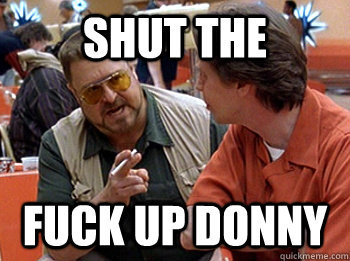
Luckily for the audience, Casper provides comic relief and presents a precursor to Steve Buscemi's Donny from The Big Lebowski.
Casper's fate is entwined his partner's as he caves into the peer pressure lurking around every corner. Casper is just as directionless as Denny, though he seems resigned and almost content to his teenage fate.
But hey, they're just angry teenagers, right? We have all been there, which is why this play hits so hard. They'll grow out of it, though...
...and then Nobody happens. Nobody follows Denny's father, Carl, who in the first scene is laid off from his factory job. Carl spends the entire play suppressing his emotions, letting them leak out through infidelity and a violent act late in the play. Carl seems to barely speak more than three words at a time during the play as he seeks meaning in his life through the dead ends of frivolous spending and crass patriotism. By the end of the play he realizes he doesn't fit in anywhere: not at a job, not in a family, not in a peer group.
Needless to say, these are not feel good plays. They do, however, examine elements of American life worth taking a closer look at if only to remind ourselves not to be mired in the false trappings of the American Dream. Denny has no identity and has nothing left to do but express himself rashly. Carl is perfectly fine working out a menial living, but when his career identity evaporates he is left futilely trying to assemble a personality that never existed in the first place. Carl does eventually get his career identify back, but only in a way that represents merely getting by until he dies, just as he did at the beginning of the play.
The two plays are essential to each other and while Fun might be the weaker of the two (or perhaps I'm just getting old), they both have something cautionary to offer.
Fun follows teenage friends Denny and Casper as they seek out a good time on a Thursday night. Their travels lead them down a causeway of botched drug-deals, botched whorehouse escapades, and botched robberies. The beauty in the play, beside seeking fun and finding only the opposite, is the lack of philosophical discussion between the two teenagers. While Denny is a Molotov cocktail of rage against the ties that bind him, he is unable to express his anger outside of the occasional mindless violent outburst. Thus, the duo are forced to discuss matters like what would happen if they snapped and took out a few dozen mall-goers.
I'll admit that after a couple scenes I was dreading the buildup. I get it. You're a teenager. You're angry. You're so disenfranchised you can't even identify with a fitting musical movement (the direction notes specifically refer to the duo as "not hardcore punks"). But again, this irony is what makes the story. Everything Denny stands against he ultimately stands for as a prototypical disenfranchised youth watching the cars, shoppers, junkies, etc. walk on by.
Luckily for the audience, Casper provides comic relief and presents a precursor to Steve Buscemi's Donny from The Big Lebowski.
Casper's fate is entwined his partner's as he caves into the peer pressure lurking around every corner. Casper is just as directionless as Denny, though he seems resigned and almost content to his teenage fate.
But hey, they're just angry teenagers, right? We have all been there, which is why this play hits so hard. They'll grow out of it, though...
...and then Nobody happens. Nobody follows Denny's father, Carl, who in the first scene is laid off from his factory job. Carl spends the entire play suppressing his emotions, letting them leak out through infidelity and a violent act late in the play. Carl seems to barely speak more than three words at a time during the play as he seeks meaning in his life through the dead ends of frivolous spending and crass patriotism. By the end of the play he realizes he doesn't fit in anywhere: not at a job, not in a family, not in a peer group.
Needless to say, these are not feel good plays. They do, however, examine elements of American life worth taking a closer look at if only to remind ourselves not to be mired in the false trappings of the American Dream. Denny has no identity and has nothing left to do but express himself rashly. Carl is perfectly fine working out a menial living, but when his career identity evaporates he is left futilely trying to assemble a personality that never existed in the first place. Carl does eventually get his career identify back, but only in a way that represents merely getting by until he dies, just as he did at the beginning of the play.
The two plays are essential to each other and while Fun might be the weaker of the two (or perhaps I'm just getting old), they both have something cautionary to offer.
Displaying 1 - 3 of 3 reviews