

What do you think?

Rhinoceros, The Chairs, The Lesson
These three great plays by one of the founding fathers of the theatre of the absurd, are alive and kicking with tragedy and humour, bleakness and farce. In Rhinoceros we are shown the innate brutality of people as everyone, except for Berenger, turn into clumsy, unthinking rhinoceroses. The Chairs depicts the futile struggle of two old people to convey the meaning of life to the rest of humanity, while The Lesson is a chilling, but anarchically funny drama of verbal domination. In these three 'antiplays' dream, nonsense and fantasy combine to create an unsettling, bizarre view of society.
220 pages, Paperback
First published January 1, 1962
Ratings & Reviews
Friends & Following
Create a free account to discover what your friends think of this book!
Community Reviews
Displaying 1 - 30 of 116 reviews

September 12, 2022
These three plays from one of the founding fathers of the theatre of absurd really do fit that description. Tragedy and (darkish) humor go around and around in them, and they may make you think of what they could be talking about, of real-life themes? The latter two are one-acts, and are a bit older than Rhino, here each play comes with information about the first plays in Paris and London, and the actor list, plus there is information about stage sets, objects, clothes, and possible looks for the actors.
I feel the first one, Rhinoceros, is the strongest (and its first London play was produced by Orson Welles). Berenger's bewilderment, fear, defiance, loneliness etc. is a bit heartbreaking to follow, but it's also interesting to see how other people in the play react to the rhinos. You may end up wondering what keeps Berenger : is it his state of mind, his 'values', his drinking? And what could be the real-life version of the rhinos and their chaos, and Berenger? Powerful.
The Chairs leaves me thinking about loneliness, what is real or imagined in the story, why the old couple is where they are, and why they are doing what they are doing, here? Does the world exist enough, outside of their island? Are the people even still alive, considering how old the couple are said to be? And the third character - the orator - why is he there, who is he? A lot of questions left, and a feeling of sadness.
And finally, The Lesson, which I felt was perhaps the darkest - why is the professor like he is, and why do the pupils keep on coming? Hasn't anyone noticed something strange about the disappearances? Why does the maid keep staying (does she gets a kick out of one level of dominance she can have when the professor is 'good'?)? And why is the pupil, already 18 years old, so stupid with math? And why does the professor talk philology with her (at least some of what he tells her is nonsense IMO), which can't be familiar to her at all? And then the end of the lesson, another
Yeah, the plays fills me with questions, and make me ponder about real-life things. I think Rhino is the one I migh reread a few times in the future, and the two others are good to experience once, not necessarily more. Yet all are worth it, and great to imagine how they might look when seen on stage. Very intersting reading experience.
I feel the first one, Rhinoceros, is the strongest (and its first London play was produced by Orson Welles). Berenger's bewilderment, fear, defiance, loneliness etc. is a bit heartbreaking to follow, but it's also interesting to see how other people in the play react to the rhinos. You may end up wondering what keeps Berenger : is it his state of mind, his 'values', his drinking? And what could be the real-life version of the rhinos and their chaos, and Berenger? Powerful.
The Chairs leaves me thinking about loneliness, what is real or imagined in the story, why the old couple is where they are, and why they are doing what they are doing, here? Does the world exist enough, outside of their island? Are the people even still alive, considering how old the couple are said to be? And the third character - the orator - why is he there, who is he? A lot of questions left, and a feeling of sadness.
And finally, The Lesson, which I felt was perhaps the darkest - why is the professor like he is, and why do the pupils keep on coming? Hasn't anyone noticed something strange about the disappearances? Why does the maid keep staying (does she gets a kick out of one level of dominance she can have when the professor is 'good'?)? And why is the pupil, already 18 years old, so stupid with math? And why does the professor talk philology with her (at least some of what he tells her is nonsense IMO), which can't be familiar to her at all? And then the end of the lesson, another
Yeah, the plays fills me with questions, and make me ponder about real-life things. I think Rhino is the one I migh reread a few times in the future, and the two others are good to experience once, not necessarily more. Yet all are worth it, and great to imagine how they might look when seen on stage. Very intersting reading experience.

April 23, 2007
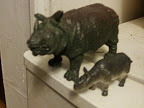
These are my two Rhinoceroses. They guard my fridge from, well I'm not sure, but they do guard it. They have also adopted a baby hippo into their family, but the hippos not in the picture. The play is called Rhinoceros, not Rhinoceros and Baby Hippo, so that's why the Hippo was kindly told to go away for a bit. He did not like being told to go away, and is in the process of writing a musical about hippos, which he says will make more money than some stupid play where everyone is a Rhinoceros. Fucking Hippo. Not that I don't love the Hippo, I just don't want him getting his hopes up too high; he's not Elton fucking John, and I know he's not going to be writing The Lion King.
I read these plays a while ago. I read Rhinoceros a bunch of times, and I don't remember much about it, except that it was about everyone being rhinoceroses. Chairs I don't remember at all, but I know I read it. I think it was an absurdist portrayal of society where everyone were chairs. It was kind of at the point where Ionesco was milking the everyon is a thing that they really couldn't be theme. The Lesson, if I remember it correctly was probably my favorite of the three. I think it was the one most explicitly about fascism. Maybe it wasn't though. That's the beauty of these new reviews of mine, I have even less idea of what I'm talking about than normally.

will-not-read-or-dnf
June 2, 2021I tried, but very quickly lost hope in these. All three plays seem empty and chaotic experimental exercises that are fruitless, and on first glance they all veer toward a word I often dislike using entirely — 'pretentious'.
It's clear there is style and thought here I'm just not in the mood to appreciate reading right now.
I'm not in a stage in my life where I can enjoy the comical nonsense of wordplay and absurd situations in the opening scenes of Rhinocerous.
Maybe when I need something chaotic I'll return, but right now, I can't appreciate these fairly and it would pain me to try slog through it.
It's clear there is style and thought here I'm just not in the mood to appreciate reading right now.
I'm not in a stage in my life where I can enjoy the comical nonsense of wordplay and absurd situations in the opening scenes of Rhinocerous.
Maybe when I need something chaotic I'll return, but right now, I can't appreciate these fairly and it would pain me to try slog through it.

April 12, 2016
Three dramatic works by the master of absurdity, of which 'Rhinoceros' is the most successful, although 'The Chairs' has its moments of humour, melancholia and nonsense.
When faced with the threat of becoming a rhinoceros, do you cling to the real world or find it preposterous?
When faced with the threat of becoming a rhinoceros, do you cling to the real world or find it preposterous?

June 29, 2024
Rhinoceros als hoogtepunt.

June 7, 2017
I had to perform a scene from the Rhinoceros with 3 classmates for a French class and it was certainly a great introduction to Ionesco's work. It gave us time to contemplate and embody the scene and I fell in love.
I have great respect for absurd humour. It is difficult to pin down why it works so well when an author or performer pulls it off. It is a certain kind of intelligence that requires an understanding of the culture, the ability to read people and some another element that I like to think of as mysterious.
I have great respect for absurd humour. It is difficult to pin down why it works so well when an author or performer pulls it off. It is a certain kind of intelligence that requires an understanding of the culture, the ability to read people and some another element that I like to think of as mysterious.

February 15, 2022
Rhinoceros 5/5
The chairs 4/5
The lesson 3.5/5
The chairs 4/5
The lesson 3.5/5

September 22, 2024
“I feel responsible for everything that happens. I feel involved, I just can’t be indifferent.”

November 8, 2017
This was so enjoyable!!! There were a few confusing parts, but besides that it was extraordinary!
^ THIS WAS FROM THE FIRST INITIAL READ IN DECEMBER, 2017.
I love this even more after the second reading!!!
^ APRIL, 2018.
^ THIS WAS FROM THE FIRST INITIAL READ IN DECEMBER, 2017.
I love this even more after the second reading!!!
^ APRIL, 2018.

February 17, 2024
Another foray into The Theatre of the Absurd. That being said, I have read The Chairs before in my university days.
Back then I just thought Ionesco was simply being chaotic with his storytelling and specific stage direction. Of course, now I see he was trying to make a precise point about how mad life can be and how mad drama trying to imitate this surely is. That being said, of the three featured plays, I enjoyed the ones that went big on this madness more than the rest.
Rhinoceros became my favourite in its later act because of its epidemic theme. All the people in Berenger's life succumb to the strange transformation and he is left the last rational man in his village. Or rather is he missing out on a strange new freedom?
On re-reading The Chairs, I gained a greater appreciation for what Ionesco was trying to say about gatherings, communication and disappointment. The old man and his wife Semiramis reach a heightened state of delirium from which they can never come back.
I lost patience with The Lesson. While I appreciate the parallel emotional journeys of the Professor and Student, I got bogged down by the transition of maths to philology and the ending seemed so neat and mainstream that I wonder if Ionesco was truly happy with it.
Then again, I suppose absurdity was always his chief end goal. Each of these three plays has its own crazed logic that I could thankfully get on board with, and the critique of society's approach to communal spirit, VIP speeches and imparting knowledge were astute and still relevant to today.
I can safely say I admire Ionesco's playwrighting enough to read more of his work and, of course, see it on stage. I recommend Rhinoceros / The Chairs / The Lesson to readers looking for set design that is ingenious and dialogue that is exquisitely unhinged.
Back then I just thought Ionesco was simply being chaotic with his storytelling and specific stage direction. Of course, now I see he was trying to make a precise point about how mad life can be and how mad drama trying to imitate this surely is. That being said, of the three featured plays, I enjoyed the ones that went big on this madness more than the rest.
Rhinoceros became my favourite in its later act because of its epidemic theme. All the people in Berenger's life succumb to the strange transformation and he is left the last rational man in his village. Or rather is he missing out on a strange new freedom?
On re-reading The Chairs, I gained a greater appreciation for what Ionesco was trying to say about gatherings, communication and disappointment. The old man and his wife Semiramis reach a heightened state of delirium from which they can never come back.
I lost patience with The Lesson. While I appreciate the parallel emotional journeys of the Professor and Student, I got bogged down by the transition of maths to philology and the ending seemed so neat and mainstream that I wonder if Ionesco was truly happy with it.
Then again, I suppose absurdity was always his chief end goal. Each of these three plays has its own crazed logic that I could thankfully get on board with, and the critique of society's approach to communal spirit, VIP speeches and imparting knowledge were astute and still relevant to today.
I can safely say I admire Ionesco's playwrighting enough to read more of his work and, of course, see it on stage. I recommend Rhinoceros / The Chairs / The Lesson to readers looking for set design that is ingenious and dialogue that is exquisitely unhinged.

March 13, 2020
Rhinoceros is the only one I read, and it's a typical, if not stereotypical, work of Absurd Theatre. Issues such as the fallibility of language, the lack and impossibility of human communication, the collapse of human morality, the problems with the definition of what is human, the meaningless search for meaning are all explored and dramatised both in and of themselves but also under a specific, political lens. The philosophical (and metaphysical) and the political are, of course, not mutually exclusive, and indeed there is something fundamentally absurd about the politics of the entire 20th century. My only criticism of the play is that it doesn't say or do anything particularly interesting that other playwrights and authors have not already, but then again not many works of literature do. Will reccommend reading it nonetheless.
April 25, 2020
Daring questions to ask in a play at the end of the 50s.
If all your friends turned into Rhinoceros, would you?
When you die, they give you an eulogy to talk about your life. When you are alive, what is it called? An apology?
If you had four students, you kill three of them, how do you know which one is going to #MeToo you?
Those may seem like attempts at being witty but I'm not sure they get at the giddyness and slight nastyness that I feel from some absurdists. Funny, yes. Humane, maybe not so much. Human, definitely.
If all your friends turned into Rhinoceros, would you?
When you die, they give you an eulogy to talk about your life. When you are alive, what is it called? An apology?
If you had four students, you kill three of them, how do you know which one is going to #MeToo you?
Those may seem like attempts at being witty but I'm not sure they get at the giddyness and slight nastyness that I feel from some absurdists. Funny, yes. Humane, maybe not so much. Human, definitely.

February 20, 2018
I really hate reading plays, but this was very funny and thought provoking. I'm excited to watch it, even if I didn't love reading it.
February 25, 2024
The art of utter existential futility shines bright. ✨

Read
June 29, 2024Took it back to the library after only reading a very little bit.
It turns out I wasn't in the mood for French absurdist theatre.
It turns out I wasn't in the mood for French absurdist theatre.

November 26, 2024
Too nihilistic for me.

January 7, 2025
Rhinoceros: loved it
The Chairs: no. i don't want to talk about it.
The Lesson: wtf was that(affectionate)
(Excluding chairs from my rating)
The Chairs: no. i don't want to talk about it.
The Lesson: wtf was that(affectionate)
(Excluding chairs from my rating)

August 23, 2025
The Chairs was so good my god.

Read
October 7, 2024read this for uni and i'm gonna have to go into that class on wednesday and pretend that any of what i just read made sense

May 5, 2018
3.25/5

November 26, 2018
The Chairs (26/11/2018): 4/5

February 26, 2017
Très drôle.

July 27, 2016
The great thing about absurdist cinema or drama or literature is that sometimes (for me at least), you don't have to truly 'get it' to enjoy it, be appalled, shocked or creeped out by it, or even be entertained. Ionesco is definitely one of the kingpins of absurd theater, and I found Rhinoceros to actually be the most 'normal', metaphorically obvious of the 3 plays here.
Rhinoceros is existentialism through and through, where the main character is left isolated as the only human in a world that has turned into - you guessed it - rhinoceroses. The herd mentality and the difficulty of the individual to remain one was as significant in the post-war era this was written as it is today.
The Chairs is even weirder, where a senile old couple welcome guests into their home - who are actually invisible - and start babbling incoherently about an important message they want to deliver, but never get around to it. It is then left to an Orator to take over and when he does, readers (and viewers) are in for a shock.
The Lesson is another example of how Ionesco expertly escalates the absurdity and mania in his plays. It starts with a reticent professor welcoming a bright, confident student for private lessons until he begins to manipulate the power of knowledge and the roles are slowly reversed, building to a creepy ending and creepier final revelation. If I had to pick a favourite it would be this one, but Rhinoceros is a masterpiece in itself.
Rhinoceros is existentialism through and through, where the main character is left isolated as the only human in a world that has turned into - you guessed it - rhinoceroses. The herd mentality and the difficulty of the individual to remain one was as significant in the post-war era this was written as it is today.
The Chairs is even weirder, where a senile old couple welcome guests into their home - who are actually invisible - and start babbling incoherently about an important message they want to deliver, but never get around to it. It is then left to an Orator to take over and when he does, readers (and viewers) are in for a shock.
The Lesson is another example of how Ionesco expertly escalates the absurdity and mania in his plays. It starts with a reticent professor welcoming a bright, confident student for private lessons until he begins to manipulate the power of knowledge and the roles are slowly reversed, building to a creepy ending and creepier final revelation. If I had to pick a favourite it would be this one, but Rhinoceros is a masterpiece in itself.

May 15, 2019
I finished reading this book this morning.
These three plays struck me as being among the best plays I've ever read. I will go further and say that Rhinoceros is the best play I have ever read. It is beautiful in a strange sort of way, as well as absurd. It is sprightly and charming as well as menacing and brutal. The main character, Berenger, is naive, gullible and incompetent, but everyone around him is equally helpless in the face of the extremely peculiar events that happen. Human beings start turning into rhinos. The life of a small French town is seriously disrupted; then world civilisation itself succumbs. The ending of the play is absolutely perfect. Romance is not a lifeboat by which Berenger and Daisy can escape the sinking of all normal values. It simply isn't powerful enough.
The Chairs is also astoundingly good. It is the best post-apocalyptic work I have ever read, beyond even Beckett and Ballard. It has a relentless velocity, a ludicrous comedic streak running through it, and a desperate sadness at its heart. As for The Lesson this is a lesson indeed, a lesson in absurd menace that is a tremendous black comedy. The dialogue is dazzling, monstrous, utterly deranged, and poetic. Ionesco was one of the true greats of the 20th Century.
These three plays struck me as being among the best plays I've ever read. I will go further and say that Rhinoceros is the best play I have ever read. It is beautiful in a strange sort of way, as well as absurd. It is sprightly and charming as well as menacing and brutal. The main character, Berenger, is naive, gullible and incompetent, but everyone around him is equally helpless in the face of the extremely peculiar events that happen. Human beings start turning into rhinos. The life of a small French town is seriously disrupted; then world civilisation itself succumbs. The ending of the play is absolutely perfect. Romance is not a lifeboat by which Berenger and Daisy can escape the sinking of all normal values. It simply isn't powerful enough.
The Chairs is also astoundingly good. It is the best post-apocalyptic work I have ever read, beyond even Beckett and Ballard. It has a relentless velocity, a ludicrous comedic streak running through it, and a desperate sadness at its heart. As for The Lesson this is a lesson indeed, a lesson in absurd menace that is a tremendous black comedy. The dialogue is dazzling, monstrous, utterly deranged, and poetic. Ionesco was one of the true greats of the 20th Century.
January 31, 2022
Regardless of the polarising critiques of his absurd farce, Ionesco is sharp. During his time, the contemporary hotshots which included the likes of Sartre, Orson Welles and others were not quite impressed by Ionesco’s theatre. Neither was Eugene Ionesco by theirs. Absurd to the point of blatant nihilism, Ionesco presents the empty meaning of human life, the failure of language and communication, the extreme drudgery of rationalism through the nonsensical strutting and fretting upon the stage which signifies nothing. Sometimes humorous, sometimes utterly ridiculous and sometimes political and sometimes existential, the playwright questions the predicament of the human condition, its collective anxiety, unrestrained desires and eventually the agony of living. From a thickheaded crowd trumpeting around in a stampede to the crushing tyranny of rational education to the frantic angst of arriving at a meaning of existence, Ionesco’s stage is neither meant for a brazen propaganda, nor meant to arrive at a definitive sociological assessment but an empty space sealed with an absurd void, “where ignorant armies clash”.

March 4, 2010
Totalitarianism, nuclear war, ideology prompted Ionesco to pen these confusing black comedies. I recommend you review the history of Europe during and after the Second World War to contextually comprehend these plays.
Of note, read Rhinoceros. This particular piece of dramatic literature is humorous, and is the most accesible of Ionesco's absurdist literature.
Of note, read Rhinoceros. This particular piece of dramatic literature is humorous, and is the most accesible of Ionesco's absurdist literature.

January 23, 2008
Read it in class taking parts. Great fun, good discussion. Stuck with me since high school. Can't say that about some of the other stuff we had to read.

April 27, 2012
Henüz sadece Rhinoceros'u okudum ama dersler ve diğer yoğunluklardan bir süre diğer iki oyunu okuma fırsatım olmayacağı için finished diye işaretliyorum. Puanım Rhinoceros'a özgüdür.

May 27, 2018
I got to be a rhino when we acted it out.
April 9, 2016
The Absurd World Is Alive and Well, But Not on the Stage
Back when the avant-garde theatre revolved around Eugene Ionesco and other European playwrights, with a few Americans thrown in for good measure, Rhinoceros was one of his more comprehensible plays. It has a minuscule plot, an anti-hero of sorts and Ionesco’s logical conundrums are comprehensibly centered in a few characters, rather than taking over the whole play, as they do in Bald Soprano. Similarly cliches point up the limitations of the characters, rather than being a central focus as in Soprano, which he calls “The Tragedy of Language” (175) in his essay on the play collected in Notes & Counter Notes.
Ionesco in his writings has clearly spelled out that Rhinoceros shows how tolitarianism takes hold of a country (this is not a play about conformism, he declares), and it’s also not a comedy but a “terrible farce and fantastic fable” (French production) or in essence a tragedy (German production, 207). Unfortunately, the American production baffled him because the “hard, fierce” character Jean is turned into a comic figure, while Beringer is made to seem “a kind of tough hard-headed intellectual, a kind of unruly revolutionary who knows quite well what he’s doing” (208) rather than the irresolute, reluctant man that Ionesco envisioned. He is put off by directors adding actions to his script, which he thinks is “sufficient” with his specific stage directions, and concluded that the American production was “intellectually dishonest” and turned Beringer into “the last of his species. He is lost. This is thought to be funny” (208).
The tolitarianism depicted is German fascism, and the roots of the play are clearly in the world of pre- and post-World War II, as is elucidated in his “Preface” to an American school edition. He says his play is certainly anti-Nazi but is “mainly an attack on collective hysteria and the epidemics that lurk beneath the surface of reason and ideas but are nonetheless serious collective diseases passed off as ideologies once we realize that History has lost its reason, that lying propaganda masks a contradiction between the facts and the ideologies that explain them” (199). Deconstructing this rather ponderous pronouncement, collective hysteria is passed off as ideologies [or perhaps ideologies align with and manipulate collective hysteria] because history makes no sense, not least because language and logic no longer connect with facts, a dissonance concealed by the propaganda of ideologies. Jean, Botard and Dudard provide examples of such ideologies in the play.
Accepting that the play is an attempt at “demystification” (199) of the rise of tolitarianism, Ionesco asserts that it provides “a fairly objective description of the growth of fanaticism, of the birth of a totalitarianism that grows, propagates, conquers, transforms a whole world and, naturally, being totalitarianism, transforms it totally. The play should trace and paint the different stages of this phenomenon” (209), a concept he could never convince the American director to accept. Similarly the play isn’t about conformism, for even non-conformism can be conformist, and “an anti-conformist play may be amusing; an anti-totalitarian play...is not. It cannot be anything else but painful and serious” (209). In another essay, he becomes more specific about “hair-brained ideologies...the new plague of modern times” which create “Automatic systematized thinking, the idolization of ideologies screens the mind from reality, perverts our understanding and makes us blind...[They] dehumanize men and make it impossible for them to be friends notwithstanding...they get in the way of what we call co-existence” (207).
As for the New York critic’s complaint that he hasn’t let “Beringer say what ideology inspired his resistance,” Ionesco says he distrusts intellectuals, who in fact were the “inventors of Nazism,” and “it is absurd to think for a whole world and give it some automatic philosophy: a playwright poses problems....An unworkable solution one has found for oneself is infinitely more valuable than a ready-made ideology that stops men from thinking.” Despite criticism that Ionesco didn’t provide a solution in his play, leaving the audience in a vacuum, “That is exactly what I wanted to do. A free man should pull himself out of vacuity on his own, by his own efforts and not by the efforts of other people” (210). This is clearly an existential approach to life that was not immediately palatable to Americans in the 1960s, barely through the sub-variety of fascism known as McCarthyism.
In the Cahiers du College de Pataphysique, which is the “science of science and ultimate philosophy,” an approach that derives from Alfred Jarry, a French playwright and philosopher, and encompasses the belief that “we are all pataphysicians” (200), meaning we construct our own reality, Ionesco interviews himself in a more theoretical essay on the nature and purpose of theatre. As Ionesco’s ego and alter ego argue about his plays’ didacticism and the need for a play to be considered as a complete performance, the ego declares that his intent is to break the spell of bourgeois drama, which is “magic drama...that asks the audience to identify itself with the heroes of the play, drama of participation” (202). On the other hand, a people’s theatre “has a different mentality: it puts a certain distance between itself and the heroes of the play...It alienates itself from the theatrical illusion in order to watch the play with a clear mind and pass judgment on it” (202), which is clearly a Brechtian approach. But then he goes on to state that from the Greeks through Shakespeare even to “Negro spirituals” dramatic forms revolve around audience identification and participation, thus “everything prehistorical was bourgeois” (203). It doesn’t matter that the middle classes are the “product of the French Revolution, of our industrial civilization, of capitalism” (203). Ego claims that everyone in the play transforms themselves into rhinoceroses, and if the audience has identified, they should be disgusted with the play’s characters and themselves as well, for “Disgust alienates more completely than anything else....Disgust is lucidity” (203) and thus the audience will be brought to self-awareness. Some might also choose the “virtue of non-participation or alienation,” and if this is so then the play becomes a synthesis of a bourgeois and an anti-bourgeois play (203). But the essay ends with the remark that both men are talking rubbish.
Clearly the reader (or more properly the viewer) of the play should not expect to find easy answers to characters’ inconsistent behavior or the play’s meaning. The stage action is both startling and certainly comical, with a woman dropping her groceries but keeping hold of her cat, and a number of simultaneous conversations overlapping with similar questions and responses. Even the appearance of the rhinoceroses is disturbing and comical, as the audience tries to grasp the idea of heavy, vicious animals charging through the stage (or even seemingly the audience). Of course, the manner in which the characters respond to these events will make them either intimidating and sinister or else laughable, so as Ionesco rightly complains the production can shift and even destroy his vision of the play. Possibly some of this difficulty comes from the fact that Americans are less involved with ideologies and intellectual activity than are most Europeans. Although it is clearly a fallacy, Americans tend to believe they don’t subscribe to an ideology, even though that is what the “American dream” and the vision of America leading the world to safety and democracy clearly is, even if not spelled out in any systematic form. Furthermore, a typical American director thinks of a play in terms of making it relateable to the audience, which, of course, is exactly what Ionesco doesn’t want. So in essence American theatre is still deeply embedded in the basic idea of bourgeois drama which is to present reality in such a way that the audience can “understand” it personally. Even American actors, following the American version of the Stanislavsky system, work to immerse themselves into the personality of their characters, and now are going to such extremes as changing their weight drastically in order to portray characters more “realistically.” Thus Ionesco’s type of play is very challenging for an American production and likely to appeal only to a limited audience more attuned to European theatrical traditions. Which is not to say that his warning about the appeal of ideologies (even if only vaguely recognized as such--distrust of government, love of gun possession, belief in the outsider as the societal savior, etc.) and their ability to transform unaware citizens into a herd of followers is inaccurate, as the 2016 Republican Presidential primary campaign clearly demonstrated.
Ionesco relies on costume to comment on and identify his characters, with the dogmatic ones dressed following whatever pattern obtains in their group: Jean is the average, conformist middle-class citizen, who doesn’t hesitate to criticize Berenger, his best friend, for his sloppy manner of dress, his drinking, being unshaven and constantly being late. In fact, whenever they’re together Jean is critical, which he claims is his right, without being in the least concerned about his friend’s feelings. Berenger, on the other hand, is apologetic about himself, and at most complains about being bored with his job and life in their small town, “I just can’t get used to life” (7). But Jean asserts that “The superior man is the man who fulfills his duty” (7). Then the first off-stage appearance of the rhinoceroses occurs, creating confusion among the characters; a woman drops her groceries but keeps hold of her cat, which she is improbably carrying while shopping. Jean wants to protest to the town council, but Berenger remains detached from the incident, proposing far-fetched explanations how the beasts could appear. The logical Jean is aghast at Berenger’s imaginative propositions, pointing up one of Ionesco’s main themes: the deficiency of logic and the freedom of imagination, although this freedom is not without its burden as Berenger discovers at the end of the play when he’s left alone with no one to communicate with. This antithesis will continue throughout the play, with various forms of logic in the different ideologies being exposed for their deficiencies and rigidity.
Logic, the foundation of the mind (which is the essence of a human), and truth, the presumed essence of reality, are the standards for pedants, such as Jean or the Logician, but Ionesco is always quick to show a logical paradox or contradiction that challenges their assumptions. Ultimately logic creates more confusion rather than resolves anything. Berenger explains that his drinking is due to his fear, which is “a sort of anguish, difficult to describe. I feel out of place among people, and so I take to drink...I’ve been tired for years. It’s exhausting to drag the weight of my own body about.... (17)...I don’t even know if I am me” (18). Although sounding like an average alcoholic, this is basically Sartre’s “nausea” at the absurdity of existence. As if to counterpoint this antithesis more strongly, the Logician and the Old Gentleman now engage in a conversation about logic, purporting to show its usefulness, while demonstrating the exact opposite, and when Berenger claims, “Life is an abnormal business,” Jean responds with pseudo-logic, “On the contrary. Nothing could be more normal, and the proof is that people go on living” (19), which cannot be the “proof” of an insufficient premise. These two separate conversations counterpoint each other in one of Ionesco’s favorite dramatic devices to show how separate conversations correlate or contradict each other because people and their thoughts are interchangeable (as happens in the Bald Soprano when the Martins replace the Smiths at the end of the play, and the play begins again). Jean’s final advice to Berenger is to immerse himself in his culture, so he will become more like everyone else, but when the latter invites the former to come with him to the theatre that evening, Jean replies he’s going for a drink with friends, showing himself for a hypocrite.
The rhinos return and kill the woman’s cat, and the Logician comforts her with the statement “All cats are mortal” (27), showing logic cannot respond to emotional needs. Act I ends with arguments about the number of horns on the rhinos, with Jean again claiming to know the truth and confusing everyone about whether Asiatic or African rhinos have one or two horns. Logic can’t answer these questions either, but the Logician prides himself on correctly posing the problem (37), which still doesn’t help with the problem of rhinos trampling a cat to death.
Act II, scene i, is the bureaucratic office where Berenger, Daisy, Botard and Dudard work. This sets up the scene for the two other rigid ideologues, Dudard, the excessively tolerant, scientific-focused intellectual who finds a way to adjust to everything because he can’t be intellectually discriminating, and Botard, the mouthpiece of the working class, rigidly anti-capitalist and anti-management, always seeing a scheme to exploit the worker. He distrusts newspapers, so doesn’t believe reports about the rhinos in town and thinks he’s logical, so will trust only his own senses (40). He thinks his own working-class education superior to that of his bosses who attended the university: “All you get at the universities are effete intellectuals with no practical knowledge of life” (41), a view that Ionesco seems to share, although not the rest of Botard’s beliefs. This is probably one of the more confusing (or thought-provoking) aspects of Ionesco’s plays: characters who are basically foolish may make statements that contain some aspect of a useful idea or Ionesco’s views. In effect Ionesco’s plays, while didactic, don’t have specific characters to present the author’s views, which are spread throughout the play and often need to be grasped by understanding the nature of what’s happening among the characters. This is especially true in Bald Soprano, and less so in Rhinoceros, where ultimately Berenger becomes the “anti-hero” and mouthpiece for the author.
Because Botard is so rigidly convinced of his own views, he argues the others are engaging in a hoax, “You’ve been making all this propaganda to get these rumors started” (46). This argument is interrupted when Mrs. Boeuf appears to make excuses for her husband’s absence from work; it turns out he’s become a rhinoceros. In fact, a rhino has followed her to the office and is waiting downstairs, which all the characters cluster to see. They sense it’s waiting for someone, and finally Mrs. Boeuf recognizes her husband and leaps out the window onto his back. Botard, finally convinced of the rhino’s reality, declares, “You can count on the union’s support” (51), and later after the manager declares it’s one less worker to replace, “Our union is against your dismissing Mr. Boeuf without notice” (53). Now that he’s convinced of the rhinos’ reality, he declares, “I’m not content to simply state that a phenomenon exists. I make it my business to understand and explain it” (54). But he refuses to state his explanation, claiming the whole business is a traitorous plot, and he’ll expose the perpetrators. “Now the hallucination has become a provocation,” he insinuates threateningly (54). “I hold the key to all these happenings, an infallible system of interpretation” (55), which is a reference to Marxist ideology that claims to explain the historical development of society. As they clamber out the window with the help of firemen (who also show up in Bald Soprano), Botard threatens to find proof of their treason, “I don’t insult. I merely prove” (56). In a nutshell, these are the attitudes of a Marxist or Communist worker, who resorts to codified explanations and accusations instead of personally analyzing the reality and responding to it instinctively and accurately.
Scene 2 is Jean’s room, where Berenger finds him gradually transforming into a rhino. Jean feels ill and is greenish in color, which deepens throughout the scene. Finally, he sprouts a horn on his forehead. Jean is still argumentative and unpleasant, while Berenger tries to apologize for their previous quarrel. Jean boasts that with his clear mind he’s in control of what happens to him, but the contrary occurs as he irresistibly turns into a rhino. Their argument reveals that Jean thinks anything that’s natural is superior to human’s moral values, “We need to go beyond moral standards!...Nature has its own laws. Morality’s against Nature.” (67), the opposite of his earlier encouragement of Berenger to immerse himself in the society’s culture. Such inconsistencies, common in Ionesco, are especially noticeable in this play where there is actual plot development. For the middle-class citizen, power (i.e., nature) now becomes the superior value, “Humanism is all washed up! You’re a ridiculous old sentimentalist....I’m all for change” (68). Here the focus is upon the transference of Jean’s earlier intellectual violence against Berenger into actual physical violence, when he declares he’ll trample Berenger.
Act III is in Berenger’s room, where he’s worrying whether he’s beginning to undergo the same transformations as Jean. Dudard arrives to comfort him, but while Berenger exclaims over the fate of Jean, “such a warm-hearted person, always so human!...I felt more sure of him than of myself! And then to do that to me!” (74), clearly not the truth, Dudard criticizes Berenger for making himself the focus of his complaints. He, on the other hand, says he observes the facts and tries to explain them, using various corrupted scientific ideas, finally proposing an epidemic. Quickly they begin to discuss Berenger’s will-power (or lack thereof) as the way to handle his concerns, but the problem becomes more existential when Berenger professes an instinctive dread of the rhinos and furthermore, “I feel responsible for everything that happens. I feel involved. I just can’t be indifferent” (78). He wishes he could be more objective, as he would be if this had happened to other people in another country, but “when you find yourself up against the brutal facts, you can’t help feeling directly concerned” (79). Dudard encourages him to face up to the facts and accept them, as you can’t do anything about them, but Berenger calls that fatalism, while to Dudard it’s common sense. When Berenger contemplates going to the authorities for help (rather like Jean previously), Dudard questions whether he has any right to object, because “who knows what is evil and what is good? It’s just a question of personal preference” (80) and states Berenger will never “become a good rhinoceros...you haven’t got the vocation” (80). Berenger still worries that no one will take action, and then learns that their boss has turned into a rhino, which Dudard tries to explain psychologically. (Ionesco doesn’t have much belief in psychological explanations of people’s behavior, which he parodies just as he does logical explanations.) He notes how upset Botard was at this event, then launches into a critique of Botard’s approach, which he claims wasn’t “precise or objective...too passionate..and therefore over-simplified...entirely dictated by his hatred of his superiors. That’s where he got his inferiority complex and his resentment. What’s more he talks in cliches, and commonplace arguments leave me cold” (83). Dudard’s approach is to accept what happens and provide an explanation for it, which Berenger opposes and defends Botard as “somebody worthwhile...down-to-earth...I’m in complete agreement with him and proud of it” (83)
Back when the avant-garde theatre revolved around Eugene Ionesco and other European playwrights, with a few Americans thrown in for good measure, Rhinoceros was one of his more comprehensible plays. It has a minuscule plot, an anti-hero of sorts and Ionesco’s logical conundrums are comprehensibly centered in a few characters, rather than taking over the whole play, as they do in Bald Soprano. Similarly cliches point up the limitations of the characters, rather than being a central focus as in Soprano, which he calls “The Tragedy of Language” (175) in his essay on the play collected in Notes & Counter Notes.
Ionesco in his writings has clearly spelled out that Rhinoceros shows how tolitarianism takes hold of a country (this is not a play about conformism, he declares), and it’s also not a comedy but a “terrible farce and fantastic fable” (French production) or in essence a tragedy (German production, 207). Unfortunately, the American production baffled him because the “hard, fierce” character Jean is turned into a comic figure, while Beringer is made to seem “a kind of tough hard-headed intellectual, a kind of unruly revolutionary who knows quite well what he’s doing” (208) rather than the irresolute, reluctant man that Ionesco envisioned. He is put off by directors adding actions to his script, which he thinks is “sufficient” with his specific stage directions, and concluded that the American production was “intellectually dishonest” and turned Beringer into “the last of his species. He is lost. This is thought to be funny” (208).
The tolitarianism depicted is German fascism, and the roots of the play are clearly in the world of pre- and post-World War II, as is elucidated in his “Preface” to an American school edition. He says his play is certainly anti-Nazi but is “mainly an attack on collective hysteria and the epidemics that lurk beneath the surface of reason and ideas but are nonetheless serious collective diseases passed off as ideologies once we realize that History has lost its reason, that lying propaganda masks a contradiction between the facts and the ideologies that explain them” (199). Deconstructing this rather ponderous pronouncement, collective hysteria is passed off as ideologies [or perhaps ideologies align with and manipulate collective hysteria] because history makes no sense, not least because language and logic no longer connect with facts, a dissonance concealed by the propaganda of ideologies. Jean, Botard and Dudard provide examples of such ideologies in the play.
Accepting that the play is an attempt at “demystification” (199) of the rise of tolitarianism, Ionesco asserts that it provides “a fairly objective description of the growth of fanaticism, of the birth of a totalitarianism that grows, propagates, conquers, transforms a whole world and, naturally, being totalitarianism, transforms it totally. The play should trace and paint the different stages of this phenomenon” (209), a concept he could never convince the American director to accept. Similarly the play isn’t about conformism, for even non-conformism can be conformist, and “an anti-conformist play may be amusing; an anti-totalitarian play...is not. It cannot be anything else but painful and serious” (209). In another essay, he becomes more specific about “hair-brained ideologies...the new plague of modern times” which create “Automatic systematized thinking, the idolization of ideologies screens the mind from reality, perverts our understanding and makes us blind...[They] dehumanize men and make it impossible for them to be friends notwithstanding...they get in the way of what we call co-existence” (207).
As for the New York critic’s complaint that he hasn’t let “Beringer say what ideology inspired his resistance,” Ionesco says he distrusts intellectuals, who in fact were the “inventors of Nazism,” and “it is absurd to think for a whole world and give it some automatic philosophy: a playwright poses problems....An unworkable solution one has found for oneself is infinitely more valuable than a ready-made ideology that stops men from thinking.” Despite criticism that Ionesco didn’t provide a solution in his play, leaving the audience in a vacuum, “That is exactly what I wanted to do. A free man should pull himself out of vacuity on his own, by his own efforts and not by the efforts of other people” (210). This is clearly an existential approach to life that was not immediately palatable to Americans in the 1960s, barely through the sub-variety of fascism known as McCarthyism.
In the Cahiers du College de Pataphysique, which is the “science of science and ultimate philosophy,” an approach that derives from Alfred Jarry, a French playwright and philosopher, and encompasses the belief that “we are all pataphysicians” (200), meaning we construct our own reality, Ionesco interviews himself in a more theoretical essay on the nature and purpose of theatre. As Ionesco’s ego and alter ego argue about his plays’ didacticism and the need for a play to be considered as a complete performance, the ego declares that his intent is to break the spell of bourgeois drama, which is “magic drama...that asks the audience to identify itself with the heroes of the play, drama of participation” (202). On the other hand, a people’s theatre “has a different mentality: it puts a certain distance between itself and the heroes of the play...It alienates itself from the theatrical illusion in order to watch the play with a clear mind and pass judgment on it” (202), which is clearly a Brechtian approach. But then he goes on to state that from the Greeks through Shakespeare even to “Negro spirituals” dramatic forms revolve around audience identification and participation, thus “everything prehistorical was bourgeois” (203). It doesn’t matter that the middle classes are the “product of the French Revolution, of our industrial civilization, of capitalism” (203). Ego claims that everyone in the play transforms themselves into rhinoceroses, and if the audience has identified, they should be disgusted with the play’s characters and themselves as well, for “Disgust alienates more completely than anything else....Disgust is lucidity” (203) and thus the audience will be brought to self-awareness. Some might also choose the “virtue of non-participation or alienation,” and if this is so then the play becomes a synthesis of a bourgeois and an anti-bourgeois play (203). But the essay ends with the remark that both men are talking rubbish.
Clearly the reader (or more properly the viewer) of the play should not expect to find easy answers to characters’ inconsistent behavior or the play’s meaning. The stage action is both startling and certainly comical, with a woman dropping her groceries but keeping hold of her cat, and a number of simultaneous conversations overlapping with similar questions and responses. Even the appearance of the rhinoceroses is disturbing and comical, as the audience tries to grasp the idea of heavy, vicious animals charging through the stage (or even seemingly the audience). Of course, the manner in which the characters respond to these events will make them either intimidating and sinister or else laughable, so as Ionesco rightly complains the production can shift and even destroy his vision of the play. Possibly some of this difficulty comes from the fact that Americans are less involved with ideologies and intellectual activity than are most Europeans. Although it is clearly a fallacy, Americans tend to believe they don’t subscribe to an ideology, even though that is what the “American dream” and the vision of America leading the world to safety and democracy clearly is, even if not spelled out in any systematic form. Furthermore, a typical American director thinks of a play in terms of making it relateable to the audience, which, of course, is exactly what Ionesco doesn’t want. So in essence American theatre is still deeply embedded in the basic idea of bourgeois drama which is to present reality in such a way that the audience can “understand” it personally. Even American actors, following the American version of the Stanislavsky system, work to immerse themselves into the personality of their characters, and now are going to such extremes as changing their weight drastically in order to portray characters more “realistically.” Thus Ionesco’s type of play is very challenging for an American production and likely to appeal only to a limited audience more attuned to European theatrical traditions. Which is not to say that his warning about the appeal of ideologies (even if only vaguely recognized as such--distrust of government, love of gun possession, belief in the outsider as the societal savior, etc.) and their ability to transform unaware citizens into a herd of followers is inaccurate, as the 2016 Republican Presidential primary campaign clearly demonstrated.
Ionesco relies on costume to comment on and identify his characters, with the dogmatic ones dressed following whatever pattern obtains in their group: Jean is the average, conformist middle-class citizen, who doesn’t hesitate to criticize Berenger, his best friend, for his sloppy manner of dress, his drinking, being unshaven and constantly being late. In fact, whenever they’re together Jean is critical, which he claims is his right, without being in the least concerned about his friend’s feelings. Berenger, on the other hand, is apologetic about himself, and at most complains about being bored with his job and life in their small town, “I just can’t get used to life” (7). But Jean asserts that “The superior man is the man who fulfills his duty” (7). Then the first off-stage appearance of the rhinoceroses occurs, creating confusion among the characters; a woman drops her groceries but keeps hold of her cat, which she is improbably carrying while shopping. Jean wants to protest to the town council, but Berenger remains detached from the incident, proposing far-fetched explanations how the beasts could appear. The logical Jean is aghast at Berenger’s imaginative propositions, pointing up one of Ionesco’s main themes: the deficiency of logic and the freedom of imagination, although this freedom is not without its burden as Berenger discovers at the end of the play when he’s left alone with no one to communicate with. This antithesis will continue throughout the play, with various forms of logic in the different ideologies being exposed for their deficiencies and rigidity.
Logic, the foundation of the mind (which is the essence of a human), and truth, the presumed essence of reality, are the standards for pedants, such as Jean or the Logician, but Ionesco is always quick to show a logical paradox or contradiction that challenges their assumptions. Ultimately logic creates more confusion rather than resolves anything. Berenger explains that his drinking is due to his fear, which is “a sort of anguish, difficult to describe. I feel out of place among people, and so I take to drink...I’ve been tired for years. It’s exhausting to drag the weight of my own body about.... (17)...I don’t even know if I am me” (18). Although sounding like an average alcoholic, this is basically Sartre’s “nausea” at the absurdity of existence. As if to counterpoint this antithesis more strongly, the Logician and the Old Gentleman now engage in a conversation about logic, purporting to show its usefulness, while demonstrating the exact opposite, and when Berenger claims, “Life is an abnormal business,” Jean responds with pseudo-logic, “On the contrary. Nothing could be more normal, and the proof is that people go on living” (19), which cannot be the “proof” of an insufficient premise. These two separate conversations counterpoint each other in one of Ionesco’s favorite dramatic devices to show how separate conversations correlate or contradict each other because people and their thoughts are interchangeable (as happens in the Bald Soprano when the Martins replace the Smiths at the end of the play, and the play begins again). Jean’s final advice to Berenger is to immerse himself in his culture, so he will become more like everyone else, but when the latter invites the former to come with him to the theatre that evening, Jean replies he’s going for a drink with friends, showing himself for a hypocrite.
The rhinos return and kill the woman’s cat, and the Logician comforts her with the statement “All cats are mortal” (27), showing logic cannot respond to emotional needs. Act I ends with arguments about the number of horns on the rhinos, with Jean again claiming to know the truth and confusing everyone about whether Asiatic or African rhinos have one or two horns. Logic can’t answer these questions either, but the Logician prides himself on correctly posing the problem (37), which still doesn’t help with the problem of rhinos trampling a cat to death.
Act II, scene i, is the bureaucratic office where Berenger, Daisy, Botard and Dudard work. This sets up the scene for the two other rigid ideologues, Dudard, the excessively tolerant, scientific-focused intellectual who finds a way to adjust to everything because he can’t be intellectually discriminating, and Botard, the mouthpiece of the working class, rigidly anti-capitalist and anti-management, always seeing a scheme to exploit the worker. He distrusts newspapers, so doesn’t believe reports about the rhinos in town and thinks he’s logical, so will trust only his own senses (40). He thinks his own working-class education superior to that of his bosses who attended the university: “All you get at the universities are effete intellectuals with no practical knowledge of life” (41), a view that Ionesco seems to share, although not the rest of Botard’s beliefs. This is probably one of the more confusing (or thought-provoking) aspects of Ionesco’s plays: characters who are basically foolish may make statements that contain some aspect of a useful idea or Ionesco’s views. In effect Ionesco’s plays, while didactic, don’t have specific characters to present the author’s views, which are spread throughout the play and often need to be grasped by understanding the nature of what’s happening among the characters. This is especially true in Bald Soprano, and less so in Rhinoceros, where ultimately Berenger becomes the “anti-hero” and mouthpiece for the author.
Because Botard is so rigidly convinced of his own views, he argues the others are engaging in a hoax, “You’ve been making all this propaganda to get these rumors started” (46). This argument is interrupted when Mrs. Boeuf appears to make excuses for her husband’s absence from work; it turns out he’s become a rhinoceros. In fact, a rhino has followed her to the office and is waiting downstairs, which all the characters cluster to see. They sense it’s waiting for someone, and finally Mrs. Boeuf recognizes her husband and leaps out the window onto his back. Botard, finally convinced of the rhino’s reality, declares, “You can count on the union’s support” (51), and later after the manager declares it’s one less worker to replace, “Our union is against your dismissing Mr. Boeuf without notice” (53). Now that he’s convinced of the rhinos’ reality, he declares, “I’m not content to simply state that a phenomenon exists. I make it my business to understand and explain it” (54). But he refuses to state his explanation, claiming the whole business is a traitorous plot, and he’ll expose the perpetrators. “Now the hallucination has become a provocation,” he insinuates threateningly (54). “I hold the key to all these happenings, an infallible system of interpretation” (55), which is a reference to Marxist ideology that claims to explain the historical development of society. As they clamber out the window with the help of firemen (who also show up in Bald Soprano), Botard threatens to find proof of their treason, “I don’t insult. I merely prove” (56). In a nutshell, these are the attitudes of a Marxist or Communist worker, who resorts to codified explanations and accusations instead of personally analyzing the reality and responding to it instinctively and accurately.
Scene 2 is Jean’s room, where Berenger finds him gradually transforming into a rhino. Jean feels ill and is greenish in color, which deepens throughout the scene. Finally, he sprouts a horn on his forehead. Jean is still argumentative and unpleasant, while Berenger tries to apologize for their previous quarrel. Jean boasts that with his clear mind he’s in control of what happens to him, but the contrary occurs as he irresistibly turns into a rhino. Their argument reveals that Jean thinks anything that’s natural is superior to human’s moral values, “We need to go beyond moral standards!...Nature has its own laws. Morality’s against Nature.” (67), the opposite of his earlier encouragement of Berenger to immerse himself in the society’s culture. Such inconsistencies, common in Ionesco, are especially noticeable in this play where there is actual plot development. For the middle-class citizen, power (i.e., nature) now becomes the superior value, “Humanism is all washed up! You’re a ridiculous old sentimentalist....I’m all for change” (68). Here the focus is upon the transference of Jean’s earlier intellectual violence against Berenger into actual physical violence, when he declares he’ll trample Berenger.
Act III is in Berenger’s room, where he’s worrying whether he’s beginning to undergo the same transformations as Jean. Dudard arrives to comfort him, but while Berenger exclaims over the fate of Jean, “such a warm-hearted person, always so human!...I felt more sure of him than of myself! And then to do that to me!” (74), clearly not the truth, Dudard criticizes Berenger for making himself the focus of his complaints. He, on the other hand, says he observes the facts and tries to explain them, using various corrupted scientific ideas, finally proposing an epidemic. Quickly they begin to discuss Berenger’s will-power (or lack thereof) as the way to handle his concerns, but the problem becomes more existential when Berenger professes an instinctive dread of the rhinos and furthermore, “I feel responsible for everything that happens. I feel involved. I just can’t be indifferent” (78). He wishes he could be more objective, as he would be if this had happened to other people in another country, but “when you find yourself up against the brutal facts, you can’t help feeling directly concerned” (79). Dudard encourages him to face up to the facts and accept them, as you can’t do anything about them, but Berenger calls that fatalism, while to Dudard it’s common sense. When Berenger contemplates going to the authorities for help (rather like Jean previously), Dudard questions whether he has any right to object, because “who knows what is evil and what is good? It’s just a question of personal preference” (80) and states Berenger will never “become a good rhinoceros...you haven’t got the vocation” (80). Berenger still worries that no one will take action, and then learns that their boss has turned into a rhino, which Dudard tries to explain psychologically. (Ionesco doesn’t have much belief in psychological explanations of people’s behavior, which he parodies just as he does logical explanations.) He notes how upset Botard was at this event, then launches into a critique of Botard’s approach, which he claims wasn’t “precise or objective...too passionate..and therefore over-simplified...entirely dictated by his hatred of his superiors. That’s where he got his inferiority complex and his resentment. What’s more he talks in cliches, and commonplace arguments leave me cold” (83). Dudard’s approach is to accept what happens and provide an explanation for it, which Berenger opposes and defends Botard as “somebody worthwhile...down-to-earth...I’m in complete agreement with him and proud of it” (83)
Displaying 1 - 30 of 116 reviews