

What do you think?

The Complete Peanuts #16
The Complete Peanuts, 1981-1982
The world's greatest comic strip enters the '80s!
"Marbles" is introduced, Sally gets fat... plus baseball stories! Introduction by Lynn Johnston! With this volume, The Complete Peanuts ventures into the lesser-known 1980s, and Peanuts fans are sure to find plenty of surprises.
In Snoopy-family news, Spike is drafted into the Infantry (don't worry, it's only Snoopy's imaginary World War I army), and a brand new brother, "Marbles" (with the spotty ears) takes his bow. We also see two major baseball-oriented stories, one in which Charlie Brown joins Peppermint Patty's team, and another in which Charlie Brown and his team lose their baseball field.
In other stories, Peppermint Patty witnesses the "butterfly miracle," Linus protests that he is not Sally's "Sweet Babboo," Sally (in an unrelated sequence) gets fat, the Van Pelts get into farming, and two of the most eccentric characters from later Peanuts years, the hyperaggressive Molly Volley and the whiny "Crybaby" Boobie, make a return engagement.
Charles Schulz's Peanuts world will never grow old, and Fantagraphics' complete reprinting of this masterpiece, now in its eighth year — still lovingly designed by world-class cartoonist Seth — has firmly established itself as one of the very finest archival comic-strip projects ever done.
"Marbles" is introduced, Sally gets fat... plus baseball stories! Introduction by Lynn Johnston! With this volume, The Complete Peanuts ventures into the lesser-known 1980s, and Peanuts fans are sure to find plenty of surprises.
In Snoopy-family news, Spike is drafted into the Infantry (don't worry, it's only Snoopy's imaginary World War I army), and a brand new brother, "Marbles" (with the spotty ears) takes his bow. We also see two major baseball-oriented stories, one in which Charlie Brown joins Peppermint Patty's team, and another in which Charlie Brown and his team lose their baseball field.
In other stories, Peppermint Patty witnesses the "butterfly miracle," Linus protests that he is not Sally's "Sweet Babboo," Sally (in an unrelated sequence) gets fat, the Van Pelts get into farming, and two of the most eccentric characters from later Peanuts years, the hyperaggressive Molly Volley and the whiny "Crybaby" Boobie, make a return engagement.
Charles Schulz's Peanuts world will never grow old, and Fantagraphics' complete reprinting of this masterpiece, now in its eighth year — still lovingly designed by world-class cartoonist Seth — has firmly established itself as one of the very finest archival comic-strip projects ever done.
322 pages, Hardcover
First published August 29, 2011
About the author
Charles M. Schulz
3,040 books1,671 followersCharles Monroe Schulz was an American cartoonist, whose comic strip Peanuts proved one of the most popular and influential in the history of the medium, and is still widely reprinted on a daily basis.
Schulz's first regular cartoons, Li'l Folks, were published from 1947 to 1950 by the St. Paul Pioneer Press; he first used the name Charlie Brown for a character there, although he applied the name in four gags to three different boys and one buried in sand. The series also had a dog that looked much like Snoopy. In 1948, Schulz sold a cartoon to The Saturday Evening Post; the first of 17 single-panel cartoons by Schulz that would be published there. In 1948, Schulz tried to have Li'l Folks syndicated through the Newspaper Enterprise Association. Schulz would have been an independent contractor for the syndicate, unheard of in the 1940s, but the deal fell through. Li'l Folks was dropped from the Pioneer Press in January, 1950.
Later that year, Schulz approached the United Feature Syndicate with his best strips from Li'l Folks, and Peanuts made its first appearance on October 2, 1950. The strip became one of the most popular comic strips of all time. He also had a short-lived sports-oriented comic strip called It's Only a Game (1957–1959), but he abandoned it due to the demands of the successful Peanuts. From 1956 to 1965 he contributed a single-panel strip ("Young Pillars") featuring teenagers to Youth, a publication associated with the Church of God.
Peanuts ran for nearly 50 years, almost without interruption; during the life of the strip, Schulz took only one vacation, a five-week break in late 1997. At its peak, Peanuts appeared in more than 2,600 newspapers in 75 countries. Schulz stated that his routine every morning consisted of eating a jelly donut and sitting down to write the day's strip. After coming up with an idea (which he said could take anywhere from a few minutes to a few hours), he began drawing it, which took about an hour for dailies and three hours for Sunday strips. He stubbornly refused to hire an inker or letterer, saying that "it would be equivalent to a golfer hiring a man to make his putts for him." In November 1999 Schulz suffered a stroke, and later it was discovered that he had colon cancer that had metastasized. Because of the chemotherapy and the fact he could not read or see clearly, he announced his retirement on December 14, 1999.
Schulz often touched on religious themes in his work, including the classic television cartoon, A Charlie Brown Christmas (1965), which features the character Linus van Pelt quoting the King James Version of the Bible Luke 2:8-14 to explain "what Christmas is all about." In personal interviews Schulz mentioned that Linus represented his spiritual side. Schulz, reared in the Lutheran faith, had been active in the Church of God as a young adult and then later taught Sunday school at a United Methodist Church. In the 1960s, Robert L. Short interpreted certain themes and conversations in Peanuts as being consistent with parts of Christian theology, and used them as illustrations during his lectures about the gospel, as he explained in his bestselling paperback book, The Gospel According to Peanuts, the first of several books he wrote on religion and Peanuts, and other popular culture items. From the late 1980s, however, Schulz described himself in interviews as a "secular humanist": “I do not go to church anymore... I guess you might say I've come around to secular humanism, an obligation I believe all humans have to others and the world we live in.”
Schulz's first regular cartoons, Li'l Folks, were published from 1947 to 1950 by the St. Paul Pioneer Press; he first used the name Charlie Brown for a character there, although he applied the name in four gags to three different boys and one buried in sand. The series also had a dog that looked much like Snoopy. In 1948, Schulz sold a cartoon to The Saturday Evening Post; the first of 17 single-panel cartoons by Schulz that would be published there. In 1948, Schulz tried to have Li'l Folks syndicated through the Newspaper Enterprise Association. Schulz would have been an independent contractor for the syndicate, unheard of in the 1940s, but the deal fell through. Li'l Folks was dropped from the Pioneer Press in January, 1950.
Later that year, Schulz approached the United Feature Syndicate with his best strips from Li'l Folks, and Peanuts made its first appearance on October 2, 1950. The strip became one of the most popular comic strips of all time. He also had a short-lived sports-oriented comic strip called It's Only a Game (1957–1959), but he abandoned it due to the demands of the successful Peanuts. From 1956 to 1965 he contributed a single-panel strip ("Young Pillars") featuring teenagers to Youth, a publication associated with the Church of God.
Peanuts ran for nearly 50 years, almost without interruption; during the life of the strip, Schulz took only one vacation, a five-week break in late 1997. At its peak, Peanuts appeared in more than 2,600 newspapers in 75 countries. Schulz stated that his routine every morning consisted of eating a jelly donut and sitting down to write the day's strip. After coming up with an idea (which he said could take anywhere from a few minutes to a few hours), he began drawing it, which took about an hour for dailies and three hours for Sunday strips. He stubbornly refused to hire an inker or letterer, saying that "it would be equivalent to a golfer hiring a man to make his putts for him." In November 1999 Schulz suffered a stroke, and later it was discovered that he had colon cancer that had metastasized. Because of the chemotherapy and the fact he could not read or see clearly, he announced his retirement on December 14, 1999.
Schulz often touched on religious themes in his work, including the classic television cartoon, A Charlie Brown Christmas (1965), which features the character Linus van Pelt quoting the King James Version of the Bible Luke 2:8-14 to explain "what Christmas is all about." In personal interviews Schulz mentioned that Linus represented his spiritual side. Schulz, reared in the Lutheran faith, had been active in the Church of God as a young adult and then later taught Sunday school at a United Methodist Church. In the 1960s, Robert L. Short interpreted certain themes and conversations in Peanuts as being consistent with parts of Christian theology, and used them as illustrations during his lectures about the gospel, as he explained in his bestselling paperback book, The Gospel According to Peanuts, the first of several books he wrote on religion and Peanuts, and other popular culture items. From the late 1980s, however, Schulz described himself in interviews as a "secular humanist": “I do not go to church anymore... I guess you might say I've come around to secular humanism, an obligation I believe all humans have to others and the world we live in.”
Ratings & Reviews
Friends & Following
Create a free account to discover what your friends think of this book!
Community Reviews
Displaying 1 - 30 of 46 reviews

December 21, 2023
This collects all the Peanuts strips from 1981 and 1982. It's not a remarkable volume and there's too much Snoopy in it for my taste and not much Linus. Still, it does feature a lot of Peppermint Patty, Marcie, and Sally. It also features Marcie admitting her fondness for Charlie Brown and him not knowing how to take it. Look at August 1982.

April 4, 2019
So since I don't need to tell you how great Peanuts is, instead of trying to review collections of the strip, I always post my favorite strip when posting my review. In this collection there were many candidates, but the one from July 23, 1981 stood out to me. In my review of the 1979-1980 collection, I included a strip where I insinuated that Charles Schulz may not have had much use for evangelists. Having seen A Charlie Brown Christmas probably a million times, I have no doubt that Schulz was not a devout Christian--if you don't believe you don't have the balls to have Linus recite a Bible verse during the denouement to let an exasperated Charlie Brown "know what Christmas is all about." But also, having now read thirty years of Peanuts comics, I have come to believe that Schulz believed in a more humanistic and abstract sort of Christianity. Instead of reading The Revelation of John literally, he was more like the former minister of my mom's Church who referred to the visions in the book as a "metaphor."
Anyway, if Schulz had not adequately shown his disdain for the "true believers" when he sent his cast to a deranged Bible camp for the summer, he does so again here. The setup: in previous strips, Peppermint Patty has a butterfly land on her nose. At some point she falls asleep and Marcie shoos the butterfly away. Patty, not being self-aware enough to realize that she has fallen asleep, thinks that the butterfly has transformed into an angel and flown away. She then tries to evangelize this to anyone who she thinks will listen to her. This leads to the strip in question:
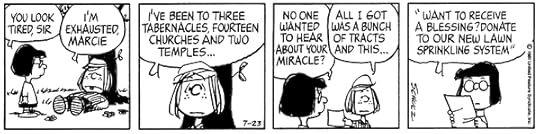
Schulz takes the likes of Joel Osteen to task here. Instead of acknowledging a possible parishioner's miracle, all the Church cares about is servicing itself (and likely it's spiritual leaders.) Mocking the capitalist nature of organized religion is a tradition that goes back to Chaucer's Canterbury Tales at least. If Schulz felt that this sort of crass money grab was in direct opposition to his own personal belief in Jesus Christ, this sort of criticism makes sense. Hell, his argument to believe makes more sense than what the likes of Osteen are selling.
This is, of course, an excellent example of why Peanuts was so brilliant and groundbreaking. Schulz is able to make radical statements through the mouths of babes--Charlie Brown and the gang are only holding the mirror up to a flawed society and asking it to look at itself. The fact that Schulz was able to make it timeless in the process...that's what makes it great.
Anyway, if Schulz had not adequately shown his disdain for the "true believers" when he sent his cast to a deranged Bible camp for the summer, he does so again here. The setup: in previous strips, Peppermint Patty has a butterfly land on her nose. At some point she falls asleep and Marcie shoos the butterfly away. Patty, not being self-aware enough to realize that she has fallen asleep, thinks that the butterfly has transformed into an angel and flown away. She then tries to evangelize this to anyone who she thinks will listen to her. This leads to the strip in question:
Schulz takes the likes of Joel Osteen to task here. Instead of acknowledging a possible parishioner's miracle, all the Church cares about is servicing itself (and likely it's spiritual leaders.) Mocking the capitalist nature of organized religion is a tradition that goes back to Chaucer's Canterbury Tales at least. If Schulz felt that this sort of crass money grab was in direct opposition to his own personal belief in Jesus Christ, this sort of criticism makes sense. Hell, his argument to believe makes more sense than what the likes of Osteen are selling.
This is, of course, an excellent example of why Peanuts was so brilliant and groundbreaking. Schulz is able to make radical statements through the mouths of babes--Charlie Brown and the gang are only holding the mirror up to a flawed society and asking it to look at itself. The fact that Schulz was able to make it timeless in the process...that's what makes it great.

December 21, 2011
When you do something for fifty years running with no vacations or breaks or assistance, something has to give at some point. For Schulz, it was creative consistency. Thirty years into its run, Peanuts finally hits some barren patches. Strips that are not funny or clever. Strips where I wasn’t even sure what the joke was supposed to be. But if creative fatigue is present there are yet runs of inspiration to make up for the strips that cause you to say *sigh* or Augh! The good news, if one were looking for trends, 1982 is superior to 1981. Sally is, as always, wonderful. As school approaches she worries: “What if I can’t remember my locker combination? What if I forget my lunch? What if I can’t remember who married Louis the Millionth?” Charlie Brown leaning on the wall with Lucy feeling good because “This happens to be a good day…I haven’t done a single thing that was stupid.” Lucy asks “Have you done anything that was smart?” Peppermint Patty explains speed learning to Marcie, “Now I can get a D minus on Tuesday instead of Friday.”
Gags that are rooted in anxiety seem to find fresh angles. Gags rooted in whimsy slip to cloying. Many of those involve Snoopy and Woodstock. While the former involve Charlie Brown, Lucy, Sally, and Peppermint Patty: “What’s a summer reading list?” Peppermint Patty wonders. “These are books she has suggested we read just for pleasure…,” Marcie tries to explain. “For WHAT?” Some things defy understanding. Linus shares a worldly bit of wisdom, “Nothing goes on forever. All good things must come to an end…” After a panel of pondering, Charlie Brown asks, “When do the good things start?” They started some time in 1950 and continue into the 1980s and at least a little beyond for Peanuts.
Gags that are rooted in anxiety seem to find fresh angles. Gags rooted in whimsy slip to cloying. Many of those involve Snoopy and Woodstock. While the former involve Charlie Brown, Lucy, Sally, and Peppermint Patty: “What’s a summer reading list?” Peppermint Patty wonders. “These are books she has suggested we read just for pleasure…,” Marcie tries to explain. “For WHAT?” Some things defy understanding. Linus shares a worldly bit of wisdom, “Nothing goes on forever. All good things must come to an end…” After a panel of pondering, Charlie Brown asks, “When do the good things start?” They started some time in 1950 and continue into the 1980s and at least a little beyond for Peanuts.

February 1, 2024
I love Charles M.Schulz’s way of drawing people!Not too simple and not too complicated.my favorite character from his books is snoopy.He does the funniest faces.(snoopy is a dog)sometimes he gets on top of his doghouse and pretends to fight Manfred von Richthofen a.k.a the red baron.There is a peanuts movie!Anyways,some of the characters from his books are Lucy who is very bossy who is jealous of ANYONE that Schroeder likes (why?Because Lucy loves Schroeder).And the main character from the peanuts books is Charlie Brown,who loves a little red haired girl ,and Linus who carries his blanket whom Sally(Charlie Brown’s sister ) tells Linus “ oh sweet Baboo!”And there are much more characters!

June 6, 2026
Eudora and Snoopy's brother Marbles put in appearances; Marcie confesses her, um, "affection" for Charlie Brown; and Peppermint Patty receives an angelic message: "On a fly ball behind third base, the play is the shortstop's." Haven't located it in the Gospels yet, but I'm pretty sure it's there.

October 16, 2020
Peanuts is white hot in the late sixties and early seventies, but cools off slowly in the 80s. There isn't anything wrong with the strip by this point, but the golden age is in the past. There are still gems though, and sometimes just individual panels jump out and grab you by the heart - or the throat. It's usually the last panel, and sometimes they are bitterly dark.

September 1, 2021
Violet: "Happy New Year, Chalie Brown!"
Charlie Brown: "Thank you! Years are like candy bars... We're paying more, but they're getting shorter."
Charlie Brown: "Thank you! Years are like candy bars... We're paying more, but they're getting shorter."
August 16, 2021
Now we are entering the years I don't recall as I had stopped buying my long lost (donated to a charity shop) paperbacks, but I recognise a few, particularly the Peppermint Patty butterfly angel storyline. As always Snoopy stands out where his brother, Spike, becomes a blighter down in the trenches, also featuring sister, Belle, as a Red Cross girl. Also making a debut is long lost brother, Marbles, who finds himself bemused by Snoopy's WW1 pilot persona so doesn't hang around. A joy as always.

March 4, 2022
The feeling I get from these as a man having arrived this year at the age Charles Schulz was when he created these is so different from the one of the boy of 10 and 11 who made sure to never miss a strip. Worthwhile just for the perspective + heartburn nostalgia ("longing for a time lost to you so acute you feel it in your chest").

February 17, 2019
Sure there is a bit of repetition, the strip has been going daily for over 30 years at this point. But, there is still some pretty great stuff in here and overall it's quite entertaining.

March 13, 2024
It's somewhat interesting to see a volume near the middle of Peanuts' run focus so heavily on its core cast of characters. The vast majority of strips feature only Charlie Brown, Sally, Lucy, Linus, Patty, Marcie, Snoopy, and Woodstock. Franklin is in a single strip! Somehow, Molly Volley and “Crybaby” Boobie make appearances but only for specific stories.
Sports is always a running theme in Peanuts. Charlie Brown attempting to kick Lucy's football is an annual tradition. Baseball, of course, is probably the most famous sport in Peanuts. But this volume has longer stories about tennis and golf. There's even the occasional hockey joke tossed in. The topical references are toned down this time, which makes these strips more timeless than others that reference specific names no longer in the zeitgeist.
Patty continues her run of totally misunderstanding alternative schools when she attempts to attend a school for gifted children. Less ridiculous than her previous venture into obedience school, but still pretty funny.
It felt like there were less poignant strips in this volume, but it's still Peanuts quality throughout. The emphasis is on what works during these middle years.
Sports is always a running theme in Peanuts. Charlie Brown attempting to kick Lucy's football is an annual tradition. Baseball, of course, is probably the most famous sport in Peanuts. But this volume has longer stories about tennis and golf. There's even the occasional hockey joke tossed in. The topical references are toned down this time, which makes these strips more timeless than others that reference specific names no longer in the zeitgeist.
Patty continues her run of totally misunderstanding alternative schools when she attempts to attend a school for gifted children. Less ridiculous than her previous venture into obedience school, but still pretty funny.
It felt like there were less poignant strips in this volume, but it's still Peanuts quality throughout. The emphasis is on what works during these middle years.
January 6, 2022
These books are great for the forwards written by other authors who were friends with Charles Schultz. This one was written by Lynn Johnston, who wrote "For Better or for Worse".
"Cartoonists use experience, intuition, impressions, and visual recording to create an imaginary world. We explore, examine, and mirror what's around us. We might distort or exaggerate, but enough reality is maintained so that we can draw ourselves, and therefore others into something familiar, believable, and clear."
Plus of course, such gems as:
Lucy: Life, Charlie Bown is like a deck chair. Have you ever been on a cruise ship? Passengers open up their deck chairs so they can sit in the sun. Some people place their chairs facing the rear of the ship so they can see where they've been. Other people face their chairs forward. They want to see where they are going! On the cruise ship of life, Charlie Brown which way is your deck chair facing?
Charlie Brown: I've never been able to get one unfolded...
"Cartoonists use experience, intuition, impressions, and visual recording to create an imaginary world. We explore, examine, and mirror what's around us. We might distort or exaggerate, but enough reality is maintained so that we can draw ourselves, and therefore others into something familiar, believable, and clear."
Plus of course, such gems as:
Lucy: Life, Charlie Bown is like a deck chair. Have you ever been on a cruise ship? Passengers open up their deck chairs so they can sit in the sun. Some people place their chairs facing the rear of the ship so they can see where they've been. Other people face their chairs forward. They want to see where they are going! On the cruise ship of life, Charlie Brown which way is your deck chair facing?
Charlie Brown: I've never been able to get one unfolded...
December 16, 2023
While the 1980s Charles Schultz works were not quite as engaging as the 1960s, this collection is pretty solid for humor and quality. Many of the old favorites are here, but some nice roles played by new characters like Spike. At this point, Snoopy has long overtaken Charlie Brown as the focus of the strip, but it is engaging all the same. Worth the read.

February 25, 2026
Fajne, głównie te paski były zabawne, niektóre absurdalne, sporo było takich, z którymi można się utożsamiać. Niektóre nie do końca miały sens w moim odczuciu, ale może się odnosiły do wydarzeń z tamtego/ poprzedniego dnia, które były opisane w gazecie. Nie wiem i się nie dowiem.
Rozrywka fajna, ale do czytania całości ciągiem męcząca, lepiej to sobie dawkować.
Snoopy największy plus 💓
Rozrywka fajna, ale do czytania całości ciągiem męcząca, lepiej to sobie dawkować.
Snoopy największy plus 💓

June 9, 2026
Another quality Complete Peanuts collection. Molly Volley reappears, and another Snoopy sibling ("Marbles") is introduced. Peppermint Patty and Marcie continue to be the most interesting characters in the middle and late period of the strip. The latter continues to show her feelings for "Charles". There's an amusing Great Pumpkin segment involving a bowling tournament.

July 22, 2025
My favorite storyline from this collection is Peppermint Patty and her "butterfly miracle". I don't really care that much for baseball storylines, but it was funny seing charlie brown suffering as always.

July 23, 2017
There's a little more with Rerun (not enough!) and a talking school building. Oh yeah...Snoopy's other brother, Marbles!

December 1, 2017
Lot's of Peppermint Patty in this one. Not enough Lucy.
April 25, 2019
Enjoyed this one more than the last one I read - less repetitive, and more of the jokes seemed funny to me. Being a bit more recent, possibly was a bit more relatable as well.

August 14, 2022
There aren't enough stars to rate what Charles Schulz means to me.
July 23, 2023
Pure entertainment.

January 19, 2024
Peanuts from 1981 and 82.
Schulz had a wonderful grasp of what it is to be human....and a beagle with an over-active imagination. Always fun to read!!!
Schulz had a wonderful grasp of what it is to be human....and a beagle with an over-active imagination. Always fun to read!!!


July 8, 2025
More beagle scout adventures for Snoopy and more romantic troubles for Charlie Brown. Any volume featuring Spike and Crybaby Boobie is an instant like.

March 31, 2026
Man mano che passano gli anni, ogni volta che rileggo i Peanuts ci trovo cose diverse. Quello che non è cambiato è la mia passione per le strisce con Molly Volley :D

March 5, 2017
Lots of repeat jokes, many of which don't always land, but a mostly charming and enjoyable read.

January 2, 2014
Lynn Johnston is the creator of For Better or Worse, the family strip featuring the Pattersons. She has a lot of great stuff about writing and drawing a daily strip. She was also a good friend of Schulz, so there are some great stories and anecdotes to share.
As for the strip Snoopy, caught behind enemy lines eats one of Sally's book reports,she brings him in to class instead. Linus continues his denial of being "the sweet baboo" and finds he has to deny being "the cutest of the cute" too. Peppermint Patty gets hit in the head by a Charlie Brown pitch and when she comes to, she finds CB gave up a 50 run lead in the 9th inning with 2 out. She tries to find CB for an explanation and maybe retribution,but is being avoided. For Snoopy snowfishing is a thing, and then he tries to get the Olympics to recognize Downhill Superdish Racing, denied. The gang discovers bowling, Linus doesnt participate because he is staking out a pumpkin patch. CB rolls a wild ball thru the patch and Linus believes it was The Great Pumpkin flying by. Sally and Charlie Brown sell Christmas wreaths without much success until Sally puts them on Snoopy's nose. Snoopy discovers a new brother in this volume too, Marbles.
This a great collection I highly recommend it to anyone who's a fan,casual or fanatical.
I have four more to read of what is already published. Five more to be published before the whole series is complete.
As for the strip Snoopy, caught behind enemy lines eats one of Sally's book reports,she brings him in to class instead. Linus continues his denial of being "the sweet baboo" and finds he has to deny being "the cutest of the cute" too. Peppermint Patty gets hit in the head by a Charlie Brown pitch and when she comes to, she finds CB gave up a 50 run lead in the 9th inning with 2 out. She tries to find CB for an explanation and maybe retribution,but is being avoided. For Snoopy snowfishing is a thing, and then he tries to get the Olympics to recognize Downhill Superdish Racing, denied. The gang discovers bowling, Linus doesnt participate because he is staking out a pumpkin patch. CB rolls a wild ball thru the patch and Linus believes it was The Great Pumpkin flying by. Sally and Charlie Brown sell Christmas wreaths without much success until Sally puts them on Snoopy's nose. Snoopy discovers a new brother in this volume too, Marbles.
This a great collection I highly recommend it to anyone who's a fan,casual or fanatical.
I have four more to read of what is already published. Five more to be published before the whole series is complete.

November 30, 2012
In the run of the strip so far, Peanuts is always Peanuts - meaning that there's a certain sameness to it through the years, for good or bad, and the quality never falls below a certain level. Still, this particular two year run has been my least favorite of the strip up to this point. Schulz has a tendency to really harp on the same joke, and in this particular period of time, Peppermint Patty's failings as a student get pretty heavy play, a little too much for my liking. Though it definitely makes her a genuine part of the Peanuts cast, her dexterity at sports had to be balanced with something, and complete incompetence in school would be the obvious choice.
For Pigpen watchers, he makes once appearance during this spell, heralded by Violet's telling him that she hasn't seen him for quite a while - a bit of fun on Schulz's part since Violet herself had to be summoned from comics limbo to deliver her line.
Anyway, here's hoping Schulz can rebound in the next volume from what seemed to me to be a bit of a lull.
For Pigpen watchers, he makes once appearance during this spell, heralded by Violet's telling him that she hasn't seen him for quite a while - a bit of fun on Schulz's part since Violet herself had to be summoned from comics limbo to deliver her line.
Anyway, here's hoping Schulz can rebound in the next volume from what seemed to me to be a bit of a lull.

August 23, 2011
The real highlight of this volume is the introduction by Lynn Johnston, author of "For Better or for Worse." In her introduction she reminisces about her friendship with Sparky and reflects on what it means to be a cartoonist. It's one of the best introductions so far, to my way of thinking, and it wildly contrasts from the previous volume's introduction by Al Roker.
Otherwise, in this volume the strip introduces us to Marbles, another one of Snoopy's brothers, Molly Volley and Crybaby Boobie make another short appearance (hurray for obscure Peanuts characters!), Peppermint Patty attempts to enter a school for gifted children (it does not go well), and more. This volume isn't dripping with pop culture references like the 1977-1978 volume, but designer jeans (Brooke Shields and her Calvin Kleins were big in these years) are given two mentions. I'm also really surprised there haven't been any Star Wars references!
Otherwise, in this volume the strip introduces us to Marbles, another one of Snoopy's brothers, Molly Volley and Crybaby Boobie make another short appearance (hurray for obscure Peanuts characters!), Peppermint Patty attempts to enter a school for gifted children (it does not go well), and more. This volume isn't dripping with pop culture references like the 1977-1978 volume, but designer jeans (Brooke Shields and her Calvin Kleins were big in these years) are given two mentions. I'm also really surprised there haven't been any Star Wars references!
This entire review has been hidden because of spoilers.

October 3, 2011
The "Peanuts" gang is older than I am but still light up the daily comic pages despite the strips being reruns since the retirement and death of creator Charles M. Schulz. This book contains a year's worth of the delights and dilemmas of Charlie Brown, his sister Lucy, their friends and of course, Snoopy and Woodstock.
I laughed out loud several times and smiled a great deal as I read these amazing comic strips from 1981. Some still seem familiar and every time Snoopy has his typewriter out on the doghouse roof, I know I'm in for a treat.
The best thing about Peanuts and the Schulz genius, new generations continute to be enthralled. Even before she could read on her own--my niece, Rachel was fascinated with the tales of "that boy and him dog" in past anthologies.
Now, she reads along with me and I'll be passing this on to her to enjoy more of the ups and downs that transform everyday life into timeless art.
I laughed out loud several times and smiled a great deal as I read these amazing comic strips from 1981. Some still seem familiar and every time Snoopy has his typewriter out on the doghouse roof, I know I'm in for a treat.
The best thing about Peanuts and the Schulz genius, new generations continute to be enthralled. Even before she could read on her own--my niece, Rachel was fascinated with the tales of "that boy and him dog" in past anthologies.
Now, she reads along with me and I'll be passing this on to her to enjoy more of the ups and downs that transform everyday life into timeless art.
Displaying 1 - 30 of 46 reviews