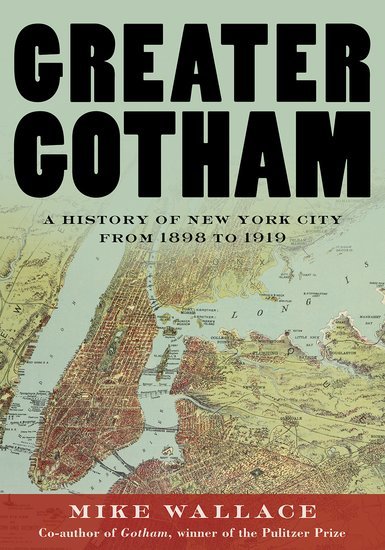
If few reviews do a book justice, in Wallace’s Greater Gotham’s case that is harder than in most. Having been blown away by the first volume, I worried that the absence of co-author Burrows would detract from the quality of the second. This worry was unjustified, Greater Gotham is as fascinating and exhaustive as plain Gotham.
As a denizen of the third world I have often wondered , half facetiously, why is it that aliens always invade and supervillains always attack New York City. During the period of this book, at least in the Americas, there was no other place for them to go. NYC was the center of it all. It had the richest capitalists (Morgans, Rockefellers, Schiffs, Schwabs), the brightest inventors (Edison, Tesla, but not Westinghouse), the founders of the labor movement, as well as those of female suffrage, socialism and black rights (notably W.E. DuBois and Marcus Garvey, although Booker T Washington generally stayed down in Tuskegee, Alabama). The pioneers of cinema, vaudeville and popular music (ragtime!). The creators of advertising. Large manufacturing (including textiles, petrochemicals and pharmacy) was still in NYC and it a New Jersey vicinity. Bohemianism came to the New World via NYC. So finance was synonymous with Wall Street. Popular entertainment with Broadway and Tinpan Alley. Advertising with Madison Avenue. Black culture with Harlem. Counterculture with Greenwich Village.
NYC in this period became coterminous with much of the American experience. And what an experience this was. In this period when Manhattan was integrated with the rest of the boroughs, most notably Brooklyn, modernity cake knocking at the door: planes, cars, telephones, music and sound recorders, elevated trains and subways. Skyscrapers. Elevators. Electricity. Amusement parks were born in Coney Island’s Luna Park. Great institutional changes were also about, particularly the creation of the Fed and of income tax.
It was the high point of progressivism, particularly during WWI. It was a time of consciousness raising: women, blacks, but also Jews and others became conscious of their situation and began to fight for their rights. It was the Belle Époque. A middle class professional man could afford a multi-story brownstone with servants and vacations in Europe, but most of the population lives in squalid tenements, on the fringes of starvation. It was a period of great busts and booms. Of working class strife and of capitalist consolidation. Of the birth of professional sports and stadiums (notably baseball). Of department stores (Macy’s, Bloogmindales, the sadly defunct Lord and Taylor.
Many of the key players of the next thirty years were already on the stage in NYC: Fiorello LaGuardia was a translator in Ellis Island. Harry Hopkins and Frances Perkins were social workers and FDR escorted his cousin Eleanor when she came off work in a settlement house. Leon Trotsky lived in the Bronx, where he was notorious for his refusal to tip in restaurants, on ideological grounds (yeah, right...). Both Maxim Gorky and Sigmund Freud visited, although the former’s visit was not a success because he came with his common law wife, which local bluenoses did not appreciate. John Reed, Paul Robeson and J Edgar Hoover where in town as well as George and Ira Gershwin, Irving Berlin, George Cohan and a very young Fred Austerlitz, later known as Fred Astaire. Robert Moses. Walter Lippmann. Margaret Sanger. Margaret Mead. Busby Berkeley and his follies. Charlie Chaplin. Al Jolson. Felix Frankfurter and Louis Brandeis. The Barrymores. Vaudeville and burlesque. Both racist darwinians like Madison Grant (the passing of the great race) and founders of social sciences such as the Columbia sociologist Frank Boas where writing virtually at the same time, in the same city. Social science was born as eugenics raised its ugly head. WWI had many consequences on the life of New Yorkers, not the least is which is that vast troop movements enabled the first global pandemic: the influenza epidemic that killed many more people than the war itself.
The whole book is like one of those 13 course banquets at Delmonico’s attended by toffs and gangsters (mostly Jewish, Irish and Italians). Or a very rich and big cake where one may pluck a plum virtually anywhere.
NYC is also at the center of political power, from William McKinley to Theodore Roosevelt to Elihu Root. The city was always a magnet for writers: in the nineteenth century it boasted as residents Washington Irving, Edgar Allan Poe, Herman Melville, Walt Whitman. Now there were Theodore Dreiser, Edith Wharton and Upton Sinclair (although he did better in LA and Chicago than in NYC). Al Smith was there too, with a big cigar hanging on the side of his mouth.
Long and short of it, I loved this book. As it ends the twentieth century really picks off. Wartime cooperation between labor and capital give way to a revived laissez faire capitalism. American imperialism takes wing (the book begins with the Spanish-American war and ends with the Paris Peace Conference, going by the Panama secession, organized and paid in Wall Street). Women get the vote and many use it to bring forth prohibition. The Bolshevik Revolution activates many hopes and fears in the new world. The KKK revives and crosses are burnt on Long Island. The Red Scare has passed, laying the ground for redbaiters and witch hunters thirty odd years later. The Harlem Renaissance is about to bloom. The mantle of greatness is passing from London and Paris to NYC, the new capital of the world.
I am really looking forward to the next volume. The author says it will cover the 20s, 30s and mid 40s (possibly until the end of WWII). I can’t wait to read it. Fiorello La Guardia. Babe Ruth. Duke Ellington. Josephine Baker. Stan Lee (Stan friggin’ Lee!). Mr Wallace must live into his nineties so he can bring his story of the Big Apple into the 1960s, with the Rat Pack, Mia Farrow, the world of Mad Men, the Silver Age of Comics, Jackie Kennedy and café society. And I must be around to read it. The only other book I am similarly waiting on is Robert A Caro’s book on the presidency of Lyndon B Johnson. Wallace is a titan, like Caro, or Gibbons, or Macaulay, or like Michelet and Braudel. A jewel of a book.