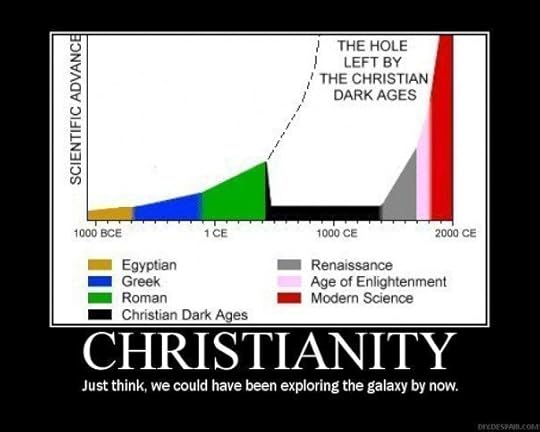
Maybe the Dark Ages WerenOCOt So Dark Afterall? Here are some facts you probably didnOCOt learn in school: People in the Middle Ages did "not" think the world was flat?in fact, medieval scholars could prove it wasnOCOt The Inquisition never executed "anyone" because of their scientific ideas or discoveries (actually, the Church was the chief sponsor of scientific research and several popes were celebrated for their knowledge of the subject) It was medieval scientific discoveries, methods, and principles that made possible western civilizationOCOs ?Scientific RevolutionOCO If you were taught that the Middle Ages were a time of intellectual stagnation, superstition, and ignorance, you were taught a myth that has been utterly refuted by modern scholarship. As a physicist and historian of science James Hannam shows in his brilliant new book, "The Genesis of Science: How the Christian Middle Ages Launched the Scientific Revolution," without the scholarship of the ?barbaricOCO Middle Ages, modern science simply would not exist. The Middle Ages were a time of one intellectual triumph after another. As Dr. Hannam writes, ?The people of medieval Europe invented spectacles, the mechanical clock, the windmill, and the blast furnace by themselves. Lenses and cameras, almost all kinds of machinery, and the industrial revolution itself all owe their origins to the forgotten inventors of the Middle Ages.OCO In "The Genesis of Science" you will discover Why the scientific accomplishments of the Middle Ages far surpassed those of the classical world How medieval craftsmen and scientists not only made discoveries of their own, but seized upon Eastern inventions?printing, gunpowder, and the compass?and improved them beyond the dreams of their originators How GalileoOCOs notorious trial before the Inquisition was about politics, not science Why the theology of the Catholic Church, far from being an impediment, led "directly" to the development of modern science Provocative, engaging, and a terrific read, James HannamOCOs "Genesis of Science" will change the way you think about our past?and our future.
Dr James Hannam is a British historian of science who lives in Kent with his wife and two children. James majored in Physics at Oxford and has a PhD in the History and Philosophy of Science from Cambridge.
His articles have boon published in magazines such as The Spectator, New Scientist, Standpoint and First Things.
It seems that I sometimes have and controversial and nonconformist taste in history books. I don’t generally like tabloid style, sensationalistic controversy for its own sake, especially if this is based on dubious assumptions or modern judgement- but sometimes controversy might spark my interest. One thing that attracted me to this book was the extreme polarization of opinion- the way that historians and interested laypeople seemed to love it, but many with secular humanists hated it. As a student of medieval history I have long known that the notion of all Medieval Europeans being backwards and stupid was a fallacy, so I was inclined to side with the author, and bought the book shortly after it first came out.
After nearly two years I finally got around to reading and finishing it. On the one hand God’s Philosophers is an accessible and necessary work. Necessary because it challenges popular views and misconceptions which still exist to this day, especially where the history of science and philosophy are concerned. Hannam demonstrates that it was in the Universities of Medieval Europe that natural philosophers, theologians and intellectuals made important discoveries and theorized, analyzed, and strove about the world around them in many subjects from astronomy to mathematics, physics to rationality. More importantly, especially to Hannam’s line of argument is that most of these important thinkers were churchmen.
The most common misconception that the author seeks to correct is that the church sought to suppress learning and rational inquiry. It may be based perhaps on a modern, humanistic understanding of reason which holds itself to be the antithesis of faith, and therefore incompatible. However, those who read anything of the scholastic thinkers of the 11th century onwards will realize that their definition of reason was different. It was not the enemy of faith, for they were men of faith, but rather a gift from God to help men. A creation based belief system told them the universe was ordered and adhered to certain laws, and so men could understand and interpret the creation and the world around them.
Of course there was conflict, especially when some scholars sought to use philosophy to challenge Orthodoxy or formulate beliefs deemed heretical. The paranoid heresy hunting church hounding innocent scientist is however not truthful or accurate picture of the time- a time in which a English blacksmith’s son by the name of Richard of Wallingford would in his closing years create one of the world’s first mechanical clocks, in Italy the first spectacles appeared, as well as many other inventions and innovations in agriculture, architecture and many other areas. So much for the supposed ‘intellectual stagnation’ of Medieval Europe which did not end until ‘the Renaissance’- in fact there was more than one Renaissance.
On the other side of the coin, there are some drawbacks to this work. Hannam is to my knowledge, a scientist first and foremost, not a historian. Hence he does seem to apply the preconceptions and attitudes of modern science and ‘progress’ to his work sometimes, and they do not always sit well. His view of medieval medicine is rather scathing, for instance, but does not seem entirely justified. At least, a medical historian at my University would not agree with his generalisation that all medicine of the time was useless and more likely to do harm than heal. To the contrary, there is some evidence that herbal remedies of past may have been effective.
Conversely, whilst having little good to say about medical practitioners and quacks, credit it given to some astrologers, alchemists and even occultists in spite of the dubious basis of their beliefs- even by the standards of the time. Also, I felt there was some bias against Creationism and Protestantism on the part of the author, which came through in the work, so the accusations of a Pro-Catholic slant may not be entirely unfounded.
Altogether, a useful and necessary work, though with some deficiencies, and perhaps suffering from one or two misconceptions itself.
God's Philosophers is a well written introduction to medieval natural philosophy. Throughout, Hannam argues that 'science' did not emerge from nowhere with Copernicus or Galileo. Rather, there is a long history of medieval natural philosophy that predates the so-called scientific-revolution and made it possible.
Being something of a fan of medieval philosophy myself, I can't help but endorse Hannam's thesis, not only because I agree with it, but also because it's right (haha).
Something interesting Hannam points out: far from advancing natural philosophy, the humanists of the fifteenth and sixteenth century probably held it back a bit. By valuing the ancients over and above the scholastics, the humanists took Aristotle and Plato to be more authoritative than Oresme and Buridan. As a result, natural philosophers, in a certain sense, had to redo what thinkers of the previous two centuries had already done. They had to show once again that Aristotle and Plato were not final authorities on all 'scientific' matters. This is, of course, an oversimplification, but I've never heard this argument before.
In all, I'd recommend this book to anyone who takes science or the history of science seriously. It certainly puts the lie to the (obviously false) thesis that science only became possible with the demise of religion.
Nothing is simple, particularly history where facts are sometimes ignored or re-adjusted to fit an ideological narrative. According to popular opinion the Middle Ages were the Dark Ages, a time of stagnation and persecution, witch-hunts and the belief that the world was flat as a pizza. Progress only came in the Renaissance period when free-thought somehow came into being after Columbus sailed the ocean blue to prove the world was round and Galileo discovered the earth revolved around the sun only to get trampled by the Catholic Church who has been keeping mankind back. The thesis of this book is that this narrative is categorically false and sets out to prove it.
This book is part of a long line of media, including the book 'Lies my Teacher Told Me' and Terry Jones' Medieval Lives, that shows that much of what we think about this particular era is just plain wrong. Certainly it was not the utopia of Arthurian Romances but it was hardly a dystopia either. Terry Jones (the Monty Python member and historian) has been very vocally critical of the way the Renaissance is depicted as time of great scientific discovery. 'Genesis of Science' (or God's Philosophers, as its known in UK-territory countries) attempts to prove that during the Middle Ages science was not constricted by Biblical dogma but surpassed not that of the ancient Greeks. And when constriction came the dogma was mostly because of scientific dogma*, not religious (though the book acknowledge that religious persecution of scientists happen on occasion but was not as widespread as usually believed and it very seldom ended in the accused being burnt at the stake). From Boethius to Nicolas of Cusa, Dunn Scotus to Jean Buridan to William of Ockham there are chains of thought that link with Copernicus, Kepler and Galileo. Some of these scientists acknowledged these sources while some plagiarized them completely.
* To explain, a lot of people in Medieval and Renaissance times believed that the pre-Christian pagan philosophers were mostly infallible, particularly Aristotle, and to questions these philosophers were like attacking the foundations of western civilization itself. Also, they believed the Romans and ancient Greeks were more advanced scientifically and so all Medieval achievement were wrong or suspect. Part of the reason our view of the Middle Ages as being "dark" is because of this view.
Hannam's style is very straightforward and very seldom launches into hyperbole and never feels exaggerated. It also focused and generally chronological, making it easy to follow particularly when he returns to subjects briefly discussed earlier in the book. That said, this is an extremely broad subject and I would have liked to know more about certain subjects than the book has room for.
At the beginning of this review I said that 'facts are sometimes ignored or re-adjusted to fit an ideological narrative' and there are times when you can be mistaken info thinking that Hannam has lapsed into this trap himself. Though he tries to focus on the positive side of the medievalist thought and tries to put a lot of their views in perspective his optimistic approach means that he can sound like he's downplaying or excusing the bad things. He is not and a careful reading will see that he condemns the actions of the Catholic Church and the Inquisitions several times through the book.
Overall, as a summary for a complex time and even more complicated thoughts this book is a good launch pad for learning about an era that is generally misrepresented.
very readable. i only wish i had it in hard copy so i could throw it at people's heads when they say "dark ages" (hissssss).
probably my favorite bit was "One noted theologian and astrologer, Richard Holcott (d. 1349), had used his art to confidently predict a peaceful death for himself. Maybe, lying in his pallet as the Black Death ravaged his body, he wondered where his calculations had gone wrong." cold as ICE.
In brief, there is some fascinating information in this book, and the bibliography points to years of more in-depth reading for the type so disposed (I am that type). Hannam has uncovered a myriad of nuggets of knowledge gleaned from thousands of pages of dreary and torturous scholasticism (the practice of laboriously reasoning one's way to artificially reconciling Aristotle et al with Christian doctrine and scripture) that prefigure the scientific discoveries of the Renaissance and beyond. Copernicus and Kepler and Galileo weren't the first to establish earth's actual position in the heavens, just to prove it so exhaustively, etc.
This would all be fine, but there is kind of an ugly undertone to this book, at least as I took it. I felt hectored by the author to be grateful to the Catholic Church for forcing all that scholasticism to take the place of honest inquiry, even before I got to the passage where Hannam declares that the humanists who sought to recover and amplify the nearly-lost writings of antiquity were "incorrigible reactionaries" who wanted to return to an imaginary past. Because they didn't spend their lives paging through all those arguments about God and Aristotle to sift out the odd germ of actual knowledge they were bad guys?
Again, it's not a bad book and a lot of the information in it is illuminating and stimulated my curiosity about some nearly-forgotten figures in medieval learning, but I still found its tone a rather rough row to hoe.
This is one of the most fascinating history books that I've read! Somehow we leave primary and secondary school history education with the preconception that the Middle Ages were dark and filthy place and that it's people were some sort of backwater bumpkins. Unless you take the time and effort to read history, or to study it and become a medievalist it's likely you'll never break those preconceptions. This book does that in delightful 20-something chapters. The book is a joy to read; Mr. Hannaman writing is clear and concise and most importantly accessible to everyone. You don't have to be a student of history or a historian to understand what you're reading. God's Philosophers is certainly an eye opener and a must read book for everyone.
The middle ages have always seemed like a wasteland as far as scientific discovery is concerned, and after reading this book it still kind of does. Nevertheless, God's Philosophers sheds some much needed light on the efforts of discovery in this time period and corrects many of the prejudices against it. Enlightening and interesting.
Сви сте сигурно чули како је у средњем вијеку католичка ��рква владала гвозденом руком, спаљивала научнике на ломачи и сл. (па је тај период, сасвим с правом, добио надимак "Мрачно доба"), како је Ђордано Бруно спаљен због својих научних претпоставки, како је Коперник прогањан због хелиоцентричног система, како је средњи вијек уназадио човјечанство за неколико миленијума и онда су се срећом десила ренесанса, дошо Галилео са екипом, извадио из нафталина прастаро и заборављено/забрањено/спаљено знање старих Грка и довео до настанка модерне науке којој данас дугујемо апсолутно све. Понешто од тога су нас чак и у школи учили. Наравно, апсолутно ништа од овога није тачно и то је суштински тема ове књиге.
Ово није неки спектакуларно револуционарни истраживачки рад, већ научнопопуларна књига која само лијепо и прегледно излаже ствари које су већ познате у научним и историјским круговима. Морам вам рећи да овде има много занимљивих ствари, првенствено у посљедњим поглављима која приказују колико је ствари Галилео "посудио" из средњевјековне науке, иако није био баш ревностан у навођењу извора.
Наравно, мени омиљени дијелови нису ти "озбиљни", већ они у којима се људи међусобно препуцавају - нпр. свађа Кардана и Тартаље, о којој смо понешто чули још на факултету - као и сјајни описи средњевјековне медицине. Ево вам неки од мојих омиљених пасуса, да видите дио онога што се ту дешавало:
"Another good and easily available antiseptic was urine. One doctor recalled how he saw a man's nose cut off in a duel. Picking up the severed organ, the doctor explained that he urinated on it and then successfully bandaged it back ono the victim's face."
"There's more demand for this than we might think. At the time, syphilis was endemic and one of its more gruesome effects was to cause the sufferer's nose to rot away. The medical textbooks preferred to avoid any references to the pox and instead noted that rhinoplasty was ideal for when the lost nose had been eaten by dogs.
Tagliacozzi set about repairing a lost nose by cutting a flap of skin from his patient's arm and sewing it over the nasal cavity. The arm was strapped in place until the flap had grown onto the face, whereupon it was cut from the artm and remoulded into a new nose. The whole process could take months."
(Ово посљедње је тек почетак приче, нећу да вам спојлујем шта се десило кад је лик тражио да се умјесто његове руке искористи рука његовог слуге.)
Све у свему, ово је књига за апсолутну препоруку. Ја јесам био свјестан суштине приче, али многе детаље (и многе ликове) упознао сам тек кроз ову књигу и вјерујем да ће то бити случај са већим дијелом читалаштва. На крају аутор препоручује неколико других књига за оне који би дубље да уроне у тематику (она која је мени већ сад омиљена и прије него што сам је прочитао зове се Bad Medicine: Doctors Doing Harm Since Hippocrates), а све то поред врло обимне коришћене литературе, уредно цитиране у самом тексту. Али чак и да се задржите само на овом наслову, ваша склоност (if any) вјеровању лошим интернет мимовима као што је нпр. сљедећи биће значајно смањена.
Hannam's argument is that medieval science - 'natural philosophy' - and its practitioners have been sadly, even criminally overlooked, and his book seeks to bring to the readers attention the developments in scientific understanding over the Middle Ages, and the men who made them (yep, all men, all the time).
As Hannam points out, 'medieval' as a word has connotations of backwards, benighted, superstitious. To generalise, we tend to think (if we think at all about such things) that no science of any real merit was done in Europe/Britain between the Roman Empire and the Reformation and that the church suffocated and punished any innovations in science that threatened its power.
The stories Hannam tells temper this. He describes the lives and works of men across the continent - most of whom were either members of universities (established in the Middle Ages) or the Church - who took God and Aristotle as their two authorities, who must be reconciled with each other, and the natural world they observed.
The thing I most enjoyed about the book was the way Hannam teased out the way people - intellectuals - thought. C.S. Lewis makes similar points, writing about medieval allegory - thinking was almost on two levels. There was what could be observed or shown, and then there were the abstractions that these observations had to me fitted into.
For example: Paracelsus (Theophrastus Bombatus von Hohenheim, 1493-1541) attacked conventional medicine, still based (as it went on to be) on Galen's concept of the four humours.
In Paracelsus' mixture of Christianity, mysticism and alchemy, all material was made up of three base elements: salt, sulphur and mercury. Paracelsus added salt to the traditional alchemical pairing of sulphur and mercury to bring his theory into harmony with the Holy Trinity.
I think my overall lesson from the book - driven home by the endless attempts of philosophers and astrologers to construct an understanding of the solar system that matched their observations with their readings of the Bible and, more importantly, their firm belief that God could only make things that were beautiful, simple and balanced - is that when you're trying to understand how something works, you need to very carefully put aside your assumptions of how it *should* work.
I'm partway into Marcus Chown's 'We need to talk about Kelvin' at the moment, and one of his obervations on Rutherford drove this home. Subatomic particles - even just atoms - fly in the face of every belief medieval philosophers held about how a god-created world should behave. Writing about the famous gold foil experiment, Chown notes
"Seeing an alpha particle richochet backwards would be like firing a bullet into a cloud of gnats and seeing it bounce back the way it had come. But the mark of geniuses - and Rutherford was the greatest experimental physicist of the twentieth century - is that they are always open to the unexpected, never allowing their theoretical prejudice to limit what nature might reveal to them."
Medieval science was really philosophy. It was reasoning from first principles, taken from the approved source material (even chunks of Aristotle were banned at times because they couldn't be made to jibe with theology). Experimentation would have to wait. As C.P. Snow writes of Rutherford:
"His ideas were simple, rugged, material; he kept them so. He thought of atoms as though they were tennis balls. He discovered particles smaller than atoms, and discovered how they moved or bounced. Sometimes the particles bounced the wrong way. Then he inspected the facts and made a new but always simple picture. In that way, he moved, as certainly as a sleepwalker, from unstable radioactive atoms to the discovery of the nucleus and the structure of the atom."
Hannam's books is a generally enjoyable read - it'll certainly tip any preconceptions you have about the Church in this period upside down, and introduce you to a totally different mindset. However, I did wish he wouldn't remind me quite so frequently of the wrongs he was setting right - a bit too much tell, slightly spoiling an otherwise very good show.
Being a medievalist, I skipped large parts of the book that did not contribute in any way to my knowledge, but I have still learnt new things. There was certainly nothing about the mean speed theorem in my medieval philosophy class.
For someone who is not a historian, this is an excellent book, even though not perfectly free from misguided assumptions (like the complete uselessness of medieval medicine), or out-dated information (the use of stirrups had spread across Europe much earlier than the Author claimed) – but these are minor drawbacks. The book is very readable. To a non-professional reader, it offers a fresh look at the Middle Ages as a period of social development and progress in human knowledge. In this respect, it is also a very useful book, disproving much of the widespread prejudice about those times.
The Author may seem overly keen to defend the Catholic Church against the accusations for the curbing of the free thought, but he is also right in pointing out that, first, there were/are taboos in every period of history and every cultural milieu, and second, it was the Catholic Church that created the conditions for the philosophers to become scientists, and it was the people of the Church themselves who took the natural philosophy to the level of scientific research.
Does exactly what it says on the tin, very convincing argument, although maybe it could've done with a chapter entitled 'OK, so here's where Christianity did prevent intellectual progress a bit'. There are moments in the text when this is briefly acknowledged but I think the book's central premise would've only been strengthened had the other side of the argument been explored and debunked more consistently.
Whilst I would agree with much of what is said, the book has an obvious Christian apologists' bias.
This is a highly readable book about the foundations of modern science in the medieval era. Anyone interested in the subject should read this; it is not written for specialists or experts but for popular audiences.
There have been lots of mythologies built up around the so-called “Dark Ages” or “Middle Ages.” Most of these were inventions of the Renaissance and later when, in love with the ancient world, they sought to downplay any advances in the intervening 1,000 years of Christendom. There were even Protestant Reformers who contributed to this myth in an effort to take shots at Roman Catholics.
Hannam shows that the roots of modern science were actually found in the Medieval Era. European universities were independent enough to give people space to study and the Christian metaphysical assumption that God created a world that made sense and can be observed gave reason to study nature.
Just one example is that Aristotle, who always loomed large, taught that heavier objects fall faster than lighter ones. Hannam shows how this idea was already questioned by John Philoponus in the 500s and by the time of Galileo, just about every natural philosopher knew Aristotle was wrong.
Not only does calling times merely “middle” ages or worse “dark” ages, calling an era the time of “scientific revolution” is a bit hyperbolic. Hannam argues we could call any century from the 12th to the 20th a time of scientific revolution. For this reason, rather than looking at those medieval natural philosophers as having nothing to offer, we should be grateful for the work they did that paved the way for modern science.
This is an excellent, popular level, overview of medieval approaches to the natural sciences, and how beliefs, theories, institutions, and new technologies developed in the middle ages where instrumental in making modern science (indeed, science as we know it today) possible. The author writes a book that reads like a novel, introducing the main characters in chronological order, and reminding us, at various points throughout the book, of how they contributed to the age-old project of understanding the natural universe. This book provides an helpful summary and synthesis of some of the best research currently being done o the history of science, and the contributions of important medieval thinkers. Every body should read this book!
Bijna honderd jaar geleden publiceerde de Franse wetenschapshistoricus Pierre Duhem zijn magnum opus Le Systeme du Monde. Hierin rekende hij op overtuigende wijze af met het beeld van de Middeleeuwen als Dark Ages. Na Duhem heeft de ontwikkeling van de wetenschap in de Middeleeuwen een onmisbare plaats in het geschiedkundig onderzoek gekregen en kan geen enkele serieuze historicus om hun belang heen. Hannams boek lijkt dan ook ongeveer honderd jaar te laat verschenen om als academische bijdrage een toegevoegde waarde te hebben. \nDe schoen wringt in Hannams centrale stelling dat de Middeleeuwers die verantwoordelijk waren voor het ontstaan van de moderne wetenschap, en dat de wetenschappelijke ontwikkelingen veelal dankzij in plaats van ondanks de Kerk plaatsvonden. Al snel wordt duidelijk dat Hannam een tweeledig doel nastreeft. Enerzijds wil hij een wetenschapshistorisch punt maken dat volstrekt overbodig is. Niemand die zich een beetje in de materie verdiept heeft zal zich herkennen in de gemeenplaatsen die Hannam als voorbeeld aanhaalt over hoe de Middeleeuwen eigenlijk nog steeds als Dark Ages worden beschouwd. De tweede, en veel ernstiger tekortkoming van God's Philosophers, is dat Hannam een katholieke apologie heeft afgeleverd waarin er met de feiten wel erg losjes wordt omgegaan. \nOm te beginnen hanteert Hannam een zeer selectieve invulling van het begrip Middeleeuwen. De vroege Middeleeuwen komen er bekaaid van af. Dit heeft te maken met het feit dat het klassieke corpus in die tijd in christelijk Europa onbekend was. Pas nadat vanaf de 12de eeuw via Arabische en Byzantijnse kanalen deze geschriften hun weg naar de universiteiten vonden, komt er een ontwikkeling op gang die uiteindelijk leidde tot datgeen als moderne wetenschap zou kunnen worden betiteld. Hannam beweert dat het de door de Kerk opgezette universiteiten waren die tot een niet eerder vertoonde geinstitutionaliseerde bloei in het denken zouden hebben geleid. Hierbij verliest hij uit het oog dat hetgeen op die universiteiten aan de orde kwam een Grieks-Arabische oorsprong had. De opkomst van de logica en het rationalisme in de Scholastiek wil niet zeggen dat daarmee perse een fundament van moderne wetenschap werd gelegd. Alle modern wetenschappelijke beweringen zijn logisch (hoewel veel postmoderne wetenschapsfilosofen ook dat zullen betwisten), maar niet alle logische beweringen zijn wetenschappelijk. Uitgaande van onbewezen axioma's, zoals het bestaan van God, kunnen immers rationele, maar weinig wetenschappelijke redeneringen opgezet worden. \nHannam schetst ook een vertekend beeld over de rol van de door de kerk gesteunde universiteiten. Hij wil doen geloven dat daar, dankzij de bescherming van de religieuze autoriteiten, de wetenschap zich naar omstandigheden optimaal kon ontwikkelen. Hij gaat daarbij echter voorbij aan het feit dat juist aan de niet door de Kerk gecontroleerde universiteiten van de Noord-Italiaanse handelssteden en Salerno de vraag naar praktische toepassingen van kennis veel sterker was. Juist op deze plaatsen vond de meest effectieve uitwisseling tussen de logisch-deductieve theorie en de technologische praktijk plaats. Aan de kerkelijke universiteiten floreerde vooral de theologie. \nHet waren Renaissance humanisten die de door Hannam bewierookte scholastici voor het nageslacht zwart maakten. Hij suggereert dat mensen als Copernicus, Keppler, Galileo, Francis Bacon en Isaac Newton zich ternauwernood aan de perfide invloed van de Renaissance hadden kunnen onttrekken en door middel van een onkritische houding ten opzichte van Kerk en Scholastiek de moderne wetenschap veilig hadden kunnen stellen. In werkelijkheid bestrijden de Inquisitie en de Index bestrijden de heterodoxie van Copernicus, Kepler, Galilei en Giordano Bruno. \nWat de eerste drie betreft, is Hannam van mening dat hun wetenschappelijke bevindingen volgens de logica van de Kerk wel op de verboden lijst moesten komen en benadrukt hij dat niemand ooit vanwege zijn wetenschappelijke denkbeelden op de brandstapel terecht is gekomen. Dit argument is niet valide. Natuurlijk werd niemand om die reden geexecuteerd. De theologie van de katholieke kerk dicteerde wat wetenschap was. Alles wat daarbuiten viel werd niet als slechte wetenschap beschouwd, maar als zijnde in strijd met de dogma's van het geloof en dus als ketterij. Giordano Bruno heeft het volgens Hannam vanwege zijn ketterij en onuitstaanbare persoonlijkheid aan zichzelf te danken dat hij op de brandstapel eindigde. Hannam bestrijdt ten stelligste dat Bruno wetenschap bedreef, maar concludeert dat hij een misleide mysticus was. Zodoende kan hij staande houden hoe redelijk en wetenschappelijk angehaucht de Inquisitie wel niet was. Voor deze analyse hanteert Hannam overigens een nie t nader omschreven demarcatiecriterium over wat in deze tijd wel en geen wetenschap was. \n
Interesting book about how science did evolve during the middle ages. The renaissance men like Copernicus, keppler and galileo could not made their progress without the men of thebchurch doing the ground work. Also the church was holding science back, but encouraging it. Nature was God's work and therefore worthy to be studied. Interesting side story where the humanist like Erasmus who looked back to the Greek philosophers and didn't think the medieval people could have done anything worthwhile. Mainly because they wrote in modern Latin and not the old "dead" Latin. In doing so the enlightened people stalled scientific progress. The book was rather long, but I enjoyed it.
This book is called "The Genesis of Science: How the Christian Middle Ages Launched the Scientific Revolution", and that title is quite descriptive. I think when I picked it up, I was thinking something more like "how Christianity launched the Scientific Revolution", but the book is really a history of science in the "dark ages" (which were in fact not so dark), and the role that the Church played with nascent science at that time is best described, as the author puts it, as a "creative tension". In addition to the well-known metaphysical assistance provided by faith (God made the universe orderly), certain Church decrees helped things along (for example a ruling that no one could say that there was something God could not do gave people freedom to speculate), and of course the Church also funded much of the work. On the other side, you have well-known events like the house arrest of Galileo that hardly helped things along.
I especially enjoyed learning about how astrology and alchemy actually helped scientific progress along - for example, how can you predict how the positions of the stars and planets will affect an event (astrology) if you cannot predict the positions of the stars and planets (astronomy)? Thus astrologers were astronomers best customers and a source of money. Also interesting to see that... the science we remember people like Galileo for was already "in the air", pieces having been proposed by names (most especially John Buridan) history has largely forgotten. (Newton said he stood on the shoulders of giants - how many can you name?)
I did think the author sometimes tried too hard to defend some of the wrongs of the Catholic Church - but all in all quite balanced. A valuable history of the middle ages and early science.
I really, really enjoyed this book. The fact that it took me so long is not the relevant factor; the fact that I finished it is. We think of the time between 476 and 1492, give or take a decade, as "not much happened besides the Crusades." Nothing could be further from the truth. This documents how the discipline of natural philosophy--the study of the natural world--became our three main branches of science. Biology, the study of medicine and the body, chemistry and its embarrassing grandfather of alchemy, astronomy's comparable relationship with astrology, even physics. The myth that the world was thought to be flat is refuted, the history of our modern university and the Church's role in research--that very basic premise that God created an orderly, knowable world and to study it is to cultivate a relationship with its Creator--is defended.
Hannam's dry sense of humor is evident as well. Read for yourself and enjoy.
I liked this book. I'm no expert on the Middle Ages, and I'm afraid I held several stereotypical misconceptions of the period that Hannam artfully demolishes in this very interesting (if you're interested in this sort of thing) read. For example, most educated people in the Middle Ages did not believe the world was flat, and Columbus' sailors did not fear sailing off the edge of the world; the church was not opposed to the advancement of scientific knowledge, as is evidenced by the fact that most natural philosophers (their version of modern scientists) were also trained theologians, and many of them were cardinals in the church; and no one really argued about how many angels could dance on the head of a pin. I have an enriched understanding of this era of history and appreciation for the foundations that were laid during this time that was anything but intellectually "Dark."
This book doesn't seem to be written by some right-wing evangelical with an axe to grind, but rather a historian who wants the truth to be known concerning the period of history that has gotten a very bad rap.. Hannam shared many of the advances in natural philosophy during the middle ages and the metaphysics that inspired it and showed how this laid the necessary ground work for modern science. The book is well-written and balanced, shattering several myths and including the good, bad and the ugly. But yeah, I have heard various speakers mention that the Christian worldview during the middle ages was significant for the rise of science and I am glad to finally have found a book that goes into this in some detail.
Mr. Hannam is a Christian apologist, but, having said that, this is a fascinating history of the evolution of science from the Medieval world of Europe and through Early Modern Europe.
It meant for those that have not read widely in Medieval European history and those that have not thought critically about the traditional reading of science history and the Medieval Catholic Church. In many ways it will be an eye-opening experience for the average reader.
The style is accessible but intelligent.
If there is one criticism, it is the book is less analytical than I had hoped. Still, an excellent and import reading of science history in the West.
4 our of 5 stars
Recommended for those interested in Science and its history.
A very interesting read. It tackles long held assumptions. One example Christians or specifically the Roman Catholic church did not prohibit human dissection. For further proof read http://news.harvard.edu/gazette/story...
It is important to source our facts and study them versus parroting long held assumptions.
Shows how the middle ages were not devoid of scientific effort, and how it set the stage for later scientific discoveries. Covers a fair number of generally unknown scientists, but scientifically significant.
Um livro muito interessante e que me ajudou a me informar a respeito do enorme "buraco" que é o ensino da história medieval. O autor ajuda a desmistificar a imagem de que a Idade Média foi a "idade das trevas" faz um tour pelos filósofos naturais que ajudaram a formar algumas bases para a ciência moderna. O livro cita nomes famosos como São Tomás de Aquino, Alberto Magno, William de Ockham e Roger Bacon mas a leitura fica mais enriquecida ao conhecer diversos personagens fascinantes como, por exemplo, Pedro Aberlado, Adelardo de Bath, os arcebispos de Canterbury Santo Anselmo e Thomas Bradwardine, o filósofo francês Jean Buridan e os filósofos árabes Averróis e Avicena.
O livro se sustenta na tese de que após a queda de Roma para os bárbaros no século V, o conhecimento ficou estagnado na Europa devido a uma barreira linguística. Todo o conhecimento em grego ficou para o lado do Imperio Bizantino, enquanto Roma e o ocidente europeu ficou com o latim e as inúmeras línguas dos povos bárbaros. Simplesmente não havia massa crítica para prosseguir. Os séculos foram passando e o conhecimento dos gregos e dos árabes (que tiveram papel importantíssimo) acabaram chegando ao ocidente através da expansão árabe do século VII-VIII. Os primeiros filósofos naturais medievais tiveram acesso a este material e começaram a recuperar o tempo perdido. Neste ponto, a Igreja também ajudou com a fundação das primeiras universidades na Europa e com a tradução e publicação de vários tratados.
O livro aponta que a imagem de vilã da Igreja Católica é mais uma obra da propaganda protestante após a Reforma com o objetivo de desgastar a igreja 'rival'. É claro que a Igreja Católica cometeu vários erros durante este período mas é muito interessante ver que desde Santo Agostinho já havia uma tentativa de conciliar o conhecimento da Grécia antiga (principalmente Aristóteles) com a Bíblia. Há uma clara tentativa de cristianizar a ciência de Grécia pagã.
O que achei mais interessante é que muita coisa que só ficou famosa com Copérnico, Kepler e Galileu já havia sido pensada séculos antes por muitos dos filósofos medievais que citei antes. Dois exemplos disso são o facto de já se saber que a terra se movia no espaço e de que a teoria de movimento de corpos de Aristóteles estava equivocada. A famosa frase de Newton "Se eu vi mais longe, foi por estar sobre ombros de gigantes." faz todo sentido quando vemos a teoria de Galileu e os vários indícios de que ele bebeu da fonte de conhecimento medieval.
Um outro aspecto fascinante do livro é como a Inquisição é vista. O autor diz que é inegável que houve tortura, erros e inflexibilidade. Por outro lado, a Inquisição pode ser vista como um protótipo do "estado de direito" uma vez que até a sua criação não havia a noção de julgamento justo ou de direito de defesa. Foi criada justamente para acabar com um certo barbarismo jurídico.
Como o livro cobre um período imenso e vários personagens, as vezes pode-se ter a sensação de que alguma parte pode ter ficado demasiado superficial. Felizmente o livro tem uma bibliografia e uma seção de notas riquíssima. Leitura recomendada.
It has always annoyed me when I've heard someone denigrate the thinkers of the middle ages as idiots or backwards.
This book eloquently and thoroughly puts that ignorance to rest by documenting how the thinkers of the middle ages laid the foundations of modern science, and without their hunger for knowledge and love for God, we would not be where we are today.
A very interesting read. Learned alot about the history of knowledge.
Exceptional. Hannam knows his science, his philosophy, and his history. And he knows how to write. Redeeming, as he explores and unfolds, not only the medieval period, but the names of men who should not be unknown to us.
I found hi treatment of Humanism the most revolutionary and enlightening.
Really eye-opening, revelatory book, easily readable by a person interested but not specializing in medieval history. Engaging and often amusing, and I feel I have a much better grasp of the era, and the thinking, than I did before I picked it up.