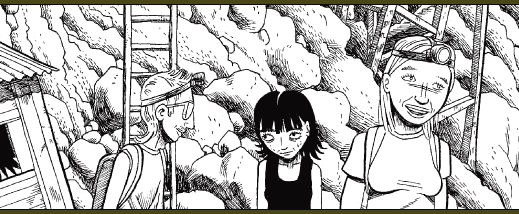
by Josh Simmons In the thick of a dense wood, a young man comes upon a decrepit house and two teen-aged girls. Deciding to explore the abandoned house together, Simmons captures the aloof ennui and deep curiosity of being a teenager. The trio quickly become entangled in a love triangle that is as tense and ominous as the house itself. This adventurous, silent graphic novel demonstrates the solid strength of this young cartoonist and his storytelling ability. House is Josh Simmons' first full-length graphic novel after years of honing his craft on the humorous, underground mini-comic series Happy , and it is a visual and formal tour de force that proclaims Simmons a major cartooning talent of the new century!
House presents for me a difficulty because I deeply wanted it to succeed better than it did. I’m a big fan of a single person working hard to bring their narrative dreams to paper reality. It takes a lot of work on the part of the creator and so I dearly want all such efforts to succeed.
You may have already guessed by my tone that House doesn’t succeed.
The storytelling conceit of a wordless story conveyed through simple art is cool enough, but though Simmons’ art is generally competent enough, its cartoony style doesn’t allow for some of the nuance he seems to be trying to convey. There are panels in which one cannot be certain whether the characters are talking or arguing or messing around or perhaps something else entirely. This makes the storytelling difficult to piece out.
As much as I’m loathe to diminish Simmons’ experiment here, I was often frustrated by the narrative inadequacies created by the book’s use of silence. I desperately wished on several occasions that there had been some sort of narration or dialog present so I could understand what story I was reading. Readers can easily ascertain the overt storyline of kids exploring an abandoned—and perhaps haunted—mansion and the inevitable trouble such investigations must incur, but anything more that this is partially (and sometimes entirely) obstructed by the book’s deficits.
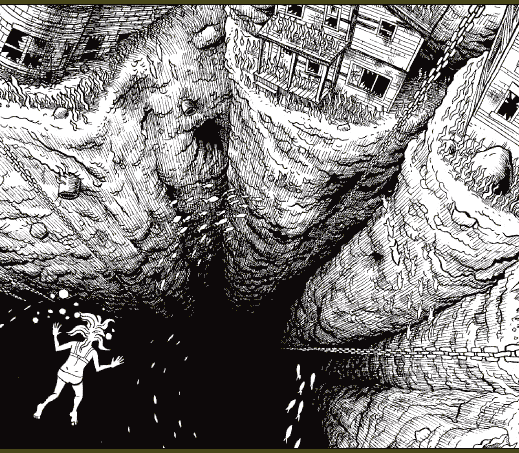
Still, while the book ultimately does not succeed, there are some things that it essays spectacularly. The revelation of the lake and the sunken parapets and chains was great. The finale with its increasing tightening and dramatic build worked very well for me, and while I couldn’t always make out the expressions on our three protagonists’ faces, the darkness enveloping them more than made up for what couldn’t be seen. And perhaps the best choice of all was the use of the front and back covers to bookend the story and give a strong metanarrative clue as to what’s going on.
While in the end I didn’t think much of House, I found the concept worth the investigation and hope to read future works by the creator as, with most things, diligence and practice will likely hone his craft.
Three plucky teens make their wordless way through a haunted house of impossible dimensions, its innards containing endless hallways, massive sets of stairs, dilapidated structures and even a bucolic spread of a pleasant lake on a sunny afternoon. Naturally, death and despair soon follow. Simmons's impressionistic debut is full of visceral suffering, unseen horror and no catharsis through at least an understanding of our protagonists' doom. A hand-drawn exercise in nihilism, shadow and decay.
I wanted to like this far more than I did. At the very least, Simmons deserves some credit for being willing to experiment with an entirely wordless graphic novel. The problem is, this is not the story for wordlessness. The art just doesn't define what's going on well enough to do without words entirely. Sure, there's some great visuals. That underwater city is pretty stunning, and the conclusion is shown effectively enough. But I can't help but feel that the entire story would have been more effective, and I would've cared about the characters more, if there had been even a few lines of dialog or narration here and there. And Simmons's odd decision to have one of the female (of course) character's shirt rip in an improbable way so she could spend roughly half the book exposing one breast just threw me out of the story. It's weirdly gratuitous, and adds nothing to the book. I give Simmons credit for experimenting, but this just fell short. It would have been better without the experiment.
I stumbled upon the concept of wordless novels after 'reading' Taki & Dira by Shah Ibrahim. With its generous use of line-shading, House has an intense atmosphere building up all the way to the climatic ending. Towards the end however, scenes get confusing as the artwork shrinks and darkens. I found it hard to decipher what was actually going on in each panel. One of the girls fell and happened to tear half her shirt, exposing one boob. Hmm... What would have happened if the guy had fallen instead? Would he had ripped his pants, thus exposing half a testicle then? Not that I have a problem with nudity in comics. But that scene definitely wasn't at all necessary.
Not sure if there is something more to it or if we should just take it at face value. Like most stories, every person will make their own interpretation.
I like to think there is more than meets the eye.
Even though this is a French edition, given it's a silent graphic novel, it doesn't really matter.
Short silent pen and ink comic about a guy and two girls that explore an old broken down Victorian haunted house. They go through a portrait at one point and fall into a well beneath the house. Maybe it's a lake, and this is really a dream or nightmare. The girls had been together before the guy meets them, and in the process of exploring they each link up with the guy, and those subtle shifts create tensions, jealousies, separations. The action leads to a deftly done conclusion for a haunted house story, working through an increasing tightening and shrinking of images to every greater darkness. Well drawn; not spectacular but interestingly done, using the craft of comics without words.
Loved this! So unexpectedly weird and creepy. I was not expecting to become so enthralled in a story told strictly with pictures and no text. The horror of House sneaks up on you and I for one, did not see it coming. Thanks to Jessica for passing this along to me about a year ago, and helping me remember it today!
Three teenagers explore a dilapidated mansion in this wordless comic from Josh Simmons. The story is bleak as is to be expected from a Simmons comic, but the exploration aspect to Le Manoir is really what makes this an enthralling experience. The initial sense of wonder in the exploration is suddenly curtailed by the more disturbing elements that Simmons revels in, but it's an exciting ride to get there. Simmons excels at employing heavy black inks to craft atmospheric tension, and this comic is no exception. The contrasts are impeccable throughout, and the encroaching darkness as the teens delve deeper into the bowels of the building just adds the perfect amount of apprehension.
I really wanted to like this book, but it fell far short of it’s potential, it’s started off interestingly with some teenagers exploring a sprawling and unusual house. There’s no dialogue so everything is told through the artwork, it was initially effective at telling the story but as it progressed the quality deteriorated, and it felt messy and rushed by the end. It became hard to follow what Simmons was trying to convey and to be honest, despite its short length I became bored.
An atmospheric and creepy wordless graphic novel. The wordlessness is, in this case, a strike against it; the small, scratchy drawings make it difficult to tell what's happening in many places. Is the guy a stranger, or a friend? Do the teenage girls know him? Have the girls been inside the house before, or is this the first exploration?
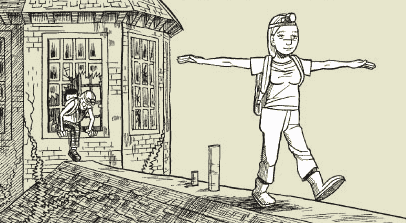
The story is a little confused, though--at times it wants to be a horror story, a surreal adventure, a romance, or a thriller. The resulting identity crisis makes the book hard to follow--finding an underwater city while exploring a decrepit old house makes a kind of sense in a surreal comic (like Shaun Tan's Arrival), but not so much here. They kiss underwater and are suddenly watching the sunset from a rooftop. The water is a surprise, as is the forest surrounding the house, as the house stood in the middle of a field when the guy walked up. If Simmons stuck with surrealism, there would be a sort of logic to it, but like this, it's more like mistakes.
Unfortunately, the genre problems aren't the worst of it--the art contributes its share of issues, as well. The back cover copy says they're all teenagers, even though one looks like an aging hippie--if they're all teens, that explains the budding romance, at least. A girl falls through a staircase, and her previously-fitted T-shirt turns into a toga--no sign of where the fabric went, no flapping torn cotton, just one boob hanging out for the rest of her story arc. As the story dwindles toward its conclusion, the house gets increasingly claustrophobic, evidenced by more and more black on the page, smaller and smaller art, until it's nearly impossible to make out what's going on.
Bleak. Dark. Cruel. Beautifully illustrated, the detail in House is remarkable.
A love triangle with no dialogue, an exploration of a decrepit world.
There's an errant boob in here which seems excessive, unnecessary. But having read some of Josh Simmons's later works, this first time out shows remarkable restraint. (Not that I necessarily have a problem with gratuity. Just an observation.)
House is a brief, stark, haunting read, petering into nothingness. Definitely worth checking out.
I like the concept more than the execution. The wordless narrative works pretty well for most of the story: two teen girls meet a traveling teen boy and all three decide to explore an obviously unsafe and possibly haunted abandoned mansion. The presence of other derelict buildings suggests a possible apocalyptic event which these young people have survived.
With little regard for caution after going through whatever catastrophe precipitated all of these buildings barely standing with jagged glass windows like broken teeth, there is bound to be dangers, conflict, regrets and sorrow. And there definitely is.
I'd like to see a longer story by this author. This one got a little muddled at the end, but the potential is there.
This was impressive and weird. A completely wordless graphic novel? Or maybe that's taking the medium too literally? Anyway, fun and refreshing perusing through-cant say refreshing read coz there was barely anything to read. The story seems familiar as far as haunted house stories go, only freshness here is you have to infer your own dialogue and description. *Shrugs* I like!
I feel like sometimes it was hard exactly to see what was going on and the lack of all dialogue for me was kind of tough, I think the idea was cool though
I felt like the book had a lot of hidden messages that could've meant a lot of different things, definitely an interesting book, i see it as a book where you put your thoughts into what you see and that's what the author was going for when he wrote the book.
I recently read Josh Simmons House having found it in the public library. My first impression was that the lack of text was a pretentious attempt to give gravity to what was a run of the mill exercise in otherwise banal storytelling. However I soon found the "silence" of the narrative to be an extremely effective way to communicate the mystery, isolation and eventual despair of the story.
The fact that we only know the characters through their actions allowed me as a reader to 'write' part of the story in my imagination as I read it. Of course one reads this in a non-literal sense as there is nothing to read but for the interpretation of visuals. This alone makes it a completely different experience than reading text or a combination of text and graphics.
I read this twice. The first time I was left with a feeling of dread but also a kind of shrug of the shoulders. What was that about? However the dread that had built up through the story lingered and still lingers days later. Reading it a second time and knowing what was inevitable made for an even greater emotional imprint upon me. This is a story that will haunt me for years to come. Quite the opposite outcome of my initial quick dismissal.
The biggest problem with this graphic novel is that it is over too quick. Simmons does his best to set the tone with repeated panels that move away from the characters, but we just aren't with those characters long enough to get a lasting impression. The illustration style may not be for everyone, but it is some of my favorite. The characters are pretty simple, but you can tell that a lot of painstaking work went into the details of the surroundings and backgrounds. If you read this and like it, check out Mome volume 19 for a story done by Simmons and another artists that will blow your mind. Simmons did the cover on that volume as well.
It just doesn't work. More of like a start to really dark story with out any actual story, no second or third act here. I just ends and feels like a waste of time in the end.
Very short work, a bit hard to get into (because of its brevity?) Story of a trio of teenagers, lured to an abandoned mansion/city by the desire to explore. It is safe to say that we all have been interested at some point by the local ruins, and those teens are no different. Once they get in, they are going to find more than what they bargained for, of course.
This is wordless, so the entire story is conveyed by drawing. I have been interested by this type of work since I read Chabouté. It is very difficult to tell a story in that manner. House might not be entirely successful at that, it is well drawn, the structure is fine and the transition are clear, as the reader (word seems inaccurate for a wordless story...) you are never lost. I could tell you the story easily, making the transition from image to words with no difficulty. But the emotional connection never quite emerged for me, the story remained somewhat cold and distant. I think I missed the words. Still worth your time if you are interested in the purely graphic story.
Jeez. This was brutal. My first real look at Josh Simmons. I'm already in love. This was a silent comic. So just artwork to tell the story. I wasn't sure what to expect going on because the only words in the book are his name and the title. Nothing to tell you what the story is about. I don't want to give too much away, but it's about a group of friends who like to explore abandoned places. We get to see them on a few of their adventures. The art is phenomenal. So many details and lines to look at. I found myself getting lost in a few pages. Just admiring the work. His way of showing light sources is absolutely beautiful. When exploring abandoned buildings, it's going to be dark. He's able to beautifully show the gradients from the light. Never shying away from pitch black. Really just a fantastic book all together. With a very crazy ending. I loved it. Highly recommend!
I noticed a lot of people left hilariously meta wordless reviews, so I’ll mix things up a bit—art: ok, story: not ok. Wordless stories didn’t do it for me in those Queseda-era Marvel’s Nuff Said books* and Simmons hasn’t changed my mind. A lot of panels I couldn’t tell what was happening. Even whether or not the characters were standing up or laying down or falling. And as fun as some of his panel choices are I just knew this was gonna be one of those stories that doesn’t end so much as peter out. Simmons for me is a frustrating artist. I think he’d have a lot more success if he had a writing partner to work with. Someone who knows how to tell a non-shaggy dog story, with proper acts and everything.
This is a wordless novel, so interpretation is up to the reader.
In short, my interpretation is a story about the dangers of urban exploring. It explores the characters feelings of love, jealousy, loss, fear, despair, and death. I could go into more details to explain how I came to these conclusions, but I do not want to sway your understanding or ruin your deciphering of this wonderful story.
The art is beautiful with outstanding line work and cross-hatching. The use of stark black between the various sizes of the panels is done brilliantly. The art creates an atmosphere that transports the reader into the scenery.
What a grim tale, what a wonderful tale. I was invested. I was proud to be reading a book without words after having read Ducks Newbury Port, a 1000 page novel with essentially one sentence. It helped me realise to read and study the art work. And I enjoyed doing so. I found the art, particularly in the first half of the book, pleasant to look at. The scenes with the dilapidated houses and the underwater scene were inspired. It boggled by adventurous mind and my spirit wanted to vicariously explore through the teenagers. What a grim ending however. Very grim.
This entire review has been hidden because of spoilers.
It’s really hard for a comic to be scary. This is a scary comic. Three people explore a dream-like area that consists of abandoned houses. They come across a house that temps them to explore deeper and deeper until they end up abandoning each other out of fear. Then the flashlights go out. No dialogue, all Intricate top-to-bottom line work and brooding shadow. Finished it then quickly read it again.
HOLY SHIT THIS WAS TERRIFYING. These three teens go into an abandoned house, which opens up into a world within a world underwater and through tunnels while simultaneously experiencing the high of falling in love, jealousy, and naivety. They end up destroying themselves with lose, mental defeat and emotional exhaustion, an apt metaphor of their inner and outer worlds becoming one as they expire. This was a righteous and totally relatable read.
This entire review has been hidden because of spoilers.
It was about a couple and this one girl exploring a abandoned house. They get lost and they eventually die slowly in the house. kinda liked it because i could really picture what was happing. But then again i didnt because it didmt show any real shock on the people when things happend to them. id rcamend this to teens.
I like the concept of the story but I wish that there was some text, not conversation wise, but things within the pictures. I also do not like the fact that it leaves the end very open. I guess I would have liked to see an explanation of what happened to each of the characters instead of just leaving the pages blank.
This entire review has been hidden because of spoilers.
Parece tão injusto perder apenas 15 minutos a ler algo tão minuciosamente criado, com detalhe e emoção. Acabei por ler duas vezes. Ler é uma forma de expressão uma vez que o livro não tem nada para ler, é uma novela gráfica muda, chamemos-lhe assim