Albert Speer was an unemployed architect when Hitler came to power in 1933. Soon he was designing the Third Reich's most important buildings. In 1942 Hitler appointed him Armaments Minister and he quadrupled production, an astonishing achievement that kept the German Army in the field and prolonged the war.
Yet Speer's life was full of contradictions. The only member of the Nazi elite with whom Hitler developed more than a purely functional relationship (he has even been called "Hitler's unrequited love"), Speer was always an outsider in Hitler's inner circle. He saw himself as an artist, above the crass power struggles of the roughnecks around him. But his enormous ambition blinded him to the crimes in which he played a leading role.
Brilliantly illustrated, this gripping account of one man's rise and fall helps explain how Germany descended so far into crime and barbarism.
Joachim Clemens Fest (1926-2006) was a German historian, journalist, critic and editor, best known for his writings and public commentary on Nazi Germany, including an important biography of Adolf Hitler and books about Albert Speer and the German Resistance to Nazism. He was a leading figure in the debate among German historians about the Nazi period.
As part of my research for my new novel, I just finished reading “Speer” by Joachim Fest. As you might imagine, there are constant references to Hitler, with whom Albert Speer worked closely, first as Hitler's chief architect and then as Minister of Armaments.
Here are some of the ways Speer described Hitler. Does anything look familiar? How many of these destructive traits are part to the persona of Donald Trump?
• Speer was taken by Hitler's aura of strangeness and unpredictability … he had no doubts about right and wrong, or good and evil
• Hitler was devoid of human contact despite the mass rallies
• when Hitler was prevented from making public appearances, he deteriorated
• Hitler's constant irritability was seen as a tactical device for whipping up the masses and possibly also as a means of self-persuasion
• Hitler did not work hard ... whiled away the time ... read Karl May ... not interested in the bureaucracy or the workings of the government ... spent less than 1-2 hours per day on "routine duties" of governing
• Hitler forbade publication of the costs of his grand building projects
• Hitler would spend weeks on end on the Obersalzberg ... surrounded by acolytes ... doing no work
• immediately after the invasion of Poland, Speer offered to assemble a technical squad for the construction and repair of bridges, roads, runways ... Hitler declined the offer ... saying no one was permitted to put aside work he was assigned to choose new tasks at his own discretion
• Hitler knew he should avoid war on two fronts ... but could not wait to invade Russia ... he convinced himself that by "a stroke of magic, he could solve all strategic embarrassments" ... Operation Barbarossa began on June 22 1941
• Speer's predecessor as Reich Minister for Armaments ... Fritz Todt ... saw by late 1941 that Germany was hopelessly overextended ... urged Hitler to find a political solution to a war that was lost in military terms ... Hitler refused to listen ... and two weeks later declared war on the U.S.
• to some Germans it seemed as if Germany was waging a world war without a government ... not an accident ... purposeful chaos surrounding the dissolution of the state apparatus ... the only law was Hitler's will ... Hitler never involved himself in government ... never held cabinet meetings ... gave conflicting orders on sudden impulse ... refused to speak with officials who had lost his favor
• Hitler remained deaf to those who told him the Allies had achieved total air superiority ... that the war was lost ... the more hopeless the situation, the more stubborn he became ... finally forbidding mention of the subject
• when faced with a memorandum about the large strategic reserves held by the Soviets ... Hitler was outraged for weeks ... and then forbade the Wehrmacht High Command to prepare such analyses
This is a fascinating and excellent biography of Speer - I don't know that it can compare with Gita Sereny's biography 'Albert Speer: His Battle With Truth' - but it is more recent and obviously has advantages of more recent scholarship to build his portrait on. In addition I have admired Fest's writing since I first encountered it in his book 'The Face of The Third Reich'.
Speer continues to fascinate - and really that says as much about the company he kept as the man himself - indeed the fact that he was not executed (when his second in command was - a terrible injustice - if the boss isn't deserving of the death penalty his assistant shouldn't either) is due, as some of those at Nuremberg admitted and Speer himself half acknowledged, that as he was the only one that accepted responsibility. Also compared to the gallery of grotesques he shared the dock with he shone out - even if it was a very flawed light. This is a book worth reading for anyone interested in the Third Reich and even more so if you are interested in how it could have happened.
I found this book frustrating and irritating. The rambling writing style didn't do it any favours, but the content is blighted by an author who seems to be an apologist for Speer, looking for any and all possible loopholes for his activities and choices...yet simultaneously presents damning evidence that renders the apologia into a snotty-sounding mess. Very much not what I was expecting.
Albert Speer was Germany's armaments and war production chief in World War II and one of the 22 Nazis in the first Nuremberg trial. Arguably the most prominent to escape a death sentence, he served a 20-year prison sentence. Speer has long been viewed somewhat differently than other high Nazis, which I have trouble understanding. Here's a couple passages from the final chapter of the book that stood out to me, the pair offering two of the main views of Speer:
"In the spectral gallery of totalitarian leaders, he has, to this day, remained the only high-ranking figure to admit his responsibility and guilt. Thousands of so-called dignitaries were driven from their command posts after the fall of both Hitler's and Stalin's tyranny. They endeavored to exculpate their rule of terror, or at least the idea from which it sprang; they complained about unfavorable circumstances or of treachery on so many sides. All these excuses showed how difficult it is to recant. Even those who fell silent have resorted to resentment against mankind, against history and the way of the world to counterbalance their discredited visions. Perhaps not enough attention has been paid to the fact that Speer never indulged in this way of thinking, and never showed any bitterness or self-pity despite increasing doubts about the justice of his sentence. For all the covert attempts at justification he undertook, the gaps in his memory and his self-delusions, he never actually tried to absolve the regime from blame. The way he exposed the regime, to the outrage of many of his former colleagues, his accounts of the degree to which everyone was out for his own advantage and of the incompetence in the leading circles, has possibly proven the most effective way of preventing any mythologizing, such as Hitler, Goring, Goebbels, and others had hoped for even at the very end. That too should be taken into account when reviewing Speer's life."
The other passage draws from a 1947 book by British historian Hugh Trevor-Roper.
"'Trevor Roper characterized him as the only man in Hitler's entourage 'whose judgment was not corrupted by attendance on that dreadful master,' and thought it a 'mystery that he should have survived, a single, solitary, disapproving figure, in that ambuscade of vigilant and vindictive conspirators.' 'As an administrator he was undoubtedly a genius,' Trevor-Roper continued, and 'his ambitions were peaceful and constructive: he wished to rebuild Berlin and Nuremberg.' Then came the unexpected, brusque turn with which Trevor-Roper narrowed down... ... broad perspective to German peculiarities: 'Nevertheless, in a political sense, Speer is the real criminal of Nazi Germany, for he, more than any other, represented that fatal philosophy which has made havoc of Germany and nearly shipwrecked the world.' 'His keen intelligence diagnosed the nature and observed the mutations of Nazi government and policy...he heard their outrageous orders and understood their fantastic ambitions; but he did nothing.' This accusation questioned not only Speer's attempts to justify himself, but those of nonpolitical Germany as a whole after the Hitler regime."
The book is ok easy to read, in many ways it felt like a summary of Inside the Third Reich. I would recommend it for people who have very little knowledge of WW2 and need some background to understand the story.
Speer: The Final Verdict published 2001 by Weidenfeld and Nicolson Joachim Fest, Translated by Ewald Osers and Alexandra Dring
Once again Joachim Fest has impressed me greatly and I now look forward to reading his book about Hitler.
Fest’s portrayal of Speer is a product of the deep understanding he has of his subject. The author was the ”interrogating editor” appointed by Speer when he wrote “Inside the Third Reich” and “Spandau: The Secret Diaries”. This involved evenings and days of conversations with Speer. Fest took this opportunity "...Since Speer was a unique witness to the era.." to make notes in order to assist with his book about Hitler. Subsequently this practice obviously helped him to also write about Speer.
Fest steps us through the disparate chapters of Speer’s life: the son of cold and distant parents and his love of academia and passion for architecture; his chance meeting with Hitler which led to Speer’s mercurial rise within his profession and being the only civilian to be taken into Hitler’s inner circle; Speer’s reign as Armaments Minister and Economic Dictator; the prisoner in Spandau for twenty years and, finally, the changed man in his final years of freedom.
"He barely took notice of 30 January 1933 when Hitler was appointed Reich Chancellor, even though it was ‘his’ Party and ‘his’ Fuhrer who had achieved that long-hoped-for success..."
Hitler’s attainment of ultimate power was during a time when Speer had been struggling for over 18 months to launch his career and had been doing some commissioned pieces of work for the Nazi Party, the highly acclaimed success of which ultimately led to his ascendancy as Hitler’s right hand man.
"...The desolate circumstances in which he found himself made the event seem remote. He could hardly remember that day and merely assumed that, along with so many others, the news had led him to hope for some vague improvement in the state of affairs. Now and again he would attend some local Party meetings, horrified at the pettiness and the bloated talk that went on there." Pg 31 Awakening
Speer bonded with Hitler, a man who was incapable of “normal” social relationships, through their shared love of art and architecture. It has been observed by many that Speer had an emotional and intellectual tie to Hitler that was not available to any other person. This created problems within itself, through jealousy and the jostling for power between those that shared the rarefied atmosphere of the very highest echelon within the Nazi’s Third Reich.
At the beginning Speer was detached from the politics surrounding the rise of the Third Reich. At this stage his appointment by Hitler was solely for the development of the grand rebuilding of cities featuring monolithic buildings for the new Germania, the Capital of the World. At this point I did think that the plans were so grandiose and fanciful that Speer may have cottoned on that Hitler was a mad man. However, perhaps he was under Hitler’s spell (as so many people describe their own experience of the man) and, of course, it maybe that his passion for art and architecture propelled him to become caught up in the impossible dream.
The dream, however, soon tumbled into a nightmare as Hitler declared war. Speer, surprisingly, was in favour of this. I can only surmise he wanted to get it all over with so he could rebuild Berlin and other cities throughout the new ‘world capital’. Who really knows what was in his head at the time.
Speer was appointed Armaments Minister when the General in charge was killed in an aircraft crash (accidentally on purpose), and as he happened to be with Hitler at the time, Speer was appointed on the spot. This new role thrust Speer into an entirely different realm. Now he had to discard his civilian clothing and finally put on the uniform.
Speer had exceptional organisational skills and although described on many occasions as a ‘cold’ person, he maintained extremely good relations with his staff and therefore enlisted their loyalty and trust and not surprisingly, managed to increase production levels and efficiencies within this Ministry at a rapid rate.
The orientation toward the ‘task’ and Speer’s single minded focus however, led to blind spots with regard to the impacts on the German people, namely the Jewish people.
"Speer once spoke of the uncanny ability of the ruling powers to stifle conflicts of conscience or even to prevent them from arising. Without doubt the regime used this method to make countless right-thinking people do things or omit to do things in which they later did not recognize themselves. Speer was one of them. But what more could provoke a conflict of conscience when neither the wreckage on Fasanenstrasse nor the pitiful scenes at suburban railway stations triggered any emotion?" Pg 121 Entanglements
Speer had to abandon his artistic ambitions at this point and become a political animal in order to retain his position and power within his ministry. The governance of the Third Reich was riddled with misunderstandings, mixed messages and overlapping roles.
He had finally been caught up in the web of the Dictator. More so because of the "...confusion of responsibilities reflected a similar muddle at all levels of the regime, which was far from being the monolithic block it pretended to be ... This muddle had not arisen accidentally. It corresponded to Hitler’s social Darwinism, according to which the strongest prevailed in internal power conflicts. In that sense the chaos promoted the dissolution of the state apparatus, as well as all its regulatory channels, in a regime whose only law was the Fuhrer’s own will. It is significant that he hardly ever went to the central office of government, that he never held cabinet meetings, and that again and again he gave chance callers, conflicting responsibilities on a sudden impulse so much so that he himself would sometimes wonder where a particular decision came from." Pg 140 Minister and Economic Dictator.
The rest is history as they say. The nightmare had well and truly begun, descending into hell. Speer regained some relative peace and happiness at the very end of his life, which was a surprise ending and I won’t spoil it for the reader if you do not know it. As for the judgement the reader may make about Speer, it could be very different from mine. The complexity of this man and his relationship with Hitler, his ability to compartmentalise his life and his incredible talents tugged at many different parts of my own conscience and emotions and raised so many questions that I cannot contemplate trying to answer.
If you want to read a book that equates to the saying “truth is stranger than fiction” this is one I can highly recommend.
I must end with my admiration for Joachim Fest. I can appreciate why he has achieved such acclamation for his abilities and insights into this blighted chapter in our world history. We have a lot to thank him for not only recording his own experiences of growing up during the war years but also his drive to write these valuable commentaries on the main ‘players'.
I wish more people would read history, as there is so much to learn from it. However, we are often so immersed in our own living and what works best for us that past lessons have to be learned all over again.
Speer is the most interesting of all the leading players of the German war effort in WW2. Neither a monster nor a faceless bureaucrat. He was a cultured, intelligent and artistic man who was well aware that much of Nazi ideology was garbage but who went along with it anyway. His proximity to Hitler and to power corrupted him. Wild architectural visions gave way to ministerial responsibility and the use of his considerable talents to prop up their appalling regime. He escaped death at the Nuremberg trials by a clever defence of pleading guilty to collective responsibility while denying any in depth knowledge of what was happening. As this book explains, it was almost impossible for him not to know what was happening. He was too close to the centre of power to not be aware of what was going on. The Soviets saw through this instantly mainly because they were well aware of how despotic regimes work and wanted him hung. The Western powers saw in him the man they could become under similar circumstances and spared him. To his credit though, he was one of the very few who had the courage to tell Hitler the truth regarding Germany’s future as far as the course of the war was concerned and he actively and openly disobeyed him regarding his orders to turn Germany into a wasteland. He also told Hitler to his face what he had been doing, something that took great bravery. He was however very fortunate to only get 20 years imprisonment. If truth be told, the Soviets were right.
I didn't find this to be an easy read, but still worthwhile the effort. Reason might be the book being translated from German into Dutch.
The book gives the reader an interesting inside view of the Hitler regime and all the intrigue that took place there. Speer had a bond with Hitler that differed from most others. Despite the Reich falling apart, Hitler could still marvel at what he and Speer had planned for the architectural future of Germany. The architecture side of this is amazing and it is mindboggling that Hitler wanted to keep it going despite Germany's war situation.
Speer himself is a person that is hard to judge. Was he a criminal like most of the other higher ups? Or was he blinded by the opportunities presented to him by his place in the ranks? What did he know and what not? One thing is certain, Speer spared the German industry a lot of senseless destruction by disobeying Hitler's 'scorched earth' orders.
The book also covers his time at Spandau prison and the publication of his books after the war.
A lot of the information inside the book was new to me, but it took some effort to make it to the end.
A fantastic and very successful effort by Joachim Fest to portray one of the most enigmatic characters in the Nazi circle. This book is not only a biography of Speer, but also a comprehensive study of the megalomanic nature of Hitler's Nazism as reflected in their ridiculous architectural designs. With the book's main objective to ascertain the extent to which Speer knew about the Holocaust, Fest did a remarkable job in presenting his final verdict of Speer...
The only issue I found with the book is that Fest treats Speer as if he was a technocrat with no opinions of his own. Fest makes no attempt to discover what Speer thought of the Jews, for example. Was he an antisemite? Did he believe in Nazi racial theories and in the inferiority of the Jews? To what extent did he believe in "stab in the back" theory?
Answering these questions would have made a more comprehensive account of Albert Speer. But, overall, this book makes a very good read, and I would warmly recommend it.
Fest, who was an editor on Speer's various volumes of memoirs, is critical of some of the former Reichminister's claims, while also refusing to accept some of the attacks on the "Speer Myth" without pushback. For instance, he argues against the idea that Speer's account of a tearful meeting with Hitler was the fabrication of a French journalist, and he goes into detail attempting to decide whether Speer was present or not at Himmler's "Posen speech" (in which Himmler explicitly announced the policy of Jewish genocide), eventually concluding that it's more likely that he was absent. The book was first published in 1999, and so cannot respond to much of the scrutiny Speer has been subject to since then. I'd have liked more on Speer's imprisonment and life after release.
Fascinante analyse du personnage Speer, de son Ascension fulgurante au sein du 3eme Reich, de ses agissements et de ses égarements à mesure que l'abyme se creuse à ses pieds. Fest maîtrise à la perfection les mécanismes et les coulisses du pouvoir nazi, mais aussi les stratégies militaires et économiques des différents protagonistes de la 2nde guerres mondiales. On peut toutefois à certains moment douter de la capacité de l'auteur à garde la distance nécessaire avec son sujet, qu'il a lui même interviewé à de très nombreuses reprises.
Nach ,,Ich nicht'' habe ich solchen Respekt vor Fests Urteil dass ich seine überlegteste Sicht auf die Hitler-Ära haben wollte. Das war eher der Grund für die Wahl dieses Buches als ein besonderes Interesse an Speer. Ich bekam das Gesamtbild, das ich wollte, sowie eine faszinierende Biographie eines Mannes, dessen Faust-Dilemma nicht ungewöhnlich, aber vielleicht schärfer gezeichnet ist.
Einige Einblicke:
die intensive emotionale Beziehung zu Hitler
p477: ,, . . . ein Mann mit vielen Fähigkeiten, aber ohne Eigenshaften.'' Auch 479-480, Trevor-Roper und die relative schuld des ,,soziale Desperados'' gegenüber der loyalen Untertanen.
p 388: ,, . . . da er nichts halb tun konnte, warf er sich mit der gleichen Energie, die er einst als Architekt und später als Rüstungminister bewiesen hatte, auf seine Verteidigung.''
I just don't know what to say about this book. It for sure held my interest, but I think it is because the subject matter (Speer) is so fascinating, not because Fest wrote a good book.
This is the 4th book on Speer I have read -- all of them are good. This one would rank 3rd or 4th behind the Sereny book, and behind the Inside the Third Reich autobiography.
Any treatment of Albert Speer is bound to be controversial, but Fest does an admirable job of providing a balanced chronicle of Hess' life and his many struggles. Whenever Adolf Hitler is involved, their are no easy explnations for people's motives. Perhaps one of Fest's most insightful observations is that, by this time, no one really cares about Speer, his motives, or admissions.
Nell'iniziare la lettura di questa biografia temevo che Fest si lasciasse trascinare fin troppo nei dettagli tecnico-artistici di una figura cardine del regime hitleriano (in qualità di architetto del dittatore, vista la mole di progetti ai quali dedicò anni, il rischio c'era). È indubbiamente vero, tuttavia, che Speer fu ciò che fu in seno al regime e agli occhi di Hitler soprattutto per via della sua formazione e della sua natura artistica, pertanto alla base del ragionamento inerente la sua biografia l'elemento cardine deve assolutamente abbracciare l'architettura. Fest lo fa, in modo impeccabile come sempre: dipinge alla perfezione ciò che fu Speer, ciò che lo mosse e ciò che lo influenzò. E, devo ammetterlo, anche tutta la parte incentrata sui progetti architettonici, sulla costruzione di "Germania" e su tutti gli altri progetti è servita allo scopo, a dispetto dei miei timori iniziali. Un libro corposo che però non soddisfa appieno la fame del curioso. Colpa dell'autore? Sicuramente no. Colpa del protagonista, abile, anzi abilissimo magheggiatore, scaltro a sufficienza da evitare la forca a Norimberga. La domanda che resta in qualche modo senza una risposta convincente è se Speer sapesse e quanto sapesse dello sterminio degli ebrei, ufficialmente (e per vie di "industrializzazione") in atto dal 1942. Rispondere a questa domanda vuol dire inoltrarsi in un labirinto troppo grande e confuso di confessioni e mezze risposte, la cui affidabilità viene messa in dubbio ora da questo ora da quell'altro ex collega ed ex amico. In sostanza una risposta Fest prova a darla, ma è oltre le sue capacità di conferma dire se la soluzione all'enigma sia o no quella giusta. In Speer ci si può ravvisare, nella sua interezza, l'atteggiamento del popolo tedesco tutto. Nella sua iniziale e ostentata apoliticità, nel suo passivo coinvolgimento, nel suo distaccarsi dalla realtà: sono i tratti essenziali che hanno permesso al nazionalsocialismo di emergere e di affermarsi. Resta l'amarezza della storia di un uomo per certi versi molto diverso dal tiranno che è purtroppo finito nel turbinio scatenato dal regime e si è lasciato trascinare - in politica! - lui che invece voleva assolutamente mantenere il distacco dalla combriccola dell'entourage e dagli intrighi di corte. Se è chiaro che uomini violenti possano essere attratti verso la violenza, perpetrandola in prima persona e creando le condizioni per applicarla, resta altrettanto misterioso come un uomo di tutt'altra estrazione sociale (una specie diversa a tutti gli effetti) possa anche solo rendersi coresponsabile delle nefandezze di un regime criminale. "Speer" cancella le speranze che personalmente ho sempre riposto negli uomini di buon senso e rende ancora piu minaccioso il rischio che un domani sorga un nuovo demagogo e che questo demagogo venga seguito e riverito da milioni di persone.
Quest'opera del grande storico tedesco Fest risponde ad alcune domande che mi ero posto: com'è stato possibile che la Germania abbia resistito contro il mondo intero per tanti anni? Chi era nella cabina di regia di un apparato produttivo che nel 1944 raggiunge il suo picco sotto bombardamenti continui che paralizzavano snodi ferroviari, centrali elettriche, porti e strade? Questa complessa macchina che utilizzava milioni di lavoratori coatti era guidata da Speer. Su di lui, il meno nazista e il più "tecnico" dei gerarchi è incentrata l'opera di Fest. Come in altre sue opere troviamo uno stile asciutto che va subito al dunque. "Silenzio, parla Fest" diceva Montanelli. Dunque ascoltiamo quanto ha da dire!
I found it useful to have read "Inside the Third Reich" before reading this; it fills out Albert Speer's book nicely.
In Joachim Fest's words: "In the spectral gallery of totalitarian leaders he [Speer] has, to this day, remained the only high-ranking figure to admit his responsibility and guilt".
Very interesting work. This book comes as close as anything to explaining how a 'normal' person would follow Hitler. It also gives a chilling warning that people like Speer are out there and are willing to work for any power wiling to promote them. There is a lesson for us all in these pages.
The Third Reich was a complex, flat-out-weird time and there was no more striking a character as Albert Speer, Hitler's "great unrequited love." The main question that still baffles people today (as it did then) was why did reasonable people become Nazis? How did they let Hitler and his gang come to power -- and then stay in power? Here, Joachim Fest answers this by using Speer as a case example.
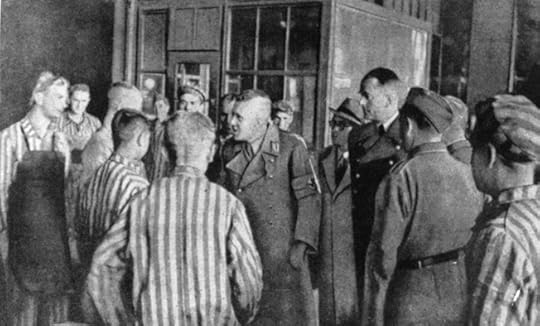
Speer was the Nazi found guilty at Nuremburg who wrote best-selling books about his time at Hitler's side, including Inside the Third Reich (which became a kick-ass mini-series with Rutger Hauer as Speer and Derek Jacobi (!) as Hitler.) Speer claimed that he didn't know about the Holocaust. However, he did (and this book shows a photo of Speer at a concentration camp -- see below (Speer is the tallest guy in the shot)). He didn't like politics but became the Minister of Armaments.
He was one of Hitler's best friends (as much as Hitler was capable of friendship) and yet he tried to plot to kill Hitler (which didn't go very far, obviously). I guess Hitler was one of those, "Can't live with him -- can't live without him" kind of guys. Speer himself had a "nice guy for a Nazi" vibe about him. Other than that, he was completely unknowable -- even to his family, to his biographers and to himself.
Ultimately, it's up to the reader to make the "final verdict" on Speer. The scary thing is that he was a likable guy (and who doesn't like a guy who died while "in the company" of a woman not his wife?) -- but he was a NAZI. Was he genuinely sorry for what he did? Possibly -- but really, what does "being sorry" matter when it comes to being a Nazi? As the old saying goes, sorry don't feed the bulldog.
One note -- you do have to know quite a bit about World War II to understand this book. Fest assumes you know more than the basics -- you need to know details (like battle names and their significance). If you never heard of World War II do not start learning about it with this.