

What do you think?

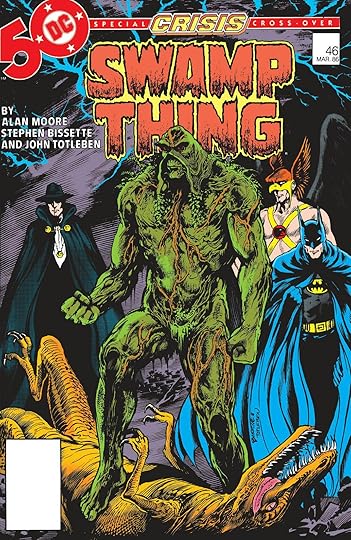
Swamp Thing (1982) (Collected Editions) #4
Swamp Thing, Vol. 4: A Murder of Crows
This fourth volume in the saga of the Swamp Thing finds the man-monster interacting with Deadman, the Phantom Stranger, the Spectre, and the Demon as he continues on his journey of self-discovery. Traveling through the horrors of a haunted house, the improbabilities of the afterlife, the depths of hell and the heights of heaven, the Swamp Thing continues his evolution from a simple monster into a powerful elemental being with a potential to exceed the bonds of the Earth itself.
Collects issues #43–#50.
Collects issues #43–#50.
206 pages, Paperback
First published July 1, 1986
About the author
Alan Moore
1,634 books22.3k followersAlan Moore is an English writer most famous for his influential work in comics, including the acclaimed graphic novels Watchmen, V for Vendetta and From Hell. He has also written a novel, Voice of the Fire, and performs "workings" (one-off performance art/spoken word pieces) with The Moon and Serpent Grand Egyptian Theatre of Marvels, some of which have been released on CD.
As a comics writer, Moore is notable for being one of the first writers to apply literary and formalist sensibilities to the mainstream of the medium. As well as including challenging subject matter and adult themes, he brings a wide range of influences to his work, from the literary–authors such as William S. Burroughs, Thomas Pynchon, Robert Anton Wilson and Iain Sinclair; New Wave science fiction writers such as Michael Moorcock; horror writers such as Clive Barker; to the cinematic–filmmakers such as Nicolas Roeg. Influences within comics include Will Eisner, Harvey Kurtzman, Jack Kirby and Bryan Talbot.
As a comics writer, Moore is notable for being one of the first writers to apply literary and formalist sensibilities to the mainstream of the medium. As well as including challenging subject matter and adult themes, he brings a wide range of influences to his work, from the literary–authors such as William S. Burroughs, Thomas Pynchon, Robert Anton Wilson and Iain Sinclair; New Wave science fiction writers such as Michael Moorcock; horror writers such as Clive Barker; to the cinematic–filmmakers such as Nicolas Roeg. Influences within comics include Will Eisner, Harvey Kurtzman, Jack Kirby and Bryan Talbot.
Ratings & Reviews
Friends & Following
Create a free account to discover what your friends think of this book!
Community Reviews
Displaying 1 - 30 of 418 reviews

April 28, 2023
The majority of this collection is a Swamp Thing crossover with the Crisis event, as he and DC's mystics fight an ancient Chtuhluish being to save Heaven from destruction.
As far as crossovers go, this was top-notch.

This is a very heavy Constantine book that introduces the Parliament of Trees. <--pretty big deal when it comes to Swampy's mythology. I like the way that Moore weaved it seamlessly into the event so that we still got a story about Swamp Thing and not a story that included Swamp Thing.

Good stuff, very cool.
Highly Recommended.
As far as crossovers go, this was top-notch.
This is a very heavy Constantine book that introduces the Parliament of Trees. <--pretty big deal when it comes to Swampy's mythology. I like the way that Moore weaved it seamlessly into the event so that we still got a story about Swamp Thing and not a story that included Swamp Thing.
Good stuff, very cool.
Highly Recommended.

June 17, 2013
A truly masterpiece!
This Hardcover edition collects "Swamp Thing" #43-50.
Creative Team:
Writer: Alan Moore
Illustrators: Stephen Bissette, John Totleben & Stan Woch
THE WRITING FLOURISHES
In this fourth hardcover edition you will find easily many of the best stories of the amazing run by Alan Moore on Swamp Thing.
The famous story like "The Parliament of the Trees" which is one of the treasures in the history of comic books.
Also, you will have here "The End" where a whole cast of guest characters will help Swamp Thing against a threat of colossal proportions.
You will be delighted too by such wonderful self-contained tales like "Windfall" that proves that Swamp Thing, under the creative writing of Alan Moore is a character so great that even a fragment of his can make a priceless story that it can be as scary as lovely at the same time.
"Ghost Dance" is also other awesome ghost story where character development and plot exploit met in the middle of their own paths merging in a perfect way.
And my favorite story of this fourth hardcover volume is "Bogeymen", maybe it's not the most known of the bunch that you'd find in this edition, and certainly while it's a totally scary tale, you may think that it isn't that good story, BUT what really impressed me about it was that it's the base (it was written first) for another excellent scary story that you can find in a whole different saga, The Sandman, in the tale "Collectors" by Neil Gaiman (close friend of Alan Moore), right in the middle of the "Hell's House" storyline. A real tribute of a writer to another, that only you'd realize if you have read both stories on each sagas.
Definitely, the seed of the saga of Swamp Thing flourished and you can enjoy the fruit of it.
This Hardcover edition collects "Swamp Thing" #43-50.
Creative Team:
Writer: Alan Moore
Illustrators: Stephen Bissette, John Totleben & Stan Woch
THE WRITING FLOURISHES
In this fourth hardcover edition you will find easily many of the best stories of the amazing run by Alan Moore on Swamp Thing.
The famous story like "The Parliament of the Trees" which is one of the treasures in the history of comic books.
Also, you will have here "The End" where a whole cast of guest characters will help Swamp Thing against a threat of colossal proportions.
You will be delighted too by such wonderful self-contained tales like "Windfall" that proves that Swamp Thing, under the creative writing of Alan Moore is a character so great that even a fragment of his can make a priceless story that it can be as scary as lovely at the same time.
"Ghost Dance" is also other awesome ghost story where character development and plot exploit met in the middle of their own paths merging in a perfect way.
And my favorite story of this fourth hardcover volume is "Bogeymen", maybe it's not the most known of the bunch that you'd find in this edition, and certainly while it's a totally scary tale, you may think that it isn't that good story, BUT what really impressed me about it was that it's the base (it was written first) for another excellent scary story that you can find in a whole different saga, The Sandman, in the tale "Collectors" by Neil Gaiman (close friend of Alan Moore), right in the middle of the "Hell's House" storyline. A real tribute of a writer to another, that only you'd realize if you have read both stories on each sagas.
Definitely, the seed of the saga of Swamp Thing flourished and you can enjoy the fruit of it.

July 28, 2019
Saga of the Swamp Thing: Book Four collects Saga of the Swamp Thing #43-50.
In this volume, we finally find out what Constantine was grooming Swamp Thing for and it's a big hairy deal. A secret society is bent on summoning an ancient force to destroy heaven. There's also a junkie that finds one of Swamp Thing's tubers, a serial killer, the sprawling mansion of a firearms heiress, and Swamp Thing learns more of his heritage.
Alan Moore gets some serious mileage out of the Swamp Thing in every outing and this volume is no different. The Parliament of Trees is introduced, Crisis is touched upon, and even Mento gets his time in the sun as all of DC's occult characters unite to fight a menace older than time.
I'm impressed that with all the shifting artists in Moore's run that the series manages to maintain a unified feel. In this volume, art is handled by Stephen Bissette, John Totleben, Stan Woch, Rick Veitch, Alfredo Alcala, Ron Randall, and Tom Mandrake.
Alan Moore delivers the goods as far as big confrontations go. At times, the final battle reminded me of one of the Doctor Who specials where multiple Doctors team up to face some universe-threatening villain.
I'm running out of ways to praise Alan Moore's run. Aside from Abbie Cable not doing much, the only thing I can gripe about is how out of place Batman was in the Bogey Man issue, although Batman not remembering being at Elasti-Girl and Mento's wedding was kind of funny.
I'm both excited to read the next volume and sad that I only have two volumes left. Alan Moore created a generational work with Swamp Thing. I can't recommend it enough.
In this volume, we finally find out what Constantine was grooming Swamp Thing for and it's a big hairy deal. A secret society is bent on summoning an ancient force to destroy heaven. There's also a junkie that finds one of Swamp Thing's tubers, a serial killer, the sprawling mansion of a firearms heiress, and Swamp Thing learns more of his heritage.
Alan Moore gets some serious mileage out of the Swamp Thing in every outing and this volume is no different. The Parliament of Trees is introduced, Crisis is touched upon, and even Mento gets his time in the sun as all of DC's occult characters unite to fight a menace older than time.
I'm impressed that with all the shifting artists in Moore's run that the series manages to maintain a unified feel. In this volume, art is handled by Stephen Bissette, John Totleben, Stan Woch, Rick Veitch, Alfredo Alcala, Ron Randall, and Tom Mandrake.
Alan Moore delivers the goods as far as big confrontations go. At times, the final battle reminded me of one of the Doctor Who specials where multiple Doctors team up to face some universe-threatening villain.
I'm running out of ways to praise Alan Moore's run. Aside from Abbie Cable not doing much, the only thing I can gripe about is how out of place Batman was in the Bogey Man issue, although Batman not remembering being at Elasti-Girl and Mento's wedding was kind of funny.
I'm both excited to read the next volume and sad that I only have two volumes left. Alan Moore created a generational work with Swamp Thing. I can't recommend it enough.

May 1, 2016
Worth waiting for. This one contains some of the best stories in the series, with maybe one award-winning story in particular to highlight. A lot of stuff is happening in this volume, but the resolution of the John Constantine trip across Amerika--Moore called it "American Gothic," and talked about it as "a kind of Ramsey Campbell version of Easy Rider," a real horror show--is "Ghost Dance," inspired by a story he had heard of the horrific existence of Sarah Winchester--yes, that Winchester, of the rifle family fame--who was haunted by the ghosts of all the millions of people killed by her family's guns. Moore, never one to shy away from a conflict, takes on the NRA and America's love affair with gun violence. Imagine, this is a story told in 1986, thirty years ago! Before the weekly American school/public place killings. The backlash was huge then, and would be huger now for his stand against guns. Because there's a constitutional right, Alan, don't ya know, the right to bear arms, even in kindergarten. Amazing story.
Moore has in mind social horror, to help us think about the nature of horror and "man's inhumanity to man". What are monsters--werewolves, zombies, chthulu, ghosts? How are creatures of the imagination scarier than the horrors we have created for ourselves--serial killing, killing the environment, slavery?
In a pulpy story of a swamp creature, there's terrible things, but then we have The Swamp Thing, who looks scary, but is associated with magic and sex and love and the regenerative power of green. Like Glynda, the white witch of the North, the folk healer.
Moore has in mind social horror, to help us think about the nature of horror and "man's inhumanity to man". What are monsters--werewolves, zombies, chthulu, ghosts? How are creatures of the imagination scarier than the horrors we have created for ourselves--serial killing, killing the environment, slavery?
In a pulpy story of a swamp creature, there's terrible things, but then we have The Swamp Thing, who looks scary, but is associated with magic and sex and love and the regenerative power of green. Like Glynda, the white witch of the North, the folk healer.

October 30, 2016
Fascinating battle and a crossover event that didn't suck.
Or did it? I mean the final meeting with the Parliament of Trees was cool for happening, but it wasn't really satisfying. The gathering storm of Crisis, pulling together all the magical types and all of heaven and hell and space and time, culminated in... what? What did I just read here? There were tragic deaths and a conflict that even laid the Spectre low. And it was freaking resolved with a Please.
And yet with that freaking ending, I'm still of two minds. The resolution is satisfying on a deep level, but for my more visceral feels, I feel damn cheated. Good Job saving the day, Greenie. Way to use your indecision WISELY. lol
I sound as if I'm unhappy about this comic, but I'm not. Not really. I was fully invested even when I was horrified by what happened to Abs. What the hell, people. We need to lock away Lois for her thing with that freaking alien, too. Consorting with *unnatural* types and all. Eeek. What freaking horrible laws. If a girl wants to get it on with a vegetable, why can't she? Sheesh.
Or did it? I mean the final meeting with the Parliament of Trees was cool for happening, but it wasn't really satisfying. The gathering storm of Crisis, pulling together all the magical types and all of heaven and hell and space and time, culminated in... what? What did I just read here? There were tragic deaths and a conflict that even laid the Spectre low. And it was freaking resolved with a Please.
And yet with that freaking ending, I'm still of two minds. The resolution is satisfying on a deep level, but for my more visceral feels, I feel damn cheated. Good Job saving the day, Greenie. Way to use your indecision WISELY. lol
I sound as if I'm unhappy about this comic, but I'm not. Not really. I was fully invested even when I was horrified by what happened to Abs. What the hell, people. We need to lock away Lois for her thing with that freaking alien, too. Consorting with *unnatural* types and all. Eeek. What freaking horrible laws. If a girl wants to get it on with a vegetable, why can't she? Sheesh.

January 3, 2021
In Book Four of “Saga of the Swamp Thing”: we discover that Swampy’s delicious yam-like tubers that fall off his body now and then make trippy hallucinogens if ingested—-good or bad trips dependent on one’s general temperament and worldview; Swampy teaches a serial killer who fancies himself a “bogeyman” a lesson on the true nature of fear; restless spirits of gun violence victims seek vengeance in the house that guns built in a story that is based on the real-life story of Sarah Winchester’s haunted house in San Jose, California; Swampy and John Constantine get swept up in the Crisis on Infinite Earths; The Parliament of Trees, a group of earth elementals, gives Swampy some weird advice; Constantine, Swampy, Dr. Fate, the Spectre, and a slew of other weird DC golden age supers must stop a powerful group of South American witches known as the Brujeria from bringing about the world-ending darkness; Abby gets arrested for “unnatural sex acts” after being caught on camera kissing Swampy.
Writer Alan Moore continues his fantastic run in this DC title from the ‘80s. This fourth volume continues what Moore called his “American Gothic” series, a series of issues (most of them stand-alones) that provided a funhouse-mirror view of America’s socio-political landscape in the mid- to late-‘80s. Leave it to a Brit to adequately capture how fucked up the U.S. is. Not a coincidence that Moore also gave birth to John Constantine, who would go on to have his own successful long-running comic book series in the DC Vertigo line.
Writer Alan Moore continues his fantastic run in this DC title from the ‘80s. This fourth volume continues what Moore called his “American Gothic” series, a series of issues (most of them stand-alones) that provided a funhouse-mirror view of America’s socio-political landscape in the mid- to late-‘80s. Leave it to a Brit to adequately capture how fucked up the U.S. is. Not a coincidence that Moore also gave birth to John Constantine, who would go on to have his own successful long-running comic book series in the DC Vertigo line.

February 13, 2014
The story with John Constantine continues and reaches its conclusion. It's very good. I loved the Parliament of Trees. Such a neat idea. You'd think tying this into Crisis for an issue would be really odd, but Moore makes it work pretty easily. I wouldn't think these big world changing stories would work well with Swamp Thing but instead it works surprisingly well. The art continues to be fantastic. I love how Swamp Thing's look changes with the environment around him.


April 15, 2025
This was another amazing book in this series. It started off similar to the last book with the swamp thing involved in horror stories of sorts before it all came together for a big finale. Enjoyed seeing some swamp thing lore in here and more Constantine as well, wonder where they’ll take this next.

October 17, 2012
Mostly outstanding, with what may be some of the best issues yet. The overarching story that was begun in the last collection is (mostly) resolved here. It does sort of tie into Crisis on Infinite Earths, but in a very roundabout way. Instead, Swamp Thing, Constantine, and a host of DC's magically oriented characters band together to stop an ancient evil force. Unfortunately, it was this part that started to drag. The stand alone stories that took up most of the first half were far better, and intensely creepy. Boogeyman and Ghost Dance were more than worth the price of admission, and good enough by far to overcome the underwhelming and sometimes overcrowded Big Event.

October 11, 2024
I enjoyed this continuation of the Saga of The Swamp Thing. This volume had more of a comic book feel yet retained it's original psychological, body horror, and existential aspects from the previous volumes. I'm looking forward to Volume 5 next. Highly recommended to Alan Moore and comic book fans. Thanks!

Read
August 12, 2020[3.5? 3.75?] This was all fine and interesting, but not as wow as the previous volume. I have always suspected that mainstream superhero comics weren't for me, and this was confirmed here: high-stakes action scenes, which I'd have found at least moderately exciting in a film, seemed merely routine. I need there to be movement for the adrenaline to happen. Meanwhile, what I do like in these comics are interactions between characters in different places, with complicated motives and backstories that only emerge gradually, and slower physical experiences which benefit from description as well as visuals.
Whilst Swamp Thing is instrumental in resolving the 'Crisis on Infinite Earths' (I'm not yet sure how similar this is to the event of the same name in recent TV shows I haven't watched), he isn't really the major feature in the story arc of these issues (#43-50). Instead the main themes are a) John Constantine's character development, fleshed out as he inveigles other DC mystics and heroes into getting together to fight a cosmic-scale Big Bad, and b) underlying philosophies.
I'm not sure how conscious Alan Moore was at the time of the ironies of his writing this plot, in which galactic doom is to be brought about by a black-magic cult in South America (and what's more indigenous South America), during a decade when US interference in Latin America was particularly visible. It does, at this distance, seem odd for an anti-establishment rebel like Moore to have been its writer (albeit at a stage when he was still trying to make a career in big brand comics, which he would soon abandon) and using a wily former punk, lefty anti-hero - a character quite capable of spotting insidious political symbolism in-universe - to resolve it. A version of this storyline was used in the 2014-15 Constantine TV series, without the other DC heroes; I should have realised that, as with many storylines in comicbook adaptations that now seem odd choices, it was because it was based on something written decades ago.
The type of intense description I am realising I like in comics was only very occasional in these issues. The battles, as I'd have said, I'd have enjoyed more as film. Whereas a relatively still scene like this, the combination of words and still pictures is great for me. (The Swamp Thing gets lots of ellipses to signify slow speech.)
"Hummingbirds hang ... in the warm blur of the groundfog... like bullets ... frozen in flight...
In their perfumed garden ... the rooted giants maintain... a gigantic silence...
High above... the vivid red shriek of a parrot... splashes out over the green ... of the treetops"
Superhero characters who make mistakes, and who have angst-filled pasts and presents, are now normal - very much because of Alan Moore's influence. Yet the characters' reactions to Constantine in these Swamp Thing stories, and the way he contrasts with their two-dimensional temperaments, shrouded in clichéd, often aristocratic, mystique, give a sense of how much of a departure this was in the 1980s (in a way that isn't as obvious where they are absent, in the Hellblazer comics, at least for me as I've never read pre-1980s comics). Then *on top of that* there is the addition of places in regional Britain and rough working-class origins
Phantom Stranger (a character I initially had to disentangle from my vague awareness of The Shadow and Phantom): I heard that you had perished during the exorcism in Newcastle last winter...
JC: Nah the kiddie died and I was in a loony bin for a few weeks, but other than that it went really well
(The timing and duration of these events, would then be retconned by Delano in the early Hellblazer comics, making it longer ago and even more serious.)
Regardless of this, Constantine gets to be generally highly competent and cool in a crisis (as do most contemporary superhero characters who have some psychological trauma). Even if there are remarkably modern-sounding falterings here like, after speaking about various horrors with icy detachment: "No no that's alright, I can talk about it …Look, I'm sorry, I'll tell you some other time, okay? I've not been sleeping much lately. I'm a bit wobbly." As I've not read a huge quantity of comics and my knowledge of pre-Marvel superhero TV shows and films is very patchy, this to me sounds remarkably ahead of its time, like something from the Iron Man films. Which owe plenty to Moore.
Baron Winter: I heard about the mess you made in Newcastle…
For a jumped up London street thug your nerve is extraordinary.
'Nerve' is his thing here, as repeated by once-and-future lover Zatanna: "Goodbye John, you haven't changed. You've still got a hell of a nerve."
Or as he says to Mento: "Pressured? How could a working class lad like me pressure the world's fifth richest man?"
(Did working class mods in the 1980s ever wear light-coloured Englishman abroad / safari type gear? It was odd seeing the character in that yet asserting these origins, but it seems plausible I missed something culturally. Though I know middle class lefties who've worn that stuff from a stance of ironic yet aesthetically pleasing.)
The schemes for getting characters to work together are so dependent on pre-internet thinking: the underlying assumption is that they are not regularly in touch with each other, and won't find out quickly through their networks that many of them have been played. (Though they all seem to agree it's for a good cause in the end.)
Among longtime fans of Hellblazer there seem to be mixed opinions about how good the character's actual magic powers are, and how much he operates on the basis of mythmaking and reputation. Here he says to Zatanna in #49: "Probably why I never got too far as a magician: too concerned with the delights of the physical world.", so one might think that his magical powers must have been augmented at least a bit by subsequent Hellblazer writers of that series. The character was always intended as a contrast to a slew of serious, austere, well-off mystics (along the lines of Doctor Strange), and it made sense to break down that dichotomy. Yet, in Swamp Thing #50 Constantine easily withstands a magical onslaught that SPOILER fries more experienced DC wizards Sargon the Sorceror and Zatara, and both issues are close together and by the same writer, so that suggests he might have been underplaying his abilities.
(Zatanna is somewhat lacking in complexity here IMO. She is appallingly under the thumb of her father, at an age I'd guess must be 25 or more. (She went to a tantric workshop with Constantine long enough ago to have forgotten - also a spooky reference, as although Constantine's appearance was based on Sting, it wasn't until years later that Sting himself first mentioned tantric sex in an interview.) Yet apparently Zatanna has no mixed feelings when the old tyrant dies. Or perhaps that was explored in another comic somewhere.)
There are occasional hints, here and in the early Hellblazer issues, that to a litfic reader like me, suggest that Constantine might be an unreliable narrator not only to other characters, but also to readers, though this seems more likely to be a side-effect of the chapter-by-chapter writing of comics. Those I've noticed in Hellblazer up to #22 have mostly been resolved. But here in Swamp Thing, Abby at one point was sort-of blackmailed by him that her employers (a special school) might find out about her life with Swamp Thing; then in issue #47-48 they do. Apparently this is unrelated to Constantine, but given that he's a character with synchronicity powers, it looks ambiguous. (Whether he detected something, or set something in train - or if it was as simple as the writers had a storyline on that theme they wanted to use sooner or later, so they had her surprised by a mercenary photographer.)
On comic-book philosophies of good and evil, it was really interesting to notice, reading this 35 years after publication, how historically-bound they are. In particular, seeing a new-to-me version of values I grew up with and which remain ingrained, and that make it hard to accept a lot of the current polarisation even if one must acknowledge changing norms.
In the Parliament of Trees, the gathering of plant elemental superpowered beings who were once humans, the second one mentioned had his human life as a WWII German pilot. (And to the contemporary younger reader. this - presumably a Nazi - mentioned among a string of names who are all male and nearly all North American or European, can make the whole set of choices look right-wing.) But the post-war peace project of reconciliation and the liberal acceptance underpinning it was still a massive, implicit backdrop to culture in the 80s. That German is, culturally, a decades-old equivalent of the contemporary diversity character in a similar roll-call. And might even have been bold to bring into in a comics context, where various old Nazi-based villains never quite died off. (Like the Hydra organisation in the Marvel Avengers films.)
There's a tension here between two apparently contradictory outlooks here: it seems reasonable to assume that Moore had sympathy with both and was trying to reconcile them.
Overarching is a hippie / cosmic / postmodern outlook (with similarities to some older mystical and religious traditions) where 'good' and 'evil' are merely two sides of the same coin, and where allying, blending and understanding both is suggested as the answer. This is advocated by the Parliament of Trees ("Aphid eats leaf, ladybug eats aphid, soil absorbs dead ladybug, plant feeds upon soil. Is aphid evil? Is ladybug evil? Is soil evil?") and by Sargon the Sorceror ("In my life I have embraced good and evil, that my knowledge of each should be complete") - and ultimately proves to be the answer that stops the villainous dark force threatening to consume the universe.
Heaven and Hell flow together and various characters' utterances about this strongly suggest there's a subtext about the end of the cold war: "The light and shade are still everywhere about us. Only the conflict between them is altered."; "Right and wrong, black and white, good and evil...all my existence I have looked from one to the other, fully embracing neither one...never before have I understood how much they depend on each other." (Phantom Stranger). And especially the dilemma it presents for writers of comics, thrillers &c: "All our stories revolve around good against evil … darkness against light … What will become of the stories? Without that ancient conflict to fall back on, what will they be about?" (Cain, the same version featured in Sandman.)
Yet this resolution came about because of a character (Constantine) who had a more humanistic, us-and-them outlook (which could be related to being working class, lefty/anarchist and/or punk, like character and creator), saying in response to the Parliament of Trees' lessons to Swamp Thing: "Bloody hell, I've read better horoscopes in the Daily Mirror! …"Where is the evil in all the wood?" Pfuh, they should have asked me... I could have said, Well as it happens chief, it's where we're meeting our chums tomorrow" (i.e. the cult that brewed up this universe annihilating plot).
Moore seems to be suggesting that it may be matter of scale and context, and that these two outlooks aren't necessarily incompatible.
(read & reviewed August 2020)
Whilst Swamp Thing is instrumental in resolving the 'Crisis on Infinite Earths' (I'm not yet sure how similar this is to the event of the same name in recent TV shows I haven't watched), he isn't really the major feature in the story arc of these issues (#43-50). Instead the main themes are a) John Constantine's character development, fleshed out as he inveigles other DC mystics and heroes into getting together to fight a cosmic-scale Big Bad, and b) underlying philosophies.
I'm not sure how conscious Alan Moore was at the time of the ironies of his writing this plot, in which galactic doom is to be brought about by a black-magic cult in South America (and what's more indigenous South America), during a decade when US interference in Latin America was particularly visible. It does, at this distance, seem odd for an anti-establishment rebel like Moore to have been its writer (albeit at a stage when he was still trying to make a career in big brand comics, which he would soon abandon) and using a wily former punk, lefty anti-hero - a character quite capable of spotting insidious political symbolism in-universe - to resolve it. A version of this storyline was used in the 2014-15 Constantine TV series, without the other DC heroes; I should have realised that, as with many storylines in comicbook adaptations that now seem odd choices, it was because it was based on something written decades ago.
The type of intense description I am realising I like in comics was only very occasional in these issues. The battles, as I'd have said, I'd have enjoyed more as film. Whereas a relatively still scene like this, the combination of words and still pictures is great for me. (The Swamp Thing gets lots of ellipses to signify slow speech.)
"Hummingbirds hang ... in the warm blur of the groundfog... like bullets ... frozen in flight...
In their perfumed garden ... the rooted giants maintain... a gigantic silence...
High above... the vivid red shriek of a parrot... splashes out over the green ... of the treetops"
Superhero characters who make mistakes, and who have angst-filled pasts and presents, are now normal - very much because of Alan Moore's influence. Yet the characters' reactions to Constantine in these Swamp Thing stories, and the way he contrasts with their two-dimensional temperaments, shrouded in clichéd, often aristocratic, mystique, give a sense of how much of a departure this was in the 1980s (in a way that isn't as obvious where they are absent, in the Hellblazer comics, at least for me as I've never read pre-1980s comics). Then *on top of that* there is the addition of places in regional Britain and rough working-class origins
Phantom Stranger (a character I initially had to disentangle from my vague awareness of The Shadow and Phantom): I heard that you had perished during the exorcism in Newcastle last winter...
JC: Nah the kiddie died and I was in a loony bin for a few weeks, but other than that it went really well
(The timing and duration of these events, would then be retconned by Delano in the early Hellblazer comics, making it longer ago and even more serious.)
Regardless of this, Constantine gets to be generally highly competent and cool in a crisis (as do most contemporary superhero characters who have some psychological trauma). Even if there are remarkably modern-sounding falterings here like, after speaking about various horrors with icy detachment: "No no that's alright, I can talk about it …Look, I'm sorry, I'll tell you some other time, okay? I've not been sleeping much lately. I'm a bit wobbly." As I've not read a huge quantity of comics and my knowledge of pre-Marvel superhero TV shows and films is very patchy, this to me sounds remarkably ahead of its time, like something from the Iron Man films. Which owe plenty to Moore.
Baron Winter: I heard about the mess you made in Newcastle…
For a jumped up London street thug your nerve is extraordinary.
'Nerve' is his thing here, as repeated by once-and-future lover Zatanna: "Goodbye John, you haven't changed. You've still got a hell of a nerve."
Or as he says to Mento: "Pressured? How could a working class lad like me pressure the world's fifth richest man?"
(Did working class mods in the 1980s ever wear light-coloured Englishman abroad / safari type gear? It was odd seeing the character in that yet asserting these origins, but it seems plausible I missed something culturally. Though I know middle class lefties who've worn that stuff from a stance of ironic yet aesthetically pleasing.)
The schemes for getting characters to work together are so dependent on pre-internet thinking: the underlying assumption is that they are not regularly in touch with each other, and won't find out quickly through their networks that many of them have been played. (Though they all seem to agree it's for a good cause in the end.)
Among longtime fans of Hellblazer there seem to be mixed opinions about how good the character's actual magic powers are, and how much he operates on the basis of mythmaking and reputation. Here he says to Zatanna in #49: "Probably why I never got too far as a magician: too concerned with the delights of the physical world.", so one might think that his magical powers must have been augmented at least a bit by subsequent Hellblazer writers of that series. The character was always intended as a contrast to a slew of serious, austere, well-off mystics (along the lines of Doctor Strange), and it made sense to break down that dichotomy. Yet, in Swamp Thing #50 Constantine easily withstands a magical onslaught that SPOILER fries more experienced DC wizards Sargon the Sorceror and Zatara, and both issues are close together and by the same writer, so that suggests he might have been underplaying his abilities.
(Zatanna is somewhat lacking in complexity here IMO. She is appallingly under the thumb of her father, at an age I'd guess must be 25 or more. (She went to a tantric workshop with Constantine long enough ago to have forgotten - also a spooky reference, as although Constantine's appearance was based on Sting, it wasn't until years later that Sting himself first mentioned tantric sex in an interview.) Yet apparently Zatanna has no mixed feelings when the old tyrant dies. Or perhaps that was explored in another comic somewhere.)
There are occasional hints, here and in the early Hellblazer issues, that to a litfic reader like me, suggest that Constantine might be an unreliable narrator not only to other characters, but also to readers, though this seems more likely to be a side-effect of the chapter-by-chapter writing of comics. Those I've noticed in Hellblazer up to #22 have mostly been resolved. But here in Swamp Thing, Abby at one point was sort-of blackmailed by him that her employers (a special school) might find out about her life with Swamp Thing; then in issue #47-48 they do. Apparently this is unrelated to Constantine, but given that he's a character with synchronicity powers, it looks ambiguous. (Whether he detected something, or set something in train - or if it was as simple as the writers had a storyline on that theme they wanted to use sooner or later, so they had her surprised by a mercenary photographer.)
On comic-book philosophies of good and evil, it was really interesting to notice, reading this 35 years after publication, how historically-bound they are. In particular, seeing a new-to-me version of values I grew up with and which remain ingrained, and that make it hard to accept a lot of the current polarisation even if one must acknowledge changing norms.
In the Parliament of Trees, the gathering of plant elemental superpowered beings who were once humans, the second one mentioned had his human life as a WWII German pilot. (And to the contemporary younger reader. this - presumably a Nazi - mentioned among a string of names who are all male and nearly all North American or European, can make the whole set of choices look right-wing.) But the post-war peace project of reconciliation and the liberal acceptance underpinning it was still a massive, implicit backdrop to culture in the 80s. That German is, culturally, a decades-old equivalent of the contemporary diversity character in a similar roll-call. And might even have been bold to bring into in a comics context, where various old Nazi-based villains never quite died off. (Like the Hydra organisation in the Marvel Avengers films.)
There's a tension here between two apparently contradictory outlooks here: it seems reasonable to assume that Moore had sympathy with both and was trying to reconcile them.
Overarching is a hippie / cosmic / postmodern outlook (with similarities to some older mystical and religious traditions) where 'good' and 'evil' are merely two sides of the same coin, and where allying, blending and understanding both is suggested as the answer. This is advocated by the Parliament of Trees ("Aphid eats leaf, ladybug eats aphid, soil absorbs dead ladybug, plant feeds upon soil. Is aphid evil? Is ladybug evil? Is soil evil?") and by Sargon the Sorceror ("In my life I have embraced good and evil, that my knowledge of each should be complete") - and ultimately proves to be the answer that stops the villainous dark force threatening to consume the universe.
Heaven and Hell flow together and various characters' utterances about this strongly suggest there's a subtext about the end of the cold war: "The light and shade are still everywhere about us. Only the conflict between them is altered."; "Right and wrong, black and white, good and evil...all my existence I have looked from one to the other, fully embracing neither one...never before have I understood how much they depend on each other." (Phantom Stranger). And especially the dilemma it presents for writers of comics, thrillers &c: "All our stories revolve around good against evil … darkness against light … What will become of the stories? Without that ancient conflict to fall back on, what will they be about?" (Cain, the same version featured in Sandman.)
Yet this resolution came about because of a character (Constantine) who had a more humanistic, us-and-them outlook (which could be related to being working class, lefty/anarchist and/or punk, like character and creator), saying in response to the Parliament of Trees' lessons to Swamp Thing: "Bloody hell, I've read better horoscopes in the Daily Mirror! …"Where is the evil in all the wood?" Pfuh, they should have asked me... I could have said, Well as it happens chief, it's where we're meeting our chums tomorrow" (i.e. the cult that brewed up this universe annihilating plot).
Moore seems to be suggesting that it may be matter of scale and context, and that these two outlooks aren't necessarily incompatible.
(read & reviewed August 2020)

August 10, 2011
This started out great like the others ones but I gotta say I got nervous when it entered "Crisis of Multiple Crossovers" territory... however it's the mark of a great comic book writer to handle obnoxious marketing schemes with charm (re: Morrison in Animal Man) and Moore goes even further by adding his own impressive potions to the big party. I'm also not too too much of a fan of cataclysmic happenings (easy heightened suspense, but where's the story going to go afterwards?) and my interest and admiration was tested occasionally within the exposition issues, though honestly a lot of the urgency building up with the past score of issues was lost on me because I read the last volume so long ago, and have forgotten past events or they're all muddled with the Constantine comic book in my head... nonetheless, I enjoyed the concluding chapter of this volume, where Moore evokes I think Arthurian elements and Children's Book language to great effect. So much effect I was practically misting up by the end, though any work of art (movie, book or otherwise) seems to have that effect on me if I commit to it early in the day.
At any rate, a bang-up job again, though I am interested in where this story will go from here.
Also good use of the Winchester Mystery House in one story: http://en.wikipedia.org/wiki/Winchest...
(Oh yeah, and the art is awesome as always. This book wouldn't be half as good if the art sucked, as it probably would if it came out now).
At any rate, a bang-up job again, though I am interested in where this story will go from here.
Also good use of the Winchester Mystery House in one story: http://en.wikipedia.org/wiki/Winchest...
(Oh yeah, and the art is awesome as always. This book wouldn't be half as good if the art sucked, as it probably would if it came out now).

October 9, 2016
Swamp Thing is a badass. I can't believe everybody isn't talking about him. He's kind of like a zen Hulk. Kind of.
I always love graphic novel cameos. This one had plenty. Very very cool.
I always love graphic novel cameos. This one had plenty. Very very cool.

April 18, 2013
I prefer the small, self-contained, unconventional little stories in this saga. The big, horror-drenched epic battle of good and evil that dominates most of this volume is typical of the kind of swamp thing stories that i find the least compelling. Hopefully the next volume will invest more into invention and feeling rather than just sheer scale like this one did.

January 8, 2023
I think this is my third read of Moore's Swamp Thing as a whole, my first for a while. For some of the issues in the back half of this particular volume - 46-50, it's maybe my 20th read because when I would find an issue from this run in a newsagent or weird bric-a-brac shop I would buy on sight and return to it until it was burned into my brain. I read the whole "war in Heaven" sequence completely out of order and it still feels like a skein of unbelievable moments rather than anything cohesive.
So yes, critical judgement suspended, whack 5 stars on these bad boys. I feel like a semi-revisionist take has emerged re. Swamp Thing - and it's one I sort of agree with - which downplays the horror stories and sees the peaks of Moore's run as the more pastoral one-shots: "Pob", "Rite Of Spring", "Windfall". While none of what Moore was doing was exactly familiar within the context of mainstream US comics it's those issues that still, 35 years later, sometimes feel the least followed-up on. Not in a literal sense - the gentle hippie protagonist of "Windfall" became a regular supporting character - just as springboards for what could be done with Swamp Thing and with ongoing titles in general.
They also stand out because they're markers for the real arc of Moore's Swamp Thing, a comic with a lead character who from quite early on strongly wants to do nothing more than enjoy his boggy domesticity. "Rite Of Spring" shows us a happy Swamp Thing and the rest of the series is him just trying to get back to that point. The sprawling American Gothic storyline is merely one of the hindrances on the way.
The back half of American Gothic takes up this particular volume. It's interesting that - as far as I know - DC have never collected it as a single-volume thing under that name, an admission perhaps that as a storyline it's a flag of thematic convenience at best. It's a bunch of vaguely linked short stories and then the 5-part finale, which is tonally completely different from the intimate heartland horrors Moore's used the American Gothic conceit to play with.
The short stories are conceptually brilliant - taking the classic horrors of werewolves, vampires, et al and using them to illuminate contemporary US problems; misogyny, gun violence, the legacy of slavery, serial killers. They're bold and snotty and go to places American writers probably wouldn't - Moore taking full advantage of his British wunderkind license to tell his hosts where they're going wrong. But at the same time as *stories* there's not a lot to them - they're a metaphor, a situation, and Swamp Thing acting as a spectator to that. That and the fact they're crammed with stereotypes means they ultimately feel like a new wave update of the 70s 'relevant' comics of Steve Gerber or Don McGregor rather than a leap forward from those books.
The final saga, though, reverses the poles. The concept is the corniest Moore's dared run with - all the DC mystical characters take sides in a final conflict of good and evil - and the execution is dazzling, making a superhero universe feel strange and magical in a way writers have been trying to capture ever since. I don't think there's ever been a better random introductory issue than Swamp Thing 49 (why yes, it was my first), with its tour of mystical DC. I don't think a comic has ever hit me as viscerally as Swamp Thing 48 - the caves, the mud, the bird transformation. There's never been a crossover issue as strange and exciting as 46; there's rarely been a lore dump as fascinating and elegant as 47's Parliament Of Trees - especially as Moore slyly makes it a big deal to the readers and a massive anticlimax to the characters. As for 50, the big ending, its conclusion is vague but the comic is scrupulously fair - and extremely exciting - in how it gets you there. These were life-changing comics to meet at age 13-14 and it's great to confirm they really were that good.
So yes, critical judgement suspended, whack 5 stars on these bad boys. I feel like a semi-revisionist take has emerged re. Swamp Thing - and it's one I sort of agree with - which downplays the horror stories and sees the peaks of Moore's run as the more pastoral one-shots: "Pob", "Rite Of Spring", "Windfall". While none of what Moore was doing was exactly familiar within the context of mainstream US comics it's those issues that still, 35 years later, sometimes feel the least followed-up on. Not in a literal sense - the gentle hippie protagonist of "Windfall" became a regular supporting character - just as springboards for what could be done with Swamp Thing and with ongoing titles in general.
They also stand out because they're markers for the real arc of Moore's Swamp Thing, a comic with a lead character who from quite early on strongly wants to do nothing more than enjoy his boggy domesticity. "Rite Of Spring" shows us a happy Swamp Thing and the rest of the series is him just trying to get back to that point. The sprawling American Gothic storyline is merely one of the hindrances on the way.
The back half of American Gothic takes up this particular volume. It's interesting that - as far as I know - DC have never collected it as a single-volume thing under that name, an admission perhaps that as a storyline it's a flag of thematic convenience at best. It's a bunch of vaguely linked short stories and then the 5-part finale, which is tonally completely different from the intimate heartland horrors Moore's used the American Gothic conceit to play with.
The short stories are conceptually brilliant - taking the classic horrors of werewolves, vampires, et al and using them to illuminate contemporary US problems; misogyny, gun violence, the legacy of slavery, serial killers. They're bold and snotty and go to places American writers probably wouldn't - Moore taking full advantage of his British wunderkind license to tell his hosts where they're going wrong. But at the same time as *stories* there's not a lot to them - they're a metaphor, a situation, and Swamp Thing acting as a spectator to that. That and the fact they're crammed with stereotypes means they ultimately feel like a new wave update of the 70s 'relevant' comics of Steve Gerber or Don McGregor rather than a leap forward from those books.
The final saga, though, reverses the poles. The concept is the corniest Moore's dared run with - all the DC mystical characters take sides in a final conflict of good and evil - and the execution is dazzling, making a superhero universe feel strange and magical in a way writers have been trying to capture ever since. I don't think there's ever been a better random introductory issue than Swamp Thing 49 (why yes, it was my first), with its tour of mystical DC. I don't think a comic has ever hit me as viscerally as Swamp Thing 48 - the caves, the mud, the bird transformation. There's never been a crossover issue as strange and exciting as 46; there's rarely been a lore dump as fascinating and elegant as 47's Parliament Of Trees - especially as Moore slyly makes it a big deal to the readers and a massive anticlimax to the characters. As for 50, the big ending, its conclusion is vague but the comic is scrupulously fair - and extremely exciting - in how it gets you there. These were life-changing comics to meet at age 13-14 and it's great to confirm they really were that good.

February 25, 2019
My friend John has a concept of someone called "The Topper."
It goes a little something like this: At a party or get-together, someone will entertain the crowd with some yarn from their personal experience. If "The Topper" is in attendance then that person will tell the same story, but with elements super-charged to "top" the original storyteller. In practice it's pretty fucking annoying, and "the Topper" pretty much gets a reputation for being an asshole.
In some circles, Alan Moore already has a reputation for being an asshole, dependent on how you view his feuding with the big publishers, Hollywood and pretty much anyone who pisses him off. But is it an assholish thing to do when your title's internal story arc is "the Topper" to a publisher's attempt to set the continuity straight? This is the driving force of Saga of the Swamp Thing: Book Four--for the last two volumes, Alan Moore has acknowledged that the events of Crisis on Infinite Earths is happening, but there isn't a direct crossover until this volume, where in issue #46, Moore's loosely connected "American Gothic" arc intersects with the events of Crisis #5--the oddity here is that when issue #46 was published in March of 1986, DC was publishing Crisis #12. Hence, the actions of some of the Who's Who of sorcerers that show up in the denouement of "American Gothic" seem to contradict the events of Crisis itself, as The Spectre has his "final" showdown with The Anti-Monitor in Crisis #10. Why am I bringing this up? Because at one point in the volume, John Constantine tells the Swamp Thing that the Brujeria (who serve as the catalyst for what happens in this volume) are merely using the Crisis to do stuff that is infinitely more horrifying than the fact that the Anti-Monitor is attempting to consume the entirety of the the DC Multiverse. Really? Alan Moore's "American Gothic" has officially become "The Topper."
This is not a bad thing.
Effectively in 1984, DC tasked Marv Wolfman to fix the seemingly contradictory DC continuity with Crisis and in 1986 Alan Moore effectively became the first writer for DC to not give a shit. While Grant Morrison would be more overt about it in his run on Animal Man when taking the Crisis into account, Moore simply wasn't going to let a little thing like retconning the entire continuity get in the way of him telling a good story. At the point that "American Gothic" comes to an end, Swamp Thing was effectively going down the path toward creating the Vertigo line of DC books and so the choice to ignore the Crisis is a good idea on Moore's part here. Besides, Moore is faithful to the Swamp Thing's continuity here--the story "The Parliament of Trees" finally tying down a plot thread introduced in a standalone story in Book Two that tried to reconcile the fact that Len Wein and Berni Wrightson had effectively created two mutually exclusive Swamp Thing origins. Moore's solution to this problem is very clever and leaves much more fertile ground to be explored--this is not the last time we will see the Parliament of Trees.
Another good reason to ultimately ignore Crisis on Infinite Earths if you are Moore--Crisis, like most superhero tales before the anti-heroes of the nineties showed up, there is a binary mode of good versus evil--Monitor (good) vs. Anti-Monitor (evil). Even when it is revealed that the Monitor has engaged with some of the shadier characters of the DC Universe, it is always for the greater good--after all, these "evil" villains would like to have a place to live should they survive their encounter with the evil Anti-Monitor, no? Of course, Moore is smart enough to know that such binaries are complete and utter bullshit, and life exists in shades of gray. When the "shadow" that ends up being the big bad of "American Gothic" makes its appearance, the battle between "good" and "evil" becomes more metaphysical. This, of course, has been par for the course for Moore's run on Swamp Thing and the book's existence as a "horror" comic. Sure, the horrors can be physical (see the Invunche avatar the Brujeria create to do their bidding) but more often than not, Moore relies on more existential horrors to drive his stories--after all, this is the sort of thing that leaves a pit in your stomach when you are up at 3am in the morning, trying to desperately get your shit together because you have to be up at 6am to resume your role as a cog in the machine. However, Moore amps this up even more in the "American Gothic" story arc--I mean show me the writer whose existential horrors have existential horrors. When the ultimate evil has things that keep it up at night--well that should terrify us all.
Because one can't easily see the endgame of "American Gothic" in Book Three perhaps DC should have released a volume of the entire story arc because as a whole it works. The jerking of Swamp Thing's chain by Constantine in the earlier volume makes much more sense with the climax of both Crisis and "American Gothic" and so I am tempted to revise my earlier review. But ultimately DC decided to split this arc into two volumes and thus they must stand on their own, even though everything in Book Four is informed by my earlier reading, of both Crisis and Book Three. That's how it goes. In the end, Alan Moore is always going to be "The Topper," simply based on the fact that some of his work is considered the gold standard of the comic genre. Given that he was on Swamp Thing for five years, there were going to be missteps--there was no way this would be as tightly wound as something like Watchmen but when this book is on, it's on. If "The Topper" simply tells a better story, then that should be the one we go with.
It goes a little something like this: At a party or get-together, someone will entertain the crowd with some yarn from their personal experience. If "The Topper" is in attendance then that person will tell the same story, but with elements super-charged to "top" the original storyteller. In practice it's pretty fucking annoying, and "the Topper" pretty much gets a reputation for being an asshole.
In some circles, Alan Moore already has a reputation for being an asshole, dependent on how you view his feuding with the big publishers, Hollywood and pretty much anyone who pisses him off. But is it an assholish thing to do when your title's internal story arc is "the Topper" to a publisher's attempt to set the continuity straight? This is the driving force of Saga of the Swamp Thing: Book Four--for the last two volumes, Alan Moore has acknowledged that the events of Crisis on Infinite Earths is happening, but there isn't a direct crossover until this volume, where in issue #46, Moore's loosely connected "American Gothic" arc intersects with the events of Crisis #5--the oddity here is that when issue #46 was published in March of 1986, DC was publishing Crisis #12. Hence, the actions of some of the Who's Who of sorcerers that show up in the denouement of "American Gothic" seem to contradict the events of Crisis itself, as The Spectre has his "final" showdown with The Anti-Monitor in Crisis #10. Why am I bringing this up? Because at one point in the volume, John Constantine tells the Swamp Thing that the Brujeria (who serve as the catalyst for what happens in this volume) are merely using the Crisis to do stuff that is infinitely more horrifying than the fact that the Anti-Monitor is attempting to consume the entirety of the the DC Multiverse. Really? Alan Moore's "American Gothic" has officially become "The Topper."
This is not a bad thing.
Effectively in 1984, DC tasked Marv Wolfman to fix the seemingly contradictory DC continuity with Crisis and in 1986 Alan Moore effectively became the first writer for DC to not give a shit. While Grant Morrison would be more overt about it in his run on Animal Man when taking the Crisis into account, Moore simply wasn't going to let a little thing like retconning the entire continuity get in the way of him telling a good story. At the point that "American Gothic" comes to an end, Swamp Thing was effectively going down the path toward creating the Vertigo line of DC books and so the choice to ignore the Crisis is a good idea on Moore's part here. Besides, Moore is faithful to the Swamp Thing's continuity here--the story "The Parliament of Trees" finally tying down a plot thread introduced in a standalone story in Book Two that tried to reconcile the fact that Len Wein and Berni Wrightson had effectively created two mutually exclusive Swamp Thing origins. Moore's solution to this problem is very clever and leaves much more fertile ground to be explored--this is not the last time we will see the Parliament of Trees.
Another good reason to ultimately ignore Crisis on Infinite Earths if you are Moore--Crisis, like most superhero tales before the anti-heroes of the nineties showed up, there is a binary mode of good versus evil--Monitor (good) vs. Anti-Monitor (evil). Even when it is revealed that the Monitor has engaged with some of the shadier characters of the DC Universe, it is always for the greater good--after all, these "evil" villains would like to have a place to live should they survive their encounter with the evil Anti-Monitor, no? Of course, Moore is smart enough to know that such binaries are complete and utter bullshit, and life exists in shades of gray. When the "shadow" that ends up being the big bad of "American Gothic" makes its appearance, the battle between "good" and "evil" becomes more metaphysical. This, of course, has been par for the course for Moore's run on Swamp Thing and the book's existence as a "horror" comic. Sure, the horrors can be physical (see the Invunche avatar the Brujeria create to do their bidding) but more often than not, Moore relies on more existential horrors to drive his stories--after all, this is the sort of thing that leaves a pit in your stomach when you are up at 3am in the morning, trying to desperately get your shit together because you have to be up at 6am to resume your role as a cog in the machine. However, Moore amps this up even more in the "American Gothic" story arc--I mean show me the writer whose existential horrors have existential horrors. When the ultimate evil has things that keep it up at night--well that should terrify us all.
Because one can't easily see the endgame of "American Gothic" in Book Three perhaps DC should have released a volume of the entire story arc because as a whole it works. The jerking of Swamp Thing's chain by Constantine in the earlier volume makes much more sense with the climax of both Crisis and "American Gothic" and so I am tempted to revise my earlier review. But ultimately DC decided to split this arc into two volumes and thus they must stand on their own, even though everything in Book Four is informed by my earlier reading, of both Crisis and Book Three. That's how it goes. In the end, Alan Moore is always going to be "The Topper," simply based on the fact that some of his work is considered the gold standard of the comic genre. Given that he was on Swamp Thing for five years, there were going to be missteps--there was no way this would be as tightly wound as something like Watchmen but when this book is on, it's on. If "The Topper" simply tells a better story, then that should be the one we go with.

November 18, 2023
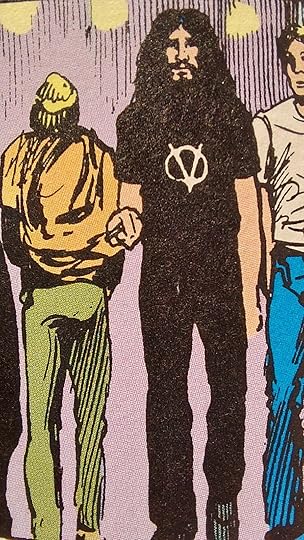
For he's a jolly good fellow, and so say all of us!
For the Man Who Has Everything
Today (November 18th 2023) marks the 70th birthday of Alan Moore
The jolly good fellow who could (at the age of 33) write lines like these:


May 12, 2019
I generally dislike event comics, as a lot of the time they end up turning into convoluted, shoddily written messes, much like the rushed-out-the-door, soulless shit that Marvel and DC have been putting out for the last several years. There's been a few events that I've read that've made the cut. Mark Millar's Civil War is enjoyable, though it suffers from his usual schtick of having an interesting idea, yet never doing anything of substance with it. Jonathan Hickman's Secret Wars fared much better in my eyes, while Hickman certainly likes to be lofty in his aspirations, I was pleasantly surprised to see that Hickman didn't get lost in explaining little, frivolous details and was focused on telling a cohesive, coherent story, and the art from Esad Ribic also didn't do much to damper anything. Yet, I still avoid them for the most part, unless a writer I enjoy takes one on, though even sometimes that can also go badly.
There have been several alternate takes on the 'event comic' over the years too, like with Robert Kirkman's Invincible with the Invincible War issue or Valiant's take on it with The Valiant, but Moore's approach is entirely unique and I like to tell people that this book is Alan Moore's take on the event comic, and in his usual style, he takes the trappings and conventions of event comics and then turns them on its ear. Though it's not necessarily an event comic, It was written during the 'Final Crisis' event at DC Comics, and Moore had to write a tie in for the event. But Moore managed to tie it in with the conclusion of the 'American Gothic' storyline that's been carried through the third trade of the series. The so called 'event' is the ending of the trade, where Swamp Thing and the previously introduced more obscure characters of the DC universe face off against the evil forces seeking to destroy the world as we know it. Moore writes with a surprisingly brisk pace, considering his usual wordiness and slow burn stories that he's known to write. Much like Love and Death, it was one that Moore was forced to write on the spot, and as thus didn't have much time to build as much as he likes to do. Yet somehow he managed to write a great story from it, as if he cast a spell from his magical beard. Moore's aforementioned love of the DC universe comes into full swing in this volume as well, with dozens of references, characters, and call backs that they can't all be captured in the first sitting.
This trade shows how event comics should be, if they were planned out and done by the actual writers instead of them being forced on by editorial to placate idiot VPs, who have no knowledge or interest in how storytelling works. The rest of the stories of the trade also showcase Moore's continued versatility in terms of theme and character, going from disturbing to fun to wryly hilarious from issue to issue, yet with a consistent sense of tone and atmosphere throughout that connects them together. Yet with this trade, we see a climax to the series, and I say that for lack of a better word with the end of the American Gothic storyline, and it wraps up in a way that only Alan Moore can, somehow grand, yet also personal in scope.
Moore writes as deftly as usual, continuing his trend of writing about bigger issues, yet never losing track of what should matter in the story. Moore's political commentary and satire also continues to be sharp and surprising astute as he tackles such topics as xenophobia, gun violence, and further environmental concerns as the trade goes along. It's often Moore's foresight into these issues and his satirical edge on them that keeps his work impressive, even if I don't always agree with it. What I most admire is that, as I've said before, he never seeks to insult his audience or tell them what to think, but to allow for them to come to their own conclusions. Certainly, he'll put out his own opinions, but he never wants to tell others what to think while he does so, it is the showcasing of a master of storytelling and also a pointer for those who want to put social or political commentary in their work.
To not sound too much like a broken record, Bissette and Totleben's art continues to impress, though Woch also manages to bring an hallucinogenic edge to the series, especially once we see Moore continue his expansion into Swamp Thing's mythology and origins that would go on to influence a generation of creators who would work on the character after him. Veitch also continues to impress, and I can't say enough how he continues to perfectly mimic Bissette and Totleben's style and add his own working to their style, becoming a suitable heir to Bissette and Totleben as they begin to fall back on art duties during the series.
Swamp Thing continues to chug along strongly, but we also see a culmination of everything that had come before it, not to say that it only goes down from here, but you do wonder where they can go next after such an epic excursion.

Read
February 5, 2023an apex, but is it the final one?

November 9, 2013
I just can't get enough of Alan Moore. I've never read anything of his that hasn't changed my world. From Hell is still probably my favorite, but Watchmen, V for Vendetta, and now Swamp Thing... the man is flawless.
I'm pretty sure this is my first five-star book in a long while, and I'm glad I haven't given anything else five stars because of how it would cheapen the ranking of this books. Looking over the last few volumes, you'll see that I gave it 3s and 4s, and that's largely because Alan Moore should really not be reviewed on an episodic basis. The man is a master at tying it all together at the end, and that makes the previous work in the series appear better in retrospect.
I feel like I don't want to reveal any more about it, except to say that this comic book about a swamp monster can change the way you see the world. Fucking read it.
I'm pretty sure this is my first five-star book in a long while, and I'm glad I haven't given anything else five stars because of how it would cheapen the ranking of this books. Looking over the last few volumes, you'll see that I gave it 3s and 4s, and that's largely because Alan Moore should really not be reviewed on an episodic basis. The man is a master at tying it all together at the end, and that makes the previous work in the series appear better in retrospect.
I feel like I don't want to reveal any more about it, except to say that this comic book about a swamp monster can change the way you see the world. Fucking read it.

July 18, 2022
Okay, I'm tapping out on this series. I don't know what the hell I'm supposed to glean from these books, but they are neither interesting nor original. Alan Moore turns everything into some metaphysical garbage so he doesn't have to write a worthwhile climax.
I thought I was going to get back on board with this book, but the end was so enormously lame that I just don't have the patience to punish myself by trying to slog through any more of this.
I thought I was going to get back on board with this book, but the end was so enormously lame that I just don't have the patience to punish myself by trying to slog through any more of this.
January 27, 2021
Naprosto skvělé!!! Moore je prostě pan scénárista. Skvěle si zde hraje s komiksovým médiem a poslední sešit je fakt nádhera.

May 28, 2009
Here Moore laid down a marker in the history of comics, ominous and unlikely as Archduke Ferdinand's tomb. Reading through the new wave of British authors who helped to reconceptialize the genre for us poor Americans, one understands more and more why it had to be this man. There is a flair amongst them all for a certain madness and depth of psychology, but Moore was the only one who didn't think it made him special. Our curiosity is always piqued by the mysterious stranger, and Moore will always be that.
There is a quote of Emerson's which helps elucidate men of mystery: "to be great is to be misunderstood". Most Zeppelin fans don't see the band in terms of their roots in early blues, just as most Tolkien fans (and followers) don't have the education to recognize the Welsh and Norse folktales he was emulating. It seems the kernel of an author's inspiration is often so specific and poorly-understood by their audience that they it becomes an endless and entrancing mystery.
There was an undeniable and immediate difference in the comic authors of the early eighties, but many of them sinned by way of dadaism, indulging difference for its own sake. After recognizing this brazen and laughably naive rebellion, one begins to understand why most of these writers couldn't keep from breaking the fourth wall and injecting themselves into the text; Morrison has never stopped doing it.
The difference between them and Moore was one of reason; and like Milton's Lucifer, their reason was flawed; and like him still: it was pride. As a young and budding author, I saw in Morrison's 'Invisibles' and, to a lesser extent, in Ennis's 'Preacher', what a silly thing it is to believe your own stories.
Gaiman we may reprieve: unlike the others, he has never imagined himself mad. His penchant for myth and psychology stays rather trimly in the realm of the curious academic, though becomes quite laughable when he attempts to portray chaos. Gaiman's is the most predictable chaos you will ever meet this side of a fourteen-year-old girl who likes penguins.
Moore, however, has loomed over us in a state of questionable sanity for his entire career. Bearded, wild-eyed, long-winded, and obsessed with little things we don't even think about, and yet completely generous and unselfish with his pen. There is something we do not trust about the man who avoids the spotlight; who spurns money; who believes in the power of names enough to remove his from this or that film. The man who stands over and over a proven genius and who plods on into stranger and wider territory is almost an unknowable commodity.
That Alan Moore cares about things we cannot see, and cares nothing about that which we expect him to becomes his strength. In his unpredictability, we come to find new and inspiring sides of ourselves, and of comics, and of others.
If Morrison has lived his entire career as the incorrigible teenager of comics, inspiring in his gusto but disappointing in his ego, then Moore has always been the old man of comics, a crafty wizard who knows things we don't want to know, who leads us patiently through our wide-eyed bumbling and self-absorption, past the explosions and gun battles, and into our own back yard to show us something beautiful that was there the whole time.
We'll wonder why he doesn't want our thanks. Or our praise. We'll wonder why he seems tired and haggard. We'll try to catch his red-rimmed eyes, as if he'll betray by some gesture or expression just what it is he gets out of the deal.
As if sudden curiosity makes us worthy to know.
My Suggested Reading In Comics
There is a quote of Emerson's which helps elucidate men of mystery: "to be great is to be misunderstood". Most Zeppelin fans don't see the band in terms of their roots in early blues, just as most Tolkien fans (and followers) don't have the education to recognize the Welsh and Norse folktales he was emulating. It seems the kernel of an author's inspiration is often so specific and poorly-understood by their audience that they it becomes an endless and entrancing mystery.
There was an undeniable and immediate difference in the comic authors of the early eighties, but many of them sinned by way of dadaism, indulging difference for its own sake. After recognizing this brazen and laughably naive rebellion, one begins to understand why most of these writers couldn't keep from breaking the fourth wall and injecting themselves into the text; Morrison has never stopped doing it.
The difference between them and Moore was one of reason; and like Milton's Lucifer, their reason was flawed; and like him still: it was pride. As a young and budding author, I saw in Morrison's 'Invisibles' and, to a lesser extent, in Ennis's 'Preacher', what a silly thing it is to believe your own stories.
Gaiman we may reprieve: unlike the others, he has never imagined himself mad. His penchant for myth and psychology stays rather trimly in the realm of the curious academic, though becomes quite laughable when he attempts to portray chaos. Gaiman's is the most predictable chaos you will ever meet this side of a fourteen-year-old girl who likes penguins.
Moore, however, has loomed over us in a state of questionable sanity for his entire career. Bearded, wild-eyed, long-winded, and obsessed with little things we don't even think about, and yet completely generous and unselfish with his pen. There is something we do not trust about the man who avoids the spotlight; who spurns money; who believes in the power of names enough to remove his from this or that film. The man who stands over and over a proven genius and who plods on into stranger and wider territory is almost an unknowable commodity.
That Alan Moore cares about things we cannot see, and cares nothing about that which we expect him to becomes his strength. In his unpredictability, we come to find new and inspiring sides of ourselves, and of comics, and of others.
If Morrison has lived his entire career as the incorrigible teenager of comics, inspiring in his gusto but disappointing in his ego, then Moore has always been the old man of comics, a crafty wizard who knows things we don't want to know, who leads us patiently through our wide-eyed bumbling and self-absorption, past the explosions and gun battles, and into our own back yard to show us something beautiful that was there the whole time.
We'll wonder why he doesn't want our thanks. Or our praise. We'll wonder why he seems tired and haggard. We'll try to catch his red-rimmed eyes, as if he'll betray by some gesture or expression just what it is he gets out of the deal.
As if sudden curiosity makes us worthy to know.
My Suggested Reading In Comics

December 31, 2021
American Gothic, the story that climaxes in this volume, is considered an all-around classic, and I tend to agree, except that part of the charm was the contained (even to the point of claustrophobia) feeling of most of the isolated tales, but what they were building to, this sort of big, cosmic confrontation... not really the best environment for Swampy as a character.
That said, two big things come out of this (or at least are part of the conversation):
1) Moral relativism. Moore is long credited, with Watchmen, as the precursor of the dark and gritty wave in american comics. Most of this is a malapropism of his writing, but I digress. The point is, the "what is good/what is evil/what's the point" discussion starts here, and it's laid out far clearer. It's interesting because it sets Swampy very clearly outside of the regular "hero/villain" dichotomy, something that would be expanded on and imitated for years after. Which brings me to...
2) Supernatural SuperFriends: Moore did not invent the "mystic characters get together to fight a big bad" trope, but he does write the definitive version here (through the creation of Constantine), but the way this has been rehashed, reused and (just barely) reinvented over the years, basically reinventing DC and then Vertigo, and then watered down into the nu52.
EVERYONE has stolen (ahem, "being influenced by") from Moore, even some of the biggest and better regarded names in the industry. It's all here, go read it.
That said, two big things come out of this (or at least are part of the conversation):
1) Moral relativism. Moore is long credited, with Watchmen, as the precursor of the dark and gritty wave in american comics. Most of this is a malapropism of his writing, but I digress. The point is, the "what is good/what is evil/what's the point" discussion starts here, and it's laid out far clearer. It's interesting because it sets Swampy very clearly outside of the regular "hero/villain" dichotomy, something that would be expanded on and imitated for years after. Which brings me to...
2) Supernatural SuperFriends: Moore did not invent the "mystic characters get together to fight a big bad" trope, but he does write the definitive version here (through the creation of Constantine), but the way this has been rehashed, reused and (just barely) reinvented over the years, basically reinventing DC and then Vertigo, and then watered down into the nu52.
EVERYONE has stolen (ahem, "being influenced by") from Moore, even some of the biggest and better regarded names in the industry. It's all here, go read it.

July 16, 2014
Not my favorite volume of Moore's Swamp Thing run. I have always thought he is at his best when he is unfettered by mainstream comic-book style continuity, and the Crisis on Infinite Earths is the polar opposite of that.
The final issue, when he trots out a dozen or so obscure occult-based superheroes for a final battle with evil, was entertaining for what it was, but I had to keep wikipedia open on my laptop to have any hope of keeping my head above water, comprehension-wise. If I understood Zatanna, Dr. Fate, Deadman, Dr. Occult, Mento, or the Spectre as well as I understand Swamp Thing, John Constantine, or the Phantom Stranger, I may have enjoyed this a lot more. (This is why I won't read a League of Extraordinary Gentlemen title without exhaustively researching the sources first. )
The cool thing about all this occult content is that one begins to see in this early work the blueprint for Promethia. And when it comes down to it, that is why I enjoy Moore's early work so much: it allows greater appreciation for where he was coming from when he wrote his best stuff.
The final issue, when he trots out a dozen or so obscure occult-based superheroes for a final battle with evil, was entertaining for what it was, but I had to keep wikipedia open on my laptop to have any hope of keeping my head above water, comprehension-wise. If I understood Zatanna, Dr. Fate, Deadman, Dr. Occult, Mento, or the Spectre as well as I understand Swamp Thing, John Constantine, or the Phantom Stranger, I may have enjoyed this a lot more. (This is why I won't read a League of Extraordinary Gentlemen title without exhaustively researching the sources first. )
The cool thing about all this occult content is that one begins to see in this early work the blueprint for Promethia. And when it comes down to it, that is why I enjoy Moore's early work so much: it allows greater appreciation for where he was coming from when he wrote his best stuff.

May 17, 2019
"It's horror. It's all horror..."
Alan Moore's Saga of the Swamp Thing series is the best. Although Book 4 was not my favorite, it was still an enjoyable read.
I kind of tune out when DC books get into the Crises stuff, and part of this book had to do with Crisis on Infinite Earths. This is a pretty Constantine-heavy book, which isn't a bad thing; I just wanted more Swamp Thing.
However, I did really enjoy the issues that were just about Swamp Thing-related stories. Abby was also barely in this book, and I wish she would have been around more. Swamp Thing is always a great read. These books are grim and always make me think. On to Book 5!
Alan Moore's Saga of the Swamp Thing series is the best. Although Book 4 was not my favorite, it was still an enjoyable read.
I kind of tune out when DC books get into the Crises stuff, and part of this book had to do with Crisis on Infinite Earths. This is a pretty Constantine-heavy book, which isn't a bad thing; I just wanted more Swamp Thing.
However, I did really enjoy the issues that were just about Swamp Thing-related stories. Abby was also barely in this book, and I wish she would have been around more. Swamp Thing is always a great read. These books are grim and always make me think. On to Book 5!

October 13, 2019
I have a bit of a love/hate relationship with Alan Moore. While From Hell is an all time favourite and amongst my best reads ever, Swamp thing is one of the comics I have struggled to read for years - I find it muddled and maybe 15% is truly enjoyable while the rest is full to get through - especially these later volumes from when he was going a bit bonkers.
But this time I’m making a proper go at it.
This volume follows the usual formula - the 15% is really enjoyable - the rest..... not so much. 1-2 stars
But this time I’m making a proper go at it.
This volume follows the usual formula - the 15% is really enjoyable - the rest..... not so much. 1-2 stars

February 25, 2023
Whoa…this is one of the best graphic novels I’ve ever read. Hard to believe that its pages were culled from a regular newsstand comic. Of course with the greatest comic writer of all time penning the stories, is it really that difficult to believe?
Like so many things I’ve come across lately, it runs the risk of embracing some kind of monistic heresy if taken completely literally, but, if taken figuratively to speak of forces under the authority of God (who is conspicuously absent from the pages of the comic world in general, but whose presence, albeit distant and indirectly involved, is sensed far more throughout the pages of this book than most I’ve come across) and the nature of the abstract qualities that permeate our world, then it sheds some interesting insight into the problem of evil. Fundamentally doesn’t say more than Leibniz said (has anyone really?), but paints us a picture that is so much more compelling than what that old great philosopher had to offer.
I was absolutely broken when Swamp Thing walked willingly into the darkness and withheld his wrath and pride; a stark contrast to the Spectre that was looking for a “worthy rival” and thought he could best something far older and wiser than he. It reminded me that we live in an upside down kingdom and that power, pride, and wrath are not the way we conquer evil, but humility and love. The sight of the Spectre broken, weeping, and crying out in sorrow to God, asking forgiveness for failing him was striking. Really good stuff. Blown away right now really.
Like so many things I’ve come across lately, it runs the risk of embracing some kind of monistic heresy if taken completely literally, but, if taken figuratively to speak of forces under the authority of God (who is conspicuously absent from the pages of the comic world in general, but whose presence, albeit distant and indirectly involved, is sensed far more throughout the pages of this book than most I’ve come across) and the nature of the abstract qualities that permeate our world, then it sheds some interesting insight into the problem of evil. Fundamentally doesn’t say more than Leibniz said (has anyone really?), but paints us a picture that is so much more compelling than what that old great philosopher had to offer.
I was absolutely broken when Swamp Thing walked willingly into the darkness and withheld his wrath and pride; a stark contrast to the Spectre that was looking for a “worthy rival” and thought he could best something far older and wiser than he. It reminded me that we live in an upside down kingdom and that power, pride, and wrath are not the way we conquer evil, but humility and love. The sight of the Spectre broken, weeping, and crying out in sorrow to God, asking forgiveness for failing him was striking. Really good stuff. Blown away right now really.
November 12, 2024
The big final crisis event happens here and it's impacted even my boy Swampy.
Though this storyline is actually way darker than that. A cult underground torturing and forming the opening for the darkness to come and destroy the world makes Hellbalzer, Swampy, and all the magic users team up to face off against this beast. With some really great moments, along with Abby going through hell being exposed to be with Swampy, this ends one major chapter and opens up the next.
A 4 out of 5.
Though this storyline is actually way darker than that. A cult underground torturing and forming the opening for the darkness to come and destroy the world makes Hellbalzer, Swampy, and all the magic users team up to face off against this beast. With some really great moments, along with Abby going through hell being exposed to be with Swampy, this ends one major chapter and opens up the next.
A 4 out of 5.

January 15, 2026
I’ve read plenty of comic books and I’ve never changed opinions on an artist, but from vol 1 to this one the art has improved significantly. The writing is great, you can see Moore start to use tricks he’ll use in his masterpiece Watchmen. My only gripe is I really struggle when the stakes are the fate of everything because we all know how this ends, and yet Moore does it in an interesting way. Excited for vol 5.
Displaying 1 - 30 of 418 reviews