For the Ai-Naidar, caste and tradition are not the shackles that imprison the spirit but the silences that make sense of the music of their lives. The Aphorisms of Kherishdar collects 25 short tales about what it is to have an Ai-Naidari soul: to find comfort in tradition, law and structure; to revere interdependence over individualism; to know one's place... to always have one. Illustrated.
Daughter of two Cuban political exiles, M.C.A. Hogarth was born a foreigner in the American melting pot and has had a fascination for the gaps in cultures and the bridges that span them ever since. She has been many things—-web database architect, product manager, technical writer and massage therapist—-but is currently a full-time parent, artist, writer and anthropologist to aliens, both human and otherwise.
Her fiction has variously been recommended for a Nebula, a finalist for the Spectrum, placed on the secondary Tiptree reading list and chosen for two best-of anthologies; her art has appeared in RPGs, magazines and on book covers.
I was one of the donating patrons for these stories while they were online.
Some of the discussion, the intense and intricate complexity of these tales blow my mind right out of the water.
I eagerly await their companion stories and the eventual novel that will go with them. Mrs. Hogarth is an incredible writer and artist and I highly recommend her to those looking for something a little outside of the average in sci-fi.
I had neither context nor expectations coming into this, so I can safely say that I was pleasantly surprised by what this book had to offer. Not a story per se, though we do get to know our humble Calligrapher rather well, this is a lovely bit of worldbuilding. It's built through a series of vignettes leading to zen-like aphorisms (most of them; I was slightly disappointed in those that didn't end so), that detail an alien society that is fragile for its rigidity, but calm and serene. The style of the illustrations matches that of the writing perfectly. And yet this society has quite a lot of gravity in its portrayal, so that certain events that occur carry with them a tremendous amount of emotional impact; I was very impressed by these instances. I was also glad for the afterword, for it dispelled what would have been my only real criticism: the continual reiteration of definitions for certain terms, or reasons behind certain actions, would have been more necessary in a situation where these chapters were written separately, as was the case before these were collected into one volume. So this is quite the lovely work, and I'm pleased it was recommended to me.
This book...what can I say about this book? I can say that I constantly re-read it and love it to the point where I have a word doc of quotes from it I think on when times are rough. I absolutely adore the world building involved. The words introduced at every story are well developed as well. They all sound like the come from the same language. Honestly, I'd say a lot more, but I'm on my kindle so...you know how it goes.
We have sections up to a few pages each, each from the perspective of a calligrapher, each headed by a word from the world that has some social aspect/pertinence to it with its definition that the section usually in some way features or relates to, each featuring an aphorism that is pertinent to the calligrapher or someone in the calligraphers association that appears in that section. It has some description of an 'end', but not much or nothing with regards to a sense of build up to it.
There are probably a couple of ways that it could have been made less of a 'hard sell' as the author, I believe, said about it -- such as by taking inspiration from say the hair carpet weavers where separate stories whilst distinct ultimately wove around the mystery of the hair carpets, which created a natural linking build up, or perhaps featuring more repeated inter-relations between characters (though a second reading might feature a few more repeats than was clocked on this particular of mine first reading), or perhaps simply a little more evidential cumulation towards the 'ending'/finalé (though it wasn't totally out of the blue). But that possibly would have resulted in a longer work, and I think, it would have been much more challenging to write well. But I don't necessarily mind reading books without much `build up' or arching plot, and if you don't either, then I'd recommend trying it. There is a quiet charm in this way that it is.
I read it quickly -- in a day or two. Found I kept wanting to pick it up if I had to put it down, and was quite happy keeping reading it. The second book in this series I found similar in this regard.
If I'm nit-picking, I'd say there are also a couple of points where some clarification in writing might have been beneficial (both first and second book), but it's hardly unusual to not come across these sort of little things in most books somewhere.
First, the narrator for the Audible version has the most even, beautiful, relaxing voice in the world, and if I could give six stars just for that, I would.
Second, I bought this book on a whim and it has become one of my favorite collections of short stories. It moralizes, but with alien morals. The protagonist is sympathetic, but things are just strange enough to occasionally jolt you out of the warm, spellbound comfort the tales draw you into. The alien society is constructed delicately and delightfully. It’s just a fantastic experience for short reading.
This book is interesting... Feels a lot like I'm reading an in-game text, similar to the books in the Elder Scrolls games. While I personally love the in-game texts/books in Elder Scrolls, those work well because your also immersed in the world virtually. Here, however, it was difficult for me to enjoy this book because there is no real context. That being said I think it is well written, and I would like to explore the universe of this book more, but from a third person perspective.
Each story, though short, was very well-written and really brought the world of Kherishdar to life with a level of detail I honestly wasn't expecting. As a sort of warning, there were some scenes that made me... uncomfortable, but that is to be expected when learning about a culture so foreign it is literally alien.
This encounter felt like poetry, beautiful and troubling. I don’t know if I’ll go on with these (the next in the series touts itself as darker) but I’m very glad I went on this journey.
I was blown away. Tsekil rocked me back and made me think, Nojzel made me love, and Thirukedi made me joy.
Edit: After this and the next two books rocked me back on my heels, I find myself rereading this days after finishing it for the first time. I am /astonished/.
“I am the Calligrapher, and I serve Civilization. You know my people as the Ai-Naidar; my empire as Kherishdar. It is a society that spans five worlds and several thousand years, with laws and customs that have served us for as long as we have walked these earths.”
With these words, author M.C.A. Hogarth introduces us to a civilization that is truly alien. And the way she does it is brilliant: the “author” of the book is an alien, a proud member of the Ai-Naidar, and is attempting to help foreigners understand how his empire functions.
He does this by telling stories from his own life and pairing them with concepts that describe various ideals that form the cohesive glue that keeps society together. Each chapter focuses on one of these concepts, and is titled with the name of the concept—for example, the first chapter is “Ishan (Full Living)” and the story illustrates how that concept (or law—this is a society of laws rather than suggestions or ideals) contributes to the way the people of Kherishdar interact with each other and life.
In this respect, the story can be thought of as an instructional guide to a society rather than as a more traditional science fiction tale. Certainly, the story focuses primarily on how this civilization works more than it focuses on any personal plot arc. That said, each story is chronological, and you see the narrator change over time. In the chapter “Pauser (To Acquiesce)”—one of the more poignant chapters in the book—the narrator is faced with the prospect of personal loss that I, as the father of a daughter of my own, found heart-wrenching. The ramifications of that chapter echo in many of the chapters that follow.
But primarily the book is about the society itself, and the society is fascinating. It is not, I think, a place where I would be willing to live, under any circumstances. On a deeply personal level I would find it horrifying—but Hogarth is able to clearly show how that culture finds it beautiful, and does in a way that made me see the beauty through the narrator’s eyes, even as I would find it ugly through my own.
M.C.A. Hogarth is an inspired writer, and the language she uses to tell this story is beautiful. It has a soothing quality throughout—the narrator finds the rules and structures of his world comforting, and the comfort and love of his world shines through in every sentence. Readers looking for a plot-driven story will probably be dissatisfied with this book, but those looking to lose themselves in the culture of an alien world will find it fascinating and compelling.
The Aphorisms of Kherishdar and The Admonishments of Kherishdar reviewed
I've never liked the aphoristic form, never warmed to twee, manga-style illustrations and have always been suspicious of Utopias — in my experience, the latter tend to be either fascist or ridiculously simplistic in nature — or both.
So it was with more than a little trepidation that I leafed through the twin volumes that recently arrived in the mail for me, The Aphorisms of Kherishdar and The Admonishments of Kherishdar, both written and illustrated by one M.C.A. Hogarth, who — remarkably — read my evisceration of Battlestar Galactica's abysmal finale and asked whether I'd be interested in reviewing her efforts at what I think she called "anthropological science fiction".
Well-bound and printed on good paper, but with covers that feel a little too much like mediocre comic book covers, before even opening either book I was already contemplating a quick email to the author, thanking her for the review copies and informing her that I would not actually review the books. Criticizing Battlestar Galactica or doing my small bit to prick the inflated reputation of the likes of Gregory Maguire is one thing. Slamming a self-published writer of little standing in the world of lit-rah-toor is something very different and not a game I intend to play without good reason.
But still, the author went to the trouble of sending me review copies; the least I could do was to ignore the covers and give the words a chance.
My first encounter with this book was through the authors live journal site. I found myself looking forward to each new story and learning more about this mysterious alien race.
This book is unique in that is probably classified as science fiction but it should also be classified as philosophy. Is not filled with action or intrigue like most science fiction books, but is just as fascinating none the less. I have sometimes tried to explain it to people as as if you were reading an alien variation of aesops fables.
While the stories are not fanciful tales of animal behaviors anthromorphized to pass on concepts of common sense behavior as aesops fables are, that comparison comes in that each tale covers a custom or social behavior in the alien society and the source and need of such behavior.
I found myself savoring each story and often re reading them because I was fascinated by how each one gave incredible insight into a very different mindset then you find in any culture on earth. Through each sample story Hogarth manages to expand and fully visualize a complex and intricate alien culture and mindset that leaves one with mixed emotions ranging from admiration to sometimes disturbed by the social structure of the Ai-Naidar,and in turn also leaves one to reflect upon the behaviors, social structures, and cultures of our own species..
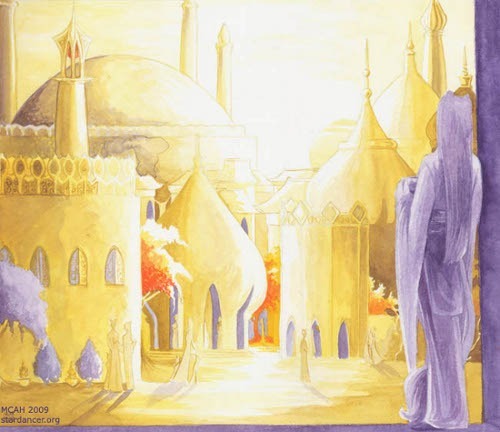
Not only does the author have exquisite world building skills the accompanying art work in the paper version of the book is magnificent. I deeply wish it was also present in the E book version.
Due to space problems I am having to convert my physical books into E books, but the paper versions of this book and its sequel, the admonishments. are kept in a treasured place in my China cabinet. So far I have only been able to acquire black blossoms, the third book of the series, in E book form but I certainly hope to be able to add it to what will eventually be my few and rare paper book collections.
Taken together, The Aphorisms of Kherishdar and The Admonishments of Kherishdar may be short reads, but richly-textured ones: in only fifty 500-word stories (25 in Aphorisms and 25 in Admonishments, respectively), Hogarth displays marvelous skill in worldbuilding - but in the method that is rare to find in modern fiction today, in that she focuses on society, not place. Aphorisms, then, might be seen as depth, whereas Admonishments is breadth: we learn about the formal structures of society and relationships from the former, but only truly from the latter, most-violent volume do we at last begin to grasp how day-to-day life appears... and in this, find the Ai-Naidar to be both alien and all-too-human, all at once.
Admonishments by nature is by far the more emotionally-difficult of the two to read, and perhaps overdoses on the blunt imagery at times - the quiet, haunting elegance of Aphorisms will win out in re-readability in the long run, without a doubt. But both volumes serve their purpose in turn... and sometimes, it's nice to see an alien world that is neither utopia nor dystopia, but struggling with problems of its own.
A round of applause to Ms. Hogarth. This is far more difficult subject matter to pull off well than it looks, and she has a true skill for it. Highly recommended.
These aphorisms are a collection of moments from the life of the Calligrapher, an alien being who is well aware humans exist and now translates his world for our benefit. Each chapter is a self-contained moral pondering, showcasing a small problem or particular moment within the Ai-Naidar's utopian society. I found the aphorisms a pleasure to read one at a time, as lovely, philosophical bites of brain food to be savoured whenever I had ten or fiften idle minutes.
When Ai-Naidar society didn't meet my storytelling expectations — such as when an ominous situation is quickly and easily resolved — I took it as a prompt to question my storytelling expectations. Humans, man. We expect fights all the time. So I enjoyed this collection and it worked well with my view of non-human societies — but this book should definitely be approached with an open mind.
I saw recently that the author is rereleasing the third in this series (prettier e-books!) and has a start on another novel, although she doesn't know when she'll finish it. This reminded me of the Kherishdar books languishing in my TBR pile and prompted me to begin reading.
I would characterize the segments of this book as vignettes rather than short stories for the most part, but overall, the book does display the character in his culture well. It is not, perhaps, a culture I would fit well in, but more than once I discovered tears on my cheeks as I read. M.C.A. Hogarth creates delightful aliens, rich cultures, and deep beliefs, and the glimpses into the Kherishdar Empire are beautifully detailed. If you've read other things by her and are looking for more, and especially if you've read Black Blossom and want more Kherishdar, I recommend this book.
As other reviews have touched on, the Aphorisms can make readers think, look at their own lives, examine their own assumptions, and find soul-touching truths.
One can also simply enjoy the snapshots of alien life and culture, and the marvelous color illustrations! When each story is but a page or two, it can make excellent "quickie" reading for when one doesn't have time to take longer.
You'll probably wind up going back when you *do* have the time, but the prose neither requires intense study, nor forces unwilling illumination upon the reader. Read it for pleasure, then read it again for the questions it raises and suggestions it offers. It can be enjoyed on many different levels.
I'm a big fan of M.C.A. Hogarth's work, both her art and her writing. And these "Incense Stories" are a particular favorite of mine. I've read and re-read them on her website, and it was a real joy when I was finally able to shell out some money and get my hands on an e-book copy of this collection.
I'm enchanted by Kherishdar, and intrigued by a place where there's a place for everyone. I'd recommend this book to anyone that likes beautiful writing that makes you think.
I admit it, I bought this book for the art. I'd read most of it on the author's website, but I wanted a hard copy for the pretty pictures. :) For the art alone, the book would be worth it; the subtle watercolors suit the tone of the Aphorisms so well. Which is not to take away from the text, a collection of "incense stories" illustrating the virtues of the Ai-Naidari. I love this sort of look into alien worlds and alien manners, and I look forward to reading more in this setting.
This is a wonderful introduction to this well-constructed alien culture. We meet them through the eyes of a Public Servant - the Calligrapher, and learn about them through short stories each centered around a word from their language. These are beautiful stories in their own right, but also good for contemplation, almost like Zen koans; they make me think about my place in the world and in society from a calm center.
Different, but interesting. Each incident stands alone, but because they are told from the same point of view, you get some continuity throughout the book, and the story at the end is all the more satisfying because of this.