Jump to ratings and reviews
Rate this book

Gentleman Jim

Rate this book
A graphic novel classic from one of the world's best-known cartoonists"Gentleman Jim" is the story of Jim Bloggs, an imaginative toilet cleaner who, dissatisfied with his station in life, devotes his time to envisioning a world beyond it. His walls are lined with books like "Out in the Silver West," "The Boys' Book of Pirates," and "Executive Opportunities," which provide fodder for his ruminations on career change. Encouraged by his wife, who is also eager to incorporate more adventure into her life, Jim sets out to bring these dreams to fruition by accumulating various accoutrements, only to discover that the life of an executive, an artist, or a cowboy is more complicated and costly than it appears.Jim's childlike understanding of the world that surrounds him is enhanced by Raymond Briggs's subtle and inventive illustrations. Fantasies are portrayed as organic clouds that move between and overlap outlined panels of his reality, and myopic Jim is drawn smaller and softer than the policemen and bureaucrats interested in impeding his search for adventure. As he begins to infringe more seriously on the law, the city workers and their speech boxes become increasingly angular, much like the rigid rules and regulations restricting his sincere quest. With this playful style, Briggs expertly transforms common feelings of inadequacy into an endearing and enjoyable experience that speaks across generations, concluding with an optimistic implication that even a misfortunate outcome can be better than no change at all.This classic novel, originally published in 1980, is presented by Drawn & Quarterly in a new edition.

30 pages, Paperback

First published September 1, 1981

4 people are currently reading
267 people want to read

About the author

Raymond Briggs

166 books242 followers
Raymond Redvers Briggs was an English illustrator, cartoonist, graphic novelist, and author who had achieved critical and popular success among adults and children. He was best known for his story "The Snowman", which is shown every Christmas on British television in cartoon form and on the stage as a musical.

His first three major works, Father Christmas, Father Christmas Goes on Holiday (both featuring a curmudgeonly Father Christmas who complains incessantly about the "blooming snow"), and Fungus the Bogeyman, were in the form of comics rather than the typical children's-book format of separate text and illustrations. The Snowman (1978) was entirely wordless, and illustrated with only pencil crayons. The Snowman became Briggs' best-known work when in 1982 it was made into an Oscar nominated animated cartoon, that has been shown every year since on British television.

Briggs continued to work in a similar format, but with more adult content, in Gentleman Jim (1980), a sombre look at the working class trials of Jim and Hilda Bloggs, closely based on his parents. When the Wind Blows (1982) confronted the trusting, optimistic Bloggs couple with the horror of nuclear war, and was praised in the British House of Commons for its timeliness and originality. The topic was inspired after Briggs watched a Panorama documentary on nuclear contingency planning, and the dense format of the page was inspired by a Swiss publisher's miniature version of Father Christmas. This book was turned into a two-handed radio play with Peter Sallis in the male lead role, and subsequently an animated film, featuring John Mills and Peggy Ashcroft. The Tin-Pot Foreign General and the Old Iron Woman (1984) was a scathing denunciation of the Falklands War. However, Briggs continued to produce humour for children, in works such as the Unlucky Wally series and The Bear.

He was recognized as The Children's Author of the Year in 1993 by the British Book Awards. His graphic novel Ethel and Ernest, which portrayed his parents' 41-year marriage, won Best Illustrated Book in the 1999 British Book Awards.

Ratings & Reviews

What do you think?
Rate this book

Friends & Following

Create a free account to discover what your friends think of this book!

Community Reviews

5 stars
97 (18%)
4 stars
219 (42%)
3 stars
146 (28%)
2 stars
45 (8%)
1 star
9 (1%)
Displaying 1 - 30 of 78 reviews
Profile Image for Bionic Jean.
1,391 reviews1,569 followers
May 20, 2025
If you know the name Raymond Briggs, it is likely to be the 1978 book, “The Snowman” which first springs to mind. Either that, or “Father Christmas”, which followed the next year, and featured his popular creation of a curmudgeonly Father Christmas, complaining endlessly about the “bloomin’ snow”. Or perhaps it is even “Fungus the Bogeyman”, from 1977, which tells of one day in the life of a working class Bogeyman with the rather boring job of scaring human beings. These three books, both written and illustrated by Raymond Briggs, are still popular.

Quite extraordinarily for the time, they were strip stories in comics format. Previously children’s books had separate text and illustrations, so it was quite a jolt for readers to come across these. Nowadays we would call these “graphic novels”, but in the 1970s and 1980s such books had never been heard of here. Raymond Briggs was way before his time for English readers.


Raymond Briggs had been a professional illustrator of children’s books since 1958, with a string of successful children’s books behind him. But now his early passion for cartoons was beginning to break out again, after years of formal study at Art school and working on more conventional illustrations. “The Snowman” is a magical book without words, and has been overwhelmingly successful in Great Britain. It led to the much-loved animated short film, which is still broadcast on television every Christmas, and a musical adaptation which is staged almost as often. A remarkable success story for a book which is entirely wordless, and illustrated with only pencil crayons.

But two years later in 1980, with Gentleman Jim, Raymond Briggs pulled another rabbit out of the hat. It may look like a conventional children’s picture book at a glance, but it is not. Gentleman Jim was his first venture into new territory, as the author had decided to write for adults, but using the same technique of strip stories, in cartoon style. Quite a risk for 1980! Nowadays there is a special category for fiction of this type, graphic novels, but at the time, there did not seem to be anyone writing in the same style as Raymond Briggs, and in a way, there still isn’t, except perhaps for Posy Simmonds.

Gentleman Jim was not very popular at first. Raymond Briggs may have switched his target audience to adults, but it is not apparent from the cover that this is not a children’s picture book. Readers did not know what to make of it, and the book went out of print for a while, even though his earlier books remained in print. There is actually plenty of humour in Gentleman Jim which a child would appreciate, but the story, and the underlying message, is firmly geared towards adults.

The title, Gentleman Jim, is perhaps not what first springs to mind. Another jokey meaning is revealed later, but this is the story of Jim Bloggs, a public lavatory attendant, who works cleaning the underground toilets in a street in Birmingham. Jim Bloggs is dissatisfied with his station in life, and devotes his time to fantasising and imagining a wonderful world beyond his confines. He’s a dreamer, who longs for adventure and romance, yearning for just a little spark and taste of freedom. Jim is a simple soul, an innocent; almost child-like in his views. He works hard, but is constantly puzzled by the world at large:


“… have a cup of tea” he decides. That usually sorts things out in his mind. Whenever he has finished cleaning, and checked the toilet rolls, he has a break and reads newspapers while he sups his well-earned cuppa. We see by the captions on the strip story, Jim’s painful spelling-out of the unfamiliar words and their context on the page. He scours the small ads to find a new job opportunity, and is perplexed to see that all the jobs require “Levels” (schools leaving examinations in Great Britain) and wonders what they are. He knows it must be something to do with Education, but sorrowfully observes that “all we got was a Bible and a thick ear”.

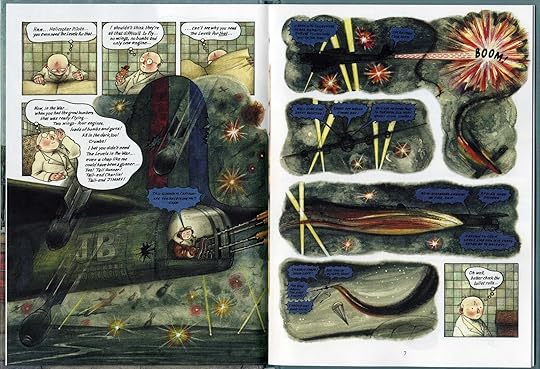
His war stories make him dream about being a pilot. “Triffic!” he thinks. So how about being a helicopter pilot?

“I shouldn’t think they’re all that difficult to fly … no wings, no bombs and only one engine … can’t see why you need The Levels for that …”


But no. Apparently you do. “Better check the toilet rolls!” he says glumly.

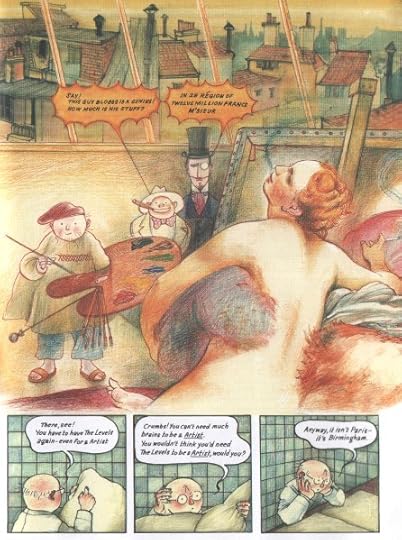
What about an artist? We see his imagination running riot here, with illustrations of figures similar to Raphael and Titian, and a stocky Jim standing amidst his creations, wearing a beret, artist’s smock, and holding an enormous palette. He imagines himself with “a beard and sandals and be all covered with paint … Triffic!” But no. Apparently you even have to have The Levels to be an artist.

“Crumbs! You can’t need much brains to be an Artist! You wouldn’t think you’d need The Levels to be an Artist, would you?” he muses in consternation

Jim Bloggs is a fantasist with big ideas. The walls in his cubby hole in the public toilets are lined with books like “Executive Opportunities”, and “How to be a Diplomat”, but there are also books he has eagerly acquired from the local library, such as “Out in the Silver West”, and “The Boys’ Book of Pirates”. At the end of the day he goes home to his wife, Hilda, and tells her of his dreams. Hilda is a kind woman, but also an innocent: and also not very well educated. She loves the idea of having a bit more adventure in their lives.

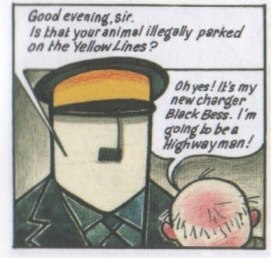
Jim is determined to somehow follow his dreams, and Hilda is right there beside him. He is barred from becoming either a helicopter pilot or an artist. Should he then become a cowboy - or a highwayman, just like the “Gentleman Jim” in one of his books, sitting astride his trusty steed, the charger “Black Bess”? Hilda quite likes the idea of becoming a bar floozy with a blonde wig and fishnet tights.


The way they attempt to acquire the trappings for these various exotic lifestyles is both hilarious and almost unbearably poignant. Of course all these dreams are doomed to failure. Jim can’t afford the boots, and the gun dealer wants to see both his certificate and an export licence. Jim can’t actually afford anything, never mind the air ticket to Texas. Jim is so keen to do everything right, trusting in a kind of natural justice and his own innocence to make it all come right in the end. But the real world does not work like that, and increasingly he is subjected to an endless procession of petty officials marching into his life, and a succession of authority figures bringing all manner of threats, trouble and summonses.


An enduring image for me is Jim holding up a police car and shouting, “Stand and deliver!” seated astride a mangy old donkey and wearing a pair of old wellingtons, his wife’s lacy blouse, an air raid warden’s battered helmet, bearing a toy mask and pistol, and a black and red cape lovingly sewn for him out of stuff from the jumble sale, by Hilda. Poor Jim. He had been kind to his old donkey, and built a lovely stable for her. He had tried to get the right forms and permission, but time and time again he had fallen foul of the bureauocratic process. Totally befuddled and confused, he observes sadly to Hilda:

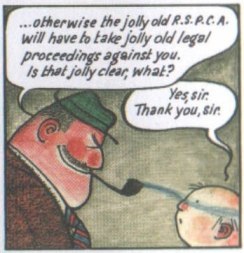
“The Cruelty man is going to do Legal Proceeding to me if it’s not up, and the Planning man is going to prosticute me if it’s not down. Then there’s the Muni-pical Authorities up the Rec, and the Sums from the man in the Yellow Hat”.

We have followed his grand ideas and unfortunate attempts to break out, and we also see his consternation as he tries to do the right thing. But we also recognise all the complicated forms and procedures involved in daily life, and understand what is likely to happen in the real world. Despite Jim’s optimistic belief that everything will turn out alright in the end, nothing he can do will can stop this swelling, ultimately quashing tide of authority.

The ending is bitter-sweet. Jim and Hilda both learn that it is best to stick to what they know. The abiding message is to feel for all the little people who try so hard in life: all the afflicted Jim and Hildas of this world. Gentleman Jim is a hymn to the mundane, and the power of the imagination. It is whimsical and sweet, uplifting and funny, but it is ultimately heartbreaking, as we witness the absolute crushing of a simple man’s dreams. Jim’s greatest wish is to escape from his humdrum life, and to start out again with Hilda at his side. They want to do something more worthwhile.

Yet in the end the reader sees that after all, life as a toilet attendant, which seemed to trap and imprison Jim and his grand ideas, actually represented safety and security of a sort for him. Ultimately Jim’s frustrations are replaced by a literal interpretation of the metaphor. Detained “At her Majesty’s Pleasure”, Jim observes to his wife:

“It’s taught me a lesson, Hilda. I realise now I got ideas above my station … I hope I can get my old job back when I come out.”

If it were not for the gentle humour which continues even through these final panes, and the stoic, upbeat, “make the best of it” attitude of these two endearing characters, the pathos would be well-nigh unbearable.

Raymond Briggs is very well known in this country. In fact he is one of Great Britain’s most popular authors. Yet to this very day, he seems to defy categorisation. Books such as “The Snowman” “Father Christmas”, and “Fungus The Bogeyman” have all led to his categorisation as a children’s author. Yet Gentleman Jim, and others are much more adult works, in the same graphic format. “Ethel and Ernest” is about his own parents’ 41-year long marriage. Later, the author was to feature Jim and Hilda Bloggs again as the main characters in his masterly, very dark book about about nuclear catastrophe, “When The Wind Blows”. Yet these important books tend to be forgotten in the public’s view of his oeuvre. Oddly too, because his work is read by people who do not normally read comics, the British comics industry tend to ignore his work, because they just do not consider what he does as proper comics.


The Art work is unique. Some full pages are quite beautiful, especially those where Jim fantasises about becoming an artist, or is avidly reading aloud the purple prose of his romantic adventure stories. (A subtle point is revealed here. Jim can read this with great skill, and enthusiasm, because this engages his imagination, and boring job adverts do not.) Raymond Briggs adopts a far wider palette of pastel colours whenever Jim dreams, perfectly illustrating his great ambitions and wild fantasies.

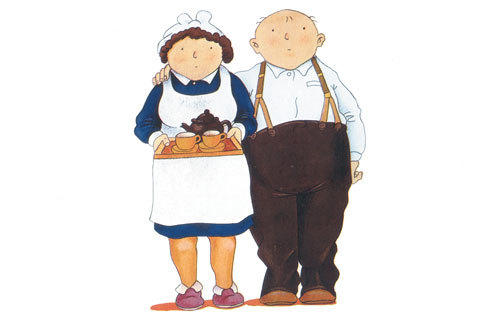
For the main part, his characters are gentle caricatures. Jim and Hilda are both drawn as almost childlike in their appearance and also their body language. They have simple and open, round faces, with ruddy cheeks, noses and ears. But the authority figures look like cruel, vicious robots, and all largely the same as one another; utterly impersonal. Even the jolly RSPCA bluff, upper-crust gentleman is an unfeeling stereotype. And the supreme example of this inhumanity is the judge, terrifyingly obscured, with glimpses of harsh, sharp features. It reminds the reader of one of Gerald Scarfe’s ugly cartoons.

Many of the pictures contain asides, or jokes. When Jim is dejectedly walking home through the monotonous grey streets, for instance, we see huge, vivid “One Way” arrow signs. We see his future all clearly mapped out. There is no escape: it is inevitable. Yet Jim can’t see it.


Gentleman Jim perfectly illustrates the sad fact that our modern world has no room for dreamers. If all you have ever known of Raymond Briggs is the short film of “The Snowman”, please search out one of these adult books by Raymond Briggs. They are by turns sad and funny, full of a quiet sorrow, all lifted by a pervading optimism through their main characters who are unable to cope with reality, which will give you a rueful smile.

But be aware, Jim and Hilda may sometimes break your heart.

Profile Image for Greta G.
337 reviews320 followers
September 19, 2017
A darkly humorous, kafkaesque story about a British middle-aged man Jim Bloggs who has been working as a lavatory attendant his whole life and who dreams of a more exciting, adventurous job with more of a challenge.
Looking at the job opportunities, he soon realizes that he needs "the Levels"(grades) to unlock his talents.
Inspired by the superhero comics he reads, and with the help of his dedicated wife Hilda, he nonetheless tries to accomplish his dreams. His naivety soon gets him in trouble with several people and authorities.
The resolute, naive cheerfulness of Jim and Hilda in envisioning a career change and a more satisfying life, in the face of obstacles and harsh rules, is amusing and enchanting.

 photo 41145385-9A64-48D8-99A8-5F923DEDF37B.jpg
Profile Image for Dave Schaafsma.
Author 6 books32.2k followers
October 3, 2017
Briggs may best be known internationally for his wordless children's classic The Snowman and other stories, but he is also a renowned cartoonist, as Seth's introduction makes clear. This 1980 book is one of the earliest graphic novels, based as so much of his work seems to be on his parents. Jim Bloggs has been thinking of changing his job for more than 12 years. He cleans bathrooms, toilets. He's pretty passive, as his supportive wife, who encourages him to follow dreams inspired by comics and adventure stories, to become a cowboy and other far-fetched schemes. It's a really sweet and poignant tale about two simple people who care au each other and are a little naive about what is possible as his ideas get crazier and her gets in trouble with the law. Reminds me a little bit of the goofy naive simplicity of Laurel and Hardy, Buster Keaton, or Charlie Chaplin. Backing print after many years, so worth checking out!
Profile Image for Práxedes Rivera.
457 reviews14 followers
October 28, 2016
A bit of a disappointment from a renowned story-teller such as Briggs. Due to the smallish format of the book, at times it is difficult to read the text or spot clues in the artwork. In some pages, the speech within the bubble is black text on a dark blue background! It may look great, but it impedes the reader. The story is simplistic, and except for a couple of cute humorous passages, entirely predictable.

The characters are charming in an infantile way, but not enough to justify reading this tome. Read this only if you are a real graphic novel buff!
Profile Image for Drka.
297 reviews11 followers
March 12, 2016
3.5 stars

I recently came across my stack of Raymond Briggs' wonderful books for children and adults, and am working my way through them again.

Gentleman Jim represents a protest against official Britain and the tyranny of the bureaucracy. It is also a cry of dissent against the disappearance of meaningful work, a tradition of work that had been shaped by the mores and values of a preindustrial world. It is a protest against economic rationalism and the bean-counters, who refuse to take the total human experience when evaluating the living standards of those who work for a wage. It is an argument that resonates with the views of EP Thompson and his questioning of whether the living standard of the British worker rose or fell as a result of the Industrial Revolution. It also taps into British nostalgia for those long-gone days of purpose and personal fulfilment that characterised the years of the Second World War. Jim’s dream is to be a latter-day Robin Hood, but he is constantly thwarted by red tape and bureaucracy. He eventually ends up in court where he is charged with highway robbery.

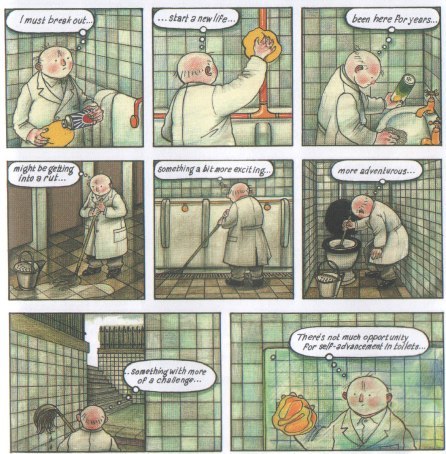
I must break out …… start a new life …been here for years …might be getting in a rut …something a bit more exciting …more adventurous …… something with more of a challenge … There’s not much opportunity for self-advancement in toilets.
Profile Image for Dominick.
Author 16 books32 followers
April 15, 2019
This is an odd, darkly comic and rather unsettling slim book, an early instance of the graphic novel--assuming something only 30-odd pages long can count as a "novel." Anyway, our hero, Jim Bloggs, is a shockingly naive, if not outright dense, middle-aged toilet attendant whose sense of reality is informed more by the boys' adventure books he reads than by reality. He yearns for a different career, and the initial pages are rather amusing as he fantasizes about possibilities (possibilities that are themselves no more than fantasies, since he has no idea of the realities involved in any of them), before deciding to become a highwayman. The satire and humour become more caustic at this point, as the target expands from the dumb naivete of the protagonist to the cold, harsh authoritarianism of the real world; if this is what the world is like, Jim's desire to escape into a boys' adventure book version of the world is understandable. Authority figures are depicted in exaggerated, caricaturish terms, in contrast to the softer-edged, comparatively realistic (albeit cartoonishly simplified) substance of Jim and his wife. Jim's idiocy gets him in trouble, but the world can't tell the difference between simplicity and criminality, any more than Jim can tell the difference between fantasy and reality. Jim's various run-ins with authority are amusing, but the humour gets progressively black as he ends up before a magistrate and ends up in jail, still cleaning the toilets (he's an expert, after all) and apparently oblivious to the fact that being literally imprisoned isn't much worse than the metaphorical prison he was in at the beginning of the book. Jim's happy optimism at the end of the book is hardly shared by the reader. Not nearly as bleak as Briggs's When the Wind Blows, but similarly ... I'm not sure what the right word is--"cold" seems too harsh--"clinical," perhaps? in its view of how easily destructive the world can be for those naive fools who complacently follow along, ignorant of the dystopian nature of their lives. The book is clearly not sympathetic to the world of authority and law, but neither is it particularly sympathetic to Jim's ill-informed dreaminess. Like I said, unsettling, rendered all the more so by the cartoony style. Briggs is one of the great comics artists.
Profile Image for Kay.
1,020 reviews217 followers
December 6, 2020
While this ostensibly might look like a children's book, there's considerable pathos in the plight of Jim Bloggs, the character in this story. Jim is a decent chap, but unfortunately he lives in a world which doesn't reward decency. (That's our world, of course.) Briggs is ever the rueful moralist here. Gentleman Jim tells the story of a council toilet attendant who just can't seem to get ahead and dreams of a better life. Thwarted by a lack of qualifications, and slighted by virtually every authority figure he encounters, Jim finally decides to become a highwayman. (Obviously, Jim is a bit of an innocent as no one becomes a highwayman these days. He's got a childishly romantic view of the world.) Alas, things don't turn out too well for our hero, though he remains characteristically optimistic even in prison.
Profile Image for Nikki in Niagara.
4,387 reviews175 followers
June 9, 2014
Ethel & Ernest and When the Wind Blows are both excellent so when I chanced upon this title at the library I was excited to bring it home. However, I was disappointed. I loved the art. Very poignant and one feels for the simple Jim just from his expressions and body positions. The story didn't do anything for me though. His imagining of being a cowboy then a highway man were just too simple-minded to be believable, not funny to me but rather I thought he was a sad man to think he might understand more about the world if he could get a modern education. I liked the beginning with him working in the toilets but the rest of it just doesn't compare to the two other titles I mentioned.
Profile Image for Ray Nessly.
385 reviews37 followers
October 29, 2017
Charming illustrations. Pretty good story. Funny, sad. A hapless, naive grown-up longs to be a cowboy. When he discovers he can't afford the plane tickets from England to Texas, he decides to become a Robin Hood type character instead. Bureaucracy stifles his dreams.
Profile Image for Emilia P.
1,726 reviews71 followers
September 25, 2015
Aww the guy who did The Snowman! I've also read a pretty awesome comic from him about his parents, and this seemed like the prototype for that, and was also a sweet, sad, exceedingly British story in its own right. The people progress left behind and the trouble that progress gets them in. And living, sweetly and tragically, in one's imagination. The ultimate conflict and the resolution are a bit on the outlandish side, but, eh, I think Briggs was still working out the kinks in what was a pretty dang new format at the time. Still cool. :) Now someone find me When The Wind Blows, please.
Profile Image for Jonathan.
994 reviews54 followers
June 10, 2019
I am thinking that this falls under the 'cautionary tale' type of story. Jim works in a gentleman's public toilet, and has had little in the way of education. Deciding that he wants to better himself he attempts to get started on various career changes until he fixes upon Highwayman (but only to take from the rich and give to the poor). Needless to say he runs up against numerous persons in authority, and things don't work out the way he wants. If only he had some O Levels (see UK History of Education, or ask an old person - OMG! Me!).
Profile Image for Molly.
3,271 reviews
January 8, 2010
I actually found this to be really sad... an old man who cleans toilets, but dreams of a more exciting job. But he doesn't understand that a cowboy or highwayman is not a legitimate profession, and everything costs more than he can afford. And the ending... I don't know- I found it to be surprisingly dark.
Profile Image for Ian Hrabe.
824 reviews19 followers
November 12, 2016
A fascinating early graphic novel from the primordial stew of the form. Seth provides a glowing introduction citing Briggs as one of the father's of the medium. The story is a darkly comic tale of tyrannical bureaucracy with beautiful illustrations.
Profile Image for Juan Fuentes.
Author 7 books76 followers
August 22, 2022
3,5 en realidad.

No tiene la profundidad de 'Cuando el viento sopla' compartiendo el mismo esquema: persona inocente que choca con el mundo real, pero el personaje es igualmente tierno y se lee con agrado.
Profile Image for Dirk Langeveld.
Author 1 book1 follower
January 18, 2021
Along with "When the Wind Blows," which utilizes the same characters, "Gentleman Jim" takes on more of an adult subject than Raymond Briggs is known for, although his characters retain a childlike innocence.

The story follows Jim, a kindly but simpleminded janitor, as he decides he needs a change in his life. It's a fairly straightforward story, and it's not spoiling much to say that Jim dreams of pursuing a few professions, tries unsuccessfully to be a cowboy, and ultimately fails spectacularly in being a highwayman.

Briggs uses the medium to full effect. Jim's dreams are immense, photorealistic depictions where he imagines himself in a new life, while his reality is simpler and often compartmentalized into small narrative boxes. The people he encounters in his doomed quest run the gamut from literally faceless bureaucrats to imposing police officers.

"Gentleman Jim" is essentially about one man's midlife crisis and attempts to find purpose, and it ends up being a tragicomic tale. Jim makes a foolhardy attempt to make a juvenile dream a reality, and ends up hitting the crushing wall of reality. Yet the result winds up more amusing than depressing, as the circumstances never seem to wear on Jim's unceasing optimism or his wife Hilda's blissful accommodativeness.

The characters anchor this story, and it's well worth reading "Gentleman Jim" to get acquainted with them. It makes their tragic fate in "When the Wind Blows" all the more jarring.
Profile Image for Michael Daaboul.
Author 1 book7 followers
October 14, 2019
Raymond Briggs is triffic in this wonderful, but dark graphic novel.

Gentleman Jim may seem like a title for a children’s picture book, but it is far from it. The humour and story have a much more darker undertone that first meets the eye.

The story explores common themes we can all relate to such as venturing out looking for a new job with the hurdles it entails, looking for something that excites the senses but confused at the world in general, with all its rules and regulations.

There is a sense of innocence about this story, you can see how the authorities fail Jim and how the system is unfair to people who are generally nice and good at heart. It’s the perfect song for our time as well.

The illustrations are vividly unique, and the humour is on point. It’s hilarious, which is odd, because the story is dark and ended, making me filled with feeling uneasy and sad. Without the humour, the end would be quite unbearable.

I highly recommend this short read, it has fast become one of my all-time favourite books!

My Creative Writing Blog | Instagram | Facebook | Twitter
Profile Image for Moira Macfarlane.
866 reviews100 followers
March 7, 2023
Gentleman Jim maakt al 12 jaar toiletten schoon en droomt van een ander leven, avontuurlijker, een tikje meer uitdaging... maar de wereld is complex en de vooruitgang sneller gegaan dan hij heeft kunnen bijbenen. Wat volgt is het verhaal van Jim Bloggs & zijn vrouw Hilda en al hun pogingen hun leven glans te geven, ach ze zijn samen zo aandoenlijk en lief. Een graphic novel met humor, een tikje melancholisch en een einde waar mijn hart een beetje van brak.

Raymond Briggs (Engeland, 1934-2022) tekende deze kleine 32 bladzijden tellende beeldnovelle uit 1980 met kleurpotlood, wat een heel mooi zacht effect geeft en de melancholische ondertoon nog eens onderstreept. Hij speelt met taal en met het beeld dat vol kleine details zit, zijn werk heeft iets unieks.
Ik ben fan!

Gentleman Jim spelling out his job opportunities in the newspaper:

"'BE-AN-OFF-IC-ER-IN-THE-ROY-AL-MAR-INES
Man-y-car-eers-will-use-the-tal-ents-you-have-
The-Nav-y-will-use-those-you-don't-even-know-you-have.'

Crumbs!
I wonder what talents I have what I don't even know I have?"
Profile Image for Jade.
820 reviews9 followers
November 28, 2018
Re-read

I'm fairly certain that I first found a copy of this graphic novel in my primary school library - exactly where this work could not be properly appreciated. This story is far more interesting for the older reader.

It seems our protagonist, through a combination of lack of opportunity and lack of talent, is likely to remain a lavatory attendant for another 12 years. He daydreams of a more interesting life, and his attempts to make it a reality brings him into repeated conflict with the authorities. Initially his attempts to seek adventure are amusing, but once you realise that he is such a simple man, the story becomes bittersweet: despite the gentle, positive personality of the protagonist, the reader is left feeling crushed on their behalf.
Profile Image for Mandy.
886 reviews24 followers
May 24, 2017
I really enjoyed this story of Jim, a toilet cleaner bored of his job. The jobs in the paper all seem to need O or A levels, and Jim doesn't know what 'The levels' are, so he starts to think of other occupations that he might enjoy. and that's when things start to go wrong....

WARNING. This book is of it's time, and the joke is often on Jim, who struggles to read, and mispronounces long words. I winced a bit, but was not sufficiently distracted from the story by that, but I lived through the times this is set in. modern readers may find the book too unpalatable.
Profile Image for Michael.
3,387 reviews
March 27, 2018
A new printing of a 1980 book by Briggs, a famed children's author, Gentleman Jim is a quaint, but interesting book about a toilet cleaner who pursues his dream of becoming a Robin Hood-esque "highwayman." Then, reality, the authorities, and society in general thwart him. Briggs' art is charming, and the characters are sort of a mix of idiocy and endearingness. Briggs draws the "authorities" as iconic, faceless blocks, contrasting the roundness of our hero. It's still very much in the mode of a kids' book. Anyway, I liked it.
Profile Image for Tim Robinson.
1,104 reviews56 followers
October 13, 2018
Gentleman Jim is Fungus the Bogeyman without the purpose, the spirit, the glamour (!), the intelligence (!!), the imagination or the originality. A much less interesting creation.


James Bloggs is a creature of poverty and ignorance, and his fantasies are limited and conventional. Almost all the humour is at his expense. He barely puts up a struggle against the army of pompous petty officials, and there can only be one outcome.
Profile Image for Rick Ray.
3,545 reviews38 followers
February 10, 2023
Briggs delivers something that is equal parts whimsical and sad, a challenge in its own right. It's a surprisingly dark comic for something that has the veneer of a childrens tale, but that is what makes this a unique comic. The ambitious nature to this comic could have made for a more interesting long form graphic novel, but overall this is still a worthwhile pick up for Briggs' highly pleasing artwork.
Profile Image for Yesenia.
798 reviews30 followers
April 25, 2024
I did not know that this existed, and I was at a friend's house, and there it was on the shelf, and I picked it up and read it and laughed out loud and was so glad.

Raymond Briggs makes you smile and makes you tear up. He is so great at making you embrace the silliness of his characters, their earnestness. And this is not his best book, but I am yet to read a Raymond Briggs book that I did not like.
Profile Image for Lara A.
633 reviews6 followers
June 9, 2023
This is marketed as a children's book, but the tale of a suburban dreamer mired into a very British labyrinth of bureaucracy is more likely to resonate with adults.

Indeed, it feels very much as a companion piece to Ethel and Ernest. The illustration is layered and warm while still capturing the mundanity of Jim's life and the textures of his dreams.
Profile Image for Esther.
924 reviews27 followers
May 15, 2022
Had this at home and I remember reading it over and over as a child. Not getting the quiet pathos, that struck me more reading it now some 30+ years later, but certainly the humour that Briggs brings to all his works. So human and English.
Displaying 1 - 30 of 78 reviews

Can't find what you're looking for?

Get help and learn more about the design.