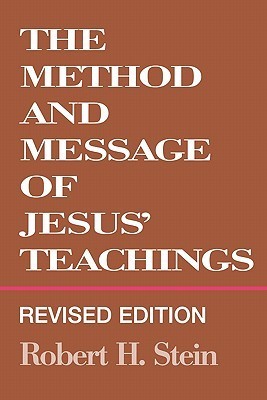
This useful and practical book provides the college student, seminarian, church study group, and interested lay person with a much-needed introductory guide on the "how" (method) and the "what" (message) of Jesus' teachings. In this revised edition, Robert Stein updates his classic work, adds a new bibliography, and introduces use of the New Revised Standard Version of the Bible, bringing this important text to a new generation of students.
I just finished "The Method and Message of Jesus' Teachings: Revised Edition," by Robert H. Stein.
I've loved Stein since I read his "The Synoptic Problem" (read it). And when I see a Stein book for sale I buy it; I will come out richer for it.
Some high points as I go:
It has been shown that Jesus spoke Aramaic. The discovery of the Dead Sea Scrolls disproved that Hebrew circa the first century a.d. was a dead language. Hebrew was spoken and Jesus had a grasp of the language as well as Greek thanks to Alexander's Greek conquest.
An example of what made Jesus such a followed teacher can be fount in the following, His method for teaching: overstatement (could do but an extreme example; pluck out one's eye), hyperbole (could not do; camel going through the eye of a needle), pun (a play on words; strain the gnat and swallow the camel; tough because the Greek has to be translated to Jesus' Aramaic to get gnat, GALMA and camel, GAMLA), simile (a comparison of unlikes; faith like a mustard seed), metaphor (similar to metaphor but the comparison is made rather than similar; eye is the lamp), proverb (a terse pithy, memorable, ethical maxim; where your treasure is there will be your heart), riddle (a saying or story that challenges the hearer to discover the meaning; destroy this temple and rebuild it in three days), paradox (an apparent contradiction; the first shall be last and the last first), a fortiori (a conclusion by logical necessity stronger than previous accepted fact; ask for bread and get a stone), irony (contrast between the stated and the suggested; the story of the Richman who tore down his barns and built bigger ones), the use of questions (well, they are questions in keeping with the Socratic method; who do people saybthat I am?), parabolic or figurative actions (an action which is a stand alone lesson; eating at Zacchaeus home), poetry (the key here is to say things that stick because of their rhythm, not their ryme; the five types are as follows)--
synonymous parallelism: the lines are synonymous repetition (ask, seek, knock).
antithetical parallelism: the second line is anathetical to the first (to save your life you must loose it).
synthetic parallelism: the thought of the second line compliments the thought of the first without repeating it (Lk 12:49-51; chew on that a bit).
step/climatic parallelism: the second strophe moves the first forward building on it (welcome a child welcomes me, welcomes me welcomes He who sent me).
chiasmic parallelism: results from an ab//BA structure similar to antithetical parallelism (who exalts themselves [a] will be humbled [b] who humbles themselves [B] will be exalted [A]).
And that was just one chapter.
Stein then covers the parables in the next chapter with four rules:
Seek 1 point with no allegory unless it's a must
Seek to understand Jesus in His sitz im Leben (situation in life)
Seek to understand how the evangelist understood Jesus in the evangelists sitz im leben
Seek to understand what take-away does God want us to have
Stein ends warning that to not to seek to apply a correct understanding of Jesus parables is wrong and to seek to apply an incorrect understanding of Jesus parables is wrong and can be dangerous.
The following chapter narrows down the totality of Jesus' message: it was that the Kingdom had come near. This was the best summary on what the Kingdom is scripturally and what theological reactions to it were. Stein lands on an inaugurated eschatology but describes other schools of thought.
Next Stein covers Jesus teaching of the Father. The concept in Greek philosophy of the unmoved mover is foreign to scripture so the Father of Jesus has to be interpreted according to the OT. Also, ABBA being the name only a child uses as per Jeremias was disrupted.
Stein finishes this work with the Kingdom ethnic, and Christology.
A detailed discussion of 7 topics on Jesus' teaching. Chapter 2 on the literary devices or forms Jesus used in His teachings was the most helpful and interesting chapter for me. The rest of the chapters go into more detail and discussion than I needed so I skimmed it for the basics.
The chapter on parables and the two-column guide to how some scholars have interpreted the parables amazed me, in a bad way. I think it's an example of poor hermeneutics. The interpreters didn't look for the author's original intent, but rather did isogesis and poured meaning into the text that wasn't meant to be there. It also reminded me of what Jesus said to Nicodemus in John 3. In order to understand heavenly things, we need to be born again by the Holy Spirit, and then let the Spirit of truth reveal the meaning of Scripture to us since scripture is God-breathed.
This book is intended for deep study or a college course or for someone preparing for a debate. I found it to be too scholarly with too much Christian-ese or religiosity rather than God-led, Spiritual-instead-of-carnal interpretation.
With great integrity, this author draws on knowledge of ancient cultural knowledge and genre to further illuminate Jesus's teachings. Highly recommended!