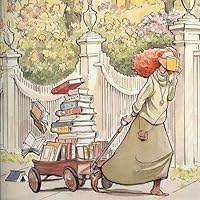
This novel follows two different characters during a difficult Christmas season: A boy, Nathan, learns that his mother is dying of cancer, while a hard-working lawyer, Robert, realizes that he has become distanced from his wife and children. When a chance encounter brings the boy and the lawyer to the same department store check-out line, Robert learns something beautiful about the true meaning of Christmas.
I was not expecting this book to be the Great American Novel. I was expecting it to be sappy, saccharine even, and it was, and I don't have a problem with that. Sometimes I'm in the mood for something schmaltzy, and that's fine. If I hadn't wanted to read something sappy, I'd have quit after the first few pages. I was not expecting it to be Christian fiction, although that doesn't really surprise me. What did surprise me was this book's knack for making me angry.
First of all, the mom has been very sick for some time. She's tired and getting weaker. She's on hospice. She knew from the very beginning that she probably wouldn't make it. She's already done the chemotherapy, and she's got a hospital bed for her living room. She's come home to die. So I want to know why in the heck she and her husband wait until the day she dies to tell their eight-year-old son that the mother won't get better. Up until that day, he thought she wasn't seriously sick. I understand the parents wanting to protect the child, but they can't save the mother, so he's going to have to face this tragedy anyway. The least they could do was be honest with him. Moreover, during the mother's last hours of consciousness, the father and grandmother sit with her, read to her, talk to her. When she's safely dead, they decide it's okay for their son to come in and say goodbye. He's eight. He's not a baby. He's certainly old enough to understand what's going on, and they have robbed him of something he'll never regain. But Nathan is relieved, because apparently his father almost waited until the next day to tell the son. So hey, it could have been even worse.
Most of the cancer plot is done well enough. It's sappy and a little predictable, but that's okay for this style of book. There were even some things that I liked. For instance, I always thought shoes were a sort of strange gift to give to someone who could no longer walk, so I was wondering how VanLiere would introduce the idea. It turns out that Nathan heard his teacher saying that her favorite Christmas was the one on which she received, as a present, a new pair of shoes. So Nathan, who only just learned of his mother's impending death, dashes off to buy the only thing he knows of TO buy. It makes sense, and its both sweet and sad. That said, the teacher character isn't all that well-written: in 29 years of teaching, she's never had a student whose parent had died. Really? 29 years' worth of students all came from happy, two-parent homes? VanLiere did not have to make Nathan's surroundings artificially cheery in order to make his situation, which is intrinsically tragic, seem sad.
What really steamed me about this book is the other plot, the lawyer who has a chance encounter with the boy. He had a nice job. He bought a nice house. This, apparently, makes him a bad guy. His wife thinks that he works too many hours, and she wants a divorce, She doesn't suggest trying to reconnect, nor does she want counseling. No, the first indication that he has that she is in any way dissatisfied is when she says that she wants a divorce, which she then tries to justify with the flimsiest rationalization I can imagine: "Let's face it, you left this family a long time ago." Are we even supposed to like the wife? It's not that she's mean. In fact, outside this one scene (a page and a half), she doesn't really have any personality. What did he do that was so wrong? He embezzled! No, wait, that's not it. Maybe he had an affair? No? Did he just get drunk and make a pass at his mother-in-law? No? Really? You mean he only worked hard and lived honestly? Heck, I'd divorce him too.
But like I said, there isn't enough of the wife in the book to like or dislike her. She's just kind of there. Robert's mother, however, has a personality. Not a great one. She's nosy, arrogant, judgmental, mean-spirited, and she's one of the story's heroes because it was she (and not the wife) pointed out to Robert the error of his ways. She cornered him, and even though he did not want to discuss it with her, he listened to her sermon lecture conversation. But did it have to be so much like a catechism? What is the problem in your marriage? I'll tell you. You are the problem in your marriage. Why are you the problem in your marriage? And on. And on. The mother seems to have been endowed with the ability to know exactly what's troubling her daughter-in-law without ever having discussed anything with her, but is she psychic? No! Turns out she can speak for all women. Joy!
Meanwhile, the rich lawyer is contrasted with Nathan's family, where money is "tight," and they "can barely make ends meet." They bought a ranch house, put in a new roof, new floors, new carpeting, and new plumbing. And I don't mean they fixed a leak; they ripped out the pipes and put in new ones, and they made repairs to the foundation as well. They made it "the nicest" home on the block. Then, the wife went nuts buying all kinds of new plants for the garden. Meanwhile, her husband had a steady job, and she worked part-time. But, oh, by the way, they're so poor. The husband is kept awake nights feeling guilty for not being a better provider, and the wife consoles him by saying that there is a difference between wants and needs, and at least they have their needs. Heck, if a sprawling ranch house, remodel, and plants are needs, I'd hate to see their wants. Of course, by the end of the story, the lawyer learns how misguided he has has been. He says, "We all have questions in this life. It's taken me a long time to figure out what the really important question are. NotHow am I going to make enough money?[. . .]No, more like What are flowers thinking beneath the snow?" That about says it all, I think. Years from now, I can tell my own kids, "Aw, gee, Sport. I'm sorry you're having the seizures/chest pains/asthma attacks/allergies/near-sightedness/any-kind-of-ailment, but son, that's just not important. You should focus instead on the emotions of last summer's dead plants. That really matters." (I assume VanLiere meant "seeds" or "bulbs," not flowers, but it's a moot point anyway since neither dead flowers nor live bulbs possess an amygdala.)
That's most of what bothered me with this book. It was too shallow, the characters were unlikeable (except for the unlikable lawyer--him I understood). It tries too hard. It presents a moving scene, but then it spells out why it's moving, and then it has the characters narrate their own process of discovering the beauty/sorrow/love of the season. It's the kind of Christian book that gives Christian fiction a bad reputation, and I'm not even sure how Christian it is. I didn't appreciate VanLiere insulting Easter, the holiest of our festivals, just to make Christmas look better by comparison, nor did I enjoy her interpretation of the star that guided the magi as being the light at the end of the tunnel. Look at the light! Go into the star! It's a death star! Oh, please.
Life is too short to read bad books. Save yourself from this one.