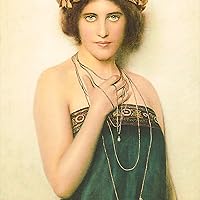
Did you know that kings AND queens wore fake beards in Ancient Egypt? Or that hair was used in medicine at the height of the Incan Empire? Or that Queen Elizabeth I had more than 80 wigs in various shades of red? Kathleen Krull and Peter Malone start at the dawn of history and bring us up to contemporary times, using incredible bits and bobs of hair fact and lore to show us just how much things have changed (and how they haven't!). This is a perfect way to introduce young readers to the idea of a longitudinal study. And it's also an irreverant and playful look at what funny fashion victims we humans have always been! Deserves a permanent spot on every bookshelf. (Get it?)
I was disappointed by this book. It is supposed to be a non-fiction book on the history of hair. As such, I thought it might be a fun read for children. I was curious about it so I read it myself.
It is just too silly to be considered non-fiction. Krull, a known name in juvenile non-fiction, included nonsense facts like the first hairbrush was invented because cave painters noticed "that their paintbrushes aren't bad at grooming hair." Come on! Blonde hair entered the scene when, supposedly quite suddenly, "a cavewoman sprouts yellow hair" so she can catch the eye of the few remaining cave men. You see, the population of eligible bachelors has recently decreased as the men have started to hunt for meat and the "reindeer, mammoths, and horses are killing too many cavemen." Sheesh!
Lastly, the timeline at the back of the book is incomplete (doesn't use full names) and doesn't always make sense. For example, "1814, Brighton, England Before this, most people around the world did not wash their hair often (once a month at the very most) and when they did, the "shampoo" was sometimes urine or, more typically, lye-water mixed with ashes from the fireplace. Even as late as 1946, the Encyclopedia Britannica advised that hair needed washing only every other week." This is the complete timeline entry. Someone please tell me what on earth this has to do with Brighton, England for Krull failed to.
I really liked the end, but the beginning kind of put me off. It's a nonfiction book, so I expect research that I can count on--and the middle and end of the book seem to have lots of that and really interesting and cool facts about hair. But the beginning. . . Is it really factual to say that "in the beginning, everyone is furry" and we lost our hairy coats because they are so "buggy and hot." Really? I know that might be an evolutionary theory, but it's treated as fact here. Hmmm. That makes me wonder what else is treated as fact that might not be prove-able. What is the nature of theory in non-fiction picture books?
Hair--we’re all obsessed with it, to one degree or another. But how many of us spend time thinking about the history of hair? Veteran non-fiction writer Kathleen Krull does--her first “book”, written when she was ten, was called “Hair-Dos and People I Know,” a collection of hair-dos of all kinds.
So it should be no surprise that her newest book looks at the history of hairstyles, and of those individuals who “made history with their hair.” In the beginning, she reminds us, “everyone is furry.” But over the centuries fur coats grow smaller and smaller, until they’re mainly on top for sun protection. Now we’ve got hair instead of fur. Krull touches briefly on many hair related topics in chronological order, from the evolution of hair color (how and why did a cavewoman wind up with blonde hair?) to Egyptians who shaved their heads to get rid of bugs but then wore wigs to protect their heads from the hot sun, to punk rockers’ Mohawks and Dorothy Hamill’s wedge cut. Kids will especially relish descriptions of all kinds of disgusting-sounding early hair products. Did you know “goat pee” and “pigeon poop” were early remedies to get rid of baldness? Cleopatra recommended a blend of horse teeth and deer marrow, mixed with toasted mice, to her bald lover, Julius Caesar. Avocado, bear grease, and butter were used in various time periods to make hair soft and shiny. Flour helped powder wigs for 17th and 18th century aristocrats, and Marie Antoinette and her friends sported huge hair-dos adorned with everything from miniature ships to birdcages and toys.
Back matter includes “hair extensions,” providing further details about hair in each of the time periods portrayed in the text as well as a bibliography with other sources suitable both for young readers and adults.
The illustrations by British artist Peter Malone greatly enhance this entertaining volume. At once elegant and hilarious, who could resist the whimsy of three monkeys sitting in the African savannah on beauty parlor chairs with hair dryers over their heads, surrounded by elephants, giraffes, and oddly enough, the Statue of Liberty? Or Cleopatra and Julius Caesar surrounded by a variety of animals in the process of urinating into buckets? Or my personal favorite, a bear barber coiffing the Mohawk hairdo of a Native American. The finely detailed gouache art will be sure to fascinate young people who take the time to carefully peruse the drawings. Especially noteworthy is the way Malone mimics the style of the art of the countries and periods discussed; i.e. text about samurai hairstyles is illustrated by a drawing in a perfect mimicry of Japanese classical art.
1. The Three Frilly Goats Fluff. By Adam and Charlotte Guillain 2015
2.Twin Connection- The reason I picked this book for the twin text is because The Three Billy Goats Gruff is a traditional story that has been told throughout time but with the twist making it match up with the fashion part of Big Wig. Also felt that since Big Wig has hair styles over the years that picking a traditional book would fit the part of a twin text.
3.Chronological Sequence
4.Strategy Application- Students could make a venn diagram that is labeled past and present. They would use both books to help them think of past and present trends in both fashion and writing. The center they would decide what has been consistent in both.
Big Wig is a comical but factual look at highlights (forgive the pun) in hair history. It is refreshing to see details from cultures on nearly every continent and to read about significant contributions to hair style and hair care originating from non-European peoples. The author takes a humorous approach, though the illustrator sometimes goes too far depicting a pun rather than a more informative drawing to accompany the text—undermining the non-fictional nature of the book in some cases. Worth a look
This one is definitely intended for younger kids. There isn't a lot of information in the main section, but the paintings are beautiful and often funny. And there is a more interesting information included in the back for curious slightly older kids or grown-ups. I wish the information was a little bit more substantial in the main section of the book as well, a happy medium between fluffy and informative would have been better, but it's a cute book with an interesting perspective on history.
Kathleen Krull shares interesting anecdotes about hair from prehistory (the very definition of a human being was one whose hair grows mainly on the head) to 2007 (someone gets the most expensive haircut ever--$16,300.00).
A fun read for all ages with quite enjoyable and funny illustrations. An important detail surprisingly missing though, is the bobbing of women's hair in the 1920
Throughout human history, people have done crazy things to their hair. Here, Krull and Malone combine wild facts about hair from history with illustrations which ape famous works of art. We follow history chronologically, learning about the white spiked do worn by the Celts a few millenia ago, the early years of shampoo, and the inspiration for the Dorothy Hamill cut. None of the information goes in-depth – we generally only read a few – albeit entertaining – sentences about each fact. The real feature is the illustrations, though most children will likely not recognize the referenced works of art. The images have elements of surrealism – for example, the first blonde cave woman is pictured made up like Marilyn Monroe. Malone’s illustrations are attractive and fun to look at, but children looking for historical information may be frustrated by the lack of concrete detail or context. Included is an appendix (titled “Hair Extensions”) of sorts, which includes additional facts for each period. There is no explanation and nothing to distinguish between the facts included in the main body of the book versus this section, so the reader must wonder why they are included in this way, instead of on the relevant pages. Although this is an attractive package and fun to read, the sparse information, overly tongue-in-cheek illustrations, and odd organization of the information makes this an additional purchase. \\pro review
That said, it really is pretty gorgeous to look at. If it had been even slightly better, I would totally have booktalked it at local elementary schools.
Some people might find this book mildly interesting or funny, but I'm marking it down myself as essential reading. There are still, today, so many cultural and racial stereotypes and detrimental issues surrounding hair that this multicultural, international children's book is invaluable. I think any girl (or child) who has ever been teased about their hair, sent home from school because of their hair, had their scalp burned to change their natural hair, can find some comfort in knowing that, historically, urine and pigeon poo were used to treat and style hair (it's not just us in this time that have hair issues). This book provides a wide perspective on how humans have dealt with hair for thousands of years. Peter Malone's illustrations are fabulous, and Krull's text and additional information is wonderful.
This informational book about different types of hair is great for kids because it mixes in historical information with silly exaggerations. It's an awesome book to learn more about how hair has evolved, but the reader will need to distinguish between actual information and the jokes made by looking at the actual facts in the back of the book. My favorite part was how many artists and musicians thought wigs were stupid and would let their hair grow wildly. I would use this in my future classroom to show my students different types of informational text that may not be 100% true throughout the entire book, and to show them that they should be critical of facts from books and either fact-check them or check in the back for any disclaimers or real facts.
Loved this book! Since seeing the documentary "Good Hair" a few years ago, I have become fascinated with the history of hair. The one thing that could have made this book better for me would be actual photographs (not that those exist for most of the entries as they are so old--but maybe modern day people representing the bygone hairstyles?) Particularly, I was fascinated with: -the appearance of blond hair as an early mate-attracting quality -the Marie Antoinette hairstyles with large ships and bird cages -the Hopi tribe women's hair and its similarities to Princess Leia -the super lengthy hair of the Sutherland sisters -the Egyptians having blue and green wigs
2nd half was better than first. I especially enjoyed how the curling iron was invented, a story I had never heard. Some of the more interesting facts were relegated to the end timeline when I felt they could’ve been better served as part of the narrative of the rest of the text. Like another reviewer mentioned I had problems with some of the claims that weren’t cited, especially the paintbrush/hairbrush (which was presented awkwardly) and the blonde hair evolution. I didn’t always feel like some of the pictures aligned completely with the text.
Travel through the hair-raising history of wigs and hair throughout time. From the Ancient Egyptians to the Baroque Court, everything from the first hair dryer, hair dye, wigs, shampoo, combs are covered by era. It also includes famous historical figures who made a difference in the hair world, like Dorothy Hamill, Marie Antoinette, George Washington, Louis the 14th and Elizabeth the 1st.
A fascinating, humorous and well-told story about the history of hair through the ages - from the very beginning to Cleopatra to the Beatles to present day - and everything in between. At the back of the book are seven pages of bonus information and fun facts. Great illustrations.
I liked the information in this book, but two thoughts: 1. not enough non-white examples (both historical or present day) 2. the organization is weird- it's not an easy task to write a book covering the long history of hair and I bet Krull would agree.
Interesting book filled with tidbits about hair throughout history. My child enjoyed the story, but thought some of the "facts" were vague. Interesting, but I wouldn't take some of the facts as true without researching first.
Interesting book provides fun facts and illustrations about hair trends around the world and different periods in history. Fun read for grades 2nd and up.
Some interesting facts, but presented in a way where some of the humor may be wrongly taken as fact. Probably not compelling for kids. May have been better to gear it toward adults.
This book was FASCINATING. I am definitely looking forward to recommending this book next year. This book was a tease -- so many things I wanted to look into further!
I am a huge fan of Krull’s nonfiction books for children. Just as her earlier books, this one has a wry sense of humor and contains fascinating facts. Here the subject is the history of hairdos. Krull starts with prehistory in Africa and then travels forward until 2007 where the most expensive haircut in history is purchased for $16,300. In between, readers will learn about different trends in color, styles, lengths and curls. The book takes an already interesting topic and through details and facts makes it even more compelling.
Krull’s writing is skillful as always, bundling intriguing facts together into small stories that capture a moment in time. Her tone of wonder and interest makes for an inviting read, encouraging readers to be excited about the information as well. Make sure you head all the way to the end and read about the history of hair extensions too.
Malone’s illustrations are fine lined and work well to both depict historical figures and to place them in unique and hair-raising situations. He changes his style of illustration to match the time period and culture at times, such as the Japanese samurai warrior page. His colors are just as fine and carefully selected as his lines are.
No snarls in this book. In fact, it goes to great lengths to avoid tangles. One might say, this is a top-knot book. Appropriate for ages 7-10.