During the 1989 Tiananmen Square massacre, poet Lin Ying escapes, desperately trying to reach her lover, but after finding him in bed with the wife he is supposed to be divorcing, she finds comfort in a fellow student's bed, in a dramatically sensual novel originally banned in China. Reprint. 15,000 first printing.
Hong Ying was born in Chongqing in 1962, towards the end of the Great Leap Forward. She began to write at eighteen, leaving home shortly afterwards to spend the next ten years moving around China, exploring her voice as a writer via poems and short stories. After brief periods of study at the Lu Xun Academy in Beijing and Shanghai’s Fudan University, Hong Ying moved to London in 1991 where she as writer. She returned to Beijing in 2000. Best known in English for the novels K: the Art of Love, Summer of Betrayal, Peacock Cries, and her autobiography Daughter of the River, Hong Ying has been published in twenty- nineteen languages and has appeared on the bestseller lists of numerous countries, she won the Prize of Rome for K: the Art of Love in 2005 and many of her books have been or are now in the process of being turned into television series and films. Hong Ying has long been interested in the stories of homosexuals living in China, a theme explored here and in her short story collection, A Lipstick Called Red Pepper: Fiction About Gay and Lesbian Love in China 1993-1998. In her work, she likes to focus on human stories, hardship and history. Her responsibility as a writer, she believes, is in part to explore the lives of marginalised groups struggling for visibility – and for compassion – in contemporary China.
This story, translated from the Chinese, is set in China at the time of the Tiananmen Square uprising (1989). A young woman has left her poor rural roots behind and is in graduate school studying to be an artist. (As was the author – she was in Beijing studying writing in 1989.) The young woman in the novel is the eldest of several girls – all “burdens” to their family at that time in rural China when sons were hoped for. She knows her father loathes her existence and thinks of herself as “the first disappointment.”
She is away from home for the first time but she is in her third relationship with a man. All three men have used and abused her in various ways. Here’s a quote: “Her mistake had been in taking physical love as the foundation of the relationship between a man and a woman, she decided. That put the man in a contrary position to the woman, which required him to play all kinds of devious tricks. Lin Ying felt she was much clearer about all this now: friendship was mutually established, whereas sex was, quite rightly, a matter pertaining solely to the individual self.”
Against the backdrop of the chaotic events going on in the city, the main character gradually expands her circle of awareness, hanging out with artists and editors and some of the elite of Beijing – those pushing the envelope against authority. She uses her sexuality to break out of that confining, stifling society and to make a political statement. It would be crude to say she goes out with a bang, but her final break-out of self-expression gets her in trouble with the police.
Here’s one more great quote on the difference between China and the West: “Here there are people listening, but one can’t speak. There one can speak, but nobody listens.”
Jag citerar bokens baksida som beskrev det hela så enkelt: ”Svekets sommar är en skrämmande och angelägen skildring av en ung kvinnas sexuella frigörelse och politiska uppvaknande.” Skrämmande kanske dock ger lite fel intryck i meningen. Men annars är det på pricken.
Den 27 åriga poeten Lin Ying’s liv börjar nystas upp sommaren 1989, med startskottet vid massakern på himmelska fridens torg. Väggarna som stadgade upp hennes nya liv i Peking som litteraturstudent raseras och därifrån startar hennes utveckling mot en tillvaro helt utan väggar, en frigörelse, som ställs på sin spets i det sexuella utspel som avslutar boken. En intressant läsning men något saknades. Jag hade nog uppskattat lite mer information, om allt möjligt. Bara generellt lite MER. Det kändes som att den lekte med tanken att vara ögonöppnande, men nådde inte riktigt dit. Kanske gjorde den det 1992 när den gavs ut första gången? Jag vill gärna pröva hennes andra böcker.
Det fanns flera tankeväckande rader och här är en där hon kommenterar Kina kontra västvärlden: ”Här finns folk som lyssnar, men man får inte tala. Där får man tala, men ingen lyssnar.”
This book is astounding. It absolutely took my breath away.
I bought it a couple of years ago, secondhand, and I thought that it was erotic literature, based on my reading of the back cover. I guess that's why it took me so long to get around to actually reading it. I'm so glad I did!
Listening to poets talk must be the most exhausting thing in the world. The time-setting of this novel is of great interest to me, the content of the book sadly wasn't. The writing isn't bad, but I just didn't connect with it at all.
En poet flyr massakern på himmelska fridens torg och hittar sin pojkvän med en annan kvinna. Bland Beijings andra kulturskapare ägnar hon en sommar åt omdefinnera sig själv i en tid när alla är rädda för att bli gripna.
“My guardian is already in a different world. It’s a world so near I can close my eyes and see it and yet so far away that my hands and feet will never reach it, but I still long for it, day after day, using the love I have that nobody needs, using the as-ever, as-before purity of my body and my smeared, feminine heart”
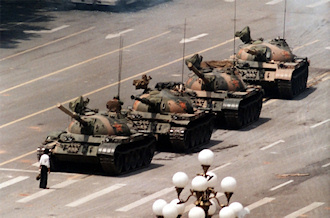
I really enjoyed this book. I've been trying to read more books by women writers and non-western writers, so this fit the bill. This book is an interesting exploration of what it means to be an artist in a society that doesn't allow for individualistic or democratic expression, and there are also lots of thoughts about freedom means for a woman. But it wasn't bogged down by philosophical treatises -- there was movement in the plot and the characters. As an American and a millennial, this book also prompted me to do a bit more research on the events leading up to the protests at Tienanmen Square -- until this point, my reference was mostly that iconic photo of the young man standing in front of the tanks.
This novel takes place in Beijing during the aftermath of the Tiananmen Square student uprising which ended on the 4th of June 1989 when the Chinese government sent in armed soldiers and tanks to clear the square and the streets with force. Students who took part in the uprising have to scatter and hide as they are hunted down to be punished by the authorities. The main protagonist is a young poetess, Lin Ying, who took part in the uprising and now is deeply affected by the crack down and return to conservatism and repression. As I myself was a foreign student studying in China during the early and mid 1980's the subject matter is of great interest to me and close to my heart. The setting in circles of young writers, poets, musicians and artists is promising. Unfortunately, the book does not deliver. The book is a mish-mash of styles ranging from a trashy student love story to an attempt at political critique, but for me it fails on all fronts. I liked the first chapter where Lin Ying finds herself shocked and lost in the midst of destruction after the flush-out of the demonstration, but in the following chapters I found the story very contrived, trying far to hard to attack political and moral taboos. The blurb on the back of the book calls it a sexual Bildungsroman depicting Lin Ying's search for freedom and individuality in trying times. This sounds promising, however, I was not impressed and never moved by her quest. The sexy bits were not sexy. Much of the philosophical thought put forward by the characters in the book was obtuse and again, did not move me. Am I being too hard?
A book that has so much promise, set against the backdrop of the uprising in Tiananmen Square in 1989, but which ultimately fails in its execution. Hong Ying makes her points about corruption in China, the yearning for democracy, and the need to treat women as equals, all of which are strong messages, so the book is not without merit. Unfortunately, her style is melodramatic, and far too focused on sex. I understand using sexual freedom to make a feminist statement, and even to make an anti-communist statement, but she comes back to it again and again, like a crutch. It doesn’t feel honest, as with authors like Anais Nin, or Erica Jong in her better moments, it just feels like it’s in there to sell books. The orgy scene at the end was especially ludicrous. Yes, that’s right, in a book where the Tiananmen uprising itself is in the background, referred to after the fact and mostly from its after-effects, there is an orgy scene. It’s an interesting book, but Hong Ying lacks discipline and maturity, and the story could have been so much better developed.
This style of contemporary literature, dreamy and vague and philosophical, always leaves me a bit cold. I think some of it might be because it's in translation, but I think most of it is just the style the book was written in. I'm still glad I read it though, since the novel has a fascinating backdrop, and because I haven't read nearly enough Chinese-language literature.
Intense but captivating read. The book is set in the immediate aftermath of Tiananmen Square, and follows the main character as she manages the twin oppressions of an authoritarian regime and misogynistic peers. The pretension of the central characters (avant-garde artist types) gets tiresome at times, but generally Ying writes about them in a way that seems pretty self-aware. The finally scene is super memorable, and you could hang a reading group discussion on the last sentence alone.
Realmente he leído poquísimo sobre China y fue un libro que sembró muchas dudas e incentivó la curiosidad. Además no es un secreto para nadie que la historia está narrada por varones y es en ese sentido en el que el libro realmente cobra valor, la voz femenina, la domesticación del deseo y los asuntos personales en una China convulsionada son el escenario del relato.
An interesting and intimate experience of the life of a young poet following the Tianmen Square massacre. It veers off into a drawn out sexual tangent at the end, but even that contains some musing on womanhood and feminine sexuality. I liked it.
Forse non ho avuto la giusta sensibilità per capirlo, forse non era il momento giusto. Ci sono diversi versi di poesia ,forse importanti per apprezzare il romanzo, che ho iniziato a saltare sistematicamente. Delle parti mi hanno coinvolta ,ma non penso di aver capito a fondo questo libro.
No es la historia que esperaba leer, no está mal pero me parece que muchas alegorías se pierden en la traducción y que por ende, me perdí parte del tema y de la trama.
As I read this I had to keep reminding myself how relatively recent these events occurred. Provides an extremely interesting window into the events surrounding Tiananmen Square. A must read for anyone interested in learning more about this subject.