Christopher Robbins began his career in journalism at the age of sixteen when he started writing jazz criticism for the Daily Telegraph. Since then he has written for numerous newspapers and magazines in Britain, Europe and the USA.
The Empress of Ireland won the Saga Award for wit, along with exceptional critical acclaim. In Search of Kazakhstan was short-listed for the Authors’ Club Best Travel Book Award 2008 in the UK and (under the title Apples Are From Kazakhstan) for the Best Travel Books of 2008 in the US. Air America, a worldwide bestseller when it was originally published, was made into a film starring Mel Gibson.
A well researched book on the secret war in Laos. The book is a threaded narrative based on interviews of numerous pilots of the secret decades-long CIA sponsored Raven program and the history of what the U.S. government knew and what lies they told its citizens.
This was a touching book because a) you get to know many of the American pilots including some who didn’t make it out alive and b) numerous Meo and Lao people who served and died fighting the North Vietnamese. The North Vietnamese invasion of Laos began in the early 1960’s to both spread communism and build out the Ho Chi Minh route to access South Vietnam.
The aftermath in Laos following the secret war that left hundreds of thousands of Lao dead is sobering. The volume of the still unexploded ordinance is nearly as tragic. The U.S. actions seen here will make any reader question our government’s policy of arming anti-communist factions to the hilt to stop or slow the spread of communism at any cost.
I loved the book and if you are a history buff you will like it.
So the writing here was closer to 4 stars. Some of the narrative was a little too conversational at times and didn’t always match the seriousness of the missions. But the author did develop the main characters well.
This entire review has been hidden because of spoilers.
This book is every bit as good as Robbins' other work, Air America. Just as with the latter, The Ravens reads almost as an adventure story. But it's history. And Robbins enjoyed unparalleled access to many of the men who were Ravens, forward air controllers in Laos during the "Secret War." Today, this group of veterans is quickly disappearing from the scene. Most are in the late 70s and early 80s. Fortunately, Robbins was there to cover the story of Air America and The Ravens from the 70s to the 2000s. Alas, Robbins himself passed away almost two years ago. An invaluable resource for the history of the neglected part of the war in Southeast Asia is no longer with us.
Truly an outstanding book. An examination of the unacknowledged war in Laos which ran concurrently with the US involvement in the Viet Nam War as told through the eyes of the Forward Air Controllers (FACs), aka The Ravens, supporting the Meo guerrillas and Royal Laos Army. Mr. Robbins uses personal accounts from dozens of first hand interviews of both Ravens and the Laos irregulars to tell of the horrific battles which took place in the Laos highlands and jungles. Interlaced between these chronologically told accounts Mr. Robbins also provides background history and political evens of Laos, Cambodia, China and Viet Nam as it relates to the greater war in Southeast Asia.
The story itself is an engaging subject for anyone interested in 20th century military history and the reason for five stars. What makes this recounting so poignant is how Mr. Robbin's recounts the heartbreaking out come of the war in Laos and the somber annual gathering by The Ravens in remembrance of those lost to the war, both brothers in arms and the Laotians. It should make you the reader wonder if our Nation is capable of absorbing and applying the lessons learned from wars such of this to current events.
The Ravens were to pilots as Delta Force is to infantrymen. Flying in a Top Secret campaign over neutral Laos to interdict supplies coming down the Ho Chi Minh trail, their saga is not very well known. Christopher Robbins tells this story in exquisite detail and with heart pounding drama. The Ravens were FACS (Forward Air Controllers) who flew slow, unarmed prop-driven spotter planes over enemy positions to discover and direct fighter-bombers onto North Vietnamese supply convoys heading south.
Like any "black ops" secret operation, the Ravens attracted a variety of adventure-seeking young warriors. They broke all the rules of comportment while flying the wings off of their obsolete spotter planes and drove the rear-area command staff nuts. Wearing all manner of non-issue clothes like cowboy hats and shorts, they didn't carry any identification and for all practical purposes, didn't even exist. They were expected to commit suicide if captured.
Along with the Laotian Hmongs, they waged an impressive battle against the North Vietnamese for years before finally being shut down and officially forgotten. Their exploits rank right up there with Merrill’s Marauders and The Flying Tigers of World War II along with the Long Range Penetration Groups (LRPs) in Vietnam.
Every time I think I've reached the end of the fractal of fuckedupedness that is the Vietnam War, I find something new. The Ravens is an oral history of the Steve Canyon program, a secret program of Forward Air Controllers that flew missions in Laos in support of the CIA backed Hmong Army of General Vang Pao.
What comes through first and foremost is the immense courage of The Ravens. These men flew Cessnas (literally, the Cessna O-1 Bird Dog) against a sophisticated air defense network of 14.5mm machine guns and 23mm cannons. In a 6 month tour, 90% of Ravens would be hit by ground fire, 60% forced to crash land, and 30% would be killed in action. Flying long hours under intense pressure, the Ravens went a little bit crazy, and Robbins does an wonderful job describing the hectic ground life at the secret airbase of Long Tieng, with drinking parties, Madame Lulu's brothel, and pet bears. Though the work was dangerous and exhausting, Ravens universally loved the ability to fight as hard as they could, without the burden of REMF oversight.
The on-the-ground story is put in a broader context, with overviews of Neutralist agreements in Laos, and high-level diplomacy with Kissinger and B-52 strikes. A great book on a lesser known aspect of the war.
Cracking book about the hidden war during the Vietnam era. There are some truly brave men out there, many who never made it home. Great insight into SE Asia during a time of madness - recommended.
Ravens is a very detailed account of the CIA’s covert operations in Laos during the Vietnam war of the 1960s. It covers everything from dips and peaks in American foreign policy on the matter, the nitty gritties of military decision making against the Pathet Lao and North Vietnam Neutralists, and personal stories on soldiers involved. I’ll summarize my thoughts on all three.
Ravens sometimes reads as an International Relations textbook, but without the whys and hows of policy. It spits facts at you in no specified order, and often devotes entire chapters to providing historical background. Personally, I think books that offer collected histories and individual accounts of war experiences should not concern themselves with providing the reader textbook knowledge except perhaps as a prologue. Kissinger, in particular, is not a figure that requires more than an hour of inattentive reading to understand. However, there was some pretty insightful information on what went down at the political tables to authorize the use of unprecedented tools of air power in Laos - next to nothing. Robbins does a good job of reminding us that the operation that he devotes 400 something pages to is actually one of the least strategized, most impulsive maneuvers on the part of the American government. There is next to no discipline in this war, and that stems from the fact that Laos, an entire country in itself, is nothing more than collateral damage in a wider conflict.
As someone with an idle interest in war strategy and the tussle between political and military decision-making, I always thought that the first military jargon-heavy book that I read would be a rush. Instead, I skimmed over at least 100 words on plane models and military ranks. The fact that Ravens reads as a university lecture by an ex-CIA guest speaker can be a recommendation or discreditation of the book, but if you are looking to expand your knowledge and nothing else, google Ravens on YouTube during lunchtime.
Personal stories on war are always monotonous; that is the catch when reading about military conflict - it is all the same. So I won’t complain about boredom here. (Although I will say I get the ick from these American Sniper renditions of military conflicts, and only feel rehearsed sympathy for characters). One Raven in the book mentions how he has trouble going scorched earth on enemy territory, but does not feel the same way about bombing settlements that have records of retaliation. Another one talks about how the Ravens connect with animals and pets in the absence of real, meaningful relationships (with women and family); this would have been a great segue into talking about the merits of friendship and camaraderie, but that only comes chapters later when it’s time to talk about shared trauma and grief.
I came across this book in Anne Fadiman’s The Spirit Catches You And You Fall Down, which is a documentation of a Hmong child’s experiences with epilepsy and other cerebral neurotic deficiencies, her treatment with American healthcare professionals, and the space Hmong families occupy in Western cultures. Fadiman claimed that Ravens was the first time Americans heard of the “secret” war in Laos in such great detail. Having loved her work, and interested in learning more about this, I was really looking forward to reading Ravens. Suffice to say, I have since had to read it twice because I did not retain anything the first time.
The Ravens: The Men Who Flew In America's Secret War In Laos is one of the best books ever written about combat flying in general and about the war in Indochina in particular. The Ravens were a secret force of Forward Air Controllers operating in Laos in support of Royal Lao and indigenous Meo (aka Hmong which is a pejorative name) forces. The Ravens also flew armed reconnaissance, seeking out North Vietnamese and Pathet Lao forces along the Ho Chi Minh trail to attack. The secret war in Laos spans the administrations of Kennedy, Johnson and Nixon. You watch as “mission creep” becomes reality. The buildup of US clandestine forces is covered well by Robbins. How a pilot came to be a Raven is explained. Quite an intricate network of bases is developed throughout Laos, supposedly secret. Gen Vang Pao and his Meo army fight against the Vietnamese forms a major part of the story. This story is essentially a tragedy as we all know the ending; we leave the Lao people to the non-existent mercy of the communist forces. Before that happens, you will read about incredible bravery, feats of flying that will amaze, sacrifice, the brotherhood of war, the craziness of a secret war, the conflict between REMFs and the men on the pointy end of the spear.
I give this book my highest recommendation, 5 Stars!
If you ever meet a Raven, thank him for his service. His country didn’t thank him back when it counted (or any Vietnam vet for that matter). http://www.youtube.com/watch?v=x2L3sk...
The best non-fiction war book I've read. It's the story of the brave (slightly mad) US pilots who fought the North Vietnamese in Laos during Vietnam, flying suicidal missions in their own clothes and with their superiors back home denying they existed. A very engaging journalistic tribute to a bunch of characters who in the end were treated quite badly.
okay quick story, since I've been selfishly spamming the site for a few days. sometimes somebody runs into you on the street and so you get all the gossip that has been stored up for a few years. the theme of this data d/load is "fate's arrow?" -->
once upon a time there were two people arriving in japan around 2006 to take up a job teaching English.
Alfa was a "texanette," a small but athletic girl who was proud of her home state and took pride in her combination of analytical talent and social popularity. She was the class president of her high school, a private school in the San Antonio region, and she played lacrosse well enough to get nationally ranked, if not very high. (like #583 of her age cohort in the country). her parents were lawyers, they had two Mercedes benzes, and from age seven to age twenty-five she had known nothing but success and being at the top of the social pyramid. so okay, texas is not connecticut, and an S500 is not a bentley; a mcmansion in san antonio is not a castle in yorkshire. but, by all measures, very high social elite.
Charlie was Ting Rong Ding, the Malaysian who nobody understood got the visa to teach English in Tokyo. He speakee Inglish likee dis, yeah? He say Malaysian pidgin gud az British English you no can . iz not dialect but gud regional inglish wid own grammar. u thinkee u bettah 'cuz u english in book?
now as you can imagine alpha and charlie lived in very different expat worlds. somebody organized a football tournament I don't think charlie even got the email. a beach blast was held in two or three summer weekends, and of course alpha had her pick of which to attend or not, making by her attendance the one she went to the "cool" one. charlie went around spikin' ching-chong changlish for sixd ord seben months, and I think mostly the foreigners in Tokyo avoided him--at least the aussies and brits and californians, though of course there is no exact demarcating line, it was just a matter of whether you felt more comfortable a fellow member of a developed country or you preferred charlie ting rong's unique experiences in the japan nightclub.
fast forward ten years.
Alfa has completed her doctorate, gotten married (a socially high individual from a professional Minnnesota family), is doing clinical research and some patient care. she has a number of papers out and is board-certified, making a good living.... yet, strangely... she seems at times troubled or disappointed in some way. there is this faint air about her, not entirely having to do with her specialty (mental health), of things going well... but not exactly as dreamed about.
well Charlie! mr. Charlie has dated and then married a japanese girl--not a Tokyo University graduate, but still a regional school; they have land outside osaka, a famous soba restaurant; charlie runs a number of town noodle night events, and he is integrated into japan, considered lucky, and he's loud and happy and boisterous.
what happened!!!
if you had met the two people, you would have instantly picked alfa as the person to hang out with. how could a person brought up in one of san antonio's top families, with a lineage extending to the bushes and the prescotts and the astors go anything but total success?
and what value would there be in hanging out with two shoes charlie?
but that's the thing, right. alfa was already born at the top. no matter what she did, she would only just maintain her position--although collapse was also possible had she pursued some unfortunate path-- working for enron, or deciding to go into development and being shot in the congo.
for charlie, every day in tokyo was a success. getting the visa was a success. making a first world friend was a success. just talking to a japanese girl was a success. for charlie, starting as he did at the bottom of the heap, mere survival was an accomplishment. and of course, despite his greater happiness, of course he's still socially lower than alfa. if you met Dr. Alfa in her lab coat, of course you don't know about the bottle of vodka stashed in her file cabinet. you don't know about the affairs and drama hidden behind proud WASP faces in San Antonio's elite social scene.
that is the story of alfa and charlie. now is this a book review, I dunno. maybe there is more than meets the eye. but it is a story i suppose.
Christopher Robbins' 1987-published book on the Raven forward air controllers and pilots who flew in Laos is a definitive historical account! It is an extraordinary look that unveils the hidden heroes and harrowing missions behind one of the most clandestine chapters of American history. Robbins masterfully crafts an immersive journey into the covert operations carried out by the intrepid Ravens during the Vietnam War. The book follows the courageous pilots and forward air controllers who were tasked with the perilous mission of supporting the Hmong and Royal Lao armies against the communist Pathet Lao and North Vietnamese forces in Laos. With meticulous research and a keen eye for detail, Robbins brings to life the personal experiences, sacrifices, and camaraderie of these unsung warriors. Robbins' ability to humanize the Ravens, painting them as real individuals with fears, doubts, and aspirations is a big plus. Through their gripping firsthand accounts, readers are transported into the cramped cockpits of tiny aircraft flying dangerous sorties over the Laotian jungles. The adrenaline-pumping descriptions of dogfights and close air support missions make you feel as if you're right there with the pilots, experiencing the heart-pounding tension and adrenaline rush. Additionally, the work and research shed light on the geopolitical complexities of the secret war in Laos, delving into the intricate relationships between the CIA, the U.S. Air Force, and the local fighters. Robbins skillfully navigates the political landscape of the time, offering readers a comprehensive understanding of the motivations and challenges faced by all parties involved. Even for readers with little prior knowledge of the Vietnam War or the conflict in Laos, Robbins ensures they can easily grasp the significance of the Ravens' role in shaping the course of history, and is a must-read for anyone interested in understanding the hidden dimensions of America's involvement in Southeast Asia during the 1960s and 1970s.
History is full of odd moments, waiting to be documented. The Ravens by Christopher Robbins certainly qualifies as a nearly forgotten event. The Ravens were civilian forward air observers that also engaged the enemy in the secret war in Laos. Christopher did an excellent job capturing their story, and this task proved to be especially tricky given the fact that much of what occurred had been classified. This book contains many lively characters, and Christopher went into great detail to describe their lives, missions, and personalities. Their story is an essential part of our history, and I enjoyed learning what they went through. Christopher did an excellent job explaining how chaotic and unorganized the planning, execution, and result were. He also did an excellent job describing how effective their results were. It must have taken lots of courage to fly poorly maintained obsolete planes into combat, with the knowledge that a rescue would not be likely. An entire war fought outside the military and public eye. I recommended this book to a friend who likes war stories. He is halfway through and told me he liked it.
While there are a lot of books that cover the air war over Vietnam, there was another war going on in Laos at the same time. It was a secret war in which the CIA had a huge roll in several ways. Air America was doing all kinds of secret stuff over there, and there were the Ravens.
The Ravens were flying in the FAC role, guiding fighters and fighter-bombers in missions supporting the ground war. A war that was not taking place... This book covers this secret part of the 'Vietnam' war in great and amazing detail. It made for a fascinating read and the stories that are told in its pages are breathtaking. And it only covers the tip of the iceberg, because a number of volumes could easily have been filled with the experiences of these amazing pilots.
What the book also does is covering the historical background of the how and why's of this secret war. Luckily we also get to see what happened to the guys that lived through it all and went home. It was not a happy return in most cases. More so now that many felt that they, or rather the US government, had betrayed the Laotions.
I think my only complaint, if you can even call it a complaint, is that large portions of the book are not exactly about the Ravens. You should stop reading right here if you don't want any spoilers.
These large portions I mention are a history/bio of Laos and the Hmong people sprinkled in numerous places. While it does provide some background about the people and country, as well as some of the motivations behind the people in the story, it did take me out of the story since I had to wade through these bits. I am sure the author had their reasons, and I attribute this to the year it was written. Times have changed, as have FOIA requests, I actually wouldn't mind seeing this revisited and revised. Definitely a fascinating subject.
NOTE: A paperback copy of this book is available free to any Goodreads friend willing to pay for shipping, (UPSP minimum $4-5 anywhere in the U.S.). If interested and you have my email, just send a note with the word "Goodreads" somewhere in the text or subject, so I can find in a search. If you DON'T have my email, add a comment on this review with YOUR email, and I'll get back to you to set something up. Happy reading!
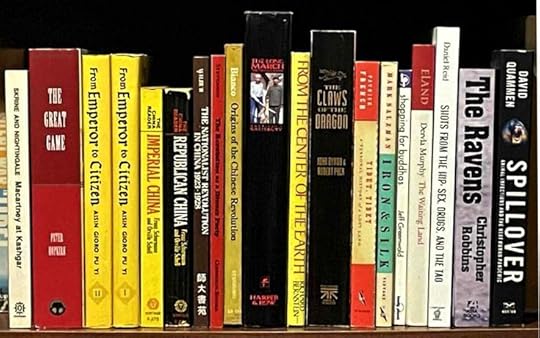
You can see other books on my "available free to friends" bookshelf (still under construction); meanwhile, here's a blurry photo with some of the other available titles:
I bought this in Laos and it was even more impactful to read it while being able to picture the places where the events took place. While the book presents a mostly laudative image of the Ravens who fought a war that technically did not exist, it does a pretty good job at showing the many dysfunctions in both the American army and political system. Moreover, it gives space to the Hmong people, who ended up the biggest losers of the war. A war that still makes victims as UXOs hurt people to this day. The book mostly presents what happened, allowing the reader to make judgments. I found it very informative and well written, a necessary book about a hidden part of the Cold War.
I wanted to read this book because we had just vacationed in Laos and our guide was from the Hmong people. This book tells the story of the ‘unknown’ war that happened in Laos during the better known Vietnam war. I found the book fascinating, but admit that the technical descriptions of airplanes and guns and war grew long and boring to me. Still, I have a greater respect for these brave pilots who dedicated their lives to what would be a losing effort.
This is a fast pace exciting book. It covers one military district in the secret war of Laos and the American volunteers that flew as Ravens there. The stories are unbelievable, but ring true of a secret war. The book is well researched with sources in the back of the book. The people outlined in the book are heroic and selfless in their actions. I really enjoyed the book and the information provided about this time period.
Just when you think you have read and know all there is to know about our involvement in Vietnam you find a book like this one that tells a story of a whole other war most of us didn't even know was going on. The history of the Ravens,or forward air controllers,over Laos and Cambodia is a amazing read.
This book is the first book I read about the war in Loas during the Vietnam War and it was a real eye opener. The book is about the Ravens who were FACs in Laos, but the book also provided background to the lead up of the American involvement in Loas.
The book also covers the discrimination against the Hmong people, and how they are still in refuge.
The real story of the Secret War and it's Heroes, the Hmong and the Ravens, Air America, CAS, and the other characters who fought and died in Laos. Thank you for the real story from the men who were there. Heartfelt and moving. A part of US/ Southeast Asia history that should always be remembered.
Excellent work about a largely ignored part of the US war in Southeast Asia. Robbins does an excellent job weaving together tales of flying dangerous missions with the strategic and political actions placing the pilots’ lives in the line. Highly recommend this well researched and very readable book.
Outstanding narrative of a secret war that even now most people don't know about. Robbins really gets into the actions and thoughts of all the pilots involved as well as the history of Laos and the secret war that was waged there.
A sound book, very well researched with a lot of information I believe available no where else. There is an in-depth analysis of Van Pao (at least during the war years) and several Laotian soldiers and pilots that I also have not found anywhere else.
"The Ravens" combines a history book's information with a novel's engrossing story. Christopher Robbins has written a fine book which anyone interested in The Secret War will find invaluable.
Fearless heroes in a war zone a vast majority of Americans are unaware of. I am in awe of the courage these warriors displayed. It is a moving tale and most interesting. Great read.
Not as I expected. Very through documentary about Laos before, and during the war in southeast Asia. Laos was a very strong ally during the war. The actual stories of the Ravens were light but understandably so.
The cover of this edition features a predictible pull quote from Tom Clancy about "real heroes." And, yes, this book covers the courage under fire of Americans in a secret war. The ethics of a "secret" war are not quite under its purview.
This is a brilliant depiction of weary, incredibly brave pilots flying at the sharp edge of conflict. It brings back bad memories and the anger forged by a mis-led dance in a quag mire.



%20the%20thinking%20girl's%20Britney,%20the%20pacific%20northwest%20madonna,%20the%20groundwork-layer%20for%20gaga%20herself.%20of%2010%20million-view%20plus%20videos,%203%20had%20'meta'%20themes;%20sweet%20escape%20about%20the%20prison%20she%20had%20constructed%20for%20herself;%20whatcha%20waiting%20for%20about%20the%20pressures%20of%20aging%20and%20creativity;%20some%20other%20third%20video%20and%20then%20seven%20other%203%20minutes%20pieces%20about%20the%20standard%20beginning,%20ending,%20or%20nostalgia%20for%20love.<br%20/><br%20/>what%20will%202050%20anthropologists%20think?%20probably:%20)