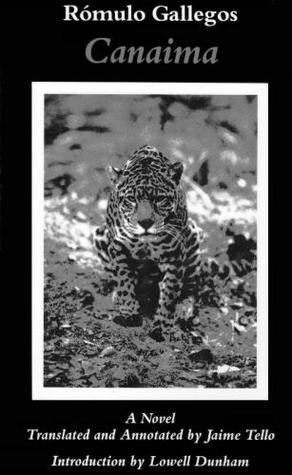
This English translation of "Canaima", first published in 1935, includes five essays of background and criticism. The book describes life in early-20th century Venezuela, a world of gold, diamonds and raw rubber, white foreigners and African slaves.
Novelista, docente y político venezolano. Se le ha considerado como el novelista venezolano más relevante del siglo XX y uno de los más grandes literatos latinoamericanos de todos los tiempos. Algunas de sus novelas han pasado a convertirse en clásicos de la literatura hispanoamericana.
Ejerce el cargo de Presidente de Venezuela en 1948 por escasos nueve meses, convirtiéndose en el primer mandatario presidencial del siglo XX elegido de manera directa, secreta y universal por el pueblo venezolano, y ha sido el Presidente de la República que ha obtenido el mayor porcentaje de votos a su favor en elecciones celebradas en el país en todos los tiempos, con más del 80% de la totalidad de los votos. Sin embargo, su separación del poder se debió al Golpe de Estado de 1948, liderado por Carlos Delgado Chalbaud.
La Universidad de Columbia le confiere el Doctorado Honoris Causa en 1948, al cual renuncia en 1955 cuando le otorgan la misma distinción al dictador guatemalteco Carlos Castillo Armas, con esto sigue mostrando su convicción democrática. Es distinguido por otras universidades, entre las que se encuentran la Universidad de San Carlos en Guatemala (1951), la Universidad de Costa Rica (1951), la Universidad de Oklahoma en Estados Unidos (1951), Universidad Central de Venezuela (1958), Universidad de Los Andes en Venezuela (1958) y la Universidad del Zulia (1958). Ganó el Premio Nacional de Literatura (1958) y fue nominado al Premio Nobel de Literatura entre los años 1959 y 1963 . ...... Rómulo Gallegos Freire was a Venezuelan teacher, novelist and politician. For a period of some nine months during 1948, he was the first cleanly elected president in his country's history.
But it was not as a teacher nor a political leader that Gallegos was to achieve greatest fame.
He was best known for his forceful novels that dramatize the overpowering natural aspects of the Venezuelan Llanos (grasslands), the local folklore, and such social events as alligator hunts.
After publishing Reinaldo Solar, his first novel in 1921, when he was 37 and five years later his second work, La Trepadora, Gallegos published his most renowned work entitled Doña Bárbara in 1929. Gallegos won then international reputation as one of the leading novelists in Latin American literature with this portrait of a ruthless female boss of a hacienda, describing therefor the typical character of the Venezuelan interior.
Gallegos se sirve de la selva del Orinoco para construir una novela en torno a este paisaje, que impulsa a todos sus personajes a tomar un rumbo. La lucha contra ella, el terror del caciquismo y el ansia de riquezas giran en torno a Canaima, reflejada a través de sus personajes.
El escritor coloca a Mario Vargas como el personaje principal, que a partir de su fuerza y valentía, se siente dominado por el ansia de aventura y el deseo de encontrarse a sí mismo en el camino como hazaña personal. Movido por la angustia del que no encuentra su camino, se inmiscuye en los ríos inmensos de Guayana, que lo sacuden y reflejan su propia vida.
Así, Gallegos de nuevo propone una lucha entre lo humano y lo salvaje, en un conflicto interior, donde la selva es amante y enemiga. Existe siempre una lucha entre el bien y el mal, que de desencadenan sentimientos de justicia y hombría que le dan soltura a la novela. Vargas se arrastra a lo desconocido, a una Canaima avasallante, misteriosa, que supone un desafío personal y la necesidad de un camino que le dé sentido a su vida.
Esto da pie a la explotación de la selva, a esa lucha entre el hombre y la naturaleza que nos ha perseguido desde inicios de la humanidad. Vargas se mide contra selva, donde Canaima, sombría y destructora y Cajuña, buena, luchan, con culebras, arañas, fieras y oro, que explotan la lucha entre los hombres.
Canaima envía la tempestad, invade el alma de Vargas y se apodera de ella. Vencido, se sepulta en una tribu, derrotado ante las divinidades selváticas. "La selva virgen es como un templo de millones de columnas, limpio de matojos el suelo donde la fronda apretada no deja llegar los rayos solares, solemne ysañuda en penumbra misteriosa, con profundas perspectivas alucinantes".
Su centro es el Orinoco, la lucha salvaje y las emociones que desata. Canaima es primitiva, dura, donde los hombres o asumen o mueren. Marcos encuentra un destino que quizá no era el suyo y se desvía el sentido de su vida, sin embargo, el caudal impetuoso y las emociones seguirán resonando. Rómulo Gallegos posee un poder increíble para describir a un país, con su naturaleza, paisajes, mitos, miserias, bondades y supersticiones. En su obra revela un gran mural geográfico y social, describiendo cada mínimo detalle que nos compone como país. Años después, la fuerza de Canaima sigue imperando y es, en definitiva, el latir que trae consigo la vigencia de una novela como esta.
Canaima portrays aspiring "Macho Man" entrepreneur Marcos Vargas's struggles against caudillos in the jungle of the Orinoco basin. This prototypical novel of Venezuelan identity resonated: author Romulo Gallegos became the nation's first democratically-elected president in 1948. In an ironic echo of the Canaima protagonist's fight against the General Jose Ardavin, real world President Gallegos was deposed in a coup-de-tat nine months after taking office and exiled. Canaima was made into a movie and Venezuela's largest national park, home of the world's largest waterfall, Angel Falls, is named Canaima. A university is named after Gallegos as is one of Caracas's important thoroughfares. The book is difficult to find in the United States; I review the Jaime Tello (University of Oklahoma Press) English translation, 1988.
The writing is fluid, reminiscent of the Orinoco River. This is a tale of the frontier, familiar to North Americans, as European and creole men interact with the indigenous tribes while chasing natural resources, specifically rubber and gold. The jungle is a character in Canaima, vividly described by Gallegos. It is, of course, alive. Nature transforms characters. Some succumb to greed, and even the effluent and optimistic Marcos Vargas is hardened by the jungle. The frontier town of Upata is lawless, all the more so because the local caudillo does as he pleases. The novel is set in a time of extreme machismo in a land of dueling and slavery. The women are in the subservient roles of the period. An ironic and telling comment is on pg. 237, "[Don Francisco] did not want Venezuelan husbands for his daughters. The two elder ones had already chosen their future husbands in France."
I enjoyed Canaima. There are touches of humor (e.g., Marcos Vargas wagering business clients at a dice game, minor characters Vellorini the Good and Vellorini the Bad). A sample passage, pg. 224, after Vargas survives a hurricane blasting through, "He noticed that the jungle was frightened. The trunks of the trees had been covered by a spectral paleness before the diurnal darkness advancing through them and the leaves trembled in the branches without a breath of wind. He felt superior to the jungle, free now from its maleficent influence, his inner fiery beast anxious to fight the jungle, and thus he spoke to it, 'This is the storm. It comes against both of us, but you are frightened. I am not!'"
On pg. 177, Gallegos's agreeable prose when Marcos Vargas first enters the jungle, "Trees! Trees! Trees! The exasperating monotony of infinite variety, the overpowering feeling of the multiple and unique!
At first, it was disillusion. That lack of grandeur; it was not, at least, what he had imagined. There were no corpulent trees around whose trunks a man's arms would not be able to meet; on the contrary, they were slender, almost rachitic, because of the enormous competition for a bit of soil.
'So that's the jungle?' he mused. 'A thick forest, nothing else.'
But then he started to feel that the grandeur was in the infinity, in the obsessive repetition of a motive seemingly unique. Trees, trees, trees! A solid green canopy over myriads of columns velvety with mosses, scabby with lichens, covered with parasitic and climbing plants, tressed and choked by lianas as thick as tree trunks. Barriers of trees, walls of trees, clumps of trees! Perennial centuries from the roots to the crowns, colossal forces in absolute apparent immobility, torrents of sap silently flowing. Green silent abysses... Lianas, thickets... Trees! Trees!
This was the fascinating jungle from whose influence Marcos Vargas would never free himself. The abyssal world where millenarian clues are lying. The inhuman jungle. Those who penetrate it begin to be something more or something less than men.
Este libro lo tuve que leer en bachillerato.. Sinceramente nunca me había pasado lo que me paso con este libro, no me gusto para nada, no me gustan los libros que tiene demasiado pensamientos y descripciones, se me hizo tediosa la lectura y a veces me perdía mucho por la manera en la que esta narrada la historia.. No me gusto es primera vez que le doy dos estrellas a un libro..
El autor venezolano publica esta hermosa obra histórica y de aventura en 1935. Con inigualable y magistral descripción del paisaje que rodea Canaima, va perfilando personajes entrañables: tales como Marcos Vargas, la pobre Maigualida, el detestable José Francisco Ardavin, y muchos más. Cada uno de ellos protagoniza eventos dentro de historias que se describen dentro de un capítulo, lo que facilita la ubicación y memorización de los mismos así como el objetivo que cada uno de ellos funge en la novela. Al final, todos se enlazan de una u otra manera, están atados. Gallegos nos muestran una Venezuela rica y pobre a la vez. Rica en recursos y pobre por la maldad y corrupción que priva a los peones de fincas de extracción de caucho natural y minas de oro, de la superación personal, les pagan mal, les cobran hasta las herramientas que usan y encima los desesperan para que se beban sus ganancias en alcohol. Trabajadores que no solo sufren el mal trato sino las inclemencias de ese lugar, no solo son víctimas del atropello de otros humanos, sino de enfermedades como la malaria, desnutrición, tuberculosis, mordeduras de serpientes, gangrenas y mucho más. Un lugar donde la ley simplemente no existe, sino para aquellos que se benefician quebrantándola. El ansía de poder, de expandir sus territorios, del dinero, del oro, la explotación del indígena, nunca lo había visto más claro como en esta novela. Una situación que muchísimos años después me rebota en la cabeza y el corazón con tristeza, ya que este hermano país sigue compungido.
Pero… ¡Qué hermosa es Canaima!!! ¡Que belleza tiene Venezuela!!! Grandísimo Rómulo Gallegos que con su pluma nos transporta a una tierra indomable, el centro de esta magnífica obra, y cuya esencia se respira, se siente, se vive o se sufre a través de las páginas cuando se van leyendo.
Canaima “¡Árboles! ¡Árboles! ¡Árboles!... La impresión primera y singularmente intranquilizadora de que en aquel mundo abismático, increada todavía la vida animal, no reinasen sino las fuerzas vegetales, sin trino de pájaro ni gruñido de bestia en el hondo silencio, porque la presencia del hombre, de ese monstruoso acontecimiento que es la bestia vertical y parlante, esparce el recelo entre los pobladores del bosque.” “…moradores de la tarimba –techo de palma sobre cuatro estacas en lo intrincado del monte– donde elaboraban el purguo recogido, compartían el mal alimento y la embrutecedora soledad y colgaban la yacija para el sueño temerario a merced de la selva inhóspita”.
Una novela que no te deja indiferente. Simplemente se tiene que leer.
¿No les pasa que leen a un autor y ven que su estilo es tan único que ya cuando leen otra cosa del mismo escritor ustedes están como: "aaah, sí, muy típico todo"? A mí me pasa con Gallegos. Por algo dicen que su narrativa es "galleguiana".
"Canaima" no es precisamente mi novela favorita de Gallegos. El autor nos muestra a su protagonista, Marcos Vargas, en un viaje que se da en consonancia por el estado Bolívar, Canaima y el Orinoco. Vemos cómo las situaciones del pasado y el presente hacen cambiar el futuro de este personaje tan vivaz pero a la vez tan introspectivo. Es un hombre que se encuentra en el limbo, entre quedarse para siempre en la civilización, o adentrarse en los misteriosos y profundos mundos de los salvajes.
Para mí, hay exceso de páginas y de personajes. Sin embargo, me parece muy hermosa la descripción que se hace de la selva. Es algo luminoso y bello, pero al mismo tiempo oscuro, cambiante, lleno de horrores. Hay ciertos pasajes muy crudos, que creo son los centrales en la obra,
Esta novela transcurre en Ciudad Bolívar, El Callao y las haciendas cercanas al río Orinoco.
El regreso de Marcos Vargas a su natal Ciudad Bolívar sirve como excusa del autor para retratar la sociedad venezolana de inicios del siglo XX, donde el indígena era oprimido por los mestizos y donde las leyes eran rotas constantemente. Gallegos toca en esta novela temas como la corrupción política, los asesinatos, etc.
A pesar de la presencia de indígenas en la novela, no se profundiza en ellos.
La novela está cargada de un lirismo impresionante donde Gallegos alaba con su prosa el río, los árboles y demás elementos de la flora y fauna, con tal de que el lector se sienta dentro del hábitat venezolano.
El personaje más interesante es Marcos Vargas. Al inicio de la novela, llega a Ciudad Bolívar como alguien culto llegado de Caracas pero a medida que transcurre la trama y se involucra en varias situaciones se va volviendo tan salvaje como los demás personajes hasta el punto que casi parece otra persona.
El final de la novela es un tanto nostálgica, ya que sientes como si toda la novela hubiera sido un gran tsunami y que ese último párrafo son las olas del mar finalmente calmándose.
Rómulo Gallegos, mi escritor venezolano favorito, conocido por la manera tan peculiar de narrar y sumergirte en los escenarios más inhóspitos de la fauna y flora venezolana. Canaima tiene un arco de desarrollo exacto a esa área del país, que cobra salvajemente todo a su paso, para devolverle a la persona exactamente lo mismo de cuando llegó allí por primera vez. Sin embargo, la lectura se pierde en querer ser tantas cosas, se vuelve tediosa y los vocablos coloquiales del sitio se vuelven casi incompresibles. El misticismo del sitio se ve apañado por la ejecución del relato. Esperando algo similar a la narración de Doña Bárbara, donde sus personajes y el paisaje se vuelven uno, incapacitando la línea que los separa; aquí encontramos una desconexión completa y ausencia de construcción de los personajes. No obstante, es impresionante, como las obras de Gallegos, pueden volverse a temporales en la realidad del país.
Este libro lo leí porque la película de 1945 con Jorge Negrete es de mis favoritas, donde además de la historia me atrae la forma de hablar de los personajes con sus rimas y sus refranes de la zona (Venezuela).
El primer capitulo es algo pesado de leer porque describe el lugar donde transcurre la historia usando palabras y descubriendo cosas muy de Venezuela, pasando ese capitulo la historia es fácil de leer y ágil.
Cómo otros libros, Gallegos realiza una comparación narrativa con algún evento social del país. En este caso, de la situación de los caudillos y su forma de trabajar. En general, me ha gustado, muchas veces me perdí jaja pero no me extraña, porque la pluma de este señor siempre me deja así. Pero siempre voy a recomendar que inicien por sus cuentos, no por las novelas. Eso les permitirá hacer un poco más ligera sus futuras lecturas.
After reading and loving Doña Bárbara, I knew that picking up another Gallegos novel would be inevitable. I did not think that it would be as immediate as it was. To even that out, I took forever to read it (eight months or so), including a long pause where I thought I might just be done with it for good (not because it wasn’t good but just because I was too overwhelmed with other things going on in my life).
Such is the draw of Gallegos’s writing is that even though I struggled to understand what was happening for much of the time (his descriptions are beautiful, his characters mysterious, his narrative unique—all of which can be tricky for a non-native language learner to process), I enjoyed every moment that I found myself ponderously progressing through his tale, one page, one paragraph, one piece at a time.
As far as I can remember (I’m writing this months later) and as far as I could decipher (I read it in the original Spanish), here is what this story is about: Marcos Vargas is a young man who hails from a high class background whose family has fallen on hard times with the loss of his father (or because of his father’s mismanagement or mistreatment before he was lost—you see, details are hard in a reading experience such as this!). He manages to purchase a transport company that would take products to and from the vast Venezuelan jungle.
The amiable man he purchases it from gives him sage advice and acts as the father that Marcos has been missing. Marcos meets and hits it off with his daughters (I’m pretty sure that’s who the daughters belong to … could’ve been another guy). He also makes enemies from the other business owners and transporters hoping to benefit from the old guy’s retirement. Marcos has to grow up quickly if he wants to show these guys that he is up to the task of doing business in this wild region of Venezuela.
Someone we respect gets murdered by a creepy hitman who is compared to a panther (confusing, because poor Marty struggled for a time thinking he was reading about an actual panther, not a person compared to a panther). Marcos finds that justice on the edge of civilization is corrupt or missing and has to take matters into his own hands. However, vigilantism does not garner the fulfillment that either Marcos or we, the audience, expect.
Time passes, Marcos becomes more and more hardened by his experiences, more wise with the passage of youth, less innocent. At some point, he refuses to find shelter as a hurricane slams into the jungle where he faces it, naked and alone. It’s a metaphor for something, I’m sure. My guess is it’s about the barbaric nature of mankind … or something. I do know that the scene is haunting, gripping, and significant—even if I can’t tell you exactly how! Afterwards, he is not the same. He is both humbled and withdrawn, he is wise but bitter (maybe?). It wraps things up after that, and not in the way it was supposed to, dangit!
Canaima was hard on multiple levels for me. It was hard to understand, first and foremost. I mean, for the majority of the time, I understood each sentence that I read. I could tell you the main points from each chapter. Heck, looking back at my summary, I’m surprised that I got as much out of it that I did … which is why it was hard. It felt like in a few crucial spots, I missed something important or pivotal, so that moving forward I was always trying to piece together why the characters were acting just a little bit off, or why someone was missing or had shown up all of the sudden. So, that was a challenge. But again, looking back, I can’t say that I didn’t understand it, because it looks like I got the gist of it pretty well.
The other way it was hard, though, is that it was hard to finish in the way that Gallegos finishes. He does not give us the fully satisfying ending that we desire or that the characters deserve. That’s hard. I mean, he does it in Doña Bárbara, so I think it was a reasonable expectation that he would do it again here. Yet he doesn’t, which was low-key tragic. At the same time, I was not annoyed by it. Oftentimes when an author changes an ending in such a way, it feels manufactured, a deliberate attempt to make themselves more important than the story. Here, though, while I disliked it and wanted a different outcome—the right one!—I did not entirely disagree with it. And I felt that the message, even if it was one that I did not completely connect with, was a real one, one true to the author’s feelings—perhaps about Venezuela, or the nature of man, or something else. But this change of expected ending was not about Gallegos, it was about his experience, and it is as true as it is disappointing, though not completely disheartening.
Overall, I found that the experience of reading Gallegos again is rewarding, no matter the outcome of the characters of his stories. I may need a break for longer this time, because he can be hard on me! But when I decide to go back (I’ve got one downloaded and read to start … dangerous!), I’ve no doubt that I will find it worthwhile. He’s that good.
Novela de Rómulo Gallegos publicada en 1935 (seis años después de Doña Bárbara, su obra más famosa) es una novela desgarradora y dura. Ambientada en la región del mismo nombre al sur de Venezuela, la selva es la gran protagonista de esta obra, así como los llanos de Apure en Doña Bárbara. Lugar de forajidos y caudillos, donde la ley brilla por su ausencia y la muerte ronda a cada paso, ya sea por asesinato o porque la selva devora a quien se interne en ella. Zona rica en oro y caucho despierta el interés de aquellos que se lanzan a la fortuna de ingresar en la selva para hacerse millonarios, no saben en la trampa que han caído. La explotación del hombre por el hombre está a la hora del día y los caudillos son los que mandan. Gallegos nos da un relato crudo de lo que es vivir en un lugar donde la vida tiene poco valor, donde se mata por unos bolivares y donde el clima es agobiante. Marcos Vargas decide internarse en la selva pese a la oposición de su madre y junto a Manuel Ladera ( propietario del negocio cauchero en la zona, una especie de padre para Marcos) logran montar un negocio de mulas. Años atrás su hermano fue muerto en extrañas circunstancias. Marcos deberá soportar los tormentos de los Ardavines, unos mafiosos que intentan dominar la zona. Uno de sus sbirros, el Cholo Parima, resulta el asesino del hermano de Marcos y más tarde de Landera. A partir de ahí se desata la guerra. Gallegos, en tono eminentemente realista, logra conformar un universo único, con personajes muy bien delineados, un paisaje estremecedor, y un ritmo de aventura que hace muy llevadero el relato, casi un western venezolano donde no faltan los buenos y los malos, las traiciones, los disparos, la sangre, los brujos indios (hermoso el personaje de Juan Solito), pero con un gran nivel de denuncia y crítica. Gran novela venezolana.