Dr. Schweickart's primary areas of research are social & political philosophy, philosophy, economics & Marxism. He also has major interests in feminist theory, existentialism, critical theory, race & racism. He's published extensively on these topics. His work has been translated into Spanish, Catalan, French & Chinese. His book publications include: After Capitalism (Rowman & Littlefield, 2002) with a Chinese translation forthcoming by the Social Science Documentation Publ. House, Chinese Academy of Social Sciences, Beijing; Market Socialism: The Debate Among Socialists (Routledge, 1998), coauthored with B. Ollman, J. Lawler & H. Ticktin, with a Chinese translation in 2000 by Xinhua Publ. House; Against Capitalism (Cambridge Univ. Press, 1993, & Westview Press, 1996), with a Spanish translation Mas alla del capitalismo, in 1997, & with a Chinese translation in 2003 by Renmin Univ. Press in Beijing; Capitalism or Worker Control? An Ethical & Economic Appraisal (Praeger, 1980)....
David Schweickart is an activist, mathematician & philosopher. He holds a Mathematics BS from the Univ. of Dayton, a Mathematics PhD from the Univ. of Virginia & a Philosophy PhD from Ohio State Univ. He's currently a Philosophy Professor at Loyola University Chicago. He's taught at Loyola since 1975. He was Visiting Professor of Mathematics at the Univ. of Kentucky from 1969 to 1970 & Visiting Professor of Philosophy at the Univ. of New Hampshire from 1986 to 1987. He's lectured in Spain, Cuba, El Salvador, Italy & the Czech Republic, as well as throughout the USA. He's a contributing writer to & editor of an online journal dedicated to Economic Democracy: SolidarityEconomy.net. He was Loyola's Faculty Member of the Year in 1999. In After Capitalism & other works Schweickart has developed a market socialism model termed Economic Democracy. It embodies: 1/Workplace self-management, including election of supervisors; 2/Democratic management of capital investment by a form of public banking; 3/A free market for most goods, raw materials, instruments of production etc; 4/Socialist protectionism to enforce trade equality between nations. Firms & factories are socially owned & worker managed. These enterprises compete in markets to sell their goods. Profit is shared by the workers. Each enterprise is taxed for the capital employed. That tax is distributed to public banks, who fund expansion of existing industries & create new ones. Publications inclued: >After Capitalism (Rowman & Littlefield 2002) ISBN 0742513009 >Market Socialism: The Debate Among Socialists, coauthored with Bertell Ollman, Hillel Ticktin & James Lawler (Routledge 1998) >Against Capitalism (Cambridge Univ. Press 1993) Spanish ed., 1997; Chinese ed., 2003 >Capitalism or Worker Control? An Ethical & Economic Appraisal (Praeger 1980)
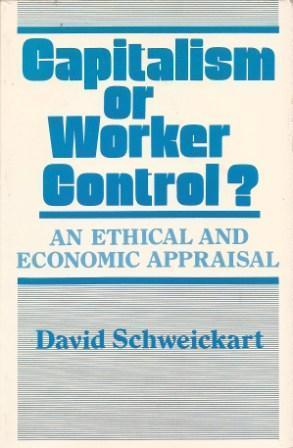
This book is the precursor to Schweickart's Against Capitalism and is similarly structured (see reviews). It differs enough, however, to be read independently, particularly by older readers to whom Milton Friedman, John Kenneth Galbraith and John Rawls are familiar thinkers. I read it originally for a class he taught at Loyola University Chicago in the eighties.