This book was converted from its physical edition to the digital format by a community of volunteers. You may find it for free on the web. Purchase of the Kindle edition includes wireless delivery.
Padraic Colum was an Irish poet, novelist, dramatist, biographer and collector of folklore. He was one of the leading figures of the Celtic Revival. (Source)
Neither my favorite version of Norse Mythology nor my favorite of Colum's books, but a decent introduction to the major tropes and stories of the mythos for readers with slight familiarity with the topic (for absolute beginners the groundwork may be inadequate). Some stories were told oddly out of chronological order so that a character might be mentioned in one chapter but then born in a later chapter, or an adventure begun and then the telling interrupted and finished later. This may be due to an attempt to incorporate more than one strand of legend, as the versions differ somewhat regionally.
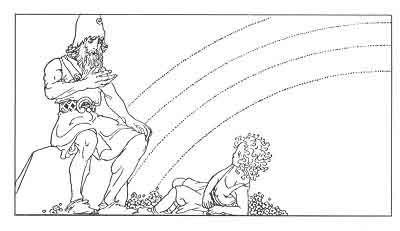
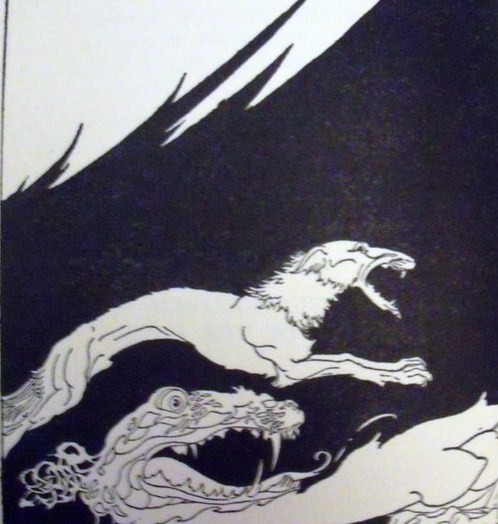
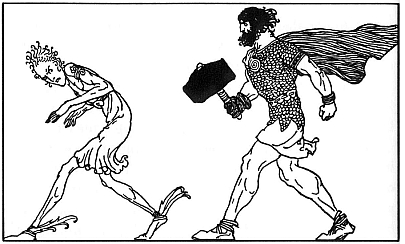
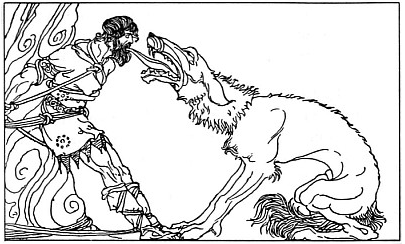
The text is somewhat coy about sexual matters -- lovers spend several days alone "talking" -- but amusingly Willy Pogany's illustrations are slightly less so, revealing the occasional gratuitous bare breast. Norse ladies are very stoic about the cold, I guess. I'm not sure why my edition was reissued with a cover by Melanie Parks with an iguana-looking thing on it. Pogany's illustrations look like this:
The edition shown is by the same publisher as my copy, but it was published in 1962. My copy has my mother's name in the cover, with the date "Sept. 1930," when she was ten years old. Published 1920, reissued 1929. Illustrated by Willy Pogany
August 19, 2017: Now showing the 1920 edition that I have. I didn't realize I'd added this one; was looking at this book since I just completed Neil Gaiman's recent one on the subject.
I enjoyed this book,and ended up taking quite a few notes, but when it came down to it, I am not sure that I quite liked how this book was organized. The myths were fascinating, but I feel there may have been a way to arrange them that would make everything easier to follow.
That being said, there's a lot to consider in this collection. Some things I jotted down as interesting:
I found Loki's role as the god of mischief turned evil fascinating. He started out neutrally troublesome and become something much more sinister. Super thought-provoking.
I loved the parallels I caught between the myths and stories we tell today; for example, the story of Brynhild and the similarity of fairy tales like Sleeping Beauty and Snow White (at least, until you get to the tragic Romeo and Juliet part). I even caught a little Arthurian thread in there (Sword in a tree, anyone?).
It was also awesome being able to trace some Tolkien imagery to ideas found in these myths. Never having read some of these stories, I didn't realize how heavily Tolkien had borrowed some of his ideas (A cursed ring? A treasure that turns a man into a dark creature? Where have I been?).
Other things weren't so much parallels as things I found interesting to ponder. For example, when Odin and Frigga wager on who is more kingly, and you can see the competition between wisdom and strength taking place in the myth. Wisdom wins, and yet, bravery is supremely important as shown in the story of the Valkyries, and Brynhild and Sigur.
You can also contemplate the price of a life in the story of Loki and the Otter... and yet the gods send Valkyries train men to die and take their places in Odin's Ragnarok army.
And okay, one last contradiction to ponder: Thor feels shamed when he dresses as Freya to fool the giants and Loki mocks him, and yet how many times does Loki borrow the falcon dress to change his shape?
Speaking of the giants, isn't it fascinating how much power giants, dwarves, and witches have over the gods themselves? I found it so. I kind of wanted to know more about the gods just so I could understand that better.
There's so much more I could write - I literally filled a page full of notes. I don't think I would be successful putting it coherently, though. I'm not sure THIS has been coherent. And while again, I didn't love the setup of this book, it definitely piqued enough interest that I will do some future research into Norse mythology. And I might work on my pronunciation of some of these Nordic names as well.
This entire review has been hidden because of spoilers.
While on vacation in Wisconsin, we happened upon a horse farm that specialized in Scandinavian horses. On a whim, we stopped in and learned all about the Gotland, Icelandic, Arland, and other varieties of Scandinavian horses. We also met Icelandic goats, chickens, and ducks. At any rate, the sign of this place, called Norse Horse Park on Washington Island in Wisconsin, featured a picture of Odin riding Sleipnir, his horse. This reminded me of the Norse mythological poems that we read in German class in high school. It was fascinating hearing those ancient stories then and that interest was rekindled. On our way back to the ferry at the end of the day, we stopped by a book store and I picked up this book. It is a selected series of stories that sort of weave the major mythological poems together ending in the Ragnorak (the war between the giants and the gods of Asgard). This was a fascinating read and I really appreciated having a chance to delve back into that world. It also provided an excellent tutorial for the movie, Thor. Not saying that the movie is accurate to the ancient tales, but I was able to explain certain aspects of the story to my wife as we watched the film. If you've read about the Greek and Roman gods, and liked learning about them, I would recommend jumping into Norse mythology. It's not as well known to most Americans but it's equally if not more interesting. They had/have truly interesting gods!
الكتاب جداً ممتع، ومدخل مسلي لأساطير شعب الفايكنق والساكسون. لوكي، ثور، فالهالا العظيمة: حرب نهاية العالم. كلها تأتي بشكل متسلسل وممتع للقارئ العادي: أظنها قصدت للناشئة. لكن هذا مايمنع المتعة والفائدة "المرتبه" لمعرفة الآلهة وتراتيبها والأساطير المرتبطة بها. وبالتالي خريطة مبدئية ومدخل ممتاز ومرتب للواحد حتى يتعمق بأساطير الساكسون ~~ هذا موقع عربي يشرح بعض الآلهة : ) http://www.schoolarabia.net/history/g...
Read aloud for my seven year old who can't get enough of Vikings/Norse mythology. Most of this was a repeat from the D'Aulaires with more details and elevated, archaic dialogue which I was surprised but pleased to find did not turn the kiddo off of it.
I also appreciated that the legend of Sigurd and Brynhild was included, which I was only vaguely familiar with. Beautiful and tragic.
I was once reading this book on a plane. Looking out the window while thinking in the beautiful simple prose of Colum's recounting, I could easily imagine the Norse gods and heroes amongst the clouds.
3.75/5 I listened to this as a free public-domain ebook on YouTube (https://www.youtube.com/watch?v=C4W34...). And that is a good way to experience this collection, because Colum uses a very “bardic” style – for example, repeating epithets like “Odin, the father of the gods”.
Mythology compilations are always a form of “re-telling”, especially in cases such as Norse mythology, where a considerable amount of scholarship and speculation has to go into trying to recreate what these stories were like pre-Christianization. Such efforts also often have the effect of making the myths and the timelines and relationships involved seem more cohesive than they really were. Just something to keep in mind when assessing which version “does it best”! In this case, Colum tries to arrange the myths into a relatively linear narrative, but there are places where that goes a bit wobbly – such as when it appears that Thor fishes up the World Serpent before Loki fathers it!
Speaking of Loki…this shape-shifting trickster is always the best part of any Norse myth collection! I particularly enjoyed the account of Thor and Loki’s “frenemies road trip”. This includes an incident when Thor’s hammer gets stolen, which results in big, muscly, heavily-bearded Thor dressing in drag as Freya to try and get it back, while Loki (the actual shapeshifter) goes along as “bridesmaid” – no doubt partly for the LOLs, but also to cover for Thor completely failing to act “ladylike”. For more on Loki’s confusing origins and role, I highly recommend this video (https://www.youtube.com/watch?v=ZDwQ3...). As Red points out, it is even hard to tell what Loki was really the god OF: “Lies and trickery were his personality, not his deific domain. Thor wasn’t the god of getting drunk and hitting stuff.”
This book was published in 1920, so perhaps it is unsurprising that Colum kind of glosses over both Loki’s more gender-fluid shenanigans as well as anything too directly to do with sex. But what IS surprising is the way he tees up that stuff before jumping over it! For instance, instead of just saying Loki turned into a mare to “distract” the horse of the giant building the wall around Asgard, we get some extensive horse flirting dialog…and then at some later point Odin just has an 8-legged steed, skipping over the bit where Loki gave birth to it! Likewise, when it comes to Freya getting the necklace of brisingamen, we get a whole scene where a bunch of dwarves promise to tell her where the giantesses who make special gold jewelry are if she spends the night with them, and wanting to kiss her…and then when she gets back to Asgard her husband is gone and refuses to be found. Call me crazy, but I think “my wife agreed to a dwarf gang-bang to get a necklace” is a much more relatable reason for that dramatic response than “dang it, I told you I don’t want shiny stuff in my house” which the narrative seems to be trying to pretend is the reason! Maybe you’re meant to read between the lines, but it felt like a slightly odd way of making one do that.
There’s more stories of human heroes than you normally get in collections of Norse god stories, particularly that of Sigurd. This is one part that clearly influenced Tolkien – as we see Sigurd claim a grey horse that is the best in the world, have his ancestor’s broken sword reforged, slay a dragon that was creating a “desolation” in the countryside around…and the return of a cursed ring from its horde. But it also links to other tales the reader may know! That broken sword was pulled by Sigurd’s ancestor from a tree (instead of a stone). Then there is Brunhilde, a Valkyrie who first falls into the role of “animal bride” - sort of. The warrior who steals her swan cloak appears not to be romantically interested in her (though…disclaimers given prior paragraph) but for her to act as his personal Valkyrie and help him win battles. She gets demoted to human for this, and requests to become Sleeping Beauty, so that she might get only the most badass husband. It is Sigurd who crosses Odin’s wall of flame to find her…but, perhaps due to that cursed ring, this story does not get a happy ending!
The book ends, as it begins, with “Ragnarok, the twilight of the gods”. IDK, there’s something anti-climactic about how that part is told. It is likely that Ragnarok wasn’t AS important in pre-Christian Scandinavia as it became afterward when it served to go “and all that’s in the past!” But if you set it up as your beginning and end for your retelling, it feels weird to rush through it!
Ah... Gods. They're as ridiculous and humorous as they are brutal and cruel, which is part of what appeals to me so much. This is rightly considered a classic and while Neil Gaiman still holds the throne for the most entertaining rendering of Norse Mythology, I greatly enjoyed this.
The Children of Odin was first published a hundred (!) years ago, so yes, the language isn't the most contemporary and catchy, but Colum carefully leads us through fifteen beloved tales from the gods and goddesses of Asgard. We meet Odin, the All Father on his hunt for wisdom, we learn how Thor received his mighty hammer and how Loki keeps coming up with ideas of how to get into the most trouble possible.
It's way darker than Neil Gaiman's retelling. Column's stories are mostly devoid of humour and I found the rather sober way of telling the story harder to focus on. I have to admit I had to reread several passages because my mind was drifting – something I probably can't blame Column for. Overall, I was surprised by how nonchalantly he portrayed Loki's mischievous demise, who over the course of the novel started to move into pretty sinister areas of morality. We don't really get to look into their heads, though and in his case specifically it would have been so interesting to find out about what's driving him.
Overall, these stories are so rich and creative. You will recognise a lot of familiar tales in these, as these stories have clearly inspired tons of things that came after, from other beloved authors like Tolkien to other fairy tales and sagas. There were also a lot of themes interesting to think about, such as the roles power, wisdom and knowledge play in our existences and what we do to possess them.
I think this would be a great starting point for those curious about Norse Mythology, as the stories are portioned into small bite-sized chapters and told in a linear manner. I've been familiar with most of these, but clearly am still a far shot from being bored by them.
The Children of Odin. Colum, Padraic (1881-1972), 1920.
"Jeez, Grandpa, what'd you read me this for?"
A clear, straightforward retelling of 35 Norse stories about Odin, Freya, Thor, Loki and the other gods and goddesses who lived in Asgard before the dawn of history. Includes The Ring of the Niebelungs.
With a drawing before each story by Pogany, Willy, 1882-1955. 271 pages.
All the heroes and most of the gods in the end, and the sun and moon are
Only the One True Hero can pull the sword from the tree. Only the One True Hero can wake the sleeping maiden.
Rick Riordan uses some of these stories in his Magnus Chase books, which have character development and an overall storyline.
The story of Ragnarok is true. It happened in 540 CE:
From /Children of Ash and Elm/ by archaeologist Neil Price: In the years 536 and 539/540, were two or more immense volcanic eruptions. p. 75 The second was Lake Ilopango, El Salvador. There may have been a third in 547. Dust veil curtailed plant growth. Endless winter. Famine, riots, civil unrest. p. 76. Worse in Scandinavia. Mean temperature fell 3.5ºC (6.3ºF). No crops in Norway & Sweden. Worst effects lasted 3 years. Impact lasted 80 years. p. 77. Survivors fought each other for what was left. Justinian plague 541 CE might have reached Scandinavia. Scandinavian population loss 50%. Many settlements abandoned.
Valhalla, hall of the slain, has 540 doors: out of each, 800 champions may pass. (Making 432,000 in all, for those keeping score at home.) pp. 170, 267, "The Valkyrie" and "Twilight of the Gods."
Simplified watered down versions of stories from the Eddas. This book seems to be aimed at a late elementary or jr. high school age reader. For that target audience this is a great introduction and would probably be the best thing you could buy if you were trying to picque a young persons interest in the Norse "Myths". If your an adult there are several other books on this subject that I would recomend over this one though.
I listened twice to try to understand. This is the first time I’ve gotten through the Norse myths. I tried D’aulaire’s a few times. It’s not my favorite, for some reason, though I definitely appreciated this reading for all the connections to Lewis and Tolkien and other fairy tales and myths. For example, I found it interesting Odin going to hell for three days to try to keep his good son from having to marry that witch in charge of hell, and then the son has to anyway (for nine days and nights he travels), but his son never comes back, so the resurrection parallel in the Gospel story is lost in this myth. I noticed a Sleeping Beauty kind of story, but that also has a sad twist at the end. Most of these stories don’t end happily.
პოეტური "უფროსი ედას" შემდეგ, პროზაულად დაწერილი ოდინის ამბებიც მშვენიერი იყო. თარგმანიც კარგია და ის ხარვეზები რაც გამოცემას თან ახლავს, საერთოდ უმნიშვნელო მგონია, რადგან ამ გამომცემლობას ძალიან ბევრი საინტერესო ჩანაფიქრი აქვს როგორც ვიცი ეზოთერული ლიტერატურის თარგმნის ამბავში. ასე რო, წარმატებები.
წიგნის წაკითხვის შემდეგ, შეგიძლიათ მთარგმნელის მიერ დაწერილი ძალიან საინტერესო ესსეც წაიკითხოთ, "ზიგურდის ინიციაცია": http://bit.ly/2rMLJOt
Literary, thorough, never in bad taste (characters limit themselves to kissing). But somehow not my favourite of the retellings; it's kind of like reading one of the more academic Bible translations. One interesting thing that is different from some of the others: Iduna's young daughter (not a character in any other book I have read) is told the stories of how things came to be, though not until partway through the book.
If I had a bookish middle schooler who had never read the Norse myths, but who could handle the thees and thous, I might choose this one.
Read this alongside my wife’s bookclub. For most of them, it was their first introduction to these stories, and seeing it from that perspective, I’m not sure I can recommend it to first-time readers. The author plays fast and loose with the pre-existing continuity, and changes some events so that the myths fit the continuity he formed. Not my favorite choice. This is probably best shown in how the Rhine maidens are mentioned during the sections about Sigurd even though I am positive they’re an invention of Wagner’s. It does portray the specter of Ragnarok well, and you have a good sense of what each character is about.
This book, comprised of Irish author Padraic Colum's retellings of classic Norse myths, was on the shelf in our apartment when we moved in. Having only encountered Norse mythology in the wonderful illustrated D'Aulaires' Book of Norse Myths, I thought it would be a good idea for me to reacquaint myself with these stories, which are referenced not infrequently in Scandinavian and Icelandic literature.
Colum's book is, as the cover claims, "very readable," although I found the choice to use a quasi-Old English throughout a little unnecessary. (The typical 'thees' and 'thous' and such became a bit grating after awhile, and don't really add significant gravitas of the Gods, either.) The story chronology also overlaps and reverses and reorients a fair amount, often owing to the structure of the myths themselves more than anything. This isn't actually a problem, rather it creates a sort of timelessness--especially in the early stories which characterize each god individually--and a sense of the scope of each immortal being's independent body of lore. Thor, for instance, has a really extensive set of his own myths and stories, many of which are related in this volume. Rather than be told in a strictly linear fashion, however, these tales tend to overlap and reference one another without entirely accounting for what happened in what order.
Overall, however, the organization of the myths into four sections--"The Dwellers in Asgard," "Odin the Wanderer," "The Witch's Heart," and "The Sword of the Volsungs and the Twilight of the Gods,"--creates a wonderful momentum and unity within stories which are, of course, linked, but were not perhaps originally told with such a coherent story arc in mind. As arranged here, the reader gets a clear sense of how simple acts have real resonance and lead to inevitable consequences, i.e. the barter of a sword for a wife, or the cruel, but seemingly innocuous act of killing an animal which leads to a compounding of events which eventually--literally-- bring on the end of the world.
Fate (with a capital 'F') is as much an actor in these stories as any of the characters, and yet each of the Gods and people involved are shown ways to avoid their grim fates, are frequently told point blank what will befall them if they choose one action over another. But that's really what makes these stories so moving and sympathetic in the end--they resonate so frequently with the very human shortsightedness and/or romantic weaknesses which lead even the most powerful and wise of beings to bring about their own downfalls.
The Children of Odin was a summer vacation read and well worth it. This is Padraic Colum's (an author) retelling of Norse myth and it seems much closer to the spirit and feel of the Eddas,et cetera, than Neil Gaiman's. Guess I don't go in for radical updates designed to suit the tastes of modern audiences. Give me epic epics, heroic heros and evil evil doers, Aye!
This is a great read. Being a Skandanavian I was especially interested in reading this book. This is nortic mythology at it's best. I recommend you all read it and enjoy and Be Blessed. Diamond
I’ve always been encapsulated by the stories of old Norse myths and this book was perfect for my learning more about the legends, myths and characters that I’ve only really brushed through film and random bits of speckled school knowledge. I recently read a Norse Mythology book by Neil Gaiman which lead me onto this one and it was a great building on the foundations of what I’ve learnt with this book which was detailed and went into further depth than those I’ve read before.
It held a great range of stories of Norse myths and some I hadn’t heard of before. I loved reading about the children of Odin, Loki’s cunning adventures and the story telling of the gods. Never thought I could be so interested in old mythology but it really held my interest and I loved it!
This book of Norse myths retold by the Irish poet Padraic Colum was a delightful read. My favorite version of the Norse myths that I have read is Neil Gaiman's, but this one is quite good in its own right, and I didn't want the book to end, or leave the mead hall. I really liked the vivid illustrations by William Pogany, and at the end of the book when Colum described, very poetically, the new heavens and new earth after Ragnarok, filled with the Sehnshuct joy C.S.Lewis wrote so poignantly about, and I found myself, filled with great hope and joy. This same great hope and joy must have been what some of my ancestors felt when telling stories around a campfire thousands of years ago.
Though a bit bowdlerized (as mentioned in the introduction) Colum’s retellings are lucid laced through with a poetic northern spirit. Definitely more evocative than Lancelyn-Green.
The Children of Odin: The Book of Northern Myths is exactly what the title says it is; a collection of several stories from Norse mythology. And, really, it's not that bad. I bought it at a train station because I needed something short and interesting to read. It fit those criteria, but little else.
This book is in serious need of a character list, or a family tree, or something. I'd really liked to have seen ten or twenty pages dedicated to certain characters, either in the front of back. Maybe a page-long description/picture/history of the major players or something. With the exception of the really big hitters (Odin, Thor, Loki), some of the names were kind of confusing (Frey, Freya, Frigg) or hard to pronounce (Svartalfheimr, Skidbladnir, Muspellsheimr) though, admittedly, these are hardly the author's fault.
Every story is short and easily digestible, and gives you a good idea of what's going on in the Norse Pantheon. Those who want to learn more about the family of Odin should definitely give it a look - especially if, like me, you're a fan of Odin in particular (he gets several chapters entirely to himself). If you're a fan of Thor from the Avengers, though... you might be in for a bit of a surprise (SPOILER: Loki is not Thor's brother).
Not a bad way to spent seven dollars or a few hours. But not the sort of book I'd be excited to sit down and spend an evening with.
4 stars [Folklore] Writing: 5 (Brilliant); Plot: 5 (Masterpiece); Originality: 5 and 2 (Watershed, but Slightly Derivative); minus 1/2 star for substantially altering tone of originals (even though admitted).
This compilation of Norse mythology was a great pleasure to read. I see now why Tolkien liked the subject. I broadly recommend it, as long as it is recognized as nothing more than interesting stories, the folklore of a self-destructive civilization that effectively ceased to exist when it converted to Christianity. In fact, these myths were first compiled by Icelandic chief Snorri Sturluson as a reaction to so many of his kin embracing the Good News.
Colum doesn't commit the literary sin of anachronism or a political agenda. This would be a great surprise in the modern day; but it was first published in 1920. And his writing is very well done epic style.
Edit: After having read Crossley-Holland, I realize what a departure Colum brought about. In Colum's version, Odin is actually wise, protagonists are noble, and the stranger magic is eschewed. In Crossley-Holland, Odin is a womanizer, bitter, and occasionally covetous, Thor is a childish braggart, and the "gods" have all the inanities of stronger versions of fallen Man. The reader must decide between accuracy or nobility when reading of the Norse gods.
Great myths, great mythology. Odin all-father attempts to create a harmonious world, but Loki, a trickster, a boarder-crosser, a half breed, introduces chaos, and the stories unfold. In exploit after exploit, Loki is dazzling to watch. Characters and themes emerge in cycles, with tensions growing greater with every gyre. Eventually, all the traps Loki laid in his life culminate in Ragnarok, the twilight of the Gods, and heaven and earth crumble. But what's this? Two greater worlds emerge. Perhaps the trickster Loki was not a force of destruction after all. He identified the holes in the flawed system of his time, and stretched them to create a greater system, much like he knotted string together to create the first net, capturing everything with nothingness. I love that this mythology ends with a glimpse of the Garden of Eden. This stresses the metaphorical nature of myth, and in these myths, that stresses the productive power of our imagination – to be able to destroy and rebuild and create something slightly more dazzling every time. If anyone would like my full notes on these myths for research, feel free to contact me.
A good introduction, but only that. The writing (by this time, although it was probably fine for when it was written) seems stilted. It got harder and harder to enjoy reading it the longer the book went on.
On the negative side, this book gives Norse mythology a story unity that it doesn't possess. On the other hand, it now has a unity that it hadn't possessed! So it reads as one long story, which can be good if that's what someone is looking for. One reason I didn't like it is that it seemed to do an injustice to the original myths this way. The Aesir lose at Ragnarok not because they are flawed, or have done anything wrong, but because they just can't stand up to the giants and monsters. Their nobility is that they know this and resist the forces of evil anyway. But in this book they slide down from a state of grace, as it were, into a more degraded state that makes their ending their own fault.
I do have to say that, stilted language or not, he DOES write a good Gotterdammerung! One of the best parts of the whole book.
This book provides a rather coherent set of Norse myths. The author ties the myths together so that they flow a lot better than your average compilation of random stories (which is my general impression of most mythology books).
The stories appear to have been selected to minimize contradiction. (As with any mythology, in Norse mythology there are many authors, resulting in inevitable confusion as they disagree over insignificant details like the names of the main characters.) They are also (well) chosen to present a chronological picture of the Norse gods and how they change. I was intrigued to learn that Norse gods, unlike those of many other mythologies (Greek, for example) actually change. Loki, in particular, changes dramatically through the stories.
All in all, I was very impressed. The author does a fine job of presenting the myths in a readable way.
I talked our school district into ordering this book for my Mythology class. I certainly haven't regretted it. We spend the second quarter of the semester class studying Norse mythology. This book is very accessible, even to the students who are dumped into the elective class just because there's nowhere else to put them. The myths are told in short story format, using simple but poetic language. Sure, the names throw the kids, but otherwise my high schoolers have no trouble with it.
They definitely are relieved to read this after nine weeks with Edith Hamilton's dry old Mythology book about the Greco-Roman gods!
I highly recommend this book as a classroom text, or as just a very good primer on Norse mythology.