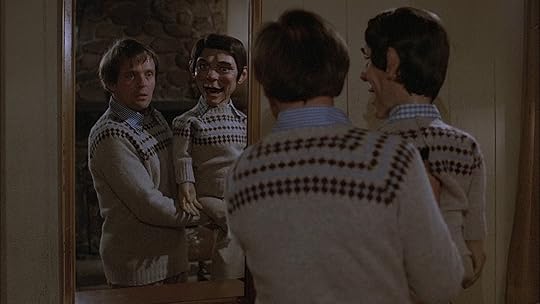
Goldman grew up in a Jewish family in Highland Park, Illinois, a Chicago suburb, and obtained a BA degree at Oberlin College in 1952 and an MA degree at Columbia University in 1956.His brother was the late James Goldman, author and playwright.
William Goldman had published five novels and had three plays produced on Broadway before he began to write screenplays. Several of his novels he later used as the foundation for his screenplays.
In the 1980s he wrote a series of memoirs looking at his professional life on Broadway and in Hollywood (in one of these he famously remarked that "Nobody knows anything"). He then returned to writing novels. He then adapted his novel The Princess Bride to the screen, which marked his re-entry into screenwriting.
Goldman won two Academy Awards: an Academy Award for Writing Original Screenplay for Butch Cassidy and the Sundance Kid, and an Academy Award for Writing Adapted Screenplay for All the President's Men. He also won two Edgar Awards, from the Mystery Writers of America, for Best Motion Picture Screenplay: for Harper in 1967, and for Magic (adapted from his own 1976 novel) in 1979.
Goldman died in New York City on November 16, 2018, due to complications from colon cancer and pneumonia. He was eighty-seven years old.
As I love stories/movies on ventriloquist dummies with a certain life of their own I definitely had to read this book and wasn't disappointed. You read a lot what it takes to become a good magician and wonder till the end if Corky (the main character) is schizophrenic or if Fats (the dummy) has an uncanny life on his own. The ending of the novel will leave you with your mouth open. I can only recommend this forgotten eerie classic. There were shivers running down my spine on some pages.
This novel was a lot of fun. There's an evil vent dummy, (just look at that face on the cover!), and a somewhat wishy-washy magician. Put them together and what have you got? A total blast!
This book seems a little tame compared to the horror that abounds today, but back in the 70's when it was written, I'm sure it was a shocker. And perhaps because I was a criminal profile junkie back in the day, the origins of the psychological issues in this story didn't quite ring true for me. But geez, it's a vent dummy story, right? Lighten up.
In that regard, this tale hits all the right notes. It's entertaining, fast paced and compelling. Goldman is also the author of The Princess Bride and The Marathon Man, so the guy knows how to write a story and this one is no exception.
If you're looking for a tale about a magician and a dummy, and you're not going to think too hard about it because you just want to have a good time, this is the book for you! Grab it and see if you can see the ventriloquist’s lips move! I dare you.
An insane magician/ventriloquist and his bloodthirsty dummy redefine what it means to kill onstage – and off!
William Goldman’s Magic is a fairly decent horror novel. It definitely has its faults but it’s also quite charming and entertaining in a trashy way.
I found the book’s disjointed narrative structure to be unnecessarily messy and frustrating. The first third is written in such a way as to hint that Corky, our protagonist, is a vampire for seemingly no reason?! Obviously he’s not and it’s never brought up again so I have no idea what Goldman was thinking. Maybe the effect he was going for was a kind of literary misdirection meant to mirror stage magic craft, making you think Corky’s one kind of monster but he’s actually another? It just felt so silly and pointless. However it does effectively set the horror tone of the narrative and the police report extracts tantalisingly build up the reader’s expectations for what’s to come.
The middle third is an overlong flashback to Corky’s early life and is by far the dullest part of the book. I suppose it’s necessary for giving Corky his contrived romance motivation later in the story but it fails to establish where he got the idea to become a magician, which you’d expect to be included in this extended origin! Instead, most of it is a dreary and largely irrelevant section full of stereotypical, clichéd characters – the jock, the preppy girl, the nerd – that, like the vampire stuff, doesn’t go anywhere, which is unsatisfying.
Corky learning magic wasn’t very interesting either – there’s a huge difference between seeing magic performed and reading descriptions of the tricks! Then, just as suddenly as we were yanked back into the past, we’re thrown into the future, a year down the line, where Corky’s been transformed from a struggling magician into a successful headliner as a magician/ventriloquist with mouthy puppet Fats. Wait - where did the puppet angle come from? Like Corky stumbling into magic, it’s yet another arbitrary storytelling choice!
And I think this is the book’s biggest failing: the lack of depth Goldman provides. We don’t know why Corky becomes a magician, how he makes the fateful decision to become a ventriloquist, why he’s unable to get over his schoolboy crush, and, crucially, we don’t know why Corky starts killing. He goes from being the archetypal nerd to a crazy serial killer and the change is bafflingly sudden and totally unconvincing. The story is compelling but Goldman is completely unable to explain key plot points to have it make any sense.
The romance is kinda cheesy and flat and the blue humour is very dated and not at all funny but once Corky starts unravelling and Fats takes over, it becomes an engaging read. It’s also helped by being very breezily-paced, easy to read and, because of the earlier foreshadowing, the prospect of murder and madness and waiting to see what would derail Corky kept me turning the pages fast. And, as a horror fan who grew up reading Goosebumps and Stephen King, the setup of a crazy ventriloquist and his killer dummy, as goofy as it undeniably is, was appealing.
Like other pulpy horror fiction such as Robert Bloch’s Psycho and Ira Levin’s Rosemary’s Baby, William Goldman’s Magic has a strong premise that doesn’t quite stretch to book length and its execution is a bit too shallow to make it a great book. The plotting is flawed and the story isn’t consistently interesting but Corky is a compelling lead character and the book overall is competently written with momentum and enough intense scenes to make it a fun read worth checking out for horror aficionados.
Was Corky's ailment a metaphor for alcoholism or some other addiction? Or was Fats a futuristic prediction of online personas which are drastically different from the real life persona of an individual? Fats could well be a supernatural entity. There are demons lurking at the borders of our sanity. Letting them in might be satisfying. For a while. I remember loving the hell out of this book and the movie starring Anthony Hopkins.
There is something sadistic about reading an account of a supremely talented man slowly losing his marbles. Who wants to read a book about someone who actually figures things out? Magic has some elements or motifs that I like. A tormented man returning to his home town. And then meeting a blast from the past. I wonder why this book isn't more famous. I mean it was really good.
I discovered Magic in a second hand Mumbai book stall on the street. My mother recently put all my old books into a large sack due to termite attacks at my parents house and stuffed the sacks inside a cupboard. Yes, so many unread books because I am just a hoarder when it comes to books, like an Indian woman who collects saris. Man, it would be so hard to find this book which is lying buried inside one of the sacks. There are around six sacks of books. I feel like digging Magic up.
Better than a third of this book had me bewildered about what was going on - there was a story there, albeit 'differently' told - but I could not see where it was going. It was going into a twist, and then it really took off. Much more coherent storytelling (but not without quite a few unorthodox takes) in the second half and by then the chill factor has really set in. Tops off with a plausible and good ending. I really liked this sometimes oddly told (not always linear time, thoughts merge into speech which merges into third person narrative) and short chiller.
Corky continued to breathe heavily. “You can talk now, say whatever you want, as long as I want you to, when I’m bored, we’ll play some more.” “Lis—” “—I’m bored, let’s play, get the knives.” “Knives?” “The Duker’s, go get ’em.” Corky went to the kitchenette, brought out the knives. “What do you think we ought to do with ’em?” Fats said. “Want me to whittle something?” “Maybe.”
I vividly remember watching the 1978 film based on this book starring Anthony Hopkins for the first time in the 1990s, and the second time about ten years later, and it is incredible that it has taken me this long to read the actual book.
There is something odd about the book. It is as creepy and gripping as the film, but I can't say that I enjoyed the writing. The writing seemed somewhat choppy. However, this is a pulp fiction novel and it does fit in with my expectations of what a mid-1970s pulp thriller / horror novel would read like. It would be interesting to read Goldman's Marathon Man at some point just to find out if his style varies in a different story of a similar genre.
Still, despite the disjointed narration, it was a pleasant surprise to find that Peggy, the "love interest", was an interesting character that had more to her than physical attraction. I liked how she got a voice in the book, even tho she was not the focus of the story. “Get this please: I’m leaving, and you’re leaving, so it happens we’ll go together but I’m not running out on Duke because he’s at the bottom, I’m going because I’m at the bottom, so it happens by coincidence that you and I are heading the same direction, out, and if it works that we stay headed that same direction, terrific, but if it doesn’t, the world’s not ending for me, which is what I was afraid of, going off and leaving one guy and then getting dumped by another and not having the first one around to take me back but that’s no problem, not anymore, ’cause if I get dumped, I’m not coming back.”
I am not even sure why I was so surprised to find that her character had a mind of her own. Maybe it was my bias with respect to books written in the 70s, maybe something else, but I enjoyed the little sub-plot that Peggy's thoughts created. “… huh …?” “… it was you all the time …” “… you sure …?” “… trust me for a while …”
Description: Starting out as a boy in the Catskills, Corky develops into a brilliant and famous magician whose long-hidden secret and expert skills attract dark forces intent on destroying him
This is an old favourite of mine; perhaps a little dated now, but no more than, say, CARRIE (and I think that adds to its noir appeal). Sparse, punchy and peopled with the kind of characters that transfer naturally to the screen, it's a terrific piece of proto-screenwriting and a masterclass in the art of the unreliable narrator. It's also a stonking illustration of the artist's condition; his relationship with his audience; his need to be loved; his passion; that sense of weird duality all artists, performers (and writers) know. And Fats, of course, is tremendous; trollish, funny and sinister; a terrific foil to Corky's shy and adolescent act. To me, it's the same underlying metaphor as Stephen King's THE DARK HALF, but more concise, and omitting the supernatural aspect. Because, let's face it, people are far more frightening than ghosts, and the mind is a hall of mirrors darker than any carnival ride.
Tight, engaging prose that is somehow both economic and colorful really made this thing a page turner for me, even though I just watched the movie a few weeks back - which I loved. Everything in the film, though, is also in the book, with scenes and dialogue often lifted wholesale, but here you get a whole lot more, and the tension plays out just as strongly, but in different parts. Both are great on their own, and they're also great together. Two creepy mannequin thumbs up.
-Muy logrado en la técnica para expresar un grave y peligroso desorden.-
Género. Novela.
Lo que nos cuenta. Un anciano cazador oye gritos cerca de una cabaña y se acerca con precaución y temor… Fats es un muñeco que Corky usa en sus espectáculos de ventriloquía y que está muy preocupado por cómo el éxito está afectando a Corky, al que nota cada vez más melancólico, callado y quizás desequilibrado. Fats y Corky anotan sus pensamientos en un diario, registrado como prueba policial para algún tipo de investigación que todavía no queda clara, y Fats trata de saber más sobre los encuentros sexuales de Corky con algunas mujeres cuyo final tampoco queda claro. Corky Withers perdió muchas cosas en su infancia y siempre buscó el cariño de los demás, especialmente el de Peggy Ann Snow, agradable muchachita de su colegio.
¿Quiere saber más de este libro, sin spoilers? Visite:
“I'm very gentle," Corky said, very gently. Then: "All my victims say that."
Corky Withers is a rubbish magician and a bit of a loser. Join him and his sinister dummy Fats, on a chilling descent into madness. Quality psychological thriller / love story. A bit confusing at the beginning but it's worth it for the utterly brilliant dialogue between Corky and Fats. A zillion times better than the film, and I liked the film.
well, goldman's not much of a stylist, but he sure knows how to tell a story... granted, it's a pretty goofy story much of the time, and feels really dated and robert zemeckis-y, but as soon as that psychotic ventriloquist's dummy starts talking, the flaws are quickly forgotten as the whole book becomes seriously and legitimately disturbing, way more so than the phrase "psychotic ventriloquist's dummy" might lead one to expect.
Just a fabulous read. A difficult to find book, but well worth the effort. Goldman shows why he's a master storyteller. The book--while exceedingly similar to the film since Goldman translated it for the screen--offers a few new insights into the characters of Corky and Fats, and even offers up to the reader the possibility that one of the two of those characters was sane. Which one it was is anyone's guess. Was it Fats? Was it Corky? This unusual slant on the book is no where to be found in the movie, and is one of the things that I found made the book so much more intriguing. Though, I must admit, it was difficult to read without having Hopkins, Margret and Meredith in mind for the characters.
Loved it. If I had anything bad to say about it at all it's that some of the dialogue, humor, and "pop culture" references are dated (the 70s), but this is one fine psychological thriller.
I think William Goldman is a genius of a writer for the screen. “Butch Cassidy and the Sundance Kid,” “Misery”, “The Princess Bride” and others are wonderful movies, due in large part to the man who wrote the screenplays. But I had never read him in book form (not even “The Princess Bride”—and don’t give me that look!).
But probably my favorite movie of his is the 1978 film, “Magic.” "Magic" is one of those really great movies that nobody knows about, starring Anthony Hopkins, Ann-Margret and Burgess Meredith, so when I saw that the original novel was available on Nook, I snapped it up and I was not disappointed.
This is a great, suspenseful read about a magician/ventriloquist who flees fame to "get his head on straight" by returning to his childhood home. I don't want to give more away, because there are plenty of exciting surprises, but if you know the movie, you'll find it was quite faithful to the book.
I would have given this five stars, but I had to take one away for the condition of the eBook. It looks as though whoever put this together just scanned the pages from the book and then didn't bother to correct the things that the computer couldn't quite make out. Sometimes the main character's name was "Corky"--which is correct--but many times, it was "Gorky." He went to the Catskills, but sometimes he was suddenly in the "CaHills". The errors were frequent enough to jog me out of the flow of the narrative.
If you want a gripping, fairly quick read, you would be hard-pressed to find much better than this.
Honestly I couldn't finish this book...Not because it wasn't an excellent story but because I saw the movie all those years ago and felt it was a waste of time to finish reading. Of course it was well written and worth the time I spent on it. I read it as a book of the month selection from one of the groups I belong to here on Goodreads.
this was so well written! lots of emotional build up, surprising how little happened but it hit hard when it happened because of the wait. corky freaked me out, and i hate fats so much!!! i didn’t like peggy either!!!! but wtf!!!! very good tension. i’m just shocked at that ending, didn’t expect that at all.
This is one of those books that reveals something about 100 pages in that makes you want to flip back to the beginning in order to reread everything with that new information in mind. Which makes it a great read, but extremely hard to review without spoiling that fun for someone else. So bear with me!
I picked up Magic (and Marathon Man, which I'll be reviewing later this week) after listening to As You Wish, in which Cary Elwes mentions William Goldman's other works. I've only ever read The Princess Bride, but I loved that, so I thought I'd dive into some other Goldman. I was not disappointed, although I was certainly surprised, as Magic is about as far from The Princess Bride as you can get.
Corky grew up a bit bullied and unhappy, until he discovers how much enjoys performing magic. Still, he struggles with that for years, until adding a partner to his show. Then his career takes off. Still, he's never been able to get over a girl from high school. When he has an opportunity to spend a bit of time with her, he takes it -- despite the secret about his show that he's been struggling to hide for years.
I know, my description could not be more vague. But it's a story best started with little-to-no knowledge of what's going to happen. And if you like suspense novels at all, you should definitely read it.
Magic is a 70s thriller with one of those unreliable narrators where after the first twist is revealed you want to immediately flip back and re-read to see if you could've, should've, caught on sooner. (Probably if you've seen certain book covers or watched the movie, you won't be shocked. I was.) Goldman, author of The Princess Bride, sure knows how to write a page-turner; I didn't wanna stop once I started. A surprise ending, too.
My reading selection was slim pickin's during my semester in Rome, and the version of this book I read had a creepy picture of a ventriloquist's dummy on the cover and a fairly cheesy writeup on the back, which my friend Chris read aloud until I was pretty much on the floor laughing. I think both of us read this book. It wasn't half bad, but Wow! The movie IS bad. Even Anthony Hopkins couldn't save that one. The climax is killer.
Very disturbing, in a great way. I remember when it dawned on me just who Corky was talking to -- I thought he was his agent. Creeps galore!
I also recall putting a real knife from the kitchen on top of the knife on the cover of Sharon's copy (we'd been using it to strip speaker wire as we set up her stereo). That creeped her out a bit *too* much.
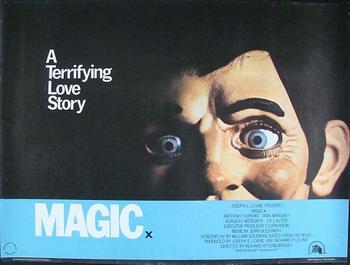
Truly a terrifying love story. The magician in this book has a heart of gold but unfortunately also suffers from terrible madness. He gets fame. He gets the woman he loves but at what price? RIP Mr. Goldman your amazing imagination will be missed.
If this were full on horror I’d probably be giving it a five but as it stands, this is about as good as it gets for evil dummy tales (and that one Twilight Zone episode)




 Watch here