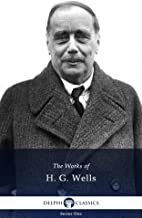
This comprehensive eBook presents the complete works or all the significant works - the Œuvre - of this famous and brilliant writer in one ebook - 25480 pages easy-to-read and • The Time Machine• The War of the Worlds• The Invisible A Grotesque Romance• The Island of Doctor Moreau• A Short History of the World• The Red Room• Tales of Space and Time• Little Wars; a game for boys from twelve years of age to one hundred and fifty and for that more intelligent sort of girl who likes boys' games and books.• The First Men in the Moon• The World Set Free• The Door in the Wall, and Other Stories• The Country of the Blind, and Other Stories• Twelve Stories and a Dream• When the Sleeper Wakes• The Outline of Being a Plain History of Life and Mankind• Ann A Modern Love Story• Tono-Bungay• The Time Machine• Astounding Stories of Super-Science January Various• The Food of the Gods and How It Came to Earth• Text Book of Biology, Vertebrata• The Pivot of CivilizationMargaret Sanger• Anticipations• The Sleeper Awakes• Astounding Stories, May, Various• A Modern Utopia• The Wheels of A Bicycling Idyll• The Stolen Bacillus and Other Incidents• The War in the Air• Mr. Britling Sees It Through• Floor Games; a companion volume to "Little Wars"• Kipps• The New Machiavelli• The History of Mr. Polly• God, the Invisible King• The Invisible A Grotesque Romance• Marriage• Masterpieces of American Wit and Humor• The Sea Lady• In the Days of the Comet• With the World's Great Travellers, Volume• The Discovery of the Future• The Secret Places of the Heart• What is Coming? A Forecast of Things after the War• Love and Mr. Lewisham• The Wonderful Visit• The Time Machine• Little Wars (A Game for Boys from twelve years of age to one hundred• Boon, The Mind of the Race, The Wild Asses of the Devil, and The Last Trump;• Mankind in the Making• War and the Italy, France and Britain at War• The Passionate Friends• The War of the Worlds• The Salvaging Of Civilization• The Island of Dr. Moreau• An Englishman Looks at the World• The Research Magnificent• First and Last A Confession of Faith and Rule of Life• New Worlds For A Plain Account of Modern Socialism• The Soul of a Bishop• Certain Personal Matters• The Plattner Story and Others• Select Conversations with an Uncle (Now Extinct) and Two Other Reminiscences• Maxims and Opinions of Field-Marshal His Grace the Duke of Wellington, Selected From His Writings and Speeches During a Public Life of More Than Half a CenturyDuke of Arthur Wellesley Wellington• The First Men in the Moon• The Invisible A Grotesque Romance• The War of the Worlds• War of the Worlds• Little Wars• Twelve Stories and a Dream• In the Fourth Anticipations of a World Peace• The Wife of Sir Isaac Harman•. etc.
Herbert George Wells was born to a working class family in Kent, England. Young Wells received a spotty education, interrupted by several illnesses and family difficulties, and became a draper's apprentice as a teenager. The headmaster of Midhurst Grammar School, where he had spent a year, arranged for him to return as an "usher," or student teacher. Wells earned a government scholarship in 1884, to study biology under Thomas Henry Huxley at the Normal School of Science. Wells earned his bachelor of science and doctor of science degrees at the University of London. After marrying his cousin, Isabel, Wells began to supplement his teaching salary with short stories and freelance articles, then books, including The Time Machine (1895), The Island of Dr. Moreau (1896), The Invisible Man (1897), and The War of the Worlds (1898).
Wells created a mild scandal when he divorced his cousin to marry one of his best students, Amy Catherine Robbins. Although his second marriage was lasting and produced two sons, Wells was an unabashed advocate of free (as opposed to "indiscriminate") love. He continued to openly have extra-marital liaisons, most famously with Margaret Sanger, and a ten-year relationship with the author Rebecca West, who had one of his two out-of-wedlock children. A one-time member of the Fabian Society, Wells sought active change. His 100 books included many novels, as well as nonfiction, such as A Modern Utopia (1905), The Outline of History (1920), A Short History of the World (1922), The Shape of Things to Come (1933), and The Work, Wealth and Happiness of Mankind (1932). One of his booklets was Crux Ansata, An Indictment of the Roman Catholic Church. Although Wells toyed briefly with the idea of a "divine will" in his book, God the Invisible King (1917), it was a temporary aberration. Wells used his international fame to promote his favorite causes, including the prevention of war, and was received by government officials around the world. He is best-remembered as an early writer of science fiction and futurism.
He was also an outspoken socialist. Wells and Jules Verne are each sometimes referred to as "The Fathers of Science Fiction". D. 1946.
The Time Machine: *** A classic, even though it's not my favourite story. The Wonderful Visit: *** What a nice surprise, Wells can do humour, too. An angel arrives in a quiet, normal, decent village in England, and his behaviour it's a scandal. The Island of Doctor Moreau: **** Again, a classic masterpiece. But I like it more than the Time Machine, I think it digs deeper into the human hubris. The Wheels of Chance: ** I get the humour... sometimes. I think that the satire in The Wonderful Visit is much better. The Invisible Man: *** Sadder than I remember, I read it many years ago in Italian. Again, a deranged scientist makes a discovery that could change the world, but it gets to his head and everything ends badly. The War of the Worlds: **** A classic, although some passages are heavy, a little too dense.
While his longer novella are interesting, his early works feel dry and shallow. Perhaps this is to be expected of short stories originally submitted to magazines as well as the relatively tame premises of some of the novels (plant grows big and has poison that kills person) for example is also to be expected but most didn’t interest me today.
I most enjoyed (excluding his most famous work) the story based on the saying “In the valley of the blind then one eyed man is king”. I’d recommend this above all else.
This is a massive collection and hence somewhat unwieldy, but what a treasury of influential works! Each of Wells’ novels is given a short anonymous introduction, which gives some of the context of the times, as well as a few illustrations, mainly images of first editions.
“The Time Machine” - A curious novella with two unnamed first person narrators. One bookends the other. The former has too little time to make an impression whilst he tells the reader the tale related to him, the latter, who relates his time travelling adventure to the former narrator, is deeply unsympathetic. The author’s imagination was grounded in the cutting edge science of the time (1895), but his social extrapolations reflect the prejudices of the time. An important seminal novel, but a merely adequate read. 3/5.
“The Wonderful Visit”
“The Island of Doctor Moreau”
“The Wheels of Chance”
“The Invisible Man” - I have separately read and commented on this novel.
“The War Of The Worlds” - What an iconic opening! This novel is very much of its time (serialised in 1897), but also strikingly modern in its unflinching and highly realistic description of chaos, which makes it a thrilling read to this day. It anticipates robotic machinery, mechanised warfare, chemical weapons, total war, and displaced populations. Such scenes are suggestive of the horrors of the first and second world wars, but imagined far beforehand. It establishes the trope of aliens as hideous predators and farmers of human cattle, and anticipates all post apocalyptic fiction published since with its plans for resistance and survival. It’s really interesting how the author comments on how slowly the realisation of the attack spreads in a Britain without modern communications (in remarkable contrast with every radio, film, and television adaptation since). Clearly he is aware this lack of communication is humanity’s greatest weakness at the time, and contrasts it with Martian telepathy. A work of genius. 5/5.
The best of the best from an author who had to have been psychic and maybe a little crazy. Readers can find The Invisible Man, The Island of Doctor Moreau, The War of the Worlds, The Time Machine (My personal favorite), In the Days of the Comet, The First Men in the Moon, The War in the Air, and a half dozen more great stories in this collection.
I've known most of these stories since I was still in primary school and I know that a lot of younger readers probably won't pick up a book of this time frame because they might think that it doesn't have all the action and aliens but it's got everything. I look upon Wells as the father of modern sci-fi ,
I read some of the stories until they started getting bad. Not everything he wrote was a winner. When he's good, he's great. When he's not, well.... IMHO Wells starts very good at the beginning of his career but his later books are less interesting.