

What do you think?

After You'd Gone
AFTER YOU'D GONE is the groundbreaking debut novel from the Costa Award winning Maggie O'Farrell, author of THIS MUST BE THE PLACE and THE HAND THAT FIRST HELD MINE. It is a stunning, best-selling novel of wrenching love and grief.
A distraught young woman boards a train at King's Cross to return to her family in Scotland. Six hours later, she catches sight of something so terrible in a mirror at Waverley Station that she gets on the next train back to London.
AFTER YOU'D GONE follows Alice's mental journey through her own past, after a traffic accident has left her in a coma. A love story that is also a story of absence, and of how our choices can reverberate through the generations, it slowly draws us closer to a dark secret at a family's heart.
A distraught young woman boards a train at King's Cross to return to her family in Scotland. Six hours later, she catches sight of something so terrible in a mirror at Waverley Station that she gets on the next train back to London.
AFTER YOU'D GONE follows Alice's mental journey through her own past, after a traffic accident has left her in a coma. A love story that is also a story of absence, and of how our choices can reverberate through the generations, it slowly draws us closer to a dark secret at a family's heart.
386 pages, Kindle Edition
First published April 6, 2000
About the author
Maggie O'Farrell
48 books21.1k followersMaggie O'Farrell (born 1972, Coleraine Northern Ireland) is a British author of contemporary fiction, who features in Waterstones' 25 Authors for the Future. It is possible to identify several common themes in her novels - the relationship between sisters is one, another is loss and the psychological impact of those losses on the lives of her characters.
Ratings & Reviews
Friends & Following
Create a free account to discover what your friends think of this book!
Community Reviews
Displaying 1 - 30 of 2,670 reviews

October 7, 2018
I could probably read O’Farrell’s grocery list and be mesmerized—I just can’t keep my eyes off her words. They make me relaxed and excited at the same time. This is the fourth book I’m read of hers in the past couple of months, which says something, because I like to sit down with a variety of writers. Once in a blue moon, I’ll read two books by the same author in a year, but no more.
In her other books, O’Farrell makes these gigantic, run-on lists telling us what’s happening. I just love that style. She doesn’t do that in this debut novel, however, but I can see why this book set off her career. She knows how to reel you in, right away.
Behold her first sentence:
“The day she would try to kill herself, she realized winter was coming again.”
I don’t know about you, but I was all ears, pronto-like. Besides a sentence that slays me, everything else is right too. Her language is beauteous, the plot is tight, the atmosphere is vivid. And the best part, for me, are the hefty characters and their thoughts.
Most of the airtime goes to Alice, a young woman in love, although we also hear about her grandmother and mother. I like everything to be a surprise for the reader, so I’m just going to say that the book is about love, grief, and a secret. Oh, O’Farrell and her secrets!
Here is Alice’s secret, which sets up the mystery at the beginning of the book:
“…she saw something so odd and unexpected and sickening that it was as if she’d glanced in the mirror to discover that her face was not the one she thought she had.”
Okay, zap, you’ve got me, Ms. Maggie. You have me right in the palm of your hand, as usual. We don’t find out what Alice saw until the end of the book, which could have pissed me off. But the story is so damn interesting, I waited patiently. The ride there was worth the price of admission.
O’Farrell’s style is unique. She seamlessly mixes up time periods and types of narration, often right in the middle of a page, with no hint that you’re going into another universe. I’ve seen this in all the books of hers I’ve read; I’d say it’s her signature. She does it brilliantly, weaving several stories together with ease, and keeping up the intensity of each storyline. I feel like she has some sort of writing trick up her sleeve. The changes are abrupt, yet your mind makes the switch, lickety-split. Sometimes the point-of-view changes (and the type of narration, too) while everyone is in a room together, so we get to see the action from multiple people, in multiple ways. All very skillfully done. I’ve shoved this book into the hands of lovers of linear, and they’ve liked the book despite their need for sequential.
There were two things that screamed “debut.” First, occasionally (thank god, only occasionally) there’s a self-conscious creative-writing-class sentence, like this one:
“The vibrations of Annie’s strenuous efforts travelled across the table and up the twin-violin-bow bones of Alice’s forearms to reverberate in her cranium.”
Oh come on! Really? Good thing I’m already a big fan, or that sentence might have sent me running. I’m betting O’Farrell worked a long time on that sentence. Personally, I think she should have killed this little darling like any good writing manual would urge.
The other thing the debut detector turned up: A logistical mess that happened right at the beginning. We’re at a train station with Alice, her two sisters, and two small kids. Was one kid holding a hand the whole time? The hand of which sister? Who had the baby? The group hug with three sisters and two kids—hard to picture. I had to read it several times. My mind couldn’t see it because it was a blob of an interaction, and I couldn’t untangle it or the bodies trying to hug each other. The editor must have been snoozing. But the good news is that it was an isolated incident.
I’ve seen some reviewers call this chick lit, but I beg to differ. For one thing, I had to look up many words—you don’t often find killer vocabulary in chick lit. Plus, O’Farrell’s plots are intricate, complicated, and interwoven, also something you don’t often find in chick lit. This is not to say I don’t like chick lit—I do. I just think of this as literary fiction is all.
A silly aside—I know I shouldn’t go by appearances, but I do sometimes: That “you’d” in the book title bugs the hell out of me. It’s not just visual, though; I don’t like the sound either—it’s too deep-sounding and mean. (It rhymes with “booed”—maybe that’s my problem.) Plus, I don’t like contracting the word “had.” Never have, never will. It just sounds wrong, and I cringe every time I see the title.
This book is comfortable and entertaining. It’s not as wonderful as I Am, I Am, I Am or The Vanishing Act of Esme Lennox, but it’s a good read. O’Farrell fans won’t be disappointed. I doubt I’ll remember the details of the story (like I will with Esme), but the book soothed me. It got me through the Kavanaugh week.
In her other books, O’Farrell makes these gigantic, run-on lists telling us what’s happening. I just love that style. She doesn’t do that in this debut novel, however, but I can see why this book set off her career. She knows how to reel you in, right away.
Behold her first sentence:
“The day she would try to kill herself, she realized winter was coming again.”
I don’t know about you, but I was all ears, pronto-like. Besides a sentence that slays me, everything else is right too. Her language is beauteous, the plot is tight, the atmosphere is vivid. And the best part, for me, are the hefty characters and their thoughts.
Most of the airtime goes to Alice, a young woman in love, although we also hear about her grandmother and mother. I like everything to be a surprise for the reader, so I’m just going to say that the book is about love, grief, and a secret. Oh, O’Farrell and her secrets!
Here is Alice’s secret, which sets up the mystery at the beginning of the book:
“…she saw something so odd and unexpected and sickening that it was as if she’d glanced in the mirror to discover that her face was not the one she thought she had.”
Okay, zap, you’ve got me, Ms. Maggie. You have me right in the palm of your hand, as usual. We don’t find out what Alice saw until the end of the book, which could have pissed me off. But the story is so damn interesting, I waited patiently. The ride there was worth the price of admission.
O’Farrell’s style is unique. She seamlessly mixes up time periods and types of narration, often right in the middle of a page, with no hint that you’re going into another universe. I’ve seen this in all the books of hers I’ve read; I’d say it’s her signature. She does it brilliantly, weaving several stories together with ease, and keeping up the intensity of each storyline. I feel like she has some sort of writing trick up her sleeve. The changes are abrupt, yet your mind makes the switch, lickety-split. Sometimes the point-of-view changes (and the type of narration, too) while everyone is in a room together, so we get to see the action from multiple people, in multiple ways. All very skillfully done. I’ve shoved this book into the hands of lovers of linear, and they’ve liked the book despite their need for sequential.
There were two things that screamed “debut.” First, occasionally (thank god, only occasionally) there’s a self-conscious creative-writing-class sentence, like this one:
“The vibrations of Annie’s strenuous efforts travelled across the table and up the twin-violin-bow bones of Alice’s forearms to reverberate in her cranium.”
Oh come on! Really? Good thing I’m already a big fan, or that sentence might have sent me running. I’m betting O’Farrell worked a long time on that sentence. Personally, I think she should have killed this little darling like any good writing manual would urge.
The other thing the debut detector turned up: A logistical mess that happened right at the beginning. We’re at a train station with Alice, her two sisters, and two small kids. Was one kid holding a hand the whole time? The hand of which sister? Who had the baby? The group hug with three sisters and two kids—hard to picture. I had to read it several times. My mind couldn’t see it because it was a blob of an interaction, and I couldn’t untangle it or the bodies trying to hug each other. The editor must have been snoozing. But the good news is that it was an isolated incident.
I’ve seen some reviewers call this chick lit, but I beg to differ. For one thing, I had to look up many words—you don’t often find killer vocabulary in chick lit. Plus, O’Farrell’s plots are intricate, complicated, and interwoven, also something you don’t often find in chick lit. This is not to say I don’t like chick lit—I do. I just think of this as literary fiction is all.
A silly aside—I know I shouldn’t go by appearances, but I do sometimes: That “you’d” in the book title bugs the hell out of me. It’s not just visual, though; I don’t like the sound either—it’s too deep-sounding and mean. (It rhymes with “booed”—maybe that’s my problem.) Plus, I don’t like contracting the word “had.” Never have, never will. It just sounds wrong, and I cringe every time I see the title.
This book is comfortable and entertaining. It’s not as wonderful as I Am, I Am, I Am or The Vanishing Act of Esme Lennox, but it’s a good read. O’Farrell fans won’t be disappointed. I doubt I’ll remember the details of the story (like I will with Esme), but the book soothed me. It got me through the Kavanaugh week.

October 19, 2025
Reading O’Farrell is like wrapping yourself in a warm, cozy blanket.
Alice is in a coma. As she slips in and out of consciousness, her memories are sharp as she recalls her past: the distance that has existed between her and her mother, Ann; her Grandma, Elspeth, has since passed but who was her champion; her husband, John -the love of her life.
The story is told in 3 POV’s although the primary POV is Alice who lays in a hospital bed, subconsciously remembering.
Three generations of these women who have become entwined with a dark secret.
The story jaunts through time seamlessly; past and present; present and past.
O’Farrell’s writing: sharp, vivid and lush.
Her characterization of Alice is delicate and bold.
The complex themes of family; relationships; loss and grief.
This was an emotional -and at times- a suffocating story. That ending? OMG!!
O’Farrell has wowed me again and continues to be food for my soul.
5⭐️
If you haven’t read: Hamnetand The Marriage Portrait they are a must!
🙏 to TGH for sharing her copy of this impressive story.
Alice is in a coma. As she slips in and out of consciousness, her memories are sharp as she recalls her past: the distance that has existed between her and her mother, Ann; her Grandma, Elspeth, has since passed but who was her champion; her husband, John -the love of her life.
The story is told in 3 POV’s although the primary POV is Alice who lays in a hospital bed, subconsciously remembering.
Three generations of these women who have become entwined with a dark secret.
The story jaunts through time seamlessly; past and present; present and past.
O’Farrell’s writing: sharp, vivid and lush.
Her characterization of Alice is delicate and bold.
The complex themes of family; relationships; loss and grief.
This was an emotional -and at times- a suffocating story. That ending? OMG!!
O’Farrell has wowed me again and continues to be food for my soul.
5⭐️
If you haven’t read: Hamnetand The Marriage Portrait they are a must!
🙏 to TGH for sharing her copy of this impressive story.

January 1, 2019
From the beginning I wanted to know what the awful thing was that Alice sees that causes her to leave Scotland so abruptly after just arriving for a family visit. She’s in a coma, after being hit by a car as she reflects back on her life, her loves, her family, as she grieves a loss. The narrative moves back and forth from past to present, from first to third person, and the reflections are not just Alice’s. Maggie O’Farrell does this phenomenal thing by moving back and forth between different points of views, different times, reminding me of her later books. There are no real breaks for the different time frames and points of view. They are blended on the same page. It’s like putting together the pieces of a puzzle and I’m amazed that for me there is never confusion. Relationships are often times complex, families many times have secrets that don’t always make life easy especially when trying to keep the secrets from others in the family. There always seems to be secrets in her novels and this creates for a little suspense, a lot of tension between the characters and wonderful character studies. It’s heartbreaking at times and my heart was with Alice as she forges her way through relationships with her mother, her grandmother, her best friend and John, the man she falls totally in love with. I’ve spent most of December reading books of some of my favorite authors that I just hadn’t gotten around to and this was one of them. Its Maggie O’Farrell’s debut novel and had I read this before her later novels, I would have thought that this was a writer I would watch for. One more to read in 2019.

August 29, 2018
In praise of this novel and writer, Colum McCann wrote:
”A psychological meditation on the issues of family and love . . . written in crisp, clear, unadorned prose. Maggie O’Farrell is certainly a voice to look out for.”
Prophetic words indeed, as we all now know. This was Maggie O’Farrell’s first novel, published in 2000. In the Author’s Notes at the end she describes how this book started with a couple of paragraphs, and was written piecemeal over a period of a few years while holding down what jobs she could during a recession. She also describes how it grew and grew until it was huge and cumbersome, and how she was fortunate to find people who helped her shape it – with solid guidance and scissors.
For any novel, this one is excellent; for a debut, it is outstanding. We experience first-hand the troubles and trials of three generations of a family struggling to make their way, as families do. Making mistakes, compounding errors by trying to cover them up; being exposed by who and how they love; the raw and unrelenting pains of loss; and the ways that families push each other out of their lives with one hand versus the need and drive to draw them closer with the other.
This is my first Maggie O’Farrell read and it will definitely not be my last. I have had several of her novels on my eReader for some time and cannot believe that I have not read them sooner. After the moving and eloquently raw writing of this first one, I am eager to explore this writer’s journey by reading her subsequent novels.
I highly recommend this novel to readers who enjoy reading family sagas that ring solidly of truth and the realities of life that we all face in some way or another.
Prophetic words indeed, as we all now know. This was Maggie O’Farrell’s first novel, published in 2000. In the Author’s Notes at the end she describes how this book started with a couple of paragraphs, and was written piecemeal over a period of a few years while holding down what jobs she could during a recession. She also describes how it grew and grew until it was huge and cumbersome, and how she was fortunate to find people who helped her shape it – with solid guidance and scissors.
For any novel, this one is excellent; for a debut, it is outstanding. We experience first-hand the troubles and trials of three generations of a family struggling to make their way, as families do. Making mistakes, compounding errors by trying to cover them up; being exposed by who and how they love; the raw and unrelenting pains of loss; and the ways that families push each other out of their lives with one hand versus the need and drive to draw them closer with the other.
This is my first Maggie O’Farrell read and it will definitely not be my last. I have had several of her novels on my eReader for some time and cannot believe that I have not read them sooner. After the moving and eloquently raw writing of this first one, I am eager to explore this writer’s journey by reading her subsequent novels.
I highly recommend this novel to readers who enjoy reading family sagas that ring solidly of truth and the realities of life that we all face in some way or another.

December 29, 2021
“Love is not changed by death and nothing is lost, and all in the end is harvest.”
Julian of Norwich
I was prepared for this not to be Maggie O’Farrell at her best. After all, it is her debut novel and she is bound to have gotten better over the years…right? Nope. She started out her writing career a full-blown amazement and never faltered afterward.
This novel starts off with a bit of a mystery. Alice sees something while visiting her home in Scotland that makes her run back to London, and we do not know what it is she saw. She is plunged into a coma immediately thereafter, so we must wait for the details of her experience to emerge. Just the desire to know what she saw would have been enough to propel me to the end, but there is so much more to this novel than that.
There is romance, but I would not label this a romance novel. There is humor, but it is tempered with foreboding. There is tragedy, particularly of the kind family members inflict upon one another. There is the reminder that our capacity for forgiveness should be equal to our capacity for love and that time is a limited commodity.
Written in flashbacks, while Alice lies in a coma, the details of Alice’s life come with clues that slowly unravel and reveal not only who Alice is but the secrets of those who touch on her life the closest. As the story progressed, my affinity for Alice grew, until I felt like I was living in her skin.
Maggie O’Farrell has rapidly become a favorite author for me, and I am convinced that her understanding of the human condition makes it unlikely she will ever fail to leave me in awe of her writing. I have hopes of reading all her books before I am through. Maybe 2022 will be the year of O’Farrell for me.
I was prepared for this not to be Maggie O’Farrell at her best. After all, it is her debut novel and she is bound to have gotten better over the years…right? Nope. She started out her writing career a full-blown amazement and never faltered afterward.
This novel starts off with a bit of a mystery. Alice sees something while visiting her home in Scotland that makes her run back to London, and we do not know what it is she saw. She is plunged into a coma immediately thereafter, so we must wait for the details of her experience to emerge. Just the desire to know what she saw would have been enough to propel me to the end, but there is so much more to this novel than that.
There is romance, but I would not label this a romance novel. There is humor, but it is tempered with foreboding. There is tragedy, particularly of the kind family members inflict upon one another. There is the reminder that our capacity for forgiveness should be equal to our capacity for love and that time is a limited commodity.
Written in flashbacks, while Alice lies in a coma, the details of Alice’s life come with clues that slowly unravel and reveal not only who Alice is but the secrets of those who touch on her life the closest. As the story progressed, my affinity for Alice grew, until I felt like I was living in her skin.
Maggie O’Farrell has rapidly become a favorite author for me, and I am convinced that her understanding of the human condition makes it unlikely she will ever fail to leave me in awe of her writing. I have hopes of reading all her books before I am through. Maybe 2022 will be the year of O’Farrell for me.

January 18, 2026
In the first ten pages, Alice sees something so shocking and life-altering that she rushes home, steps into traffic, and is in a coma. What did she see, and did she mean to put her life at risk?
“Alice sometimes worries that she might lose her grip on life.”
The novel is in three sections, each split into chapters, but every chapter jumps about in time (occasionally switching to first-person, present tense, including “exhausting cycles of thoughts” in a coma), but often with a daisy chain. For example, a section ends with little Alice being stung by a bee on her foot, moves forward many years to John hurting his foot in a lift and then borrowing a book, before winding back a few years to Alice reading the same book at university.
“Time seems to have splintered.”
This isn’t detective fiction, but the reader has to fit the pieces and timeline together, working out which are most pertinent. It’s very cleverly done. There are several potentially traumatic incidents in Alice’s life (and in her mother’s and paternal grandmother’s), but although one secret is obvious early on, the rest of the story is not, despite occasional foreshadowing.
“In about two hours’ time I will tell him [something]... but we don’t know this yet.”
Attitudes to are significant, and some readers may not like the way it’s handled. It seems fine to me, but it’s not for me to judge.
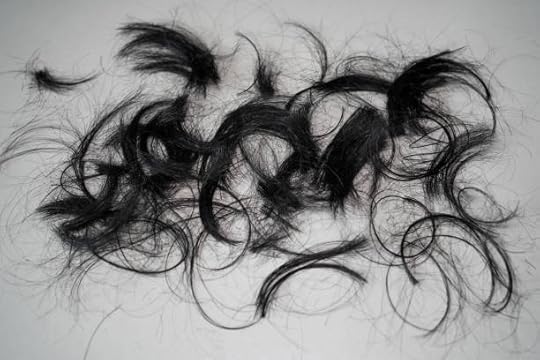
Image: Offcuts of dark hair, on the floor (Source)
Threads of hair
Flowers and florals are mentioned often, but not as much as hair (though I don’t think the two are ever combined). Alice has long, dark hair, and isn’t pretty, like her white-blonde sisters. Throughout the book, hair is stroked, smelt, described, and a mark of identity. The intimacy of a fallen hairpin is a turning point. In two significant instances, it is cut off. Hair is also casually mentioned where there’s no real need for it (tying it in a topknot at the pool). Like the plot, hair can tangle, but when you brush it out, you have something satisfying.
Red herrings?
These are not necessarily irrelevant (certainly not the first one), but they are threads that seem important for a while, then get left. Perhaps because the hair and flowers are so deliberate, I’m over-analysing. If you’ve read the book and disagree with any of these, please let me know:
My only actual criticism is that Ann (Alice’s mother) has absolutely no redeeming qualities.
Quotes
• “The fickleness, the blank, impassive callowness of mirrors.”
• “The tube... is a fearsome thing: a horrible machine into which you get sucked, dragged down by crowds and escalators, spat out onto blackened platforms where trains arrive and leave with alarming speed, and all you have to find your way is a map of tangled, coloured wires and strange-sounding names.” [Not how I think of it, but I don’t come from a small town in Scotland.]
• A bunch of flowers, sent to hospital, “the small card stapled to their polythene shroud”.
See also
• After enjoying two O’Farrells in the last couple of years, I picked this up, not realising it’s her first. See my reviews of:
• The Vanishing Act of Esme Lennox, HERE.
and
• The Marriage Portrait, HERE.
• Teenage Alice wrote an essay on Robert Browning’s My Last Duchess, which is the key to The Marriage Portrait, which O’Farrell wrote 22 years after this.
• Alice is fond of The Private Memoirs and Confessions of a Justified Sinner. I’m not sure what to make of that.
• O’Farrell herself has had many brushes with death (see I Am, I Am, I Am: Seventeen Brushes with Death, which I’ve not read), but I don’t think she’s been in a coma.
“Alice sometimes worries that she might lose her grip on life.”
The novel is in three sections, each split into chapters, but every chapter jumps about in time (occasionally switching to first-person, present tense, including “exhausting cycles of thoughts” in a coma), but often with a daisy chain. For example, a section ends with little Alice being stung by a bee on her foot, moves forward many years to John hurting his foot in a lift and then borrowing a book, before winding back a few years to Alice reading the same book at university.
“Time seems to have splintered.”
This isn’t detective fiction, but the reader has to fit the pieces and timeline together, working out which are most pertinent. It’s very cleverly done. There are several potentially traumatic incidents in Alice’s life (and in her mother’s and paternal grandmother’s), but although one secret is obvious early on, the rest of the story is not, despite occasional foreshadowing.
“In about two hours’ time I will tell him [something]... but we don’t know this yet.”
Attitudes to are significant, and some readers may not like the way it’s handled. It seems fine to me, but it’s not for me to judge.
Image: Offcuts of dark hair, on the floor (Source)
Threads of hair
Flowers and florals are mentioned often, but not as much as hair (though I don’t think the two are ever combined). Alice has long, dark hair, and isn’t pretty, like her white-blonde sisters. Throughout the book, hair is stroked, smelt, described, and a mark of identity. The intimacy of a fallen hairpin is a turning point. In two significant instances, it is cut off. Hair is also casually mentioned where there’s no real need for it (tying it in a topknot at the pool). Like the plot, hair can tangle, but when you brush it out, you have something satisfying.
Red herrings?
These are not necessarily irrelevant (certainly not the first one), but they are threads that seem important for a while, then get left. Perhaps because the hair and flowers are so deliberate, I’m over-analysing. If you’ve read the book and disagree with any of these, please let me know:
My only actual criticism is that Ann (Alice’s mother) has absolutely no redeeming qualities.
Quotes
• “The fickleness, the blank, impassive callowness of mirrors.”
• “The tube... is a fearsome thing: a horrible machine into which you get sucked, dragged down by crowds and escalators, spat out onto blackened platforms where trains arrive and leave with alarming speed, and all you have to find your way is a map of tangled, coloured wires and strange-sounding names.” [Not how I think of it, but I don’t come from a small town in Scotland.]
• A bunch of flowers, sent to hospital, “the small card stapled to their polythene shroud”.
See also
• After enjoying two O’Farrells in the last couple of years, I picked this up, not realising it’s her first. See my reviews of:
• The Vanishing Act of Esme Lennox, HERE.
and
• The Marriage Portrait, HERE.
• Teenage Alice wrote an essay on Robert Browning’s My Last Duchess, which is the key to The Marriage Portrait, which O’Farrell wrote 22 years after this.
• Alice is fond of The Private Memoirs and Confessions of a Justified Sinner. I’m not sure what to make of that.
• O’Farrell herself has had many brushes with death (see I Am, I Am, I Am: Seventeen Brushes with Death, which I’ve not read), but I don’t think she’s been in a coma.

February 12, 2023
My goodness Ms. O’Farrell, where have you been all of my reading life and why is this only the second of your novels that I have read?
This debut was absolutely astonishing. Maggie O’Farrell can tell a story and fit all of the pieces together flawlessly. I knew from reading The Vanishing Act of Esme Lennox that I needed to read more from this author, and now I want to gobble up and savor everything she’s written!
I also learned that it’s important not to start a book like this when I know I’m not going to be able to devote the time to read it straight through. I had guests in town for a week just after I started reading this book, and started over from the beginning after I’d only gotten just under a hundred pages done. This one needs your devotion and attention so that you can fully experience all of the emotional ups and downs Ms. O’Farrell takes readers through.
The story is simple but it’s not quite so really. It’s about love and family, grief and loss, forgiveness and healing. Ms. O’Farrell starts at the end of the story and works her way through the entire life story of Alice who is lying in a coma. She arrives on the train in Scotland to visit her family when she sees something so horrifying and shocking that she can’t stay. She abruptly heads back to London in a daze and is hit by a car on the way to the supermarket. As she lies in a coma, she reflects on her life’s events and remembers old boyfriends, fun times with her sisters, wonderful moments spent with her grandmother, some difficult experiences with her mother, and a loss she cannot get over.
To me it feels as if everything has been tilted to reveal this whole other picture which has existed just out of sight, all along.
The story goes back and forth in time almost effortlessly. If you don’t catch on pretty quickly that the narrative is not chronological, you might get confused. There aren’t breaks between each change in tense but I found that the flow of the story moving from different points of view and times was beautifully done. Through her memories, Alice’s life comes to make sense when the details are so perfectly and slowly revealed and the family secrets come to the surface. Several times I winced in agony over the heartbreaking events. O’Farrell’s stunning prose puts readers right there with her characters so that you feel with them, cry with them, laugh with them, and love with them.
I never knew it was possible to think about someone all of the time, for someone to be always doing acrobatic leaps across your thoughts. Everything else was an unwelcome distraction from what I wanted to think about.
This is a book not to be missed if you are a Maggie O’Farrell fan. I’m already trying to decide what I will pick up next.
This debut was absolutely astonishing. Maggie O’Farrell can tell a story and fit all of the pieces together flawlessly. I knew from reading The Vanishing Act of Esme Lennox that I needed to read more from this author, and now I want to gobble up and savor everything she’s written!
I also learned that it’s important not to start a book like this when I know I’m not going to be able to devote the time to read it straight through. I had guests in town for a week just after I started reading this book, and started over from the beginning after I’d only gotten just under a hundred pages done. This one needs your devotion and attention so that you can fully experience all of the emotional ups and downs Ms. O’Farrell takes readers through.
The story is simple but it’s not quite so really. It’s about love and family, grief and loss, forgiveness and healing. Ms. O’Farrell starts at the end of the story and works her way through the entire life story of Alice who is lying in a coma. She arrives on the train in Scotland to visit her family when she sees something so horrifying and shocking that she can’t stay. She abruptly heads back to London in a daze and is hit by a car on the way to the supermarket. As she lies in a coma, she reflects on her life’s events and remembers old boyfriends, fun times with her sisters, wonderful moments spent with her grandmother, some difficult experiences with her mother, and a loss she cannot get over.
To me it feels as if everything has been tilted to reveal this whole other picture which has existed just out of sight, all along.
The story goes back and forth in time almost effortlessly. If you don’t catch on pretty quickly that the narrative is not chronological, you might get confused. There aren’t breaks between each change in tense but I found that the flow of the story moving from different points of view and times was beautifully done. Through her memories, Alice’s life comes to make sense when the details are so perfectly and slowly revealed and the family secrets come to the surface. Several times I winced in agony over the heartbreaking events. O’Farrell’s stunning prose puts readers right there with her characters so that you feel with them, cry with them, laugh with them, and love with them.
I never knew it was possible to think about someone all of the time, for someone to be always doing acrobatic leaps across your thoughts. Everything else was an unwelcome distraction from what I wanted to think about.
This is a book not to be missed if you are a Maggie O’Farrell fan. I’m already trying to decide what I will pick up next.

February 23, 2019
4★
“Why isn't life better designed so it warns you when terrible things are about to happen? I saw something. Something awful.”
I didn’t realise this was Maggie O’Farrell’s debut until after I’d read it. I’ve enjoyed other books of hers and always wanted to read more. Her female characters are complex and flawed and believable. I don’t remember any of the men, but perhaps that’s just me.
Alice is in a coma after being hit by a car, with her mother Ann and devoted dad, Ben, at her bedside. We see a lot of Ann’s story as well as Alice’s. We don’t know Ben particularly well (nice man) but we meet his mother, Elspeth, who was young Alice’s closest confidante.
There seems to be a fashion currently writing crossing timelines and points of view, but O’Farrell wrote this almost two decades ago. She runs scenes together, but something about the voice changes enough that I realised pretty quickly that I was in someone else’s head. I think she does it better than most.
We meet Alice as an adult, taking the train to Edinburgh to see her sisters, but after a brief cup of coffee at the train station, she suddenly announces she has to return to London. Now, this instant, next train. We were there, but we have no idea what it is except she seems to have seen “something. Something awful” reflected in a mirror when she was in the big bathroom at the station.
Mirrors do appear in other scenes, and one conceit I found interesting, was when Alice stops to look in a mirror and wonders if mirrors capture us when we look in them.
“It must have an image of him locked away somewhere in its depths. . . to imagine that he is standing just behind it, his face pressed up close to the surface, watching her passing beneath him . . . “
It’s an interesting idea. I have to say, however, in real life I find it disconcerting to see people I know well in a mirror. All the familiar irregularities are backwards, but it’s still a curious idea that part of us may be still be there. It’s akin to the belief that photographs will steal a piece of your life. But I digress.
Each of these women has had her own trials. Elspeth was only seven when her parents, who adored each other, became missionaries and left her in boarding school for seven years, sending her little gifts and postcards from time to time. Not only that, they didn’t tell her they were going.
“They dressed Elspeth in her best clothes and took her out for a walk on the beach, each holding one of her hands. While she was playing with the pebbles and seaweed on the blustery seashore, they slipped away and when she turned round they were gone and in their place was the upright figure of a housemistress for St Cuthbert's School for Girls, who took her by the elbow and led her up the beach and on to a train for Edinburgh and boarding-school.”
I was immediately reminded of the days of yore when young lads of seven (I think) left home to be assigned to serve knights. SEVEN! It really doesn’t bear thinking about for me. That was Elspeth’s generation.
Ann is the middle generation and another product of boarding school – eleven years of it – where the nuns teach the girls to peel fruit and exit a car gracefully without showing their slip. All the things a well-bred young lass needs to know to face the world. Ann learns it all easily and does well.
“Ann glances at herself in the rear-view mirror. Her way isn’t rebellion but inner defiance. She hoists herself from the seat gracefully, her skirt falling at the desired angle into the correct folds.”
She seems to maintain that defiant core right through life, and she needs it to deal with Alice, the middle of her three daughters. They are at permanent loggerheads.
“. . . [Alice] left to travel the world. She waved goodbye from a train window, beads looped and plaited into her long black hair, rainbow skirts trailing the ground. She returned crop-haired, in tight leather trousers, an Oriental dragon rampant on her shoulder-blade.
'How was the world?' Ann asked.
'Full,' she replied.”
Alice was outwardly rebellious, unlike her inwardly defiant mother, and she often went to Elspeth for understanding. Elspeth seemed to sense what would keep Alice in line, which is sometimes the case with skipped generations. Mind you, Alice set fire to the curtains and thought it was wonderful, so she wasn’t an easy child to understand!
There are a few love stories woven in, the central one being Alice’s, of course, and we are allowed into her mind in the coma as she remembers and relives her past. Because it’s not a chronological story, we piece the bits together as they are revealed until we have the whole picture. Love, jealousy, joy, grief – life, the whole thing.
It’s quite a picture and quite a debut.
P.S. I've just discovered this publication, which I haven't read yet, but it's free on Amazon and Google Books.
Maggie O'Farrell: A Reader's Guide - free digital compendium
“Why isn't life better designed so it warns you when terrible things are about to happen? I saw something. Something awful.”
I didn’t realise this was Maggie O’Farrell’s debut until after I’d read it. I’ve enjoyed other books of hers and always wanted to read more. Her female characters are complex and flawed and believable. I don’t remember any of the men, but perhaps that’s just me.
Alice is in a coma after being hit by a car, with her mother Ann and devoted dad, Ben, at her bedside. We see a lot of Ann’s story as well as Alice’s. We don’t know Ben particularly well (nice man) but we meet his mother, Elspeth, who was young Alice’s closest confidante.
There seems to be a fashion currently writing crossing timelines and points of view, but O’Farrell wrote this almost two decades ago. She runs scenes together, but something about the voice changes enough that I realised pretty quickly that I was in someone else’s head. I think she does it better than most.
We meet Alice as an adult, taking the train to Edinburgh to see her sisters, but after a brief cup of coffee at the train station, she suddenly announces she has to return to London. Now, this instant, next train. We were there, but we have no idea what it is except she seems to have seen “something. Something awful” reflected in a mirror when she was in the big bathroom at the station.
Mirrors do appear in other scenes, and one conceit I found interesting, was when Alice stops to look in a mirror and wonders if mirrors capture us when we look in them.
“It must have an image of him locked away somewhere in its depths. . . to imagine that he is standing just behind it, his face pressed up close to the surface, watching her passing beneath him . . . “
It’s an interesting idea. I have to say, however, in real life I find it disconcerting to see people I know well in a mirror. All the familiar irregularities are backwards, but it’s still a curious idea that part of us may be still be there. It’s akin to the belief that photographs will steal a piece of your life. But I digress.
Each of these women has had her own trials. Elspeth was only seven when her parents, who adored each other, became missionaries and left her in boarding school for seven years, sending her little gifts and postcards from time to time. Not only that, they didn’t tell her they were going.
“They dressed Elspeth in her best clothes and took her out for a walk on the beach, each holding one of her hands. While she was playing with the pebbles and seaweed on the blustery seashore, they slipped away and when she turned round they were gone and in their place was the upright figure of a housemistress for St Cuthbert's School for Girls, who took her by the elbow and led her up the beach and on to a train for Edinburgh and boarding-school.”
I was immediately reminded of the days of yore when young lads of seven (I think) left home to be assigned to serve knights. SEVEN! It really doesn’t bear thinking about for me. That was Elspeth’s generation.
Ann is the middle generation and another product of boarding school – eleven years of it – where the nuns teach the girls to peel fruit and exit a car gracefully without showing their slip. All the things a well-bred young lass needs to know to face the world. Ann learns it all easily and does well.
“Ann glances at herself in the rear-view mirror. Her way isn’t rebellion but inner defiance. She hoists herself from the seat gracefully, her skirt falling at the desired angle into the correct folds.”
She seems to maintain that defiant core right through life, and she needs it to deal with Alice, the middle of her three daughters. They are at permanent loggerheads.
“. . . [Alice] left to travel the world. She waved goodbye from a train window, beads looped and plaited into her long black hair, rainbow skirts trailing the ground. She returned crop-haired, in tight leather trousers, an Oriental dragon rampant on her shoulder-blade.
'How was the world?' Ann asked.
'Full,' she replied.”
Alice was outwardly rebellious, unlike her inwardly defiant mother, and she often went to Elspeth for understanding. Elspeth seemed to sense what would keep Alice in line, which is sometimes the case with skipped generations. Mind you, Alice set fire to the curtains and thought it was wonderful, so she wasn’t an easy child to understand!
There are a few love stories woven in, the central one being Alice’s, of course, and we are allowed into her mind in the coma as she remembers and relives her past. Because it’s not a chronological story, we piece the bits together as they are revealed until we have the whole picture. Love, jealousy, joy, grief – life, the whole thing.
It’s quite a picture and quite a debut.
P.S. I've just discovered this publication, which I haven't read yet, but it's free on Amazon and Google Books.
Maggie O'Farrell: A Reader's Guide - free digital compendium

March 4, 2023
Time is not infinite, and there is no way of knowing just how much of it a person has been allotted in a given life. It would behoove us to use it as wisely as possible. If forgiveness is warranted, grant it if you are able. Some choices made will make life more difficult. The power of love and of grief make themselves known in vastly different ways.
A stunning debut by Maggie O'Farrell. Fresh out of the egg, and she was already brilliant.
A stunning debut by Maggie O'Farrell. Fresh out of the egg, and she was already brilliant.

February 21, 2025
'I am somewhere. Drifting. Hiding. Thoughts running around tracks, random and unconnected as ball-bearings in the circuit of a pinball machine'.
'After You'd Gone' begins near its end. Alice is upset. Alice is not in her right mind. Alice now lies in hospital in a coma. What we get are snippets of her memory; scattered stories that let us know just how she got to this place. But this is not a linear journey. We also jump to Alice's mother's life and we also ricochet back to Alice's silent, comatose present.
This book doesn't read like a true story but rather a gamut of emotions, bundled together like letters left to a loved one. Its jumbled paragraphs can make it difficult at times to follow, yet I felt that best represented what it might feel like to be locked within your head.
With a title like, 'After You'd Gone', there's a spectre of heartache hanging over every vignette. Just what happened after you'd gone, where'd you go, and why? 'She knows enough about love to be aware of its double bind - that there's no love without pain, that you can't ever love someone without that tinge of dread at how it might end'.
This was Maggie O'Farrell's debut and it's a doozy. It's about life and love; finding love, showing love, being true to yourself and true to your love. Read it if you love your emotions being tossed around in a washing machine, as it slowly begins the spin cycle. Like a good wash, you'll feel great after.
'What are you supposed to do with all the love you have for somebody if that person is no longer there? What happens to all the leftover love? Do you suppress it? Do you ignore it? Are you supposed to give it to someone else'?
'After You'd Gone' begins near its end. Alice is upset. Alice is not in her right mind. Alice now lies in hospital in a coma. What we get are snippets of her memory; scattered stories that let us know just how she got to this place. But this is not a linear journey. We also jump to Alice's mother's life and we also ricochet back to Alice's silent, comatose present.
This book doesn't read like a true story but rather a gamut of emotions, bundled together like letters left to a loved one. Its jumbled paragraphs can make it difficult at times to follow, yet I felt that best represented what it might feel like to be locked within your head.
With a title like, 'After You'd Gone', there's a spectre of heartache hanging over every vignette. Just what happened after you'd gone, where'd you go, and why? 'She knows enough about love to be aware of its double bind - that there's no love without pain, that you can't ever love someone without that tinge of dread at how it might end'.
This was Maggie O'Farrell's debut and it's a doozy. It's about life and love; finding love, showing love, being true to yourself and true to your love. Read it if you love your emotions being tossed around in a washing machine, as it slowly begins the spin cycle. Like a good wash, you'll feel great after.
'What are you supposed to do with all the love you have for somebody if that person is no longer there? What happens to all the leftover love? Do you suppress it? Do you ignore it? Are you supposed to give it to someone else'?

August 26, 2023
This is the fifth novel I’ve read of this author and its her debut.
I enjoyed it… a novel about love, loss, family, friends and grief… with a mystery in the beginning… what did Alice see in the lavatory of the train station that set her into a tailspin… you wonder about this through most of the book.
Great characters, Scotland and London settings.. a bit of a dark novel.
I enjoyed it… a novel about love, loss, family, friends and grief… with a mystery in the beginning… what did Alice see in the lavatory of the train station that set her into a tailspin… you wonder about this through most of the book.
Great characters, Scotland and London settings.. a bit of a dark novel.

July 20, 2022
'OK. My father said that if I were to marry you it would be like letting Hitler win,' he says, in a rush.
There is a pause while Alice attempts mentally to process this statement. 'Letting Hitler-?' She shakes her head. 'I don't understand. What on earth have we got to do with Hitler?'
'Because if I were to marry you, our children wouldn't be Jewish, and he sees that as the extermination of Jews.' (PG. 214)
What an intricate beautiful love story!! Against all odds Alice and John love one another and stay together only to be separated. Bittersweet.
The story is told in different viewpoints, which oddly enough, didn't confuse me. This is the author's earlier work and I feel through this title she found her niche. The families past coincides with the future and mistakes are made from the past that tumble into the present. We see each journey of the maternal side. O'Farrell knows how to weave her story. Glad she wasn't born a spider....
I love this author and her brain!
There is a pause while Alice attempts mentally to process this statement. 'Letting Hitler-?' She shakes her head. 'I don't understand. What on earth have we got to do with Hitler?'
'Because if I were to marry you, our children wouldn't be Jewish, and he sees that as the extermination of Jews.' (PG. 214)
What an intricate beautiful love story!! Against all odds Alice and John love one another and stay together only to be separated. Bittersweet.
The story is told in different viewpoints, which oddly enough, didn't confuse me. This is the author's earlier work and I feel through this title she found her niche. The families past coincides with the future and mistakes are made from the past that tumble into the present. We see each journey of the maternal side. O'Farrell knows how to weave her story. Glad she wasn't born a spider....
I love this author and her brain!

August 13, 2023
Sendo esta uma autora de eleição de algumas meninas aqui do GR, quando vi este livro na feira de velharias cá da cidade, resolvi trazê-lo comigo.
Comecei a ler, mas não me entusiasmou. Achei um pouco confuso. Apanha o comboio, sai do comboio, visita as irmãs, volta para o comboio. Não estava a perceber nada.
Depois, vi uma menina que não dá estrelas aos livros, sim, menina Katya, estou falando com você 😅, a ficar completamente arrebatada e tive de ir ver o que se passava de tão interessante para além do comboio.
E não me arrependo de o ter feito. Sente-se que houve uma tragédia, mas vai sendo revelada aos poucos, não é logo clara. Isso foi o que me deixou um pouco de pé atrás, pois nunca mais chegava ao que realmente aconteceu e eu sou pessoa impaciente que quer saber as coisas. E impaciente é algo que Dona Margarida não é.😂
Concluindo, é trágico, sim, mas é bonito, também.
Comecei a ler, mas não me entusiasmou. Achei um pouco confuso. Apanha o comboio, sai do comboio, visita as irmãs, volta para o comboio. Não estava a perceber nada.
Depois, vi uma menina que não dá estrelas aos livros, sim, menina Katya, estou falando com você 😅, a ficar completamente arrebatada e tive de ir ver o que se passava de tão interessante para além do comboio.
E não me arrependo de o ter feito. Sente-se que houve uma tragédia, mas vai sendo revelada aos poucos, não é logo clara. Isso foi o que me deixou um pouco de pé atrás, pois nunca mais chegava ao que realmente aconteceu e eu sou pessoa impaciente que quer saber as coisas. E impaciente é algo que Dona Margarida não é.😂
Concluindo, é trágico, sim, mas é bonito, também.

August 1, 2011
You know that rule some people have about reading 50 pages of a book and deciding whether to put it down or continue with it? Well I’m not sure if this would have made it if I were a stickler to that rule. Actually, writing that, I’m not sure exactly which page it was that made me realize I liked this book. But I do know that I mostly muddled my way through the first lot of pages. The narration confused me a little. Multiple points of view, different periods of time. It was as if the pieces of the jigsaw puzzle were in front of me, but I didn’t have the faintest idea what the picture was. It didn’t help that I read part of it after the 430/5 am feedings, using the night mode on the Bluefire ereader app.
But there was something about Alice. When she meets her John and they muddle their way into a relationship. There’s something about his doggedness, her seeming initial reluctance to be a part of it, then it grows into that sweetness of love, bolstered by their determination to be together despite disapproval. Their immense, heady, head-in-the-clouds love. That was what made me want to carry on. That was what took my own heart a little bit. This relationship, this character of Alice, these things creep under your skin and
The story begins with Alice, heading out on the train to Edinburgh to see her sisters. But something happens and she decides to head back to London. She steps out into the street and is hit by a car. As she lies in a coma in hospital, the narrative, as I had mentioned earlier*, flits from the present to the past, unravelling the circumstances that have led up to this day. This involves her mother, her grandmother, her sisters, and her John.
This story has stayed with me, and everytime I think of it, I feel strangely overwhelmed. There is so much emotion and sentiment in this story. Perhaps it’s a little melodramatic, but it is very moving, and beautifully and sharply written.
I look up O’Farrell’s bibliography and realised that this was her first novel. I can’t wait to read the rest of her books!
But there was something about Alice. When she meets her John and they muddle their way into a relationship. There’s something about his doggedness, her seeming initial reluctance to be a part of it, then it grows into that sweetness of love, bolstered by their determination to be together despite disapproval. Their immense, heady, head-in-the-clouds love. That was what made me want to carry on. That was what took my own heart a little bit. This relationship, this character of Alice, these things creep under your skin and
The story begins with Alice, heading out on the train to Edinburgh to see her sisters. But something happens and she decides to head back to London. She steps out into the street and is hit by a car. As she lies in a coma in hospital, the narrative, as I had mentioned earlier*, flits from the present to the past, unravelling the circumstances that have led up to this day. This involves her mother, her grandmother, her sisters, and her John.
This story has stayed with me, and everytime I think of it, I feel strangely overwhelmed. There is so much emotion and sentiment in this story. Perhaps it’s a little melodramatic, but it is very moving, and beautifully and sharply written.
I look up O’Farrell’s bibliography and realised that this was her first novel. I can’t wait to read the rest of her books!

September 28, 2007
NOT A REVIEW OF AFTER YOU'D GONE, WHICH WAS OKAY BUT WENT IN ONE EAR AND OUT THE OTHER
I realise goodreads is for books but I found a piece of beautiful writing about the vain search for modern romance in a movie called Kissing Jessica Stein. The first part of this movie is all about a thirty-ish woman in New York who can't meet the right guy, fairly usual but quite funny too. Then it takes off in a different direction, which I'll refrain from commenting on or you'll raise your eyebrows, I know you will. Anyway the dvd contained some deleted scenes, and in those scenes I found this gem.
Jessica our heroine has been seeing a guy for a week or so and he seems okay-ish but fairly aggravating, and by now what she really wants is for him to go far far away, but at that very point he announces that he thinks he's in love with her and that he's never felt so close to another person and that he feels they just click. So this is what Jessica says, and she says it all in a breathless rush at 60 miles an hour.
Click? No. We do not click. You know we don't have one thing in common. We don't click in any way. We don't have chemistry or banter or common interests. You're a yoga instructor, you get colonics, you don't
appreciate the chaos and absurdity of life on this planet and in this city, you don't understand irony or eccentricity or poetry or the simple joy of being a regular at your diner on your block - I love that. You don't drink coffee or alcohol, you don't overeat or
cry when you're alone, you don't understand sarcasm, you plod through life in a neat, colourless caffeine free dairy free conflict free banal self-possessed way. I'm bold and angry and tortured and tremendous
and I notice when somebody has changed their hair parting or when somebody is wearing two distinctly different shades of black or when someone changes the natural timbre of their voice on the phone. I don't
give out empty praise, I'm not complacent or well-adjusted. I can't spend 50 minutes breathing and stretching and getting in touch with myself, I can't even spend three minutes finishing an article. I check
my phone machine nine times a day because I feel there's so much to do and fix and change in the world and I wonder every day if I'm making a difference and if I will ever express greatness or if I will remain
forever paralysed by muddled madness inside my head. I've wept on every birthday I ever had because life is huge and fleeting and I hate certain people and certain shoes and I feel that life is terribly unfair
and sometimes beautiful and wonderful and extraordinary and also numbing and horrifying and insurmountable and I hate myself a lot of the time but the rest of the time I adore myself. I adore my life
in this city, in this world that we live in, in this huge and wondrous bewildering brilliant horrible world.
(Pause)
In these ways I feel that we do not click.
I realise goodreads is for books but I found a piece of beautiful writing about the vain search for modern romance in a movie called Kissing Jessica Stein. The first part of this movie is all about a thirty-ish woman in New York who can't meet the right guy, fairly usual but quite funny too. Then it takes off in a different direction, which I'll refrain from commenting on or you'll raise your eyebrows, I know you will. Anyway the dvd contained some deleted scenes, and in those scenes I found this gem.
Jessica our heroine has been seeing a guy for a week or so and he seems okay-ish but fairly aggravating, and by now what she really wants is for him to go far far away, but at that very point he announces that he thinks he's in love with her and that he's never felt so close to another person and that he feels they just click. So this is what Jessica says, and she says it all in a breathless rush at 60 miles an hour.
Click? No. We do not click. You know we don't have one thing in common. We don't click in any way. We don't have chemistry or banter or common interests. You're a yoga instructor, you get colonics, you don't
appreciate the chaos and absurdity of life on this planet and in this city, you don't understand irony or eccentricity or poetry or the simple joy of being a regular at your diner on your block - I love that. You don't drink coffee or alcohol, you don't overeat or
cry when you're alone, you don't understand sarcasm, you plod through life in a neat, colourless caffeine free dairy free conflict free banal self-possessed way. I'm bold and angry and tortured and tremendous
and I notice when somebody has changed their hair parting or when somebody is wearing two distinctly different shades of black or when someone changes the natural timbre of their voice on the phone. I don't
give out empty praise, I'm not complacent or well-adjusted. I can't spend 50 minutes breathing and stretching and getting in touch with myself, I can't even spend three minutes finishing an article. I check
my phone machine nine times a day because I feel there's so much to do and fix and change in the world and I wonder every day if I'm making a difference and if I will ever express greatness or if I will remain
forever paralysed by muddled madness inside my head. I've wept on every birthday I ever had because life is huge and fleeting and I hate certain people and certain shoes and I feel that life is terribly unfair
and sometimes beautiful and wonderful and extraordinary and also numbing and horrifying and insurmountable and I hate myself a lot of the time but the rest of the time I adore myself. I adore my life
in this city, in this world that we live in, in this huge and wondrous bewildering brilliant horrible world.
(Pause)
In these ways I feel that we do not click.

Read
January 4, 2018This book wrecked me. It follows a woman named Alice who’s in a coma after stepping into traffic, and her family doesn’t know whether or not it was a suicide attempt. The narrative jumps around to all different periods of her life, focusing on her relationship with her lover, John – a relationship that we learn has ended, but we don’t know why. We also get snippets of her mother and grandmother’s lives.
The writing overall wasn’t my favorite. Mostly I thought there were too many adjectives (she never uses one when she could use two or three, and I recognized this because it’s one of the flaws in my own writing), and sometimes the verb choices were strange and distracting. And there are several cases of insta-love that taken collectively would’ve bothered me more in another book.
But really, I loved this novel. So much of the writing is beautiful in a slightly disjointed way (which I viewed as intentional, given the characters’ mental states), and the whole story happens in that emotional space where your chest aches and you feel tears pressing behind your eyes. The way O’Farrell crafts Alice and John’s relationship is gorgeous. She captures that feeling of being completely comfortable with someone, and loving them more than you ever thought you could.
Having finished the story I feel emotionally fragile and like I might burst into tears if someone looks at me the wrong way. I’ll be reading all of O’Farrell’s backlist, I think – I’m just in the mood for her tone and imagery.
The writing overall wasn’t my favorite. Mostly I thought there were too many adjectives (she never uses one when she could use two or three, and I recognized this because it’s one of the flaws in my own writing), and sometimes the verb choices were strange and distracting. And there are several cases of insta-love that taken collectively would’ve bothered me more in another book.
But really, I loved this novel. So much of the writing is beautiful in a slightly disjointed way (which I viewed as intentional, given the characters’ mental states), and the whole story happens in that emotional space where your chest aches and you feel tears pressing behind your eyes. The way O’Farrell crafts Alice and John’s relationship is gorgeous. She captures that feeling of being completely comfortable with someone, and loving them more than you ever thought you could.
Having finished the story I feel emotionally fragile and like I might burst into tears if someone looks at me the wrong way. I’ll be reading all of O’Farrell’s backlist, I think – I’m just in the mood for her tone and imagery.
March 15, 2023
4.5 🌠🌠🌠🌠🌠
Bingo O 4 ✅
The Marvelous Ms. Maggie O.
It would be reasonable to expect a let down reading a favorite author's debut novel after one has read her entire collection. But if you're a fan, you know that's probably a long shot if you're a betting person.
It's like she's a human MRI scanner with her words, exposing detailed and intimate images of our deepest humanity and heartbreaks.
It got a wee bit drawn out in the end hanging with Alice in her coma, just like it would if you were waiting it out with any comatose loved one, and then, and then . . .
I am
I am
I am crying. I'm an emotional wreck and I don't care. I loved it.
What to do now? Maybe check out her husband's work looking for guilt by association?
Thank you friend-fans for your marvelous reviews. I love revisiting the reading experience through your minds and hearts.
Bingo O 4 ✅
The Marvelous Ms. Maggie O.
It would be reasonable to expect a let down reading a favorite author's debut novel after one has read her entire collection. But if you're a fan, you know that's probably a long shot if you're a betting person.
It's like she's a human MRI scanner with her words, exposing detailed and intimate images of our deepest humanity and heartbreaks.
It got a wee bit drawn out in the end hanging with Alice in her coma, just like it would if you were waiting it out with any comatose loved one, and then, and then . . .
I am
I am
I am crying. I'm an emotional wreck and I don't care. I loved it.
What to do now? Maybe check out her husband's work looking for guilt by association?
Thank you friend-fans for your marvelous reviews. I love revisiting the reading experience through your minds and hearts.

August 22, 2025
Hard to believe this was a first novel, it's expertly plotted even with the shifting timelines and different povs. A grieving young woman lays in a coma after being hit by a car. Suicide or accident? Through flashbacks and family stories we get it all. Love, grief, adultery, loving grandmother, difficult mother, saintly father, growing up, not fitting in........as I said there's a lot to process here. My interest never flagged, these characters came alive for me, and everything came together in the end.
There was one character who seemed extraneous and unneeded to me, and a couple of niggly unexplained incidents which is why I couldn't give it 5 stars. This is O'Farrell's first novel, but my fifth by her, with more to come.
There was one character who seemed extraneous and unneeded to me, and a couple of niggly unexplained incidents which is why I couldn't give it 5 stars. This is O'Farrell's first novel, but my fifth by her, with more to come.

July 20, 2025
When I bought my copy of this novel I did not realize it was O’Farrell’s debut, but a quick scan of GR reviews before I started reading made me aware that it was. That knowledge lowered my expectations just a bit; you don’t expect an author’s first attempt to measure up to what you have come to expect from her work. No need, though. This was an excellent story no matter where it fell in her career. I thoroughly enjoyed the character of Alice. Another GR reader commented on O’Farrell’s talent in creating great female characters; I concur. Ann, Alice’s mother, was not someone I liked very much, but she was the most complex character in the book—her evident love for her children contrasted with the disdain she showed her husband and Elspeth, her mother-in-law. Elspeth was another wonderful female character.
This novel at its center is a love story; I usually am not drawn to love stories, but I enjoyed this one. I liked the structure of the novel: the story jumped around in terms of timeline and POV; I found it easy to follow. While there was little justification that I could find in the story for this structure, I thought a strictly linear narrative would have been a much weaker telling. Fitting the pieces together as the story progressed was part of the fun. I did find the story predictable, and the ending too fortuitous, but even with those comments I thought this was an outstanding debut effort and a very good read.
This novel at its center is a love story; I usually am not drawn to love stories, but I enjoyed this one. I liked the structure of the novel: the story jumped around in terms of timeline and POV; I found it easy to follow. While there was little justification that I could find in the story for this structure, I thought a strictly linear narrative would have been a much weaker telling. Fitting the pieces together as the story progressed was part of the fun. I did find the story predictable, and the ending too fortuitous, but even with those comments I thought this was an outstanding debut effort and a very good read.

June 18, 2013
I feel as though a cloud has been lifted, now that I've finished this book. That's not to say I didn't like it, but Maggie O'Farrell manages to create such an intense atmosphere, I felt almost exhausted reading it.
I feel i am giving an unfair impression of this book. It's a mix of mystery, thriller, romance... and I cannot possibly assign it to a single genre.
Alice, the central figure in this story, ends up in a coma after witnessing a mysterious incident when she goes to visit her family.
O'Farrell skips around in time and various POVs, which some readers might well find annoying, but after a while I really got used to it, and it is done very skillfully.
The story slowly unravels and we are given glimpses of the past, distant and near, like separate puzzle pieces, which only in the last 100 pages really fit together.
It is a story about family, and family secrets, romance and love, and dealing with all the complications and joys those aspects of life entail.
As mentioned before, it's an extremely atmospheric novel, and I can hardly believe this is a debut! Truly impressive, and well worth reading, but not recommended as a pick-me-up or for a laugh.
It reminded me, stylistically, of 'Into the Darkest Corner' or even a little of a more elegant and English Jodi Picault story.
Find more reviews and bookish fun at http://www.princessandpen.com
I feel i am giving an unfair impression of this book. It's a mix of mystery, thriller, romance... and I cannot possibly assign it to a single genre.
Alice, the central figure in this story, ends up in a coma after witnessing a mysterious incident when she goes to visit her family.
O'Farrell skips around in time and various POVs, which some readers might well find annoying, but after a while I really got used to it, and it is done very skillfully.
The story slowly unravels and we are given glimpses of the past, distant and near, like separate puzzle pieces, which only in the last 100 pages really fit together.
It is a story about family, and family secrets, romance and love, and dealing with all the complications and joys those aspects of life entail.
As mentioned before, it's an extremely atmospheric novel, and I can hardly believe this is a debut! Truly impressive, and well worth reading, but not recommended as a pick-me-up or for a laugh.
It reminded me, stylistically, of 'Into the Darkest Corner' or even a little of a more elegant and English Jodi Picault story.
Find more reviews and bookish fun at http://www.princessandpen.com

January 11, 2023
Nas duas primeiras partes andei à deriva a maior parte do tempo; capítulos curtos referentes a demasiadas personagens que apareciam em diversos períodos das suas vidas sem ordem ou qualquer identificação. Cheguei a ler mais de uma página até perceber de quem se tratava. Também não me identifiquei minimamente com nenhum deles, irritava-me até com o seu comportamento e não encontrava nada de excepcional no desdobrar do enredo. Quando já cogitava que isto de ler Hamnet e achar que a Maggie já teria saído do berço a escrever daquela maneira tinha sido asneira, eis que morre alguém. ”Et voilà!”, ninguém escreve sobre luto como Maggie O`Farrell! Ninguém usa esta eloquência com tanta sensibilidade e clareza. Até quem nunca teve uma grande perda reconhece os sentimentos que terá no dia em que tal acontecer. E isto é muito difícil de fazer sem cair na lamechice.
Lavei os olhos por dentro e fiz as pazes com a Maggie.
Lavei os olhos por dentro e fiz as pazes com a Maggie.

April 29, 2017
"After You'd Gone," is a gracefully written novel, fast-paced, yet contemplative - about love, and family and grief. I'm still thinking about the ending - I think it is hopeful.

August 30, 2026
Maggie O'Farrell nunca me desilude.
Com um início um pouco confuso, Depois de Tu Partires agarrou-me pela densidade da personagem principal, uma jovem mulher com um grande amor e uma história trágica.
Com um início um pouco confuso, Depois de Tu Partires agarrou-me pela densidade da personagem principal, uma jovem mulher com um grande amor e uma história trágica.

November 18, 2018
2.5/5
The mystery around the storyline sounds so promising: MC sees something shocking and a few moments later she’s had an accident (which might’ve been a suicide attempt) that gets her in a coma. However, this book turned out to be more psychological novel/family drama than mystery/thriller. Although those kind of books can be very interesting, this one was rather boring. The author keeps switching from past to present and every moment in between, and although Alice is supposedly “drifting through various stages of consciousness” (see description) it rather felt as if an omniscient narrator was doing the talks. There are also so many details that I might not even have read every word in this book, and if you add some disturbing passages you get a novel that is very hard to get through.
What really disappointed me though is that these disturbing/problematic events don’t seem to serve a point, as they have little consequences. Alice’s mom Ann has been causing Alice a lot of distress during her childhood, and Alice has grown to dislike her mom but somehow it doesn’t really affect her beliefs or traits. Alice’s had some obsessive, even abusing boyfriends, but she just refers to them as ‘douchebags’ and has no trouble at all trusting her (soon to be) current boyfriend (sexually). Ann is a cold, almost sociopathic person, but nobody ever confronts her with this. Her feelings also change creepily quickly . And although we learn a lot on some generations before Ann, we really have no clue how Ann turned out this way. Pointing out how past experiences can affect someone’s present could have made the book. But it didn’t.
So the only things that captivated me and motivated me to keep reading were 1. What did Alice see that was so shocking – to which the answer turned out to be a huge anti-climax and 2. Part three (the final part) of the book because FINALLY we were getting some emotions and that part really touched me. I even think if part three had been the central theme of the book it could’ve been a good novel.
But then there was the ending with more anti–climaxes, mainly because the author prefers not to tell us much on subjects that actually matter . And in retrospect, some characters were so flat that they seem to have been there just to fill some holes in the storyline – like Beth & Kristy .
It was not a terrible read considering there were some good elements, like the relationship between John & Alice and the third part and had this been the focus of the book I would have enjoyed the read. However, the writing style really isn’t my thing, I missed the point of this novel because there were a lot of issues but too little on how this affected the characters’ lives and the ending was unsatisfying. Therefore I would not recommend it.
The mystery around the storyline sounds so promising: MC sees something shocking and a few moments later she’s had an accident (which might’ve been a suicide attempt) that gets her in a coma. However, this book turned out to be more psychological novel/family drama than mystery/thriller. Although those kind of books can be very interesting, this one was rather boring. The author keeps switching from past to present and every moment in between, and although Alice is supposedly “drifting through various stages of consciousness” (see description) it rather felt as if an omniscient narrator was doing the talks. There are also so many details that I might not even have read every word in this book, and if you add some disturbing passages you get a novel that is very hard to get through.
What really disappointed me though is that these disturbing/problematic events don’t seem to serve a point, as they have little consequences. Alice’s mom Ann has been causing Alice a lot of distress during her childhood, and Alice has grown to dislike her mom but somehow it doesn’t really affect her beliefs or traits. Alice’s had some obsessive, even abusing boyfriends, but she just refers to them as ‘douchebags’ and has no trouble at all trusting her (soon to be) current boyfriend (sexually). Ann is a cold, almost sociopathic person, but nobody ever confronts her with this. Her feelings also change creepily quickly . And although we learn a lot on some generations before Ann, we really have no clue how Ann turned out this way. Pointing out how past experiences can affect someone’s present could have made the book. But it didn’t.
So the only things that captivated me and motivated me to keep reading were 1. What did Alice see that was so shocking – to which the answer turned out to be a huge anti-climax and 2. Part three (the final part) of the book because FINALLY we were getting some emotions and that part really touched me. I even think if part three had been the central theme of the book it could’ve been a good novel.
But then there was the ending with more anti–climaxes, mainly because the author prefers not to tell us much on subjects that actually matter . And in retrospect, some characters were so flat that they seem to have been there just to fill some holes in the storyline – like Beth & Kristy .
It was not a terrible read considering there were some good elements, like the relationship between John & Alice and the third part and had this been the focus of the book I would have enjoyed the read. However, the writing style really isn’t my thing, I missed the point of this novel because there were a lot of issues but too little on how this affected the characters’ lives and the ending was unsatisfying. Therefore I would not recommend it.

October 12, 2020
This one was depressing. Accurate in its portrayal of grief. Above average wordcraft but this is the one book of hers that, to me, became a trudge read. Too much frenetic time and narrator hopping for my taste.
Despite all, she encapsulates emotional climates superbly here. Tense and stressful (eternally sad or depressed) over all possible types of happy or joyful states in an exhausting miasma!
Despite all, she encapsulates emotional climates superbly here. Tense and stressful (eternally sad or depressed) over all possible types of happy or joyful states in an exhausting miasma!

August 11, 2022
I think I chose to read my first Maggie O' Farrell book at exactly the right time in my life. I'm feeling a little wobbly myself right now, so I don't know if this has majorly impacted my enjoyment of this book because quite frankly, this was an incredibly unique experience to say the least, and I hoovered up O'Farrells words faster than a Dyson.
She had me at the very first sentence;
"The day she would try to kill herself, she realized winter was coming again.”
I mean, wow. As soon as I had read that, I had an incredibly strong urge to find out the reason behind this attempted suicide. I was entirely intrigued, shall we say.
Our main character is called Alice, and Alice falls in love, but I wouldn't say for a moment that this is a glorious, romantic love story. This is one of pain, depression and making impossible decisions. There are many wonderful characters that weave perfectly together throughout the story, and as we read the story, we also learn much about those characters and their personal thoughts.
O' Farrell's style is a rather unique one, and she jumps from one time period to the next rather abruptly, but I must say, this is done wonderfully well, because in doing so, she ensures there is still a build up of tension within each scene. I really liked that.
There obviously were a couple of issues, but not ones that ruined my enjoyment of the book. I can't really appreciate the title of the book too much as there is a 'You'd' in it. I mean, why? And, I must say, the actual 'secret' didn't shock me all that much, because I knew it was coming, and to be honest, I was hoping for something more dramatic.
Despite those, this was a wonderful read, and it has encouraged me to seek out more from O'Farrell in the near future.
She had me at the very first sentence;
"The day she would try to kill herself, she realized winter was coming again.”
I mean, wow. As soon as I had read that, I had an incredibly strong urge to find out the reason behind this attempted suicide. I was entirely intrigued, shall we say.
Our main character is called Alice, and Alice falls in love, but I wouldn't say for a moment that this is a glorious, romantic love story. This is one of pain, depression and making impossible decisions. There are many wonderful characters that weave perfectly together throughout the story, and as we read the story, we also learn much about those characters and their personal thoughts.
O' Farrell's style is a rather unique one, and she jumps from one time period to the next rather abruptly, but I must say, this is done wonderfully well, because in doing so, she ensures there is still a build up of tension within each scene. I really liked that.
There obviously were a couple of issues, but not ones that ruined my enjoyment of the book. I can't really appreciate the title of the book too much as there is a 'You'd' in it. I mean, why? And, I must say, the actual 'secret' didn't shock me all that much, because I knew it was coming, and to be honest, I was hoping for something more dramatic.
Despite those, this was a wonderful read, and it has encouraged me to seek out more from O'Farrell in the near future.

August 12, 2018
Read pre GR. This is the book that made me fall in love with Maggie O’Farrell’s writing. Discovered this book while I was in London at Hatchard’s book store. Lucky me, I have an original signed copy.

March 31, 2022
In form this is similar to O’Farrell’s The Distance Between Us, one of my Reading Ireland selections from last year: short sections of a few pages flit between times and perspectives. (There’s also an impulsive trip from London to Scotland in both.) But whereas in her third novel I found the jump cuts confusing and unnecessary, here they just work, and elegantly, to build a portrait of Alice Raikes, in a coma after what may have been a suicide attempt. That day she’d taken a train from London to Edinburgh at the last minute, met her sisters at the station, seen something that threw her, and gotten right on a return train. Back in London and on the way to the shop for cat food, she stepped off the kerb and into the path of a car.
Scenes from Alice’s childhood in Scotland are interspersed with her love affairs; her parents’ disappointing marriage serves as a counterpoint to her great passion for John. The setup of three female generations in North Berwick and the question of sexual autonomy reminded me strongly of Evie Wyld’s The Bass Rock.
This is a bold debut novel, refusing to hold readers’ hands through shifts from now to near past to further ago, from third to second to first person (even Alice from her coma: “my body still clings to life, and I find myself suspended like Persephone between two states … I am somewhere. Drifting. Hiding.”). Loss, secrets and family inheritance may be familiar themes, but when this was published at the millennium it must have seemed thrillingly fresh; it still does now.
Originally published on my blog, Bookish Beck.
Scenes from Alice’s childhood in Scotland are interspersed with her love affairs; her parents’ disappointing marriage serves as a counterpoint to her great passion for John. The setup of three female generations in North Berwick and the question of sexual autonomy reminded me strongly of Evie Wyld’s The Bass Rock.
This is a bold debut novel, refusing to hold readers’ hands through shifts from now to near past to further ago, from third to second to first person (even Alice from her coma: “my body still clings to life, and I find myself suspended like Persephone between two states … I am somewhere. Drifting. Hiding.”). Loss, secrets and family inheritance may be familiar themes, but when this was published at the millennium it must have seemed thrillingly fresh; it still does now.
Originally published on my blog, Bookish Beck.

October 28, 2020
This is Maggie O’Farrell’s debut novel and the 4th I’ve read by her. I only read her for the first time last year, I don’t know why I’d never come across her before because she is a wonderful writer.
After you’d gone is about Alice, a young Scottish woman living in London. The story jumps backwards and forwards in time, through points of view, and Alice in first person. It could be confusing but somehow it isn’t, it just made me want to read quicker so I could join all the threads.
It’s main themes are love, family and relationships, secrets in families (and the known but unsaid secrets), loss and grief. Also that parents need to accept the choices their adult children make, particularly their choice of partner. I found myself drawn into this story and getting quite emotionally involved, I felt shock at about the two thirds mark, it really increased the impact of the story for me.
After you’d gone is about Alice, a young Scottish woman living in London. The story jumps backwards and forwards in time, through points of view, and Alice in first person. It could be confusing but somehow it isn’t, it just made me want to read quicker so I could join all the threads.
It’s main themes are love, family and relationships, secrets in families (and the known but unsaid secrets), loss and grief. Also that parents need to accept the choices their adult children make, particularly their choice of partner. I found myself drawn into this story and getting quite emotionally involved, I felt shock at about the two thirds mark, it really increased the impact of the story for me.

February 7, 2012
I made a huge mistake in choosing to read AFTER YOU'D GONE, by Maggie O'Farrell. I'm not a fan of family dramas and here we have not one, not two, but three generations of familial bickering. I was initially intrigued by the book description where Alice, the youngest of the generations, "witnesses something so shocking that she insists on returning to London immediately." I wanted to know what she saw. Unfortunately, we don't know what she saw even when she sees it. I read 165 pages before I gave up. Skipping ahead to the end I finally got my answer. SO not worth it.
Displaying 1 - 30 of 2,670 reviews