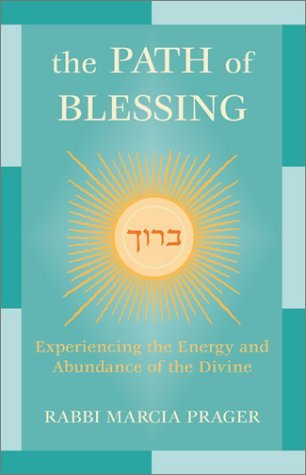
Enrich your spiritual practice with a deeper understanding of Hebrew blessing. A Hebrew blessing is a powerful thing―a short, deeply meditative exercise exploring the nature of God and the dynamic relationship between God, human consciousness and the unfolding universe. Written in clear, illuminating prose, this book will guide you through the opening words of a Hebrew blessing―six words which embody the depth of Jewish spirituality―revealing how the letters and words combine to promote joy and appreciation, wonder and thankfulness, amazement and praise. Each word becomes an invitation to discover the Presence of God flowing through even the smallest actions of our lives. Examine the deeper meaning In the ancient language of the Jewish mystical tradition and the modern language of hasidism, creation theology and psychology, The Path of Blessing brings the words of the Hebrew invocation dramatically alive.
Easy read. The author has a very creative and applicable approach to daily blessings. Some of the language might seem a bit simplistic for the experienced Jewish student, although the creative lenses are very inspiring.
I found the prose and metaphors in this book beautiful and artistically inspiring; I am in fact working on a collection of art pieces directly inspired by the book. However, I was disappointed by Prager’s handling of two important aspects of the Hebrew blessing formula.
1) Prager’s discussion of gender in G!d-language was superficial and unconvincing. Her nominally feminist critique of the male/masculine default fell short, choosing to reinterpret a patriarchal norm with a female/feminine twist rather than offering meaningful alternatives to that sexist norm*. She also, despite quoting Torah asserting that G!d is beyond gender, is very clearly stuck in a binary gender rut, describing G!d as “both” genders or “neither” rather than exploring the full realm of what it might look like to be in relation to a G!d who is not bound by (white, Western, cisheteronormative) strictly binary gender narratives.
2) Despite an exciting broad introduction to the layers of etymology encoded in Hebrew words via their roots, Prager didn’t actually dig into the root meanings of each word. Her word analysis throughout the book was restricted mostly to kabbalistic interpretations based on the significance of individual letters, leaving me wanting to know much more about the deeper Hebrew etymology of each word. To be fair, I am more interested in linguistics than the average person; but this books bills itself as an analysis of the language of Hebrew blessing, and I think that warrants more page space devoted to etymology.
So while I found this book an interesting read in terms of visual metaphors and kabbalistic information, as well as creatively inspiring, it was not intellectually satisfying in the way I hoped it would be.
*I strongly recommend Judith Plaskow’s _Standing Again at Sinai_ for an explanation of why this form of feminist critique reinforces sexism in Judaism rather than dismantling it.
A modern take on the act of blessing, the relationship of man and God, and the relevance of carrying out mitzvot in modern times. The linguistic analysis of the bracha formula was very good. I felt that the author’s analysis of the relationship between man and God still left me the idea idea of God as an entity as opposed to God as a source of reality and the basic rules for living a righteous life. This is well worth reading.
This beautifully written book is a analysis of the words in our prayers from a feminist viewpoint. It’s an invitation to look differently at blessings we have and also to meditate on blessing from a historical and philosophical analysis. Still enjoying this book it’s going to remain open to dig into periodically.
Compared to many other books by Rabbi Prager's teachers and mentors, this is a middling offering. Her insights can be helpful but also inconsistent in their logic.