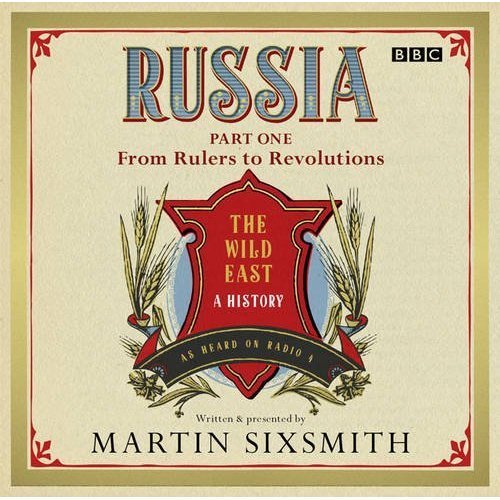
Martin Sixsmith brings his firsthand experience of reporting from Russia to this fascinating narrative, witnessing the critical moment when the Soviet Union finally lost its grip on power.
Power struggles have a constant presence in his story, from the Mongol hordes that invaded in the 13th century, through the iron autocratic fists of successive Tsars. Ivan the Terrible, Catherine the Great, Peter the Great – all left their mark on a nation that pursued expansion to the East, West and South. Many Tsars flirted with reform, but the gap between the rulers and the ruled widened until, in 1917, the doomed last Tsar, Nicholas II, abdicated. The first part of Sixsmith’s history ends with Lenin and the Bolsheviks forcing through the final Revolution and paving the way for the Communist state.
Eyewitness accounts and readings from Russian authors and historians, from Pushkin to Solzhenitsyn, enhance this fascinating account, as well as music taken from a wide range of Russian composers including Glinka, Tchaikovsky, Borodin and Shostakovich.
George Martin Sixsmith, British author and journalist. Sixsmith joined the BBC in 1980 where he worked as a foreign correspondent, most notably reporting from Moscow during the end of the Cold War. He also reported from Poland during the Solidarity uprising and was the BBC's Washington correspondent during the election and first presidency of Bill Clinton. He was based in Russia for five years, the US for four, Brussels for four and Poland for three.
Sixsmith left the BBC in 1997 to work for the newly elected government of Tony Blair. He became Director of Communications (a civil service post), working first with Harriet Harman and Frank Field, then with Alistair Darling. His next position was as a Director of GEC plc, where he oversaw the rebranding of the company as Marconi plc.
In December 2001, he returned to the Civil Service to join the Department for Transport, Local Government and the Regions as Director of Communications in time to become embroiled in the second act of the scandal over Jo Moore. Moore was special adviser to the transport secretary Stephen Byers and had been the subject of much public condemnation for suggesting that a controversial announcement should be "buried" during the media coverage of the September 11, 2001 attacks.[1]
Sixsmith incurred the displeasure of Downing Street when his email advising Byers and Moore not to bury more bad news was leaked to the press. Number Ten attempted to "resign him", but had later to issue an apology and pay him compensation. Sixsmith was widely expected to write a memoir or autobiography in the wake of his civil service departure, but was gagged by the government[citation needed] Instead, he produced a novel about near-future politics called Spin, published in 2004.
His second novel, I Heard Lenin Laugh, was published in 2005. In 2006 he was commissioned by BBC Radio 4 to present a series of programmes on Russian poetry, literature and art.
In 2007 he wrote The Litvinenko File, an examination of the feud between the Kremlin and Russia's émigré oligarchs.
In 2008 Sixsmith worked on two BBC documentaries exploring the legacy of the KGB in today's Russia and also presented a BBC documentary, The Snowy Streets of St. Petersburg, about artists and writers who fled the former Eastern bloc.
In 2009 he wrote The Lost Child of Philomena Lee, about the forcible separation of a mother and child by the nuns of an Irish convent during the 1950s, and the subsequent attempts of the mother and child to contact one another.[2] The book was adapted into the film Philomena, directed by Stephen Frears, starring Dame Judi Dench and Steve Coogan (as Sixsmith), and written by Coogan and Jeff Pope; it premiered at the Venice Film Festival and was released in the UK on November 1 2013.
In February 2010 Sixsmith wrote Putin's Oil, about Russia's energy wars and their consequences for Moscow and the world.
He worked as an adviser to the BBC political sitcom The Thick of It, and the Oscar-nominated film, In the Loop.
In 2011, he presented Russia: The Wild East, a 50-part history of Russia for BBC Radio 4, the last episode of which was broadcast on 12 August.[3] His book Russia, a 1,000 Year Chronicle of the Wild East was published by Random House.
In 2014 Sixsmith will present a 25 part programme about the history of psychology and psychiatry for the BBC radio.
BBC radio series which serves as the audio edition for the book of the same name. (This is series 1 which goes up to the revolution. Series 2, of equal length, covers the Soviets.) The Wild East is a lot of fun, in the way that popular history can be even when its approach may not be the best academically.
It’s a lively listen, with news clips, readings from chronicles, short dramatisations of historical events and passages of music peppering the main story, and giving breathing spaces in the usual constant torrent of audiobook narrative. With the audiobook I listened to just before this one, I’d noticed I found lectures easier to take in than standard audiobooks, and being a regular binge-listener to BBC spoken-word radio shows anyway, so this one seemed ideal. Some repetition can be useful in audio if (like me) you don't take it in as well as the written word - but this, made up of 25 episodes of a series (average length 13.4 mins) created to be heard on different days, has considerably more repetition of some points than most people will need if listening in stretches of an hour or so at a time.
The Wild East’s historical narrative is organised around the question of why Russia has returned to autocratic government rather than becoming a Western-style liberal democracy. Sixsmith was a BBC news correspondent in Russia in the 1980s and early 90s, reporting on Gorbachev's reforms and the collapse of the USSR. He both felt and propagated the late 1980s’ optimism that the Eastern Bloc was on its way to democratisation. The Wild East series was made in 2011, when Putin was firmly entrenched in Russia, but the shift of Hungary, Poland, and potentially other countries towards "Illiberal democracy" was not yet apparent as a major trend in European politics (though Viktor Orban was first elected in 2010). The timing means Sixsmith addresses Russia as a unique example, not part of a regional trend. (However, one of the primary explanations for this more recent phenomenon, a rejection of measuring one's own country by outside - i.e. Western European - standards, is, in effect, explored in The Wild East via the theme of Russia being caught between east and west.)
As the title The Wild East suggests, the series has a degree of fascination with the exoticism of Russia - but when a country and its artists frequently play up this angle themselves, and when unpleasant aspects of life are built in to that exoticism, it is by no means as straightforward to criticise as it might be in other cases. Likewise, the theme of ‘why isn’t Russia a liberal democracy?’, or to quote Sixsmith in one of the later episodes, why didn’t it become “a sort of British constitutional monarchy”, is open to criticism from some political angles - including those in which the far right hijacks left-wing social justice talking points, such as applying Western standards on other countries, for its own ends. But if you know there are real Russian people who would prefer living in a Western-style liberal democracy (and yes there are a lot of real Putin supporters too), and would also just like to know some possible answers, then it is interesting, regardless of being an obviously biased approach.
As in too many survey histories, there is not enough time here given to the medieval period (which I wanted to know about most). Only one fifth of the way through, the narrative is already up to Ivan the Terrible (d.1584). However, in this respect it is still better than some other histories of Russia available on audio, which start with either Ivan the Terrible or Peter the Great.
Sixsmith homes in on a number of turning points through the history of the last 1000 years, at which Russia’s direction was decided, with the underlying hypothesis that if at least one of these times, rulers had proceeded differently, modern Russia might not be an autocracy.
- the medieval legend of Rurik, a Viking, being invited to rule the Rus, and a “tendency to autocracy and penchant for military conquest” emerging as early as the 8th century
- the story of Prince Vladimir, who, according to an account written 100 years later, sent out four envoys circa 988 to investigate which religion his country should choose, his people at the time “worshipping mysterious gods, sacred oaks, and spirits of earth, wind and thunder”. He knew that it would be politically useful to choose one of the religions of his neighbours, the Jewish Khazars, the Western Christians of Germany, Islam [Sixsmith says the Ottomans, but the Ottoman Empire wasn’t founded until c.1300], and the Eastern Orthodox Greeks. He couldn’t countenance Russians not drinking (as under Islam) and the rich splendour and “unforgettable beauty” of the Orthodox buildings made his choice.
- the early Kievan Rus developed an unusually liberal political system for their time, with women having some role in public life, and there was a sort of proto-democracy. However, the loose confederation involved meant that the territory lacked the power needed to stand up to outside enemies, and it was an easy target for Mongol invaders. This reminded me of the weakness of Poland’s elected monarchy which led to the partitions of the late 18th century. Kievan Rus was conquered and further north, Muscovy became a vassal state under the ‘Tatar yoke’. (The beginning of Norman Davies’ history of Poland, God’s Playground (1979, rev. 2005), brings out the geopolitical angle, noting that Switzerland, Venice and England had natural defences making them harder to invade, allowing for the development of pioneering systems of government uninterrupted by invasion, in contrast to territories of the North European Plain such as Poland and Ukraine.)
- Sixsmith traces the tendency for autocratic government back to the Mongol era, following the lead 18th and 19th century historians from Russia. He could use the term “Asiatic despotism” rather less; I think even back in 2011 it would have sounded a bit off. The lasting effects of Mongol overlordship were not just a system of government. Russia was culturally isolated from the developments that led to the Renaissance in Western Europe (an idea which I would like to see explored and challenged in more substantive depth). In the 16th century there were increased Western connections - one memorable scene is Ivan the Terrible raging when Elizabeth I rejected his marriage proposal - but Russia remained a separate sphere. This was magnified when, whilst in much of Western Europe, the peasantry were becoming freer, Russian serfs became tied to the land under Boris Godunov (1598-1605), which, as well as immiserating millions of people for generations, affected future demographic distribution, land use and potential for industrial development.
- The famous reigns of Peter the Great (1682-1725) and Catherine the Great (1762-1796) are shown as further turning points, at which Russia could have become more democratic, but did not, although they marked a shift from "asiatic style despotism" to "enlightened paternalistic despotism." Peter wanted Westernisation, yet using autocratic methods to try to achieve it, and, like Ivan IV, possessed of a frightening temper. Catherine corresponded with Voltaire and instituted Enlightenment reforms that worried Western European monarchs - but intimidated by popular rebellion against them, and late in her reign by the events of the French Revolution, she returned the country again to autocracy.
- The 19th century was marked by alternation between repressive and mildly reforming tsars. (Though none was consistent: Alexander II, known for finally emancipating the serfs, also clamped down on autonomy and rebellion in Poland, and became more authoritarian after the first serious assassination attempt he faced.) Sixsmith feels that if Nicholas II in particular had embraced substantial reform and tried to make Russia into that British-style constitutional monarchy then the revolution may have been averted. (Yes this book feels very post-war British establishment at times, perhaps most of all here.)
There are a number of thematic chapters interspersed among the chronological history; these are some of the most interesting in the whole account, especially those about the south - i.e. the Caucasus - and the history of serfdom. In contrast, the one about Siberia was lacking, especially in material about the indigenous peoples. Sixsmith mentions it was a myth that Siberia was an empty land (colonialist myths seem remarkably similar across the world) but then he goes on to talk only about Russians’ activities within the two paradigms of “Siberia as land of opportunity” versus “Siberia as prison hell”.
It is in the material about the Caucasus where Russia as oppressive coloniser becomes apparent. Forest was destroyed because it removed rebel hiding places just as the US did in Vietnam. Historical quotes show a visceral hatred of Russia from republics such as Chechnya, describing Russians as animals, and the enduring legacy of the brutal General Yermolov who was responsible for some of the worst 19th-century campaigns in the region. Sixsmith’s history indicates how strongly and for how long history echoes in Russia, affecting contemporary life and events - and in this region emphatically so.
Sixsmith seems pretty good on explaining Russian serfdom, how it came to be, and its scale. (Although there are errors such as saying “in Russia, slavery lasted longer than anywhere else”; he is ignoring more obscure countries like Oman.) He mentions how initially, many people voluntarily became serfs because of the laws of village collective responsibility for taxes and military service. By the 19th century, he says the system had become chattel slavery on a vast scale: by the beginning of the century 17 million people out of a population of 36 million were serfs. (By the time of emancipation there were 23 million serfs, and the reforms were piecemeal, as too many landowners objected to giving serfs land.) As is more or less tacitly noticed by many western readers of classic Russian novels, he points out that serfdom was a major theme in art; much literature reads as a desperate attempt to expurgate the guilt of the intelligentsia. Turgenev talks of the nobility of serfs and the vacuity of aristocracy. Tolstoy is famous for his portrayals of liberal landowners (rather like himself) who want to improve life for their serfs and experience peasant tasks for themselves; a recording of Tolstoy by Edison has him talk of peasants as “the very people by whose labour we all live… [whose] goodness, nobility simplicity and hard labour are the guarantee of our russian way of life”. This is typical of the way the radical intelligentsia saw peasants as “an idealised abstraction to be fought for”, “not real people to be consulted and understood”. They were “two separate nations living in the same country who could never hope to understand each other”. Sixsmith relates an episode in the later 19th century when young revolutionary activists went to live with peasants in the hope of raising their consciousness and inciting them to rebellion, but instead several of the activists ended up killed by peasants, and others fled.
The book/series is shot through with references to Russian art and literature, which provides points of connection if you’ve read any. There are some wonderful dramatised lines from Dead Souls here which made me actual-LOL: if this is a real audiobook I want to find it. I was also prompted to listen to Boris Godunov on the day I wrote most of this post (Ghiaurov, Karajan version from 1971, should you care for these details) and it was good to discover another of the few exceptions to my not liking opera. this is absolutely magnificent, and dare I say, rocks.
In summarising answers to the central question of why Russia has returned to autocracy, familiar points are reiterated. Repeated invasion made Russian obsessed with its own vulnerability, leading it to drive the frontier ever further from the heartland - vastly increasing the size of the country. Through much of history there has been a sacrifice of individual to the state and a pride in this. Old Russian thinkers are quoted making the point that perhaps the sheer size of the territory necessitates autocracy. (He finds "the Russian Voltaire" Mikhail Speranksy a little too deterministic; however he considers many of his views still applicable today.) All this could be explored in more depth, with a wider variety of views, but The Wild East is still an interesting start, and very listenable.
Epic! R4. Historically, the changes made mean that Russia constantly stays the same. (Quote from The Thunderer - 'Sixsmith was the BBC's correspondent in Moscow, knows many of the Russians...His forensic manner is like a Panorama programme.')
blurbs - Russia in its earliest history was a disorderly group of tribes which followed pagan religions. As Rurik's descendant Vladimir took control in the 10th century AD, two priorities emerged, the choice of a religion that would bind the state together and the choice of an alphabet that would cement the religion in place and become a common language for the people.
As Martin Sixsmith relates, 'Russians have been Orthodox Christians for so many centuries that we tend to take it for granted. But Russia came close to adopting another religion - Islam. If Russia had chosen Islam, history could have been very different - not only for Russia, but for all of us in Western Europe too.' It was said that Russia only rejected Islam because of its ban on alcohol, which was a step too far for the thirsty Russians.
And, as for the language, the Russians owe that to two missionary Saints, Cyril and Methodius. They based their alphabet partly on Ancient Greek, and created a unifying language for Church and State, one which allowed the people access to the Bible and thus to the message of Christianity.
By the 10th century Russia had established a new capital in Kiev, now the capital of Ukraine, and from there sent traders and envoys west into Europe and east into Asia. It was a period when the nation found a stability, but Vladimir had 12 sons, and a fratricidal war would inevitably follow.
Producers: Adam Fowler & Anna Scott-Brown A Ladbroke production for BBC Radio 4.
This entire review has been hidden because of spoilers.
Fantastic. I have the original BBC Radio 4 broadcasts of this series and they are wonderful. Sixsmith, the BBC's Russia correspondent shows his mastery of all things Russian. It is clear that he not only is an expert on modern Russia but an expert on the history of this enigmatic empire. The BBC broadcasts include music, sound effects and dramatic readings by dozens of voice actors, including this guy who is simply wonderful. I hope that these broadcasts are on this disc intact since the elaborate audio production is worth more than the price of admission.
Sixsmith's love of his material is evident, and his learning vast. While I would have liked a little more focus on the medieval period of Kiev, this part is chock full of fascinating episodes in the intriguing history of Russia. If you have any interest at all in the history of Russia, this is the place to start. While lacking in specific detail, this series provides a perfect introduction to the history of the world's largest country for the non-specialist or amateur historian.
Audioraamatuks koondatud raadiosarja osad, siuliselt esimene pool samanimelisest raamatust. Nagu "Müstiline Venemaa" algajatele - läbilend Venemaa juurtest 10. sajandil kuni 1917. aastani. Paratamatult on paljud olulised sõlmpunktid puudu või pälvivad vaid üksiku märkuse, kuid mäluvärskendamiseks hoogne ja kenasti seostatud materjal. 3/5
A broad look at the history of Russia from inception to revolution. An excellent overview to this complex and diverse state, the challenges it faced and how it's distinct development and experiences inform current government.
A narrative journey from the founding of Kiev and the early Rus to the rise of the Bolsheviks as an early frame work for the Soviet/Council Union which shepherded all of Russia.