

What do you think?

Conditioning for Climbers: The Complete Exercise Guide
The only conditioning book a rock climber needs! Rock climbing is one of the most physically challenging sports, testing strength, endurance, flexibility, and stamina. Good climbers have to build and maintain each of these assets. This is the first-ever book to provide climbers of all ages and experience with the knowledge and tools to design and follow a comprehensive, personalized exercise program. Part One covers the basics of physical conditioning and goal-setting. Part Two takes readers through warm-up and flexibility routines, entry-level strength training, weight loss tips, and fifteen core-conditioning exercises. Part Three details climbing-specific conditioning, with twenty exercises to target specific muscles of the fingers, arms and upper torso to develop power and endurance. An entire chapter focuses on the antagonist muscle groups that help provide balance and stability, and prevent muscle injury. This section also has a chapter devoted to stamina conditioning, increasing the climber's endurance at high altitudes. Part Four shows how to put together a customized training program to suit the climber's needs. The book includes workout sheets for Beginner, Intermediate, and Advanced skill levels, tips for children and those over age fifty, secrets of good nutrition and an insider's take on avoiding injuries. Eric Hörst is a performance coach who has helped thousands of climbers. His published works include Learning to Climb Indoors, Training for Climbing, and How to Climb 5.12. He lives in Lancaster, Pennsylvania.
224 pages, Paperback
First published May 1, 2008
Ratings & Reviews
Friends & Following
Create a free account to discover what your friends think of this book!
Community Reviews
Displaying 1 - 10 of 10 reviews

January 23, 2013
Learned so much from this book, absolutely worthed its time and money. It introduced me some very new perspectives about injury prevention from opposite muscles and sleeping, the importance of mind and depth of influence of mind job in climbing, and enjoyed the very calculated micro scheduling for a climbing week, and daily workout scheduling for a climbing day. Over all, the only reason I didn't give a 5 star point to this book, was that it did not provide in depth theoretic and sports scientific reasons and hypothesis for the body building and rest period activities. I mean, you could not really know why you should do this specific exercise, how actually it affects your muscle, why do we perform it in 2 sets with 20 repetitions and rest for 3 minutes after each set? These should be related some basic sports science principles and laws, which I have no idea from, as if, the author has noticed that he will not go into weird information and his aim is mainstream climber auditions.
After all, personally I still feel lack of a comprehensive sports science principals and methods, and still need a source, at this level and as good, about common climbing injuries and how to rehabilitate from.
After all, personally I still feel lack of a comprehensive sports science principals and methods, and still need a source, at this level and as good, about common climbing injuries and how to rehabilitate from.
September 2, 2017
It is a good book.
The good points are that there are some interesting exercises and the basic principles are well tested and true. This is something that can be of use to an intermediate climber
The bad points are mainly in the area related to nutrition. Recent research on fats and carbohydrates tell a different and more complex story. He seems to have some really outdated information. I think that following that advice might be OK for intermediate and advanced climbers. It won't do too much harm at that level since they are already near optimal body composition and workout schedule. For an overweight beginner though, his advice is really bad in my opinion.
However I consider this a minor point in the overall scheme of the book. The aim of the book is mainly on climbing conditioning and it delivers on that nicely.
The good points are that there are some interesting exercises and the basic principles are well tested and true. This is something that can be of use to an intermediate climber
The bad points are mainly in the area related to nutrition. Recent research on fats and carbohydrates tell a different and more complex story. He seems to have some really outdated information. I think that following that advice might be OK for intermediate and advanced climbers. It won't do too much harm at that level since they are already near optimal body composition and workout schedule. For an overweight beginner though, his advice is really bad in my opinion.
However I consider this a minor point in the overall scheme of the book. The aim of the book is mainly on climbing conditioning and it delivers on that nicely.
February 17, 2018
Decent book with some great images to aid understanding the exercises. Let down by some consistent and fundamental mistakes. For example, that climbers have overtrained external rotators and undertrained internal rotators. Overall, a pretty okay book. But, it would have been an excellent book if small details like these were not overlooked.

March 29, 2010
This book is great for constructing a training plan personalized to your own body for improving your physical abilities as they relate to climbing.
I would've given this a higher rating but for the following criticisms:
Firstly, this book supports some pervasive myths inside the subject of physical fitness: doing high repetitions of core exercises, implying that stretches should take place before the "real" workout, and showing an exercise that performed as demonstrated would likely leave you with a herniated disc (although he does have a word of warning on that exercise.)
My other gripe is that too much of the content is demonstrating specific exercises. I would've liked to have had more in-depth examination of actual program construction.
Don't shy away from this book, though. I still consider it worth my purchase. So I'll say some things I like about it so that you don't feel like I just shat all over this thing.
The theory given for constructing a program is solid. He provides a great outline for working muscle groups and getting enough rest.
The nutritional information is good -- in fact, it helped me realize that my carbohydrate intake was too low. I saw nearly instant results by tweaking my diet.
Every climber should at least give this book a read.
I would've given this a higher rating but for the following criticisms:
Firstly, this book supports some pervasive myths inside the subject of physical fitness: doing high repetitions of core exercises, implying that stretches should take place before the "real" workout, and showing an exercise that performed as demonstrated would likely leave you with a herniated disc (although he does have a word of warning on that exercise.)
My other gripe is that too much of the content is demonstrating specific exercises. I would've liked to have had more in-depth examination of actual program construction.
Don't shy away from this book, though. I still consider it worth my purchase. So I'll say some things I like about it so that you don't feel like I just shat all over this thing.
The theory given for constructing a program is solid. He provides a great outline for working muscle groups and getting enough rest.
The nutritional information is good -- in fact, it helped me realize that my carbohydrate intake was too low. I saw nearly instant results by tweaking my diet.
Every climber should at least give this book a read.
October 11, 2010
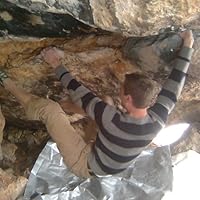
Fantastic breakdown of how to become a stronger climber. Breaking into the upper 12's and beyond requires more than just climbing occasionally. You have to train specific areas of your body to be able to have the local endurance, stamina, and strength to pull your hard projects. This book is very comprehensive in its approach to help you identify areas you need to strengthen and helping you to develope a strategy for accomplishing your climbing goals.

Currently Reading
February 17, 2010This guy writes the best climbing books so far...

Read
November 11, 2010This is a valuable resource for climbing.

October 10, 2012
Great training resource, didn't add a whole lot to the prior "Training for Climbing" but some of the new exercises and insights are pretty cool.
October 31, 2014
Training for Climbing is a much more comprehensive book.

Read
July 21, 2016Great info
This book helped me to understand climbing better as well as how to prepare better and get better at climbing.
This book helped me to understand climbing better as well as how to prepare better and get better at climbing.
Displaying 1 - 10 of 10 reviews