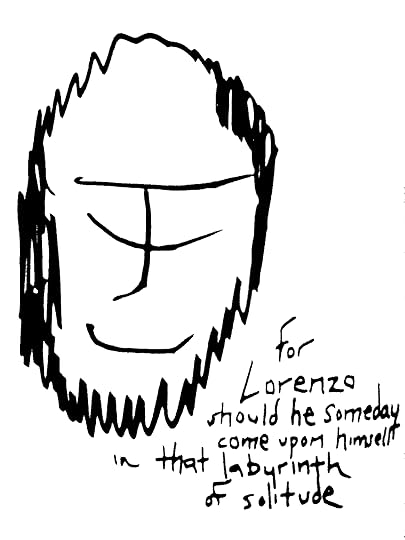
"The Mexican Night" is the first of several travel journals, to be published over the next few years, which Ferlinghetti originally envisioned under the title of "Writing Across the Landscape." It is considerably more than a travel book, including as it does much pure prose-poetry, new poems, and drawings taken from the author's notebooks. This book is not only personal but political, white at times it would seem to be a kind of "travel novel" - with but one character - the wandering figure (somehow surrounded with solitude) of the poet himself. [From back cover]
A prominent voice of the wide-open poetry movement that began in the 1950s, Lawrence Ferlinghetti has written poetry, translation, fiction, theater, art criticism, film narration, and essays. Often concerned with politics and social issues, Ferlinghetti’s poetry countered the literary elite's definition of art and the artist's role in the world. Though imbued with the commonplace, his poetry cannot be simply described as polemic or personal protest, for it stands on his craftsmanship, thematics, and grounding in tradition.
Ferlinghetti was born in Yonkers in 1919, son of Carlo Ferlinghetti who was from the province of Brescia and Clemence Albertine Mendes-Monsanto. Following his undergraduate years at the University of North Carolina at Chapel Hill, he served in the U.S. Navy in World War II as a ship's commander. He received a Master’s degree from Columbia University in 1947 and a Doctorate de l’Université de Paris (Sorbonne) in 1950. From 1951 to 1953, when he settled in San Francisco, he taught French in an adult education program, painted, and wrote art criticism. In 1953, with Peter D. Martin (son of Carlo Tresca) he founded City Lights Bookstore, the first all-paperbound bookshop in the country, and by 1955 he had launched the City Lights publishing house.
The bookstore has served for half a century as a meeting place for writers, artists, and intellectuals. City Lights Publishers began with the Pocket Poets Series, through which Ferlinghetti aimed to create an international, dissident ferment. His publication of Allen Ginsberg’sHowl & Other Poems in 1956 led to his arrest on obscenity charges, and the trial that followed drew national attention to the San Francisco Renaissance and Beat movement writers. (He was overwhelmingly supported by prestigious literary and academic figures, and was acquitted.) This landmark First Amendment case established a legal precedent for the publication of controversial work with redeeming social importance.
Ferlinghetti’s paintings have been shown at various galleries around the world, from the Butler Museum of American Painting to Il Palazzo delle Esposizioni in Rome. He has been associated with the international Fluxus movement through the Archivio Francesco Conz in Verona. He has toured Italy, giving poetry readings in Roma, Napoli, Bologna, Firenze, Milano, Verona, Brescia, Cagliari, Torino, Venezia, and Sicilia. He won the Premio Taormino in 1973, and since then has been awarded the Premio Camaiore, the Premio Flaiano, the Premio Cavour. among others. He is published in Italy by Oscar Mondadori, City Lights Italia, and Minimum Fax. He was instrumental in arranging extensive poetry tours in Italy produced by City Lights Italia in Firenze. He has translated from the italian Pier Paolo Pasolini’s Poemi Romani, which is published by City Lights Books. In San Francisco, his work can regularly be seen at the George Krevsky Gallery at 77 Geary Street.
Ferlinghetti’s A Coney Island of the Mind continues to be the most popular poetry book in the U.S. It has been translated into nine languages, and there are nearly 1,000,000 copies in print. The author of poetry, plays, fiction, art criticism, and essays, he has a dozen books currently in print in the U.S., and his work has been translated in many countries and in many languages. His most recent books are A Far Rockaway of the Heart (1997), How to Paint Sunlight (2001), and Americus Book I (2004) published by New Directions.
He has been the recipient of numerous prizes, including the Los Angeles Times’ Robert Kirsch Award, the BABRA Award for Lifetime Achievement, the National Book Critics Circle Ivan Sandrof Award for Contribution to American Arts and Letters, the American Civil Liberties Union’s Earl Warren Civil Liberties Award. Ferlinghetti was named San Francisco’s first poet laureate.
Lawrence Ferlinghetti is one of my all-time favourite modern-day poets. Not only do I love his major works, such as Coney Island of the Mind, Pictures from the Gone World, and Far Rockaway of the Heart, just to name a few of many classics he has put out in his 98 years (and still kicking!) on this mortal coil, but I also share many of his political beliefs, although he tends to act on his beliefs more than I do, which makes him a braver man than I.
This was a refreshingly enjoyable read as once again I have come across a new 'genre' or perhaps to be more precise, a novel which crosses and blends many genres into one. Essentially this is a journal of Ferlinghetti's travels and experiences in Mexico in the early to late 60s and his reflections on US economic oppression, Che Guevara and Neal Cassady (who both died in 1968), the Mexican government's brutal murder of 500 protesting students just days before the Olympic Games were held in Mexico City (which I did not know about before I read this book) but also the quotidian poverty and observations of street-singers, prostitutes, old women in black shawls going to church and more.
What is most interesting about this book is how Ferlinghetti blends 'conventional' journalistic observations with snippets of poems he is working on and also surrealistic visions and hallucinations induced by the strong, heady Mexican weed he was smoking at the time. Therefore, you get this very interesting pot pourri of poetry, sober prose and 'under-the-influence' prose. In some parts, Ferlinghetti lost me but I thought this was him at his loosest and most spontaneous. In parts you can feel the influence of Kerouac's and Ginsberg's spontaneous bop prosody style and also what surprised me was his strong sardonic humour which had a touch of the grotesque to it and reminded me much of Burroughs and his dark sense of humour.
Once again Ferlinghetti has blown me away. He is definitely one of my heroes and I have yet to read a 'weak' book published by him - this book was very entertaining, perceptive and vivid. Highly recommended.
[rating = A+] One of my Best Books of the Year (for 2015) Mexican Night is an explosion of prose-poetry and poetry. It tells the story of day to day travels through Mexico, often hilariously described either by the beautifully unique word-choice or the drug-talk. A major critic on Mexican-American relations and an out-spoken call to individuality! A brilliant little book.
The second entry in this diary begins with «A visionary journey without visions», but the few visions are actually among the most powerful parts of it. A good mixture of poetic prose, drug induced paranoia, and travel + history log.
El tiempo le ha pasado factura a varias de las obras del periodo Beat y este libro no es la excepción; Ferlinghetti llega a México en los 60's con una visión exotizada de México, buscando el "paraíso beat" de drogas y desenfreno, el México de "Bajo el Volcán", y en su lugar se encuentra una realidad diferente.
El desencanto de Ferlinghetti se hace evidente en un pasaje en que hace una crítica del colonialismo de Estados Unidos, pero colocando a México al nivel de baratija geográfica:
(Haciendo alusión a las 50 estrellas que representan los estados en la bandera de USA) "Quizá haya otras estrellas usadas que recoger en barata. Nuevo México fue lo suficientemente barato, prácticamente nada, pero las estrellas sueltas de las banderas del autobús podrían resultar incluso más baratas"
Se entienden las circunstancias de post guerra y experimentación cultural que llevaron a la generación beat a adoptar esa visión sobre México, como documento histórico-cultural el libro tiene un valor innegable, pero la visión que presenta se hizo anticuada en poco tiempo.
“He who travels on peninsulas must expect someday to turn back. It is as if I were waiting for the sea to stop it’s absolute incoherence….I see myself in the dark distance, a stick figure in the world’s end….”
... no countries, no nations, nothing at all to stop us anywhere, nothing to stop the hordes of the world still starving and howling like Calibans at the gates.