

What do you think?

The Last Colonial Massacre: Latin America in the Cold War
After decades of bloodshed and political terror, many lament the rise of the left in Latin America. Since the triumph of Castro, politicians and historians have accused the left there of rejecting democracy, embracing communist totalitarianism, and prompting both revolutionary violence and a right-wing backlash. Through unprecedented archival research and gripping personal testimonies, Greg Grandin powerfully challenges these views in this classic work. In doing so, he uncovers the hidden history of the Latin American Cold War: of hidebound reactionaries holding on to their power and privilege; of Mayan Marxists blending indigenous notions of justice with universal ideas of equality; and of a United States supporting new styles of state terror throughout the region.
With Guatemala as his case study, Grandin argues that the Latin American Cold War was a struggle not between political liberalism and Soviet communism but two visions of democracy—one vibrant and egalitarian, the other tepid and unequal—and that the conflict’s main effect was to eliminate homegrown notions of social democracy. Updated with a new preface by the author and an interview with Naomi Klein, The Last Colonial Massacre is history of the highest order—a work that will dramatically recast our understanding of Latin American politics and the role of the United States in the Cold War and beyond.
“This work admirably explains the process in which hopes of democracy were brutally repressed in Guatemala and its people experienced a civil war lasting for half a century.”—International History Review
“A richly detailed, humane, and passionately subversive portrait of inspiring reformers tragically redefined by the Cold War as enemies of the state.”—Journal of American History
With Guatemala as his case study, Grandin argues that the Latin American Cold War was a struggle not between political liberalism and Soviet communism but two visions of democracy—one vibrant and egalitarian, the other tepid and unequal—and that the conflict’s main effect was to eliminate homegrown notions of social democracy. Updated with a new preface by the author and an interview with Naomi Klein, The Last Colonial Massacre is history of the highest order—a work that will dramatically recast our understanding of Latin American politics and the role of the United States in the Cold War and beyond.
“This work admirably explains the process in which hopes of democracy were brutally repressed in Guatemala and its people experienced a civil war lasting for half a century.”—International History Review
“A richly detailed, humane, and passionately subversive portrait of inspiring reformers tragically redefined by the Cold War as enemies of the state.”—Journal of American History
346 pages, Paperback
First published September 15, 2004
About the author
Greg Grandin
20 books610 followersGreg Grandin is the author of Fordlandia, a finalist for the Pulitzer Prize, the National Book Award, and the National Book Critics Circle Award. A Professor of History at New York University, Grandin has published a number of other award-winning books, including Empire's Workshop, The Last Colonial Massacre, and The Blood of Guatemala.
Toni Morrison called Grandin's new work, The Empire of Necessity, "compelling, brilliant and necessary." Based on years of research on four continents, the book narrates the history of a slave-ship revolt that inspired Herman Melville's other masterpiece, Benito Cereno. Philip Gourevitch describes it as a "rare book in which the drama of the action and the drama of ideas are equally measured, a work of history and of literary reflection that is as urgent as it is timely."
Grandin has served on the United Nations Truth Commission investigating the Guatemalan Civil War and has written for the Los Angeles Times, The Nation, The New Statesman, the Guardian, the London Review of Books, and The New York Times.
He received his BA from Brooklyn College, CUNY, in 1992 and his PhD from Yale in 1999. He has been a guest on Democracy Now!, The Charlie Rose Show, and the Chris Hayes Show.
Toni Morrison called Grandin's new work, The Empire of Necessity, "compelling, brilliant and necessary." Based on years of research on four continents, the book narrates the history of a slave-ship revolt that inspired Herman Melville's other masterpiece, Benito Cereno. Philip Gourevitch describes it as a "rare book in which the drama of the action and the drama of ideas are equally measured, a work of history and of literary reflection that is as urgent as it is timely."
Grandin has served on the United Nations Truth Commission investigating the Guatemalan Civil War and has written for the Los Angeles Times, The Nation, The New Statesman, the Guardian, the London Review of Books, and The New York Times.
He received his BA from Brooklyn College, CUNY, in 1992 and his PhD from Yale in 1999. He has been a guest on Democracy Now!, The Charlie Rose Show, and the Chris Hayes Show.
Ratings & Reviews
Friends & Following
Create a free account to discover what your friends think of this book!
Community Reviews
Displaying 1 - 30 of 30 reviews

Want to Read
January 28, 2019Venezuela this week got me thinking some heavy thoughts about the rivers of blood spilt by CIA-supported coups and US trained death squads in Latin America during the cold war. Are we headed back to those dark days? Might be a good time to read a book on Guatemala.
The two migrant children who died in the custody of border patrol this past December were both Guatemalan. Over twenty years since the peace accords that brought an end to the genocide, Guatemala still does not appear to be a livable place for its poor.
The two migrant children who died in the custody of border patrol this past December were both Guatemalan. Over twenty years since the peace accords that brought an end to the genocide, Guatemala still does not appear to be a livable place for its poor.

January 25, 2012
The Cold War wasn't fought only between the United States and the Soviet Union; Latin America was a battleground from the 1950s to the 1980s and not only in Chile, Cuba and Nicaragua. Guatemala, the unfortunate locus of a thirty-years long civil war characterized by the slaughter of entire villages, including the machine-gunning of peasants gathered to petition the government and the pioneering use of untraceable death squads for the extrajudicial murder of political activists was a theater of the Cold War in which Communism was defeated by the genocidal massacre of unarmed civilians. Since most of the dead were Mayan Indians, Guatemala today has the only military in Latin America accused of genocide by a U.N. sponsored truth commission. It is almost impossible for any United Nations organization to come to a definitive and damning conclusion we can be sure that the evidence of genocide was stark, shocking and impossible to miss. Which it was.
Guatemala's coffee elite prospered by using workers tied to the land through debt peonage that was little different than the serfdom of Tsarist Russia in the nineteenth century. State power backed the economic control by the planters--it was illegal for a peasant to run away from the job to which
he and his family were bound and was a criminal offense to organize opposition to compulsory labor.
Inspired by the anti-fascist campaigns of World War II and the Popular Front Jacobo Arbenz was elected President in 1950. He was overthrown in 1954: his program of educating the peasantry was as dangerous to the plantation owners as was his ideas of land reform. According to Grandin, an author I have come to respect and trust, a combination of land owners, Catholic bishops, the military and the U.S. trained central political intelligence service made sure that the experiments of the early 1950s wouldn't be repeated.
The last colonial massacre referred to in "The Last Colonial Massacre" took place in 1978. It harkened back to the original Spanish conquest of the isthmus but was also as modern as today's headlines. Indians gathered in a town square to petition the mayor against the most ruthless feudal rules of the plantation owners; many were shot down by the army, the rest dispersed in what seemed to be a repeat of hundreds of military responses to political demands. In this case, though, they were led by left-wing organizers and coordinated their activities with unions in the cities, attempting to bring their grievances to a national constituency.
Grandin suggests that the greatest defeat of the Cold War in Latin America was of the United States and our belief in the principals of liberal civility, tolerance and pluralism. It is hard to disagree with him particularly after reading this meticulously researched and well written book.
Guatemala's coffee elite prospered by using workers tied to the land through debt peonage that was little different than the serfdom of Tsarist Russia in the nineteenth century. State power backed the economic control by the planters--it was illegal for a peasant to run away from the job to which
he and his family were bound and was a criminal offense to organize opposition to compulsory labor.
Inspired by the anti-fascist campaigns of World War II and the Popular Front Jacobo Arbenz was elected President in 1950. He was overthrown in 1954: his program of educating the peasantry was as dangerous to the plantation owners as was his ideas of land reform. According to Grandin, an author I have come to respect and trust, a combination of land owners, Catholic bishops, the military and the U.S. trained central political intelligence service made sure that the experiments of the early 1950s wouldn't be repeated.
The last colonial massacre referred to in "The Last Colonial Massacre" took place in 1978. It harkened back to the original Spanish conquest of the isthmus but was also as modern as today's headlines. Indians gathered in a town square to petition the mayor against the most ruthless feudal rules of the plantation owners; many were shot down by the army, the rest dispersed in what seemed to be a repeat of hundreds of military responses to political demands. In this case, though, they were led by left-wing organizers and coordinated their activities with unions in the cities, attempting to bring their grievances to a national constituency.
Grandin suggests that the greatest defeat of the Cold War in Latin America was of the United States and our belief in the principals of liberal civility, tolerance and pluralism. It is hard to disagree with him particularly after reading this meticulously researched and well written book.

April 18, 2018
Guatemala 1980'lerde emperyalizmin Orta Amerika'da en çok kan döktüğü yerlerden biriydi. Grandin bu yüzden "son sömürge katliamı" adını vermiş ülkeyi anlatan kitabına.
Özellikle giriş ve sonuç bölümleri Latin Amerika'daki emperyalist politikaların çok güzel bir özeti. 1920'lerden 2000'lere uzanan tarihte amacın yalnızca halk direnişini bastırmak olmayıp, yeni ve kabullenmiş bir köleler toplumu yaratmak olduğunu biraz da moral bozukluğu içinde göstermiş.
Özellikle giriş ve sonuç bölümleri Latin Amerika'daki emperyalist politikaların çok güzel bir özeti. 1920'lerden 2000'lere uzanan tarihte amacın yalnızca halk direnişini bastırmak olmayıp, yeni ve kabullenmiş bir köleler toplumu yaratmak olduğunu biraz da moral bozukluğu içinde göstermiş.
November 25, 2014
This book is a brutal read. It really gives a different perspective than the history textbooks on Reagan and US foreign policy in Latin America during the Cold War.

June 12, 2023
To clarify - the title says "Latin America", but aside from the Intro and Conclusion the entire book is about the Maya of the Polochic Valley in Alta Verapaz, Guatemala.
The author actually changed how I think about 20th century Central America, and he openly starts by challenging a common narrative. If you look at Guatemala from a big picture, you will see the descent from Spanish exploitative negligence to 19th century planter tyranny to 20th century mass genocide. This is all true, but the author highlights an alternate perspective. Latin America as a region is plagued by political violence, and in light of that what is remarkable is the tenacity of communities that spend generations fighting for their rights and dignity.
The "Last Colonial Massacre" is a reference to the 1978 Panzos Massacre in Guatemala, which marked a turning point from periods of protest, negotiation, and concessions to blatant state mass murder. The author explores the period before that - roughly 1920 to 1978 - and how the Maya peasants of the Polochic Valley negotiated their situations with the government and with ladino landowners. This encompasses the decade of the far-right Ubico dictatorship, 1944 October Revolution that brought Arevlo and then Arbenz to power via free and fair elections, the 1954 coup, and the subsequent decades of ever-intensifying state repression and terror.
The Maya peasants were always on the back foot - they were the main economic producers, but they did not have the legal title of the landlords nor the weapons of the state. And yet, we can follow the careers and tactics of labor organizers as they sought to end the repressive laws that tied workers to the land, while denying them ownership of the land they worked. Through the author's work, we can examine this history with all of it knottiness, and the unsexy back-and-forth of conflict and negotiation, petition and violence, and community divisions over how to proceed.
We can follow the earliest activist, José Icó - dressed in "blue wool pants, white shirts, dark jackets, and white rimmed hats" (p. 34) as he used populist authoritarianism to "round up Q'echi's to vote for revolutionary candidates" (p. 62), and we can see how even some Q'echi's were not in full support. "When asked if any Q'echi's opposed the reform, he confessed that a few did but they were wealthy and lived in Carchá's center. When questioned about rural Q'echi's who testified on Alvarado's behalf, or about why supposed support quickly turned after the fall of Arbenz, Cucul admits that there were some who did not agree with the Revolution" (p. 61).
We can read about how in 1952, the CIA dumped plans to openly topple Arbenz because Tacho Somoza was a blabbermouth who "began talking openly of invasion plans" (p.77).
We can see just how different the Catholic Church was a few generations ago. In the 1950s, the Catholic Archbishop of Guatemala wrote that "The disorganized tribes that inhabited our America would have disappeared had not the Spanish conquest arrived so providentially to unite them and give their triple gifts of religion, blood, and language," or again "In the shade of Christ's cross was forged the temperate character of our ancestors, to whom we owe what is noble and generous in our high classes and patient and abnegated in the popular classes" (p. 80 - 81). This is a prelate who opposed not only social security but the entire Enlightenment project.
We can read about the interesting scenario where a planter actually sold off his land (relatively) cheaply to his former workers, on condition that they pay off the mortgage. The community was divided 50-50 between those who would accept this and those who wanted the government to grant the land for free. As a result, the ones who accepted paying burned down the houses of all who refused and destroyed their crops, forcing them out. (p. 114).
The 20th century conflict between Maya peasants and ladino landlords did not just consist of contemporary displeasure, but also entailed generations of exploitation and disagreement about the nature of society. "I fed your grandfather, I fed your father, and I fed you," stated one planter, to which an unmoved peasant leader supposedly retorted "No, you exploited my grandfather, you exploited my father, and now you are exploiting me" (p. 147).
What is amazing is that after the colonial period, "republican" governments resurrected or even intensified the systems of colonial exploitation "republican governments resurrected a range of colonial coercive mechanisms, from debt peonage and vagrancy laws to government organized labor drafts, in order to secure workers for agricultural commodity production" (p. 179). The army itself "continued to view national security as synonymous with a defense of social hierarchy" (p. 163), and it is was this intensifying exploitation that escalated to the guerrilla movement and reactionary genocide of the later 20th century.
The conclusion is an absolute masterpiece, that ties this local story into the author's broader point about Latin America in the Cold War. The story of social movements and democracy does not begin in the last quarter of the 20th century, but extends throughout the 20th century and even into the 19th. Millions of people suffered unspeakable brutalization, and yet - generation after generation, and in the wake of deepening repression - people still fought for their rights. The author paints the grim yet hopeful image of a continent where ordinary people really do believe in the ideals of liberty, equality, fraternity. This is the story - the grim, blood-soaked, and forgotten story - of ordinary people struggling for Enlightenment democracy.
The author actually changed how I think about 20th century Central America, and he openly starts by challenging a common narrative. If you look at Guatemala from a big picture, you will see the descent from Spanish exploitative negligence to 19th century planter tyranny to 20th century mass genocide. This is all true, but the author highlights an alternate perspective. Latin America as a region is plagued by political violence, and in light of that what is remarkable is the tenacity of communities that spend generations fighting for their rights and dignity.
The "Last Colonial Massacre" is a reference to the 1978 Panzos Massacre in Guatemala, which marked a turning point from periods of protest, negotiation, and concessions to blatant state mass murder. The author explores the period before that - roughly 1920 to 1978 - and how the Maya peasants of the Polochic Valley negotiated their situations with the government and with ladino landowners. This encompasses the decade of the far-right Ubico dictatorship, 1944 October Revolution that brought Arevlo and then Arbenz to power via free and fair elections, the 1954 coup, and the subsequent decades of ever-intensifying state repression and terror.
The Maya peasants were always on the back foot - they were the main economic producers, but they did not have the legal title of the landlords nor the weapons of the state. And yet, we can follow the careers and tactics of labor organizers as they sought to end the repressive laws that tied workers to the land, while denying them ownership of the land they worked. Through the author's work, we can examine this history with all of it knottiness, and the unsexy back-and-forth of conflict and negotiation, petition and violence, and community divisions over how to proceed.
We can follow the earliest activist, José Icó - dressed in "blue wool pants, white shirts, dark jackets, and white rimmed hats" (p. 34) as he used populist authoritarianism to "round up Q'echi's to vote for revolutionary candidates" (p. 62), and we can see how even some Q'echi's were not in full support. "When asked if any Q'echi's opposed the reform, he confessed that a few did but they were wealthy and lived in Carchá's center. When questioned about rural Q'echi's who testified on Alvarado's behalf, or about why supposed support quickly turned after the fall of Arbenz, Cucul admits that there were some who did not agree with the Revolution" (p. 61).
We can read about how in 1952, the CIA dumped plans to openly topple Arbenz because Tacho Somoza was a blabbermouth who "began talking openly of invasion plans" (p.77).
We can see just how different the Catholic Church was a few generations ago. In the 1950s, the Catholic Archbishop of Guatemala wrote that "The disorganized tribes that inhabited our America would have disappeared had not the Spanish conquest arrived so providentially to unite them and give their triple gifts of religion, blood, and language," or again "In the shade of Christ's cross was forged the temperate character of our ancestors, to whom we owe what is noble and generous in our high classes and patient and abnegated in the popular classes" (p. 80 - 81). This is a prelate who opposed not only social security but the entire Enlightenment project.
We can read about the interesting scenario where a planter actually sold off his land (relatively) cheaply to his former workers, on condition that they pay off the mortgage. The community was divided 50-50 between those who would accept this and those who wanted the government to grant the land for free. As a result, the ones who accepted paying burned down the houses of all who refused and destroyed their crops, forcing them out. (p. 114).
The 20th century conflict between Maya peasants and ladino landlords did not just consist of contemporary displeasure, but also entailed generations of exploitation and disagreement about the nature of society. "I fed your grandfather, I fed your father, and I fed you," stated one planter, to which an unmoved peasant leader supposedly retorted "No, you exploited my grandfather, you exploited my father, and now you are exploiting me" (p. 147).
What is amazing is that after the colonial period, "republican" governments resurrected or even intensified the systems of colonial exploitation "republican governments resurrected a range of colonial coercive mechanisms, from debt peonage and vagrancy laws to government organized labor drafts, in order to secure workers for agricultural commodity production" (p. 179). The army itself "continued to view national security as synonymous with a defense of social hierarchy" (p. 163), and it is was this intensifying exploitation that escalated to the guerrilla movement and reactionary genocide of the later 20th century.
The conclusion is an absolute masterpiece, that ties this local story into the author's broader point about Latin America in the Cold War. The story of social movements and democracy does not begin in the last quarter of the 20th century, but extends throughout the 20th century and even into the 19th. Millions of people suffered unspeakable brutalization, and yet - generation after generation, and in the wake of deepening repression - people still fought for their rights. The author paints the grim yet hopeful image of a continent where ordinary people really do believe in the ideals of liberty, equality, fraternity. This is the story - the grim, blood-soaked, and forgotten story - of ordinary people struggling for Enlightenment democracy.

February 17, 2008
The first major criticism I have with this book is the title. While it touches on events in Latin America in the introduction and the conclusion..the rest of the book is a detailed study of the events in Guatemala. That is okay, I found it very interesting, but the title misrepresents. I saw some of the reviewers on the back of the book mentioned he used Guatemala as a case study on the Cold war events in Latin America, but I don't think that is possible. While history may have played out simarly in the hand full of countries that compromise Latin America, they are still very individual and diverse in their culture and the way foreign powers influenced them during the Cold War, and the way their population's responded. The title did not play well with me. That said, the book was well researched and interesting. His writing was a bit disorganized, at times he would add statements that needed clarification, but wouldn't be there. A sign that the writer was very close to the project and very knowledagble of what he wrote.. I would guess. It was a tough read, but it was only 200 pages so you could get through it. I would not attempt it unless you are really interested in Latin American history..it does not have the style to entertain other genre readers..

September 25, 2022
i think this is a great place to start to understand the modern discourse that follows latin america. it is absolutely appalling how bad the US forces actions were in Latin America and to realize that the US has never taken responsibility. very interesting and great tool to start the conversation
definitely a confusing book to read though, the timeline is a little weird set up.
definitely a confusing book to read though, the timeline is a little weird set up.
June 26, 2013
very very boring

March 8, 2025
The Last Colonial Massacre: Latin America and the Cold War, Greg Grandin (1962-), 2004, 311 pages, Dewey 972.8105, Library-of-Congress F1466.5 G73 2004, ISBN 0226305724
Thorough. Explains the what, how, and why of the Guatemalan genocide, 1954-1996.
Based on >100 interviews with >75 people in Guatemala, Mexico, and the U.S. p. xvii.
There was nothing senseless about the genocide. The United States Government and local owning class did it for greed. For decades, under every presidency.
The Cold War in Latin America (as elsewhere) began after WWII.
The U.S., allied with the local landowning aristocracy and the Catholic Church, destroyed democracy and its proponents. pp. 105, 174.
State- and elite-orchestrated preventive and punitive terror was key to ushering in neoliberalism in Latin America. p. 14.
The Guatemalan army murdered 200,000 people, disappeared 40,000, and tortured unknown thousands more. pp. 3, 74, 98.
The 1996 Guatemalan peace accords confirmed the absolute right of private property, and precluded any possibility of future land redistribution. p. 194.
Pressure applied by international markets, financial institutions, and the United States forced states to open up their economies, privatize their industries, and roll back their social services. p. 197.
Wealth inequality is at an all-time high. p. 191.
Democracy is now but a shade of its former substance. p. 198.
Those who make peaceful revolution impossible will make violent revolution inevitable. --John F. Kennedy. p. 157.
POSTWAR DEMOCRACY
Postwar, democracy meant social and economic improvement for the poor. This threatened the power and privileges of the ruling elite. p. 6.
In 1944, only 5 Latin American countries--Mexico, Uruguay, Chile, Costa Rica, and Colombia--could nominally call themselves democracies. By 1946, only 5--Paraguay, El Salvador, Honduras, Nicaragua, and the Dominican Republic--could not. p. 5.
Labor unions were suddenly permitted in Guatemala when socialist Juan José Arévalo became president in 1944. By 1954, 60% of the 1950 voting population were union members. pp. 6, 51.
RULING-CLASS REACTION
Latin American elites, and the Catholic Church, bought U.S. goals: prevent communism; ensure U.S. dominance. pp. 7-8, 78-82. Communism was defined so loosely that "we can arrest anyone, and hold them as long as we want."--a U.S. embassy official in Guatemala in 1954. p. 66.
1947-1948 were bad years for democracy, globally: creation of the CIA; the Truman Doctrine; Taft-Hartley; the National Security Act; the repudiation of Henry Wallace as the legitimate heir to the New Deal; apartheid; the partition of India; USSR's ideological hardening; the Communist coup in Czechoslovakia; Stalin's betrayal of the partisans in the Greek civil war. p. 8.
Beginning in 1947, Latin America suffered military coups and government crackdowns on labor unions and leftists. By 1954, dictators again ruled most Latin American countries. p. 8. By 1976, only 3 nations could be considered democratic. p. 10. [Grandin doesn't say which 3.]
The 1954 CIA-led invasion against Guatemala's Arbenz government was clumsy. Guatemalan troops could've defeated it easily. But. Officers abandoned Arbenz because they feared the power of the U.S., which they knew had organized, trained, and paid for the invasion. pp. 85-86. The military purged reformers. Remaining officers were corrupt, opportunistic, brutal. p. 94. Security forces committed robberies and kidnappings, blamed on the left. p. 96.
MEDIA COMPLICIT
After the CIA-sponsored overthrow of Arbenz's government in 1954, the New York Times obeyed the CIA's request to keep reporters out of the Guatemalan countryside--so there was no reporting of the slaughter of labor-union leaders and other democrats. p. 67, 76, 139.
The U.S. in 1966 assassinated more than 30 Guatemalan reformist politicians and activists--especially the non-militant ones--to prevent peace between leftists and the government, which might lead to legalizing left-leaning political parties. This ended hopes of reform through political means--but didn't extinguish all hope of violent overthrow of the U.S.-imposed dictatorship. This ensured nearly 3 more decades of murder by government forces of suspected proponents of reform. pp. 12, 73, 98. Thirty-five names of victims, p. 201. The U.S. (and South Africa, Israel, and France) armed death squads for Guatemala's military dictatorship. p. 13.
The 1966 U.S. imposition of what would be 30 years of slaughter in Guatemala led a parade of counterinsurgent terror states: Brazil 1968, Chile and Uruguay 1973, Argentina 1976, El Salvador late 1970s. p. 74.
The U.S. assault on Chilean president Allende increased after the U.S. realized that Allende would /not/ turn Chile into a Cuban-style Soviet satellite. The Chilean threat was the example it showed of a popularly-elected Marxist government combining democratic pluralism and real socialism. Cuba restricted political rights of anticommunists. Guatemala, Chile, and Nicaragua did not. Only Cuba's government survived the vicious U.S.-led attacks. p. 175.
Considering the repression it suffered throughout the 20th Century, the Latin American left on the whole responded with extraordinary restraint, almost in inverse proportion to the torment inflicted on it by the state, domestic elites, and the U.S. p. 176.
After the 1979 Sandinista revolution in Nicaragua, Reagan determined to destroy the left in Latin America. p. 175.
Death squads killed leftists, students, labor-union leaders, peasants, professors, nuns, democratic politicians, and less-than-virulent anticommunists. pp. 88-89, 159.
After destroying unions, political parties, and religious and peasant communities, the army in 1981 unleashed a genocide p. 165.
1981-1983, the Guatemalan military razed hundreds of Mayan communities, committed over 600 massacres, murdered over 100,000 indigenous peasants, tortured thousands more, and drove, in some areas, 80 percent of the population from its homes. pp. 127, 196.
WHY?
The CIA admitted in 1968 that violence has been, is, and will continue to be used not to protect Guatemala from communism but for the oligarchy to oppress legitimate social change. p. 99.
The corruption, intransigence, and greed of army officials and the ruling class led to increasing violence against the growing oppositional movement. p. 162.
COFFEE
In the 1860s, the Mayan majority still owned their land and subsisted on it as they had for centuries. By 1879, coffee barons claimed the land and enslaved the labor. The government worked to ensure a labor force for coffee planters. pp. 24-26, 131. Unpaid labor was still common in the 1960s; a single family owned 100,000 acres (= 156 square miles = 405 square km = 40,500 hectares). pp. 108-110, 179.
Planters' wealth resides (now as then) not in the soil but in the low wages of laborers. p. 38. Pre-1944, plantation workers were paid 5 cents a day--in plantation scrip, or in salt or sugar. p. 109. (During the 4-year Arbenz presidency, 1950-1954, wages were 60¢/day; after the U.S.-led coup, they plummeted to 15¢/day. p. 142.) By 1963, the minimum wage was 25 cents a day--sometimes paid in IOUs or in goods: "They gave us four cigarettes, soap, and a can of sweets instead of a week's salary." p. 111. As of 2025, Guatemalan agricultural minimum wages are $14.79 per day https://www.auxadi.com/blog/2025/02/0... , and are rarely enforced: https://align-tool.com/source-map/gua...# .
Wealth and poverty persist. Poverty is /because/ of wealth. p. 130.
"A system of exploitation that we have been living for 400 years." --Comité de Unidad Campesina, 1979. p. 161.
BANANAS
Manuel Estrada Cabrera, Guatemala's dictatorial president 1898-1920, turned over Guatemala's railroads, ports, electric company, and vast tracts of land to United Fruit Company [now Chiquita]. pp. 27, 141.

More about Guatemala: https://www.goodreads.com/review/list...
Thorough. Explains the what, how, and why of the Guatemalan genocide, 1954-1996.
Based on >100 interviews with >75 people in Guatemala, Mexico, and the U.S. p. xvii.
There was nothing senseless about the genocide. The United States Government and local owning class did it for greed. For decades, under every presidency.
The Cold War in Latin America (as elsewhere) began after WWII.
The U.S., allied with the local landowning aristocracy and the Catholic Church, destroyed democracy and its proponents. pp. 105, 174.
State- and elite-orchestrated preventive and punitive terror was key to ushering in neoliberalism in Latin America. p. 14.
The Guatemalan army murdered 200,000 people, disappeared 40,000, and tortured unknown thousands more. pp. 3, 74, 98.
The 1996 Guatemalan peace accords confirmed the absolute right of private property, and precluded any possibility of future land redistribution. p. 194.
Pressure applied by international markets, financial institutions, and the United States forced states to open up their economies, privatize their industries, and roll back their social services. p. 197.
Wealth inequality is at an all-time high. p. 191.
Democracy is now but a shade of its former substance. p. 198.
Those who make peaceful revolution impossible will make violent revolution inevitable. --John F. Kennedy. p. 157.
POSTWAR DEMOCRACY
Postwar, democracy meant social and economic improvement for the poor. This threatened the power and privileges of the ruling elite. p. 6.
In 1944, only 5 Latin American countries--Mexico, Uruguay, Chile, Costa Rica, and Colombia--could nominally call themselves democracies. By 1946, only 5--Paraguay, El Salvador, Honduras, Nicaragua, and the Dominican Republic--could not. p. 5.
Labor unions were suddenly permitted in Guatemala when socialist Juan José Arévalo became president in 1944. By 1954, 60% of the 1950 voting population were union members. pp. 6, 51.
RULING-CLASS REACTION
Latin American elites, and the Catholic Church, bought U.S. goals: prevent communism; ensure U.S. dominance. pp. 7-8, 78-82. Communism was defined so loosely that "we can arrest anyone, and hold them as long as we want."--a U.S. embassy official in Guatemala in 1954. p. 66.
1947-1948 were bad years for democracy, globally: creation of the CIA; the Truman Doctrine; Taft-Hartley; the National Security Act; the repudiation of Henry Wallace as the legitimate heir to the New Deal; apartheid; the partition of India; USSR's ideological hardening; the Communist coup in Czechoslovakia; Stalin's betrayal of the partisans in the Greek civil war. p. 8.
Beginning in 1947, Latin America suffered military coups and government crackdowns on labor unions and leftists. By 1954, dictators again ruled most Latin American countries. p. 8. By 1976, only 3 nations could be considered democratic. p. 10. [Grandin doesn't say which 3.]
The 1954 CIA-led invasion against Guatemala's Arbenz government was clumsy. Guatemalan troops could've defeated it easily. But. Officers abandoned Arbenz because they feared the power of the U.S., which they knew had organized, trained, and paid for the invasion. pp. 85-86. The military purged reformers. Remaining officers were corrupt, opportunistic, brutal. p. 94. Security forces committed robberies and kidnappings, blamed on the left. p. 96.
MEDIA COMPLICIT
After the CIA-sponsored overthrow of Arbenz's government in 1954, the New York Times obeyed the CIA's request to keep reporters out of the Guatemalan countryside--so there was no reporting of the slaughter of labor-union leaders and other democrats. p. 67, 76, 139.
The U.S. in 1966 assassinated more than 30 Guatemalan reformist politicians and activists--especially the non-militant ones--to prevent peace between leftists and the government, which might lead to legalizing left-leaning political parties. This ended hopes of reform through political means--but didn't extinguish all hope of violent overthrow of the U.S.-imposed dictatorship. This ensured nearly 3 more decades of murder by government forces of suspected proponents of reform. pp. 12, 73, 98. Thirty-five names of victims, p. 201. The U.S. (and South Africa, Israel, and France) armed death squads for Guatemala's military dictatorship. p. 13.
The 1966 U.S. imposition of what would be 30 years of slaughter in Guatemala led a parade of counterinsurgent terror states: Brazil 1968, Chile and Uruguay 1973, Argentina 1976, El Salvador late 1970s. p. 74.
The U.S. assault on Chilean president Allende increased after the U.S. realized that Allende would /not/ turn Chile into a Cuban-style Soviet satellite. The Chilean threat was the example it showed of a popularly-elected Marxist government combining democratic pluralism and real socialism. Cuba restricted political rights of anticommunists. Guatemala, Chile, and Nicaragua did not. Only Cuba's government survived the vicious U.S.-led attacks. p. 175.
Considering the repression it suffered throughout the 20th Century, the Latin American left on the whole responded with extraordinary restraint, almost in inverse proportion to the torment inflicted on it by the state, domestic elites, and the U.S. p. 176.
After the 1979 Sandinista revolution in Nicaragua, Reagan determined to destroy the left in Latin America. p. 175.
Death squads killed leftists, students, labor-union leaders, peasants, professors, nuns, democratic politicians, and less-than-virulent anticommunists. pp. 88-89, 159.
After destroying unions, political parties, and religious and peasant communities, the army in 1981 unleashed a genocide p. 165.
1981-1983, the Guatemalan military razed hundreds of Mayan communities, committed over 600 massacres, murdered over 100,000 indigenous peasants, tortured thousands more, and drove, in some areas, 80 percent of the population from its homes. pp. 127, 196.
WHY?
The CIA admitted in 1968 that violence has been, is, and will continue to be used not to protect Guatemala from communism but for the oligarchy to oppress legitimate social change. p. 99.
The corruption, intransigence, and greed of army officials and the ruling class led to increasing violence against the growing oppositional movement. p. 162.
COFFEE
In the 1860s, the Mayan majority still owned their land and subsisted on it as they had for centuries. By 1879, coffee barons claimed the land and enslaved the labor. The government worked to ensure a labor force for coffee planters. pp. 24-26, 131. Unpaid labor was still common in the 1960s; a single family owned 100,000 acres (= 156 square miles = 405 square km = 40,500 hectares). pp. 108-110, 179.
Planters' wealth resides (now as then) not in the soil but in the low wages of laborers. p. 38. Pre-1944, plantation workers were paid 5 cents a day--in plantation scrip, or in salt or sugar. p. 109. (During the 4-year Arbenz presidency, 1950-1954, wages were 60¢/day; after the U.S.-led coup, they plummeted to 15¢/day. p. 142.) By 1963, the minimum wage was 25 cents a day--sometimes paid in IOUs or in goods: "They gave us four cigarettes, soap, and a can of sweets instead of a week's salary." p. 111. As of 2025, Guatemalan agricultural minimum wages are $14.79 per day https://www.auxadi.com/blog/2025/02/0... , and are rarely enforced: https://align-tool.com/source-map/gua...# .
Wealth and poverty persist. Poverty is /because/ of wealth. p. 130.
"A system of exploitation that we have been living for 400 years." --Comité de Unidad Campesina, 1979. p. 161.
BANANAS
Manuel Estrada Cabrera, Guatemala's dictatorial president 1898-1920, turned over Guatemala's railroads, ports, electric company, and vast tracts of land to United Fruit Company [now Chiquita]. pp. 27, 141.
More about Guatemala: https://www.goodreads.com/review/list...
January 25, 2024
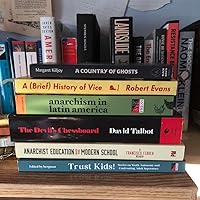
WHAAAA-AAAAT’S FINALLY GETTING BACK INTO READING ABOUT LATIN AMERICAN HISTORY MY WILDLY UNPREDICTABLE BRAIN!!! Hi, I’m (not) Robert Evans. Anyone who doesn’t get the Behind the Bastards reference was probably confused why I did the writing equivalent of yelling in your face. But yeah, I’m getting back into reading Latin American history, which is good because I’ve had a few books just sitting on my shelf waiting for me to randomly decide I wanted to learn some Latin American history. I go through phases, don’t we all. Anyway, very dense book but has all the action of like a being on the edge of your seat book so that’s an odd mix. The narrative through-line while there, was not chronological or really categorical, so that was interesting. I feel like the subtitle of this book is a bit misleading because it says “Latin America” but the bulk of the book is talking about Guatemala with other countries being sort of the bread of the sandwich, putting things in a broader perspective. I don’t know if that makes sense. If you like history you’ll like this book and if you don’t you probably won’t but if you don’t like history why would you have picked this book up in the first place? Also, not where I’d start with reading about Latin American or Guatemalan history. I’ve read about the overthrow of Arbenz many a time, and if this was the first time I’d read about it I’d be very confused. The rural aspect and focus on the indigenous community were two of my favorite parts about this book. And the context around Arbenz being overthrown not just the coup itself.
September 10, 2025
Good book. Cool story. He does a good job of keeping the reader engaged even though it is scholarly writing.I enjoyed parts of this a lot only because of how he tells the story.
April 23, 2015
Grandin, Greg, The Last Colonial Massacre: Latin American in the Cold War. United States: University of Chicago Press, 2004.
The Last Colonial Massacre: Latin America in Cold War by Greg Grandin, who is a professor of history at NYU with a specialization in Latin America and the Caribbean history, has written authoritative works concerning Latin American conflicts. The Guatemalan counterrevolution is used as a case study about how he views the conflict as two distinct visions of democracy shared by Guatemala and the United States in the 1950s. It is a view that differs from other historical works that often cite the conflict between two different ideologies. The tactics used by the American government has been a focal point of my senior thesis and Grandin’s books offers some insights several of the techniques used by U.S. operatives. This book has provided information about the different tactics used to isolate Guatemala economically and diplomatically from its neighbors. Grandin introduces the idea of democracy used as a weapon can become deadly. The seven chapters cover the entire story of the conflict, from its inception to the bloody episodes that occurred in the 1980s. There is a bibliography, index, and glossary included in the text to document the citations. Some of the Guatemalan newspaper sources listed have provided some insight into the thought process of the people at that current time. The scholarly work seems to be aimed college students and experienced researchers. The format of the book could possibly make be difficult for some casual readers. Altogether, The Last Colonial Massacre: Latin America in Cold War is a relatively unbiased authoritative look at the U.S. involvement in Guatemala and the consequences of the actions taken by the government.
The Last Colonial Massacre: Latin America in Cold War by Greg Grandin, who is a professor of history at NYU with a specialization in Latin America and the Caribbean history, has written authoritative works concerning Latin American conflicts. The Guatemalan counterrevolution is used as a case study about how he views the conflict as two distinct visions of democracy shared by Guatemala and the United States in the 1950s. It is a view that differs from other historical works that often cite the conflict between two different ideologies. The tactics used by the American government has been a focal point of my senior thesis and Grandin’s books offers some insights several of the techniques used by U.S. operatives. This book has provided information about the different tactics used to isolate Guatemala economically and diplomatically from its neighbors. Grandin introduces the idea of democracy used as a weapon can become deadly. The seven chapters cover the entire story of the conflict, from its inception to the bloody episodes that occurred in the 1980s. There is a bibliography, index, and glossary included in the text to document the citations. Some of the Guatemalan newspaper sources listed have provided some insight into the thought process of the people at that current time. The scholarly work seems to be aimed college students and experienced researchers. The format of the book could possibly make be difficult for some casual readers. Altogether, The Last Colonial Massacre: Latin America in Cold War is a relatively unbiased authoritative look at the U.S. involvement in Guatemala and the consequences of the actions taken by the government.

January 31, 2019
This is an excellent book in many ways, and a great roadmap for Latin Americanists looking to write history from below. This book accurately depicts the punitive influence of the United States in the region, while showing how that influence affected grassroots indigenous Guatemalan activists and what they did about it. A great blend of the micro and macro with attention to detail around voices from below. I wish every American could read this book to come away with the idea that the Cold War was not solely fought by the U.S. and the Soviet Union, and in Latin America it was definitely not a "cold" war.

May 17, 2020
I wish Goodreads allowed for 4 1/2 stars. Excellent writing, fantastic book. The only (very slight) gripe I have is that based on the title I was expecting it to be more about the Cold War in Latin America as a whole, whereas this book largely focuses on Guatemala until the last chapter. Of course, this would be very difficult to comprehensively document in a relatively short book such as this and the story of Guatemala shares many parallels with the stories of other Latin American countries during this period (ie. US backed coups, repression, and violence).
Gripping and tragic. Great writing.
Gripping and tragic. Great writing.

April 25, 2012
I found Grandin's prose very convoluted and full of grammatical errors. That aside, his interest in Guatemala as a representation of the damage Cold War ideology did to the ideals of democracy was interesting. So I thought his overarching arguments were effective while his organization and prose were lacking.

June 4, 2008
This book discusses the unrest that took place in Guatemala with the support of the CIA. Before this book I had no idea there was a cold war in Latin America. It is a great read to begin understanding how people develop personal and social consciousness.

Read
June 17, 2008I recommend this book

May 18, 2012
i wanted to love this more -- the intro and conclusion were amazing, but the history was a bit hard to follow if you weren't already an expert on guatemala in the 20th century.

September 7, 2013
had to read this for an assignment in college and found it very intriguing. I admire the well written work finding more a out this dark history of Guatemala and the war.

Read
September 13, 2015In his critically acclaimed work, Grandin uses Guatemala as a case study for the (often American-backed) repression of the Cold War in Latin America.

June 11, 2025
I first came across Greg Grandin in college while earning my bachelors degree in history. I have developed an appreciation for his extensive and accessible work on Latin American history and have much respect for him as a historian.
I thoroughly enjoyed this book, however the title is a bit misleading. This book certainly does take place in Latin America during the Cold War. However, it is only about Guatemala during the Cold War. Specifically it is about Guatemala from the beginning of the 20th century up to roughly 1980. This history is presented through and introduction, five chapter, and a conclusion. The 5 chapters use a narrative model that largely uses the experiences of an individual or a family to present the broader history of Guatemala in a way that I think is effective but gets a bit info-dense at times. While the information is good, it lead me to forgetting who was the main individual protagonist of the chapter was.
My main problem with this book is the conclusions that Grandin comes to within this book. I agree with the premise of this book, which I would say is that within Latin America the Left (Which to me I would say encapsulates social democratic reformers to communists, but I believe that Grandin would add Liberal reformers too) was committed to a struggle for the expansion of democracy within all levels of society and national economic development. That even the most militant left wing guerrillas were committed to this vision. Also, that the process of seeking the realization of these goals through the liberal democratic state had a dialectical consequence of also strengthening the potential of reaction and counter-revolution, and that this counter revolution was aided and largely driven by US empire. (Which is objectively the reality) Grandin seems to argue that the takeaway from these historical developments is that US empire and reaction actually stopped the potential of a full expression of liberal values.
My disagreement is that it seems that Grandin excludes the USA and imperial pursuits from the liberal tradition. I would content, and I think this is historically grounded, that US empire and the reaction that it enforces is perfectly within the liberal tradition. After all, liberals were once recognized as moderate constitutional monarchists who pursued a free market economy and the limitations of democracy amongst the masses. Whom they saw as uneducated and unworthy of having political power. It was republicans, and more so radical republicans internationally who pursued the full abolition of the monarchy and even the executive office and the expansion of democracy at all political levels. This was taken even farther with the development socialist republicanism that began with Marx, as the economic or social field was now recognized to be in need of democratization for true freedom to be reached.
My conclusion from this book is best summed up with a quote from Marx, "But the working class cannot simply lay hold of the ready-made state machinery, and wield it for its own purposes." Guatemala further shows that socialism is not just when the government does more stuff for people, socialism means the entire restructuring of the state, the economy, and society.
I thoroughly enjoyed this book, however the title is a bit misleading. This book certainly does take place in Latin America during the Cold War. However, it is only about Guatemala during the Cold War. Specifically it is about Guatemala from the beginning of the 20th century up to roughly 1980. This history is presented through and introduction, five chapter, and a conclusion. The 5 chapters use a narrative model that largely uses the experiences of an individual or a family to present the broader history of Guatemala in a way that I think is effective but gets a bit info-dense at times. While the information is good, it lead me to forgetting who was the main individual protagonist of the chapter was.
My main problem with this book is the conclusions that Grandin comes to within this book. I agree with the premise of this book, which I would say is that within Latin America the Left (Which to me I would say encapsulates social democratic reformers to communists, but I believe that Grandin would add Liberal reformers too) was committed to a struggle for the expansion of democracy within all levels of society and national economic development. That even the most militant left wing guerrillas were committed to this vision. Also, that the process of seeking the realization of these goals through the liberal democratic state had a dialectical consequence of also strengthening the potential of reaction and counter-revolution, and that this counter revolution was aided and largely driven by US empire. (Which is objectively the reality) Grandin seems to argue that the takeaway from these historical developments is that US empire and reaction actually stopped the potential of a full expression of liberal values.
My disagreement is that it seems that Grandin excludes the USA and imperial pursuits from the liberal tradition. I would content, and I think this is historically grounded, that US empire and the reaction that it enforces is perfectly within the liberal tradition. After all, liberals were once recognized as moderate constitutional monarchists who pursued a free market economy and the limitations of democracy amongst the masses. Whom they saw as uneducated and unworthy of having political power. It was republicans, and more so radical republicans internationally who pursued the full abolition of the monarchy and even the executive office and the expansion of democracy at all political levels. This was taken even farther with the development socialist republicanism that began with Marx, as the economic or social field was now recognized to be in need of democratization for true freedom to be reached.
My conclusion from this book is best summed up with a quote from Marx, "But the working class cannot simply lay hold of the ready-made state machinery, and wield it for its own purposes." Guatemala further shows that socialism is not just when the government does more stuff for people, socialism means the entire restructuring of the state, the economy, and society.
May 19, 2025
An exploration of the meaning of the Cold War in Latin American and world history through the lens of emancipatory and reactionary politics in the Mayan highlands of Guatemala. Grandin ably draws on oral histories and declassified counterinsurgent documents to analyze the ways the global political cultures of Communism and anticommunism became meaningful to peasants and planters in one of the poorest and most marginal regions in Latin America, and especially the way that Mayan campesinos organized by the Left sought to make national citizenship real in their individual and collective lives. The description of the way clandestine Communist organizers in the 1960s/70s tapped into Mayan spirituality remains one of my favourite passages of historical writing.
My one complaint is that in his effort to defend the democratic credentials of Latin America's Left, Grandin at times excessively reproduces a division between the 'good reformist Old Left' and the ''60s Castroist guerrillas who got caught in a cycle of violence with the dictatorships,' which I think is unfair to the latter (but also reflects different assumptions about the use of force in left projects, leave it at that).
My one complaint is that in his effort to defend the democratic credentials of Latin America's Left, Grandin at times excessively reproduces a division between the 'good reformist Old Left' and the ''60s Castroist guerrillas who got caught in a cycle of violence with the dictatorships,' which I think is unfair to the latter (but also reflects different assumptions about the use of force in left projects, leave it at that).

February 8, 2019
Grandin uses Guatemala as a case study for the Cold War terror inflicted by the United States on Latin American countries. I appreciated Grandin's focus on indigenous and peasant communities, giving a voice to those usually without international visibility. However, some of Grandin's message is lost in his hyper-bias against neoliberalism and what he refers to as the "brutal effects of capitalism." A worthy read, but with an eye to the author's bias.

December 15, 2021
Fantastic book, Grandin has accomplished an amazing feat with this beautiful retelling of Guatemala history from the vantage point of those who lived through the most extreme aspects of; indigenous peasants. Absolutely recommended for all students of Latin America, as well as anyone curious about the "Cold War" and military dictatorships.

December 3, 2021
Un tema interesante y un aparato crítico muy completo. Se nota que el autor es un académico serio y trata sus fuentes como tal. Sin embargo, la redacción es densa y se interpone en la comprensión de la lectura como un todo.

April 17, 2023
“Every day when I went to work, I dreamed that they were the same bodies that floated down the river. Even though I knew it wasn’t possible, it was too awful to believe that each day the river brought new dead."

August 20, 2020
Another senseless incident of extreme suffering and death carried out in South America by US backed forces on indigenous people, documented in great detail

February 3, 2023
First book of the semester. Super dense but highly recommend. I want to revisit it and sit with the writing in the future.
March 19, 2023
Read this for the second time, I don’t think I appreciated it the first time because it’s very dense. Grandin does a good job of explaining the ideological nuances of the Latin American Cold War

February 22, 2025
Great reframing of the Cold War in this one.
Displaying 1 - 30 of 30 reviews