

What do you think?
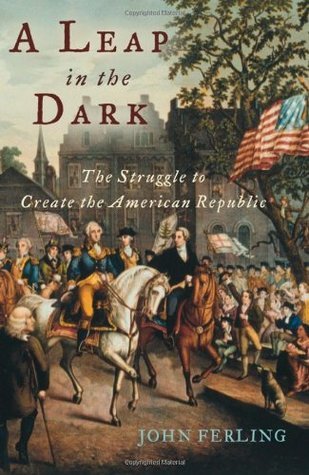
A Leap in the Dark: The Struggle to Create the American Republic
It was an age of fascinating leaders and difficult choices, of grand ideas eloquently expressed and of epic conflicts bitterly fought. Now comes a brilliant portrait of the American Revolution, one that is compelling in its prose, fascinating in its details, and provocative in its fresh interpretations.
In A Leap in the Dark , John Ferling offers a magisterial new history that surges from the first rumblings of colonial protest to the volcanic election of 1800. Ferling's swift-moving narrative teems with fascinating details. We see Benjamin Franklin trying to decide if his loyalty was to Great Britain or to America, and we meet George Washington when he was a shrewd planter-businessman who discovered personal economic advantages to American independence. We encounter those who supported the war against Great Britain in 1776, but opposed independence because it was a "leap in the dark." Following the war, we hear talk in the North of secession from the United States. The author offers a gripping account of the most dramatic events of our history, showing just how closely fought were the struggle for independence, the adoption of the Constitution, and the later battle between Federalists and Democratic-Republicans. Yet, without slowing the flow of events, he has also produced a landmark
study of leadership and ideas. Here is all the erratic brilliance of Hamilton and Jefferson battling to shape the new nation, and here too is the passion and political shrewdness of revolutionaries, such as Samuel Adams and Patrick Henry, and their Loyalist counterparts, Joseph Galloway and Thomas Hutchinson. Here as well are activists who are not so well known today, men like Abraham Yates, who battled for democratic change, and Theodore Sedgwick, who fought to preserve the political and social system of the colonial past. Ferling shows that throughout this period the epic political battles often resembled today's politics and the politicians--the founders--played a political hardball attendant with enmities, selfish motivations, and bitterness. The political stakes, this book demonstrates, were first to secure independence, then to determine the meaning of the American Revolution.
John Ferling has shown himself to be an insightful historian of our Revolution, and an unusually skillful writer. A Leap in the Dark is his masterpiece, work that provokes, enlightens, and entertains in full measure.
In A Leap in the Dark , John Ferling offers a magisterial new history that surges from the first rumblings of colonial protest to the volcanic election of 1800. Ferling's swift-moving narrative teems with fascinating details. We see Benjamin Franklin trying to decide if his loyalty was to Great Britain or to America, and we meet George Washington when he was a shrewd planter-businessman who discovered personal economic advantages to American independence. We encounter those who supported the war against Great Britain in 1776, but opposed independence because it was a "leap in the dark." Following the war, we hear talk in the North of secession from the United States. The author offers a gripping account of the most dramatic events of our history, showing just how closely fought were the struggle for independence, the adoption of the Constitution, and the later battle between Federalists and Democratic-Republicans. Yet, without slowing the flow of events, he has also produced a landmark
study of leadership and ideas. Here is all the erratic brilliance of Hamilton and Jefferson battling to shape the new nation, and here too is the passion and political shrewdness of revolutionaries, such as Samuel Adams and Patrick Henry, and their Loyalist counterparts, Joseph Galloway and Thomas Hutchinson. Here as well are activists who are not so well known today, men like Abraham Yates, who battled for democratic change, and Theodore Sedgwick, who fought to preserve the political and social system of the colonial past. Ferling shows that throughout this period the epic political battles often resembled today's politics and the politicians--the founders--played a political hardball attendant with enmities, selfish motivations, and bitterness. The political stakes, this book demonstrates, were first to secure independence, then to determine the meaning of the American Revolution.
John Ferling has shown himself to be an insightful historian of our Revolution, and an unusually skillful writer. A Leap in the Dark is his masterpiece, work that provokes, enlightens, and entertains in full measure.
576 pages, Hardcover
First published January 1, 2003
About the author
John Ferling
23 books214 followersJohn E. Ferling is a professor emeritus of history at the University of West Georgia. A leading authority on American Revolutionary history, he is the author of several books, including "A Leap in the Dark: The Struggle to Create the American Republic", "Almost a Miracle: The American Victory in the War of Independence", and his most recent work, "The Ascent of George Washington: The Hidden Political Genius of an American Icon". He has appeared in television documentaries on PBS, the History Channel, C-SPAN Book TV, and the Learning Channel.
Ratings & Reviews
Friends & Following
Create a free account to discover what your friends think of this book!
Community Reviews
Displaying 1 - 30 of 59 reviews

July 18, 2022
“Showers from the previous day blew out, and the skies in eastern Massachusetts cleared during that busy night. First light was visible at 4 a.m. Thirty minutes later, as the [British] regulars approached Lexington, streaks of orange and purple in the eastern sky heralded the dawn of what was to be a historic day. An advance party – six companies of 238 red-clad regulars – reached Lexington Common at 4:30 a.m. They discovered a single company of local militia... drawn up on the Common. It was hardly a spit-and-polish unit. These Americans were citizen-soldiers…who appeared to the regulars to be a ragtag collection of troublemakers. As the regulars deployed before the Common, amid the rattle of drum and fife, and the clatter of horses, Major John Pitcairn…briskly rode forward to face his counterpart, Captain John Parker…Pitcairn did not exchange pleasantries. Brusquely, and with tangible contempt, he commanded: ‘Lay down your arms, you damned rebels…!’ Parker ordered his men to step aside, although he did not command them to surrender their weapons. Not one man laid down his arms. In this anxious moment in the half light of daybreak, someone fired a shot…”
- John Ferling, A Leap in the Dark: The Struggle to Create the American Republic
National creation myths serve an important purpose in simplifying complex events in such a way that they can be easily understood and used as a basis of a shared civic understanding. Every country has one, and the United States is no exception.
The American Revolution is a tight Gordian knot of competing, often contradictory ideas and actions that has been sliced with a blade labeled “freedom” or “liberty,” and celebrated every July with hot dogs, fireworks, and great deals on new cars. To a certain extent, this is fine, because most people don’t need an in-depth knowledge of the Founding Era to get through their daily lives. The trouble, however, comes when we try to order present society based on a falsely-assumed past.
To that end, it’s worth noting that almost 250 years after the Declaration of Independence, there is still debate about the causes, motivations, and meanings of the American Revolution that brought it into being. Was it a philosophical revolt based on enlightenment principles? Or was it an economic uprising meant to protect the merchant class? Did the revolutionaries intend to destroy a strong central government, or merely replace it with one a little bit closer to home? Was the goal a tightly unified nation, or a loose and mutually beneficial confederation with a hollow core? Was the spirit of the Revolution populist in nature, as Thomas Jefferson believed, shaking the world with the voice of the people? Or was it conservative at heart, overthrowing one strict hierarchy only to replace it with another?
The answer, as John Ferling implies in his magisterial A Leap in the Dark, is that there is no answer. Everyone involved – especially those Founders to whom we look for “original intent” – carried their own conceptions, and even as the ink dried on the Constitution, they were arguing about it.
***
A Leap in the Dark is extremely impressive in its scope. In just under 500 pages of text, Ferling manages to cover the years from 1750 to 1801 in an integrated fashion, demonstrating the ways events flowed from one to another.
The proceedings begin with the French and Indian War, part of a larger conflict (the Seven Years’ War) that pitted the Empires of Great Britain and France against each other. Though Ferling does not get deep into the details of this war, he uses it to show a nascent unification movement among the thirteen colonies. Squabbling, self-interested, and self-absorbed, early French successes forced them to consider working together.
With France defeated, Ferling moves into the momentous interwar period, which – in its simplest terms – boiled down to a dispute over taxes. Not unreasonably, Great Britain sought to have the colonies pay for its own defense. The way it went about doing this, however, was peremptory and arrogant, brooking no debate. Slow communications hampered attempts at negotiation, and the arrival of British troops said more than any words. Great Britain also undercut itself by employing greedy officials who relentlessly profited from the colonists, even as a postwar economy slowed.
All this led to Lexington, Concord, and national independence, if not personal liberty. Though space constraints keep Ferling from giving a full military history (which can be found in his Almost A Miracle), he marvelously outlines the struggle, explaining how battlefield failures and successes impacted the Continental Congress, and shaped the division of powers of the future United States. I somewhat expected Ferling to skip the fighting entirely, in order to give a laser-focus on the politics, but he smoothly integrates the two disciplines.
Even after the guns fall silent, A Leap in the Dark keeps going, covering the presidential terms of George Washington and John Adams, and ending with the 1800 election of Thomas Jefferson, a bitter contest pitting central-government Federalists against states’ rights Republicans. Having read separately about the French and Indian War, the American Revolution, and the writing of the Constitution, I found a great deal of value in having all these subjects encompassed in one ambitious book. The dominoes of history rarely fall in neat rows, by simple cause and effect. Still, by taking a broad overview of a lengthy time-span, you see the mechanics at work, the way that ideas and mindsets and people evolve in the face of a stirring speech, a well-written pamphlet, a heroic stand, a bloody battle.
***
Ferling structures this mass of material chronologically, with each of the 14 chapters date-stamped. His approach is a hybrid one, combining analysis, narrative, and biography. Part of the joy in reading this comes from Ferling’s ability to provide smart commentary about the competing politics, but also to set a scene with novelistic detail, whether that is Washington’s farewell speech or the skirmish on the Lexington Common. His prose is crisp, sometimes evocative, and even though he has a weakness for obscure words – here, you get both “lubricious” and “lucubration” – the sentences flow smoothly.
Much of the tale is told through the participants, some famous, others less well known. Ferling gives these characters vibrant background sketches, so that in the space of a couple pages – or even a couple paragraphs – they come to life.
Though accessible, A Leap in the Dark is not dumbed-down. Ferling is a well-respected historian and professor, and has written numerous volumes about the birth of the republic. He is keen-eyed, sometimes skeptical, and often sharp, yet he does not bring any obvious modern biases to his interpretation. Ferling is capable of holding opposing thoughts, meaning that he can be critical of both Federalist Alexander Hamilton, who he sees as elitist and anti-democratic, and Thomas Jefferson, who he terms pre-democratic, more philosophical than practical, and prone to avoiding work by hiding at Monticello.
***
The theme that runs through A Leap in the Dark – a theme that seems more relevant than ever – is the debate between union and disunion. The choice to go it alone, or go forward together.
Starting before the French and Indian War – with the Albany Plan of Union – the colonies struggled with whether to help each other, or simply help themselves. The Articles of Confederation represented a compromise, binding them in some ways, but leaving most of the power in local hands. The failure of the Articles led to the Constitution, another act of compromise – or rather, series of compromises – that was written in vague language, subject to wildly divergent interpretations, and which was made devilishly hard to amend. The balance between federal and state authority has always been inconstant, tilting one way, then the other. At best, it was imperfect. At worst, it collapsed into civil war.
Right now, it feels like things are ready to fracture.
Open up a map today, and you can see all the fault lines. We are becoming a nation of littler nations. The borders of each state are the seams where it can all fall apart.
It is something of a consolation to know that this tension has been here from the very first minute of the nation’s existence, and has always been a concern. On the other hand, the realization that this tension has been here from the very first minute of the nation’s existence is deeply troubling, a symptom of something that is perhaps irreconcilable.
It leads one to wonder: How long can it go on? How long can it last?
- John Ferling, A Leap in the Dark: The Struggle to Create the American Republic
National creation myths serve an important purpose in simplifying complex events in such a way that they can be easily understood and used as a basis of a shared civic understanding. Every country has one, and the United States is no exception.
The American Revolution is a tight Gordian knot of competing, often contradictory ideas and actions that has been sliced with a blade labeled “freedom” or “liberty,” and celebrated every July with hot dogs, fireworks, and great deals on new cars. To a certain extent, this is fine, because most people don’t need an in-depth knowledge of the Founding Era to get through their daily lives. The trouble, however, comes when we try to order present society based on a falsely-assumed past.
To that end, it’s worth noting that almost 250 years after the Declaration of Independence, there is still debate about the causes, motivations, and meanings of the American Revolution that brought it into being. Was it a philosophical revolt based on enlightenment principles? Or was it an economic uprising meant to protect the merchant class? Did the revolutionaries intend to destroy a strong central government, or merely replace it with one a little bit closer to home? Was the goal a tightly unified nation, or a loose and mutually beneficial confederation with a hollow core? Was the spirit of the Revolution populist in nature, as Thomas Jefferson believed, shaking the world with the voice of the people? Or was it conservative at heart, overthrowing one strict hierarchy only to replace it with another?
The answer, as John Ferling implies in his magisterial A Leap in the Dark, is that there is no answer. Everyone involved – especially those Founders to whom we look for “original intent” – carried their own conceptions, and even as the ink dried on the Constitution, they were arguing about it.
***
A Leap in the Dark is extremely impressive in its scope. In just under 500 pages of text, Ferling manages to cover the years from 1750 to 1801 in an integrated fashion, demonstrating the ways events flowed from one to another.
The proceedings begin with the French and Indian War, part of a larger conflict (the Seven Years’ War) that pitted the Empires of Great Britain and France against each other. Though Ferling does not get deep into the details of this war, he uses it to show a nascent unification movement among the thirteen colonies. Squabbling, self-interested, and self-absorbed, early French successes forced them to consider working together.
With France defeated, Ferling moves into the momentous interwar period, which – in its simplest terms – boiled down to a dispute over taxes. Not unreasonably, Great Britain sought to have the colonies pay for its own defense. The way it went about doing this, however, was peremptory and arrogant, brooking no debate. Slow communications hampered attempts at negotiation, and the arrival of British troops said more than any words. Great Britain also undercut itself by employing greedy officials who relentlessly profited from the colonists, even as a postwar economy slowed.
All this led to Lexington, Concord, and national independence, if not personal liberty. Though space constraints keep Ferling from giving a full military history (which can be found in his Almost A Miracle), he marvelously outlines the struggle, explaining how battlefield failures and successes impacted the Continental Congress, and shaped the division of powers of the future United States. I somewhat expected Ferling to skip the fighting entirely, in order to give a laser-focus on the politics, but he smoothly integrates the two disciplines.
Even after the guns fall silent, A Leap in the Dark keeps going, covering the presidential terms of George Washington and John Adams, and ending with the 1800 election of Thomas Jefferson, a bitter contest pitting central-government Federalists against states’ rights Republicans. Having read separately about the French and Indian War, the American Revolution, and the writing of the Constitution, I found a great deal of value in having all these subjects encompassed in one ambitious book. The dominoes of history rarely fall in neat rows, by simple cause and effect. Still, by taking a broad overview of a lengthy time-span, you see the mechanics at work, the way that ideas and mindsets and people evolve in the face of a stirring speech, a well-written pamphlet, a heroic stand, a bloody battle.
***
Ferling structures this mass of material chronologically, with each of the 14 chapters date-stamped. His approach is a hybrid one, combining analysis, narrative, and biography. Part of the joy in reading this comes from Ferling’s ability to provide smart commentary about the competing politics, but also to set a scene with novelistic detail, whether that is Washington’s farewell speech or the skirmish on the Lexington Common. His prose is crisp, sometimes evocative, and even though he has a weakness for obscure words – here, you get both “lubricious” and “lucubration” – the sentences flow smoothly.
Much of the tale is told through the participants, some famous, others less well known. Ferling gives these characters vibrant background sketches, so that in the space of a couple pages – or even a couple paragraphs – they come to life.
Though accessible, A Leap in the Dark is not dumbed-down. Ferling is a well-respected historian and professor, and has written numerous volumes about the birth of the republic. He is keen-eyed, sometimes skeptical, and often sharp, yet he does not bring any obvious modern biases to his interpretation. Ferling is capable of holding opposing thoughts, meaning that he can be critical of both Federalist Alexander Hamilton, who he sees as elitist and anti-democratic, and Thomas Jefferson, who he terms pre-democratic, more philosophical than practical, and prone to avoiding work by hiding at Monticello.
***
The theme that runs through A Leap in the Dark – a theme that seems more relevant than ever – is the debate between union and disunion. The choice to go it alone, or go forward together.
Starting before the French and Indian War – with the Albany Plan of Union – the colonies struggled with whether to help each other, or simply help themselves. The Articles of Confederation represented a compromise, binding them in some ways, but leaving most of the power in local hands. The failure of the Articles led to the Constitution, another act of compromise – or rather, series of compromises – that was written in vague language, subject to wildly divergent interpretations, and which was made devilishly hard to amend. The balance between federal and state authority has always been inconstant, tilting one way, then the other. At best, it was imperfect. At worst, it collapsed into civil war.
Right now, it feels like things are ready to fracture.
Open up a map today, and you can see all the fault lines. We are becoming a nation of littler nations. The borders of each state are the seams where it can all fall apart.
It is something of a consolation to know that this tension has been here from the very first minute of the nation’s existence, and has always been a concern. On the other hand, the realization that this tension has been here from the very first minute of the nation’s existence is deeply troubling, a symptom of something that is perhaps irreconcilable.
It leads one to wonder: How long can it go on? How long can it last?

May 24, 2019
John Ferling brings the politics and economics of the Independence movement to life with his scholarly penmanship. From the opening monologue it is evident that this will be a daunting challenge of condensing the years 1754 through 1800, yet by the end there is no debate that he has gone above and beyond in fulfilling this undertaking. The characters and topics discussed are backed by a multitude of primary sources, and Ferling’s in-depth analysis easily sets him up amongst the top American historians of the modern age.
What sets A Leap in the Dark apart from other histories of the American Revolution is its clear ability to show the war and politics of the time as exactly what they were—a civil war. Controversial Founders such as John Dickinson get fair justice, with insight on him being the radical author of the Farmer pamphlet before hostilities, to his concern and reluctance to break away from the mother country in the early Congress. Powerful micro-biographies of men whom usually go unnoticed are covered throughout the book, including Andrew Oliver, James Otis Jr., Richard Henry Lee, and Joseph Galloway. Ferling has a talent in his ease of summarizing and allowing the reader to comprehend the specific events from the current chapter, as well as what may be discussed in the next:
The British ministry had made a fundamental mistake in bringing on the crisis, but its greatest misstep was to have gone into the breach with absolutely no idea what it would do if it met resistance. Had the ministry in fact brought the crisis to a head in 1765, employing force to face down the protest, it well might have solved its problems then and there.
The reader looking to understand what exactly led up to the first shot heard around the world, the politics and scuffles of the Continental Congress and Parliament alike, and the factions and dynamics that carried over in the aftermath of the Revolutionary War should look no further. Just the right amount of wealthy material has been written into the book to capture the mind and attention of both novices and scholars of the American Revolution alike. As hard as it was to put down, it allows for a great segue to Ferling’s other epic, Almost a Miracle, which details the calamities of war and the battlefront of the Revolution. Detailed maps, as well as illustrations in plenty easily earn this book a place amongst the greatest.
What sets A Leap in the Dark apart from other histories of the American Revolution is its clear ability to show the war and politics of the time as exactly what they were—a civil war. Controversial Founders such as John Dickinson get fair justice, with insight on him being the radical author of the Farmer pamphlet before hostilities, to his concern and reluctance to break away from the mother country in the early Congress. Powerful micro-biographies of men whom usually go unnoticed are covered throughout the book, including Andrew Oliver, James Otis Jr., Richard Henry Lee, and Joseph Galloway. Ferling has a talent in his ease of summarizing and allowing the reader to comprehend the specific events from the current chapter, as well as what may be discussed in the next:
The British ministry had made a fundamental mistake in bringing on the crisis, but its greatest misstep was to have gone into the breach with absolutely no idea what it would do if it met resistance. Had the ministry in fact brought the crisis to a head in 1765, employing force to face down the protest, it well might have solved its problems then and there.
The reader looking to understand what exactly led up to the first shot heard around the world, the politics and scuffles of the Continental Congress and Parliament alike, and the factions and dynamics that carried over in the aftermath of the Revolutionary War should look no further. Just the right amount of wealthy material has been written into the book to capture the mind and attention of both novices and scholars of the American Revolution alike. As hard as it was to put down, it allows for a great segue to Ferling’s other epic, Almost a Miracle, which details the calamities of war and the battlefront of the Revolution. Detailed maps, as well as illustrations in plenty easily earn this book a place amongst the greatest.

October 12, 2020
This book covers a period of history that is a particular favorite of mine, our early national founding and our Revolution. The author's treatment covers roughly the last quarter of the 18th century and ends with the historic election of 1800 and Jefferson's assumption of the presidency. Without reservation I will say this is one of the best books covering this period that I have ever read. The research and analysis are first rate and to say that the book is informative would be an understatement though it does have its faults. The faults are purely subjective however and I will leave them for the end of this review so as not to diminish the virtues of this work.
I have read a great deal about the history of our founding and revolution so much so that it is almost impossible to find anything new and original. While the events and people discussed in this book are all well known and subjects of countless other books Mr. Ferling has manage to add a depth and analysis I have never before encountered. I now come away with an appreciation for Sam Adams that I have never had before and I have a better idea of how James Madison transformed from an advocate of the new constitution into an acolyte of Thomas Jefferson's who reviled the form of government that the Constitution created. The author doesn't merely cite the accepted histories of such men he also delves into previously unknown (at least to me) correspondence and other sources to characterize the motives and behaviors of key figures, like that of these two men, in our history. Ferling then analyzes the events in discussion in order to opine what was really going on and what the real intended goal was. The author offers much to think about and to rethink our previous beliefs. As for Adams, everything I have ever read where he is mentioned it is always as some sort of secondary figure working on the fringe of things. I always got the impression that he was rather a slovenly radical embarrassment that was useful only for stirring up the trouble in the streets. Mr. Ferling certainly corrects that impression and goes on to describe how Sam practically had to drag his cousin John into getting involved in the rebellion. Seems John was more than a bit worried about how such involvement might affect his law practice so he wasn't all that interested in being a part of what Sam was doing. Sam seems to have gotten the short end of the historical stick and now I need to learn more about this neglected figure in our history.
As for the faults of this book, well this book is probably not likely to be enjoyed by the casual reader of history. At 488 pages of text with chapters that are frequently too long and rarely include page breaks it is a daunting read. I have to admit that I was nodding off far too often and had to read things several times to get the intended meaning. I do not mean that the writing is at fault only that the aging reader had a hard time staying awake at times. While the events of the Revolutionary War are mentioned that is generally all the attention they get, a mention. This is a book with very little excitement or action and is almost exclusively about the politics and economics that shaped the events of the time. It is an excellent history but it can be regarded as dull by some. It would have helped if the chapters could have been shorter or that page breaks could have been used more liberally. It is difficult to have to put a book down in the middle of the author's discourse and then come back to it and try to recall the direction of the author's narrative flow. That might be me being picky but it did affect my ability to enjoy the book but what the author was saying had me hanging in there to the end and I am glad I did. This is a great history and if you are interested in this era you shouldn't fail to read it.
I have read a great deal about the history of our founding and revolution so much so that it is almost impossible to find anything new and original. While the events and people discussed in this book are all well known and subjects of countless other books Mr. Ferling has manage to add a depth and analysis I have never before encountered. I now come away with an appreciation for Sam Adams that I have never had before and I have a better idea of how James Madison transformed from an advocate of the new constitution into an acolyte of Thomas Jefferson's who reviled the form of government that the Constitution created. The author doesn't merely cite the accepted histories of such men he also delves into previously unknown (at least to me) correspondence and other sources to characterize the motives and behaviors of key figures, like that of these two men, in our history. Ferling then analyzes the events in discussion in order to opine what was really going on and what the real intended goal was. The author offers much to think about and to rethink our previous beliefs. As for Adams, everything I have ever read where he is mentioned it is always as some sort of secondary figure working on the fringe of things. I always got the impression that he was rather a slovenly radical embarrassment that was useful only for stirring up the trouble in the streets. Mr. Ferling certainly corrects that impression and goes on to describe how Sam practically had to drag his cousin John into getting involved in the rebellion. Seems John was more than a bit worried about how such involvement might affect his law practice so he wasn't all that interested in being a part of what Sam was doing. Sam seems to have gotten the short end of the historical stick and now I need to learn more about this neglected figure in our history.
As for the faults of this book, well this book is probably not likely to be enjoyed by the casual reader of history. At 488 pages of text with chapters that are frequently too long and rarely include page breaks it is a daunting read. I have to admit that I was nodding off far too often and had to read things several times to get the intended meaning. I do not mean that the writing is at fault only that the aging reader had a hard time staying awake at times. While the events of the Revolutionary War are mentioned that is generally all the attention they get, a mention. This is a book with very little excitement or action and is almost exclusively about the politics and economics that shaped the events of the time. It is an excellent history but it can be regarded as dull by some. It would have helped if the chapters could have been shorter or that page breaks could have been used more liberally. It is difficult to have to put a book down in the middle of the author's discourse and then come back to it and try to recall the direction of the author's narrative flow. That might be me being picky but it did affect my ability to enjoy the book but what the author was saying had me hanging in there to the end and I am glad I did. This is a great history and if you are interested in this era you shouldn't fail to read it.

May 23, 2009
This awesome book probably changed my life. It was a great overview of the American Revolution, focusing briefly on the contribution of the founding fathers. It was like introducing me to a fascinating series books and letting me pick and choose which characters held the most interest for me. I followed it immediately with a biography of Alexander Hamilton.

October 26, 2013
I loved this book! When we learned about the American Revolution in junior high, my teacher assigned me alternative assignments because I loved history and did very well in that subject. Unfortunately, the special assignments were done in the library and I was not in the actual classroom during class. I learned nothing about the American Revolution, and have gone through the last three decades with absolutely no idea about this all-important event in American history. After reading this book, I feel almost giddy over how much I learned, and over how insanely exciting this history was! I was on the edge of my seat more times than I can count, and there were times I couldn't put this book down. I can't believe how many misconceptions I had about the American Revolution, the establishment of the new nation and its government, and the Founding Fathers! Everything was just so new to me, and so thrilling!
I was amazed at how many parallels there are between the government then and the government now. Sometimes I feel like our government is broken, but after reading this book, I actually felt comforted. Our government is functioning no better and no worse than it ever has. It is functioning in the very way the Founding Fathers intended it to. It's not broken, it's enduring, even in its imperfection.
I did love this book, but I do not recommend it in Kindle format. There were all kinds of formatting anomalies in the Kindle version, and at times those really interfered with the text of the story. I bought the paper version for my grandmother, and she reports that the font is quite small, but the text is formatted correctly.
I was amazed at how many parallels there are between the government then and the government now. Sometimes I feel like our government is broken, but after reading this book, I actually felt comforted. Our government is functioning no better and no worse than it ever has. It is functioning in the very way the Founding Fathers intended it to. It's not broken, it's enduring, even in its imperfection.
I did love this book, but I do not recommend it in Kindle format. There were all kinds of formatting anomalies in the Kindle version, and at times those really interfered with the text of the story. I bought the paper version for my grandmother, and she reports that the font is quite small, but the text is formatted correctly.

January 16, 2016
It seems reasonably clear that this book was written at least partially in response to what may be seen as extremely patriotic and exceptionalist claims in the inevitability of American Independence [1]. Yet it is also clear that this book goes too far in the other direction by pointing merely to the contingent and chance elements of the period between 1754 and 1800 (in 480 pages of very scholarly writing) without any understanding of the divine providence that works through human agency. Sometimes it feels as if this book spends so much time looking at the chaos and manipulation and canny political sense (or lack thereof) of American and British and French leaders in this tumultuous period that the overall sense is lost of autonomous and often feuding colonies whose pressures for greater recognition of autonomy led to independence and then to an uneven progress towards greater egalitarianism and democracy.
Even given its flaws, though, this is an excellent book that is worthy of being read by anyone who does not mind the high level of language as well as the immense wealth of detail, albeit selective detail, chosen in the book’s 480 pages. The book is clearly interested mostly in political philosophy and political history, with other elements (like military history) receiving much less commentary except insofar as they deal with political concerns. What is interesting about this book is that it seeks to draw threads not only between the behavior of different people over time as they shifted in their alliances and in whether they would be considered as radicals, moderates, or conservatives, and as nationalists and localists. Given the general drift of American politics, it also appears as if there was early an oscillation between different sides, in which the behavior of temporary majorities often provoked a severe response on the part of those in opposition. Examples of this appear over and over again in the book–the temporary majorities of those who wanted reconciliation with Britain were crushed by Britain’s politically maladroit behavior in 1774 through 1776. Likewise, localists acted in ways that provoked a significant amount of people to support the establishment of a much more nationalist Constitution, while the Federalists severely overreached in pushing Hamilton’s aims as well as the Alien and Sedition Acts that led to the establishment of a nominally egalitarian Democratic-Republican majority in 1800, where this book closes. This oscillation is certainly relevant with regards to contemporary political trends.
Also of great interest is the way that this book seeks to point out that no sides were innocents here. Regardless of political ideology, there was seeking, problems of corruption, and a certain amount of hypocrisy in the sort of appeals to freedom that were made. While Southerners like Jefferson were often abhorrent at the exploitation of the poor that would take place in an industrialized America, they were often blind to the exploitation of poor whites and enslaved blacks in their own section. Likewise, the Federalist desire for order was often hypocritical in that many Federalists were recent elites themselves who had risen because of profiteering during the American Revolution. Likewise, service in the Continental Army gave many people a perspective that was far wider than those whose interests had been merely local or diplomatic in nature. Being a book that is full of wise, if somewhat dark and murky, insights about the very human nature of America’s founding fathers, it is a testament both to the caution as well as to the bravery of the early American Republic and how it gradually and hesitantly pointed its way to our contemporary republic. Readers of this book will find much to appreciate, much to muse over, and a great deal more detail about political shenanigans in the early American Republic than most would care to know.
[1] See, for example:
https://edgeinducedcohesion.wordpress...
https://edgeinducedcohesion.wordpress...
Even given its flaws, though, this is an excellent book that is worthy of being read by anyone who does not mind the high level of language as well as the immense wealth of detail, albeit selective detail, chosen in the book’s 480 pages. The book is clearly interested mostly in political philosophy and political history, with other elements (like military history) receiving much less commentary except insofar as they deal with political concerns. What is interesting about this book is that it seeks to draw threads not only between the behavior of different people over time as they shifted in their alliances and in whether they would be considered as radicals, moderates, or conservatives, and as nationalists and localists. Given the general drift of American politics, it also appears as if there was early an oscillation between different sides, in which the behavior of temporary majorities often provoked a severe response on the part of those in opposition. Examples of this appear over and over again in the book–the temporary majorities of those who wanted reconciliation with Britain were crushed by Britain’s politically maladroit behavior in 1774 through 1776. Likewise, localists acted in ways that provoked a significant amount of people to support the establishment of a much more nationalist Constitution, while the Federalists severely overreached in pushing Hamilton’s aims as well as the Alien and Sedition Acts that led to the establishment of a nominally egalitarian Democratic-Republican majority in 1800, where this book closes. This oscillation is certainly relevant with regards to contemporary political trends.
Also of great interest is the way that this book seeks to point out that no sides were innocents here. Regardless of political ideology, there was seeking, problems of corruption, and a certain amount of hypocrisy in the sort of appeals to freedom that were made. While Southerners like Jefferson were often abhorrent at the exploitation of the poor that would take place in an industrialized America, they were often blind to the exploitation of poor whites and enslaved blacks in their own section. Likewise, the Federalist desire for order was often hypocritical in that many Federalists were recent elites themselves who had risen because of profiteering during the American Revolution. Likewise, service in the Continental Army gave many people a perspective that was far wider than those whose interests had been merely local or diplomatic in nature. Being a book that is full of wise, if somewhat dark and murky, insights about the very human nature of America’s founding fathers, it is a testament both to the caution as well as to the bravery of the early American Republic and how it gradually and hesitantly pointed its way to our contemporary republic. Readers of this book will find much to appreciate, much to muse over, and a great deal more detail about political shenanigans in the early American Republic than most would care to know.
[1] See, for example:
https://edgeinducedcohesion.wordpress...
https://edgeinducedcohesion.wordpress...

February 14, 2012
A Leap in the Dark is a good overview of the wider Revolutionary period (1754 to 1800). It is a long book, but Ferling provides a good, fun read because the story always moves. It is primarily a political and economic history, not focusing on military or social history (so say slavery and religion are only discussed in political terms) in too much depth. It offers many small biographical vignettes of both the famous and the not so famous. Ferling highlights the rise of democracy and the conservatism of both the Constitution and the Federalists. I appreciate his positive assessment of Jefferson, but I am still not a big fan.

October 26, 2017
An accessibly written history of our Nation’s founding and early Administrations. Similarities with our current politics abound and, frankly, give me great hope that we’ll do just fine. If anything, we’ve been too polite in our criticism of the Trump Administration - in fact, I plan to borrow, mimic, and plagiarize the writing of our Founders who played politics without gloves.

December 26, 2015
I’m going to preface this by saying that this is part of an opinion review that I wrote for my class, so the style is a little different from my normal reviews, but I still though it would be a valuable contribution to the blog.
I have read widely on the subject of the American Revolution, more than on any other historical subject, and A Leap in the Dark by John Ferling is one of the better ones that I have read. I enjoyed the style in which he writes; it took me a while to read each chapter, but that was because there was a lot of information and new styles of analysis to digest. That being said, it never felt like the flow was bogged down by information that was included just because it had been researched. The book is expansive in the elements that it covers and I did not feel like anything important had been left out.
The text focused on not only the political elements, but also the social issues surrounding the American Revolution. In my experience, a lot of time in other courses and texts is spent on the political implications of the various Acts and taxes imposed by the British Parliament; while this is important, and Ferling does spend time on these areas, I most appreciated how he drilled down into what the motives were behind the different historical figures actions on both sides of the Atlantic. This is where I encountered the most new material and a more well-rounded perspective on the lead up to hostilities; most notably for me were his commentaries on Samuel Adams and the Boston Tea Party. The Boston Tea Party was a much more complicated event than the mere surprising coming together of Bostonians to spill the hated tea into the harbor and to understand that makes the interpretation of this iconic event much more significant. Additionally, Samuel Adams deserves a lot more credit for his historical role than just being a rabble rouser. I also appreciated that the author did not limit his in-depth attention to those on the colonial side, but also gave significant background attention to the figures in Parliament and why they were interested in penalizing the colonists despite growing indications of hostilities. This made it easier to understand why the British acted the way they did, even though it may have seemed counterproductive to the large scale goals. Ferling does this well with many other events that occurred during the timeframe covered by this book and I am more knowledgeable for it.
One thing I appreciated that Ferling did not do in his book was spend ample time on the battles of the Revolution. I am not one who likes to read about battlefield logistics and I tend to space out and skim past these sections when they crop up in books I am reading; it is just not an area that interests me. However, I do like to learn about the implications of battlefield decisions or how a singular event or battle factored into the grand scheme of the war. This is exactly what I found in A Leap in the Dark. Ferling brings attention to select battle actions, such as Washington’s attacks at Trenton and Princeton, because they offered significant glimpses into the character of people and reasons why the war was able to continue despite many setbacks. I do not need to know how each battle was carried out, but rather what it meant to the whole of the war. Ferling never lost my attention through these sections.
While I was a fan of most of Ferling’s historical interpretations, he started to lose me when he began the discussions surrounding the animosity between the Federalists and Republicans, particularly Alexander Hamilton and Thomas Jefferson. I detected a noticeable bias against Hamilton in Ferling’s analysis and a favoring of Jefferson. As historians, we are encouraged to make efforts to keep personal bias out of historical interpretation, but Ferling appears to have had issue with this here. He did not have much nice to say about the man; the closest he came to something kind was when he indicated that latter politicians should have taken a note from Hamilton’s playbook and immediately fess up when caught out in a less than desirable action. The author appears to have went out of his way to highlight all the underhanded things Hamilton did or might have done. While he also discusses the work Jefferson did behind the scenes, the manner in which he discusses these actions comes off in a more positive and respectful manner than when he discusses Hamilton. From a personal perspective, this bothered me more than it might have others because I tend to find myself favoring Hamilton over Jefferson in these discussions, but regardless, Ferling’s treatment of Hamilton felt heavy-handed.
I think that the timeframe that Ferling chose to cover in this book was well chosen. Most would expect that a book on the American Revolution might cover the war exclusively or maybe through the presidency of George Washington, as this would be the real start of the United States as we recognize it now. Ferling chooses to bring the narrative up through the election of Thomas Jefferson, the third president of the country. I think this was an excellent choice because everything was still very rocky for the fledgling country up through then and it could have easily foundered. Up until Jefferson’s election, the country had been run by those who had significant roles in the pre-revolution days as well as the founding of the country and led the country in a similar style. With the election of Jefferson it was a transition of power from one political party to another. In many other countries, a shift in political power was accompanied by bloodshed or even the collapse of a newly formed country, and others were waiting to see what would happen to the United States. Here it was a peaceful shift in power which signified the strength of the country to be able to do so and showed the world, and those in the States, that they had made it to a new stage in development; they were arguably no longer in their revolutionary days.
This review was previously posted at The Maiden's Court blog.
I have read widely on the subject of the American Revolution, more than on any other historical subject, and A Leap in the Dark by John Ferling is one of the better ones that I have read. I enjoyed the style in which he writes; it took me a while to read each chapter, but that was because there was a lot of information and new styles of analysis to digest. That being said, it never felt like the flow was bogged down by information that was included just because it had been researched. The book is expansive in the elements that it covers and I did not feel like anything important had been left out.
The text focused on not only the political elements, but also the social issues surrounding the American Revolution. In my experience, a lot of time in other courses and texts is spent on the political implications of the various Acts and taxes imposed by the British Parliament; while this is important, and Ferling does spend time on these areas, I most appreciated how he drilled down into what the motives were behind the different historical figures actions on both sides of the Atlantic. This is where I encountered the most new material and a more well-rounded perspective on the lead up to hostilities; most notably for me were his commentaries on Samuel Adams and the Boston Tea Party. The Boston Tea Party was a much more complicated event than the mere surprising coming together of Bostonians to spill the hated tea into the harbor and to understand that makes the interpretation of this iconic event much more significant. Additionally, Samuel Adams deserves a lot more credit for his historical role than just being a rabble rouser. I also appreciated that the author did not limit his in-depth attention to those on the colonial side, but also gave significant background attention to the figures in Parliament and why they were interested in penalizing the colonists despite growing indications of hostilities. This made it easier to understand why the British acted the way they did, even though it may have seemed counterproductive to the large scale goals. Ferling does this well with many other events that occurred during the timeframe covered by this book and I am more knowledgeable for it.
One thing I appreciated that Ferling did not do in his book was spend ample time on the battles of the Revolution. I am not one who likes to read about battlefield logistics and I tend to space out and skim past these sections when they crop up in books I am reading; it is just not an area that interests me. However, I do like to learn about the implications of battlefield decisions or how a singular event or battle factored into the grand scheme of the war. This is exactly what I found in A Leap in the Dark. Ferling brings attention to select battle actions, such as Washington’s attacks at Trenton and Princeton, because they offered significant glimpses into the character of people and reasons why the war was able to continue despite many setbacks. I do not need to know how each battle was carried out, but rather what it meant to the whole of the war. Ferling never lost my attention through these sections.
While I was a fan of most of Ferling’s historical interpretations, he started to lose me when he began the discussions surrounding the animosity between the Federalists and Republicans, particularly Alexander Hamilton and Thomas Jefferson. I detected a noticeable bias against Hamilton in Ferling’s analysis and a favoring of Jefferson. As historians, we are encouraged to make efforts to keep personal bias out of historical interpretation, but Ferling appears to have had issue with this here. He did not have much nice to say about the man; the closest he came to something kind was when he indicated that latter politicians should have taken a note from Hamilton’s playbook and immediately fess up when caught out in a less than desirable action. The author appears to have went out of his way to highlight all the underhanded things Hamilton did or might have done. While he also discusses the work Jefferson did behind the scenes, the manner in which he discusses these actions comes off in a more positive and respectful manner than when he discusses Hamilton. From a personal perspective, this bothered me more than it might have others because I tend to find myself favoring Hamilton over Jefferson in these discussions, but regardless, Ferling’s treatment of Hamilton felt heavy-handed.
I think that the timeframe that Ferling chose to cover in this book was well chosen. Most would expect that a book on the American Revolution might cover the war exclusively or maybe through the presidency of George Washington, as this would be the real start of the United States as we recognize it now. Ferling chooses to bring the narrative up through the election of Thomas Jefferson, the third president of the country. I think this was an excellent choice because everything was still very rocky for the fledgling country up through then and it could have easily foundered. Up until Jefferson’s election, the country had been run by those who had significant roles in the pre-revolution days as well as the founding of the country and led the country in a similar style. With the election of Jefferson it was a transition of power from one political party to another. In many other countries, a shift in political power was accompanied by bloodshed or even the collapse of a newly formed country, and others were waiting to see what would happen to the United States. Here it was a peaceful shift in power which signified the strength of the country to be able to do so and showed the world, and those in the States, that they had made it to a new stage in development; they were arguably no longer in their revolutionary days.
This review was previously posted at The Maiden's Court blog.

Read
September 26, 2018A bit conflicted. It's part of a series meant to be easily accessible history and it is. I found it a tad redundant, but one of my resolutions this year is to work through all the OUP American history texts I can, to fill in blanks. Certainly not the author's fault that I've been reading the same things over and over again all year.
Here's my problem: when unattributed quotations were provided in the text and I went to the endnotes to learn more (for example, simply who said what was quoted), more often than not I only found citations to other secondary sources. Even if I owned the books--and I did in a number of cases--that's still a waste of my time, and if I were a casual reader of history, it would be a colossal waste of my time.
If it was an editorial issue, then the author should have been clearer in the text; if it was the author's fault, the editors should have insisted on better notes. YMMV.
Here's my problem: when unattributed quotations were provided in the text and I went to the endnotes to learn more (for example, simply who said what was quoted), more often than not I only found citations to other secondary sources. Even if I owned the books--and I did in a number of cases--that's still a waste of my time, and if I were a casual reader of history, it would be a colossal waste of my time.
If it was an editorial issue, then the author should have been clearer in the text; if it was the author's fault, the editors should have insisted on better notes. YMMV.

July 12, 2019
A Leap in the Dark traces the creation of the United States from the 1760s through the inauguration of the Jefferson administration. Historian John Ferling enlightens readers on the ideals and personalities which shaped the founding of the American republic, and he does superb work fleshing out the intrigues populating this period.
The book begins by recounting the growing tensions between American colonists and their mother country. A Leap in the Dark is kicked off by Benjamin Franklin’s trek to Albany for the meeting which ultimately produced the Albany Plan of Union. After its failure, the narrative goes to show just how slow many of the founding fathers were to embrace the idea of a full break from England. In fact, those calling for a revolution early on were looked at even by many non-Loyalists as rabble rousing extremists. The growing furor over the Townshend and post-Boston Tea Party Intolerable Acts builds toward a crescendo, a period in time laid out by the author in expertly readable fashion.
The anger directed toward British agents in America like Andrew Oliver and Thomas Hutchinson-men viewed by colonists as pawns of London-was shocking to read about. The burning down and sacking of their property morphs into more well-known confrontations like the Boston Massacre and eventually the Boston Tea Party. Digging up side anecdotes from these years is an excellent accomplishment of A Leap in the Dark.
The book traces the contours of a young nation’s development, focusing particularly on the division between those who embraced what amounted to a near-total democracy (like Patrick Henry and Samuel Adams) with men like Alexander Hamilton who seemed to want more safeguards protecting the government from the folks they perceived as less well-bred. The manner in which struggles between Federalists and those of the Republican persuasion were laid out was masterful, and this makes the narrative that much better of a read.
The examination of the key people during the revolutionary era is the book's biggest strength.
Pre-presidency, James Madison was shown to initially lean more in the Federalist direction before evolving over the course of the Washington and Adams administrations to a stance aligning more with the decentralist faction. Madison’s evolving embrace of Republicanism was clearly illustrated when he teamed up with Thomas Jefferson to pen the Kentucky (Jefferson) and Virginia (Madison) Resolutions, writings which endorsed the idea of state legislatures nullifying federal laws. These were largely the results of furor over the Alien and Sedition Acts, and Ferling indicates that most of these acts, as well as the Kentucky and Virginia Resolutions, were scorned by the American public.
George Washington is painted as a man more aligned with the Federalist mindset, and A Leap in the Dark implies he was manipulated at times by Treasury Secretary Alexander Hamilton into toeing more of a Federalist line than he otherwise would have. Ferling’s willingness to write about the first president’s proclivities to look askance at the idea of pure democracy (or even the questioning of public officials by their constituents) demonstrate the critical eye he casts toward individuals seemingly beyond public reproach.
The fraying of the relationship between John Adams and Alexander Hamilton is an important narrative strand. The two seemed to have no issue with one another at the outset of Adams’s presidency, but a series of backhanded moves by Hamilton undermined the second president’s authority. This led to a rupture that left the two distrustful of each other, a similar circumstance to what took place between Treasury Secretary Hamilton and Secretary of State Jefferson during Washington’s time in office.
An interesting element is the degree to which Presidents Adams and Washington valued being seen as nonpartisan, above-the-fray chiefs. But in spite of good intentions, these attempts were frequently overshadowed by difficult executive decisions which require the choosing of sides.
The Federalists' unraveling occurs as the book reaches its end.
In the early to mid 1790s they had seemed invincible, but an erosion of support turned into a groundswell as 1800 approached. A Leap in the Dark provides several hypotheses to why this might have been the case. The unpopularity of the Alien and Sedition Acts on account of the hostility toward immigrants and curtailing of free speech it enacted certainly did not help the Federalist case. Additionally, the sense that Federalists only cared about the rich, powerful, and well-bred cost them support. Through their commitment to hard money and the over representation in their ranks of merchants/those who lived off rents, the perception took hold that Federalists only cared about the wealthy and propertied classes. The ability of Republican party men like Aaron Burr to better turn out their voters resulted in the Federalists sustaining a severe downturn at the conclusion of the Adams administration.
Some of the more obvious things the book could have focused on were present, but they are looked at just tangentially. The highlights of Revolutionary War battles-Lexington and Concord, Bunker Hill, Trenton, Saratoga, Yorktown-are touched upon, but as this book is more about political ideals and political people, they are not the primary focus. This is done intentionally, and in no sense do readers get the idea that Ferling is not knowledgeable enough about these conflicts to write about them extensively.
In explaining the Republican Jefferson’s close victory in the 1800 presidential election over the incumbent Federalist Adams, Ferling stated that “To most in this (election of 1800) generation the revolution was an epic undertaking to eradicate the political stranglehold of a small patronizing, privileged elite, enhance individual opportunity, thwart a central government that grasped at greater power and control, and permit ordinary people to structure their lives largely free of interference by the state.” This was how he summed up the rising tide for four decades prior to 1800, one which pushed out the overbearing British authorities before ultimately retiring the allegedly overbearing Federalists as well.
A Leap in the Dark concludes with Jefferson's swearing-in, the culmination of years of groundwork led by Republican leaders in curtailing federal power.
This book is a great documentation of the early years of the American republic. It will leave readers with a good feel for how things evolved in the last third of the eighteenth century, and much of the intrigue detailed in it will relate to what people still see in the public arena today. The reading never becomes dull, and there are few wasted words in the weaving of this truthful narrative.
-Andrew Canfield Denver, Colorado
The book begins by recounting the growing tensions between American colonists and their mother country. A Leap in the Dark is kicked off by Benjamin Franklin’s trek to Albany for the meeting which ultimately produced the Albany Plan of Union. After its failure, the narrative goes to show just how slow many of the founding fathers were to embrace the idea of a full break from England. In fact, those calling for a revolution early on were looked at even by many non-Loyalists as rabble rousing extremists. The growing furor over the Townshend and post-Boston Tea Party Intolerable Acts builds toward a crescendo, a period in time laid out by the author in expertly readable fashion.
The anger directed toward British agents in America like Andrew Oliver and Thomas Hutchinson-men viewed by colonists as pawns of London-was shocking to read about. The burning down and sacking of their property morphs into more well-known confrontations like the Boston Massacre and eventually the Boston Tea Party. Digging up side anecdotes from these years is an excellent accomplishment of A Leap in the Dark.
The book traces the contours of a young nation’s development, focusing particularly on the division between those who embraced what amounted to a near-total democracy (like Patrick Henry and Samuel Adams) with men like Alexander Hamilton who seemed to want more safeguards protecting the government from the folks they perceived as less well-bred. The manner in which struggles between Federalists and those of the Republican persuasion were laid out was masterful, and this makes the narrative that much better of a read.
The examination of the key people during the revolutionary era is the book's biggest strength.
Pre-presidency, James Madison was shown to initially lean more in the Federalist direction before evolving over the course of the Washington and Adams administrations to a stance aligning more with the decentralist faction. Madison’s evolving embrace of Republicanism was clearly illustrated when he teamed up with Thomas Jefferson to pen the Kentucky (Jefferson) and Virginia (Madison) Resolutions, writings which endorsed the idea of state legislatures nullifying federal laws. These were largely the results of furor over the Alien and Sedition Acts, and Ferling indicates that most of these acts, as well as the Kentucky and Virginia Resolutions, were scorned by the American public.
George Washington is painted as a man more aligned with the Federalist mindset, and A Leap in the Dark implies he was manipulated at times by Treasury Secretary Alexander Hamilton into toeing more of a Federalist line than he otherwise would have. Ferling’s willingness to write about the first president’s proclivities to look askance at the idea of pure democracy (or even the questioning of public officials by their constituents) demonstrate the critical eye he casts toward individuals seemingly beyond public reproach.
The fraying of the relationship between John Adams and Alexander Hamilton is an important narrative strand. The two seemed to have no issue with one another at the outset of Adams’s presidency, but a series of backhanded moves by Hamilton undermined the second president’s authority. This led to a rupture that left the two distrustful of each other, a similar circumstance to what took place between Treasury Secretary Hamilton and Secretary of State Jefferson during Washington’s time in office.
An interesting element is the degree to which Presidents Adams and Washington valued being seen as nonpartisan, above-the-fray chiefs. But in spite of good intentions, these attempts were frequently overshadowed by difficult executive decisions which require the choosing of sides.
The Federalists' unraveling occurs as the book reaches its end.
In the early to mid 1790s they had seemed invincible, but an erosion of support turned into a groundswell as 1800 approached. A Leap in the Dark provides several hypotheses to why this might have been the case. The unpopularity of the Alien and Sedition Acts on account of the hostility toward immigrants and curtailing of free speech it enacted certainly did not help the Federalist case. Additionally, the sense that Federalists only cared about the rich, powerful, and well-bred cost them support. Through their commitment to hard money and the over representation in their ranks of merchants/those who lived off rents, the perception took hold that Federalists only cared about the wealthy and propertied classes. The ability of Republican party men like Aaron Burr to better turn out their voters resulted in the Federalists sustaining a severe downturn at the conclusion of the Adams administration.
Some of the more obvious things the book could have focused on were present, but they are looked at just tangentially. The highlights of Revolutionary War battles-Lexington and Concord, Bunker Hill, Trenton, Saratoga, Yorktown-are touched upon, but as this book is more about political ideals and political people, they are not the primary focus. This is done intentionally, and in no sense do readers get the idea that Ferling is not knowledgeable enough about these conflicts to write about them extensively.
In explaining the Republican Jefferson’s close victory in the 1800 presidential election over the incumbent Federalist Adams, Ferling stated that “To most in this (election of 1800) generation the revolution was an epic undertaking to eradicate the political stranglehold of a small patronizing, privileged elite, enhance individual opportunity, thwart a central government that grasped at greater power and control, and permit ordinary people to structure their lives largely free of interference by the state.” This was how he summed up the rising tide for four decades prior to 1800, one which pushed out the overbearing British authorities before ultimately retiring the allegedly overbearing Federalists as well.
A Leap in the Dark concludes with Jefferson's swearing-in, the culmination of years of groundwork led by Republican leaders in curtailing federal power.
This book is a great documentation of the early years of the American republic. It will leave readers with a good feel for how things evolved in the last third of the eighteenth century, and much of the intrigue detailed in it will relate to what people still see in the public arena today. The reading never becomes dull, and there are few wasted words in the weaving of this truthful narrative.
-Andrew Canfield Denver, Colorado

June 25, 2012
A good political history of revolutionary America beginning with the French and Indian War in the 1750s and culminating with Jefferson's election in 1800. Ferling's chapters on the controversies that lead to the American Revolution are very good, but the chapters on the Revolution itself are dry. The best section is the one covering the early republic. He breaks down the perspectives of the Hamiltonian Federalists and the Jeffersonian Republicans better than I've read before. A major focus of his book is the creation of an American "Union". He starts with the attempts of Benjamin Franklin and Thomas Hutchinson in 1754 to bind the colonies together for mutual protection and political benefit at the onset of the French and Indian War. He views this revolutionary period as the final success of American Union by the time of Jefferson's election.
November 24, 2012
A fascinating, well-written history of the events leading up to the American revolution, largely from the bottom up. An essential perspective on an event which still reverberates around the world. Full of fresh, 3-dimensional portrats of the 'Founding Fathers' & their little brothers.

February 1, 2019
In A Leap in the Dark: The Struggle to Create the American Republic, Professor John Ferling provides an overview of his views on the political history of Era of the American Revolution which he defines as extending from 1750 until 1800. The book is lengthy at 488 pages of text, plus useful end notes, but his effort is well worth the time for the reader.
In his preface, Ferling states his views clearly. Ferling muses that the scholarship taught in his graduate school days focused on ideas as the key factor in the coming of the American Revolution and the direction of the early national period. However, over time, he has come to reject the view that “ideas shape behavior” (p. XII) for the position “that political behavior usually owes more to economic considerations and that most people embrace ideas that tally with their personal interests, especially their pecuniary interests.” (p. XII).
In short, John Ferling seems to fall in the camp of those historians who hold to a Neo-Progressive interpretation of the American Revolution, while rejecting the views of scholars such as Bernard Bailyn (Neo-Whig/Ideological Interpretation). Interestingly, Ferling provides a great deal of detail about famous, infamous, and now-forgotten members of the leadership of late colonial British North America’s colonies, the American Revolution, the Continental Congress, and the early United States, especially at the national level, but with little focus on the mass of the American population, in contrast to New Left historians such as Gary Nash.
If you are interested in how different groups of historians have discussed the Era of the American Revolution, I will suggest the short essay by historian Michael Hattem in the Journal of the American Revolution, which can be found online at https://allthingsliberty.com/2013/08/....
At each step of the way, Ferling points to the financial interests of the key players and how these interest lined up with the policies they preferred Whether George Washington or Benjamin Franklin, John Adams or Samuel Adams, Thomas Jefferson or James Madison, or a myriad of other historical figures, all seems to turn around the financial interest of the person or group.
For example, he notes that George Washington had become a major speculator in lands west of the Appalachian Mountains. Thus, the 1763 Proclamation Line, whereby the English kind forbade English colonizers to cross these same mountains, in order to appease their Native allies in the just concluded Seven Years War was a major impediment to Washington’s pursuit of wealth. Then, channeling perhaps his inner Charles Beard, Ferling noted how the creation of a national government able to regulate commerce across state lines fit with the financial interests of those who attended the Constitutional Convention.
Yet, at times, the reasons for the actions of certain historical persons seem less well explained by reference to their own financial interests.
I will explore what seems, at least to me, an interesting inconsistency of Ferling's explanatory model.
Dr. Ferling argues that the enlargement of the voting public over against the expectation of deference to one’s social superiors was a key and ongoing part of the spirit of the American Revolution. His focus is interesting, given his focus on political elites and those rising to become part of this elite.
Thus, Professor Ferling states, the election of Thomas Jefferson to the presidency of 1800 signaled the recovery of this democratic spirit from the clutches of a Federalist counter-revolutionary movement which had been advanced by the adoption of the Constitution, the creation of a Hamiltonian finical system, and the creation of a standing army. Exactly how this fits within Ferling’s framework is not clear. Whether Ferling concludes that Jefferson actually acted based on ideas rather than financial interest is not exactly made clear. It was true that there were financial financial negatives for large-scale planters and slave owners such as Jefferson in this new Federal government. Yet, Ferling does not seem to argue expressly that this pecuniary interest was the motive behind Jefferson's political beliefs and actions. In fact, he used much more ink on Jefferson's ideas.
End of the day, Ferling’s account leaves me unconvinced. In part, this may reflect my own bias as a historian. I tend to think that human beings and the societies we create are rather complex, meaning that historical causation is rather complex. I tend to think that historians can be rather myopic, coming up with only part of the answer but becoming so fixated as to believe that they have found the entire solution.
In his preface, Ferling states his views clearly. Ferling muses that the scholarship taught in his graduate school days focused on ideas as the key factor in the coming of the American Revolution and the direction of the early national period. However, over time, he has come to reject the view that “ideas shape behavior” (p. XII) for the position “that political behavior usually owes more to economic considerations and that most people embrace ideas that tally with their personal interests, especially their pecuniary interests.” (p. XII).
In short, John Ferling seems to fall in the camp of those historians who hold to a Neo-Progressive interpretation of the American Revolution, while rejecting the views of scholars such as Bernard Bailyn (Neo-Whig/Ideological Interpretation). Interestingly, Ferling provides a great deal of detail about famous, infamous, and now-forgotten members of the leadership of late colonial British North America’s colonies, the American Revolution, the Continental Congress, and the early United States, especially at the national level, but with little focus on the mass of the American population, in contrast to New Left historians such as Gary Nash.
If you are interested in how different groups of historians have discussed the Era of the American Revolution, I will suggest the short essay by historian Michael Hattem in the Journal of the American Revolution, which can be found online at https://allthingsliberty.com/2013/08/....
At each step of the way, Ferling points to the financial interests of the key players and how these interest lined up with the policies they preferred Whether George Washington or Benjamin Franklin, John Adams or Samuel Adams, Thomas Jefferson or James Madison, or a myriad of other historical figures, all seems to turn around the financial interest of the person or group.
For example, he notes that George Washington had become a major speculator in lands west of the Appalachian Mountains. Thus, the 1763 Proclamation Line, whereby the English kind forbade English colonizers to cross these same mountains, in order to appease their Native allies in the just concluded Seven Years War was a major impediment to Washington’s pursuit of wealth. Then, channeling perhaps his inner Charles Beard, Ferling noted how the creation of a national government able to regulate commerce across state lines fit with the financial interests of those who attended the Constitutional Convention.
Yet, at times, the reasons for the actions of certain historical persons seem less well explained by reference to their own financial interests.
I will explore what seems, at least to me, an interesting inconsistency of Ferling's explanatory model.
Dr. Ferling argues that the enlargement of the voting public over against the expectation of deference to one’s social superiors was a key and ongoing part of the spirit of the American Revolution. His focus is interesting, given his focus on political elites and those rising to become part of this elite.
Thus, Professor Ferling states, the election of Thomas Jefferson to the presidency of 1800 signaled the recovery of this democratic spirit from the clutches of a Federalist counter-revolutionary movement which had been advanced by the adoption of the Constitution, the creation of a Hamiltonian finical system, and the creation of a standing army. Exactly how this fits within Ferling’s framework is not clear. Whether Ferling concludes that Jefferson actually acted based on ideas rather than financial interest is not exactly made clear. It was true that there were financial financial negatives for large-scale planters and slave owners such as Jefferson in this new Federal government. Yet, Ferling does not seem to argue expressly that this pecuniary interest was the motive behind Jefferson's political beliefs and actions. In fact, he used much more ink on Jefferson's ideas.
End of the day, Ferling’s account leaves me unconvinced. In part, this may reflect my own bias as a historian. I tend to think that human beings and the societies we create are rather complex, meaning that historical causation is rather complex. I tend to think that historians can be rather myopic, coming up with only part of the answer but becoming so fixated as to believe that they have found the entire solution.

October 30, 2020
A solid history of the Founding with a light focus on the economic motivations.
Ferling's "A Leap in the Dark" is a well-researched and well-written general history of the pre-Revolutionary era up to the election of 1800. It's structured chronologically with each chapter covering a couple years with mini-biographies of all the major (and some minor) players.
The deeper one dives into Revolutionary history, you start to the sense that the Rebels really didn't have it so bad and there's an undercurrent of "what's the big deal?" That's not to say the American Revolution was a bad thing (it certainly wasn't), but with more and more examples of real oppressive tyranny occupying the historical space between the Revolution and now, complaints about George III or Parliament sound *almost* quaint.
Ferling's history eschews the histrionic and melodramatic and works from the premise that those pushing for rebellion had legitimate grievances, but that they tended to be of a type: economic interests and economic independence threatened or impinged upon coupled with a consistent lack of respect or influence from/within Parliament. As a result, his framing of much of the debates/conflicts over what form the government should take (and debates after the ratification) has an economic focus of agrarian Republicans vs merchant and moneyed Federalists.
Unfortunately, Ferling could have done a deeper dive into this economic framing device but really doesn't. So as a result we get a perfectly fine general history that leaves the reader wanting a little more of the suggested premise.
Ferling's "A Leap in the Dark" is a well-researched and well-written general history of the pre-Revolutionary era up to the election of 1800. It's structured chronologically with each chapter covering a couple years with mini-biographies of all the major (and some minor) players.
The deeper one dives into Revolutionary history, you start to the sense that the Rebels really didn't have it so bad and there's an undercurrent of "what's the big deal?" That's not to say the American Revolution was a bad thing (it certainly wasn't), but with more and more examples of real oppressive tyranny occupying the historical space between the Revolution and now, complaints about George III or Parliament sound *almost* quaint.
Ferling's history eschews the histrionic and melodramatic and works from the premise that those pushing for rebellion had legitimate grievances, but that they tended to be of a type: economic interests and economic independence threatened or impinged upon coupled with a consistent lack of respect or influence from/within Parliament. As a result, his framing of much of the debates/conflicts over what form the government should take (and debates after the ratification) has an economic focus of agrarian Republicans vs merchant and moneyed Federalists.
Unfortunately, Ferling could have done a deeper dive into this economic framing device but really doesn't. So as a result we get a perfectly fine general history that leaves the reader wanting a little more of the suggested premise.

August 31, 2019
Excellent, non-tendentious look at the founding of the Republic, with an emphasis on the politics of the time. Lots of details (some times, perhaps, too much detail) with a well-written, smooth-flowing narrative.

May 7, 2026
This was pretty boring, but it was written to convey a large amount of information in a somewhat pleasant manner.

March 1, 2025
Historian John Ferling delivers a comprehensive political history of revolutionary America, a period he defines as existing from roughly 1750 to 1801. I thought this book was a superior example of historical writing. Ferling packs an amazing amount of detail into the nearly 500 pages of small-font text, giving a clear timeline of events and painting vivid pictures of the major players. His insights are valuable, too, and like any good historian he's fair and balanced. I never found him sycophantic towards the founding fathers. He discusses them as real people who made decisions and interacted with one another as any people with their own ideas and prejudices would. Only in this case, they were forming a nation.
The book is readable and clear, if dense. Though Ferling occasionally uses obscure words when a more common one would do, and some paragraphs are so packed with information that I had to read them twice, I came away from this in awe more than anything else. In awe at Ferling's skills, yes, but also at the history itself. It was such a transformative, fascinating time. Competing ideas and factions battled throughout these fifty years, with the American experiment emerging as something of a miracle. Things were ugly and messy. Ferling shows not just how the country was created, but why it was created in the way it was. One aspect he’s especially convincing on is why the Federalists ultimately fell out of favor. There are many parallels to this in subsequent American history.
Because of its political focus and limited space in capturing fifty years of history, some aspects aren’t given as much attention as others. Slavery, alas, is minimally discussed, while parts of the war (such as Lafayette’s role and the Battle of Yorktown) are given only brief mentions. Still, Ferling is able to contextualize and clearly explain a large amount of events given the constraints; I can hardly imagine a better overview of this era. Even in the limited space, the (many) leaders and politicians are fleshed out, feeling like three-dimensional figures.
There's so much else to discuss, but I'll just say that if you're at all interested in the American revolution and the government’s early years, I highly, highly recommend this book.
The book is readable and clear, if dense. Though Ferling occasionally uses obscure words when a more common one would do, and some paragraphs are so packed with information that I had to read them twice, I came away from this in awe more than anything else. In awe at Ferling's skills, yes, but also at the history itself. It was such a transformative, fascinating time. Competing ideas and factions battled throughout these fifty years, with the American experiment emerging as something of a miracle. Things were ugly and messy. Ferling shows not just how the country was created, but why it was created in the way it was. One aspect he’s especially convincing on is why the Federalists ultimately fell out of favor. There are many parallels to this in subsequent American history.
Because of its political focus and limited space in capturing fifty years of history, some aspects aren’t given as much attention as others. Slavery, alas, is minimally discussed, while parts of the war (such as Lafayette’s role and the Battle of Yorktown) are given only brief mentions. Still, Ferling is able to contextualize and clearly explain a large amount of events given the constraints; I can hardly imagine a better overview of this era. Even in the limited space, the (many) leaders and politicians are fleshed out, feeling like three-dimensional figures.
There's so much else to discuss, but I'll just say that if you're at all interested in the American revolution and the government’s early years, I highly, highly recommend this book.

April 8, 2018
As John Ferling demonstrates in this well-written and accessible political history of the War of Independence and the first decades of the republic, the success of the American Revolution was not guaranteed. No one could foresee exactly what shape new political and social orders would assume following the defeat of the British. Indeed, Ferling took the title of his book from the 1776 essay of an anti-independence Pennsylvanian who warned that separating from Great Britain would constitute 'a leap in the dark'.
How to bind together into a cohesive union a collection of colonies, each of which had its own special interests and its own relationship to England? This question occupied the men who became the Founding Fathers long before the outbreak of hostilities with the imperial power across the Atlantic. It would also be one of the questions underlying many of the bitter disputes between the Federalists and the Jeffersonian Republicans in the new nation's infancy.
Ferling takes the reader right into the heart of the mid-18th century philosophical and ideological debates that underpinned competing visions for the nascent United States. From the vantage point of the 21st century, it is easy to forget how fragile the Union was in its early years. In vivid prose, Ferling describes the personalities and the events that gave birth to republican government, complete with the tension between the states and the federal administration that, to this day, remains unresolved.
A Leap in the Dark depeened my understanding of this crucial period in American history.
How to bind together into a cohesive union a collection of colonies, each of which had its own special interests and its own relationship to England? This question occupied the men who became the Founding Fathers long before the outbreak of hostilities with the imperial power across the Atlantic. It would also be one of the questions underlying many of the bitter disputes between the Federalists and the Jeffersonian Republicans in the new nation's infancy.
Ferling takes the reader right into the heart of the mid-18th century philosophical and ideological debates that underpinned competing visions for the nascent United States. From the vantage point of the 21st century, it is easy to forget how fragile the Union was in its early years. In vivid prose, Ferling describes the personalities and the events that gave birth to republican government, complete with the tension between the states and the federal administration that, to this day, remains unresolved.
A Leap in the Dark depeened my understanding of this crucial period in American history.
October 2, 2018
Great high level overview of 1750-1800. Learned a lot.

June 13, 2019
I think this is an excellent political history of the 1754-1801 period. This is a scholarly work for the general public filled with a lot of information. I think the author successfully manages to keep the narrative moving without getting bogged down by all the information he presents. I enjoyed his brief personality sketches of the individuals he discusses. These brief bios provide rationale to the positions and the traction to events taken by the individuals. I found myself fascinated, as I usually am when reading about the founding of our nation, by how the divisions and partisan activities of this period still exist. I am frequently amazed, as I was while reading this book, how the formation of our government did not result in a demagogue, like a Lenin, Mao, Castro, etc., rising out of the divisions. I think this is a good resource to read to understand the underpinnings of our government, how it is not black & white, and how the divisions of this formative period still resonate today.

September 5, 2021
This is the first of this author's books that I've read. Admirable scholarship, and I liked the way he included so much source material verbatim. Next I'm reading his most current book that just came out a few months ago.

April 10, 2007
Overall a very interesting snapshot of 1750-1800 in America, though it's a bit long-winded in spots. One of the best parts is how Ferling will weave the names everyone knows in and out of his presentation of the story with little to no warning. You'll be reading about some low ranking politician in Boston and he'll say something like, "(Mr. low-ranking politician) frequently attended dinners at the home of a well-known silversmith named PAUL REVERE..." This approach may not work for everyone, but I enjoyed it.
Ultimately, the book probably reaches a little too far with its scope, which is to be expected when you 're covering 50+ years of formative American history. It's worth a look if you want a detailed overview.
Ultimately, the book probably reaches a little too far with its scope, which is to be expected when you 're covering 50+ years of formative American history. It's worth a look if you want a detailed overview.

November 17, 2014
John Ferling is an excellent historian and writes a beautifully crafted narrative of the political side of the American Revolution. "A Leap in the Dark" is a brilliant description of what the Americans did in 1776 and Ferling's narrative brings you through all the governing challenges from 1754 to 1800. The first rumblings, to crisis, to war, to fragmentation with the rise of the party system and near self destruction to calmer waters in the establishment of Jeffersonian democracy. The young republic would enter the 19th century on a promising footing but European wars and issues not dealt with by the founding generation, mainly slavery, would haunt the subsequent generations with the War of 1812 and America's own bloody civl war in the 1860s.

February 13, 2011
Fantastically brilliant historical account of the early days of the USA. It is surprisingly contemporary-feeling in its approach, focusing on the shifting debates of the time, and some of the personal conflicts between the founders (there's a lot of drama around Hamilton in particular). If anything can be carried away from the reading of this book, it's that most of the political struggles of current-day America had their roots in the founding of this country, and that said conflicts have survived pretty much in their original form.

December 2, 2012
A political history of the American Revolution from the beginnings of the French & Indian Wars in 1754 up until the 1800 election between Thomas Jefferson and John Adams, this is a good companion to Ferling's "Almost a Miracle: The American Victory in the War of Independence, which concentrated on the military part of the American Revolution.

March 23, 2010
Ferling writes for an audience with passing knowledge, and inserts some commentary on the historiography of particulars. With his continued theme of foundational policy decisions (leaps in the dark), he succeeds in bringing the reader into the heated debates and motives of the revolutionary period. It is a book that provides intimacy with the policy challenges more so than with the characters - which was refreshing for this reader after a series of biographies.

November 19, 2017
Brain Food: Cesar Salad
Scandal Level: none
Violence: historial
Must be ___ old to read: 16
Read if you liked: 1776, but thought it was a little too mainstream.
Re-readability: Once is good
Thoughts: I was assigned to read this for my History 510 class. It is a more in depth text book about the beginings of the American revolution, but it did not knock my socks off. It is not bad by any stretch but it just was not as engaging as I might have hoped for.
Scandal Level: none
Violence: historial
Must be ___ old to read: 16
Read if you liked: 1776, but thought it was a little too mainstream.
Re-readability: Once is good
Thoughts: I was assigned to read this for my History 510 class. It is a more in depth text book about the beginings of the American revolution, but it did not knock my socks off. It is not bad by any stretch but it just was not as engaging as I might have hoped for.
February 8, 2008
As an avid American History fan,and as the father of an only son, currently deployed to Afghanistan as an American soldier serving his country, I have an intense interest in all things which support our American way of life, and how it all got started. This book comes highly recommended to me by a friend whose opinions I respect highly.

December 30, 2007
Grab your dictionary because this author will increase your vocabulary! Positively wonderful use of words. Not an easy read but a very good one for its perspective on the personalities, politics, and convictions of our founding fathers.
Displaying 1 - 30 of 59 reviews