

What do you think?

The Cleanest Race: How North Koreans See Themselves - and Why It Matters
Understanding North Korea through its propagandaA newly revised and updated edition that includes a consideration of Kim Jung Il's successor, Kim Jong-On What do the North Koreans really believe? How do they see themselves and the world around them? Here B.R. Myers, a North Korea analyst and a contributing editor of The Atlantic, presents the first full-length study of the North Korean worldview. Drawing on extensive research into the regime’s domestic propaganda, including films, romance novels and other artifacts of the personality cult, Myers analyzes each of the country’s official myths in turn€”from the notion of Koreans’ unique moral purity, to the myth of an America quaking in terror of ";the Iron General."; In a concise but groundbreaking historical section, Myers also traces the origins of this official culture back to the Japanese fascist thought in which North Korea’s first ideologues were
217 pages, Paperback
First published January 26, 2010
About the author
B.R. Myers
7 books29 followersLibrarian Note: There is more than one author by this name in the Goodreads database.
Ratings & Reviews
Friends & Following
Create a free account to discover what your friends think of this book!
Community Reviews
Displaying 1 - 30 of 209 reviews

October 20, 2014
The Cleanest Race is a short but very interesting and informative book on North Korea, and its unique approach to its subject makes it an important one. Most available books on world's most reclusive country tend to analyze its history and political system; many are stories of defectors who managed to escape. But there's perilously little material focused on North Koreans as a society - how is it different from other societies of this world, and how is it similar? How do North Koreans see their country and themselves, and how do they see the world around them?
B.R. Myers attempts to answer these questions by analyzing North Korean propaganda. Instead of focusing on external broadcasts from Korean Central News Agency aimed at South Korea and the rest of the international community, Myers focuses on internal propaganda written/performed in Korean and aimed specifically at North Koreans, which surrounds them like a cocoon. Myers guides his readers through the various propaganda films, books and novels of North Korea - which he refers to collectively as "The Text" - to understanding of the North Korean national character, which is deeply troubling. Although originally established as a Soviet satellite with central characteristics of one - undemocratic single-party system, centrally planned economy, personality cult of its leaders - Myers argues that North Korea is driven by an ideology resembling traditional Japanese fascism than any form of communism. References to Marxism-Leninism - foundation of European communism and the Soviet Union - have been removed from the country's constitution in 1972, and in 2009 all references to communism in general have been removed entirely.
What is the first striking difference between North Korea and other communist countries is the virulent racism and discrimination of foreigners. The Soviet Union was a diverse, multi-national state, originally established with hopes of a world socialist revolution, which would expand to Germany, Britain, France and eventually establish global socialism. Even after western communists failed to gain power and Joseph Stalin implemented the doctrine of "Socialism in One Country" as the official state policy, The Soviet Constitution allowed for bringing new republics into the Union (which happened after World War 2 with annexation of Estonia, Latvia and Lithuania), and foreign policy emphasized international friendship between socialist nations. The official effort of the Soviet Government was to eliminate nationalism, which it believed to be counter-revolutionary and contrary to class struggle, and establish a state where all nationalities were accommodated equally and free to pursue socialism. This is best seen in Lenin's open denunciation of traditional Russian nationalism, and creation of individual republics and autonomous regions for the Soviet Union's many nations to protect them from Russian domination, and his efforts at promoting non-Russians in the Communist Party to balance its leadership and counter the large Russian presence within the party. Despite his initial opposition, after Lenin's death Stalin further expanded on these ideas and introduced the supranational concept of Soviet People - nations united under the banner of socialist patriotism and guided by Marxism-Leninism.
In contrast, nationalism plays a central role in North Korean society and is actively encouraged by the government - Myers presents plenty of official propaganda which portrays North Koreans as a unique race, characterized by innocence and spontaneity - clean and pure. Racial mixing is considered a treachery, and the hatred of foreigners extends even to friendly communists - Myers cites a brutal attack on a black Cuban family in Pyongyang and beating of Soviet women married to North Korean officials. North Korean women who married eastern European aid workers were accused of betraying the race; those who return pregnant from China, the country's main supporter and protector, are forced to submit to abortions. While nationalism, racism and discrimination of foreigners also exists in South Korea, the difference between both countries is incomparable. In a widely reported 2006 meeting between the North and South Korean delegations, the topic of race-mixing was raised by Northern officials. The Southern delegation replied that the non-Koreans living in their republic were "but a drop of ink in the Han River" and do not cause a problem in peaceful co-existence; to which the Northern diplomat responded: "Since time immemorial, our nation has been a land of abundant beauty. Not even one drop of ink must be allowed to fall into the Han River.
North Koreans pride themselves on purity of their bloodline, their homogeneity and mono-ethnicity, which is completely irreconcilable with Marixism-Leninism. Even South Korea is constantly refereed to as a corrupt "Yankee Colony", and anti-Americanism is the official policy of the North Korean state. Contrary to other communist regimes - which claimed to oppose the ruling bourgeoisie and desired to free the oppressed social masses to estabilish the dictatorship of the proletariat - North Koreans don't make a distinction between bad American capitalists and good Americans workers and peasants. The propaganda uniformly presents all Americans in a racist, deriding and quasi anti-Semitic fashion - dark-skinned, sunken-eyed, hook-nosed - and as "jackals in human form", with other descriptions rendering them further sub-human and comparable to animals in their degradation. The dissolution of the Soviet Union, North Korea's godfather, is ridiculed by the propagandists as "having happened without a single shot" - which emphasizes the strength of North Korea's military-first policy and the iron grip of the regime over its people. Xenophobic, race-based nationalism is the essence of contemporary North Korea, where people pride themselves on their innocence; it is best seen in their approach to sex - when one North Korean falls for another, it's only because the other is a model citizen who is devoted to the state; propaganda encourages and promotes chastity and modesty of model North Korean women, and never depicts lovers touching one another and behaving in an adult way - this celibacy aims to reflect the one of a child. All eventual unions are completely heterosexual - there is absolutely no place for homosexuality, which is universally condemned as a "characteristically American perversion", for which there is no place among the pure Korean people. Communist societies provided free higher education for their citizens as a mean to empower the working class; North Korea encourages the complete opposite - its citizens are encouraged to remain in the state of intellectual ignorance dressed up as Korean innocence, be forever the faithful children under the kind eye and guiding hand of their Dear Leader.
The cult of personality of North Korean leaders, the Kim family, is also an interesting and unique case. Cult of personality surrounding Stalin, Lenin and other communist leaders focused on their devotion to the communist cause, but also stressed their contribution - real and falsified - to scholarly work, not limited to Marxism-Leninism. Both Stalin and Lenin have given countless speeches and were genuinely concerned with ideas, actively participated in debates and were prolific writers, and were portrayed as such. This is not the case with North Korea's Dear Leader - as the propaganda emphasizes the innate innocence of North Koreans, the Kims are not allowed to be shown as thinkers - all their ideas are supposed to spring from their uniquely Korean spontaneity. The Leader cannot be displayed as if he were engaging in any intellectual behavior, which is why portraits of Kim Il-sung usually display him with blank eyes. Contrary to the patriarchal character of Stalin, named by propagandists as "The Father of Nations", the elder Kim's role is more matriarchal - since all North Koreans are by their own nature an innocent, child-like race, they need a leader who will act like a mother (fathers are largely absent in North Korean propaganda). Therefore Kim is presented as a caring, nurturing figure, personally attending to soldiers and holding them to his bosom, making sure that they have proper food and clothing.
Although the Japanese are shown as a hostile, imperial power, Myers argues that the North Korean propagandists borrow heavily from Japanese myths. Contrary to personality cults of communist leaders - which emphasized their rise to the top of the party through hard work and dedication to the communist cause - Kim Il-sung was portrayed as a messianic figure, destined to lead Korean people to socialist victory and ultimately unify the peninsula under his rule. Dear Leader is often portrayed similarly to the Japanese emperor - embodiment of all virtues of his race, which makes it perfectly logical that his decisions should not be questioned and that he should be obeyed. Mount Paektu, North Korea's highest peak, was given the same mystical character as the sacred Japanese Mount Fuji, and was appropriately chosen as the place where the Dear Leader was born.
For the propagandists the love for the Dear Leader is pan-Korean - even when reports began to surface in the North that the Yankee colony of South Korea enjoys a much higher standard of living, the propagandists changed their tune accordingly: South Koreans owe their material wealth because of Dear Leader's selfless military-first policy and the heroic North Korean citizens, which is the only thing stopping the yankees from plunging them into another war, and that no amount of wealth can silence the yearning of the southern brethren for freedom and moral purification under the Dear Leader's rule. When North Korea was hit by a disastrous famine in the mid 1990's the official reason given by the government was that the teachings of Kim were not properly followed; American food aid was presented as a tribute to the nation by frightened Americans, while at the same time official posters advocated for revenge against the "yankee vampires". Myers argues that such animosity can be explained by the fact that the regime needs a hostile threat from the U.S. to justify its existence - contrary to the former communist states, who participated in peace talks and signed peace treaties, and whose official foreign policy argued for world peace, the North Korean government depends on threats of war from both America and its yankee colony for its very existence. Actually signing a peace treaty would not strengthen its rule but possibly fuel the fire for an internal revolution against it.
The Cleanest Race present a fascinating portrayal of North Korea, a country which is a totalitarian society but at the same time far and away from the bastion of communism it is so often portrayed to be. It's racist-based, military-first ideology puts it in the extreme right of political spectrum rather than the far left associated with communist societies. It's incredibly informative and very readable, and will doubtlessly prove valuable for any reader interested in the inner dynamics of North Korea, and provide as a great companion for Barbara Demick's Nothing to Envy: Ordinary Lives in North Korea - a record of six refugees from the country, which offers a very personal perspective.
B.R. Myers attempts to answer these questions by analyzing North Korean propaganda. Instead of focusing on external broadcasts from Korean Central News Agency aimed at South Korea and the rest of the international community, Myers focuses on internal propaganda written/performed in Korean and aimed specifically at North Koreans, which surrounds them like a cocoon. Myers guides his readers through the various propaganda films, books and novels of North Korea - which he refers to collectively as "The Text" - to understanding of the North Korean national character, which is deeply troubling. Although originally established as a Soviet satellite with central characteristics of one - undemocratic single-party system, centrally planned economy, personality cult of its leaders - Myers argues that North Korea is driven by an ideology resembling traditional Japanese fascism than any form of communism. References to Marxism-Leninism - foundation of European communism and the Soviet Union - have been removed from the country's constitution in 1972, and in 2009 all references to communism in general have been removed entirely.
What is the first striking difference between North Korea and other communist countries is the virulent racism and discrimination of foreigners. The Soviet Union was a diverse, multi-national state, originally established with hopes of a world socialist revolution, which would expand to Germany, Britain, France and eventually establish global socialism. Even after western communists failed to gain power and Joseph Stalin implemented the doctrine of "Socialism in One Country" as the official state policy, The Soviet Constitution allowed for bringing new republics into the Union (which happened after World War 2 with annexation of Estonia, Latvia and Lithuania), and foreign policy emphasized international friendship between socialist nations. The official effort of the Soviet Government was to eliminate nationalism, which it believed to be counter-revolutionary and contrary to class struggle, and establish a state where all nationalities were accommodated equally and free to pursue socialism. This is best seen in Lenin's open denunciation of traditional Russian nationalism, and creation of individual republics and autonomous regions for the Soviet Union's many nations to protect them from Russian domination, and his efforts at promoting non-Russians in the Communist Party to balance its leadership and counter the large Russian presence within the party. Despite his initial opposition, after Lenin's death Stalin further expanded on these ideas and introduced the supranational concept of Soviet People - nations united under the banner of socialist patriotism and guided by Marxism-Leninism.
In contrast, nationalism plays a central role in North Korean society and is actively encouraged by the government - Myers presents plenty of official propaganda which portrays North Koreans as a unique race, characterized by innocence and spontaneity - clean and pure. Racial mixing is considered a treachery, and the hatred of foreigners extends even to friendly communists - Myers cites a brutal attack on a black Cuban family in Pyongyang and beating of Soviet women married to North Korean officials. North Korean women who married eastern European aid workers were accused of betraying the race; those who return pregnant from China, the country's main supporter and protector, are forced to submit to abortions. While nationalism, racism and discrimination of foreigners also exists in South Korea, the difference between both countries is incomparable. In a widely reported 2006 meeting between the North and South Korean delegations, the topic of race-mixing was raised by Northern officials. The Southern delegation replied that the non-Koreans living in their republic were "but a drop of ink in the Han River" and do not cause a problem in peaceful co-existence; to which the Northern diplomat responded: "Since time immemorial, our nation has been a land of abundant beauty. Not even one drop of ink must be allowed to fall into the Han River.
North Koreans pride themselves on purity of their bloodline, their homogeneity and mono-ethnicity, which is completely irreconcilable with Marixism-Leninism. Even South Korea is constantly refereed to as a corrupt "Yankee Colony", and anti-Americanism is the official policy of the North Korean state. Contrary to other communist regimes - which claimed to oppose the ruling bourgeoisie and desired to free the oppressed social masses to estabilish the dictatorship of the proletariat - North Koreans don't make a distinction between bad American capitalists and good Americans workers and peasants. The propaganda uniformly presents all Americans in a racist, deriding and quasi anti-Semitic fashion - dark-skinned, sunken-eyed, hook-nosed - and as "jackals in human form", with other descriptions rendering them further sub-human and comparable to animals in their degradation. The dissolution of the Soviet Union, North Korea's godfather, is ridiculed by the propagandists as "having happened without a single shot" - which emphasizes the strength of North Korea's military-first policy and the iron grip of the regime over its people. Xenophobic, race-based nationalism is the essence of contemporary North Korea, where people pride themselves on their innocence; it is best seen in their approach to sex - when one North Korean falls for another, it's only because the other is a model citizen who is devoted to the state; propaganda encourages and promotes chastity and modesty of model North Korean women, and never depicts lovers touching one another and behaving in an adult way - this celibacy aims to reflect the one of a child. All eventual unions are completely heterosexual - there is absolutely no place for homosexuality, which is universally condemned as a "characteristically American perversion", for which there is no place among the pure Korean people. Communist societies provided free higher education for their citizens as a mean to empower the working class; North Korea encourages the complete opposite - its citizens are encouraged to remain in the state of intellectual ignorance dressed up as Korean innocence, be forever the faithful children under the kind eye and guiding hand of their Dear Leader.
The cult of personality of North Korean leaders, the Kim family, is also an interesting and unique case. Cult of personality surrounding Stalin, Lenin and other communist leaders focused on their devotion to the communist cause, but also stressed their contribution - real and falsified - to scholarly work, not limited to Marxism-Leninism. Both Stalin and Lenin have given countless speeches and were genuinely concerned with ideas, actively participated in debates and were prolific writers, and were portrayed as such. This is not the case with North Korea's Dear Leader - as the propaganda emphasizes the innate innocence of North Koreans, the Kims are not allowed to be shown as thinkers - all their ideas are supposed to spring from their uniquely Korean spontaneity. The Leader cannot be displayed as if he were engaging in any intellectual behavior, which is why portraits of Kim Il-sung usually display him with blank eyes. Contrary to the patriarchal character of Stalin, named by propagandists as "The Father of Nations", the elder Kim's role is more matriarchal - since all North Koreans are by their own nature an innocent, child-like race, they need a leader who will act like a mother (fathers are largely absent in North Korean propaganda). Therefore Kim is presented as a caring, nurturing figure, personally attending to soldiers and holding them to his bosom, making sure that they have proper food and clothing.
Although the Japanese are shown as a hostile, imperial power, Myers argues that the North Korean propagandists borrow heavily from Japanese myths. Contrary to personality cults of communist leaders - which emphasized their rise to the top of the party through hard work and dedication to the communist cause - Kim Il-sung was portrayed as a messianic figure, destined to lead Korean people to socialist victory and ultimately unify the peninsula under his rule. Dear Leader is often portrayed similarly to the Japanese emperor - embodiment of all virtues of his race, which makes it perfectly logical that his decisions should not be questioned and that he should be obeyed. Mount Paektu, North Korea's highest peak, was given the same mystical character as the sacred Japanese Mount Fuji, and was appropriately chosen as the place where the Dear Leader was born.
For the propagandists the love for the Dear Leader is pan-Korean - even when reports began to surface in the North that the Yankee colony of South Korea enjoys a much higher standard of living, the propagandists changed their tune accordingly: South Koreans owe their material wealth because of Dear Leader's selfless military-first policy and the heroic North Korean citizens, which is the only thing stopping the yankees from plunging them into another war, and that no amount of wealth can silence the yearning of the southern brethren for freedom and moral purification under the Dear Leader's rule. When North Korea was hit by a disastrous famine in the mid 1990's the official reason given by the government was that the teachings of Kim were not properly followed; American food aid was presented as a tribute to the nation by frightened Americans, while at the same time official posters advocated for revenge against the "yankee vampires". Myers argues that such animosity can be explained by the fact that the regime needs a hostile threat from the U.S. to justify its existence - contrary to the former communist states, who participated in peace talks and signed peace treaties, and whose official foreign policy argued for world peace, the North Korean government depends on threats of war from both America and its yankee colony for its very existence. Actually signing a peace treaty would not strengthen its rule but possibly fuel the fire for an internal revolution against it.
The Cleanest Race present a fascinating portrayal of North Korea, a country which is a totalitarian society but at the same time far and away from the bastion of communism it is so often portrayed to be. It's racist-based, military-first ideology puts it in the extreme right of political spectrum rather than the far left associated with communist societies. It's incredibly informative and very readable, and will doubtlessly prove valuable for any reader interested in the inner dynamics of North Korea, and provide as a great companion for Barbara Demick's Nothing to Envy: Ordinary Lives in North Korea - a record of six refugees from the country, which offers a very personal perspective.

June 15, 2018
June 12, 2018 saw a momentous event in world politics, an event that future historians will single out as a defining event of the twenty first century, an event the like of which has never been seen before in relations between sovereign states, not in this century, not in the last century, not in the whole of recorded human history. I am of course referring to the 2018 North Korea – United States summit..
Why was this summit so different from all past summits, past conferences, conclaves, councils, seminars or any other meeting between heads of state ever? Why so unlike Yalta or Potsdam or Munich or Camp David or Sharm el-Sheikh? Was it the participants – a vicious dictator meeting the ‘leader of the free world’? Was it the circumstances – a summit held to prevent the almost certain outbreak of nuclear war triggered by the twitter rivalry of ‘Little Rocket Man’ and a US President ready to press his “…Nuclear Button…” which is “…much bigger and more powerful…”?
The first clue to the unique nature of this summit came a few days before it took place. You can see this clue on prominent display in the picture below. The clue is not the letter inside the envelope of course – President Trump thought it was a great letter, although he never read it – but the big shiny envelope itself.
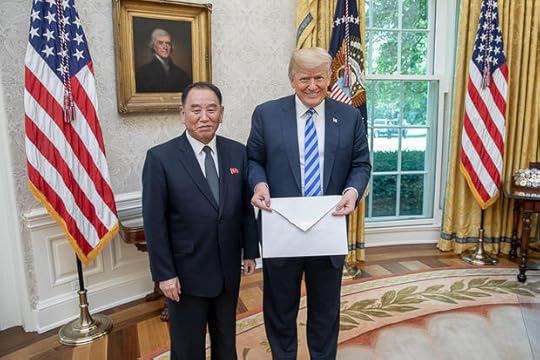
Historians of early generations read the Zinoviev Letter, the Letter from Birmingham Jail or Einstein’s letter to President Roosevelt. Historians of the Trump administration will pass over the letter's contents and instead ponder the size of the envelope and the abundantly shiny reflective properties of the paper out of which it was made. They will remark on its resemblance to envelopes used during the Oscar ceremony or when announcing the winner of Miss World.
The next clue to the special nature of the 2018 North Korea – United States Summit comes in the form of a trailer produced by “Destiny Pictures” and distributed by that well known source of popular light entertainment, the White House. Click through to the video below to see what is one of the most incredible videos your taxes ever paid to produce.

I think we are close to the real nature of the 2018 North Korea – United States Summit (I’ll use its popular name from now on: Comic Yalta). This is the first time in history that an international summit was not the serious meeting of sovereign states that it pretended to be but instead was what it looked like to all the world: the pilot episode of a poorly produced reality TV show.
For the first time in history a major international summit meeting was held with no substance at all. None. No sherpas, no agreement, no agreed press statement, no objectives, no resolution. Nothing at all; just two individuals of doubtful moral character hanging out in a room for forty five minutes pretending to each other and to the world that they were having a world changing international summit meeting. This has actually happened in our lifetimes. It might even happen again.
Trump didn’t have to prepare for Comic Yalta because he has performed in a reality TV most of his working life, and to a record breaking audience since November 2016. The DPRK has been preparing Kim for his role on set for decades as well. The sole objective of Comic Yalta was to entertain the populations of Korea, America, Japan and other countries and make the people feel good for a few hours. This, not co-incidentally, is also the purpose of most prime time TV. And by all accounts Comic Yalta has succeeded; Kim looks secure and Trump’s popularity his ticked up. Not “panem et circenses” exactly, more “porcus crustum et linum rapio” (“McDonalds and Netflix” – or the closest I could get with google translate).
How can I be so certain that Comic Yalta was nothing more than reality TV? Might it not have been a sincere attempt by both parties to serve up World Peace, with a chunk of Nobel Prize on the side?
Well, besides that envelope, Destiny Pictures and everything about Comic Yalta looking like a cheap TV program, we have this book, being an excellent review of North Korean domestic propaganda. DPRK propaganda for the home market is very different from propaganda aimed at the world outside and, as the author notes in his introduction, is often ignored on account of being either inaccessible or just too weird.
‘The Cleanest Race’ argues convincingly that domestic DPRK propaganda is built on Japanese propaganda from the time Korea was a Japanese colony when both countries saw their citizens as ethnically superior to the rest of the world. As a result at its heart it is deeply racist and fascistic. Other races – particularly the Americans - are inferior while the Korean people are pure blooded and virtuous, albeit too virtuous to survive in an evil world without a great parental leader.
This ethno-centric ideology is broadly held in the DPRK and sustains the popularity to the regime.
Typical of authoritarian regimes, other races are portrayed as subhuman and worth of extinction. It is interesting to see how DPRK writers portray ethnically inferior Americans, as this excerpt from a popular novel about the deliberate poisoning of Korean children by American missionaries shows:
An example of the success of DPRK propaganda efforts is the famous canard that North Korean citizens believe that American food aid is nothing of the sort but rather tribute paid by the US to the Korean people. This seems hardly credible to someone outside DPRK but the book explains why this can be true; the North Korean people have been fed a complex but believable narrative about the US and South Korea over the years that can justify such a belief.
In the eighties and nineties it became increasingly clear that South Korean standards of living were outpacing those of the North. The ever increasing flow of communications from South to North showing better material lifestyles in the south – the tapes, videos, DVDs, broadcasts – was difficult to stop. DPRK propaganda rose to this new challenge, with the narrative that Kim Jong-il I had swung to a “military first” strategy, which meant the DPRK forgoing material luxuries in order to focus on a military build up that would protect both North and South Korea from increased Yankee military aggression:
Even the Korean famine in the 1990s was built into the narrative:
But while the DPRK propagandists have fed these narratives they have boxed themselves more and more into a corner, giving themselves less room to maneuver while they try and produce a coherent story. As a result the greatest security risk they have been facing more recently comes not from America, but from the prosperity of South Korea. As the author states, the Kim regime would not survive the realization that it was not the Yankees who were blocking reunification all long but their own blood brothers in the south:
Trump, as ignorant of DPRK ideology as he is of everything outside his own field of vision at any particular moment, gave the North Koreans exactly what they wanted – status on the world stage as equal to America, recognition as a nuclear armed power, concessions on military maneuvers – and all for nothing.
Amazingly works by DPRK propagandists written years before Comic Yalta anticipated a time when the DPRK could be seen by the world as equal to America, as illustrated by this excerpt from a North Korean propaganda novel which imagines a conversation between US and DPRK nuclear negotiators:
So when Trump salutes a North Korean general it makes perfect sense – the propagandist’s lie that North Korea was equal to America was never a lie after all. This long DPRK propaganda video made after Comic Yalta shows the salute.

But the Koreans have no intention and never had any intention of keeping their word. Why would a superior race make promises to degenerate animals like the Americans?
Why would a superior race ever be scared of the degenerate Americans?
So there we have it. Comic Yalta’s main achievment was to keep the people entertained until the next distraction comes along. Already we have No sign of North Korea dismantling nuclear weapons programme, Mattis admits.
Ironically talking to the North Koreans and curtailing military maneuvers was a good idea from the point of view of avoiding accidentally triggering a nuclear war, but that was not the original plan of Comic Yalta because there was no plan. But given the success of its pilot episode, this reality show can run and run, keeping us on the edge of our seats until the White House production company and Destiny Pictures, who don't even know how the series will turn out themselves, screens a final, unexpected denouement.
Why was this summit so different from all past summits, past conferences, conclaves, councils, seminars or any other meeting between heads of state ever? Why so unlike Yalta or Potsdam or Munich or Camp David or Sharm el-Sheikh? Was it the participants – a vicious dictator meeting the ‘leader of the free world’? Was it the circumstances – a summit held to prevent the almost certain outbreak of nuclear war triggered by the twitter rivalry of ‘Little Rocket Man’ and a US President ready to press his “…Nuclear Button…” which is “…much bigger and more powerful…”?
The first clue to the unique nature of this summit came a few days before it took place. You can see this clue on prominent display in the picture below. The clue is not the letter inside the envelope of course – President Trump thought it was a great letter, although he never read it – but the big shiny envelope itself.
Historians of early generations read the Zinoviev Letter, the Letter from Birmingham Jail or Einstein’s letter to President Roosevelt. Historians of the Trump administration will pass over the letter's contents and instead ponder the size of the envelope and the abundantly shiny reflective properties of the paper out of which it was made. They will remark on its resemblance to envelopes used during the Oscar ceremony or when announcing the winner of Miss World.
The next clue to the special nature of the 2018 North Korea – United States Summit comes in the form of a trailer produced by “Destiny Pictures” and distributed by that well known source of popular light entertainment, the White House. Click through to the video below to see what is one of the most incredible videos your taxes ever paid to produce.
I think we are close to the real nature of the 2018 North Korea – United States Summit (I’ll use its popular name from now on: Comic Yalta). This is the first time in history that an international summit was not the serious meeting of sovereign states that it pretended to be but instead was what it looked like to all the world: the pilot episode of a poorly produced reality TV show.
For the first time in history a major international summit meeting was held with no substance at all. None. No sherpas, no agreement, no agreed press statement, no objectives, no resolution. Nothing at all; just two individuals of doubtful moral character hanging out in a room for forty five minutes pretending to each other and to the world that they were having a world changing international summit meeting. This has actually happened in our lifetimes. It might even happen again.
Trump didn’t have to prepare for Comic Yalta because he has performed in a reality TV most of his working life, and to a record breaking audience since November 2016. The DPRK has been preparing Kim for his role on set for decades as well. The sole objective of Comic Yalta was to entertain the populations of Korea, America, Japan and other countries and make the people feel good for a few hours. This, not co-incidentally, is also the purpose of most prime time TV. And by all accounts Comic Yalta has succeeded; Kim looks secure and Trump’s popularity his ticked up. Not “panem et circenses” exactly, more “porcus crustum et linum rapio” (“McDonalds and Netflix” – or the closest I could get with google translate).
How can I be so certain that Comic Yalta was nothing more than reality TV? Might it not have been a sincere attempt by both parties to serve up World Peace, with a chunk of Nobel Prize on the side?
Well, besides that envelope, Destiny Pictures and everything about Comic Yalta looking like a cheap TV program, we have this book, being an excellent review of North Korean domestic propaganda. DPRK propaganda for the home market is very different from propaganda aimed at the world outside and, as the author notes in his introduction, is often ignored on account of being either inaccessible or just too weird.
‘The Cleanest Race’ argues convincingly that domestic DPRK propaganda is built on Japanese propaganda from the time Korea was a Japanese colony when both countries saw their citizens as ethnically superior to the rest of the world. As a result at its heart it is deeply racist and fascistic. Other races – particularly the Americans - are inferior while the Korean people are pure blooded and virtuous, albeit too virtuous to survive in an evil world without a great parental leader.
"...We have all seen clips of the Arirang mass games in which scores of children of the same height, body type and hairstyle dance and leap in unison. These games are not the grim Stalinist exercises in anti-individualism that foreigners (such as the makers of the aforementioned documentary) often misperceive them as, but joyous celebrations of the pure-bloodedness and homogeneity from which the race’s superiority derives..."
This ethno-centric ideology is broadly held in the DPRK and sustains the popularity to the regime.
"...Paranoid nationalism may well be an intellectual void, and appeal to the lowest instincts—there is nothing in North Korean ideology that a child of twelve cannot grasp at once—but for that very reason it has proven itself capable of uniting citizens of all classes.."
Typical of authoritarian regimes, other races are portrayed as subhuman and worth of extinction. It is interesting to see how DPRK writers portray ethnically inferior Americans, as this excerpt from a popular novel about the deliberate poisoning of Korean children by American missionaries shows:
"...the Americans’ evil can be “read” in their big noses, large breasts and sunken eyes. The old jackal’s spade-shaped eagle’s nose hung villainously over his upper lip, while the vixen’s teats jutted out like the stomach of a snake that has just swallowed a demon, and the slippery wolf-cub gleamed with poison like the head of a venomous snake that has just swallowed its skin. Their six sunken eyes seemed … like open graves constantly waiting for corpses..."
An example of the success of DPRK propaganda efforts is the famous canard that North Korean citizens believe that American food aid is nothing of the sort but rather tribute paid by the US to the Korean people. This seems hardly credible to someone outside DPRK but the book explains why this can be true; the North Korean people have been fed a complex but believable narrative about the US and South Korea over the years that can justify such a belief.
In the eighties and nineties it became increasingly clear that South Korean standards of living were outpacing those of the North. The ever increasing flow of communications from South to North showing better material lifestyles in the south – the tapes, videos, DVDs, broadcasts – was difficult to stop. DPRK propaganda rose to this new challenge, with the narrative that Kim Jong-il I had swung to a “military first” strategy, which meant the DPRK forgoing material luxuries in order to focus on a military build up that would protect both North and South Korea from increased Yankee military aggression:
“…the southern masses are acutely aware that were it not for the DPRKs military first policy, the Yankees would long since have plunged them into another ruinous war., They owe their material comfort to the self sacrifice not only of the Dear Leader, but of all the heroic citizens of the DPRK…”
Even the Korean famine in the 1990s was built into the narrative:
"...if anything, the famine may have strengthened support for the regime by renewing the sense of ethnic victimhood from which the official worldview derived its passion. Many migrants remember a widespread yearning for war with America during the famine..."
But while the DPRK propagandists have fed these narratives they have boxed themselves more and more into a corner, giving themselves less room to maneuver while they try and produce a coherent story. As a result the greatest security risk they have been facing more recently comes not from America, but from the prosperity of South Korea. As the author states, the Kim regime would not survive the realization that it was not the Yankees who were blocking reunification all long but their own blood brothers in the south:
“…Pyongyang negotiates with Washington not to defuse tension but to manage it, to keep it from tipping into all-out war or an equally perilous all-out peace. Ignorant of this, because ignorant of the North’s ideology, Americans tend to blame problems in the US-DPRLK relationship on whoever happens to be in the Oval Office, thinking him either too soft or too hard on Pyongyang…"
Trump, as ignorant of DPRK ideology as he is of everything outside his own field of vision at any particular moment, gave the North Koreans exactly what they wanted – status on the world stage as equal to America, recognition as a nuclear armed power, concessions on military maneuvers – and all for nothing.
Amazingly works by DPRK propagandists written years before Comic Yalta anticipated a time when the DPRK could be seen by the world as equal to America, as illustrated by this excerpt from a North Korean propaganda novel which imagines a conversation between US and DPRK nuclear negotiators:
'...Gallucci: “We respect you. The future peace not only of the Korean peninsula but also of Asia, the Pacific Region, depends on us, on the US and [North] Korea.”
Mun: “Whose words are those? Yours?”
Gallucci. “The words of the White House.”
Mun: “That amounts to saying that we’re a superpower too.”
Gallucci: “That’s right, you’re a superpower. A superpower like America!”
Now Korea was on an equal footing with the United States, the world’s only superpower. Asia’s small country Korea, which had once lost its luster on the world map..."
So when Trump salutes a North Korean general it makes perfect sense – the propagandist’s lie that North Korea was equal to America was never a lie after all. This long DPRK propaganda video made after Comic Yalta shows the salute.
But the Koreans have no intention and never had any intention of keeping their word. Why would a superior race make promises to degenerate animals like the Americans?
“…Let us turn now to [DPRK domestic propaganda’s] treatment of the ongoing nuclear dispute. Here too the contrast to Soviet propaganda is stark. Where Moscow always professed a respect for international law, the North Koreans reject the notion that a pure race should be bound by the dictates of an impure world. [DPRK domestic propaganda] thus cheerfully admits that the DPRK joined the Non-Proliferation Treaty in 1985 only to “use” it for the country’s own ends, whereupon it “ignored” or “scorned” the treaty’s stipulations…"
Why would a superior race ever be scared of the degenerate Americans?
"...Suffice to say that there is no trace of fear of any adversary in [DPRK domestic propaganda] (One is struck by the contrast to anti-American propaganda in East Germany during the 1980s, which constantly raised the specter of nuclear war.) On the contrary, the child race is depicted as itching for a “holy war” or sŏngjŏn—once a common term in Pacific War propaganda—in which to kill Yankees and reunite the motherland..."
So there we have it. Comic Yalta’s main achievment was to keep the people entertained until the next distraction comes along. Already we have No sign of North Korea dismantling nuclear weapons programme, Mattis admits.
Ironically talking to the North Koreans and curtailing military maneuvers was a good idea from the point of view of avoiding accidentally triggering a nuclear war, but that was not the original plan of Comic Yalta because there was no plan. But given the success of its pilot episode, this reality show can run and run, keeping us on the edge of our seats until the White House production company and Destiny Pictures, who don't even know how the series will turn out themselves, screens a final, unexpected denouement.

February 6, 2010
I picked this up because I read some reviews praising it as a guide outlining why North Korea is NOT like Communist regimes. Which was news to me -- I'd always thought it to be a USSR-derived satellite. It turns out that NK has a truly unique, and disturbingly understandable, personality cult that encourages its citizens to prioritize naivete, innocence, and childhood.
The best parallel I can make is: imagine a cult that basically convinced a population to go back to Adam and Eve in Eden. A single nurturing guardian will protect you from the corrupted world, and it's just your job to remain carefree. Now strip out the religion and replace it with a deeply racist cultural position, chuck in some historical aggression from external threats, find a motherly-looking figurehead, and you've got North Korea.
Really, the whole book's fascinating. The cult itself makes no sense to an onlooker, but I can see why it's the most natural thing in the world to the people raised in it. But don't go looking for more than propaganda analysis here -- this is about how N Koreans see themselves and their national identity, not about prison camps and famine.
I'm knocking a star off purely because you need a bit of grounding in Korean War-era events to grasp some concepts. When dealing with propaganda to this degree, it can be hard to untangle the propaganda from the reality. There were a few mentions of outrageous crimes that I had to research as I read, as you can't tell if the author's recounting NK propaganda, if NK's exaggerating a real event, or if the entire thing's true.
As I neared the end of the book, I definitely started to get outraged at the idea that the US are sending immense amounts of food aid to North Korea, and NK is telling its citizens that it's basically tributes from a fearful nation to the Great Leader. BR Myers seems pretty convinced that we're going about North Korea in the wrong way, and after reading this, I wanted to cut off foreign aid completely. Jeez.
Anyhow. Fascinating read, and also probably a good bit of research if you're writing a novel and want some source material for world-building a personality cult.
The best parallel I can make is: imagine a cult that basically convinced a population to go back to Adam and Eve in Eden. A single nurturing guardian will protect you from the corrupted world, and it's just your job to remain carefree. Now strip out the religion and replace it with a deeply racist cultural position, chuck in some historical aggression from external threats, find a motherly-looking figurehead, and you've got North Korea.
Really, the whole book's fascinating. The cult itself makes no sense to an onlooker, but I can see why it's the most natural thing in the world to the people raised in it. But don't go looking for more than propaganda analysis here -- this is about how N Koreans see themselves and their national identity, not about prison camps and famine.
I'm knocking a star off purely because you need a bit of grounding in Korean War-era events to grasp some concepts. When dealing with propaganda to this degree, it can be hard to untangle the propaganda from the reality. There were a few mentions of outrageous crimes that I had to research as I read, as you can't tell if the author's recounting NK propaganda, if NK's exaggerating a real event, or if the entire thing's true.
As I neared the end of the book, I definitely started to get outraged at the idea that the US are sending immense amounts of food aid to North Korea, and NK is telling its citizens that it's basically tributes from a fearful nation to the Great Leader. BR Myers seems pretty convinced that we're going about North Korea in the wrong way, and after reading this, I wanted to cut off foreign aid completely. Jeez.
Anyhow. Fascinating read, and also probably a good bit of research if you're writing a novel and want some source material for world-building a personality cult.

Want to Read
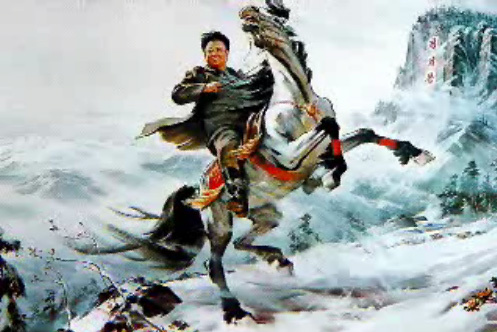
April 15, 2017“Where Moscow always professed respect for international law, the North Koreans reject the notion that a pure race should be bound by the dictates of an impure world.”
“Just as a jackal cannot become a lamb, the U.S. imperialists cannot change their rapacious nature”
(from the book)

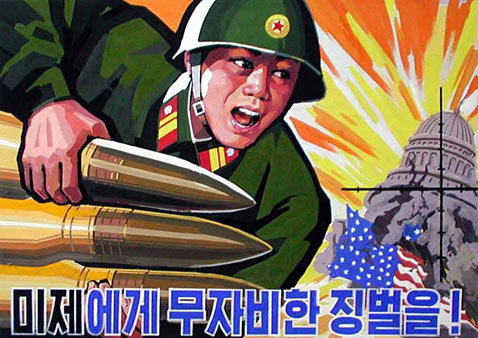
"Our enemies are the American bastards
Who are trying to take over our beautiful fatherland.
With guns that I make with my own hands
I will shoot them. BANG, BANG, BANG."

This book is timely. Maybe, it will help finding possible scenarios on the North-Korean strategy facing America's recent moves. The book is a good exercise in social psychology; the psychology of a people, and their leaders. Myers describes at length the "maternal" side of the North Korean leaders; stresses also the Japanese influence early on, on the sense of nationalism of the north Koreans; a distinct race.
"This is the biggest deal of Trump’s life."
Tom Rogan, 14th April 2017
in: http://www.thedailybeast.com/articles...
Japan readying for N. Korea emergency
in: http://the-japan-news.com/news/articl...
https://www.theatlantic.com/magazine/...
RAPID ESCALATION
Nasty, brutish, and short—what the next Korean War will look like
in: https://qz.com/950488/nasty-brutish-a...
https://www.theguardian.com/commentis...
CAN YOU BELIEVE IT??
This a complete new premise:
North Korea Signals Willingness to ‘Denuclearize,’ South Says
in: https://www.nytimes.com/2018/03/06/wo...

“Just as a jackal cannot become a lamb, the U.S. imperialists cannot change their rapacious nature”
(from the book)
"Our enemies are the American bastards
Who are trying to take over our beautiful fatherland.
With guns that I make with my own hands
I will shoot them. BANG, BANG, BANG."
This book is timely. Maybe, it will help finding possible scenarios on the North-Korean strategy facing America's recent moves. The book is a good exercise in social psychology; the psychology of a people, and their leaders. Myers describes at length the "maternal" side of the North Korean leaders; stresses also the Japanese influence early on, on the sense of nationalism of the north Koreans; a distinct race.
"This is the biggest deal of Trump’s life."
Tom Rogan, 14th April 2017
in: http://www.thedailybeast.com/articles...
Japan readying for N. Korea emergency
in: http://the-japan-news.com/news/articl...
https://www.theatlantic.com/magazine/...
RAPID ESCALATION
Nasty, brutish, and short—what the next Korean War will look like
in: https://qz.com/950488/nasty-brutish-a...
https://www.theguardian.com/commentis...
CAN YOU BELIEVE IT??
This a complete new premise:
North Korea Signals Willingness to ‘Denuclearize,’ South Says
in: https://www.nytimes.com/2018/03/06/wo...

July 24, 2013
there's something slightly unhinged about Professor B.R. Myers, whose vitriolic takedowns of North Korean 'juche' philosophy have the character of a personal attack--until you learn that Professor Myers is a long-time Korea expat, and surrounded by a culture that notoriously comes off as 'highly emotional' to many Americans and certainly almost all Japanese, Myers himself resorts to loyalty-demonstrating 'takedowns' of unKoreanness in N.K. propaganda as well as forces in his adopted country he despises. the strange mood-swinging dysphoria in Myers' writing ironically echoes the weirdness of North Korea itself, and although Myers' long-standing feud with leftist Bruce Cumings is well known, I'm not sure Professor Cumings deigns to respond. it's the flea raging against the tiger, and the tiger can't be rid of the flea, but the tiger is still looking where to find its next ibix.
Although CLEANEST RACE has plenty of nice propaganda photos and reads fluently, in many ways it comes a distant third to Cumings or even the right-of-centre Barbara Demick. Part of the problem is that Demick is at least trained in journalism, but Myers did all his graduate study in Soviet studies and didn't even work in the East Asian field after getting his degrees. it's cold war geopolitical approaches mixed in with some german and japanese thinking about Korea culture, and while fascinating in its own way, lacks the academic rigor of others in this field.
although a useful edition to the north korea literature, this brief work can't be considered ground-breaking scholarship. there is truth in madness, sometimes, but I'm not sure I'd want to be locked in a room with either a group of north korean soldiers or Professor Myers.
Although CLEANEST RACE has plenty of nice propaganda photos and reads fluently, in many ways it comes a distant third to Cumings or even the right-of-centre Barbara Demick. Part of the problem is that Demick is at least trained in journalism, but Myers did all his graduate study in Soviet studies and didn't even work in the East Asian field after getting his degrees. it's cold war geopolitical approaches mixed in with some german and japanese thinking about Korea culture, and while fascinating in its own way, lacks the academic rigor of others in this field.
although a useful edition to the north korea literature, this brief work can't be considered ground-breaking scholarship. there is truth in madness, sometimes, but I'm not sure I'd want to be locked in a room with either a group of north korean soldiers or Professor Myers.

June 7, 2011
I liked B.R. Myers's takedown of literary fiction way back when and was game to give this a try, even though it's on a totally unrelated topic, namely, the political and national mythology of North Korea. The general idea is that it's a mistake to see North Korea as the last bastion of hardline Stalinism. Instead, their militant and isolationist stance is the result of a bizarre mythos of racial purity. Over several generations of political turmoil, and encouraged by Kim Il-Sung and Kim Jong-Il, there arose a story of Koreans as a racially immaculate people, characterized by childlike innocence and spontaneity, who require a seemingly genderless parental figure to shepherd them through an evil and debased world. Americans are the worst of all, and South Koreans yearn for unity under North Korean leadership. Myers presents the various aspects of this story, which he draws from visual and written propaganda--and not the stuff that's been translated into English, instead the original Korean-language materials. It's oddly like an art historical project of iconographic analysis, except instead of explaining what a lily represents in a picture of the Virgin Mary, we're finding out what a picture of Kim Il-Sung hugging a soldier is supposed to mean. The overall effect is bizarre but convincing. Extra points for brevity.

December 10, 2011
"If we did not know that Iran is an Islamic state, it would forever baffle us, no matter how good the rest of our intelligence might be." Myers succinctly and persuasively lays out why the US seems to be similarly baffled by North Korea. What is North Korea? Is it a crazy mix of traditional Confucianism and Marxist-Leninism? If only. The real answer is far weirder and much more disturbing. The North Koreans adopted and amped up the propaganda world-view of the Japanese colonial regime (without the Japanese). The Koreans are the purest and most virtuous race in the world. Their virtues are those of children. (North Korea is often compared to 1984, but Brave New World with its infantilization of the masses seems equally applicable.) The simple Koreans would like to be left alone but need to be protected from the depredations of the outside world by the parental leaders, the Kims. The word parental is key, since while the Kims are male, their virtues are those of the mother. (No fooling.) Juche, or self-reliance, is just intellectual window dressing. The disturbing part is that Myers clearly shows that the popularity of this racist ideology explains Pyongyang's behavior and that this ideology will not let us talk North Korea down from the ledge.

August 4, 2010
Fascinating on the North Korean ideology - which builds on the legacy of the half-century of Japanese rule, to invent the notion that the Koreans are the purest of all Asian races - pure rather than superior. Their purity makes them helpless, and they need a father figure to guard their purity. This is much more important than Marxism, to which lip service is paid, but which confuses American lefties, and far more important than Confucianism, which is non-existent in NK. The complexity is that many South Koreans are attracted by this notion (which, after all, is something that the oldest generation grew up with before WWII), and that NKs hold it sincerely. Completely amazing.

January 16, 2012
For years, I have wondered if the people of DPRK could possibly believe in the propaganda of the Kim regimes. I wonder no more. This book takes a look at the domestic propaganda (as opposed to KCNA-type propaganda disseminated for foreign consumption), and what it presents is sad, frightening, and seemingly way over the top, yet absolutely true. I used to listen to DPRK propaganda on the radio, and obviously was not swayed by its fantastical claims. If you've ever read or heard this sort of stuff, intensify it by an exponential factor, and you'll get an idea of what the North Korean people hear and see everyday.
With lots of photos of posters, and quotes from novels and other print media, The Cleanest Race makes it clear why and how the DPRK can get away with what it does. The case is made that the Korean image of itself as a virtuous race of pure childlike people was instilled into the people through decades of the Japanese occupation (necessitating the protection of the Emperor), and later became the basis for the Party ideology (which truly has almost nothing to do with Marxism or any other variant of communism), and is now the very heart of the identification of the Korean people in the North. With such an understanding of themselves, the need for a Mother Leader (Kim Jong Il) makes sense, and Myers explains how the propaganda machine manufactured the image of Kim as a nurturing mother, rather than an ideologue or people's hero in the tradition of Stalin or Mao Zedong.
A quick read, with lots of notes. Well worth the time for anyone who wants to understand what's going on in Pyongyang. I recommend The Aquariums of Pyongyang for those who want to see what happens when a North Korean runs afoul of the Party.
With lots of photos of posters, and quotes from novels and other print media, The Cleanest Race makes it clear why and how the DPRK can get away with what it does. The case is made that the Korean image of itself as a virtuous race of pure childlike people was instilled into the people through decades of the Japanese occupation (necessitating the protection of the Emperor), and later became the basis for the Party ideology (which truly has almost nothing to do with Marxism or any other variant of communism), and is now the very heart of the identification of the Korean people in the North. With such an understanding of themselves, the need for a Mother Leader (Kim Jong Il) makes sense, and Myers explains how the propaganda machine manufactured the image of Kim as a nurturing mother, rather than an ideologue or people's hero in the tradition of Stalin or Mao Zedong.
A quick read, with lots of notes. Well worth the time for anyone who wants to understand what's going on in Pyongyang. I recommend The Aquariums of Pyongyang for those who want to see what happens when a North Korean runs afoul of the Party.

February 3, 2010
Myers argues convincingly that North Korean ideology is less influenced by Marxism than the leftovers of Japanese colonialism and emperor worship. A professor of North Korean literature, he uses several excerpts from popular fiction as illustration. A favorite was a story in which a soldier wakes up after a leg operation to find the hospital staff hobbling because they've each given him parts of their own legs.
It's also interesting that the stories about Kim Il Sung do not place him at any specific location or landmark. He simply appears in an undisclosed place and sets off to roam the countryside. This reminded me of a North Korean war film I'd seen a few years ago that showed an equal lack of attention to physical space. At the time I thought it was clumsy filmmaking, but now...
It's also interesting that the stories about Kim Il Sung do not place him at any specific location or landmark. He simply appears in an undisclosed place and sets off to roam the countryside. This reminded me of a North Korean war film I'd seen a few years ago that showed an equal lack of attention to physical space. At the time I thought it was clumsy filmmaking, but now...

December 29, 2011
EXCELLENT. I've long questioned how seriously North Koreans take their ideology, and where exactly the ideology came from in the first place. This goes a long way toward answering both.
It makes a compelling case that North Korea is not at its core a communist, Marxist, or Confucianist, state but rather a Korean racial nationalist one. While the cult of personality makes it superficially resemble Stalinism or Chinese Maoism, the similarities are not very deep. It most resembles the Imperial Japanese ideology, from which Myers claims that the current North Korean ideology springs (they literally just swap out things like Mt. Fuji for Mt. Baekdu)
The leaders are portrayed in propaganda, literature, and art as maternal figures, with the korean people as children. The Korean race is seen as as virtuous and moral, but innocent and instinctual rather than intelligent or strong so they need a Great Leader to keep them safe in this wretched world. Its pretty clever propaganda which appeals to basic psychological crutches (esp. in times of difficulty).
The book portrays Korean (including south Korean) culture as basically conformist. It denies heavy police presence in North Korea, as most Koreans including expatriates support the regime.
It also details the role of South Korea in Northern ideology, the role of Juche, the role of America, and about how the personality cult has evolved from Sun Il to Jong Il. This leaves me extremely curious about the future.
Oh yeah, and if he is right than most public commentators on North Korea and most policymakers have a very poor grasp of what they are doing.
5 unhesitant stars
It makes a compelling case that North Korea is not at its core a communist, Marxist, or Confucianist, state but rather a Korean racial nationalist one. While the cult of personality makes it superficially resemble Stalinism or Chinese Maoism, the similarities are not very deep. It most resembles the Imperial Japanese ideology, from which Myers claims that the current North Korean ideology springs (they literally just swap out things like Mt. Fuji for Mt. Baekdu)
The leaders are portrayed in propaganda, literature, and art as maternal figures, with the korean people as children. The Korean race is seen as as virtuous and moral, but innocent and instinctual rather than intelligent or strong so they need a Great Leader to keep them safe in this wretched world. Its pretty clever propaganda which appeals to basic psychological crutches (esp. in times of difficulty).
The book portrays Korean (including south Korean) culture as basically conformist. It denies heavy police presence in North Korea, as most Koreans including expatriates support the regime.
It also details the role of South Korea in Northern ideology, the role of Juche, the role of America, and about how the personality cult has evolved from Sun Il to Jong Il. This leaves me extremely curious about the future.
Oh yeah, and if he is right than most public commentators on North Korea and most policymakers have a very poor grasp of what they are doing.
5 unhesitant stars

January 6, 2011
Not an easy read. The author looks at the big picture, so big that I lost interest. The author also tries to sell the idea that the regime wants its citizens to be "childlike, spontaneous & naive", which I found weird. Although, they did not present their idea without having researched. A few times in the book it's like they're saying, "Obviously this, obviously that", which I also found dull. This book is like a text book or a very opinionated research paper. I finished it with determination. In conclusion, not interesting, but inevitably a bit enlightening.

November 1, 2011
A unique study on the cultural, political, and societal differences that make the North Koreans unique to their southern counterparts. A pretty cool book that made me learn several things.

October 30, 2011
The Cleanest Race: How North Koreans See Themselves — and Why It Matters attempts to decode the North Korean state religion, a religion that is obscured by the fact that very few outsiders even speak, much less read, Korean (I guess there just isn't enough anime from South Korea for there to be an otaku community in the west). Author B. R. Myers does speak and read Korean, and has assembled what he knows. His excerpts and analysis show that internal propaganda for North Korea is wildly different from that distributed to the West, and what that difference means.
Myers calls internal propaganda "The Text," and makes references to it. His chapters start with his summary of The Text regarding a specific issue-- Who are the North Koreans?, Who is Kim Jung Il?, What of the South Koreans?, What of the United States?-- and then proceeds to show, through extensive excerpts from internal North Korean propaganda, including officially permitted popular books and movies, what The Text disseminated through North Korea says.
The title comes from an quote from official North Korean propaganda, worked into one of his summaries: "The Korean people are the cleanest, purest, and therefore most virtuous race on Earth. Our purity is like that of a child, and therefore our innocence is also that of a child. Only a truly strong leader can protect us from the stain of outside influence." This is the basis of North Korea's entire ideology: that Koreans are pure, uncorrupted, and child-like in their innocence, and they deserve to stay that way, because innocence is pleasure, while maturity and adulthood are painful.
Myers' work is pretty comprehensive, although there are times when takes other historians and analysts to task for their own lack of criticality; he has his eye particularly on leftist historians who try to excuse North Korea, and find solidarity between it and the USSR. He also takes to task South Korean and Chinese historians who interpret North Korea as an extreme example of Confucian polity. Myers claims that nothing could be further from the truth; there is nothing of "fraternity" and the masculine "fatherland" concepts, nothing of the economic benefits of solidarity, nor is there honoring of ancestors and paternal authority; instead, there is familial feeling, always centered on a cthonic maternal ideal, and the people are not to worry too much about the economy and looking forward (the Soviet concept), or the ancient traditions (the Confucian ideal), but instead to hold fast to their individual pasts, to hold to their childhoods and the all-engulfing mother-love of the motherland.
Myers also points out that we misinterpret Pyongyang. Many in the free world see the immense status of the Kim family, and the enormous buildings with their broad, automobile-free streets, as somehow attempting to make the visitor feel small. What Myers points out is that these instead make the North Korean visitor feel big-- look at how powerful his state is, to have raised such monuments. Without the transcendent individualizing religions that arose in the West with a paternalistic god-concept, the North Korean attaches his need for immortality, his own fear of an existential end, by emphasizing his role in the immortality of the state. The North Korean propaganda machine has done a masterful job of conflating the persistence of the state with the purity of the race.
For Myers, Pyongyang is not a "leftist" institution at all, but one of the extreme right: a fascist state propped up by an earnest racism that comes from the top down. Myers also emphasizes that the topmost tiers of the North Korean political system believe in the racial purity as much as the ordinary people do; the Dear Leaders have always had more popular support than we suppose in the West; and that their propaganda has, since the end of WWII, emphasized that there is no chance whatsoever for rapprochement between Korean and the "mongrelized" world, because there is no chance for compromise between purity and corruption. North Korea is on a knife's edge: it needs not to die of economic collapse (and the Chinese can't afford it to); it also needs not provoke a war, but to be true to its ideals it cannot ever be seen by its own people to be seeking peace.
One thing Myers does well is show that the South Koreans are not so far behind the North Koreans in their racism and centrism. This is one of the reasons there is so little South Korean entertainment reaching American shores-- their own ideology allows only for small, dull conflicts. South Korean kids entertain themselves by imagining how violent the rest of the world is, compared to tranquil Korea.
The book is a solid read, and only 200 pages long, filled with long out-takes from North Korean literature translated into English for the first time. There are also hundreds of illustrations of posters and movie stills, showing that as recently as 2006 the North Korean government was reminding its people that Americans poison Korean babies and run over schoolchildren for entertainment. It's a pretty scary book that leaves you with one impression: the North Koreans really believe what they say they believe, and any attempt to negotiate with them "in good faith" is doomed, because they believe that no good faith is possible with a world that seeks their corruption.
Myers calls internal propaganda "The Text," and makes references to it. His chapters start with his summary of The Text regarding a specific issue-- Who are the North Koreans?, Who is Kim Jung Il?, What of the South Koreans?, What of the United States?-- and then proceeds to show, through extensive excerpts from internal North Korean propaganda, including officially permitted popular books and movies, what The Text disseminated through North Korea says.
The title comes from an quote from official North Korean propaganda, worked into one of his summaries: "The Korean people are the cleanest, purest, and therefore most virtuous race on Earth. Our purity is like that of a child, and therefore our innocence is also that of a child. Only a truly strong leader can protect us from the stain of outside influence." This is the basis of North Korea's entire ideology: that Koreans are pure, uncorrupted, and child-like in their innocence, and they deserve to stay that way, because innocence is pleasure, while maturity and adulthood are painful.
Myers' work is pretty comprehensive, although there are times when takes other historians and analysts to task for their own lack of criticality; he has his eye particularly on leftist historians who try to excuse North Korea, and find solidarity between it and the USSR. He also takes to task South Korean and Chinese historians who interpret North Korea as an extreme example of Confucian polity. Myers claims that nothing could be further from the truth; there is nothing of "fraternity" and the masculine "fatherland" concepts, nothing of the economic benefits of solidarity, nor is there honoring of ancestors and paternal authority; instead, there is familial feeling, always centered on a cthonic maternal ideal, and the people are not to worry too much about the economy and looking forward (the Soviet concept), or the ancient traditions (the Confucian ideal), but instead to hold fast to their individual pasts, to hold to their childhoods and the all-engulfing mother-love of the motherland.
Myers also points out that we misinterpret Pyongyang. Many in the free world see the immense status of the Kim family, and the enormous buildings with their broad, automobile-free streets, as somehow attempting to make the visitor feel small. What Myers points out is that these instead make the North Korean visitor feel big-- look at how powerful his state is, to have raised such monuments. Without the transcendent individualizing religions that arose in the West with a paternalistic god-concept, the North Korean attaches his need for immortality, his own fear of an existential end, by emphasizing his role in the immortality of the state. The North Korean propaganda machine has done a masterful job of conflating the persistence of the state with the purity of the race.
For Myers, Pyongyang is not a "leftist" institution at all, but one of the extreme right: a fascist state propped up by an earnest racism that comes from the top down. Myers also emphasizes that the topmost tiers of the North Korean political system believe in the racial purity as much as the ordinary people do; the Dear Leaders have always had more popular support than we suppose in the West; and that their propaganda has, since the end of WWII, emphasized that there is no chance whatsoever for rapprochement between Korean and the "mongrelized" world, because there is no chance for compromise between purity and corruption. North Korea is on a knife's edge: it needs not to die of economic collapse (and the Chinese can't afford it to); it also needs not provoke a war, but to be true to its ideals it cannot ever be seen by its own people to be seeking peace.
One thing Myers does well is show that the South Koreans are not so far behind the North Koreans in their racism and centrism. This is one of the reasons there is so little South Korean entertainment reaching American shores-- their own ideology allows only for small, dull conflicts. South Korean kids entertain themselves by imagining how violent the rest of the world is, compared to tranquil Korea.
The book is a solid read, and only 200 pages long, filled with long out-takes from North Korean literature translated into English for the first time. There are also hundreds of illustrations of posters and movie stills, showing that as recently as 2006 the North Korean government was reminding its people that Americans poison Korean babies and run over schoolchildren for entertainment. It's a pretty scary book that leaves you with one impression: the North Koreans really believe what they say they believe, and any attempt to negotiate with them "in good faith" is doomed, because they believe that no good faith is possible with a world that seeks their corruption.
April 28, 2025
This is a nice quick read that will turn on its head much of what you think you know about North Korea. Myers pushes against the mainstream view of the DPRK as a communist state with a Marxist ideology derived from the USSR, arguing that it is more accurately viewed as a fascist state with a race-based ideology taken from Imperial Japan. He examines media intended for internal consumption by the North Koreans and shows that they see themselves as "the cleanest race," a virtuous people characterized by childlike spontaneity who are beset and victimized by inferior races (principally white Americans) who are depicted as filthy, bestial savages.
Though the totalitarian Kim cult of the Hermit Kingdom is hardly as synonymous with traditional Koreanness as the regime would like its subjects to believe, can the DPRK really be called LESS Korean than the globalized, westernized, consumerist South? Between the two, we have examples of one nation that has diverged into opposing extremes. "Instead of an implacably xenophobic, race-based worldview derived largely from fascist Japanese myth, the world sees a reassuringly dull state nationalism conceived by post-colonial Koreans, rooted in humanist principles, and evincing an understandable if unfortunate preoccupation with autonomy and self-reliance." It is always interesting to see how far our mainstream perspectives vary from reality.
Though the totalitarian Kim cult of the Hermit Kingdom is hardly as synonymous with traditional Koreanness as the regime would like its subjects to believe, can the DPRK really be called LESS Korean than the globalized, westernized, consumerist South? Between the two, we have examples of one nation that has diverged into opposing extremes. "Instead of an implacably xenophobic, race-based worldview derived largely from fascist Japanese myth, the world sees a reassuringly dull state nationalism conceived by post-colonial Koreans, rooted in humanist principles, and evincing an understandable if unfortunate preoccupation with autonomy and self-reliance." It is always interesting to see how far our mainstream perspectives vary from reality.

December 19, 2011
A very interesting and informative insight into North Korea. Far from being one of last bastions of Communism left in the world, the author argues that the racial doctrines and military first policies of Kim Jong Il and Kim Il Sung are closer in ideology to Japanese Facism. The relatively short length and ease of reading makes it an excellent place to start with learning more about this strange country. Sections on the written propoganda (known as The Text, very orwellian) are incredible, and personally I found it incredible that the citizens of North Korea believe what is written about America and the West. The edition I read contains some wonderful reproductions of propaganda posters, some of which bring to mind some of the anti semitic illustrations from Nazi Germany

January 7, 2019
Asi nejzajímavější knížka o Severní Koreji, co jsem kdy četla. A pokud budeme všemu věřit, tak i nejpřínosnější. Myers totiž analyzuje jak severokorejci vidí sebe i svět, jak vzdáleny jsou jejich postoje od myšlenek komunismu či konfucianismu (ke kterým jsou ale často řazeni) atd. Na začátku knihy autor uvádí i stručnou historii Severní Koreje, včetně nedostatků či změn ve verzi historie oficiálně předkládané v Koreji.
Trochu otravné jsou občasné poznámky o tom, co ostatní autoři uvádí špatně, zatímco tady je to konečně správně, ale pokud je tomu skutečně tak (čemuž by napovídalo autorovo vzdělání a několikastránkový seznam použitých zdrojů), pak chápu autorovo nutkání to zmiňovat.
Pokud se aspoň trochu zajímáte o Severní Koreu, přečtěte si to.
Trochu otravné jsou občasné poznámky o tom, co ostatní autoři uvádí špatně, zatímco tady je to konečně správně, ale pokud je tomu skutečně tak (čemuž by napovídalo autorovo vzdělání a několikastránkový seznam použitých zdrojů), pak chápu autorovo nutkání to zmiňovat.
Pokud se aspoň trochu zajímáte o Severní Koreu, přečtěte si to.

April 2, 2012
North Korea brainwash its citizen to think they are ethnically superior. Repeated 100 times.
August 22, 2025
I've recently found myself getting more irritated than usual at the tendencies of Marxist-Leninist-inclined leftists online - certainly more than is warranted given the current geopolitical climate, too, but regardless. This is a trite observation, but it often seems as if the politics of ostensible radicals in Western countries begin and end at uncritical support for whoever happens to be opposing the United States at any given moment, even if, like Putin's Russia, they are decidedly non-communist; there's no room for anything but adulation for one government or another, taking their propaganda at face value, writing off every atrocity allegedly committed by them as US state department propaganda and every action in subversion or protest of them as the CIA's doing. This put me in the prime headspace to be seduced by this book's blurb: An analysis of North Korea as an ethnosupremacist state that's abandoned communism for Nazi-style racism? Promising both as vindication and a weapon. But if this book's a weapon it's like one of those inflatable decoy tanks that the British used during WWII, and in reading it my irrational fear and anger towards a marginal political tendency has been somewhat sublimated by bewilderment at the unearned confidence and smugness of B. R. Myers!
The worst part is - there's a nugget of something useful here. A dispassionate survey of North Korean propaganda would be damning enough on its own. There are works of propaganda literature quoted and cited (albeit all but inaccessible to the public, unless they live in South Korea and have the time to pore through records at the "Unification Ministry's North Korea Resource Center") that do smack of an obsession with racial purity and vengeful exterminationist rhetoric. But Myers doesn't leave it at that. Summarizing Korean history during World War II, he makes the audacious claim that North Korean propaganda culture and racial ideology were lifted wholesale, or transubstantiated, from propaganda introduced to Korea while it was under Japanese occupation. This claim is kneecapped by the lack of important details and nuance in Myers's myopic summary of the colonial era and its aftermath (an argument used to prop up the claim is the idea that Japanese collaborators were tolerated more in the North than the South, and went on to build the North Korean propaganda apparatus) and the lack of compelling examples from propaganda material to back up the argument - one particularly egregious flight of fancy is the implication that a portrayal of Kim Il-Sung atop a white horse was inspired by a photograph of Hirohito on a similar animal!
But worse yet is Myers's insistence on self-consciously amateur psychoanalysis of the entire populace of North Korea. The idea that North Koreans are groomed to valorize spontaneity over intellect, though shaky at times (Myers asserts without elaboration that North Korea has a problem of "intense anti-intellectualism"), is compellingly argued; less so is the idea that Myers insists on of the ideal North Korean "child race". To be fair, my problem with this particular argument is based largely on vibes - Myers is an American expat who, despite living in Korea, wrote this book for a Western audience - though I feel confident in saying that the exempla he chose to demonstrate the prominence of the "child race" motif don't do nearly enough to convincingly argue that this is something distinct from general, if intense, leader-veneration.
The worst part is - there's a nugget of something useful here. A dispassionate survey of North Korean propaganda would be damning enough on its own. There are works of propaganda literature quoted and cited (albeit all but inaccessible to the public, unless they live in South Korea and have the time to pore through records at the "Unification Ministry's North Korea Resource Center") that do smack of an obsession with racial purity and vengeful exterminationist rhetoric. But Myers doesn't leave it at that. Summarizing Korean history during World War II, he makes the audacious claim that North Korean propaganda culture and racial ideology were lifted wholesale, or transubstantiated, from propaganda introduced to Korea while it was under Japanese occupation. This claim is kneecapped by the lack of important details and nuance in Myers's myopic summary of the colonial era and its aftermath (an argument used to prop up the claim is the idea that Japanese collaborators were tolerated more in the North than the South, and went on to build the North Korean propaganda apparatus) and the lack of compelling examples from propaganda material to back up the argument - one particularly egregious flight of fancy is the implication that a portrayal of Kim Il-Sung atop a white horse was inspired by a photograph of Hirohito on a similar animal!
But worse yet is Myers's insistence on self-consciously amateur psychoanalysis of the entire populace of North Korea. The idea that North Koreans are groomed to valorize spontaneity over intellect, though shaky at times (Myers asserts without elaboration that North Korea has a problem of "intense anti-intellectualism"), is compellingly argued; less so is the idea that Myers insists on of the ideal North Korean "child race". To be fair, my problem with this particular argument is based largely on vibes - Myers is an American expat who, despite living in Korea, wrote this book for a Western audience - though I feel confident in saying that the exempla he chose to demonstrate the prominence of the "child race" motif don't do nearly enough to convincingly argue that this is something distinct from general, if intense, leader-veneration.

April 21, 2013
I'm not a big fan of non-fiction. Mostly because, as a child, non-fiction was what they forced me to read in school, and fiction was what I read for fun. However, a large part of my dislike for non-fiction stems from the understanding that a lot of non-fiction is misinformed, embellishing, or just plain lying. I don't want to have to read hours and hours of footnotes and then fact check those against their original source and read 2-to-3 more books on the same topic in order to make sure that everyone agrees on the topic. It's just not for me.
Although, I do try to force myself to complete two or three of them a year. When I do I pick a topic I'm intrigued by, I do a little preliminary research, and pick one of the books that seems both equal parts credible and entertaining.
Boy was this one entertaining. I blew through the first 60% faster, I suspect, than any non-fiction book before. What I truly enjoyed about this book was that it actually stuck to it's title. Near the beginning it wavers and becomes sort of a mix between "Korea: A History" and "Haha, isn't that propaganda funny?"
However, around 30% in it switches gears and gets back to its self appointed task; Namely, expressing how North Koreans view themselves, and how that effects their interactions with the rest of the world. This is where the book shines. It accepts the personality cult state and asks no questions and supplies no answers toward the merit, idea, or proliferation of NK's propaganda and military-first Text. Instead, it simply lays out the numerous rise and falls of propaganda shift delivered to the people through the Text dating back to Kim Jung Un's Great Grandfather. The book then begins to show how that Text has influenced the people, and alternately bent and changed, through WW2, the Cold War era, the Korean War era, leading up to the post-Clinton administration and even touching on some of the Obama administration era.
All in all the book is very well laid out, delivers information in a relaxed but informative way. The author seems to be very on top of their references and, while some topics are slanted in a subjective terminology, never tries to convince you of any one thought or philosophy. B.R. Myers, for the most part, just wants to lay out how the North Korean's think about themselves and the world around them, and let you make connections to foreign policy.
I would definitely recommend the book to anyone interested in the are, and I wish that there was another one like it focused more on the 2008-2013 era and the passing of the torch to Kim Jong Un. But alas, this is one of the most recent books I've seen on the topic.
Although, I do try to force myself to complete two or three of them a year. When I do I pick a topic I'm intrigued by, I do a little preliminary research, and pick one of the books that seems both equal parts credible and entertaining.
Boy was this one entertaining. I blew through the first 60% faster, I suspect, than any non-fiction book before. What I truly enjoyed about this book was that it actually stuck to it's title. Near the beginning it wavers and becomes sort of a mix between "Korea: A History" and "Haha, isn't that propaganda funny?"
However, around 30% in it switches gears and gets back to its self appointed task; Namely, expressing how North Koreans view themselves, and how that effects their interactions with the rest of the world. This is where the book shines. It accepts the personality cult state and asks no questions and supplies no answers toward the merit, idea, or proliferation of NK's propaganda and military-first Text. Instead, it simply lays out the numerous rise and falls of propaganda shift delivered to the people through the Text dating back to Kim Jung Un's Great Grandfather. The book then begins to show how that Text has influenced the people, and alternately bent and changed, through WW2, the Cold War era, the Korean War era, leading up to the post-Clinton administration and even touching on some of the Obama administration era.
All in all the book is very well laid out, delivers information in a relaxed but informative way. The author seems to be very on top of their references and, while some topics are slanted in a subjective terminology, never tries to convince you of any one thought or philosophy. B.R. Myers, for the most part, just wants to lay out how the North Korean's think about themselves and the world around them, and let you make connections to foreign policy.
I would definitely recommend the book to anyone interested in the are, and I wish that there was another one like it focused more on the 2008-2013 era and the passing of the torch to Kim Jong Un. But alas, this is one of the most recent books I've seen on the topic.

January 24, 2012
I picked up this book after reading an op-ed from Myers in the Times; there he hit on the theme (heavily repeated in this book) that most N. Korea watchers, as well as most news outlets, laugh off North Korean propaganda and political culture. The result is that we get a stream of interpretations that ignore what evidence is there to read, are determined by the authors' politics, and which as a result don't really tell us anything. North Korea's propaganda is bizarre, but so are our own so-called authorities on regional politics who qualify every lukewarm guess about the regime with "we really don't know." They ignore the currents of ethnic supremacy that run through Korean culture, especially in the North, but also sometimes in the South.
At least Myers has his eye on the right ball.
That being said, there still isn't THAT much here, perhaps because the body of knowledge is so patchy. The two most important themes I got from the book were:
A) The DPRK's political culture is not so different from the ROK's rhetoric.
B) The DPRK propaganda machine has been able to explain away the ROK's economic success; despite the ROK's economic progress, the story goes, they yearn to reunite, and so will never leave the bargaining table. And so Myers theorizes that the ROK can undermine the regime in North Korea by accepting a permanent division in the peninsula, or at least acting like a permanent division would be acceptable in DVDs and other media that are starting to filter into the North. Whether or not that is possible remains to be seen--most of the literature I've read laments that only the older generation wants to reunite. Perhaps the younger generation's indifference will be what topples the regime and gives a shot at reunion.
At least Myers has his eye on the right ball.
That being said, there still isn't THAT much here, perhaps because the body of knowledge is so patchy. The two most important themes I got from the book were:
A) The DPRK's political culture is not so different from the ROK's rhetoric.
B) The DPRK propaganda machine has been able to explain away the ROK's economic success; despite the ROK's economic progress, the story goes, they yearn to reunite, and so will never leave the bargaining table. And so Myers theorizes that the ROK can undermine the regime in North Korea by accepting a permanent division in the peninsula, or at least acting like a permanent division would be acceptable in DVDs and other media that are starting to filter into the North. Whether or not that is possible remains to be seen--most of the literature I've read laments that only the older generation wants to reunite. Perhaps the younger generation's indifference will be what topples the regime and gives a shot at reunion.

October 11, 2019
A really strange ride through the mindset and ideology of North Korean propaganda.
Listening to and reading a lot of news coming out of the US, I'm always interested in the different countries that intersect with US politics. When I came across this book in a bookstore, I chose to take a peek inside the mindset of what always seemed to me like unnecessarily militant North Koreans. It's strange - the concept of moral purity that was found in here, and the lengths that Kim Jung Un and the machine around him go through to bestow honorifics, salutations, designations and the presentation of power in the region. At times I found Myers to be comical bordering on hyperbolic, but nope, cross-referencing some of the information in here with Wikipedia - most of it seemed right on the money. The propaganda is wild.
Also a huge eye-opener re the allegiance of the citizens of North Korea. The devotion. It was insightful to see the crazy lengths of logic that North Korean citizens could suspend to believe what to the outside world just seems ridiculous. It was also surprising to see how much one could give of themselves, their brains and their families individually, over to the country, but here we are. Seemingly Stockholm syndrome, as well as things way more sinister.
It's a great read for those who have a passing interest in why things are the way they are in North Korea. This is a true leisure read.
Listening to and reading a lot of news coming out of the US, I'm always interested in the different countries that intersect with US politics. When I came across this book in a bookstore, I chose to take a peek inside the mindset of what always seemed to me like unnecessarily militant North Koreans. It's strange - the concept of moral purity that was found in here, and the lengths that Kim Jung Un and the machine around him go through to bestow honorifics, salutations, designations and the presentation of power in the region. At times I found Myers to be comical bordering on hyperbolic, but nope, cross-referencing some of the information in here with Wikipedia - most of it seemed right on the money. The propaganda is wild.
Also a huge eye-opener re the allegiance of the citizens of North Korea. The devotion. It was insightful to see the crazy lengths of logic that North Korean citizens could suspend to believe what to the outside world just seems ridiculous. It was also surprising to see how much one could give of themselves, their brains and their families individually, over to the country, but here we are. Seemingly Stockholm syndrome, as well as things way more sinister.
It's a great read for those who have a passing interest in why things are the way they are in North Korea. This is a true leisure read.

February 26, 2010
A trim, concise look at the North Korean regime from a centrist academic perspective. Fleshes out the history of Korea from Japanese colonization and occupation to the present, and then examines the state's ideology and worldview. Touches on the Leader personality cult, on the role of the Party and the military in the state, on the nature of fine arts and literature in North Korea, on the weakening information cordon sanitare and how the state propaganda machine is struggling to cope with the change. Of particular interest is the role the United States plays in North Korea's propaganda and self-image.
If I walk away with only one thing from this book, it'll be this bullet point:
* North Korea isn't a communist state or a socialist state. It isn't Maoist, it isn't Marxist, it doesn't follow the precepts of Lenin. It doesn't even pay any attention to Juche Thought (an intentionally opaque and vapid pseudo-political theory used as a prop and nothing more). Instead, North Korea is a racialst-nationalist state in the mold of WWII Japan. It's easy, therefore, to misinterpret NK's actions on the world stage if we insist on thinking of it as "communist Korea."
Recommended.
If I walk away with only one thing from this book, it'll be this bullet point:
* North Korea isn't a communist state or a socialist state. It isn't Maoist, it isn't Marxist, it doesn't follow the precepts of Lenin. It doesn't even pay any attention to Juche Thought (an intentionally opaque and vapid pseudo-political theory used as a prop and nothing more). Instead, North Korea is a racialst-nationalist state in the mold of WWII Japan. It's easy, therefore, to misinterpret NK's actions on the world stage if we insist on thinking of it as "communist Korea."
Recommended.

April 26, 2011
Americans don't understand how North Koreans think. Because we don't understand, we make assumptions and mistakes when interacting with them. We assume that their communism system is a step child of the U.S.S.R. Myers states that their system's legititism is based not on monetary and class superiority but on moral and racial superiority. North Koreans are the cleanest and most pure race and that's what makes them special.
Why I started this book: Long flight... and the death of Kim Jong-Il. I need to learn more about my neighbor to the north.
Why I finished it: Myers states that Kim JOng-Il and his successor won't surrender, they justify their rules by their ability to fight against the US and their claims of moral superiority. And they are the kings of spin, all the humanitary aid we having been sending north is labeled "tribute" and is distributed to the people because we admire their racial superiority.
Why I started this book: Long flight... and the death of Kim Jong-Il. I need to learn more about my neighbor to the north.
Why I finished it: Myers states that Kim JOng-Il and his successor won't surrender, they justify their rules by their ability to fight against the US and their claims of moral superiority. And they are the kings of spin, all the humanitary aid we having been sending north is labeled "tribute" and is distributed to the people because we admire their racial superiority.

April 30, 2011
Myers makes his case persuasively, presenting the North Korean world view in its own terms as well as how it interacts with the U.S. We are their foil, and the conflict with us is essential to the North Korean regime's legitimacy. They cannot make peace with us and continue to survive as a regime. All attempts to persuade the North Koreans by threats or promises are doomed to failure. Aid and sanctions alike are just grist for their propaganda mill. I conclude that North Korea will either attack the south or collapse from within, but whatever replaces it is likely to be just as repugnant, if not moreso.

September 1, 2015
Z której dowiedziałem się, że rządząca doktryna Korei Północnej to nie marksizm-leninizm, ale rasizm; że jej przywódcy byli dla narodu nie ojcami, lecz matkami; że idea Dżucze została naprędce wymyślona z zazdrości o maoizm i że radosny uśmiech i puste spojrzenie wodza na portretach i obrazach nie jest przypadkowe, ale reprezentuje właściwą czystej koreańskiej rasie naiwność, czystość i entuzjazm. Napisał to akademik-koreanista, więc chyba nie zmyśla. A myślałem, że nic mnie już nie zaskoczy.

June 19, 2010
Probably the psychology of anyone in a totalitarian state is in some sense impenetrable, but the experience of actual North Koreans is nearer to unimaginable. Even a book like "Nothing to Envy: Ordinary Lives in North Korea," which does very important reporting on the facts of its subjects' lives, doesn't really get inside their heads.
This book gets us the closest yet, I think, by studying the propaganda and cultural product of North Korea for the messages they reinforce to the people there about themselves.
What it finds is a story that really doesn't jibe with outsiders' view of the state, which is that it is a brutal Stalinist dictatorship a la, say, Robert Mugabe's Zimbabwe or any number of other places. The book's basic argument is that North Korea is more akin to a race-based fascist state than it is to a Stalinist one. And it's through that lens -- racial purity being all that matters -- that we can best understand its people's psychology.
Myers uncovers case after case of the North Korean texts that 1) regard their bloodline as the purest in the world, 2) feel that they are under constant threat of having that purity contaminated by assorted race traitors, and 3) view their leader as the single figure responsible for protecting that lineage. That is the story the regime tells North Koreans, and at least to a great extent it's the story North Koreans seem to tell themselves.
I'm especially convinced by Myers' evidence that Juche Thought is basically all B.S. and doesn't play much of a role in the North Korean psyche at all. I've seen a lot of writers look for the key in the so-called "self-reliance" doctrine of Juche, but Myers pretty devastatingly illustrates that it is basically just something the regime made up in the '60s to sound impressive, not anything that actually tells us about North Koreanness -- nor, even, something North Koreans think much about.
It is basically a pretty convincing case, and it certainly does a better job of explaining the behavior of both the regime and the citizens of North Korea than simple Stalinism. Of course this still leaves us pretty short on the question of what the U.S. government or any government can actually do about North Korea. But that may just be because there is no answer to that question.
This book gets us the closest yet, I think, by studying the propaganda and cultural product of North Korea for the messages they reinforce to the people there about themselves.
What it finds is a story that really doesn't jibe with outsiders' view of the state, which is that it is a brutal Stalinist dictatorship a la, say, Robert Mugabe's Zimbabwe or any number of other places. The book's basic argument is that North Korea is more akin to a race-based fascist state than it is to a Stalinist one. And it's through that lens -- racial purity being all that matters -- that we can best understand its people's psychology.
Myers uncovers case after case of the North Korean texts that 1) regard their bloodline as the purest in the world, 2) feel that they are under constant threat of having that purity contaminated by assorted race traitors, and 3) view their leader as the single figure responsible for protecting that lineage. That is the story the regime tells North Koreans, and at least to a great extent it's the story North Koreans seem to tell themselves.
I'm especially convinced by Myers' evidence that Juche Thought is basically all B.S. and doesn't play much of a role in the North Korean psyche at all. I've seen a lot of writers look for the key in the so-called "self-reliance" doctrine of Juche, but Myers pretty devastatingly illustrates that it is basically just something the regime made up in the '60s to sound impressive, not anything that actually tells us about North Koreanness -- nor, even, something North Koreans think much about.
It is basically a pretty convincing case, and it certainly does a better job of explaining the behavior of both the regime and the citizens of North Korea than simple Stalinism. Of course this still leaves us pretty short on the question of what the U.S. government or any government can actually do about North Korea. But that may just be because there is no answer to that question.

Read
January 4, 2011If what Myers says is true-- that the majority of self-proclaimed and media-proclaimed "North Korea experts" in the U.S. can't speak a lick of Korean and rely on English language propaganda and translations as the basis for their analyses-- then we're in for trouble. I'd like to see him or someone else contrast his method of analyzing with North Korea with the methods of other DPRK-watchers, but it's still a pretty sobering claim.
So what we see is a form of government and society so totally alien from the one we're used to. Generally we in the West think of North Korea as a "Communist" state, and those who feel like we're in the know like to refer to it as "Confucian." I guess it's neither. "Our Great Mother, General Kim Jong Il!" Whoa!
There were a lot of whoa's when I was reading The Cleanest Race. This is the first book-length treatment of the Democratic People's Republic that I've read, and it was a tour de force, penetrating the situation so much more deeply than the typical "Blah! Look at these crazy monuments and shit!" coverage that graces the pages of the Western news media.
So what we see is a form of government and society so totally alien from the one we're used to. Generally we in the West think of North Korea as a "Communist" state, and those who feel like we're in the know like to refer to it as "Confucian." I guess it's neither. "Our Great Mother, General Kim Jong Il!" Whoa!
There were a lot of whoa's when I was reading The Cleanest Race. This is the first book-length treatment of the Democratic People's Republic that I've read, and it was a tour de force, penetrating the situation so much more deeply than the typical "Blah! Look at these crazy monuments and shit!" coverage that graces the pages of the Western news media.

September 24, 2010
To be honest, I did not understand the portion of the title, "The Cleanest Race" and was disturbed to learn that they view themselves as the ethnically purest (cleanest) race. It smacked eerily Hitler-esque.
It was interesting to learn all the propaganda and how all events are portrayed to the populace of the DPRK. If this one-sidedness is all you've known, I can understand why they believe what they believe concerning their "Dear Leader" and their position in the world.
I walk away from reading this very impressed that they can remain so isolated in an ever-shrinking world but at the same time agree with the author's conclusion that behind the scenes they probably DO want better relations with the US despite all the public rhetoric.
That fact, coupled with a transition of power in the near future for them should result in an interesting time in DPRK/US/world relations.
It was interesting to learn all the propaganda and how all events are portrayed to the populace of the DPRK. If this one-sidedness is all you've known, I can understand why they believe what they believe concerning their "Dear Leader" and their position in the world.
I walk away from reading this very impressed that they can remain so isolated in an ever-shrinking world but at the same time agree with the author's conclusion that behind the scenes they probably DO want better relations with the US despite all the public rhetoric.
That fact, coupled with a transition of power in the near future for them should result in an interesting time in DPRK/US/world relations.

February 1, 2010
This is about North Korean propaganda. While I enjoyed reading the "official" version of how Kim Il-Sung came to power, overall the book was pretty dull. It's an analysis of the various propaganda within North Korea.
I was hoping for some interviews with North Koreans, but there weren't any. Ultimately, the North Korean propaganda isn't very interesting, and it seems like all countries employ it to some extent. So the book's depiction of North Korea's propaganda as particularly crazy and anti-American didn't really phase me all that much.
I was hoping for some interviews with North Koreans, but there weren't any. Ultimately, the North Korean propaganda isn't very interesting, and it seems like all countries employ it to some extent. So the book's depiction of North Korea's propaganda as particularly crazy and anti-American didn't really phase me all that much.
Displaying 1 - 30 of 209 reviews