

What do you think?

The Eighty-Minute Hour
An ambitious, incredible - Space Opera!A science-fiction story which occasionally breaks off into song - a genuine space opera.Quite possibly Aldiss's Brian Aldiss' highly inventive space opera is a mind-expanding range of songs and science that takes us, twisting and turning, through a cornucopia of intergalactic merriment and melodrama. Eccentric characters burst into full-throated song with each meandering plot.strangest novel, and that is saying something.
- GenresScience FictionFiction
Mass Market Paperback
First published January 1, 1974
About the author
Brian W. Aldiss
836 books693 followersPseudonyms: Jael Cracken, Peter Pica, John Runciman, C.C. Shackleton, Arch Mendicant, & "Doc" Peristyle.
Brian Wilson Aldiss was one of the most important voices in science fiction writing today. He wrote his first novel while working as a bookseller in Oxford. Shortly afterwards he wrote his first work of science fiction and soon gained international recognition. Adored for his innovative literary techniques, evocative plots and irresistible characters, he became a Grand Master of Science Fiction in 1999.
Brian Aldiss died on August 19, 2017, just after celebrating his 92nd birthday with his family and closest friends.
Brian W. Aldiss Group on Good Reads
Brian Wilson Aldiss was one of the most important voices in science fiction writing today. He wrote his first novel while working as a bookseller in Oxford. Shortly afterwards he wrote his first work of science fiction and soon gained international recognition. Adored for his innovative literary techniques, evocative plots and irresistible characters, he became a Grand Master of Science Fiction in 1999.
Brian Aldiss died on August 19, 2017, just after celebrating his 92nd birthday with his family and closest friends.
Brian W. Aldiss Group on Good Reads
Ratings & Reviews
Friends & Following
Create a free account to discover what your friends think of this book!
Community Reviews
Displaying 1 - 30 of 30 reviews

Read
August 6, 2011Although this doesn't have a score, it does have arias and so it is at last, the science-fiction novel that is literally a space opera.
There aren't too many arias to interrupt the adventures of a disparate band of adventures from the league of non-aligned countries attempting to stand against a carve up of the earth between two super-powers - no doubt the now largely defunct USA and USSR.
Younger readers may be mystified by the appearance of strange-sounding countries like Yugoslavia. So perhaps science fiction, if you leave it unread for long enough, can actually become fictional rather than simply a commentary on the present.
There aren't too many arias to interrupt the adventures of a disparate band of adventures from the league of non-aligned countries attempting to stand against a carve up of the earth between two super-powers - no doubt the now largely defunct USA and USSR.
Younger readers may be mystified by the appearance of strange-sounding countries like Yugoslavia. So perhaps science fiction, if you leave it unread for long enough, can actually become fictional rather than simply a commentary on the present.

June 18, 2016
Well, where to start with this novel?
Firmly rooted in the New Wave science fiction of the early seventies, The Eighty-Minute Hour is Brian Alsiss’ attempt at a humorous, surreal, literary sf novel. With it’s weird character names, such as Chambers Technical Dictionary, Devlin Carnate, Choggles and May Binh Bong, along with a surreal sub-plot involving Julliann of the Sharkskin and Harry the Hawk, the novel brings to mind in it’s style that other, more well known New Wave series, Michael Moorcock’s Dancers at the End of Time.
As for the plot, the use of massive nuclear weapons during the Third World War has lead to time turbulences appearing at random on Earth and throughout the Solar System. These areas of space-time move whatever lies within them back in time and possibly also location. Various leaders of the governmental factions set up after the war vie with one another and with Computer Complex, the vast AI which controls all world systems, to discover as much as they can about the anomalies, and exploit them for their own ends.
Meanwhile, mega-industrialist Attica Saigon Smix has gone missing, possibly into a sub-atomic dimension, and Computer Complex wants to know how he did it, as it might be the only escape from the destruction caused by the time tubulences.
There are also sub-plots dealing with a Dr. Mengele-style war criminal living on Mars, and a medieval-type quest, where we meet the Spider King and the Queen of All Questions — a quest which isn’t explained until the concluding chapters.
Oh, and the novel is sub-titled ‘A Space Opera’, which it literally is, as many of the characters burst into song at various points throughout the story for no apparent reason.
If you want to know what the experimental science fiction of the seventies New Wave was all about, then this is a perfect example. In parts too pretentious for it’s own good, at least it is readable New Wave, unlike a lot of work produced at that time under the same label. It’s not an all-action page turner and can be slightly baffling at times, but it’s written in an unusual style, and you won’t have wasted your time if you give it a go.
Firmly rooted in the New Wave science fiction of the early seventies, The Eighty-Minute Hour is Brian Alsiss’ attempt at a humorous, surreal, literary sf novel. With it’s weird character names, such as Chambers Technical Dictionary, Devlin Carnate, Choggles and May Binh Bong, along with a surreal sub-plot involving Julliann of the Sharkskin and Harry the Hawk, the novel brings to mind in it’s style that other, more well known New Wave series, Michael Moorcock’s Dancers at the End of Time.
As for the plot, the use of massive nuclear weapons during the Third World War has lead to time turbulences appearing at random on Earth and throughout the Solar System. These areas of space-time move whatever lies within them back in time and possibly also location. Various leaders of the governmental factions set up after the war vie with one another and with Computer Complex, the vast AI which controls all world systems, to discover as much as they can about the anomalies, and exploit them for their own ends.
Meanwhile, mega-industrialist Attica Saigon Smix has gone missing, possibly into a sub-atomic dimension, and Computer Complex wants to know how he did it, as it might be the only escape from the destruction caused by the time tubulences.
There are also sub-plots dealing with a Dr. Mengele-style war criminal living on Mars, and a medieval-type quest, where we meet the Spider King and the Queen of All Questions — a quest which isn’t explained until the concluding chapters.
Oh, and the novel is sub-titled ‘A Space Opera’, which it literally is, as many of the characters burst into song at various points throughout the story for no apparent reason.
If you want to know what the experimental science fiction of the seventies New Wave was all about, then this is a perfect example. In parts too pretentious for it’s own good, at least it is readable New Wave, unlike a lot of work produced at that time under the same label. It’s not an all-action page turner and can be slightly baffling at times, but it’s written in an unusual style, and you won’t have wasted your time if you give it a go.

February 1, 2019
Jesus that was confusing and bizzarre. Luckily it was fun too.

July 17, 2022
I found this quite hard to classify. Probably a 2.6 read. There's a lot to admire. With much SF there's often a lot of exposition - things are set far-future and then are explained for the modern reader - but there's little of that here. Terminology and concepts are used matter-of-factly, it's for us to work it out (or not). So - whilst sometimes frustrating - this was in the book's favour. However, it's also a bit of a jaunt, not tightly pinned down. Almost a farce in places, with jokey language that I could have done without. Aldous was born 20 miles up the road from me and there's a tendency in this region to undermine the serious with humour (which is why a lot of our musical groups never quite made it), and I'm wondering if that's a cultural trait. At least with this book. So character names like Devlin Carnate, Choggles Chaplain and Monty Zoomer annoyed me, detracted from the plot. I wanted to take it more seriously (probably myself missing the point), and hence my divided score. So it was alright, would never be published today, but also contained many great ideas and passages that had me re-reading in awe. A puzzle, to be sure!

July 12, 2011
Truly an early space opera published in 1974 and this copy dedicated to my recently deceased brother-in-law in 1975. It includes people breaking out into song every once in a while. A number of separate stories woven together with the tongue firmly in cheek. A lot of uncanny predictions. Dense, full of word play, weak characterization and weird plotting. I assume the author was on some psychotropic writing aid. If you can get through it you will find it amusing, high on the intellectual stuff, low on the emotional content.

May 12, 2014
I only got through 30 pages of this. Incomprehensible, full of smug yet unfunny puns, tiresomely psychedelic and pretty much pointless.

October 30, 2022
Well, my Aldiss read-a-thon continues.
Here we have The eighty-minute hour, subtitled 'a space opera', which perhaps it is, though not in the way you might expect.
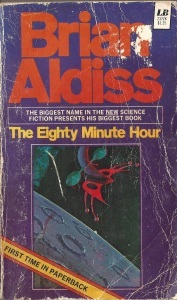
The cover of this edition – 1975, Leisure Books
I feel like I ought to begin by talking about the physical aspects of this edition. First, it is replete with typographical errors – every few pages there's some typesetting error. It is not badly edited, but it is badly set. Leisure Books does not give the impression of being a premium publisher. Nor terribly literate. The back cover tells us 'You may have to wait until 2001 to read a better Aldiss. But don't count on it.' This was presumably to slip a 2001: A space odyssey reference in there, but I'm not sure it says what they meant to say.
At least it doesn't have any cigarette adds in the middle.
Having said all that – and I could add cheap paper, though a generous typeface – the somewhat random nature of the presentation rather fits with the contents, because this is a strange book. Not always in a good way.
Aldiss is in freewheeling mode here. He throws in allusions to many other books (including intelligences vast, cool and unsympathetic), now and again the characters burst into song (that's the opera part). There's a sword and sorcery subplot, time travel, space travel, world war III and resulting scrambling of time periods, sending people back in time unpredictably. And on and on it goes. The book is endlessly inventive, often amusing and aphoristic, and verges on the chaotic, yet I think it all ties together.
Some quotes:
[she was] not only misanthropic, but the cause of misanthropy in others
it was either a glacier or an iceberg with ideas far beyond its station
if you refuse to accept the conditions of life, you become slave to them
mankind's most-used vehicles: prams and coffins
... and so on...
The most crucial quote is a bit of verse:
And this is perhaps the main problem with the book – a sense of sound and fury, signifying nothing. There's a little stuff on determinism, quite a few interesting thoughts thrown off, the old 'time loop without end' time travel plot, espionage, superscience (indeed, whole new sciences), strange words, twists and turns, but somehow it does not add up to more than passing amusement.
I guess it comes back to what we look for in fiction. The central game in much fiction is that we know it is not real, yet we agree to take it seriously. We agree to care about the created characters, or the world, or defeating the terrorists, or something that keeps us reading. Some fiction, generally of more limited appeal, is essentially more directly about fiction and writing (even if it does have characters, or at least figures in it), and we must care about the process of fiction and the skills involved in writing good sentences and constructing interesting metaphors and suchlike if we are to be entertained. Such books are inevitably more for a coterie than is a thriller or a romance. (And I am not sure such books are really better, though they are often perceived as such.)
The very playfulness in this book kept reminding me that it was an amusing construct, cleverly assembled by a skilled craftsman. Like a puzzlebox or a Rubik's cube. So while I could admire Aldiss's ingenuity, his breadth of allusion, his creativity sentence by sentence, his simultaneous knowledge of, manipulation of, and subversion of genre tropes, and so on, I could put the book down at any time to go off and do something else, and I had to choose to finish it – rather than wanting to finish it.
Plenty of books fail to entertain. This one does not fail. But there is a sense that it adds up to less than the sum of its parts.
Opera
Here we have The eighty-minute hour, subtitled 'a space opera', which perhaps it is, though not in the way you might expect.

The cover of this edition – 1975, Leisure Books
I feel like I ought to begin by talking about the physical aspects of this edition. First, it is replete with typographical errors – every few pages there's some typesetting error. It is not badly edited, but it is badly set. Leisure Books does not give the impression of being a premium publisher. Nor terribly literate. The back cover tells us 'You may have to wait until 2001 to read a better Aldiss. But don't count on it.' This was presumably to slip a 2001: A space odyssey reference in there, but I'm not sure it says what they meant to say.
At least it doesn't have any cigarette adds in the middle.
Having said all that – and I could add cheap paper, though a generous typeface – the somewhat random nature of the presentation rather fits with the contents, because this is a strange book. Not always in a good way.
Aldiss is in freewheeling mode here. He throws in allusions to many other books (including intelligences vast, cool and unsympathetic), now and again the characters burst into song (that's the opera part). There's a sword and sorcery subplot, time travel, space travel, world war III and resulting scrambling of time periods, sending people back in time unpredictably. And on and on it goes. The book is endlessly inventive, often amusing and aphoristic, and verges on the chaotic, yet I think it all ties together.
Some quotes:
[she was] not only misanthropic, but the cause of misanthropy in others
it was either a glacier or an iceberg with ideas far beyond its station
if you refuse to accept the conditions of life, you become slave to them
mankind's most-used vehicles: prams and coffins
... and so on...
The most crucial quote is a bit of verse:
...Our fate is that we have our fate
Pre-cast, yet feel that all is still at stake!
And this is perhaps the main problem with the book – a sense of sound and fury, signifying nothing. There's a little stuff on determinism, quite a few interesting thoughts thrown off, the old 'time loop without end' time travel plot, espionage, superscience (indeed, whole new sciences), strange words, twists and turns, but somehow it does not add up to more than passing amusement.
I guess it comes back to what we look for in fiction. The central game in much fiction is that we know it is not real, yet we agree to take it seriously. We agree to care about the created characters, or the world, or defeating the terrorists, or something that keeps us reading. Some fiction, generally of more limited appeal, is essentially more directly about fiction and writing (even if it does have characters, or at least figures in it), and we must care about the process of fiction and the skills involved in writing good sentences and constructing interesting metaphors and suchlike if we are to be entertained. Such books are inevitably more for a coterie than is a thriller or a romance. (And I am not sure such books are really better, though they are often perceived as such.)
The very playfulness in this book kept reminding me that it was an amusing construct, cleverly assembled by a skilled craftsman. Like a puzzlebox or a Rubik's cube. So while I could admire Aldiss's ingenuity, his breadth of allusion, his creativity sentence by sentence, his simultaneous knowledge of, manipulation of, and subversion of genre tropes, and so on, I could put the book down at any time to go off and do something else, and I had to choose to finish it – rather than wanting to finish it.
Plenty of books fail to entertain. This one does not fail. But there is a sense that it adds up to less than the sum of its parts.
Opera

November 28, 2024
The synopsis: well... in the post-nuclear future the world is ruled by a capitalist-communist alliance. They're in conflict with the Dissident Nations who strive for more autonomy. Things get messy when weapons used in WW3 cause time rifts that blend past and future together.
Oh, and there are chapters about three knights overcoming dangerous challenges in search of a mythical castle.
This book was a hot mess, and I guess it was supposed to be. No main protagonist but tons of characters who all seem to have hidden agendas. And they love to sing. During several key moments in the book they take the term space-opera very literally.
Of course, it's a book so you'll have to make up your own melody to the lyrics. Unless you're listening to an audiobook, which I don't think exists. But it should...
So, like I said, a hot mess. Every chapter seems to start another storyline and some storylines are just abandoned (much to the surprise of the characters themselves).
It's obvious Brian Aldiss didn't take this story too serious. It just shows how well it is written because despite the convoluted plot and abundance of characters, it's still very readable and at times hilariously funny.
Probably not everyone's cup of tea, but I liked it.
Oh, and there are chapters about three knights overcoming dangerous challenges in search of a mythical castle.
This book was a hot mess, and I guess it was supposed to be. No main protagonist but tons of characters who all seem to have hidden agendas. And they love to sing. During several key moments in the book they take the term space-opera very literally.
Of course, it's a book so you'll have to make up your own melody to the lyrics. Unless you're listening to an audiobook, which I don't think exists. But it should...
So, like I said, a hot mess. Every chapter seems to start another storyline and some storylines are just abandoned (much to the surprise of the characters themselves).
It's obvious Brian Aldiss didn't take this story too serious. It just shows how well it is written because despite the convoluted plot and abundance of characters, it's still very readable and at times hilariously funny.
Probably not everyone's cup of tea, but I liked it.

October 25, 2025
There's a lot going on in this book. Nuclear war has ruptured space in places, and vast time turbulences appear, in which people get stuck in the past. Aldiss comes up with a bunch of interesting SF concepts: a new world order, computer dominance (AI), time not being linear, human evolution impacted by time warps, and others. He also writes very well, with lots of original applications of language. The cons of the story is that there's a lot of characters, and that their story lines are scattered over various chapters, so it's easy to lose the thread. There's a bit of humor in it that I don't care for much, but it's not very dominant.
Overall, I think this is an underrated book. You do need to pay close attention and make notes to better enjoy it, but if you can commit a little, SF fans should have a good time with this.
Overall, I think this is an underrated book. You do need to pay close attention and make notes to better enjoy it, but if you can commit a little, SF fans should have a good time with this.
November 3, 2017
Fabulous psychedelic 70's SF, but still surprisingly topical. Not one of BA's best, but surely the only space opera in which the characters do actually burst into song to comment on the action. A dazzling interplay of characters and ideas which does not take itself at all seriously, and the hallucinated alternate sword-and-sorcery world is a weird joy to behold.
A memorable collection of villains and some real big-image full-on action -- as well as unusually witty dialogue -- give this an extra couple of stars which the bare bones do not deserve.
A memorable collection of villains and some real big-image full-on action -- as well as unusually witty dialogue -- give this an extra couple of stars which the bare bones do not deserve.
May 22, 2022
Delightful use of vocabulary, with many individual sentences being among the most beautiful I’ve ever seen. However the plot shows clearly that the author belonged to a “psychedelic” movement in American science fiction…. It feels like the frenzied output of dozens of acid trips, dictated to a cocaine-powered scribe. The qualities that result are nothing if not interesting, but hard to describe forthrightly as “good” in any recognizable way. Yet I was unable to put it down.

June 2, 2021
This book was strangely stimulating at times, incredibly confusing, and dizzying. It certainly did not follow the norms as pertains fiction, and I haven't decided whether or not that is a good thing.
Certainly creative, certainly full of surprises-and it does make one thing, which was the primary function of many of the delightful little SciFi books written in their golden years of the 60s-80s.
Certainly creative, certainly full of surprises-and it does make one thing, which was the primary function of many of the delightful little SciFi books written in their golden years of the 60s-80s.

June 22, 2022
Great fun, and at times almost Moorcockian in its surreal weirdness, but ultimately feels hollow: it does not have a conceptual ethical core like Ballard or even aforementioned Moorcock, and does not sing like Zelazny, to use just some of New-Wave parallels. Witty, imaginative and inventive--but quite dated and seems rather pointless.
September 30, 2018
A lot pushed into a small book. Not for your average sci-fi reader requiring them to keep track of the storyline by ignoring aspects of our own history. Always a problem with classics of sci-fi as their "futures" are our past.

December 29, 2023
An overlooked novel in Aldiss's oeuvre, one that I will admit it took me 2 or 3 tries to complete. Absolutely insane. Ideas beyond belief. Intriguing philosophical arguments. All things I love in my science fiction.

January 21, 2018
Nostalgia

Read
October 11, 2020I didn't get very far. I don't enjoy being thrown in the deep end. I find it too confusing. Also, I didn't enjoy how the author uses language, his syntax.
August 27, 2025
I found it full and pretentious. I guess I must be missing something. I stopped halfway through, which is unusual as I typically carry through to the bitter end with books

May 24, 2015
Peguei neste livro com a expectativa de ler uma história clássica de apocalipse atómico dos tempos da guerra fria e saiu-me algo completamente inesperado, um delírio experimentalista high weird que pega no influente ideário de destruição mutuamente assegurada da guerra fria e o mistura com viagens no tempo, linhas narrativas histriónicas e um forte experimentalismo linguístico que mesmo em tradução se faz sentir.
Não é facil definir este livro. Digamos que estamos num futuro pós-conflito atómico, com os dois antigos blocos unidos numa união capitalista-comunista e um conjunto de países não alinhados que se recusa a fazer parte da tecnocracia, controlada por uma rede de super-computadores que se vai tornando cada vez mais dominante sobre as decisões da humanidade. As animosidades em fronteira difusa vão se espalhando ao longo do sistema solar, e para complicar a situação as armas usadas na guerra nuclear causaram progressivas instabilidades no tecido do espaço-tempo, o que causa curiosas anomalias com regiões inteiras do planeta a serem transplantadas para outros tempos, com o presente a escorregar para o passado e o passado a materializar-se no presente futuro. Ainda temos o proverbial líder mundial de ética duvidosa que se oculta num universo paralelo contido num medalhão, espalo cobiçado pelas inteligências artificiais para se protegerem das instabilidades espácio-temporais, e uma guerra surda entre nações não alinhadas e bloco principal que ameaça resvalar para uma guerra. Esta tarda porque uma das naves de espionagem dos não-alinhados cai numa anomalia temporal para um passado tão profundo que acabará por colonizar um planeta que se situou há milénios atrás entre as órbitas da Terra e de Marte, desintegrando-se sem deixar rasto, excepto por ruínas milenares sob a superfície marciana e a modificação genética aos primeiros mamíferos antepassados dos antepassados dos antepassados do homem que introduz o hipocampo nas espécies, forma bio-engenhada de um dispositivo de controle de mentes que está a ser prototipado neste estranho futuro. Marte, claro, é uma espécie de campo de concentração para inadapatados e, simpático, Aldiss pulveriza as ilhas britânicas, transformando os ingleses numa nação sem território.
Um livro estranho, que salta as fronteiras de género da FC com um forte experimentalismo linguístico e conceptual, que se atreve a rir-se de si próprio com um profundo sentido de humor escatológico.
Não é facil definir este livro. Digamos que estamos num futuro pós-conflito atómico, com os dois antigos blocos unidos numa união capitalista-comunista e um conjunto de países não alinhados que se recusa a fazer parte da tecnocracia, controlada por uma rede de super-computadores que se vai tornando cada vez mais dominante sobre as decisões da humanidade. As animosidades em fronteira difusa vão se espalhando ao longo do sistema solar, e para complicar a situação as armas usadas na guerra nuclear causaram progressivas instabilidades no tecido do espaço-tempo, o que causa curiosas anomalias com regiões inteiras do planeta a serem transplantadas para outros tempos, com o presente a escorregar para o passado e o passado a materializar-se no presente futuro. Ainda temos o proverbial líder mundial de ética duvidosa que se oculta num universo paralelo contido num medalhão, espalo cobiçado pelas inteligências artificiais para se protegerem das instabilidades espácio-temporais, e uma guerra surda entre nações não alinhadas e bloco principal que ameaça resvalar para uma guerra. Esta tarda porque uma das naves de espionagem dos não-alinhados cai numa anomalia temporal para um passado tão profundo que acabará por colonizar um planeta que se situou há milénios atrás entre as órbitas da Terra e de Marte, desintegrando-se sem deixar rasto, excepto por ruínas milenares sob a superfície marciana e a modificação genética aos primeiros mamíferos antepassados dos antepassados dos antepassados do homem que introduz o hipocampo nas espécies, forma bio-engenhada de um dispositivo de controle de mentes que está a ser prototipado neste estranho futuro. Marte, claro, é uma espécie de campo de concentração para inadapatados e, simpático, Aldiss pulveriza as ilhas britânicas, transformando os ingleses numa nação sem território.
Um livro estranho, que salta as fronteiras de género da FC com um forte experimentalismo linguístico e conceptual, que se atreve a rir-se de si próprio com um profundo sentido de humor escatológico.
November 4, 2011
Brian Aldiss' highly inventive space opera is a mind-expanding range of songs and science that takes us, twisting and turning, through a cornucopia of intergalactic merriment and melodrama. Eccentric characters burst into full-throated song with each meandering plot.
I found this book to be really poor and was a "Did not complete". Overwhelming in the attempt to make the world so different it seemed to be an exercise in "how to alienate your reader"
Aldiss did not present the reader with anything they can grasp hold to in order to follow the narrative - in fact I'm still not entirely sure what the narrative was supposed to be. Few words seemed to be proper non-made-up word in English.
Not worth my time in continuing, so I abandoned quite early on
November 1, 2015
Aldiss work from the early 70s, an overblown would-be romp about life in a post-apocalyptic world where power elites are coming together but time is breaking apart. It seems Brian had been reading work by Burroughs, Ballard and Alan Burns from the same period and tried his hand a bit, but couldn't really do it. The characters are too cartoonish and interchangeable, such that I found them blankly unmemorable and thus couldn't care really for the convoluted plot (there is one, that tortuously sets up a time-travel paradox). However like the other Aldiss book I've read ("Earthworks") it does have some engaging moments when he relaxes a little and just gives us some straight 60s-style sci-fi that isn't tainted by aspirations to literary cleverness.

March 15, 2012
I have to admit I was completely lost while reading this book. It was actually a few years ago but I still shudder when I recall the experience. Maybe I was trying too hard to make sense of it, when I should have chosen some other method. I did get the feeling the author was "traveling" while he wrote it...
I couldn't help wondering if maybe this is a good book but I just didn't manage to get there, so I searched for some reviews. I'll leave you with one that sums it up quite nicely.
I couldn't help wondering if maybe this is a good book but I just didn't manage to get there, so I searched for some reviews. I'll leave you with one that sums it up quite nicely.

June 3, 2014
More like something by William Burroughs than by Brian Aldiss. I loved how bizarre, confusing and manic this story was and some of the ideas are very impressive but I doubt many people will rate this book particularly highly.
Read
August 23, 2008isbn,original

November 11, 2009
In this book, Brian Aldiss shows one how to have a titanic amount of fun hoisting space opera conventions up a flagpole and setting fire to them. This book is hilarious, ridiculous, and a blast.

January 11, 2010
rather crazy & learnt a few new words...

October 21, 2015
Another political thriller set in the future. Good stuff.

June 30, 2016
Slice of 70s experimental Sci-fi, filled will all the joy de vivre and hope of that era.
God fun, little outdated now.
God fun, little outdated now.
April 12, 2014
Nuttiest novel I've ever read

April 10, 2017
So that happened. Maybe it's because I read it sporadically and left multiple days betweens sessions, but I doubt it. It's just an odd book thats hard to follow. Characters did not seem consistent in their reactions and the plot didn't seem to actually matter at all to the prose. The plot was interesting, but it was background to the dialogue (which rarely delineated who was speaking at any given time).
Also, people randomly breaking out into song in a novel only works for Tolkien.
Also, people randomly breaking out into song in a novel only works for Tolkien.
Displaying 1 - 30 of 30 reviews