A novel about death and grieving, about Afro-Caribbean culture and Voodoo and about the four waves of Nanotechnology development. The world of CRESCENT CITY RHAPSODY is a world that is being changed by the day by advances in nanotechnology; it is a world where radio has died, of vastly increased lifespans and where extra terrestrials will play a pivotal role in everyone’s life.
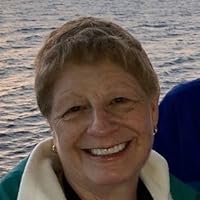
Author Kathleen Ann Goonan, 68, died January 28, 2021. She was born May 14, 1952 in Cincinnati OH and at age eight moved to Hawaii for two years while her father worked for the Navy, after which the family moved to Washington DC. She got a degree in English from Virginia Tech in 1975, and earned her Association Montessori International Certification in 1976. She taught school for 13 years, ten of those at Montessori schools, including eight years at a school she founded in Knoxville TN. She spent a year back in Hawaii and took up writing full time before returning to the DC area in 1988, the same year she attended Clarion West. She began teaching at Georgia Tech in 2010, where she was a Professor of the Practice.
Goonan’s first story ‘‘Wanting to Talk to You’’ appeared in Asimov’s in 1991. Notable stories include ‘‘Kamehameha’s Bones’’ (1993), Nebula Award nominee ‘‘The String’’ (1995), British SF Award finalist ‘‘Sunflowers’’ (1995), and Sturgeon Memorial Award finalist ‘‘Memory Dog’’ (2008).
Debut novel Queen City Jazz (1994), a New York Times Notable Book, was shortlisted for a British Science Fiction Association Award, and launched her Nanotech Quartet: sequel Mississippi Blues (1997), Nebula Award-nominated prequel Crescent City Rhapsody (2000), and final volume Light Music (2002), also a Nebula Award finalist. Standalone The Bones of Time (1996) was a Clarke Award finalist. Alternate history In War Times (2007) won the Campbell Memorial Award and was the American Library Association’s Best SF Novel of 2007, and was followed by sequel This Shared Dream (2011), a Campbell Memorial Award finalist. Angels and You Dogs, a short story collection, was published by PS Publishing in 2012.
Goonan and her work were featured in venues such as Scientific American (‘‘Shamans of the Small’’) and Popular Science (‘‘Science Fiction’s Best Minds Envision the Future’’). As a member of SIGMA, she gave talks for the Joint Services Small Arms Project and the Global Competitiveness Forum in Ryhad. She published more than 40 short stories, including ‘‘A Love Supreme’’ (Discover Magazine 10/12), ‘‘Bootstrap’’ (Twelve Tomorrows 9/13), ‘‘Sport’’ (ARC 2/14), ‘‘What Are We? Where Do We Come From? Where Are We Going?’’ (Tor.com), ‘‘Girl In Wave; Wave In Girl’’ (Hieroglyph), ‘‘Wilder Still, the Stars’’ (Reach for Infinity), and ‘‘Tomorrowland’’ (Tor.com).
Goonan lived in Tennessee and Florida with husband Joseph Mansy, married 1977.
I didn't realize I was jumping into the middle of a series, but you don't actually need to have read #1-2 to enjoy this one. In this book, a pulse comes from outer space and interferes with radio communication, causing worldwide havoc and forcing the governments of the world to find alternative means of communication. Additionally, children who were conceived at the time of the first pulse grow up to have altered brains that give them special abilities but also leave them writhing in pain when radio and other broadcast signals do manage to be sent out. Goonan not only gives us a wonderful "idea" story but does a great job of creating complex characters who aren't all good or all bad, and definitely aren't stereotypes. I loved this so much that I am planning to read the next in the series very soon. Highly, highly recommended to fans of spec fic.
8.5/10 Although it is book 3 in Goonan’s Nanotech Cycle, the events take place before books 1 and 2, which was a surprise to me. This fills in a lot of holes and lays a good foundation for the events of the first 2 books. Although there was a large cast of characters and settings all over the world, it was, in many ways, a more focused story, more tightly plotted, more maturely written.
I wanted to like this more than I did. There are some very interesting characters and story lines (Zeb and his brilliance-tinged-with-mental-illness; the strange and amazing abilities of the children in utero during the initial Pulse), and these are what kept me from shelving this mid-book. But, ultimately, there were too many different threads and too much time spent on the ones that didn't interest me. The author tries to tie them all together by the book's end, but it wasn't enough for me to overlook all the time and effort spent on the plot lines that were less engaging for me (the nanotech angle, the biocities). I was much more drawn to what happens in the opening chapter: a pulse of some sort washes over the earth and silences everything electrical, and Zeb, a radio astronomer, has a dipole antenna set up that records incoming information during the silence. Had the book opened with one of the other story lines, I probably would have put it down.
very interesting tale of possible future ... lots of interweaving characters. this was one of the few books i've ever encountered where i wasn't sure if i was enjoying it, but yet i was enthralled enough to keep reading.
I have not read any other volumes in this series, so I do not know how well it fits. This is a book about revolution, or at least upheaval. It is relevant to our time even though the incipient technological change is not mechanical but informational. The idea here is that humans could, if they are unscrupulous or inattentive, bring about a fundamental shift in reality by releasing nanotech into the wild. Nanotech is still speculative, still decades in the future, but Goonan depicts such a change convincingly. There will be winners and losers. Solid, satisfying and salient science fiction. My highest recommendation. (It is a little too long.)
Yet another surprising evolution in the storytelling in this series, yet another masterpiece of hard scifi. This third book in the series takes us back before the events of the first two, taking us through the history up to the founding of Crescent City - explaining everything that led up to the events in Mississippi Queen, and laying the foundation for the fourth book to tell us what happened after the third book. I’m so glad I’m reading all four in a row instead of over 20 years! (I read #1, QCJ, when it first came out - but didn’t realize there were any sequels til this year!)
This entire review has been hidden because of spoilers.
I hoped that I would like Crescent City Rhapsody more than I did Mississippi Blues, and thankfully it turned out that I did. The third installment in Goonan's Nanotech Cycle was a much more solid story than its predecessor, thanks to tighter characterization and a lot less delving into paragraphs of Telling Rather Than Showing Technonanobabble.
There were fewer instances of her lyricism this time around, but at least for me the portrayal of several characters I liked helped make up for that. I've seen people posting on Amazon.com that they had a hard time following the storylines of so many characters, and one person even complained that there were not one, not two, but three love stories in the plot. The multitude of characters didn't bother me in the slightest; for one thing, it had a sort of Close Encounters of the Third Kind feel to it, bringing together several disparate characters and showing us how this huge thing changing the world affected them all, and I didn't think that was a bad thing in the slightest. Moreover, it fit in with the whole "rhapsody" point of the title--taking all these disparate lives and weaving them together into one big story. I liked that a lot, even though it took a while to bring all the viewpoint characters together.
Also--I definitely disagree with the person who was complaining about the love stories. Sure, there are multiple instances of characters becoming lovers, and actually there are more than three: Zeb and Ra, Jason and Abbie, Kita and Hugo, and Illian and Artaud. That reviewer seemed ready to dismiss this story as a romance just because of the number of pairings in it, but I don't think that does it any justice. This smacks of the attitude that an SF story can't be "serious" if it has a love story in it, and I think that's bullshit, as I have ranted before. None of these pairings dominate the story at any time; they are merely single themes in the overall greater piece telling the reader about these people's lives. And let's face it, folks, falling in love is a regular part of people's lives. With the time frame this story covers, and the number of people it introduces to the reader, it's inevitable that we're going to see some of them in relationships--especially in the context of how the changes sweeping the world affect those relationships. And we do get a lot of that.
One point I saw raised on the Amazon.com reviews holds true, though, and that is that because of the number of viewpoint characters, some of the depth of characterization does suffer. We get several things hinted at but not touched on with any detail at all--we don't have time because Goonan's switching back and forth between her viewpoint characters more often. Some of them are interesting side details about relationships between the characters; some of them are larger details about the disintegration of the political climate all over the world, things that would have been nice to see spelled out a little more. And one major plot detail from Mississippi Blues, the creation of the New Orleans Plague and who was responsible for it, was only very briefly mentioned at all in this story--which seemed odd to me given that the whole point of Crescent City Rhapsody was supposed to be Marie Leveau's using New Orleans as a jumping off point to get Crescent City created. It would have been nice to see the creation of the plague touched on a little more to tie the previous books better into this one.
And I was vaguely disappointed to see not one mention of what happened to Cincinnati at all--or even a mention of Abe Durancy.
All in all... some rough spots, but not nearly as many as in Mississippi Blues, and a lot more tightly put together.
This book is an attempt to translate jazz music into a science fiction novel. I think it is quite successful at that and I fully appreciate the artistry that it required. The only problem is that I don't really like jazz.
The story follows many separate characters over the course of twenty or so years from around 2010 to 2030. Each chapter follows a different set of characters and is set a year or two after the preceeding chapter. There's no real plot to speak of, very few of the characters overlap in any significant way, and the term "Crescent City" isn't even mentioned by any character at all until page 290. The theme is the exploration of the many different ways nanotechnology might be incorporated into daily lives across the world and how different societies will evolve based on those applications. Some societies weaponize the technology. Some use it to try to build utopias. Some use it to control the masses and establish dictatorial governments. The subtle progression of the technology over time is interesting to watch and some of the technological innovations that Goonan writes about (she has an invention almost identical to Microsoft Surface) were almost prescient considering she published this in 2002 and obviously wrote it even earlier than that, but I had a lot of trouble changing focus from chapter to chapter without any indication as to where the story was eventually going to lead me.
This being novelized jazz, obviously all of the disparate pieces have to come together to form a whole by the end, and they do that in a very satisfying manner. The attention to detail displayed to get all of the characters into place over the span of a few decades is admirable, and much like jazz the separate parts all collide to make A Conclusion moreso than The Ending, but I just didn't care enough about any of the characters or the loosely formed story to want to read any more in this universe.
Kathleen Ann Goonan, the author, majored in English Literature and Philosophy at Virginia Polytechnic Institute. Her writing is eloquent, thoughtful, and often profound. Her love of jazz and music in general gives it yet another dimension. Her main interest in this book is in biotechnical advances, which have the potential to make and unmake our world in ways that strain credibility. Yet I believe she's done her homework, and that a large percentage of what she writes about here can indeed happen.
My favorite passage from the book takes place in New Orleans. Kita: "...we still have a challenge." Marie (the most powerful person in New Orleans): "What's that?" Kita: "This new metapheromone mix is activated in human brains by the repetition of a certain strong rhythm." Marie: "We can do rhythm."
This is an outstanding novel. Thanks to Adam Booker for recommending it to my wife, who recommended it to me.
The book was interesting, but failed to make me care about the characters or the plot. I think that the slow pacing and flipping back and forth between radically different storylines (both with non-sympathetic protagonists) did me in. I just couldn't finish it, even though I liked the world that she created.
Interesting,but could have been better.Too many characters,unnecessary romances and sex scenes,incomprehensible techno babble,sudden time skips,and too much elaboration.Could have been told just as well with half the page count if all these were trimmed.