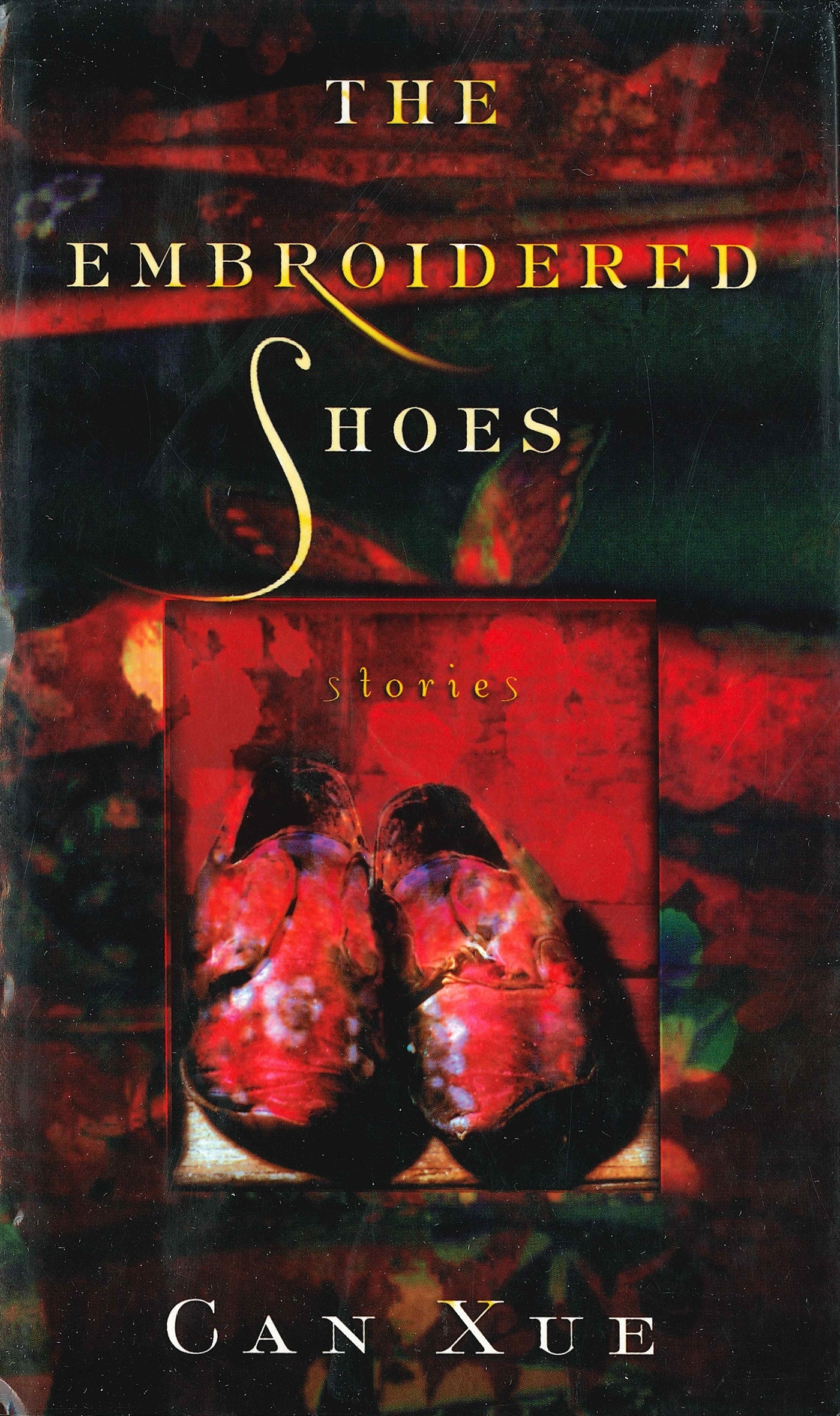
Can Xue (pronounced "tsan shway") is considered by many to be the most spirited, fearless, radical fiction writer to come out of contemporary China. Even her name is marked by tenacity (it's a pen name referring to dirty, leftover snow that refuses to melt). Her most important work to date, The Embroidered Shoes is a collection of lyrical, irreverent, sassy, wise, maddening, celebratory tales in which she explores the themes central to our contemporary mortality, memory, imagination, and alienation.
At times constructed like a set of graduated Chinese boxes, these New Gothic ghost stories build into philosophical and psychological conundrums that we ponder long after reading the final page. A doctor-detective-warrior who sleeps like a hippo in a cistern! A homicidal maniac housewife whose husband winds up in the hospital with a stomach full of very fine needles! These and many more strange, yet strangely recognizable, characters populate Can Xue's dream-ridden, transcendental territories.
Written between 1986 and 1994, ten years after the death of Chairman Mao and during and following the 1989 Tiananmen massacre, The Embroidered Shoes is a life-affirming testament to the creative spirit.
Can Xue (Chinese: 残雪; pinyin: Cán Xuĕ), née Deng Xiaohua (Chinese: 邓小华), is a Chinese avant-garde fiction writer, literary critic, and tailor. She was born May 30, 1953 in Changsha, Hunan, China. Her family was severely persecuted following her father being labeled an ultra-rightist in the Anti-rightist Movement of 1957. Her writing, which consists mostly of short fiction, breaks with the realism of earlier modern Chinese writers. She has also written novels, novellas, and literary criticisms of the work of Dante, Jorge Luis Borges, and Franz Kafka. Some of her fiction has been translated and published in English.
3.5; whether due to a lack of cultural awareness or inadequate translation, the first few stories here weren't quite clicking with me, but I found my enjoyment growing throughout the collection's second half, peaking with the concluding novella that felt like an underground comic captured in prose, a wonderfully oneiric and nonsensical work (but deadly serious like all true nonsense) with a tone reminiscent of the writings of Gisele Prassinos, Leonora Carrington and Benjamin Peret, or of ultra-absurdists like Urmuz and Kharms; I now look forward to exploring Can Xue's oeuvre further in the future.
Let's be frank. It's no surprise that Can Xue is unread. Nearly unread. We are a very tight=lace literal conventional uptight literary culture. We actually have the nerve to be disappointed when Franzen suddenly (!) disappoints and appears to not be our literary leading light. (! seriously folks we're at a point when folks get uptight that Franzen--friggin Franzen!--disappoints. If you're in a position to care whether Franzen is up to the task or not of being our literary leading light you are the epitome of a conservative literary establishmentarian hack. There is no Franzen question.
There is Can Xue. And I dare you to read her. I just dare you.
Recently Annelise Finegan Wasmoen won the BTBA for her trans of The Last Lover (they same award that later embarrassed itself with the BD/ZT debacle but you see they are capable of recognizing someone like Can Xue). Utterly other discourse and of course not read. You see, The Last Lover has a gr=Score of 72 :: 20 and that's with being available for our delectation for over 3 years. [I include myself in here in regard to fault and it is a fault make no mistake its always a fault to leave unread the books which ought to be read].
The Embroidered Shoes was pub'd way back in 1997. Its gr=Score is 37 :: 6.
Since I really don't know what to make of these associational stories*, let's listen to our blurbs [careful with that blurb Eugene] ::
Robert Coover (!) says :: Can Xue is the most original voice to arise in Chinese literature since the mid-century upheavals. Although nothing is predictable here, each line as if plucked anew from space, there is nonetheless a profound organicity about this book, and oddly, in spite of all its delightfully eccentric and surreal elements, it delivers a vivid sense of place--in this case, the Chinese town or village--though less in the manner of a Faulkner, Joyce or Shabai, than that of Rulfo, Kafka, Gogol. In short, there's a new world master among us and her name is Can Xue. ["each line as if plucked anew from space" -- exactly very much so. If you insist on stringing one sentence after another in a preconceived manner such that there is no freeplay among them, then don't read these fictions.]
And Bradford Morrow says :: Can Xue possesses one of the most glorious, vivid, lyrical, elaborate, poignant, hellacious imaginations on the planet. She is the finest revolutionary Gothicist writing today and, as well, the true daughter of Kafka and Borges. All the promise of her first collection, Dialogues in Paradise is richly realized in The Embroidered Shoes. No reader emerges from her powerful fictional dreams unscathed, for here is a book as dangerous as it is beautiful. [yes its true, here is an instance of what imagination really looks like.]
andAnd Joanna Scott says :: Can Xue is a visionary artist, an acrobat of paradox. The tales that make up The Embroidered Shoes are serene and jolting, elegant, mysterious, hilarious and powerfully transforming. [yes its true Can Xue cannot be described with single adjectives ; only the list approaches an honest evaluation]
* They are dreams. They are childs play. You are too sophisticated perhaps. Become as a child Jesus said. You must unlearn.
This seemed like an intriguing book, so I was excited to read it, but it was not for me. The first story was excellent, the second was solid, but each story thereafter became more and more nonsensical and, to me, almost unreadable, culminating in a long 100-page story filled with gibberish.
Start from this review, I will use my own rating system. I use 1-10 rating scale for each categories like here below. And for non-fiction books, I still think about the system.
Characterization : 7.5 World building: 7.5 Readability : 9.5 Theme Uniqueness : 10 Story plot : 8 Execution : 8.5
You can read Lu Xun, the forefather of Chinese contemporary literature, without reading Gogol or Ibsen, and you will do just fine with Mo Yan - some say, the most prominent Chinese author of nowadays, if you happened to miss One Hundread Years of Solitude. When it comes to Can Xue, sold in China as a "hot name for the Nobel Prize" (well, next year maybe), I must admit I feel very unsecure about making any statements without understanding of the authors which inspire her works: Kafka, Joyce, Borges.
Some stories, Floating Lotus, for instance, took me two attempts just two realize that I was not getting any closer to grasp the sense of what I'd just read.
The initial story of this collection, The Embroidered Shoes and the Vexation of Old Lady Yuan Si (what a title, by the way), despite the author's firm claim to be apolitical in her writing, seems to carry some political subtext; a story of an individual thrown on a pile that somebody else uses to climb up. The translation of this story follows the source language patterns too strictly, which results in stiff, literal, hand-wringing phrases such as "raised an issue of borrowing my pair of shoes" or "And the main factor, was, of course, my embroidered shoes.". That is definitely not an idiolect that fits Chinese old lady...
Even when I sorely failed to comprehend the story (especially the last one, Apple Tree in the Corridor - I wish I could give 4 stars, but this one is the bulk of the book, and I find it way too non-sensical, it just does not click to me), I can appreciate Can Xue's vivid imagination and sweet, sticky sentences ('Small potatoes have small potatoes' ideals; they don't feel the least bit less than others' is my favorite one). And I strongly believe there is some logic behind all that - it is very unfair to say that Can Xue is unread(able). Extremely complex inner life, fixation, inner transformation - there are many threads that you may follow in these absurd, impossible stories, if you're only willing to.
The Embroidered Shoues is a tough read, but I do not feel discouraged at all to go through other Can Xue's works.
I do think the later collections are better; this collection is more radical and sometimes more provocative for that reason, but there seems to be a lot of distance between text and reader. This might be a function of the translation, which Can Xue has said in interviews that she dislikes (she has since switched translators). Still, plenty to appreciate here: "Two Unidentifiable Persons," "The Boy Who Raised Poisonous Snakes," the riddle and spatial gamesmanship of "Homecoming," and especially "A Strange Kind of Brain Damage." "The Apple Tree in the Corridor" could serve as a thesis statement for Can Xue's larger project. The morpheus quality, the poisonous family dynamic, the extreme subjectivity, the spiral of social distrust: everything here is at the heart of her work.
There is a vein of deep soul magic running throughout these deadpan, corrosive, febrile stories. I have no doubt that Can Xue is a genius, but, for me, reading her is just as likely to induce nausea and headache as awakening and laughter. She is an author to which I will surely return, maybe after I have read some more Kafka.
I suspect there are layers of meaning that I am not understanding in these stories that would increase my enjoyment, but the majority of them were opaque to me in their seeming randomness. "The Child Who Raised Poisonous Snakes" and "A Dreamland Never Described" were the ones I found most worth the price of admission.
I stumbled upon Can Xue while looking for modern and exciting chinese writers. Perennially tipped for the nobel (that there should have put me off her), even by Susan Sontag, and lauded as a great intrepid avant-garde artist with a deep love for Becket, Borges, Dante and Kafka, I downloaded most of her work in translation a few months ago, but hadn't tackled any before this past monday. I decided on this collection because I haven't read short stories in a while and thought that it would be a good starting point. I was wrong. Maybe these early works (written between the '80s and the '90s) are "juvenilia" and don't reflect on Can Xue's prowess as a writer. But I am inclined to think that they are a good account of what she can and wants to do. Before reading this book, I read an interview with her in which she exposes herself as a narcissisctic egocentric idiot who thinks she's ahead of her time (verbatim). These stories are only readable due to their short length. It's Beckett without humor, Becket without love. She is a tremendously cold writer. She has good ideas and then she distances herself completely from them, from her characters, she looks from afar and only adds and adds layers of complexity that only serve to muddle the few golden threads. There are highlights naturally, Homecoming, for instance could be a really great story, but it is muddled up by an overextended ambition.
This book has another problem, it is not only made up of short stories. The back half is a novella which remedies, at first, some of the criticisms I have made. Mainly, it has humor. But then the absurd complexity starts to pile up, and nothing makes sense anymore. Random things happen continually, while structure and form do not go through a radical alteration that can keep up with the constant punches, the comings and goings, the metamorphoses of plot that serve no purpose, etc.
This is self-serving "avant-garde" bullshit, which dishonors out-of-the-box writers.
"She never arrived when he expected. To put this another way, she always appeared in her apartment just at the moment he thought she would."
I'm a sucker for corny, bizarre, and hyperbolic blurbs, and the back matter for Can Xue's "The Embroidered Shoes" has what seems to be a whole collection: "here is a book as dangerous as it is beautiful" writes Bradford Marrow; proclaims Robert Coover: "there's a new world master among us, and her name is Can Xue."
But these, I learned, are not hyperbolic in the slightest. She's completely expanding what the short story is capable of. A master indeed. When I teach my fiction unit to middle schoolers on up, I always open with a discussion of the 6 elements of story and the questions they answer: 1. Characters: Who is this story about? 2. Setting: Where are they? 3. Plot: What are they doing? 4. POV: Who is telling this story? 5. Mood/Tone: How are they telling it? 6. Theme: Why are they telling it? Hunting for these elements in a Can Xue story is like trying to walk across a trampoline at night while drunk on baijiu; eventually you give up and just started bouncing up and down, because that's what trampolines are for anyway. I'm not sure if my metaphor is working, but what I'm saying is that Can Xue seems to be saying that just like the aforementioned trampoline-walker forgot what the thing is supposed to be used for in the first place, somewhere along the line we forgot what stories are for, not for marking off a check list of different "elements" and forms and genres, not for reading, but for getting lost.
I'd encourage anyone who likes something different, surreal, in their fiction to give this author a try.
Det är som att dyka ner i en psykadelisk dröm, varje rad är en citeringsbar knasighet, i princip. Kanske passade novellformatet rätt bra på grund av det, i Love in the new millennium var det svårt att hålla reda på alla trådar. Här är dom uppdelade mer, med sista novellen som undantag - längre och med trefyra perspektiv, som dock hjälpte till att belysa historien, om man nu kan tala om en historia i det här fallet. Jag släpper på kravet att förstå när jag läser, och låter mig bara flyta med i galenskaperna, det är mer njutbart,o och framför allt läsbart så. Jag vet inte om berättelserna betyder något, eller om de måste det. Det surrealistiska har sin egen funktion, att liksom stiga ner i det undermedvetna/drömmar som följer sin egen eller ingen logik alls. Uppfriskande! Några noveller lättare att finna ett narrativ i än andra.
The closest thing I could compare this to would be Angela Carter, except this language is harsher, more abrupt, and the narrative is more disjointed. There is a constant flow of events but it’s often very difficult to understand how they are connected with one another. Causal links are missing. At first, I did not like reading this . . . but after awhile, I started to enjoy myself. I think it’s a matter of adjusting expectations—giving up any hope of retaining what has come before, let alone of understanding how it relates to what is happening in the present. Riding the words and images becomes (at times) a magical experience, and there is some spiritual depth here—I think Buddhist? The thing about a book like this is that it leaves readers free to experience whatever they are ready to experience. It’s so open and rich that I feel like I could read it again next week and find a completely different book.
The short stories are pretty hit or miss; it seems an awkward sort of style to get right. But the novella at the end is nothing short of exhilarating. Different from the two in Old Floating Cloud... This was less fiction than brilliant manifesto. I read and my awareness opened up to process what I was reading. I understand, a little bit, now, how to express what I previously thought inexpressable.