Jump to ratings and reviews
Rate this book

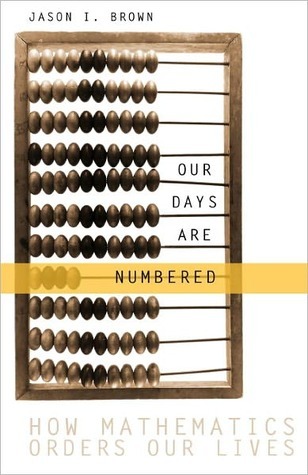
Our Days Are Numbered: How Mathematics Orders Our Lives

Rate this book
A revealing and entertaining look at the world, as viewed through mathematical eyeglasses.From the moment our feet touch the floor in the morning until our head hits the pillow, numbers are everywhere. And yet most of us go through each day unaware of the mathematics that shapes our lives.In fact, many people go through life fearing and avoiding mathematics, making choices that keep it at arm’s length or further. Even basic math — like arithmetic — can seem baffling.In Our Days Are Numbered, Jason Brown leads the reader through a typical day, on a fascinating journey. He shows us the world through a mathematician's eyes and reveals the huge role that mathematics plays in our lives. It lies hidden within the electronics we use, the banking we do, and even the leisure activities we enjoy. Whether we’re putting a down payment on a new car, reading the financial pages, or listening to our favourite songs, math is behind it all.At once entertaining and informative, Our Days Are Numbered covers an array of mathematic concepts and explores the hidden links between mathematics and everyday life. Brown reveals that a basic understanding of math can make us more creative in the way we approach the world.From the Hardcover edition.

304 pages, Kindle Edition

First published January 1, 2009

2 people are currently reading
32 people want to read

About the author

Jason Brown

206 books32 followers

Ratings & Reviews

What do you think?
Rate this book

Friends & Following

Create a free account to discover what your friends think of this book!

Community Reviews

5 stars
2 (4%)
4 stars
16 (35%)
3 stars
14 (31%)
2 stars
11 (24%)
1 star
2 (4%)
Displaying 1 - 9 of 9 reviews
Profile Image for Kara Babcock.
2,109 reviews1,593 followers
March 13, 2013
I read math books for fun. I realize that, right away, this puts me in an unusual portion of the population. It’s not just my fancy math degree that makes these books attractive. However, I do think that there are some math books written for people interested in math (whether professionally or amateurly), and then there are math books written for people who, usually thanks to a bad experience in school, have sworn off math like they said they would swear off cheap booze. Our Days Are Numbered is one of the latter. In a passionate and personal exploration of shape, algebra, geometry, and number, Jason I. Brown illuminates the fundamental mathematics behind some everyday tasks. While some people will still run away screaming, others will hopefully begin to see math in a new way.

Among the topics Brown explores are: converting between units, using graphs to display data, the meaning behind averages, the role of chance in decision-making, networks and coincidences, prime numbers in cryptography, fractals in art, and the math behind the mystery of the Beatles’ Chord. Each chapter is bookended by a short, two- or three-paragraph anecdote related to its given topic. For the main body of the chapter, Brown gradually develops some of the math behind common tasks. For example, he shows how an understanding of ratio and conversion factors makes converting between units a breeze without any memorization (aside from the factor itself, of course). Later, he explains why the Web and social networking has guaranteed that graph theory will remain a practical and important field of math for a long time.

This is not really my kind of math book, and that isn’t even because of the audience or the way Brown presents the math. Rather, I read math books for the story. I’m interested in math books that take a specific topic and explore its history, its present state, and the different ways to interpret it using mathematics. Our Days Are Numbered instead covers a variety of topics. There isn’t anything wrong with this approach. However, each of these topics can be (and has been) the subject of entire, weighty tombs. It’s difficult for Brown to do them justice. Sometimes, such as with the chapter on conversion factors, he does a very thorough job. Other times, such as with his explanation of prime numbers and Internet security, he leaves something to be desired.

Also, much of one’s enjoyment will hinge on how one much one likes or dislikes Brown’s writing style. As the chapter titles and subheadings demonstrate, he is a man of corny humour, easy puns, and deprecating remarks towards himself and fellow mathematicians. I can get behind the first and third attribute, and I can ignore the second. Although I think a book any longer might have begun pushing its luck, as it is, I enjoyed Brown’s conversational and easygoing style. Others will find it overbearing and intrusive, however, and there is no escape from it here.

So, Our Days Are Numbered isn’t my mathematical cup of tea, but could it be anyone’s? Well, one way in which this book excels is Brown’s unrelenting insistence that math is useful, relevant, and not at all scary. As a math enthusiast and math teacher, the opposites of these sentiments besiege me constantly. I love how Brown comments on the somewhat unique reception math receives at parties:

When I tell people what I do for a living, the most common response is a look of dismay, followed by “I always hated mathematics!” This statement is made with relish and without a hint of embarrassment. I don’t think there is another profession out there that gets the same response. Do people state they’ve always hated English? Music? Lawn care? I think not.


Tongue-in-cheek, Brown touches on a very crucial and deplorable fact: hating math is socially acceptable. It’s cool to disparage math and one’s ability to do math. To some extent, the aura of nerdery surrounds all of the STEM fields, but scientists and engineers get a little more recognition—people’s eyes might glaze over if one announces oneself as a theoretical physicist, but there is a little gleam of gruding respect. Mathematicians, however … what do they even do?

The social acceptability of disparaging mathematics troubles me. Math is the foundation of the other three STEM fields. Science, technlogy, and engineering are all fields that require creative, passionate thinkers. Yet from an early age we send children signals that math is a dull, uncreative subject and it’s OK to hate it for being boring and irrelevant. This is nothing short of educational sabotage. It’s certainly fine for people not to like math, and I understand how parts of the educational system foster that feeling. But we should do everything we can to avoid reinforcing that notion, especially among our children.

Hence the power of this book. Brown takes it as a given that math is a useful, powerful tool in the everyday world. He isn’t out to convert everyone to a science or engineering job. He isn’t trying to shoehorn calculus into a discussion of changing a car tire. (As a teacher, the incessant call to include real-world applications and contexts in my lessons wearies me at times.) He is careful not to insist that everyone uses or needs all of this math all the time—you don’t need to know how to use prime numbers in order to keep your online banking secure. But isn’t it nice to know why it is secure?

Brown’s non-evangelical stance is refreshing, though it can also be a little frustrating. Our Days Are Numbered lacks a true, cohesive message, aside from the idea in the title. With no introduction and no conclusion, Brown relies on the title and the chapters to come together to create that singular idea. While not essential, some kind of introduction or meta-narrative would lend additional structure to this otherwise scattered text.

With brilliant mathematics, hardcore mystery-solving, and no small amount of humour, Our Days Are Numbered is a well-written and very successful math book. It isn’t anywhere close to my Platonic ideal of what a math book should be—but that’s me being picky. Nor do I think, in the long run, that people convinced math is uninteresting or “not for me” will find their convictions toppled by anything in here. But for anyone who is open to learning about the role of math in everyday life, there is definitely something here, waiting to be read.

Creative Commons BY-NC License
Profile Image for Pascale.
406 reviews
March 7, 2024
I read this one when it first came out and loved it.

Maybe I should read it again soon?
Profile Image for Y.
238 reviews10 followers
September 2, 2013
I thought the book was interesting and fun. This book is geared toward people who might not like math, it reminded me of my math teachers who were excited about math just like this author. I agree with the author when he states it is a shame that not all of us are taught by enthusiastic math teachers who love the topic.
What I found most interesting was how math is used in marketing, they know what you might want to buy at what price point and send you individualized coupons, show you different pricing on amazon I bet!
76 reviews9 followers
November 22, 2011
Truthfully, I am a mathematically challenged and read this book because I thought it would be broadening to read something completely different to what I usually choose. I found some explanations too lengthy, and some I simply found uninteresting and skimmed through. But there was some interesting stuff in here, especially the discussions of music. I'm glad I read it, even though I didn't understand much of it.
120 reviews
November 13, 2012
I found this book sorta boring so dropped it after a couple of chapters. He started out by explaining how people use math a lot in their everyday lives, such as calculating tax or tips when buying something or while at a restaurant, or while measuring things for recipes. I already know how to do these things (as do most people) so wasn't that excited by having it explained to me in detail. Maybe the rest of the book is more interesting, but I wasn't sticking around to find out!
Profile Image for Andrew Clarey.
15 reviews1 follower
July 21, 2013
An interesting look at topics that a pre-calculus student would be familiar with. Well written in language accessible to all.
Profile Image for Donna.
166 reviews
June 2, 2014
Great book! Too bad I didn't know these things when I was taking math classes in school -- I might have not hated it so much. I learned some techniques that I hope to use.
Displaying 1 - 9 of 9 reviews

Can't find what you're looking for?

Get help and learn more about the design.