

What do you think?

Under the Shadow
"Under the Shadow"?takes the form of fifty-nine brief sketches with simple nouns as titles. These exquisite vignettes take place on a plane at once surreal, abstract, and ominous, describing a set of people and incidents derived largely from fragments of conversation and gossip gathered here and there. They are reminiscent of Raymond Roussel's characters amid his inimitable ersatz pastorals, with tableaux both innocent and grotesque. There is something ambiguous about these passages, something deliberately closed and dreamlike. Many of them read like primal scenes of private pathologies; others are memories that, many years later, retain their power to haunt.
137 pages, Paperback
First published January 1, 1991
About the author
Gilbert Sorrentino
46 books138 followersGilbert Sorrentino was one of the founders (1956, together with Hubert Selby Jr.) and the editor (1956-1960) of the literary magazine Neon, the editor for Kulchur (1961-1963), and an editor at Grove Press (1965-1970). Selby's Last Exit to Brooklyn (1964) and The Autobiography of Malcolm X are among his editorial projects. Later he took up positions at Sarah Lawrence College, Columbia University, the University of Scranton and the New School for Social Research in New York and then was a professor of English at Stanford University (1982-1999). The novelists Jeffrey Eugenides and Nicole Krauss were among his students, and his son, Christopher Sorrentino, is the author of the novels Sound on Sound and Trance.
Mulligan Stew is considered Sorrentino's masterpiece.
Obituary from The Guardian
Interview 2006
Mulligan Stew is considered Sorrentino's masterpiece.
Obituary from The Guardian
Interview 2006
Ratings & Reviews
Friends & Following
Create a free account to discover what your friends think of this book!
Community Reviews
Displaying 1 - 12 of 12 reviews

December 30, 2019
Under the Shadow consists of loosely linked fanciful miniatures and Gilbert Sorrentino recounts his tale as if he creates tableaux vivants…
All that happens is imbued with florid absurdity but the stories are told as though they are the banal facts of everyday life…
Everything seems to turn around Clair de lune, a poem by Paul Verlaine: “Your soul is a chosen landscape where charming masquerades and dancers are promenading…” and three lacustrine nymphs constantly appear throughout the entire narration…
The world is wide but there is no one without a bat or two in one’s belfry in the whole world.
On closer inspection, the snowman’s aspect seemed not so much sinister as demented: the fact that his mouth was fashioned from dried leaves, grit, pebbles, and nameless detritus added to this impression. At certain moments, his eyes closed and then opened again, although this probably did not actually happen.
All that happens is imbued with florid absurdity but the stories are told as though they are the banal facts of everyday life…
He is a mediocre physician and although he has never been directly responsible for anyone’s death, he has made his small contribution to the misery of the world. He has no gift for the medical arts, and to escape the unsatisfying life chosen for him thirty years earlier, he has become something of an astronomer, and at the present time is writing a monograph on aspects of the moon as they relate to mood shifts in the middle-aged professional, in this case, perhaps not surprisingly, himself. He is fluttered to find that he has moods, and that they shift, since his mother taught him that moods do not exist.
Everything seems to turn around Clair de lune, a poem by Paul Verlaine: “Your soul is a chosen landscape where charming masquerades and dancers are promenading…” and three lacustrine nymphs constantly appear throughout the entire narration…
Being a historian, he believed, of course, that the past is history, and that history, that which happened somewhere, can be retrieved, almost whole. But as the months and then the years passed, he revised, then doubted, and finally discarded these beliefs. The tortured scrawls on his stacks of paper, he came to know, were not the way to the past. They were the meaning of the past.
The world is wide but there is no one without a bat or two in one’s belfry in the whole world.

April 28, 2011
An excellent little book in conception and execution, even if the aesthetics within are worlds away from the Cornell collage adorning the cover. It's a puzzle book of sorts, neither novel nor collection of autonomous stories, more a reflecting chamber of lucid prose poems with recurrences of characters (ever engaged in the same activity) and static rather mundane images that grow more pregnant with each occurrence; but what really turns me on about it is that each of the 59 entries is directly based on each of the 59 illustrations (by Henri Zo) included in Raymond Roussel's long poem New Impressions of Africa, in their original sequence I might add; which is the puzzle element earlier mentioned, at least for me, as I flipped back and forth from Sorrentino to Roussel mentally noting when prose detail matched graphic detail. Though Under the Shadow does not add up to much (in a strictly logical way) the reward here is not quantity, but quality; a hoard of literary pleasures of the (in turn) lovely, mysterious, rich, funny, ribald, and even romantic (in the sense of romantic imagination).
The workmanlike illustrations by Zo have intrigued me ever since I first came upon them in the Exact Change volume How I Wrote Certain of My Books. The illustrations and the captions I should say. Like Roussel's writing they are on the surface seemingly devoid of any aesthetic flourish, but in their resonance as they bed down in the imaginative penetralia of your mind are well nigh endlessly fascinating. Sometimes the best trigger to reverie is the utterly mundane and un-artistic.
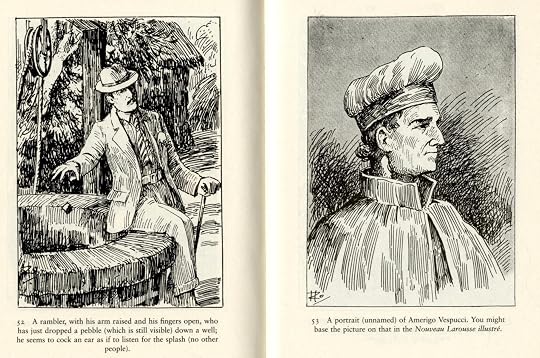
Left: A rambler, with his arms raised and fingers open, who has just dropped a pebble (which is still visible) down a well; he seems to cock an ear as if to listen for the splash (no other people).
Right: A portrait (unnamed) of Amerigo Vespucci. You might base the picture on that in the Noveau Larousse illustre.
The workmanlike illustrations by Zo have intrigued me ever since I first came upon them in the Exact Change volume How I Wrote Certain of My Books. The illustrations and the captions I should say. Like Roussel's writing they are on the surface seemingly devoid of any aesthetic flourish, but in their resonance as they bed down in the imaginative penetralia of your mind are well nigh endlessly fascinating. Sometimes the best trigger to reverie is the utterly mundane and un-artistic.
Left: A rambler, with his arms raised and fingers open, who has just dropped a pebble (which is still visible) down a well; he seems to cock an ear as if to listen for the splash (no other people).
Right: A portrait (unnamed) of Amerigo Vespucci. You might base the picture on that in the Noveau Larousse illustre.

July 18, 2010
On a second reading, this still ranks as “minor” Sorrentino, and lacks the prose beboppery of earlier works, or the steely sentimental wonder of later ones. The vignettes are entertaining, opaque, skimmable, involving, and brilliant in equal measure.

February 5, 2022
There is, by the way, nothing exceptional about the picture. A rather brilliant imitation of the Hudson River School, it depicts, beneath an unsettled, stormy sky, a dark lake. At its far end, there can be barely descried the figures of three young women in wide straw hats and luminous white dresses, wading in the shallows, their full skirts held modestly close to their perfect thighs. They appear to be dead. [55]

February 9, 2024
The missing link between Kenward Elmslie's Orchid Stories and Ben Katchor's Julius Knipl comics, perhaps?

Read
August 17, 2024I liked what I read. Nice little vignettes.

November 18, 2020
This was quite a frustrating and puzzling read. His sentences are long and digressive and sometimes it's hard to get a fix on the point of each vignette.
Gradually as you get into the book, some of the characters and situations repeat and that makes it more enjoyable, there is a sense of getting to grips with something.
I couldn't say what it's about really. It does dwell on describing photographs and films and paintings, and the short stories are a little like that, odd pictures in a gallery removed from their meaning.
I had to really concentrate and re-read bits of this, and hardly any of the stories had real endings or twists so I may have got about the same out of if as I did, by just going with the flow.
He definitely was trying to do something, whether that was highly planned or following some kind of dream logic intuitive thing I do not know, probably the later.
Gradually as you get into the book, some of the characters and situations repeat and that makes it more enjoyable, there is a sense of getting to grips with something.
I couldn't say what it's about really. It does dwell on describing photographs and films and paintings, and the short stories are a little like that, odd pictures in a gallery removed from their meaning.
I had to really concentrate and re-read bits of this, and hardly any of the stories had real endings or twists so I may have got about the same out of if as I did, by just going with the flow.
He definitely was trying to do something, whether that was highly planned or following some kind of dream logic intuitive thing I do not know, probably the later.

July 31, 2007
Later in life Sorrentino wrote a series of novels with short, vignette-like chapters. This is one of the better of those.

April 21, 2010
The Enamel Club was internationally renowned as the casino that permitted to play only those who no longer knew how to do anything else but gamble.
-Gilbert Sorrentino, Under the Shadow
-Gilbert Sorrentino, Under the Shadow


November 13, 2016
Linguistic puzzles splayed upon a barbed knoll.
Displaying 1 - 12 of 12 reviews