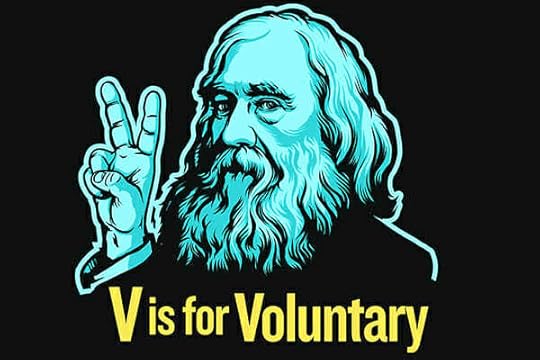
Lysander Spooner (1808–1887) is the American individualist anarchist and legal theorist known mainly for setting up a commercial post office in competition with the government and thereby being shut down. But he was also the author of some of the most radical political and economic writings of the 19th century, and continues to have a huge influence on libertarian thinkers today. He was a dedicated opponent of slavery in all its forms — even advocating guerrilla war to stop it — but also a dedicated opponent of the federal invasion of the South and its postwar reconstruction.
This collection was selected personally by Murray Rothbard as his best work. It includes "Trial by Jury," which argues for the idea of jury nullification, that is, the right of the jury to reject the law under which a defendant is tried. It also includes his "Letter to Grover Cleveland," which remains one of the most rigorous pieces of political argument ever penned. Finally, it includes his classic work "No Treason," which argues that the U.S. Constitution is not a social contract at all and that it cannot bind the current generation.
Spooner was obviously a great dissident -- and one of the most brilliant thinkers of the 19th century and an American original. His influence has been quiet but very long and pervasive.
The title here is of Rothbard's own choosing, it sums up the theme of his best work.
Lysander Spooner was an American individualist anarchist, entrepreneur, political philosopher, abolitionist, supporter of the labor movement, and legal theorist of the nineteenth century. He is also known for competing with the U.S. Post Office with his American Letter Mail Company, which was forced out of business by the United States government. He has been identified by some contemporary writers as an anarcho-capitalist,while at least one writer is convinced that his advocacy of self-employment over working for an employer for wages qualifies him as an anti-capitalist or a socialist, notwithstanding his support for private ownership of the means of production and a free-market economy.
Forceful libertarian critiques of the state voiced by a prominent 19th century anarchist thinker. The book includes a long work on the right of trial by jury, Spooner's essay "No Treason" attacking the constitution and a short letter to a former senator from Delaware as well as a scan of some stamps from the private post-office Spooner ran during the 1840s. Interesting reading for those interested in libertarianism and its 19th century forebears.
Truly Sooner is one of the best anarhists I have ever read. He goes against the state not only on the grounds of it's theft (aka taxes) and compulsions of all kind; but goes in a very elaborate legal demolishion of the state and specifically of the constitutional and democratic type of state. The first book started was a bit long and with way to much quotations from very old English legal documents (the language used in this quotes was hard for me as a non Eng native). But all of this served his point to show what is the purpose of the trial by jury and how a truly free people conduct a trial by jury. I think the main thing one gets from this lengthy book is that Spooner is a believer in natural law, that a free society with or without a state enforces and instinctively recognizes only natural law as legitimate. That the entity that may exercise coercion (be it a protection association/firm or ultra-minimal state) can not make any law besides natural law and at bast it just puts in written natural law. Back to the trial by jury: The jury must also judge the law infringed upon by the accused; yet today the jury is restricted only in giving a guilty or not statement. For the jury to judge laws is a great way to control any guv and to amend stupid laws. He goes on with more finer details of what the jury should be possible to judge and use in the trial (jury selection, jury not the judge must select evidence to be considered for the trial etc etc). The next big book is his "Letter to Grove Cleveland", where starting from the presidents speech he legally demolishes the Us constitutional system. I would not say that he considers the content of the Us constitution as bad, he points out many times that the constitution is interpreted in a way to further the interest of the authoritarians. He dose give good intention to most of the content of the Constitution but points out that a constitution is just a peace of paper and not a good guardian of freedom. He extensively uses the right of making contracts (of witch he uses a layers understanding of it) between individuals to give a very strong critique of the constitution and representative democracy. On economics he is against all privileges to any group and a full right to engage in contracts with other people. He is not like the European anarchists to dispute the right of free trade and commerce or private property. But he dose have a somewhat wrong, somewhat correct aversion to big business and the employment of large number of wage laborers in factories. Here he considers this situation as unnatural and arising from a money privilege given by the state to a few (partially correct). He dose believe that if every individual had the right to create/give his own money/IOU (basically extending the right to emit IOU to every individual) than everyone will have his own workshop. I guess here he is an idealist and dose not see (even with bank privileges to emit IOU`s gone) that large factories with hundreds of employees are not a bad thing, and are necessary to make the sophisticated consumer goods of today. But this (partial) error in economics dose not make him a Marxist or socialist at all, he is far from any of this. True he seems to adhere to the labout theory of value (witch is Ricardo's ) but he never once used the term capitalism and did not attack (but strongly defended) private property, the free exchange of products and the right to enter intro contracts with other individuals. I called him an anarchist, yet his anarchism is the most consistent and pragmatic of his time (in comparison with the European anarchist scene), unlike Malatesta, Bakunin and Proudhon he deserves this title. He may be put somewhere as an individualist-voluntarian with a view of the political organization of society in between the current NAP an-cap view and an ultra minimal state.