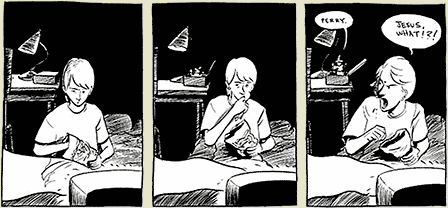
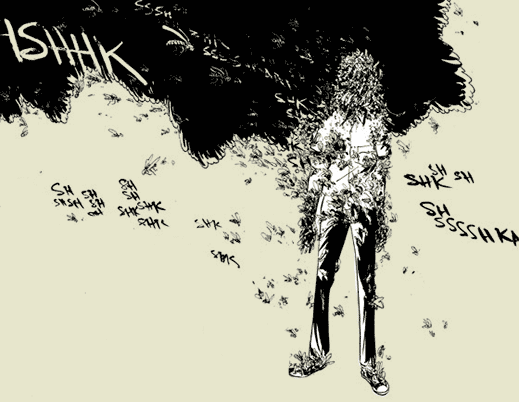
Nate Powell’s follow-up to the Eisner award-winning Swallow Me Whole examines war and violence, and their trickle-down effects on middle America. As a gang of small-town kids find themselves reunited in adulthood, their dark histories collide in a struggle for the future. Any Empire follows three kids in a Southern town as a rash of mysterious turtle mutilations forces each to confront their relationship to their privileged suburban fantasies of violence. Then, after years apart, the three are thrown together again as adults, amid questions of choice and force, belonging and betrayal.
Nathan Lee Powell is an American cartoonist and musician. Born in 1978 in Little Rock, Arkansas, Nate spent his childhood in different parts of the country, as his family moved around following his father's duties as an Air Force officer. Powell became active in the punk rock scene since his teen age. He ended up performing in several bands over the years, and even owing a DIY punk record label. At the same time, he developed an interest in visual arts and majored in Cartooning at the School of Visual Arts (SVA) in New York. For about ten years Powell worked as a care giver for adult with developmental disabilities, while also drawing comic books. His major break came with the graphic novel Swallow Me Whole, which won the Ignatz Award for Outstanding Debut and Outstanding Artist in 2008, as well as the Eisner Award for Best Original Graphic Novel in 2009. Between 2013 and 2016 Nate Powell released what remains his most famous work, the three volumes of March, a comic biography of civil rights activist and Congressman John Lewis.
In a pretty wild display of my country's militarism, the US Marine Corps ran some close to full-scale training exercises in actual American cities. Dayton. Birmingham. Boise. In order to simulate for soldiers the difficulties involved in urban warfare, the marines were tasked to carry their training, complete with helicopter drops and in some cases live ammunition, through the civilian streets. At least in some cases, areas were cordoned off in an effort to protect citizens from, well, injury and death. In others, city-dwellers were given the opportunity to play a part in these exercises. Some saw these events in a dim light and really, for the already mistrustful public, what does it say when a nation's military practices invading its own cities?
That's probably neither here nor there so far as concerns Any Empire. Probably. But let it be known that until after I finished the book the first time and did some poking around, I had no idea that this sort of thing happened. And that ignorance cost me a perfectly enjoyable experience on my first read-through. I had gotten to this point in the last third of the book and I was just completely baffled, thinking that Powell had without enough warning taken readers into the same surreal territory as he had in Swallow Me Whole. (If you've forgotten Swallow Me Whole, the male protagonist talks to a wizard the size of his fist and the female lead becomes the Queen of Insects.)
But see, he hadn't. I didn't know it at the time, but Powell's finale is largely literal. Based-on-true-events kind of stuff. Certainly there's a bit of subjective magical reality going on, but the stuff that happens there at the end? It happens.
I wish I had known about these maneuvers before I had read the book. That's why I led off with the stuff. It would have helped a lot and made my first reading more enjoyable. Which would have been great because Any Empire is an incredibly rich book. Heck, it's an incredible book. And that my first experience of it should have been less than stellar just makes me sad. On the inside.
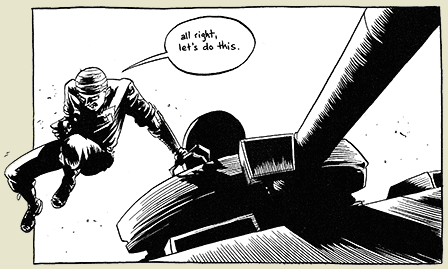
Any Empire is an exploration of the essentially violent worlds that many of us have grown into. Powell's male lead, Lee, grows up in the late '80s or early '90s reading Larry Hama's G.I. Joe and imagining his town a war zone. Visually, Powell projects these imaginations and visions into real space, showing how strongly they exert their force upon Lee's interpretation of the world around him.
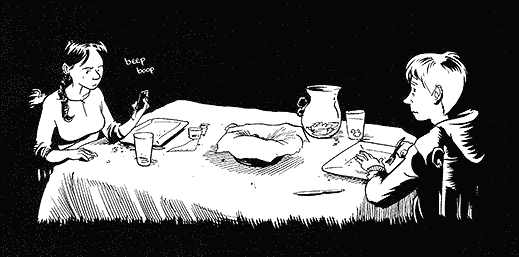
[Worst date ever. Tip for the kiddies: never ever text on a date.]
Similar forces play on the perspective of Lee's neighbour, Purdy. An insecure child, both bully and bullied, Purdy is at odds with a world that he cannot understand, a world that doesn't care to be understood by him. He's not quite a bad guy, but he's not good enough not to be. He too lives in a militaristic imagination and even during his childhood, the reader sees that he is a bit unhinged from any sort of plausible take on reality.
It's as Powell follows these two through their lives into young adulthood that we see how their affections for the implements of war have impacted their lives. Powell creates a couple worthwhile lessons here, but even if those are his main point, he doesn't seem to feel any need to belabour them. Powell says his piece through several moments and leaves the story to unfold itself.
He definitely has things to say both about our culture of violence and the human affection for war, but Powell spends time on the healing side of our nature as well. Any Empire's female lead, Sarah, cares deeply for animal life and goes to great lengths to secure the welfare of any injured creature she discovers. Just as Lee lives in a world propped up by G.I. Joe, the clockworks of Sarah's world grinds under the direction of Nancy Drew mysteries. And these affections follow her into adulthood. While as a child, she investigated the abuse of the local turtle population by a gang of ruthless children, as an adult she makes investigative housecalls for child services. Both are thankless jobs, but she pursues them because it was in her nature to do so.
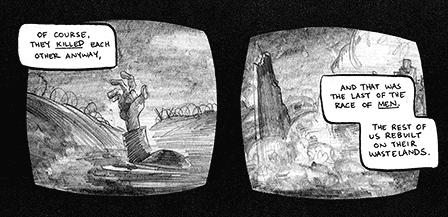
It's Sarah and her mom who drive home the lesson that not all people are such as those described in 1939's classic animated short, Peace on Earth—a powerful, anti-war piece that Powell uses to good effect in one of the book's more poignant scenes. In Peace on Earth and its 1955 remake, Good Will to Men, some animated squirrel children (or mice in the remake) ask an older animal what men are, referencing the lyric "Peace on earth, good will to men." The grandfather figure explains how men were terrible creatures, bent on destruction, and how even when there were only two left, those two still ended up killing each other. It's a fearsome picture and I recall vividly the first time I saw Peace on Earth as a child. Powell uses this story to lead into a powerful moment between Lee and his father, but it's seeing Sarah live out a life counter the film's example that really sells the idea.
[Powell retells the film beautifully, even if ther were squirrels in the original, not mice.]
Powell continues to show himself a creator who is absolutely worth paying attention to and Any Empire may even be better than Swallow Me Whole, which was sublime. The great thing about these books (I mean, beyond the stellar art) is how well they stand up to multiple reads. Powell crafts a rich tapestry of both visual and narratory tricks that serve to inject subsequent investigations with a freshness and interpretive excitement. Any Empire is a good book, a great book.
Just kinda disappointing really. Everything was just a touch flawed, and the combination of those flaws really sink this book. It's undoubtedly ambitious, but in this case it couldn't save the comic.
The art is very attractive, but is not clear enough. This means, for example, that the jarring juxtapositions (of small town life and war) don't work well. Similarly the characters aren't distinct, and the sense of location is poor. This all makes the plot hard to follow.
The actual comic-craft - the selection and pacing of panels - is off. The timing seems wrong, and the things that are shown in the panels seem slightly odd choices. Again, this just makes the story too much work to follow.
The dialogue is sparse, and I think perhaps is supposed to be naturalistic, but ends up sounding awkward. This part could have worked without changes, but with the confusion caused by the other flaws it didn't.
The plot itself is interesting, and the themes are worthwhile (if a little too worthy). But again problems with pacing, and the temporal jumps, and some unexpectedly unrealistic parts at the end... well, it just wasn't handled very well.
It's a shame, as I think there could have been a good comic lurking here. The comic is certainly ambitious, but unfortunately in this case that was not enough to make it enjoyable.
The artwork is so good. The inks are so well done and in general everything is visually good.
And then, the story begins.
What I thought was I'd read about a bunch of kids having their own adventures and whatnot.
I didn't mind the war part, I love war books and comics. I love everything about history, war, military and whatnot. But no.
This was... all over the place, this was confusing as hell, and even the artwork more than once had me questioning who was who like "is this this kid or the other kid, I know that face or am I now seeing this guy for the first time?" and "who's that again?" and all that shit.
So yeah, other than that, the story itself is a bunch of kids killing animals and also a bunch of grown ups (the kids all grown up) being soldiers and these two stories are getting in between each other and whatnot.
The story is ok at first and then it gets really boring really fast. The whole turtle thing kept it interesting but the outcome was meh... there was no payoff for the story, at least not one that would make me have fun with what I just read.
It gets 2 stars because of the artwork alone the more I think about it, because honestly I had fun when I started reading this and I finished it bored as fuck.
The artwork was wonderful. The storytelling was super disjointed and hard to follow. The characters felt undeveloped. I really really disliked the parts where in order to signify inaudible talking,the words were super small and unreadable. You never knew when this was going to happen and it was a surprise every time. Then it got to be downright annoying. This could have been so much more. :-/
Received from: Top Shelf Productions Received Via: NetGalley.com
The cover intrigued me. A kid holding a gun. Well, this book is definitely not for kids. I'm not very familiar with militarism unlike other people so I couldn't relate to some parts of this book. The plot is a bit confusing because of the flash forward scenes wherein the character's past experiences tried to merge with that of the present.
The illustrations are superb. The party scene kinda reminded me of Craig Thompson's illustrations. I just hoped that the characters doesn't look a like much or they should've have more distinct features so that I can easily identify them in the black and white output.
All in all, the story is quite confusing but still an interesting read. This is the first time I read a work by Nate Powell I would like to read some more.
This entire review has been hidden because of spoilers.
There’s an almost dreamlike (nightmarish?) quality to this graphic novel. It works on some levels: disjointed like memories of childhood can be. But doesn’t work on others: the narrative feels a bit too fragmented and disoriented. Somethings feel like flashbacks, but don’t end up working into the story as flashbacks. This non-linear quality seems to be at the heart of the problem, making it hard to distinguish between time passing and memories or flashbacks. Or maybe I’m just reading too much into the narrative (wouldn’t be the first time).
Like almost everyone, I liked Swallow Me Whole better, but this is amazing artwork, and what this books says about militarism, testosterone, coming of age into MANhood is powerful... if at times a little confusing in places.
Nicely drawn, very nice line work. I liked the characters, but I was a little lost in the plot. Maybe it is on me, but in the last pages I was struggling to understand what was "really" happening in the story and what was in the imagination of the characters.
Maybe it is on purpose, it makes sense. I mean, once you go to war, you might leave the war but it never leaves you, as I am told. It might also be seen as a commentary of the fascination of Americans for all things weapons (934 billions in defense spending budgeted from October 2020 to September 2021, according to Google... It's a lot of money!)
When I try to think of the cultural difference between English Canada and the United States, I come up short. Being a francophone, I see the two entities as being very similar, culturally speaking. But the one aspect where I can see a difference, is the culture of weapons. While I know many Canadians hunters and gun enthusiasts, I literally never met anyone who think it would be a good idea to take a weapon in a school, or in a Tim Hortons. The very idea of ordering my coffee next to someone with a assault weapon strapped around their back is truly absurd to me. Perhaps those people are rarer in the USA too than I would think, perhaps I am just fooled by mass medias. It is not impossible...
As I said, a little confused by this story, admire the art though, very nice.
Look, sometimes I'm just wrong about things, and it's okay with me if this is one of those times. But like, isn't this book actually terrible?
It just seems like everyone involved was in such a rush to make a, y'know, BIG BOOK ABOUT HOW WAR IS WRONG that they didn't actually stop to think about whether or not the story makes any sense.
I'm on board with Powell ideologically, and like, hey dude, it's fine if you wanna explore non-chronological storytelling and, uh, whatever the hell else you were going for here.
But at the end of the day if you can't form a coherent narrative idea and then you just shout YEAH BUT WAR IS BAD, like, you're not doing anyone any favors, okay?
And if it's all the same with you, I think I'd prefer to read G.I. Joe.
I am going to do a pastiche of excerpts from other gr reviews below. Personally, I found this book to be baffling and preachy, a strange combination. Some things that might have made the book more meaningful to me would be 1) to have understood the action 2) to have been able to form a better connection with the characters and to recognize who was doing what when 3) to have a better understanding of the chronology 4) to have known (here captioning would have worked great) that the end was at least to a degree based on actual events. (I thought in that last part the book was going back and forth in time to some fantastical but real-in-the-book apocalypse. But according to Seth T's interesting and informative review, the U.S. military actually did practice invasions of U.S. cities. Still, the ending was kind of a mess and whatever interest I had in the book was at that point unraveled.) It is fair to say that sometimes a narrative has very good reasons for being opaque. Perhaps Powell had his reasons but it is hard for me to see what was gained by not offering a stronger more lucid connection to the characters and action here.
Quotes from GR folks below (I think I only linked to one of the reviews because there was more than one person with that name. The rest are hopefully easy for you to find!)
Great visual storytelling, although sometimes the precise narrative thread is elusive and character relationships remain opaque.
-Sean Kottke
The artwork was wonderful. The storytelling was super disjointed and hard to follow. The characters felt undeveloped. I really really disliked the parts where in order to signify inaudible talking,the words were super small and unreadable.
-Nnedi
I had gotten to this point in the last third of the book and I was just completely baffled, thinking that Powell had without enough warning taken readers into the same surreal territory as he had in Swallow Me Whole . (If you've forgotten Swallow Me Whole, the male protagonist talks to a wizard the size of his fist and the female lead becomes the Queen of Insects.)
But see, he hadn't. I didn't know it at the time, but Powell's finale is largely literal. Based-on-true-events kind of stuff. Certainly there's a bit of subjective magical reality going on, but the stuff that happens there at the end? It happens.
I wish I had known about these maneuvers before I had read the book.
-Seth T
This was good! The art was luscious, and it totally captured the rhythms of how children interact with each other, which is annoyingly hard to do right. And for all that it was pretty heavy-handed, it still really put its finger on something particularly sad about the ways boys learn to engage with the concept of violence.
-Nick Fagerlund
I mean, I got the overall message--don't hurt animals; hurting animals as a kid as a sign of serious pathological problems; war is bad--but there were too many holes in this story to create anything particularly cohesive.
The fantastical-realism was intriguing here. The way Powell illustrates the unabashed violence and brutality of his characters in their younger years and the way that violence, both enacted and witnessed, influences their adulthood is gripping and tragic.
-Lauren
I started out really liking this book about kids playing war but really hurting animals and each other. I ended up not liking it very much. I felt like the characters were yelling at me the whole time, and the jump to adulthood in the end was too fast. The story was too disjointed for me to ever get to know or care about the characters…
-Kim Herrington
Nate Powell's artwork is incredible, but I never felt emotionally invested in this book. I did not feel that I understood the characters or that I could get into their heads. This is partly due to the lack of narrative captions or thought balloons, as well as the inexpressivity of the facial expressions. Furthermore, the storytelling is often unclear. And I have no idea what all is going on at the end of the book, although here the lack of clarity is probably on purpose.
I’ve been a big fan of Nate Powell’s work since I read “Swallow me Whole” and saw his artwork for “The Silence of Our Friends.” The illustrations that he does for both works blew me away and his storytelling for “Swallow me Whole” was captivating and thought provoking. So I eagerly picked up “Any Empire” and wasn’t disappointed (although it made my brain hurt a little bit more.) “Any Empire” is a coming of age tale that examines youthful fantasies of war and the realities of the real world.
Lee is a typical young boy growing up in a small town in the midwest in the 1980’s. He’s a quiet kid, who daydreams of GI Joe and heroes like his father, whose in the air force. He meets Purdy, a young boy who lives down the street, who also dreams of war and fighting and being a better warrior than his dad, although Purdy will tell you he’s a SEAL and an Army Ranger. Also entering their world is Sarah who struggles to find out whose mutilating local turtles and…making the villains suffer. Together they grow up, apart, and back together and have to answer questions about choice, war, hope, and belonging.
With Nate’s work it isn’t really possible to discuss his art and story telling in two different paragraphs, in part because in many places the illustrations are the story. And while that should be the same for any graphic novel/comic it really hits home with Nate’s works. In many places there are long stretches where the panels tell an evocative story of growing up and attempting to make friends. The main protagonist in this story, Lee, really resonates with me. Not because I would day dream about soldiers and war all of the time, but because I would day dream. I’d sit in gym and imagine something else going on, I’d go outside and my imagination would run rampant. And I also had friends like Purdy. Who would dream of being a solider and who would exaggerate the accomplishments of their father to fit in. Nate has accurately captured the feeling and mentality of real life with his story telling. I can relate to each and every character that Nate has crafted and feel like I really know them.
And his illustrations are pitch perfect and his ability accurately capture the expressions of the human face is amazing. I really love the expressions on Lee’s face when he is younger and that feeling that Nate captures, such as when Lee is sticking his tongue out while hauling a piece of lumber. It’s just a natural gesture that you can imagine yourself making and Nate captures it so effortlessly. The characters movements on the page are natural and fluid and it feels like we’re watching something from real life as it happens. These aren’t stale and static pictures.
The biggest issue I had with really understanding this work is right at the end of the book. And part of my problem is that I expected the reality to consider (yes the characters day dreamed so it was fantasy, but it was still reality.) But Nate surprises us with weaving together multiple daydreams/time lines together. And the understanding problems aren’t really Nate’s but mine. My expectations diverged and I had to read the book a couple of times to fully appreciate and understand what was going on. I also found help in reading an interview that Nate did with Graphic Novel Reporter about the book and the insight he offered about what he was thinking with the ending. I do wish that there was an afterward or perhaps a foreword that these types of events that Nate depicts in the last part of the book…are real. It would have gone a long way to clearing up some of the confusion I had.
Clearly this isn’t a book for everyone. It’s one that requires a couple of reads and most likely a bit of time to process what you’ve read. And yet…it’s still a book that I think everyone should read at least once and it deserves a place on many bookshelves. Nate Powell is a master illustrator and a fantastic storyteller. And I for one can’t wait to see his next work. I give the book 4 out of 5 stars.
Gorgeous art, great ideas about violence, angry youth and what it can (not necessarily will) lead to in adulthood. I identified quite a bit with the story when the main characters are kids----three very different people with different ways of looking and and interacting with the world, but still forced to interact with each other because of school, their town, life, etc.
The ending is odd, though. Time, ideas and points of view twist and merge. I appreciate (and often relish) difficult, complex reads but this change in tone and style came out of nowhere for me. Really wanted to like this more, I just can't.
i feel like the entire thing was just very hard to follow. the art style / plotting didn't really do enough to differentiate the characters / locations / time shifts so i was constantly trying to figure out what was going on. a good idea but just poorly executed imo. also this isn't really something i would normally read. i got it in a humble bundle so i figured i would just read through it quickly, so that probably affects my rating as well.
Un fumetto imbarazzante, in cui l'abilità di Powel nella costruzione delle vignette e il suo tratto attraente (almeno a prima vista) si sgonfiano in una storia senza mordente e senza la poeticità a cui vorrebbe aspirare. Un guazzabuglio di scene banali che tra l'altro non sono nemmeno nascoste bene da disegni spesso talmente approssimativi da ricordare Jeff Lemire. 22 euro BUTTATI.
You know, this one is really hard. I'm between a 3 and a 4 on this one. Any Empire at its core is an anti-war story, and it observes the progression of violence through the age progression of kids in a small town. It's exceedingly ambitious as it tries to observe and track the path through the lenses of media contribution, domestic abuse, and animal cruelty, and while some of these get developed, nothing ever feels fully cooked.
I think what Powell does best here is taking a look at kids and their fascination with war stories and weapons. The main character starts off idealizing war, including making up scenarios in his head. He thinks up stories where war is romantic and just, unlike the complexities that lie below. We also see domestic abuse and animal cruelty carried out in town, but honestly these threads have a hard time really coming together here.
I can't really get into it because of spoilers, but because of the nature of what the military is doing in this story, some of the nuance kind of falls apart. It's almost like the story wants to critique war but only straw men about war. We never see anything really morally provoking or complex here. It's almost as if the story just wants you to see war idealization and war itself as a meaningless cycle of violence, but we never get an understanding of how we actually got to that point. Like, a good place to go would have been how many volunteers actually tend to be lower-income individuals who are looking for opportunities for school, etc, not someone who likes to smash turtles in the field. Like the contrivance for the final scene doesn't even make a lot of sense, honestly. I just wish this script could have been tightened up.
Of course, Powell's art is great. He's got an amazing sense of space, and the way he varies up his panels is always a pleasure. Some of the expressions the characters give are just so good. I would honestly study this work for the art alone.
Overall, I think Any Empire made a great attempt at its own crack at anti-war, but it needed a bit more nuance and care to really make its story shine. I would still probably love to see more from Nate here for the art, but I would have loved to see a tighter story.
I have to say, I didn't get it. The first part is okay, painting a pretty relatable version of childhood, dealing with an unpleasant 'friend' and leader of the gang, and imagining war games every where you go - I knew kids like this, and it feels very familiar and true to life. But Part 2, which is a time jump, throws everything askew, as the future versions of characters start interacting with their past, and there's a military attack on the city and things just go completely to pot and I honestly had no idea what aspects were 'real' and which were metaphorical, and ultimately what the point of any of it was. Maybe that our pasts inform our futures? I don't know, and ultimately it didn't have much impact. The page to page experience isn't bad, with Nate Powell's art style very present; unfortunately that made it very hard to distinguish between several of the characters. And there were some subplots whose inclusion I don't understand and didn't go anywhere. Ultimately, the story between Lee and Sarah had some value; Purdy's experiences were less sympathetic, and the twins and other minor characters were practically pointless. It feels like it was loosely autobiographical, which may have hampered the storytelling. Definitely not one Powell's better works, and not one I would recommend.
This was good. I'm not super into war comics or the nuances within them. I think someone who liked those books would like this one more. I do however like the characters and how they quickly change. Though I wish we got to watch more of that change happen rather than seeing them age in a montage over a dozen or so pages. The main story follows some children in a small town in the mid-late 80's(given the appearance of the NES). The kids grew up around war stories from their parents. Reading G.I. Joe and watching Platoon. They often played war and some children even took things too far. Two of the kids begin to investigate a series of turtle mutilations in order to find whoever is hurting these poor creatures. In the midst of all of this there's a quick montage that leads into their early adulthood. The kids have jobs, some are in the military. They all meet again and it sort of abruptly ends. I don't fully understand some of the choices in the book. But the characters were interesting and some of what happened was good to read. A little sad and somber at times. A weird tension around most of the characters. Overall it was a good book. I wish there was a little bit more in it though.
A little sad about this one because it could've been great, but I think Powell's storytelling style (both here and in Swallow Me Whole) leaves a lot to be desired.
The narrative is difficult to follow at best and utterly baffling in its weakest parts. The messaging is overt to where there seems to be very little story that isn't allegory. The characters seem like prop representations of a certain era and a certain mentality. Despite this, the timeline and sequence of events is often unclear and I think too much is left to the reader's interpretation, which makes everything difficult to follow. I'd much prefer the opposite: less messaging, more story. The very organic art style and panel layouts also contribute to a dream-like storytelling style that does not do anything to add clarity.
I respect Powell's perspective and message a lot, but I think his work is much stronger in straight-up opinion, explanatory, or political comics -- his storytelling feels weirdly bland and weirdly fringe at the same time.
Amazing art and layouts, with a minimum of text throughout.
And much like “Swallow Me Whole,” there was a thread that I was following (and really into) for about 2/3 of the book. Then it veers so far off course and into this weird magical realism/ outright fantasy/ I-don’t-know-what that I’m mostly left unfulfilled despite the early promise.
It was going somewhere…then it just went weird, almost in defiance of the narrative.
I had a really hard time keeping track of who was who. A lot of the young boys would have similar faces and statures of their friends and so would read a page or two thinking it was about one boy when it was another. It would also flash forward very, very briefly and flashback again leaving me a few panels behind in understanding the chronology of the story.
I know this was a commentary on the glorification of war and how the war machine both preys upon and needs the "lower class" citizens, but I was still very lost on the finer plot points. I think this project was a bit too ambitious. The line work was second to none, as always for Nate Powell. I am a big fan of his work.
I loved it. Lacking a definable message it is more an exploration into violence and our exposure to it, and it's fantasy in youth. I love the surreal storytelling and the aspects of magic realism written into it. It improves with multiple reads.
The art was great, but I was a lot less lost after I read Seth's review that clarified that the American military really did use small-town America as a training ground. Way to be creepy, military. The comic could really benefit from a foreword or afterward about that.
“You always seemed so sure that one day we’d be fighting in a suburban war. You part of town against mine. I saw you standing on the opposite shore, but by the time the first bombs fell we were already bored.”
This phenominally rendered, nonlinear fable of the war on terror, and of the violent power fantasies that permeate every facet of American culture had me by the throat from beginning to end.
Nate Powell is daring us all to risk more, to draw more, to love delicate things and reject the boot.