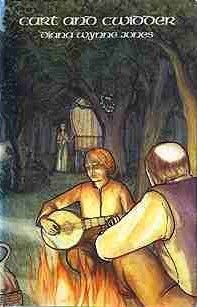
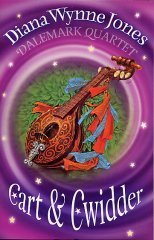
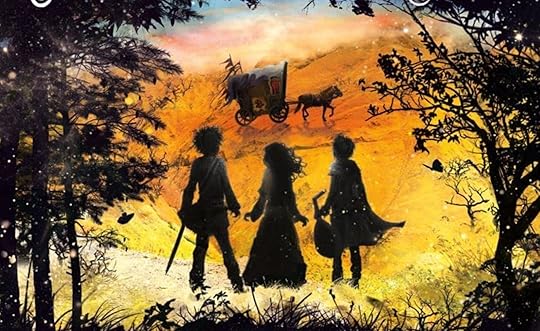
Cart and Cwidder is the first in the best-selling Dalemark Quartet of books and tells the story of Moril and his brother and sister who are travelling musicians journeying through Dalemark, until one day they pick up a mysterious passenger. Somehow Moril's family and the stranger are becoming bound together in terror, flight, and music.
* Diana Wynne Jones is an outstanding writer of fantasy. * The Dalemark Quartet books are for good readers who have enjoyed the Christopher Chant books by the same author. The books contain the same ability to immerse the reader with real child characters having magical adventures in an imaginary world. * Diana Wynne Jones has won the Guardian Award for fiction and has written over twenty novels in less than twenty years. * Diana Wynne Jones has a huge cult following of avid admirers.
Diana Wynne Jones was a celebrated British writer best known for her inventive and influential works of fantasy for children and young adults. Her stories often combined magical worlds with science fiction elements, parallel universes, and a sharp sense of humor. Among her most beloved books are Howl's Moving Castle, the Chrestomanci series, The Dalemark Quartet, Dark Lord of Derkholm, and the satirical The Tough Guide to Fantasyland. Her work gained renewed attention and readership with the popularity of the Harry Potter series, to which her books have frequently been compared.
Admired by authors such as Neil Gaiman, Philip Pullman, and J.K. Rowling, Jones was a major influence on the landscape of modern fantasy. She received numerous accolades throughout her career, including the Guardian Children's Fiction Prize, two Mythopoeic Awards, the Karl Edward Wagner Award, and the World Fantasy Award for Life Achievement. In 2004, Howl's Moving Castle was adapted into an acclaimed animated film by Hayao Miyazaki, further expanding her global audience.
Jones studied at Oxford, where she attended lectures by both C.S. Lewis and J.R.R. Tolkien. She began writing professionally in the 1960s and remained active until her death in 2011. Her final novel, The Islands of Chaldea, was completed posthumously by her sister Ursula Jones.
Diana Wynne Jones certainly doesn’t create a world that is sanitized and pastel just because she writes for kids. The world she created in Cart and Cwidder is harsh and cruel, fitting a book for an older audience.
And yet, free from any sentimental attachment that may have come from reading this as a kid, my adult self was not that impressed.
Moril is an eleven-year-old boy in a family of traveling performers, on a journey through a very repressive feudal country. His job is to play a cwidder (apparently a lute-like musical instrument). But then his father is murdered and his mother removes herself from the story, and Moril’s life is irrevocably upended as suddenly he is involved with rebellion and magic and saving not just himself but quite a few others.
It’s a high fantasy book, and somehow it felt more conventional than other books by her I’ve read. And besides, it just felt detached. Things happened, and pretty terrible things at that, but I just didn’t feel it and the young protagonists didn’t seem to feel much either. The kids seemed to get over traumatic events surprisingly quickly, and maybe some of it was childhood resilience — but it made things seem a bit distant and unreal and sketched-in, hard to really connect with the characters or the story to the point where I’m quite content to leave it as a stand-alone and leave this series unfinished.
The things that I wish Jones had spent a bit more time on — like the complex relationship between the parents, Clennen and Lenina with layers and pain hinted at through the eyes and remarks of the children — were not in the foreground, naturally, given that it’s a book for kids and not middle-aged women curious about complicated family dynamics. But how I wish those had been, given that I read it now and not thirty years ago! But my age is not Jones’ fault, and so I’ll let it go.
And yet it wasn’t bad. It had sweet moments, and didn’t sugarcoat things, and would have probably kept my attention easily had I been a few decades younger and closer to the protagonists’ age. But it won’t be a book I remember years (or even months) later, unlike her brilliant Howl’s Moving Castle or Dark Lord of Derkholm.
I thoroughly enjoyed this – great world-building, a fun plot and an interesting magic system linked to music. Possibly my favourite Diana Wynne Jones so far.
This is a fantasy story about a country divided along a familiar line—north and south. The southern lands are repressed, dangerous; the north represents freedom. If this sounds cookie-cutter, it's because it is—a popular trope in fantasy. But what makes this book special is, of course, the talent of a great writer.
When you open Jones' book, you can always expect complexity. Her characters are vivid, relationships are messy yet deeply human, and she never underestimates her young readers. The world she creates is a wonderful, scary place, whether you're 30 or 10. But there are always people to help you, even though there are always baddies to fight.
Jones never writes sentimental parent-child dynamics. I think I once read in her essays that she didn't have a good relationship with her mother, and it shows. Yet if you're not blessed with a great family, you can find your own group of misfits. And anyway, Jones will sneak a sweet, kind granny into a story like Fire and Hemlock, and great siblings into this one. But there's almost always a sadness in her endings—kids always lose something by the end, but that's growing up for you. In that way, she’s like Pullman.
This is the first part of a tetralogy, written early in her career. I find her books from the '70s to be more simplistic than the ones that came later. Yet this book has heart and charm, and I’m open to continue my adventures in this world.
This is the first installment in Diana Wynne Jones’ epic Dalemark Quartet. I first read this series when I was 13 or 14 (which is the intended age group), and I remember being so swept up in these books, they remained in my “favorites of all-time” for many years afterward and began my lifelong love of epic, multi-volume fantasy. Of course, revisiting something you LOVED when you were in middle school is always a gamble. So, the real question is: did it hold up?
Yes!
And no.
Cart and Cwidder is the story of Moril Clennensson and his family of travelling Singers. Moril is an eleven-year-old musician and daydreamer who lives on the road and performs with his family all over the politically divided land of Dalemark. When the family takes on an arrogant young passenger named Kialan, a chain of events begins that will change not only Moril’s life, but will affect the entire land of Dalemark.
I wanted to leave my description as vague as possible, as it is the progression of discovery that makes it so much fun. But I do want to look at the elements I still love. Moril is a fantastic character, seemingly ordinary and likeable, but obviously designed for bigger things. For those of us that spent most of our teenage years in a fog of daydreams, he’s the embodiment of the dreamy but secretly astute creatures we may have believed (or hoped) ourselves to be. Moril sees things, but people rarely realize it, and the look of vague inattention on his face fools those around him into constantly underestimating his abilities. He's an average boy stuck in a not-so-average situation, and he proves himself to be up to the task, but not without some sadness and regret.
The emphasis on the lives of itinerant musicians in this first volume gives us an early glimpse at the beautifully constructed world of Dalemark. It is a land divided; there hasn’t been a king on the throne in over 200 years, and the earls that rule the various territories have created a fierce division between North and South that promotes prejudice and keeps the people separate and easy to manipulate. The South is known for being efficient and aristocratic, but also harsh and authoritarian. To the North, people have more freedom, but life is a bit more hardscrabble in the cold and less productive climate. (Yes, I do realize that there are definite American Civil War divisions going on here. Agricultural, repressive south vs. progressive, industrial north is a very old story from many Western nations at this point. But it works.)
This being a fantasy series and not simply a work of pre-industrial historical fiction, there is magic and wonder aplenty, but it is done in such a way as to not overwhelm the character-driven nature of the story. Moril inherits a very old and mysterious musical instrument from his father, known as a cwidder which, to the best of my knowledge, resembles a large lute. This cwidder is *ahem* instrumental to the series, both in this volume and later on. When Moril unlocks its magical potential near the end of this adventure, the real story is just beginning.
As the first entry in a four-part series, Cart and Cwidder does a very good job of setting up the overarching structure of the whole. It gives us an overview of the land, and insight into the nature of the North-South division. Moril is a living, breathing manifestation of the opposing sides; his father is from the North, while his mother was once a Southern aristocrat. The religious belief structure that comes into greater play in later installments is mostly absent, but it isn’t necessary and is probably better off without it. Jones does an excellent job of creating a solid foundation to build on later, not overwhelming the reader right out of the gate, but prompting a desire to learn more as the story progresses.
Now, in what ways does this not hold up to my original perceptions? In this volume, there actually isn’t much that let me down. As I mentioned, this introduction does a very good job of slowly building a world in which the reader becomes more and more involved. I suppose my only argument against it, and would keep it from receiving a full five stars if this were my first time reading it, is Jones’ inclination to rush understanding in some instances. There is a tendency to have characters discover things in a rush, which requires a suspension of disbelief I was much better at when I was a teenager. It’s not entirely unconvincing; the story couldn’t survive if it was, but it can be a little less satisfying than it could be. However, I still love it and to explain, I’m going to lift a phrase from a fellow Goodreader that really captures the essence of my continuing appreciation: “I'm sorta fond of my fond memories of fondness.”* Yeah, that could mean I’m in love with the ideal of my initial reading. But I don’t think, in this case, that it does. My fond memories and my current enjoyment came together quite nicely to create a lovely, nostalgic experience that doesn’t overshadow the story’s ultimate worth.
Ultimately, I'm leaving the 5 star rating. As a first time read at the age of 27, it may be more in the 4 range, but if you average my initial response and my current one, it really does still merit 5.
(Oh, and my only other complaint: the horrible, childish covers on the British Oxford paperback editions. The library copies I read had lovely covers; these are a travesty.)
I've heard vague things about the Dalemark Quartet for a long time (...as with so many things I read, I suppose), and today seemed the perfect time to start, while I was procrastinating from my dissertation. It doesn't feel quite like any other Diana Wynne Jones book I can think of: there's something rather serious about it, ultimately, where often her books seem to be rather frivolous. Perhaps it's the oppressive setting of the South, where there are few basic freedoms, perhaps it's the fact that the magic -- when it comes -- is a little bit awful.
It's an interesting world, really, and something about it feels more three dimensional than some of Diana Wynne Jones' others. At the same time, it's surprising to see a work of hers with so many trappings of conventional fantasy -- though it does remain uniquely her own work as well. It's just closer to what you'd expect from the fantasy genre at large than from Diana Wynne Jones.
Four young people must save the world and an adventure begins. This didn't really work for me unfortunately. It was well written and entertaining enough however I didn't quite connect with the story.
This was one of the first books I read by Diana Wynne Jones, back in the days when I would read and love a book and then lack the good sense to look up other books by the same author. I must have stumbled over three or four of her books this way before "discovering" DWJ; what a surprise to me, later, to pick up one of her books and find it oddly familiar.
Diana Wynne Jones's sixth book is her first fantasy set in a world other than our own, and is also more serious than the previous ones. The Dales are a country divided north and south; the North is a land of freedom, and the South is dominated by oppressive lords who tax the people heavily and ferret out rebellion wherever it sprouts. Moril's family are traveling performers and some of the few allowed to cross between the countries, carrying messages between towns and entertaining with song and story. When Moril's father Clennen takes a young passenger named Kialan, their lives take a different turn, and Moril discovers the truth about the old cwidder his father plays and that he's told Moril will be his someday.
Family is at the heart of this story, and family is one of the things DWJ does best. It's a truism in young adult literature that the first thing an author has to do is kill off the parents so the children have to depend on themselves. I think the first part of that statement is what gets remembered, when the second part is what's actually true: YA literature requires that children learn to solve problems because adults are not reliable, for many reasons. In Cart and Cwidder the parents are present, but not reliable, because they have their own lives; Clennen is absorbed in performances, and their mother Lenina (sorry, I keep having Brave New World flashbacks with that name) is cool, efficient, but distant. It's true that Moril and his siblings Brid and Dagner end up on their own , but that's about halfway through the book. And even then, that "abandonment" is because both parents have lives of their own--and this makes the point even more powerfully than if the book had simply started with three orphans making their way in the cold, cruel, heartless world.
Cart and Cwidder marks a satisfying change in DWJ's approach to fantasy fiction. I recommend reading the entire series in the order listed, even though The Spellcoats comes first chronologically.
This is a tricky one. I would like to start by saying that I love Diana Wynne Jones and this is a perfectly well-written book. I just think perhaps it was not the book for me.
Cart and Cwidder is not exactly what you would expect from Diana Wynne Jones. It lacks the sass and perhaps somewhat eccentric magic systems. Instead, this is much more in the same vein of classic fantasy. Given that it is a middle grade rather than an adult book, I would liken it to The Book of Three. Both are quite dark compared to most other middle grade books and given a bit more length and some older characters they wouldn't be far off from being adult fantasy.
I enjoy both middle grade and adult fantasy, but I felt as though Cart and Cwidder wasn't truly one or the other and was thus lacking on both fronts. As a middle grade book, I felt this lacked a bit of cheer and wonder whereas for an adult book it wasn't fleshed out enough. Reading this book felt like we barely scratched the surface of what is meant to be Dalemark - sure, this is only the first in a series, but an entry to a series should make the world interesting enough for me to pick up the next volume.
I will say that I really enjoyed the characters and what we got to see of the world and magic system was definitely interesting. It is well-written and likely easily loved by people who enjoy classic fantasy and don't want to sit down for a whole epos. Had the world drawn me in a bit more, I would have enjoyed reading more adventures about these characters. For better or for worse, the following books in the series seem to feature different characters in different times. I am not sure how I would feel about it but I shan't find out anytime soon as I have no plan to continue this series - and believe me, I am sorry to say so.
Another thing that couldn't quite convince me was how characters reacted to tragedy. Everyone was always so calm - whether a character they loved died, vanished, was arrested or deserted them, everyone was just so ridiculously calm. If any of the aforementioned happened to someone I cared about, I'd cry or become angry or just do something to express the loss I am feeling. These characters just seem to take everything in a stride.
I love Ms. Jones with all of my heart, and that is why it pains me to admit that I didn't really enjoy these stories. There was no connection between the stories (although the first two novels are set during the same period, they concern two completely different cultures and geographic areas--the difference between A Horse and His Boy and Prince Caspian for instance), so there's really no point at having them all part of the same "quartet." Moreover, the stories just didn't grab me. I don't know why not, but these are probably her least-enjoyable works.
A nice but not all-together unique entry in the DWJ canon. I've been slowly working my way through her less well-known books and was inspired by the fact that this is the first in a series. One of my favorite aspect of Jones' writing, as I've said repeatedly, is her ability to candidly asses what are often very real and heavy subjects through the lens of childhood. Moril doesn't stand out particularly amid her host of vague and dreamy young protagonists, but once again the way he deals with topics such as death and endangerment of his family members feels very real and very heartfelt.
Another thing I tend to enjoy about DWJ books, echoed in this novel, is the way that her magic systems are borne more of feelings rather than science. The descriptions of Moril's powers with the Cwidder are at once precise and evocative, as Jones utilities her characteristic, matter-of-fact tone to describe the extraordinary.
However, I wasn't especially moved by any of the characters. This novel's failing, in my opinion, is that it fails to stand out from the rest of her canon; while it is rife with many of the tones and tropes that make me enjoy her other works, it doesn't play off of them enough to distinguish itself.
I've been trying to read this quartet since I was gifted the books over a decade ago. I still don't know why I never managed - especially after finally picking up this first book yesterday and realising that it is fantastic and not at all difficult.
It's strangely sombre for a children's book, the world is a harsh place and the journey that the main characters go on is challenging in a way that quests rarely seem to be these days. The consequences are as harsh as the world they belong to, and death - though shocking - is an easily accepted thing. Maybe this is why I struggled to read it as a child?
Moril is a wonderful lead character, and the music theme is explored differently than I've seen before - though of course this is Diana Wynne Jones and so I would expect no less!
Can this be written by the same author of Howl’s Moving Castle— that story full of lighthearted and witty banter and riddles? This book was a good deal darker, but also laden with real wisdom. It had much to say about family, loyalty, truth, courage, music and art, and the way we relive the world’s greatest stories without even realizing. The Diana Wynne Jones style that stood out the most is the many-layered quality of the plot and characters. I’ll have to read it again to be able to appreciate the plot twists fully.
There is sometimes an assumption that if a novel’s protagonists are youngsters then the novel can only be for other youngsters to read. This is not always the case, and for me many of Diana Wynne Jones’ ‘young adult’ stories can and ought to be enjoyed by youngsters of all ages.
It is also sometimes assumed that fantasy is a lesser genre than more mainstream novels. I don’t accept that needs to be so, and the author herself has made clear that to dismiss fantasy as escapist is a mistaken attitude. The best fantasy has as much to say about the human condition as more literary examples, and Jones’ fantasy mostly falls into this category. Add to that the fact that Jones attended lectures by Tolkien at Oxford (he mumbled a lot, apparently) as well as C S Lewis and then this series of four related fantasy novels deserves to be given more consideration.
The first three of the Dalemark Quartet were published in the 1970s, with the first two published in North America as Volume 1 nearly thirty years later. As Cart and Cwidder happens more or less contemporaneously with Drowned Ammet it made sense to have the two titles combined in one, as the publishers Greenwillow did back in 2005 (though just the former title is considered here). The action takes place in a land wracked by civil war between north and south, in which Jones’ young heroes and heroines must make their precarious way.
In a lecture on ‘Heroes’ delivered in Australia in 1992, Diana Wynne Jones makes it quite clear that she sees her heroes (and heroines) as flawed beings in whom we, the spectators, seek to invest our sympathy. And so it is with the young travelling musician Moril in this tale, an apparent dreamer who inherits a stringed instrument called a cwidder. He is expected to shoulder a lot of responsibility, despite his age, and how he responds is the mainspring of the story. And his response involves exactly that dreaminess that many other creative people have, in concert with the latent magical powers of the cwidder.
'Cwidder' by the way seems to be a made-up word. It’s based on a family of stringed instruments, from Ancient Greek kithara and zither, through the crwth or bowed lyre of medieval Wales to the modern guitar and sitar, though cover illustrations seem to show a cross between a Renaissance lute and a mandolin. A great many stories of magic, both old and new, involve the power of sound, from Orpheus’ singing to his lyre to the necromantic bells of Garth Nix’s Old Kingdom series, from the musical instruments in Alison Croggon’s Pellinor tales to the traditional use of terms like ‘spell’, ‘enchantment’ (from French chanter), ‘grimoire’ and ‘glamour’ (from ‘grammar’). These refer to both spoken and sung words as well as sounds notated and played, and this Dalemark story follows in the same tradition.
The thirteen chapters mostly seem to settle on towns and villages visited by Moril’s family — Derwent, Crady, Fledden, Markind, Cindow, Neathdale — and average around sixteen pages each in my edition, suggesting Jones knew how to structure and pace her story. The general air of suspicion — between North and South, from wary villagers to shuttered houses — helps to keep the reader on guard so that any stranger, or indeed acquaintance or family member, is a possible suspect.
Yet I liked the way there are no absolute goodies or baddies for most of the time. Moral ambiguity within the family is matched by the attitude of court officials at Neathdale, the reluctant recruits to the tyrant Tholian’s army and the “murmuring gentleman” who gently accosts Moril’s mother Lenina at the family’s various stops. I liked that this character, Ganner, turns out to be neither black nor white: as someone who makes compromises because he’s aware that his position and power may be in jeopardy if he crosses Tholian, he’s still clearly sweet on Lenina and will do his best by her.
Incidentally, I’m quite clear on the difference between a villain and an antagonist: a villain is someone with corrupt morals, while an antagonist is simply someone who opposes the protagonist (agon is Greek for contest or conflict). With the antagonist (and protagonist) there may be moral ambiguity — neither being wholly right or wrong — they may question themselves, lack a sense of self-esteem, or simply be confused. A villain however could be a sociopath, psychopath, narcissist, liar, manipulator, abuser, a power-hungry CEO or politician with few or no redeeming features despite surface charm or other dissembling habits.
As we see pretty much everything through Moril’s eyes perhaps it’s unsurprising that Tholian is two-dimensional, with Moril seeing him responsible for all the South’s ills. Mind you, Tholian deserves all the opprobrium he gets; and as this is a kind of bildungsroman (albeit over a very short period) Moril is going to have to develop a more mature attitude, and it will be a painful process with loss of family members and unexpected responsibilities.
For an epic fantasy this has precious little magic for most of the time, though hints of that grow throughout. It fits different moulds at various times — alternative world or paracosm, even steampunk towards the end with the giant musical organ. And the historical setting is confusing, medieval at times, Thirty Years War at others (the armour and the guns suggest that). 17th-century Europe seems to me to be Jones’s main inspiration here: not only the murderous Thirty Years War and the English Civil War but also the obsession with spying, political intrigue and, crucially, mysticism (along the lines of Rosicrucianism) with suspicions of witchcraft. The lute (the equivalent of the cwidder) reached its height of popularity at this time; also this century saw a fashion for automata and similar mechanical toys, especially in France. I see Cart and Cwidder being set in this kind of period.
Yet there is certainly magic, and there are magicians. My first instinct was to think of magic-users as thaumaturges, but that term suggests a seasoned practitioner of the art. Even ‘charmer’ (as in ‘someone using a charm or magical object’) implies someone who knows what they’re doing. Perhaps ‘a sensitive’ might be be the best description of people like Moril. Even animals, such as the troupe’s horse Olob, are an aspect of this world’s magic; he reminds me of Falada, the talking horse in the Grimm fairytale The Goose Girl.
The names used here also intrigue me, many of them modelled on Northern European exemplars: Mendakersson and Thornsdaughter reminiscent of Icelandic patronymic and matronymic customs, Konian and Kialan very Medieval Welsh, Fledden and Medmore almost Scottish. There are also Tolkienian echoes: Lenina’s father Thorn (for Thorin?), Markwood (Mirkwood?). There are distinctions between Northerners and Southerners, as when Kialan is dubbed ‘Collen’ at some stage to disguise the fact he’s from the North. Collen was not just an ancient Welsh name meaning “hazel” but also, I suspect, a closet reference to the author’s son, Professor Colin Burrow, who has complained that she’d ‘borrowed’ him for characters in her novels, such as in Fire and Hemlock.
I kept being reminded of the phrase in Hamlet, “Something is rotten in the state of Denmark,” except here it’s the state of Dalemark. That sense of malaise and malevolence which is present here is all-pervasive in Drowned Ammet too. Does it match up with what Jones observed in 1974, the year she would have been writing this novel? It was a year of unrest in Britain, certainly: a compulsory three-day working week, minority governments, two general elections, a state of emergency in Northern Ireland, an IRA bombing campaign on ‘mainland’ Britain, a politician sacked for an inflammatory anti-immigration speech predicting “rivers of blood”, and much more. And that was just the UK. That sense of a malevolent ruling spirit is only resolved in the final novel, The Crown of Dalemark, completed many years later. Reflecting the prevailing zeitgeist is not uncommon in fiction.
Closely related to fictional reflections on zeitgeist are foreshadowings. These foreshadowings, and also closet remarks, seem typical of Jones’s writing, a technique she will have come across in Tolkien’s fiction. In fact, Clennen’s gnomic utterances remind me a lot of Gandalf’s advice to the hobbits, and looks forward to Albus Dumbledore’s sage sayings to Harry Potter.
I’ve said more than enough to indicate how complex and rich this novel is, and yet I’ve given precious little attention to a synopsis of the novel, to its characters and to the atmosphere created. The best way to appreciate these is of course to read the novel itself; but I hope that armed with the foregoing remarks the reader may approach a first or subsequent read with deeper insights into the powerful storytelling that makes this so effective a fantasy.
Decided to start a reread of the series - Cart and Cwidder is a weird one for me because it's the first book in the series, and it's the beginning of so many characters (and not just Moril and Kialan. Like, I forgot the number of people who show up in this who become important later, like Keril, obviously everything with Hadd and Henda for the next book, and Hestefan). But it's also one of the very few DWJ books where the world-building outweighs the plot. The world-building itself feels effortless like it always does (there's something so matter-of-fact with how DWJ introduces you to a new universe), but here it feels like it took precedence over the plot. Because the plot is so thin and the end is really rushed and it reads like she had other priorities.
But I loved getting back into this world. I just love these characters and how they interact and everything about Moril and where he is at the start of the book vs. the end vs. who he'll become. Also, I have a LOT of thoughts about Keril in this one.
Another fun book with a completely different take on magic from Diana Wynne Jones, Cart and Cwidder tells about a family of singers who use their unique status as entertainers to cross back and forth between two nations/regions which are in a cold war and otherwise have no traffic with each other. Like many of Jones' stories, this is also a coming-of-age story, in that the main protagonist, Moril, is eleven years old, and he comes to realize both his passion and his identity over the course of the story. The cwidder of the title is a large stringed instrument that is never really described in much detail (I pictured a cross between a guitarrón and a lute); the family band plays harmonies with bass and treble cwidders for many of their songs.
Up until I'd started this book, I'd been reading and enjoying Mary Doria Russell's The Sparrow, but once I started this, I couldn't stand to read The Sparrow any more until I'd finished Jones' book. Her writing is just so much better that it makes Russell's writing seem clumsy and awkward. I really need to be more careful about picking up Jones books when I'm reading something else.
Diana Wynne Jones is one of my favourite writers from my childhood and Cart & Cwidder is one of my favourite of her books, and so it was the one I chose to re-read for DWJ-month in the blogosphere – a global celebration of her books and writing. This is the story of a family of musical travellers in a world divided between North and South, and has DWJ’s trademark mix of the ordinary and the magical. A truly delightful children’s fantasy.
After hearing about the genius of Diana Wynne Jones more times than I can count, I have finally joined the ranks of her admirers. Jones truly knows her craft. I found many similarities between her writing and the writing of Megan Whalen Turner. Namely, amazing plot twists, nuanced characters, and a finished project worth reading over and over. I'm glad this is a series of four, because I am far from being done with her incredible universe.
Moril's family are singers who travel around unfriendly regions of Dalemark giving shows on the cwidder— a lute-like instrument.
Apparently out of the blue, Moril's father is murdered by some mercenaries; before he dies, he gives Moril his cwidder. Moril's mother then remarries on the same day. Moril has to figure out what's going on before too many more people get killed.
This is the first of the four Dalemark books, DWJ's main venture into high fantasy. The books are deftly written and believable, though I miss the usual humour. As usual in DWJ, there's a lot of family tension and a lot about the nature of words and story.
this was comforting in a way that a lot of 90s/early 2000s mg books are. i love that it felt very small scale and intimate despite the larger scale issues that came into play, and how human the characters were (a favorite moment was when the older kids fa tried to stay up late to keep watch and then promptly fell asleep the next day and the younger kids just kind of rolled their eyes) and the different skills they brought to the table, and the way it felt so traditional and simple while having all kinds of fun trope subversions and surprises and depths. i did think there was a bit too much info dumping and spelling things out for the reader but i still loved it and diana wynne jones is brilliant.
I wasn't sure I liked this all tha tmuch, right up until the last third. I think it's fairly obvious this is an early book of DWJ's. The first two thirds is really all set-up. First she sets up this travelling family who act as a performance troupe, and the general politics of Dalemark (North v. South), then tragedy befalls said family, and the three children (and the person they were taking north) have to fend for themselves.
Thing is, I wasn't super invested in the first third. The mother is almost a non-entity. Not much happens. Just four squabbling kids, and then a sudden murder and escape. But it all comes together when Moril starts realizing what his Cwidder can do, and why his parents are/were like they are/were, and exactly what the difference is between him and his siblings. And he realizes why he wants to do what he's doing. Then there is some discussion about reasons for doing things, and telling the truth and about performance, and it's really lovely. I seriously enjoyed the last third a lot.
But the caveat is, that no matter how well a book comes together in the last third, it still needs to be excellent in the first two thirds. And this book didn't always achieve that. The realizations Moril comes to are really excellent, but he comes to them by just sitting and reflecting most of the time. I felt like there could have been better development leading up to them in the first half of the book.
Also, I've read two of DWJ's books in a row now, and something has occured to me. DWJ doesn't sanitize her children's books. People die. People are murdered. The villains are actually horrible. . It's a quality I think DWJ should be commended for.
However, I also think that maybe what her books are occasionally lacking is something in the heart of them. Because people die (or are presumed dead) in both books, but I wasn't particularly upset. The characters around them grieve, but it's not particularly affecting to the reader, I find. Not always. Maybe it isn't meant to be, as a concession towards the audience. But I suspect it's one of the reasons why I don't love some DWJ books as much as I love others.
Originally published in 1975. I really wish I had read this short novel as a kid. I still enjoyed reading it now, but I think it would have been one of my favorite books if I had read it at a younger age. Although a YA novel, with a fun and fast-moving, adventurous tone, this book doesn't shy away from ‘heavier' emotional issues and political situations. The feudal land of Dalemark is divided, and the South is extremely politically repressive. But people depend on traveling minstrels for not only entertainment but news and mail delivery – so entertainers have a more free rein than most. Moril has spent his whole life traveling and performing with his family from a horse-drawn cart, singing and playing the cwidder across the land. But when his father is murdered by a group of richly-dressed men, his mother immediately chooses to return to the stable, well-to-do suitor that she left for a musician years before. Moril and his brother and sister, driven both by suspicions that their mother's new beau had something to do with the murder, and a lack of enthusiasm for a bourgeois lifestyle, take the cart and strike out on their own, agreeing to take the young man who had been their family's passenger to his destination in the North. More trouble awaits than they had bargained on however, as secrets regarding an underground political movement are revealed, and the children realize that their life was not all the happy-go-lucky glamour that it seemed. Soon they're well in over their heads – which makes it convenient that Moril's inherited cwidder, reputed to have belonged to the legendary bard Osfameron, may have more-than-simply-musical powers.
This is a really interesting plot with great characters and written well too WHICH IS WHY I’M SO DISAPPOINTED!!
This is nowhere near long enough. I feel as if the Author couldn’t be bothered to delve further and fill out all the brilliant plot points. Everything’s covered, but in a very shallow way.
The plot headed in a great direction and I was enjoying it despite the pace. I found some things happening were too blunt, but, considering Diana Wynne Jones, is one of my favourite Authors I assumed there was a reason. And there was, but it still happened too quick and, despite explaining why, it was never addressed.
Nothing quite became of the plot. I had a lot of expectations and build up, but it ended way too soon. The book, at 180-odd pages, is way too short.
This may be an enjoyable read for a younger person dipping their imaginations into fantasy for the first time because, as I said, it is well written. I just wanted MORE. It’s like only having one crisp, (potato chip whatever you call them), out of the bag. Yummy, but not fulfilling. NO, I WANT TO EAT THE ENTIRE BAG!! D:<
I will be reading the next book, (in this four book series), and we’ll see if it’s worth continuing the series.
To sum up, Good plot, Good characters, Way too short leaving you disappointed.
I picked up books 2-4 in this series from a little rural library liquidation, and because of my love of DWJ, I eagerly searched out online and bought the first book in this new to me series. What a treat! I love me some middle grade fantasy fiction, especially of the bard-ing sort (probably because I have no special musical abilities), and this was a lot of fun. The characters were complexly layered and so interesting. DWJ has such a gift in showing characters on a journey of self discovery that don't just come off as angst-y. Realizing things you're good at and like doing and that others have different motivations and skills isn't intuitive, at least for me, and the characters in Cart & Cwidder (and others in the series) seem very real because of these struggles to make sense of the world without being little lost puppies.
The first in my very favourite fantasy series. (8+)
*Please note: this review is meant as a recommendation only. If you use it in any marketing material, online or anywhere on a published book without asking permission from me first, I will ask you to remove that use immediately. Thank you!*
I associate DWJ with somewhat wholesome children's fantasy like Howl's Moving Castle (one of my all time favorites) and the Chrestomanci series. I've read some of her works meant for teens as well, like Dogsbody and Hexwood. But this book was so different from all of the above.
She still writes in a very easy style here, as if she was writing for children, but the events of this book was much harsher than I expected. Deaths, whether by murder or execution, do happen. Battles and skirmishes are fought. The synopsis may make it seem like a cheery children's fantasy or hero's journey sort of book, but it's got some of the grit of adult fantasy that I was not expecting.
Overall though, I couldn't really quite buy into the characters or the world. They weren't annoying, I was just... indifferent. The dynamics of the world was also a little complex for such a short book, and I took a fair bit to figure out the characteristics of the North and South factions, and where each character's loyalties lie. I do feel a certain curiosity to check out subsequent books but perhaps it won't be too high on my priority.
Cart and Cwidder is a magical read. Diana Wynne Jones brought me in another world again. I enjoyed every minute of reading this. One of the things I love the most about DWJ's stories is that her characters always have an interesting back story. At first the characters will seemed to be ordinary but then it will be revealed eventually that there are more to them than meets the eye. In Cart and Cwidder, the revelations about the characters were impressive.
Another thing I enjoyed is the beautiful and smooth way the author writes her descriptions. For this book, I loved reading her narrative when Moril plays the cwidder. The way she describes the notes coming out of the instrument, the effect it has on people and the images playing in Moril's head; all of these were vivid in my mind as I read.
There was a scene towards the end of the book that was, in my opinion, the highlight of the story. It was when Moril was finally able to release the cwidder's full power. It was a cwidder that he inherited from his father and was said to originally belong to Osfameron, one of their Gods in Dalemark. It was an enchanting scene. I was awestruck. I had goosebumps while reading that part and I even clapped. It was really the best part of the book and it made me excited for the next books in this series.
one of DWJ’s english fantasies, but set in a medieval realm and with a plot much more genre-typically epic than her usual lighthearted fare. a traveling band headed by a jongleur goes through the countryside performing ballads, before taking on a passenger for pay and angering a few despotic earls. this has many of DWJ’s beloved themes: fraught familial relationships, knowledge of self, &c. and it’s a punishing read. i really didn’t expect this to become so tragic so quickly. i caught a few allusions: the family’s carthorse is reminiscent of the knowing falada from the grimm’s goose-girl, and the first poem: “the adon’s hall was open. through it swallows darted. the soul flies through life...” is pulled from bede’s an ecclesiastical history of the english people, written in 731 AD.
dwj really stood up with a children’s book in the 70’s and said Effective Art Is Protest. the dalemark quartet is maybe her most political work, and imo some of her most underrated. it’s a deft exploration of how national histories/myths are re-enacted and deconstructed in service of political propaganda while still being accessible to its intended middle grade audience And each book presents folk histories passed down through a different art form or craft (i.e. singing, doll making, weaving). what’s not to love.