Mitford's brave look at the funeral business, her attack on the Famous Writers School, and her war against a California University that insisted on fingerprinting her are accompanied by her running commentary on the strategies of muckraking journalism
Jessica Lucy Freeman-Mitford was an English author, journalist and political campaigner, who was one of the Mitford sisters. She gained American citizenship in later life.
I accidentally deleted my review! Yes, it was me not Goodreads. That'll teach me to idly scroll this site on my phone while watching TV.
Worse still, this means I lost all my notes!
So, I'll rewrite what I remember.
I have been a fan of (some of) the fabulous Mitford Sisters for quite some time. This is my first time reading any of Jessica's work. & her left wing political views made her very different from the rest of her family.
Jessica may have called her journalism muckraking because she was wading through the mud of some very murky practices. Her own standards were very high!
The early essays weren't up to the standard of the later ones - understandable as Jessica (known to her family as 'Decca') wasn't a trained journalist. but when she hit her stride, she really hit her stride!
My favourite article was the one taking apart the Famous Writers School
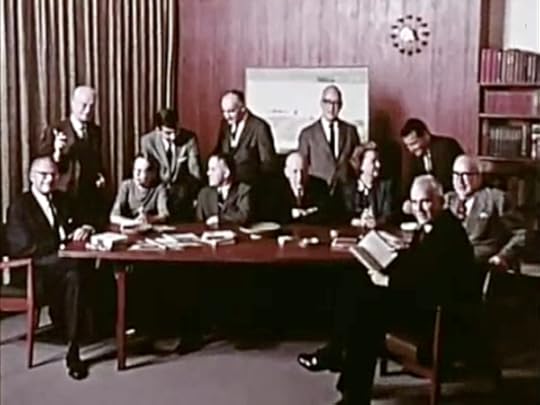
I remember seeing the above picture in magazines that my aunt sent to my mother after she had finished with them. I was young & naive to think of how kind these famous authors (although at the time Bennett Cerf was the only one I had heard of) were to impart their skills to beginners.
& these writers were rash enough to sing like canaries when Jessica interviewed them!
"If anyone thinks we have time to look at the aptitude tests that come in, they're out of their minds!" Bennett Cerf.
Phillis McGinley "...Of course anyone with a real gift for writing wouldn't have to be taught." This fine establishment eventually went bankrupt.
My other favourite was about hoity-toity New York restaurant The Sign of the Dove After Ms Mitford wrote a critical article about an unpleasant experience dining there, the restaurant & people associated responded by trying to imply she had been drunk. This is never a good idea when dealing with a combative (but charming) journalist who is married to a lawyer. You could feel Mitford's glee when she took them apart.
Jessica Mitford (1917-1996) began writing articles when she was 40; this engaging collection has several must-reads, as well as some fizz for contrast. Each concludes with a COMMENT section in which she discusses the development, research, writing of the accompanying piece, her satisfaction with the edit and, where necessary, how she might have improved it -- all modestly presented. In sum, it's a very good course in journalism 101 unto itself.
The gem herein is her exposure in 197o of a highly publicized group called "The Famous Writers School," which - for a fee - would like to help you find out if you could be a successful writer. Bennett Cerf, head of Random House, a columnist and TV panelist said in ads that he and his colleagues, which included Faith Baldwin, Clifton Fadiman, and Phyllis McGinley, among others, would be right there as mentors. A 72 year-old widow put down her entire bank account for the course, then decided she really needed to eat and asked for her money back. The School refused...Mitford heard about it, got on the case and : look out, soon, with Mitford's scrupulous investigation, The School was exposed as a fraud and went out of business. Most embarrassed of all was the toothy a/hole Bennett Cerf who got the piece cancelled from McCalls Magazine, but Jessica later published it in The Atlantic where it provoked a sold-out issue. "I've nothing to do with how the school is run," Cerf said and then, asked why he lent his name, added, "I'm an awful ham -- I love to see my name in the papers!" (In 1969, tuition revenue for The School zoomed to $48m). Cheers for Jessica Mitford--. Bennett Cerf died a year after the article was published. Good career move, and, oh yes, his name was in the papers.
Another fine piece, from 1965, explains how the TV producer-writer of an NBC medic show, "Mr Novak" wanted to do 2 episodes on the dangers of syphilis, aimed at schoolkids, parents, teachers. Just before the shoot was to start, NBC cancelled the project. The subject was deemed too clinical. Mitford went on an unsuccessful search for those the program would offend. You'll also be entertained by her short life as Distinguished Professor at San Jose State University (Ca) where she was up against deplorable academic bureaucracy.
One night, 1977, she took a NYC friend as guest to the now-closed Sign of the Dove (over-priced) restaurant on the Upper East Side. She didnt have enough cash and carried no credit card, so wrote out a check. The management wouldn't accept it. A burpy operetta ensued. What happened? You'll have to read the book.
I cannot imagine why I have never read this before, given my Mitford sisters mania, but it was, as I hoped, utterly fabulous. It has not only Decca's most famous pieces, but also her comments on how she wrote them and what the reaction to them was. Her turn of phrase is, as always, hilarious and pointed, and her investigations unflinching. I think I most enjoyed her takedown of Bennett Cerf's Famous Writers School (entitled "Let Us Now Appraise Famous Writers"), but everything here is simply marvelous to read, essential for both Mitford fans and those interested in great muckraking journalism.
Premier muckraker Jessica Mitford (yes, those Mitfords), collects together some of her finest muckraking pieces and reflects on them too.
The essays were easy, amusing, and informative reading - I certainly enjoyed this glimpse at the everyday concerns of mid century America, and Mitford’s irony. Her follow ups to the essays were even better, because she is clear eyed in how she critiques herself, and it’s amusing the winding path some essays took to be written and published.
You can definitely tell though, as she says, when her essays fall a touch flat - instructive to analyse, but not as fun to read. Still, I think I would have had a good time in her Intro to Muckraking course.
This was truly an interesting read, despite the very datedness of the articles featured herein. I was directed to this book by an article that covered modern scams which prey upon writers' insecurities. Mitford is well-known among publishing circles as the journalist who took down the Famous Writers' School, which was sort of the grandaddy of writer-scams. I wasn't born until 1970 but my grandparents saved a stash of old readers' digests and Saturday Evening Posts. Every summer when I'd visit their farm for two weeks (and every Christmas, Thanksgiving and Easter) I'd devout those old magazines. They were like time capsules, with timely articles about events in 1964 or 1952. The other interesting feature was the advertising. Scattered among the girdle and oven-cleaner ads were the ones offering you the opportunity to submit a brief essay to be considered for enrollment in the Famous Writers School. If selected you could begin your journey down the road to phenomenal riches and glorious fame, or so they said. In my mind this school and writing as a career were thus inextricably linked for years. Thankfully I got common sense enough to not commit funds to it myself...not that it would have mattered because Mitford's exposé on the school effectively shut the place down. Awwww.
That expose is in here, along with many other of her articles. Mitford was 20/20 and Dateline before those shows were dreamed of, and it's enjoyable to read her various pieces. Not only because you see the precision with which she used her pen to destroy the destroyers but also because most of the events are very much of their time. It's a glimpse of a certain part mid-20th century life that one doesn't find many places.
Writers will find special interest in the both the book's introduction and the afterwards appended to each of the collected articles. Mitford introduces the book with an overview of her start in the business, her advice for journalists and anecdotes about her successes and failures in that career. She then collects several of her most noticeable articles, ending each article with a summary that critiques the piece with the experience of hindsight. She also offers details about how the piece played out in the real world and the various consequences that resulted. I highly recommend this for pretty much anyone with a curious mind.
Marvelous snark on all sorts of topics, ranging from the funeral industry to diet resorts to Eqyptologists. It is a fine primer for aspiring journalists and highly amusing good fun for the rest of us. Now I want to go read more Mitford.
Jessica Mitford is most famous for her classic expose on the funeral industry “The American Way of Dying”, which earned her the title “queen of the muckrakers” those journalists who expose corruption and swindling among the powerful and the profitable. Before her American success she hailed from a distinguished British family of accomplished sisters. This is a collection of some of her journalism with comments on the behind-the-scenes process of reporting. Stand-out pieces: “You-All and Non-You-All” is a log of her travels around the South in the 1960s, speaking to racist country club folks as well as white society ladies who acted in solidarity with the Civil Rights Movement. “Let Us Now Appraise Famous Writers” is her takedown expose of a correspondence course in writing, precursor to today’s for-profit colleges. Her piece on teaching for a controversy-marked semester at San Jose State is hilarious. This short book is recommended, but non-required, reading for aspiring journalists.
Wonderful reminisces of mitford’s time as a muckraker taking on the usa death industry, the usa prison industry, frenemies, bad restaurants, and much more, all told in her bright, somewhat surprised sounding, but posh prose. She went to fight against franco when young.
Jessica Mitford. Poison Penmanship: The Gentle Art of Muckraking . New York: New York Review of Books Classics. Reprint, 2010.
Though her work was better known in the 1970s, Jessica Mitford is still worth reading today. Mitford was born into an eccentric English aristocratic family; two sisters, Jessica and Nancy became writers, while two others, Unity and Diana, became notorious for their pre-World War II support of Adolf Hitler. In 1939 she moved to the United States and it was here that she became a writer.
Poison Penmanship, first published in 1979, is a collection of Mitford’s articles published in magazines such as the Atlantic, the Nation, and the New York Times Book Review. Her books, The American Way of Death (on the funeral business), and Kind and Unusual Punishment (on prisons) may be better known than her brief works. Subtitled The Gentle Art of Muckraking, Poison Penmanship will be a delight both for the reader who may remember her books and for those young writers and readers interested in a close up view of a writer’s career.
Mitford begins the book with an introduction which discusses a number of issues relevant to writers (and I would add, to lawyers) including picking other people’s brains, trade magazines, interviewing, blind alleys, organization, style, editing, libel, and luck. On the issue of libel, Mitford (herself married to a lawyer) comes down hard on lawyers who practice in this area:
"To the extent that I have had dealings with this curious subspecies of the genus lawyer, which breeds and proliferates mainly in the swamplands of Eastern publishing centers, I have concluded that their main function is summed up by the title of a recent best-seller: Looking Out for Number One."
Mitford goes on to suggest that libel lawyers see defamation everywhere mainly to protect themselves should a potential plaintiff claim libel. “Thus, in one effortless operation he protects himself and garners a fat fee.”
Knopf’s libel lawyer listed thirty-four potential libels in the manuscript of her book The Trial of Dr Spock, beginning with “Page 1, para.1: It is alleged that Mitchell Goodman, Michael Ferber and Marcus Raskin were codefendants with Dr. Spock and Rev. Coffin, which would be libelous if untrue…,” One can imagine the steam coming from her ears as she replied: “Page 1, para 1 – that’s from the indictment, which lists the codefendants….”
The bulk of the book consists of seventeen published articles arranged in chronological order, from her first published piece, “Trial by Headline” (the Nation, October 26, 1957) to “Egyptomapia: Tut, Mut, And the Rest of the Gang,” (GEO magazine, 1979). Each essay is followed by Mitford’s comments specifically written for publication in the book. While it’s easy to imagine writers being critical of their early works, few ever publish those critiques. Her trenchant analyses are often full of dry humor. In her comments on the essay “Trial by Headline,” Mitford evinces unmerciful judgment on her first published article:
"Why those oddly short paragraphs, having nothing to do with the change of subject, which I have since learned is the whole point of paragraphs? ….Also, I regret those exclamation marks, which strike me as a form of unnecessary emphasis. …Why did I not seek to interview the principles of the story…? I supposed I assumed they would rebuff me and refuse to answer questions. I now know better. It is a rare and exceptional individual, in almost any line of work, who will decline the opportunity to expound his views to a reporter."
First published in 1979, it is no surprise that parts the book seem dated. In “Proceed with Caution,” Mitford describes a humorous mechanism from an era when long-distance phone calls were very expensive. When calling home “collect” (does anyone under age 30 remember this?) ask for a fictional person whose name suggests that the caller has arrived somewhere. “Person-to-person, calling collect for Minnie S. Oder,” suggests the caller has arrived in Minnesota. Ms. Oder, of course, is never available.
Perhaps Mitford’s most famous essay is “Let Us Now Appraise Famous Writers,” a damning appraisal of the Famous Writers School where a dozen or so famous writers of the 1960s and 70s formed the Guiding Faculty of the Famous Writers School. The guiding faculty, renamed by Mitford as the Famous Frauds, turned out to have done almost nothing — no curriculum, no teaching, no critiques,—except collect their fees. After testing the aptitude of potential students — almost everyone was accepted — a salesman would come to applicant’s home and hard-sell a very expensive writing classes. Students paid up front and then wrote essays, which were mailed to the school. There a phalanx of adjunct instructors using automated typewriters sent copious boilerplate criticism back to the aspiring writers. The 90% of students drop out but prove unsuccessful in obtaining refunds. “We couldn’t make any money if all students finished,” admits one of the Guiding faculty in a surprising moment of candor..
In her comments on this essay Mitford explains how the Famous Writers School declared bankruptcy soon after the publication of her essay only to be reborn three years later using the same discredited techniques.
In “My Short and Happy Life as a Distinguished Professor,” Mitford writes of a year spent as a visiting professor at San Jose State University teaching a course called the American Way. There, before classes start, she is asked to sign a loyalty oath, a requirement under the California Constitution, and to be fingerprinted, which turned out to be a policy created somewhere in unwritten university history and not a statutory or constitutional requirement. The remainder of the essay plays out what happens when she refuses to sign the oath or get fingerprinted. In the comments to this essay, Mitford points out that what looked like a success turned out to be a muckraking failure:
This, an example of muckraking that not only fizzled but backfired, illustrates the limitations of the genre: absent an ongoing protest movement which in this case failed to materialize, the mere exposure of bureaucratic absurdities is insufficient in and of itself to force change.
Mitford ultimately did sign the loyalty oath, after posing several unique arguments. The oath requires upholding and defending the US and California Constitutions:
[The California Constitution annotated] runs to three hefty volumes and covers all manner of subjects. Do I uphold and defend, for example, Article 4, Section 25 ¾, limiting boxing and wrestling matches to fifteen rounds. I don’t know. Perhaps it should be fourteen, or sixteen? ….What if I strike out the words “freely and without any mental reservation’ and substitute ‘under duress? No, that won’t do, [Mitford was told] you can’t tamper with the oath. Then…you are requiring me to swear falsely as a condition of employment?
Mitford prevailed in court in her case against fingerprinting. When Mitford later checked on the status of fingerprinting new faculty members, she found that California universities merely changed their policy and ensured that the new hires get fingerprinted before they start working. In fact, some universities that had previously not enforced the fingerprint rule started to do so. All these machinations played out in front of her students and perhaps that proved to be best education for budding investigative reporters. Mitford died in 1996. She was the sort of person I’d love to sit next to at a dinner party, well read, broadly interested in the world, and with a rapier wit. When one considers the current crop of journalists that make up the Fourth Estate, the shenanigans behind News Corporation’s News of the World telephone hacking, and the polarized talking heads of cable-TV, one longs for another well-written muckraking essay by Jessica Mitford.
Jessica Mitford is a self admitted muckraker, once she found out what the label meant, she heartily agreed and called herself such from then on and was happy to see that each new dictionary had a nicer take on the word as it became more commonly used. In 1957 she published her first expose, which, as she was willing to admit, was rather dull and fell flat. Yet that is the charm of this book. Jessica views this book as a kind of "how to" for the muckraker to be. She details her techniques and theories of friendlies and unfriendlies and then after you read a given article of hers, she has a little commentary on how she felt the article worked or didn't work, and in some cases, the far reaching consequences of that article. Therefore, without any hesitation, she republishes some very slip shod work, and she agrees that it is such. Yet how are we to learn if we don't see her mistakes along the way.
For Jessica there where many mistakes, even later in her career there are articles that fall dreadfully flat, while others sparkle with her wit and wisdom. To say this is an uneven book would be an understatement. For me, being a worshiper of her autobiography Hons and Rebels, it was interesting reading Jessica's writing over a twenty year period and seeing how she was able to find her voice. Her first articles are so stiff and uninviting. Plain facts infused with no Mitford wit. Yet, if you look at the articles that fail versus succeed, you can see a pattern. The stories she was more involved in have a great depth and a personal feel, like a diary. Jessica's style not only lends itself to this way of writing, but it feels as if she was made for writing memoirs and autobiographies. You feel as if you are gossiping over tea as she is telling you about going to the extravagant Maine Chance Resort run by Elizabeth Arden, not reading an article in McCall's. Or as she tells you how important life long enemies are and that Liberace was really excited to hear her ideas about his role in the adaptation of Evelyn Waugh's The Loved One. These stories make the book enchanting to read. Though it's not all tea and biscuits with the Hon.
The article, "St Peter, Don't You Call Me" is one that sticks out because it was what would become the basis for her famous book, The American Way of Death. At this point I will admit that I have not read this yet, seeing as funerary exposes are not exactly "my thing." Yet, seeing as it was written by Jessica Mitford, I will admit that I will eventually get to it, it's waiting on my shelf for me even now. The article though is so stiff and boring that I wondered, would the book that came from this article be like this. Later though she includes three more articles about what has happened since the first article spurred the book and therefore changed her life. These articles, written five years later, have more of her conversational style that I love. Which makes me wonder... was her style still developing during the time of the article and therefore the book will be fabulous, unlike the article, or was it just the freedom of being done with the book that let her sink back into her witty patter? Because, if I could get more stories about Pet Cemeteries and directors running wild in funeral parlors, sign me up.
One thing that nagged me though was once she was known for The American Way of Death she wouldn't shut up about it. It didn't feel like she was inflating her ego... but that she was riding the books coattails was very evident. Her teaching and anything she was to speak on was all "The American Way of..." I felt a little sorry for her that this book had so become synonymous with her name that they became inseparable. Yet she didn't seem to mind. I think I might have minded a little... or at least stopped harping on about it. Though she went on to do several other big exposes, from the deathly dull expose on the Famous Writers School, to prisons and policies existing in California Universities, to me it was the little stories that I loved best. The rude treatment at a restaurant, the little things that lend a similar feel of Helene Hanff to them, who is another author whom I adore. Though, in the end, it was of course the article on Egypt that kept me way up until the wee hours. While she thought it a failure of an article because she didn't rake any muck, I felt it wonderful, because it was just what I loved about this book, a little diary about an English woman in Egypt immune to the Eyptomania as she called it, which sadly, I think she would diagnose me as having.
I have read two of Nancy Mitford's novels and perused several biographies of the Mitford sisters but wasn't really motivated to pick up Jessica Mitford's writing until I read that JK Rowling (an author I've never read but whose career interests me on a feminist level) called her her favorite writer. Then my boyfriend brought home this book as a gift for me.
I was really pleased by it and I'm now somewhat baffled as to why Jessica Mitford is not as widely read as a lot of the other journalists cutting their teeth with essays amid the political turmoil of the late 60s and early 70s (ok, not really - obviously it's because she's a woman, and was a middle-aged woman when she wrote these pieces to boot!). It might be that despite her unerringly American sense of optimism for social justice, there is something classically British in her approach to these subjects - she is never preachy or "fired up", but reserved, letting the events she covers speak for themselves, and even on the topic of more harrowing events (such as a night spent in an AME church with MLK during a race riot, where her borrowed car was torched and flipped over by an angry white mob) her narrative voice is sharp and witty instead of somber and moralizing.
I appreciate her wit, however. Jessica Mitford is most remembered for her battering o the American funeral industry (which she frequently revisits in her essays) but the essay in this book that struck the biggest chord with me was her personal account of a brief job teaching at San Jose University in the early 70s. I won't go into too much detail about the essay, preferring people read it themselves - but this essay was in many ways the most poignant & the most heartbreaking essay in the book, and so sharply illustrative of how conservative backlash began to crest against the New Left in the 1970s. I think it would reasonate with anyone who has ever agitated for social change and been disappointed with the longterm results.
Highly recommended for other leftists, journalism students & journalists (there are lots of little tips on how to dig for dirt on people!), fans of dry English wit and people interested in first-person accounts of this time period.
Jessica Mitford was born into an aristocratic family of stunning privilege and inborn conservatism. Her sister Unity was in love with Hitler and became part of his inner circle, and her sister Diana married one of Britain's most prominent fascists. Jessica, a devout communist, ran away to see the Spanish Civil War and ended up becoming a muckraking journalist in America. This collection gathers many of her most famous pieces: an expose of a correspondence school scam, exposes on funeral home overpricing, inquiries into various scams she encountered, and even a piece about her first foray as a professor (and how she took the university to court for requiring fingerprints and a loyalty oath.) Each piece has later commentary appended at the end where she describes the origin of the subject, the methods she used to investigate, and the outcome of its publication.
Mitford was a great wit and her wry tone and sense of justice underlies all of these pieces. One of the most scathing is a piece about her journey to the South to document the Civil Rights movement's reception from local whites...who turn on her after finding out she is a dreaded radical. As always, NYRB has curated a very enjoyable read.
Delightful window into someone else's journalistic practice (the explanatory notes at the end of each piece about how it came to be written and sold, and what the process was like, were so welcome. It's the kind of thing I've always wanted attached to most of the feature articles I read). Practical and entertaining. Also a window into writing and life in the pre-internet age (I liked the chronological order of the pieces, late 1950s to late 1970s). Carried along on torrents of its author's personality, an interesting and mostly charming blend of humor, self-confidence, hard-headedness, and mega energy. Recommend for journalists in search of inspiration, guidance, chicken soup for soul.
I'm a big fan of Jessica Mitford, especially "Hons and Rebels." I love her humour and feisty attitude to life. This book is a good overview of the writing she did in the USA, on the funeral industry, her time as a visiting lecturer at Yale, working in the Civil rights movement in the southern states, investigating the mail order teaching business (hilarious) and various other activities that have not been written up as books. A great read.
The two books my mother paid full price for to give me were Stella Gibbons' _Cold Comfort Farm_ and Jessica Mitford's _The American way of death_. I fell in love with Mitford (and to some extent her famous sisters), and especially her, as she calls it, muckraking journalism. Her memoirs Are fascinating, but I particularly love writers, journalists, who don't have an agenda beyond truth and curing the injustice often caused by lies.
Jessica Mitford published two memoirs, Hons and Rebels, and A Fine Old Conflict, before Poison Penmanship, and in a way this collection of magazine pieces works as a third: a memoir of the writing life. It’s also something of a journalism manual, beginning with a great introduction and following each piece with comments and criticism from Mitford, in which she often kicks herself for missing an opportunity here or there, or wishes she had structured her story differently. Above all, the articles are hilarious. “Maine Chance Diary,” “My Short and Happy Life as a Distinguished Professor” and the two Sign of the Dove pieces in particular are as funny as anything in A Supposedly Fun Thing I’ll Never Do Again. Any way you read it, and whatever you take from it, this book is a joy.
I've been reading this off and on for five years, which is less a commentary on any problem with the book and more on my perverse desire to endlessly savour Mitford's perfectly-pitched acidic tongue and inimitable brain. This collection of her muckraking articles is delectable and endlessly fun, particular with her included endnotes that explore the fallout post publication.
(One minor caveat: the final Egyptology essay is a bit moribund by comparison, which she cops to in her endnotes. Consider it a closing exhale in which you realise that this phenomenally gifted writer is, in fact, capable of writing merely at the level of a talented human on her down days.)
Ahhhhhhhhh Jessica Mitford. A hilarious, brilliant collection of articles she published over a long career, along with her commentary on them. I’m desperately jealous of the students who got to take classes with her, and I wish I’d gotten to meet her and have tea. What a brilliant lady.
I really enjoyed this, despite how long it took me to read. Some of the pieces are dated and uneven, some are really interesting, but the comments after each are really excellent even if the articles aren’t.
I looked for a copy of this book in my favorite used bookstore, but to no avail. The kind woman who tried to help me find it agreed with me that Jessica Mitford is a great writer. "But a horrible person!" she insisted. I think she may have confused her with one of her sisters.
THIS Mitford is the ex-communist, Americanized, very amusing muckraker. This book contains not only some of her best essays (with her own criticism of them), but a cleverly-interwoven thread of instruction on how to rake muck (and write well). Her targets are wide-ranging but all-deserving, including university bureaucrats, rude restaurateurs, the Famous Writers School, TV censors, and, of course, funeral directors. It's easy to take it all lightly, since even if you don't care about the topic, her prose is light and funny; but read her brief talk with George Jackson and see how strong and serious her values were.
I thought of giving it only four stars, since a couple of the essays seem less to the topic at hand. But I know I'll want to go back and read the rest again numerous times. She makes it seem so easy and tossed-off. What a gift.
Highly readable seminar on muckraking. Each piece is accompanied with commentary on Mitford's perspective on strengths and weaknesses in the piece, including successful tactics and tidbits she's devastated to have missed. This also means she includes weak, petty, and failed pieces--some are instructive, some should probably be skipped altogether. Many of these pieces seem oddly modern and current--though more conversational than we usually tolerate in journalism today.
The pieces' continued relevance, and the places where muckraking failed to produce lasting results, provide insightful case studies for advocates on the strengths and limits of investigative journalism.
Reading Mitford felt like rediscovering an old friend, though I had never read anything by her before. I tore through the book and at the same time really didn't want it to end. Wondered if it might not be too late to embark upon a career in muckraking journalism. It's absolutely delightful to tag along as Mitford sinks her teeth into a juicy enemy and exposes them for all they're worth. Really great stuff.
Really delightful and funny. She put in her unedited manuscripts for articles that ran in various places and then commented on the articles and why she thought they were interesting and relevant and what was cut by the editors and why she thought things were cut and changed. Also tips on how to write like Jessica Mitford which really more people should. Every article was fascinating and funny. The dated stuff read like a snapshot history of a time. So engaging.
A wonderful primer on muckraking, a.k.a. "investigative journalism." Mitford writes with humour and style on a wide variety of topics, from her misadventures upon refusing to be fingerprinted at San Jose State University to desegregation in the South to the high-pressure sales rhetoric of the funeral industry. This collection of articles published from the late 50s to late 70s includes a great introduction elucidating her research techniques and writing method. Entertaining and illuminating.
Jessica Mitford is at her funny and wicked best here. From racist whites in the Civil Rights era to the snobs at the Elizabeth Arden spa, Mitford skewers many here and seems to have had an fantastically fun time doing so. The essay on the "Famous Writers" course is the best.
A wonderful book on the craft of investigative journalism. Jessica Mitford, a fascinating woman with an extraordinary life, demonstrates perfectly that the job of a journalist, or a muckraker, as she preferred to be called, doesn’t have to be a lifeless and boring amalgamation of facts and quotations. Her humor is top notch, as well as her hunger to tell stories that bring some sort of reckoning on topics that are frequently thought of as taboo, or even worse, too small for a journalist to cover. One of the best parts of the book is the commentary that accompanies most pieces where Mitford describes how she got the story, her investigation process, her failures along the way, and the aftermath of publication. All in all, a fantastic book that can teach young and old journalists new tricks and, above all, not to take themselves too seriously.
A fully enjoyable read. Wit, tenacity, well constructed sentences and pieces, with a bit of humble self criticism in her editorial commentary on the origins, process, or results of a piece. Plus a does or two of insider, journalism insider gossip. Only the Egytpomania and the George Jackson articles failed to engage me. A near total delight start to finish.