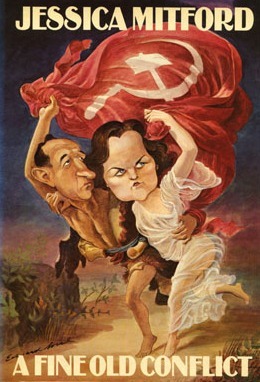
The famous, once-notorious, still-controversial writer and political activist chronicles her girlhood in England, her years with the American Communist Party, and her latter-day adventures as America's premier muckraker
Jessica Lucy Freeman-Mitford was an English author, journalist and political campaigner, who was one of the Mitford sisters. She gained American citizenship in later life.
At times I found myself getting annoyed with Jessica Mitford to downright angry while reading her second memoir. A Fine Old Conflict is about her life in the America communist party, her problems with the CIA as a result and her later career as a muckraker. The highlight of the book was her romance with her husband Treuhoff. She shared her sister Deborah's tendency to name-drop the various famous people she knew in her life but at least she didn't thank the people who picked out tea cosies.
Her opposition to fascism was admirable but she ignored obvious civil liberty violations at the hands of communist regimes. I couldn't help but wonder how she would've felt if she actually lived in Hungary. She decided the plight of the three individuals who came to her for help were working with fascists and that the students deserved to be killed in the uprising. Now it's possible she would not have seen a problem from being on the "right side" due to the horrid statement many explain lack of civil liberties and privacy with. The old "If your not doing anything wrong you have nothing to fear" but her own situation in the U.S.A was very similar when you think about it. I'd go as far as saying it's eerily similar to how the East Germans were being treated. The communist party [as ineffective as it ended up being] was filled with spies and informants. We know from history that you could be totalitarian and communist at the same time. Decca never admits this and her own son goes to Cuba to work in the '90s well after the practices of the DDR were exposed. She had time to learn about the gulags in '96 but she still stayed to true her lifelong belief. Her beloved sister Unity's nazi party had social economic policies after all. I am stressed to find any real differences between their two political beliefs. As children they split their rooms up and decorated them with Soviet and Nazi icons. I guess people are not just going to admit both sides were wrong.
The wiretapping scandal that came out under the Bush administration and the one about to be made legal under Obama came to my mind while reading this book. The anti communism and cold war almost landed Decca in a detention camp. After it was discovered exactly what the wiretapping was used for [to ruin political lives and find dirt on Martin Luther King] FISA was created. FISA made warrant-less wiretapping illegal. Too bad it didn't stay that way.
Now our president has made that a thing of the past and our government can [legally] spy on it's citizens for the very things they were doing during Decca's time in U.S.A history.
When she was given her cia files she discovered that JFK signed the order for her detention but she never went. GASP! It wasn't just the republicans who didn't care about civil rights. I wonder if her sister Diana's relationship with him helped her out there. Her cousin being married to Winston Churchhill and Decca herself being the widow of his nephew probably didn't hurt shielding her from what might have happened to her. Less connected people probably disappeared at the hands of the government.
People don't seem to care that detention without trial is against our constitution. America has come full circle. It's still both political parties who don't care and people are still operating under the delusion that it's just the republicans who don't. Republicans and southerners of course are the bad guys. A liberal would never...
That brings me to the other topic of the book that irked me. The nasty comments about Southern Americans was especially irritating. You can not explain the racial tensions in Oakland, California because many of the cops parents came from the South. If you look at what has happened during the Occupy protests I'm sure it's not more people from Alabama moving to California but an issue of power vs. no power. She admits they tried to manipulate people trying to actually fight to gain civil liberties and trick them into joining the party where the end game is the party is in power. Not an improvement at all. People aren't helping things by separating blue/red states, south/north, republican/democrat, communist/fascist, black/white etc.
On a different note.... Jessica made the comment that Americans don't like to be teased. Her own family were merciless to each other but when she moved to the states she found people couldn't take it. I find that over here that it's really that people like to tease others but can't take it themselves. Just because an American is mad someone teased them does not mean they aren't going to tease someone else. We have a saying that goes "He can dish it but he can't take it".
I grew up with three siblings and I was the brunt of most of the teasing. My oldest sister was quite like Nancy. She lied and exaggerated like nobody's business.
A Fine Old Conflict is the second of Mitford's lively and witty autobiographies; Daughters and Rebels covered her childhood as the fifth of the Mitford sisters and her elopement with and marriage to Esmond Romilly, and A Fine Old Conflict picks up the story just before Romilly's death in action in World War II.
In an astonishing contrast to her fascist and Nazi-sympathizing sisters, Diana and Unity, Jessica was a committed Communist (causing a lasting rift in the family), and this book is largely about her experiences in the American Communist Party, as well as her marriage to American attorney Bob Treuhaft and the publication of their famous muckraking book about the American undertaking industry, The American Way of Death.
Jessica Mitford (aka Decca Treuhaft) tells a fabulous story about her life and adventures in the American Communist Party in the 1940s and 1950s. Married to a comrade, with comrades for children, she takes a humorous and serious look at the Party and the idealists who worked so hard to make America a better place.
Born into the British aristocracy, but denied an education by her parents, Decca is one of the notorious Mitford sisters. She runs away to the Spanish Civil war with her cousin Esmond Rommily, whom she marries when she's 19. She comes to the US via Canada, loses Esmond to WWII, mixes with the liberal elite in DC, migrates to California and marries Bob Treuhaft, a fellow traveller. Her life goes very fast.
Decca's CPUSA strongly foreshadows the sixties Civil Rights movement that characterized the presidency of Johnson and the dreams of Bobby Kennedy and Eugene McCarthy. The Hippies were the natural heirs to Communism, and it was only during the 60s that being a Left winger -- being like a Communist -- was acceptable to America's youth and some of its elders.
The Mitford sisters followed their hearts....to love, to Nazism and to Communism. It is hard to say which sister is the most fascinating. But Decca is certainly the one that can appeal to Americans of many ages.
Mitford's wit is my favorite aspect of this memoir. It is fascinating to read about the Communist Party in the United States in the 1940s, 50s, and 60s from the perspective of someone who was an unashamed, unapologetic member. So often, when writers look back on their political lives, they adjust their behavior to accommodate currently popular viewpoints, but Mitford makes it clear that she believed in what she did. Nearly all of the book is composed of her activities in the Communist Party and the hysteria in the U.S. from the House UnAmerican Activities Commission. It's important not to forget what happened in that time, not only to those falsely accused of being Communists but to those who actually were (and should have had every right to be) Communists. Revealing that the same kind of witch hunts go on today. Maybe the "what" people are accused of being or thinking shuffles a little, but the belief that dictating what a U.S. citizen's opinion ought to be (and to think otherwise should be punishable) still exists.
Jessica Mitford got it wrong right from the beginning!!!
As a teenager walking with Nanny or governess in Hyde Park, London, she would wander off to listen to the Communist orators and join in the singing of the stirring anthem 'The Internationale'.
'Tis the final conflict, Let each stand in his place, The Internationale Shall be the human race...
However, Jessica always sang:"It's a fine old conflict..." and that is what she has titled her book, a biographical history of the American Communist Party, (U.S.A. , that is.) As far as I can see that is the only mistake Jessica ever made. And even THAT is an improvement!!!!!
This is not a dry old history. This has verve and sparkle and humour and wit. Because it has Jessica. Born into a most interesting landed gentry family who seem to have been mostly quite mad and loving and have all become famous, infamous, and written and been written about loads, she yet had the good sense to abandon it and follow her love, Esmond Romilly, to the Spanish Civil War.(She never did anything by halves!!!) Before she met him, she already had her own plans re getting to Spain's War and had a goodly 50 Pounds in her Running-Away Account.The only problem was that she was going to join the Loyalists and her Esmond was a radical Communist. He was also Winston Churchill's nephew and 18 years old. She was 18 or younger. They eloped and finally landed up in the USA. Both Communists. Esmond was killed early in WWII and Jessica and child ended up with the intelligent, loving and funny Bob Treuhaft, Jewish and Communist too.
Well, why tell you any more about this intelligent and rollicking book. A fascinating inside history of the much-maligned American Communist Party which did so much for Black Civil Rights and of two of its leading lights, Bob and Jessica, who left it after the Hungarian Invasion of 1956. I made one serious attempt to vote Communist. I was 21 in 1968 and was nearing the end of my time as a Catholic monk. Having read The Acts of the Appostles and endorsing the communal living espoused by the First Christians ( although pretty much loathing my own Community Monastic Life), I decided that my first act as a voter would be to bed with the Reds.Imagine my chagrin to find that the voting booths in Melbourne's then rustic outer suburb of Templestowe had nothing as exotic as a Communist Candidate, just the familiar Labour and Liberal.I have no memory of how I voted but I can remember my bitter disappointment. I have been a Communist sympathiser ever since, although like Jessica and Bob I left it in spirit, knowing its ideals were well and alive elsewhere. As Jessica said: A Fine Old Conflict!!!!
Jessica (Decca) is probably the most likeable of the Mitford clan--at least of the famous ones: she's not a fascist, a Nazi, or a very arch, cruelly brilliant novelist. Instead, she was a very committed Communist, which she makes seem like a lot of fun to be. It's not that she doesn't take the Party and its purposes (particularly civil rights) seriously--it's that she doesn't see why that precludes funny anecdotes or self-mocking humor. This book is not as much fun as "Hons and Rebels," simply because her life became rather more normal the further she got away from her family. But it's breezy and fun and makes Communism in the 1940s and 50s seem like a lark and a valid option--even a necessity--which is more than anyone else has done for me.
A fascinating book telling the story of a very aristocratic English woman's life in the Communist party in California and her view of the involvement of the state (FBI and House Committee on Unamerican Activities) against her as a threat to society and the overthrow of the American way of life. For someone who had no formal education she writes well - indeed pretty well everything she wrote is a page turner. Worth reading both as an account of her life and of subversion in the 1950s and the quite strange insecurity of a prosperous democracy. Indeed it seems that the perception of communism a threat still abides in some US politicians and clerics.
Interesting and entertaining slice of history of the Communist Party USA, amusing and sympathetic, plus the author's eccentrically unique background and life.
I read this biography immediately after finishing "Hons and Rebels" which to me, read like a love letter to her late husband. "A fine old conflict" was a lot harder to get involved with. Not having many sympathies with the concept of communism I found this book tough going and found myself truly entranced when she related more personal "adventures" such as meeting and marrying Bob and her journey back to England. For me that was when Jessica Mitford truly shone. I am very ashamed to admit that for the longest while she was often my least favourite Mitford, but after reading both biographies and her letters in the collection of the letters by the six Mitford sisters I have the utmost respect for her. I have developed a fondness for her and although I don't agree with many of her decisions I respect her for the events she related in the biography. On reading "A fine old conflict" I gained more of an understanding on why she felt socialism and communism were right for her and I can safely say she is no longer my least favourite Mitford. Her style is just as engaging as her sisters' and her wit just as sharp as Nancy's. It is with great excitement that I freely freely admit I am looking forward to reading her letters.
Oft humorous memoir of the author and her husband's involvement with the Communist party in the US during and just after WWII and the resulting estrangement from her titled family in England. Peopled with other leftist bigwigs and leaders in the labor movement.
“A Fine Old Conflict” is Mitford’s memoir of her time in the U.S. Communist Party, the generally irreverent tone of which can be deduced from the fact that the title comes from a misunderstanding of the lyrics of the Internationale: it actually is “a final conflict”. Not that Mitford is apologetic about having been a member, and it doesn’t really seem that she has any reason to be. From the vantage point of three-quarters of a century, it’s pretty clear that in this time period the CPUSA was dedicated not to the revolutionary overthrow of the American government but to a program of entirely sensible reform. Mitford herself spent most of her time as a party member doing civl rights work as executive secretary of the Bay Area chapter of the Civil Rights Congress. The one time she comes off as somewhat Stalinist is when she visits Hungary in 1954 or so, and thinks that everything is great. In the U.S., though, she has a much better grasp of the political situation, and when the Party doubled down on Stalinism following Kruschev’s revelations, becoming ever more rigid, sectarian, and humorless, she (and her second husband, Robert Treuhaft) quit. The humorlessness was, one imagines, quite important for her, because Mitford has an excellent sense of humor and the book is frequently hilarious. Mitford is just as good of a writer as her novelist sister Nancy, and has a fund of great stories, all well told. Even the trip to Hungary includes the very funny story of how she, her husband, and her kids managed to get passports from the McCarthyite State Department, and then inveigled their way into Hungary — they started the trip by visiting Mitford’s family in England (and in Nancy’s case, Paris) — by claiming that the family friend they were traveling with was Paul Robeson’s niece. (I admit that this last part is somewhat implausible, but it’s funny enough that I didn’t care.) And it’s not a purely political memoir either, though for committed Party members the personal often overlapped with the political. For instance, in an early chapter she writes about meeting her second husband via their war work. After describing her recollection of their meeting, she quotes from his description of it, written for his 25th Harvard reunion, and then sets the tone for the rest of the book by immediately dismissing his characterization of her as the most beautiful woman he had ever seen as an obvious exaggeration. There is, it must be admitted, nothing that quite matches the early chapters of “Hons and Rebels”: the childhood of the Mitford sisters (and brother), with its unusual mixture of intense strictness and total laxity leading to the development of a number of very strong personalities, is difficult to top for sheer entertainment value. But anyone who read “Hons and Rebels” will be very glad to learn that there’s a second volume of Mitford memoirs available, and won’t be disappointed by it.
A wonderful book for those who care, as I do, about the history of the Communist Party in the United States. Decca--the author's nickname--lived in the East Bay, and I was at her house and met her and her husband Bob Truehaft several times. Long-gone now, as my generation soon will be, her humorous kind and complex description of her own history in the CPUSA is invaluable for an understanding of the cruelty of McCarthyism in the forties and early fifties, a period that resembles the present in so many ways. Remember that Donald Trump was raised under the influence of Roy Cohn, cruel man, gay but not out, ally of J. Edgar Hoover, head of the FBI. Listen to Trump's diatribes against federal workers as he eliminated their jobs, as "communist agitators," with clandestine motives in addition to all their "waste, abuse and fraud." Allegations for which there is no evidence whatsoever, given that the CPUSA no longer even exists. Not to mention his threats to use "domestic terrorists," (read communists, the term he often adds) as an excuse to become full dictator of the U.S. The harshness of capitalism's pushback to any and all challenge lives on. But the actual communists in the Bay Area were and remained Decca's friends, long after she left the Party. She and they were real people trying to address real problems, and with some real success, despite the constant attacks. This book was old-timey and sweet, that resonated with my own childhood as a "Red Diaper Baby," without being about me or my family at all. Take a look. You might like it.
I followed this directly from having read Mitford’s 1st autobiographical work, Hons and Rebels, and recommend this as an approach.
The time between each book, 14 years (60 v 74), is evident as I found this a more studied piece compared to the relative pace of the first - less youthful energy maybe. To that end, A Fine Old Conflict is a more concentrated read, drilling into the minutiae of Communist Party (or CP front org) workings which at times I felt bogged me down. Nevertheless the vast majority of the book is full of fascinating detail and often remarkable events. There is a slice of history here that in 2024 may be repeating, and thus lends this book a more contemporary feel than I had expected.
My favourite parts, apart from the sheerness of the bureaucracy as described, are the recollections of family interactions (despite myself, aristocracy still fascinates) and the parabolic influence of HOUAC throughout the 40s, 50s and 60s - Mitford’s perspective shines a interesting light on a period I’m unfamiliar with. Also, the appendix on ‘L’ language is worth a standalone read if only to confirm that corporate (Comintern?) speak, and its practitioners, are always around us.
A lovely, unexpected, autobiography! I knew very little about Jessica Mitford, or her family, prior to reading this. I must say, that did make the beginning of this book rather confusing. With the aid of Wikipedia I was able to decipher why she was able to reference so many biographies written about The Mitfords. I do suppose that this is best read after her first biography (which I had not realized existed).
I first turned to this book as I was interested in learning about the 1940s Communist Party in America. The first half of the book speaks mostly about what led Mitford to become an American and a communist. The second half of the book goes into great detail as to what her life was like as a communist. I just adored it!
I would give it a 4.5 out of 5. The beginning was written as though you already knew a lot about her and her family which did disrupt comprehension. Also, she used many abbreviations for organizations which I found quite difficult to remember. Overall, I greatly enjoyed this book and I have the intention of reading more of Mitford’s books —along with those written by her sister Nancy.
Jessica “Decca” is one of the aristocratic Mitford sisters: one a famous novelist, two supporters of Hitler, one married to the leader of British fascism. This memoir focuses on Decca’s time in the Communist Party USA from the late 1930s-1950s. During the war, the widowed single mother Decca worked in the office overseeing price controls (along with John Kenneth Galbraith) where she met a Jewish lawyer who would become her life-long partner. They joined the Party in San Francisco, living and fighting for Civil Rights in Oakland. The best chapters narrate the internal dynamics of the Party—populated by dour misfits, Marxist Quixotes, and a core of Americans concerned with racial justice and class struggle. Mitford’s wry humor and upbeat tone is a poor fit in a movement that takes itself too seriously. Her flippant and jaunty attitude towards the Soviet project is unsettling. The last few chapters chronicle the writing and reception of her classic expose “The American Way of Death” (1963).
AFOC offers a fascinating peek into the goings on of mid-century Marxists. As many reviewers have noted, Mitford was largely oblivious to the glaring faults of communism, but in her defense was mostly in it for the most noble of reasons: anti-fascism and a commitment to civil rights for African Americans. (And - forgive my detour into what-aboutism, but what about the way so many non-communist writers of her era remained oblivious to the glaring faults of capitalism, racism, and imperialism and so on?). Her much vaunted wit is less in evidence here than "Hons and Rebels" yet still spices up the story quite nicely.
If you are a fan of Jessice Mitford tis is essential reading. It follows up on her first biography "Hons and rebels". There is much information about the communist party in the USA, which I found very interesting. Jessica Mitford is rather restricted in what she divulges about her life. The death of one of her sons is completely left out. She clearly does not like focusing on the deeply private and sad parts of her life. That said, it still provides an interesting and humorous glimpse into her fascinating life.
A clever, sardonic account of life within the American Communist party in the years following the Second World War. As such, it includes interesting lessons for true believers of whatever stripe. The chapter on the author's experience on a 'White Women's Delegation to Mississippi' to demonstrate support for clemency for Willie McGee is worth reading in and by itself. It has nothing to do with communism or the author's eccentric background, and everything to do with the history and reality of racism.
I loved her first memoir - Hons and Rebels - so purchased a used copy of this one (the second). there were lots of details about her involvement in the Communist Party in the U.S. I didn't find most of it interesting but did complete the book - as within there were glimmers of more engaging info.
If the author was as entertaining and exuberant as her writing suggests, she must have been a lot of fun to know. She even made American Communism sound like fun, and threw herself into seeking social justice and improving the lives of her fellow humans.
Tremendously entertaining while never selling the political substance short. Mitford's description of the work of the Communist-led Civil Rights Congress in postwar antiracist struggles is especially powerful.
Author Jessica Mitford was the lefty among the famous Mitford sisters. Born into the British aristocracy in the first decades of the 20th century, schooled at home, and destined for marriage to aristocrats, they were having none of it—except, ironically, Jessica, who did elope with her equally aristocratic cousin—to the Spanish Civil War.
A Fine Old Conflict is the chronicle of her years as a member of the American Communist Party. It picks up where her memoir of her youth and marriage, Hons and Rebels (also published in the US as Daughters and Rebels) left off. It portrays the Communist Party's big picture -- where the Party stood in relation to world Communism, world events, and US politics over the course of the 1950s and early 1960s. And, with Mitford's irrepressible humor and joie de guerre, it fills in the details of day-to-day Party participation, the fund-raising, secrecy, organizing, socializing and confrontation. Students of American history will also appreciate the chapters about civil rights and the House Committee on Un-American Activities. It is one of my go-to books for feeling better about the state of the world, politics and being female.
Although Jessica Mitford was an unabashed and dedicated member of the Communist Party, by this account she was never a blind follower of its doctrine, and her chapter about Stalin and her parting with the Party offer a sober counterbalance to her earlier devotion.
Although The American Way of Death established Mitford's reputation as a muckraker -- and she never shirks on research -- it is her buoyant humor that makes whatever difficult subject she takes on a pleasure to read about. I highly recommend A Fine Old Conflict.
I've read this before, but it must have been before I got a Goodreads. It's interesting to read it in the light of current political assaults on the less convenient parts of the US Constitution - depressingly, that part is no less relevant in 2012 than in the early 2000s. Parts are laugh-out-loud funny, and the bits about how she came to write Hons and Rebels are fascinating, but it's not essential reading in the same way as Hons and Rebels. But Decca's verve is as infectious as always, and her style as appealing.
(Goodreads, it would be fantastic if you didn't delete the text of my review when I try to switch editions.)