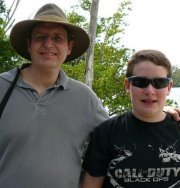
R(ichard) M(orton) Koster is an American novelist best known for the Tinieblas trilogy—The Prince (1972), The Dissertation (1975), Mandragon (1979)—set in an imaginary Central American republic much like Panama, the author's home for many years. He is the author, besides, of two other novels, Carmichael's Dog (1992) and Glass Mountain (2001), and (with Panamanian man of letters Guillermo Sánchez Borbón), of In the Time of the Tyrants (1990), a history of the Torrijos-Noriega dictatorship. Koster's approach in the trilogy is post-modern magical realism, reminiscent of García Márquez in its sometimes fantastical content. In The Prince, for example, conflict over an American military base near the capital of Tinieblas causes a "flag plague" in which activists break out in stinging rashes of their national colors. As García Márquez's translator, Gregory Rabassa, has remarked, however, "Koster’s magical realism was direct, not an imitation of anyone. He was there in Panama so he just fell naturally into it." In its verbal and structural inventiveness Koster's approach is sometimes likened to that of Nabokov. The Dissertation presents itself as a doctoral thesis with contrapuntal stories in the text and notes. Each novel focuses on a larger-than-life protagonist around whom the action revolves, as in a concerto for solo instrument and orchestra. The author himself likens the books to the panels of a triptych, "since each of the three is complete in itself and since they need not be considered in the order of their publication." Major characters from one book appear as minor characters in the others, and vice versa. The unifying "character" of all three is Tinieblas itself. The Tinieblas trilogy may be seen as an imaginative response to the unrest that convulsed Central America during the 1970s and '80s, and as an extended reference to the work of Niccolò Machiavelli. Each protagonist is a political leader, in The Prince an adventurer on the model of Cesare Borgia, in Mandragon a charismatic like Savonarola. For the protagonist of The Dissertation pursuit of powern is a disease, yet he accepts leadership when it is thrust upon him. Throughout the trilogy the wages of power is death, and there are many incidents of grim violence and grotesque humor, often combined.The tiology received considerable acclaim, including a National Book Award nomination for The Prince. Overlook Press is currently reissuing it. The Prince reappeared in March 2013. The Dissertation will be published in October, 2013, and Mandragon early in 2014. Koster was born in Brooklyn in 1934 and has degrees from Yale and New York Universities. He went to Panama as a soldier in the 1950s and has lived there since. He taught English at the National University of Panama, and from 1964 to 2001 was a member of the faculty of the Florida State University, serving at its Panama branch. He has lectured in English and Spanish at more than 20 universities in the United States and Latin America. In 2003 he was a visiting professor at Southern Methodist University. Koster has had parallel careers in politics and journalism. He was a member of the Democratic National Committee 1967-1996, served on many Democratic panels, and wrote presidential debate copy for Senator John Kerry in 2004. He has reported for the Copely News Service, Newsweek and the New York Times. Essays by him have appeared in Harper's, Playboy, and other magazines. Koster's work is deeply grounded in the western literary canon, though references tend to be playful not pedantic. In Carmichael's Dog (1992), which takes place in a parallel universe, characters quote the playwright Robin Speckshaft, creator of Malaspina, 'the gloomy duke' who had his dwarf strangled for making him smile. Koster's wife, Otilia Tejeira trained as a ballerina and later had a career as a human rights monitor. They have two children and three grand children.
Although it's one of the thickest, this was the easiest to read of the Panamanian history books I've gone through. I wasn't expecting a history book to make me laugh and cry like this did. Sanchez and Koster are so witty while exposing the dictatorship's follies you feel like you're reading about a bunch of bumbling second-rate bandits. Which you kind of are. And then the tone changes when you read about the atrocities committed by the regime. At times it reads like a novel with rich detail and whimsical characterizations. It's no surprise that Koster is(/was?) a novelist and Sanchez a news columnist.
The book starts out with a dramatic, depressing account of the assassination of Hugo Spadafora, then backtracks to the politics surrounding the military coup, documents Noriega's rise to power, and ends quickly with the invasion as an afterthought. I am curious if the authors have changed their favorable opinion of the invasion since all the facts (particularly the death toll) came in; the book appears to have been published while the smoke was still clearing from Chorrillo, and my husband says there are not many Panamanians today who remember La Invasion as a good thing. In fact, my oldest was born on December 20, and my husband's friends tease him about it being a bad omen.
My criticisms: Their assessment of Carter as a disinterested party using the Treaties as a PR stunt isn't supported by another book I read - "Drawing the Line at the Big Ditch," I think it was -- that basically says Carter sacrificed his political career to do what he felt was the right thing by Panama. Their summation of him seems to be based on the kind of disgruntled speculation you'd hear from old guys talking over drinks at a cafe.
It would make sense if there was a Spanish version of this book. My husband would have liked to read through this to learn more about his own country, but the English is too high level for him. We joke that I, the gringa, know Panamanian history better than him now.
They paint a vivid portrait of a fascinating time. Tristán Solarte was on the front lines of the struggle, the well known author became a founding member of La Prensa and offered one of the few sane perspectives on the reality of the situation. Despite his high profile, he was not spared the looming threats and violence of the era. This book is yet another example of his beautiful way with words, put to practical use: making it very clear just how dire things were under the combined 20 year military rule of Torrijos and Noriega. Between the 1968 coup where Torrijos took control, his opportunism and populist back handedness. His death in a mysterious plane crash (which the authors feel was actually just an accident), and on to Noriega turning the country into a launch pad for the Colombian cartel. He got a little too heavy handed and was finally forced out by an American invasion on Xmas 1989. An event that the authors feel was one of the best possible outcomes.
There are wild stories all along, from Noriega being threatened by Pablo Escobar not to leave (he was sent a child size coffin filled with VHS tapes of his daughters attending kindergarten and elementary school), to his erratic paranoia, hiding out in the Vatican Embassy while American troops cranked heavy metal playlist via military strength loudspeakers. To the head of the American DEA going straight from press photos with the freshly captured Noriega, to being arrested himself after trying to smuggle $950,000 in cash back to his home in Texas.
Panama has an amazing history and this book captures some of its most unbelievable passages.
Enjoyed reading this. Good overview of the fall of democratic panama, rise of militaristic panama, and fall again. Giving this a 4 for now, though might change as I learn more about Panamanian history. From what i've read, based on some light reading, it gets a lot of details right, though I did find a review that did have problems with 1) innacuracies with Hugo Spadafora's death, apparently there was a error in how this book reports the death vs. actual autopsy results (doesn't really affect anything about the books thesis though even if true) and 2) that it was too harsh on the Omar Torrijos regime (I need to do more research on this to know whether to concur). That being said I learned a lot from this and overall enjoyed my read, the 4 is more reflective of the latter than of the former. If I come across information that serves to undercut many parts of the books main thesis, which in this case, as the majority of the book tries to do, cut down Omar Torrijos a peg, avoid his idolization by foreign leftists and panamanians. i'll probably come back and knock it down. But from a birds eye view it appears to geet most things right.
I referred to this book frequently when writing the "Hiatus" chapter and Introduction to Peace Corps in Panama: Fifty Years, Many Voices. I found it extremely useful and fascinating to say the least. It was especially gripping to read the account of John and Susan Freivalds, Peace Corps Volunteers in (Panama, 1968-1969) who were taken into captivity by then Lieutenant Manuel Noriega. A full account of this chilling story is featured in the Many Voices anthology. My only issue with Tyrants is that it is clear the authors have an agenda-- but when it comes to chronicling the doings of brutal dictators, it's hard to fault them for that.
If you want to read a good book about the Torrijos era in Panama, this is a really good one. It covers the period of Torrijos coming to power from the personal view of two journalists in Panama, both of whom had to leave under Noriega under threats. As I noted in my review of Divorcing the Dictator, it is not easy to find good books on Panamanian politics in english, but his is definitely one.
It was fine, but not really compelling, and the tone was weird. I think the book was written mainly to convince people about the atrocities in Panama, but everyone is now convinced, so the tone seems weirdly belligerent.