A witty, winning, and revelatory personal narrative of the author's transition from sightedness to blindness and his quest to learn about blindness as a rich culture all its own
"The Country of the Blind is about seeing--but also about marriage and family and the moral and emotional challenge of accommodating the parts of ourselves that scare us. A warm, profound, and unforgettable meditation on how we adjust to new ways of being in the world." --Rachel Aviv, author of Strangers to Ourselves
We meet Andrew Leland as he's suspended in the liminal state of the soon-to-be blind: he's midway through his life with retinitis pigmentosa, a condition that ushers those who live with it from sightedness to blindness over years, even decades. He grew up with full vision, but starting in his teenage years, his sight began to degrade from the outside in, such that he now sees the world as if through a narrow tube. Soon--but without knowing exactly when--he will likely have no vision left.
Full of apprehension but also dogged curiosity, Leland embarks on a sweeping exploration of the state of being that awaits him: not only the physical experience of blindness but also its language, politics, and customs. He negotiates his changing relationships with his wife and son, and with his own sense of self, as he moves from his mainstream, "typical" life to one with a disability. Part memoir, part historical and cultural investigation, The Country of the Blind represents Leland's determination not to merely survive this transition but to grow from it--to seek out and revel in that which makes blindness enlightening.
Thought-provoking and brimming with warmth and humor, The Country of the Blind is a deeply personal and intellectually exhilarating tour of a way of being that most of us have never paused to consider--and from which we have much to learn.
Andrew Leland’s writing has appeared in The New York Times Magazine, The New Yorker, McSweeney’s Quarterly, and The San Francisco Chronicle, among other outlets. From 2013-2019, he hosted and produced The Organist, an arts and culture podcast, for KCRW; he has also produced pieces for Radiolab and 99 Percent Invisible. He has been an editor at The Believer since 2003. He lives in western Massachusetts with his wife and son.
Review What I found most interesting about the book was how the author experienced and developed his senses other than his failing sight. The author had retinitis pigmentosa, so his sight had been failing since his teens and was now reduced to a small tunnel, functionally useless for finding his way through the world.
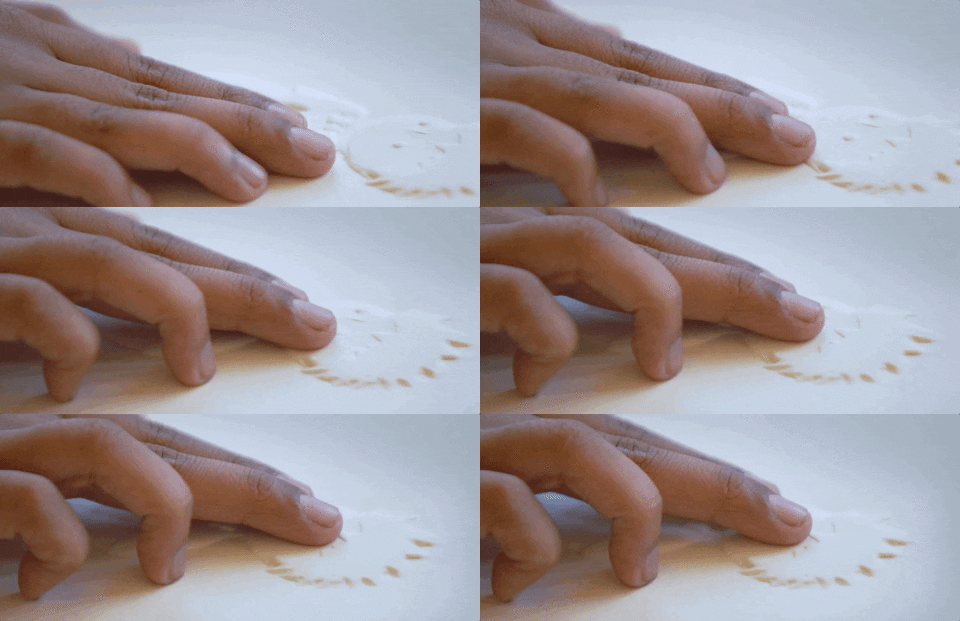
One of his first challenges after losing his sight is cooking, specifically baking bread. He learns to rely on touch, to know when the dough is ready, the warmth of the oven, and the scent of the bread. It was a small victory, knowing he would be able to cook for himself. Eating it is different too, "The crunch of the crust was more vivid than the flavor of the dough. I savored the tactile experience more than the flavor itself."
Then there is his first trip out without sight. He uses a cane, relies on the sounds of footsteps, voices, and traffic, and the memory of the familiar streets. Getting to the store by himself started with fear but ended with triumph. He can travel, shop, and cook for himself. That's independence right there.
But not everything can be accomplished alone. Leland says how vulnerable he felt having to ask a friend to help him dress for a wedding. He feels it is kind of humbling to know that for some things he has to recognize his disability and have trust in other people. My partner has MS and struggles a lot with mobility. He limps quite badly but doesn't give up; we walked 7 miles one day, but if people offer to help, he kind of shrugs them off. It's not rudeness, it's pride. One day he will have to go the route of Leland and accept he has a disability and sometimes must trust other people to help him.
As his sight worsens, the author becomes more attuned to his other senses, and he describes standing in the rain for the first time in years. "The droplets, falling on my face, seemed to speak a new language to me, one that wasn’t seen but felt." His perception is shifting from the visual to the tactile and auditory. The author notes that his awareness of space includes listening to sound bouncing off the walls. The sound of his cane tapping is different in a hallway than in a wide-open space. He can orient himself in a room by the subtle gradations of temperature, cooler by windows and constant in the centre of the room, and small drafts from windows and doors.
In this way, his world takes on a new shape. It is mapped not by what he once saw, although of course, he still carries the mental pictures to fit his new map around. It is a new way of living, not just about loss, but also discovery, being able to see the world in a way he never expected, but is both useful and full of delight.
Great book. Absolutely recommended. It expanded the world for me too.
Most people who are blind or going blind do not really like to read books like this. They are depressing. I know this from talking to a group of Blind people. This book was important, so I read it. He spent some time talking about learning braille. I don't know of many who use braille. We usually use a BARD app on any of our devices. This allows us to listen to books from the library of the blind. Or they will give you a cassette player and mail you books.I also buy kindle books. I have my kindle turned on to voice over Or maybe it is called voice view. I picked a English voice , and his name is joey He reads most of my books or at least all of my books on kindle. And yes, his voice does not fluctuate much, but Neither did mine when I read books.
What I Really would like is for amazon to improve their keyboard as I use it to dictate my reviews. Think blind when creating a keyboard for assess ability setting. If you read reviews where there are capital letters where they shouldn't be or perhaps there is no commas or Maybe words are misspelled, think maybe the person is blind. If you find that your vision is making it hard for you to read books, please call the library for the blind and find a group that will help you because it is easier to learn to navigate things when you can still see.
Blind people can learn to do a lot of things, but never compare them to Helen Keller who knew that She was special. But as a woman, I can clean my house, I can cook many things, And I can Chop Vegetables. It would be good to buy a tray to place things on so if anything gets spilled it is spilled on the tray and not all over the counter in the floor.
And 1 thing that blind people do not want to tell others for fear that they will think that they are crazy is this. You can get hallucinations and in color. This happens as the eye tries to compensate for lost division and will end unfortunately. I do not get Hallucinations often. But, when I do I just spend the day watching them. They consist of people, animals, and scenery. My most favorite hallucination I placed in my review of Cormac McCarthy's book, The Passenger
For extra support you can call the HULL foundation in either Salem or Portland Oregon. I don't remember which town. They have mini free groups. I joined there book club.
One of the best things I've read this year. Smart, vulnerable, intimate, wide scope, well researched and reported. Just all the things you'd want from a memoir that also zooms out to capture the world around it. I think Leeland's own struggles with going blind is handled with care and the utmost respect for disabled people even when he admits to his own ableism.
Really well researched and written. But I just didn't connect to the narrative even though it touched on so many points. I wish there were less historical and researchy bits and more personal stories.
As a life-long "high partial" blind person, this book certainly resonated deeply with my own experience of becoming blind over the years. Beyond that, it is incredibly well-written and researched. Leland does a masterful job of weaving his own story of becoming blind into his research. The tone is positive, while acknowledging the often complicated nature of being disabled in a world that is not designed for disabled folks
I also wanted to share an image description of the book cover from the ALT text of an image on the author's Twitter/X feed, because a.) I think the book cover is great, and so is the description b.) it shows one of the ways that I consume and appreciate visual information, and c.) I feel low-key annoyed at the idea of sighted people looking at the cover and saying "cool cover - not that blind people can appreciate it". I hope that my celebration of the cover does some tiny part to counteract any small but present micro aggression vibes out there.
Author's cover description: "The cover shows the book's title, subtitle and author--"The Country of the Blind / A Memoir at the End of Sight /Andrew Leland." It also depicts blind people of varying ages, abilities, and ethnicities, nearly all of them blind, holding either white canes or guide dogs in harnesses, going about their business in a chill happy aspect: some are carrying groceries, one has a baby strapped to her chest in a carrier. There's a blind skateboarder and a pair of rollerskaters. A white woman in a wheelchair reads a braille book in her lap, and a bearded Black man using a walker has a cane at his side."
An engaging work—part journalism, part memoir—by a man who is slowly losing his vision due to a currently incurable condition called retinitis pigmentosa. In response, Leland immerses himself in blind history and culture, studying the question philosophically while also grappling with its practical effects. The book is definitely an overview, without reaching the sort of depth or heights that make a 5-star read for me (though it may be for others!), but I was engaged throughout, enjoyed and learned from it. Certainly worth a look for the interested, whether or not it’s personal for you.
Some notes:
- Only 15% of blind people have no light perception. Most can see some, though not enough to navigate the world purely through vision. Leland struggles with the question of at what point he’s “really” blind: at the time of writing, he’s lost virtually all of his peripheral vision while maintaining a small amount of central vision, which qualifies him as legally blind. In practical terms, it means he can see people’s faces, read very large print, and generally identify his surroundings, but loses objects he’s set down, can’t drive safely or see anything in the dark, and needs a cane to get around without running into things and falling down stairs. When out in public, people sometimes react as if he’s “faking” blindness by using the cane (why would someone even do that?) when he definitely does need it, even if he can make eye contact.
- Lots here about people’s different relationships to blindness, especially as Leland struggles with the question about how to embrace his situation while still hoping for a cure. Those who have been blind as long as they can remember tend to be matter-of-fact about it, seeing it as an incidental trait that’s mostly just important when they encounter discrimination or lack of accessibility. For those who lose their sight as adults, however, there usually seems to be a grieving process. Leland celebrates when he learns his retinal decline will be slower than he anticipated, while other people he meets mention being out of commission for a month or a year as they came to terms with their blindness, and some memoirists write about never enjoying certain aspects of life as much. Blind people overall have a much less fraught relationship with the idea of curing their condition than the capital-D-Deaf community.
- That said, people do adjust to blindness and can manage much more than the sighted give them credit for, though it often requires training: Leland visits a “blindness training” school where students spend nine months to a year on life skills. Graduation involves tasks like cooking a meal for the entire cohort, and being dropped off alone in town and finding their own way back. Leland also writes about the need to accept imperfection: for instance, just getting lost sometimes.
- Despite all that, blind Americans are still mostly unemployed, hovering at around 70%. In part this is probably about discrimination, and in part because successfully navigating the world while blind requires both accessibility devices and savvy—many technological advances benefiting everyone were originally innovations to serve the blind, and sometimes invented by blind people themselves. But having cutting-edge technology or the ability to develop it yourself tends to require being born into some amount of money, and success is correlated with getting services early.
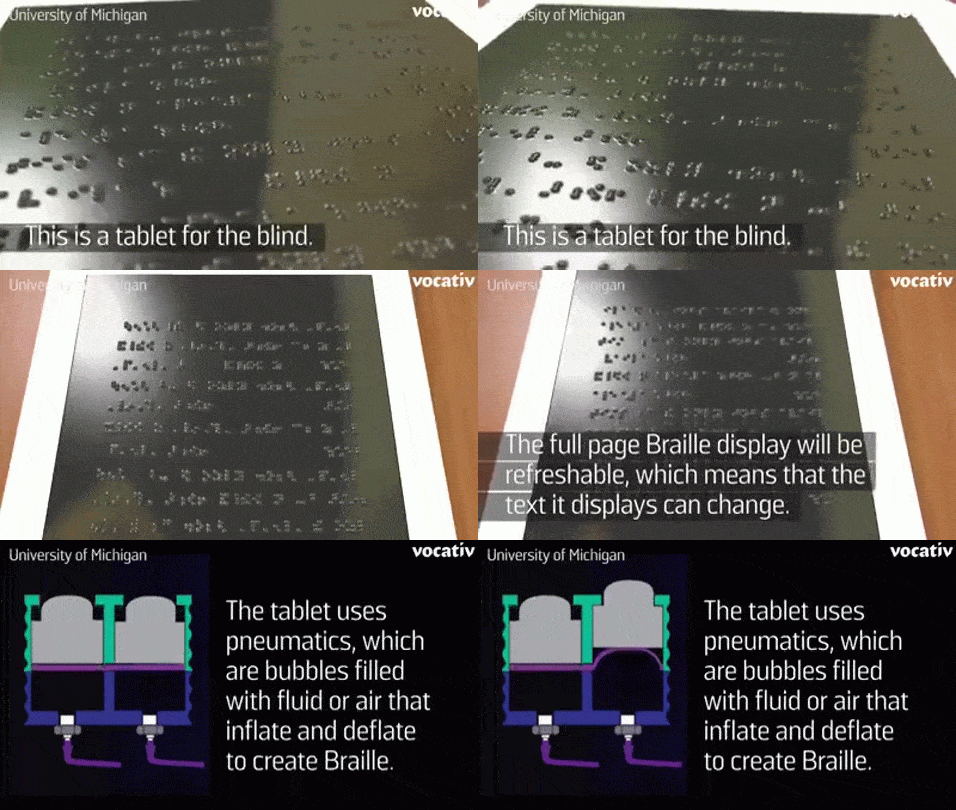
- Leland notes that most successful blind professionals use braille displays attached to their computers, for instance, but his doctor and his state services for the blind both discouraged him from learning braille! It’s apparently much harder to learn as an adult, and “you can just use audio”—as a sighted person who hates audio, this last sounds like a terrible excuse. Leland too values reading so he does learn braille, although it is indeed hard.
- Leland gets involved with the National Federation for the Blind, which is fantastically successful at getting services and recognition for the blind (they are the reason that Americans all specify whether we are blind on our taxes—and no other disability), but also parochial and drama-prone. They resist the idea that any identity other than “blind” could be important to their members (so they’re lousy on sexual harassment, race, LGBT issues, etc.), and they even oppose accessibility proposals made by splinter and rival organizations. For instance, the NFB opposed audio signals for crosswalks, claiming this was patronizing because blind people can hear the traffic. (Anyone making this argument can’t possibly get out much—I can’t think of a single intersection in my area with a constant flow of traffic at all hours.) They even opposed the Americans with Disabilities Act because providing accommodations (to other people) is also apparently patronizing—though this at least resulted in their successful argument that the accommodations needed to be requested by the disabled person rather than forced on them. Leland lets the NFB off a bit lightly, but provides enough information that you can draw your own conclusions.
- Leland also goes easy on blind men obsessed with women’s physical beauty, even as they need others to relay it to them—and while I understand how expecting people not to care about certain things can be infantilizing or put them on a pedestal, it nonetheless strikes me as depressing that even blind men would want to objectify women, suggesting that the urge to do so is really about power or about women as status symbols.
- I’m still pondering Leland’s objection to a religious service where a poem expressing gratitude for one’s eyesight is read. On the one hand, it makes absolute sense that this is alienating and off-putting to him. And more broadly, no one wants their life to be the catalyst that makes other people thankful for their own. On the other hand, isn’t it good and healthy for all of us to be reminded of our advantages—even though people can make a worthwhile life without them? After all, we all have advantages we take for granted (and Leland himself is grateful for his remaining eyesight). But advertising those musings to people who don’t have the advantages in question is indeed gauche.
In the end, I liked this and would recommend it to anyone interested in blindness, or in disability justice and different ways of navigating the world.
Thank you to NetGalley and the publisher for providing this book in exchange for an honest review. The cover of this book immediately caught my attention because of the images. I'm slowly losing my vision too and a lot of the author's thoughts and experiences were relatable to me. I mostly picked this book to learn of his experience and how he mentally dealt with vision loss. He weaves his story with information about blindness in history as well as the organizations that have been created to assist low vision and blind people to live independently. Fascinating book!
Leland has retinitis pigmentosa but has been slow to accept or adapt to the increasing loss of his eyesight, which creates an interesting backdrop for a big picture examination of blindness and ableism within society. He details the trajectory of not being diagnosed until college to writing this book in his 40s and the ways he’s had to accept and adapt to various assistive devices, as well as how his family has responded. There’s a range of blindness so it’s no surprise that even the leading organizations have very different ideas about their position and relationship to disability, as well as work to do when it comes to intersectionality.
Leland’s relationship to his own blindness starts out quite ableist and I loved watching the journey toward more acceptance. Systemic ableism doesn’t seem to be an issue many able-bodied people are aware of, unless someone close to them has a disability. Accessibility can be an afterthought as a result, if it’s even thought of at all. One of my favorite chapters was about the origin of certain assistive tech that so many of us use in our day to day lives. I had no idea about the story behind the jacuzzi! I found this to be a thoughtful and fascinating read. I would like to next read a version of it from someone who has been blind their whole life and see how it compares.
For such a great examination of ableism, I was disappointed by the inclusion of ableist language related to mental illness and intellectual disability. This kind of casual ableism is so fully embedded in our slang that it’s difficult to root out but it matters to try. This is a great resource for those interested in learning more.
Content notes: retinitis pigmentosa (diagnosed 20 years ago), various causes of blindness (including cancer, illness, accidents), sexual assault and sexual harassment cases, workplace sexual misconduct case, institutionalized abuse, victim-blaming (countered), child medical neglect (mother didn’t take him to eye clinic until college), ableism, internalized ableism, discussion around abortion and disability, discrimination, intellectual disability, antisemitism, systemic racism, transphobia, past panic attack, COVID-19, divorced parents, pregnancy, marijuana, past recreational drug use, inebriation, casual ableism/ableist language (primarily insane/crazy and stupid/idiot), hyperbolic language around suicide, Harry Potter references
I was a little worried at first because the book’s content is kind of all over the place, but it was fascinating throughout. The author has been gradually going blind his whole life. He has one foot in the seeing world and one foot in the blind world, not quite fitting in in either. To prepare for his future, he researched blind history and blind culture extensively and shares his most interesting finds here. It is only part memoir, so adjust your expectations accordingly.
He talks about things like the ADA and how different blind factions felt about it. He talks about Descriptive Audio Services, where the newly blind like more description while the long-time blind prefer less. More museums are doing tactile exhibits. There’s all the technology we’ve gotten thanks to the blind, including audiobooks and text-to-speech apps. Such technology has gotten so good, Braille literacy is declining. Does not needing or using Braille make one illiterate, though?
There are many blind who don’t feel like they are disabled; blindness isn’t an obstacle because they’ve adapted so well. One blind woman became pro-life after finding out how many infants with a blind diagnosis get aborted as the sighted decide their lives aren’t worth living.
Like deafness, blindness is a spectrum of ability. Many blind people can still see blobs of light or vague shapes.
I have always been interested in blindness because of my poor eyesight. I got glasses at age 7 and was soon legally blind without glasses. I became familiar with Braille, just in case, but I cannot read it by touch. I had Lasik surgery done about five years ago. Though I still need reading glasses and things aren’t crystal clear, I’m glad to still have vision.
It is narrated by the author, who did a pretty good job despite not being a professional narrator.
Language: I can’t remember Sexual Content: Vague references Violence/Gore: Some eye injuries may be disturbing Harm to Animals: Harm to Children: Other (Triggers):
first five-star of 2024 and what a TREAT. I first heard from Andrew Leland on the "search engine" podcast, and I haven't stopped thinking about that episode since. Needless to say, I was delighted to get seven more hours of his thoughts through this audiobook. I'm always blown away by how little I know about disability justice and its history, but it's so fascinating and definitely something I want to read more about. Andrew Leland's story is so engaging and enlightening, and I know that I'll be thinking about this book for a very, very long time. In an age where it's trendy to say "i don't think helen keller was real" . . . read a book!
I was looking forward to this memoir and there were parts that I found both moving and enlightening. However, this would have worked better for me as a long form essay rather than getting stretched out and padded into a full length book.
This is as much memoir as it is a study of the culture of blindness, tackling philosophical questions such as to what extent is blindness a mere characteristic, rather than a defining aspect of who we are? What do you lose as a result of blindness, and is it possible to come out the other side the same person you were before?
Andrew Leland uses his own experiences slowly losing his vision to RP as the backdrop for the text. As he loses more sight, he digs deeper into what it means to be a blind person navigating the world in the present day. He contextualises this within the history of blindness and thus blind people, from the little we know about blind people in antiquity to the creation of Braille and the first real opportunity blind people had for true literacy.
This book manages to strike the difficult balance between challenging the reader to look beyond their own ideas and experiences, whilst also being accessible to a wide range of readers. It has a place in academia as much as it does on the shelf of a person who simply wants to learn about how an individual experiences the world in a way that is unfamiliar to them.
It is rare that as a blind person, I find a book that captures what it truly means to be blind. Perhaps the success of this lies in the recognition that there is not one way to be blind, and that to imply any of us have the answers to the more abstract questions of life would likely be untrue. Andrew's willingness to say that he was on a journey of discovery, and that many of the answers he had discovered and that felt true to him were contradictory, was refreshing to read. This is an honest and profound book that I will not easily forget.
as a paraplegic, i feel like leland doesn’t know any disabled people besides blind people. there’s multiple points in this book where the subtext reads as blind people suffer more than other disabled people, particularly where he refers to how paraplegics can just get a wheelchair and go about their life, as if it’s not incredibly difficult to get a chair that fits in a timely manner, and you don’t have to go through tons of OT to adapt. i liked the research parts, i just feel like he should hang out with other types of disabled people before automatically assuming they have it earlier. playing the suffering olympics doesn’t help anyone.
The Country of the Blind is an interesting read about blind culture and history, as well as the author's personal journey through increasing blindness. Unfortunately, Leland's acerbic wit, defensive writing, and tunnel vision desire to reach his final version of blindness was distracting and frankly off-putting.
Absolutely masterful and illuminating. So grateful to have this and eager to share with a blind family member once it (and the audiobook) has been released
An informative, thought provoking, well researched, and unique book about a man with retinitis pigmentosa (RP).
The author covers a broad range of topics that, if I listed them all, would seem all over the place - but it worked well. There was a great mix between information and feeling. I learnt a lot and "see" things differently now.
Some nuggets for thought: -many inventions started out as accommodations for those with disabilities, which have been later adopted by the able bodied. Future technology will be largely shaped by tech that serves deaf and blind people today. -our laws are in a constant tension between personal liberties and public welfare. -American progress movements in the 1970s that advocated for rights of women, African Americans, and immigrant communities all entailed a disassociation from disability. These groups were advocating for their rights under the basis that they could "do" what the (able bodied) white man could do. If the true basis of rights was the capacity of individuals, this offers justification for political inequality to those with a different set of capabilities.
As a side note, I'd be curious how others with RP feel about this book. I've found that content around fully able bodied people becoming physically disabled can be quite patronizing sometimes, and would be curious if some people with RP would feel that way about this book since the author is very accepting about his blindness.
I really loved this book. It’s coming up on one year f being blind. I was diagnosed with CNS lymphoma and my first week in the hospital I had a series of mini strokes which took out my vision very quickly. So my experience is different from Andrew’s but there were many things I enjoyed about the book. His relationships with his wife and son were very sweet and emotional. The history of disability and the activists who did so much to help change the world hit close to home as my wife is a professor at a local university teaching about the culture of disability.
An eye-opening story about the gradual loss of vision of the author and the frustrations and discoveries that come with it. Along with the personal narrative, the book talks about blindness history, assistive technology and community. Wonderfully written - both informative and vulnerable.
The Country of the Blind: A Memoir at the End of Sight invites readers along Andrew Leland's journey in becoming blind, which he memorably describes is notably different than "going blind". Andrew is a husband, father, and media professional who immerses himself in the study of blindness for his own personal growth and preparation as well as ours. Even as someone relatively familiar with disability history, I was reminded how siloed our communities can be by my almost total lack of knowledge around much of the historical stories Andrew shares about ancient stories of blindness, its changing meanings in society but also the pervasive stigma of fear and vulnerability that perpetuates ableism.
My favorite parts of this memoir were probably predictably given my interests, Andrew's reflections on fatherhood and blindness. Ironically, I could picture he and his son working out these shared challenges-like how to describe the talons of a bird in flight-or sharing a tender moment, his young son's head on his chest-which served as both a loving gesture and a practical way to keep our children closer than arm's reach.
Leland demonstrated bravery and vulnerability in sharing his evolving relationship with his wife Lily. As someone partnered with my disabled husband for 20+ years, it was painful to think about my significant other demonstrating what I viewed as ableism in some of Leland's descriptions of Lily's statements or actions. She, too, likely demonstrated courage in this openness to sharing. I actually teach about our need to allow others time, space, and knowledge needed to unlearn ableism. So I understand this intellectually but felt for Andrew in what it must feel like when home was not a sanctuary from judgement or maybe more accurately a lack of understanding.
This is one of those books I want to thank the author for writing. I especially loved the commentary about the history of the National Federation of the Blind and other organizations, all of which bring their own brands of drama. These perspectives inform my work in disability policy. So while they weren't as heartwarming as reflections on parenthood, I benefited from them nonetheless.
Anyone who enjoys memoirs would like this book. Disability scholars should read it, especially those steeped in work mostly focused on physical or developmental disabilities. I'd welcome another book by Leland and if he's short on ideas, here are a few areas I wanted to hear more from him: 1) Even more on technology and how the blind community is involved in the innovations that often impact all of us 2) more on guide dogs and their complex relationships with their people 3) the experience of blindness in childhood-while I know this isn't the experience of Leland, I know he'd do justice to writing about it by sharing the stories of others.
As someone who has been blind since birth, I can't say that this book offered a lot of new information. In fact, I was a little hesitant to pick it up because some books about blindness or about losing sight can actually be quite depressing. But I enjoyed his writing and reading about his experience. This was very well researched, offering a lot of statistics and back stories on blindness organizations that I actually did not know. I also really like his outlook on blindness.
Part memoir of a man with RP, part history lesson of treatment of people with a disability, adaptive technology, and techniques used to aid visually impaired people. I was horrified to listen that a doctor suggested to a pregnant woman with RP that she might want to consider abortion since her child may have RP.
This memoir covers the authors journey towards losing his vision, the rights granted to blind citizens, and the services and tools available to the blind. Majority of the time I found it quite interesting but at times it felt like I was listening to an infomercial.
This was so informative, well-researched, and touching! I learned a lot from Leland’s interviews and research on blind history, subcultures, communities, and lifestyles, as well as his own insights and personal experiences as a blind person, which were vulnerable and thoughtful.
This is a book that makes sense to listen to over audiobook, as I mostly did - starting on a long drive, something I learned quickly that this author would not be able to do himself, drive rather than listen to an audiobook.
Especially once I learned that audiobooks, duh, are technology advancements that we owe credit to the blind for! Along with epub (ebooks!) and text-to-speak, and maybe even AI. Then it make even more sense to read some of it on my phone, and then my kindle, then back to my airpods, etc.
This book is a lot of things.... a very personal firsthand intimate account of going blind as it's happening to a person and then a couple and then a family; a rumination, mediation, and critical dialogue about what it means to be sighted and not sighted; a 101 FAQ as to the questions you SHOULD be embarrassed to ask a blind person, much less things you should know already; a historical, cultural, mechanical, technological, sociological, and political accounting of blindness, how blind are treated/taught, various factions and organizations of the blind fighting for different overlapping political agendas, how disabled and disability laws change and affect everyone, and then some.
It's basically a long New Yorker article, an exemplary piece of creative and researched nonfiction. And it's good! But by trying to pack so much (everything that the author is interested in, dives deep into, and is curious about), it's trying to be everything for everyone and that's not a bad thing.
I felt most moved by his personal history of learning about then wrestling with his long term degenerative blindness. THAT is the This American Life version that drew me in - I've never read anything like this book! Then it keeps going and becomes a Ken Burns documentary series, where the personal story takes a backseat to research, background, opinions, sensitivities, and grandstanding. And then it comes back to the intimate, the personal, the real here now.
Andrew Leland is a talented storyteller, weaving in and out so many threads here. His book becomes an essential contribution to extending in-my-shoes empathy to those outside his 'disability' and how he hasn't changed as a person just because his eyesight has. He tells us what he feels, how he wants to be treated (not differently!), what he worries about when he thinks about his son and his wife.
It's very rewarding and human. I loved when he went to a blind person 'boot camp' where they wear eyeshades all day and work on power saws. It's at times Sedaris funny in that it's self-aware, but not awkward about it. Lots to love here and lots for everyone who wants to understand the context around how you might build a sidewalk curb ramp JUST for the blind person - BUT it ends up benefitting parents with strollers, old people with carts, and kids on bikes and scooters.
That's the story of designing for disability pushing us forward, to thank for these many improvements and features and technologies that we don't think about who they happened for first and what those people had to do to make it happen. I'll be trying not to over look that now myself.
WOW WOW what an illuminating book on the blind experience!!! perfect balance between personal opinion and factual information. this book expanded the scope so much wider than anticipated, getting into the intersection of blindness with race, abortion, love and relationships, sexuality, gender, culture, everything. comparing and contracting the blind experience with both the sighted experience AND the experiences of people with so many other disabilities. 10/10
I’ve read a few of these kinds of books that examine life with diminishing sight. This is one of the more cogent I’ve come across, especially as the author smoothly weaves his personal experience with the vast, and I would imagine largely unknown, history of blindness. For instance, we learn plenty about the start of schools for the blind, the National Federation of the Blind and similar consumer organizations, and ways that society has dealt with blindness over the ages. I thought one of the more interesting parts was the author’s recounting of his two-week stint in the Colorado Center for the Blind, an NFB training facility. He notes that individuals usually stay there for nine months to get the intensive training to enhance independence, but he mostly just wanted to see what it was like and speak with participants. On the whole, it was a well-balanced book. You get the real feeling that, while adjusting to blindness can be a struggle, he also welcomed t and pointed to many of the interesting facets that can arise from such an experience.
I really liked this book, especially hearing about personal lived experiences with disability and how it can be reframed in an engineering / rehabilitation sense. It’s wasn’t necessarily a quick read (for me), but it was so informative into the history of blind people, disability rights, personal anecdotes, and new developments/ tech. Highly recommend! *Note: given the topic it may be better as an audio book :)
A quote I like “It’s the gap between what a disabled and a nondisabled person are expected to accomplish without technology that makes disabled people seem like they don’t have independence. If you need a cane or a guide dog to safely cross the street, you’re disabled; if you need glasses and a pair of shoes to get there, you’re fine. But the relationship with the tools is the same…Disability is not, at its heart, a design problem—even if its lived experience requires daily feats of engineering and imagination.”