A picture book edition of the board book about grief, offering adults the opportunity to begin important conversations with young children in an informed, safe, and supported way.
Developed by experts in the fields of early childhood and activism against injustice, this topic-driven picture book offers clear, concrete language and compelling imagery to introduce the concept of grief. This book aims to normalize the topic of death by discussing what it means and how it feels to experience loss. It centers around several questions that arise about grief and honest, simple ways to answer them.
While young children are avid observers and questioners of their world, adults often shut down or postpone conversations on complicated topics because it's hard to know where to begin. Research shows that talking about tough issues from the age of two not only helps children understand what they see, but also increases self-awareness, self-esteem, and allows them to recognize and confront things that are unfair, like discrimination and prejudice.
These books offer a supportive approach that considers both the child and the adult. Stunning art accompanies the simple and interactive text, and the backmatter offers additional resources and ideas for extending this discussion.
Megan Pamela Ruth Madison (she, her) is an early childhood educator, scholar, and activist based in New York City. She began her career working as an assistant in a Waldorf elementary school. After completing her undergraduate degree at the University of Michigan, Megan then went on to become a teacher in a Head Start preschool classroom. Now, as a doctoral candidate at Brandeis University, she works part-time facilitating workshops for teachers and families on race, gender and sexuality. Megan is currently working on a board book series with co-author Jessica Ralli for Rise x Penguin Workshop on race, gender, consent and body positivity. Megan recently completed a term on the governing board of the National Association for the Education of Young Children (or NAEYC) after several years serving as a co-facilitator of the association's Diversity & Equity Interest Forum. In that role, she worked to organize early childhood professionals around the country who are passionate about social justice. She is proud to hold a master’s degree in early childhood education from Dominican University. Megan lives in Harlem (unceded land of the Lenape people), where she loves reading, eating ice cream, and building community with Jews for Racial and Economic Justice (or JFREJ).
Another fantastic addition to the First Conversations book series. In this book, it's all about grief, life, and loss. As parents, we need to be sure we are prepared to take on this topic at any point in time. This is a great way to approach the topic with your children in a gentle manner. I'd recommend getting this before you need it.
Some topics you'll find in this book are: • What children need to know about death • How to talk about death with your children • What grief is • What grief looks like • Misconceptions & misinformation
This book handles the topic of death in such a gentle manner. It's certainly not an easy topic to approach for anyone. It makes most people feel sad and/or uncomfortable. Unfortunately, those are things we have to learn to deal with because death is all part of life. Teaching that to children can be hard and scary, which is why I love this book. It acts as a guide to help parents and caregivers talk about this with their children.
Just like all the other books in this series, the book is diverse and inclusive in both the illustration and the theme. I love how this book talks about how everyone has different beliefs when it comes to death and what happens after. The world is full of different cultures, religions, and beliefs, and it's important that children understand this so that if they have a friend with different beliefs, they can respect that.
I really think that all parents and caregivers would benefit from this book, especially if they are unsure of how to approach this topic. Life is unexpected, and we never know when we will need to teach our children about this, and I truly believe that slowly teaching them over time will help them and their parents or caregivers in the future.
For more bookish opinions, visit my blog: Craft-Cycle
A wonderful introduction to talking about death, dying, and grief with young ones. Told in kid-friendly language, this book provides talking points for caregivers to introduce concepts of death and grief. The book is broken down into different common questions such as what grief is, what it can look like, and what it can feel like.
The information is presented in a way that acts as a baseline for caregivers to add to and expand on depending on the child. Good flow. Includes various check-in points to address children's questions and allow them to reflect of their own experiences.
Allows room for caregivers to work in their own ideas such as what happens to a person when they die. It shows different ways of grieving, remembering, and saying goodbye, treating all as valid.
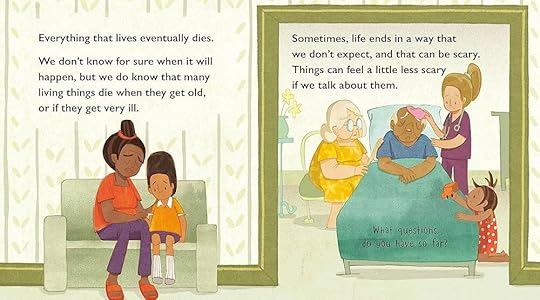
The illustrations are wonderful. They follow various families through the process of saying goodbye from illness to funerals to remembering those who have died. They do not shy away from some of the hard feelings associated with death including anger, confusion, frustration, and sadness.
At the back is further information for caregivers on how to approach conversations with tips such as pointing out fantasy versus reality in movies and stories, using straightforward language, and confronting children's fear or worry of death.
An encouraging, empathetic, informational guide to help navigate difficult conversations. A wonderful resource.
This picture book has simple, kid-friendly text, exploring the concept of death and grief in a straightforward and honest way that children can understand. The illustrations are nice, and they help convey the book's meaning, showing different scenarios and using speech bubbles to reflect people's different beliefs surrounding death and varied grief experiences.
Unlike some of the other books in the First Conversations series, this one does not push a specific political or social agenda, and I would recommend this to anyone from any background who wants a helpful tool for discussing death with their child. Also, the back of the book includes extra tips and ideas for parents about how they can support grieving kids and facilitate helpful conversations on the topic.
Almost everybody in the world feels grief at some point in their lives. Even though it's a normal part of life, it can still be really hard to feel or talk about.
This is an excellent board book for explaining death and the grieving process to the youngest readers/listeners. There are an additional four pages at the end of the book that serve as a guide for grownups.
One of those books that you wish you didn't need, but you know you eventually will . . .
Explaining death to children is no easy task. This picture book is clearly meant to supply the starts of conversations, rather than explaining everything once and for all. No wonder this book offers so many prompts to readers.
Let me quote, or paraphrase, some of these to give you the flavor of this unusual book... on an unusual topic for a picture book.
What do you know about death or dying? What do you think happens to a person after the body dies? What does grief feel like? How long does grief last? How do the people in your family say goodbye.
Good questions all. FIVE STARS to this important book.
This book was exactly what I was looking for a few months ago for a child with a terminally ill parent and I could not find anything like it at that time. I am so grateful this came out; it was a really helpful conversation guide for my nephew and his mom. He is 7, a little older than the target age but still very young to comprehend a topic like death, especially when talking about a parent, and the way the book is structured helps tailor it to the child’s needs and questions. This book was much appreciated during a difficult time.
4.5 (docked for the art, Isabel Roxas's illustrations don't speak to me). I want to read more books on grief, for all ages. Understanding grief wasn't something that was modeled for me, it wasn't talked about, but obviously I experienced it growing up (and continue to, as an adult). I love love LOVE how interactive all the books are in this series, all the conversation prompts, and how open and accepting everything is.
A simple, straight-forward book about death, dying, and grief. Has question prompts throughout to encourage discussion while reading. Not religious, but discusses how religion can shape thoughts about what happens after death and how someone may cope. I really liked that it goes over how grief can look and act differently for different people and at different times.
I was sent this book by accident in a book order. I have a young child in my life who lost their mother at a very young age, so I wanted to give it a read.
I like how fact-based and straight forward, yet gentle this is. It helped give me perspective on how to better have these conversations when they come up. It isn't religion-based but it still acknowledges how people have different beliefs on what happens after we die. It also has tips at the end for having these conversations with kids.
I think it's a very in-touch, sensitive way to start the conversation about grief. I like how books like this aim to treat children as people that can process their own thoughts and emotions, acknowledging that children can't and shouldn't be shielded from conversations like this.
This is a straight forward introduction to grief and how we may feel when someone dies. The author points out that brief is different for everyone. It's how we feel and how we deal with it. Questions to the reader are interspersed with the text to be used as talking points.
Really impressed by this First Conversations series, particularly the way they invite open-ended conversations for kids. I feel like humans of all ages might get comfort from this book in a way.
This is a great book to bring up the topic about death and grieving to young kids. What I appreciated most about it is all the backmatter material to help facilitate the conversation which I'm sure some if not most adults find difficult especially when they're going through it at the same time.
I love books that don't speak down to kids and try to placate them with trite platitudes. Lots of kids will have to deal with grief during childhood. I'm glad there is a book that helps the adults around them address the topic honestly and factually.