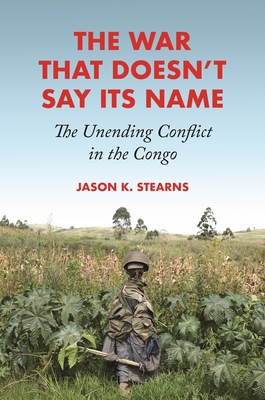
Why violence in the Congo has continued despite decades of international intervention
Well into its third decade, the military conflict in the Democratic Republic of the Congo has been dubbed a “forever war”―a perpetual cycle of war, civil unrest, and local feuds over power and identity. Millions have died in one of the worst humanitarian calamities of our time. The War That Doesn’t Say Its Name investigates the most recent phase of this conflict, asking why the peace deal of 2003―accompanied by the largest United Nations peacekeeping mission in the world and tens of billions in international aid―has failed to stop the violence. Jason Stearns argues that the fighting has become an end in itself, carried forward in substantial part through the apathy and complicity of local and international actors.
Stearns shows that regardless of the suffering, there has emerged a narrow military bourgeoisie of commanders and politicians for whom the conflict is a source of survival, dignity, and profit. Foreign donors provide food and urgent health care for millions, preventing the Congolese state from collapsing, but this involvement has not yielded transformational change. Stearns gives a detailed historical account of this period, focusing on the main players―Congolese and Rwandan states and the main armed groups. He extrapolates from these dynamics to other conflicts across Africa and presents a theory of conflict that highlights the interests of the belligerents and the social structures from which they arise.
Exploring how violence in the Congo has become preoccupied with its own reproduction, The War That Doesn't Say Its Name sheds light on why certain military feuds persist without resolution.
Jason K. Stearns is an American writer who worked for ten years in the Congo, including three years during the Second Congo War. He first traveled to the Congo in 2001 to work for a local human rights organization, Héritiers de la Justice, in Bukavu. He went on to work for the United Nations peacekeeping mission (MONUC). In 2008 Stearns was named by the UN Secretary General to lead a special UN investigation into the violence in the country.
Stearns is the author of the book, Dancing in the Glory of Monsters: The Collapse of the Congo and the Great War of Africa, and the blog, Congo Siasa
Well, it's my third book from Princeton uni press and the third one that feels like a 3,5. But it's not a bad book! Once again it was a good and enlightening read with some frustrating edges.
Stearns's writing is theory-pilled, but in the best possible way (the concepts make empirical sense instead of being forced onto reality). Congolese state and society are analysed through three important lenses:
(1) As the birthplace of a "military bourgeoisie" since the 1990s. Members of this class (whether they are in the regular army, in militias, or switch between both) think of themselves in terms of their status as "fighters", rather than the ethnic labels which they like to claim. Unlike countries like Rwanda and Angola, the Congolese military bourgeoisie apparently is uninterested in entryism into party politics or forcing the private sector into submission. Rather, it extracts value from state and society through large-scale smuggling, bribes, roadblocks, embezzlement and illegal mining.
(2) As an extremely fragmented society. In the Eastern Congo, over one hundred separate rebel groups are active; within every militia, individual careerists clash with eachother; in the national army, commanders mistrust each other and give contradictory orders. Local political and business elites encourage this fragmentation as they try to co-opt factions for their own ends.
(3) As the site of "symbiosis" or "involution" between warring factions (the latter concept is pulled from Clifford Geertz). This means it's in no one's interest to work towards peace. Army officers profit from the war because it justifies inflated military budgets, clears the path to embezzle funds and to illegally exploit mines; the state sees this as a way to "coup-proof" by keeping officers loyal and troops far from Kinshasa. Indeed, Kabila almost always preferred to co-opt warlords and tolerate their excesses instead of disciplining them, even those that actively tried to overthrow him.
What's also striking is how Rwanda and Uganda, two small and peripheral countries under the rule of neoliberal kleptocrats (yet stable for the region), are intervening in the Congo as if they're great powers. Stearns gives a good dissection of the Rwandan state's bunker mentality, forged in the ruling RPF's guerrilla struggle, that has made it so bellicose. This centralized and scheming Rwandan regime contrasts sharply with the ineffective Congolese state. About Uganda's motives there is very little in here, which is a pity because a whole chapter is devoted to the pro-Ugandan UPF (but I'm looking forward to Mahmood Mamdani's latest book to learn more about that country).
There are some other downsides to the book. Firstly it may not come as a surprise that this is not a light read. That's not just because of the brutality and severity of the contents, but also how dense it is in terms of political and military details. Some parts were hard to follow. I like complex historical reading but this was less enjoyable (if that's the word) than other books on similarly heavy topics – I'm thinking of Nathaniel Powell's France's Wars in Chad, endlessly dense but so so engaging.
Secondly the broad international context could've been more prominent. Stearns is a Congo expert and an amazing local researcher, but not someone who puts geopolitics front and center. That's fine, the regional dynamic is key to these wars, but the fact the DRC (including Kivu) has been submitted to Western and Chinese extractivism throughout this period should be given due weight.
Stearns also implies that donors and lenders insufficiently conditionalized their lending on political reforms. On the one hand I have doubts about that strategy's effectiveness (Deborah Bräutigam's The Dragon's Gift has excellent stuff on how non-conditioned grants/loans do more to help a country develop than the demand that bad governance be fixed first) and on the other hand it is naive about the agendas of the World Bank and co., who aren't too interested in political improvement as long as privatizations can be squeezed out of it. It should be said that Stearns is clearly critical of the privatization process. He points at the plunder by actors such as Glencore and notes that the same amount (over $25 billion) was funneled to the West between 1996 and 2010 as Congo earned in state revenue. Yet all of this comes as an afterthought and is analytically rather meager.
Thirdly the book is not recent enough to take the renewed M23 offensive into account. It helps to understand the new offensive's background, but leaves many questions as to why Rwanda and the rebels have made the decision to escalate again at this exact moment. Some assertions have aged like milk (p. 236: "armed conflict today does not threaten major urban centers or divide the country"; p. 256: "Today, foreign governments, especially Rwanda, are much less involved than in the past"). Still, a good and important read, and crucial for anyone who wants a deep dive into the Kivu conflict.
This book was awesome! Provided a very in-depth and thought-provoking review of the war in the DRC from the early 2000s up until around 2020. This is perhaps more important to know about than ever with all the increasing conflict in the area right now.
Although this conflict is extremely complicated (there's over 120 rebel groups) the author does a good job boiling it down and making it as digestible and easy to understand as possible. Provided a very nuanced analysis and helps readers to understand that minerals aren't really the main impetus behind the conflict. Would highly recommend if you are at all interested in what is going on in this region.
there is some really brilliant information in here and it is well worth reading!!! stearns brings up some really salient points about the processes of normalization, involution, and essentialization that have made "forever war" so profitable to elites in congo, rwanda, uganda, the US, the UK, China, and a handful of massive Western companies profitting off of widespread violence and chaotic destruction. i did knock off a star because i disagree with his belief in reform and the UN (though of course his faith in the UN makes sense as he was formerly on the UN peacekeeping mission). he is still highly critical and it is an invaluable text; i do think however his placing disappointment in a government agency for not "doing what it should" is a misconception. from everything i have learned from this text and others about the congo, this is neocolonialism intentionally propped up; regardless of whether the root cause is at times simply disinterest and a racist disregard rather than the blatant conspiratorial capitalist pillaging of other times.
" "As war -which itself stagnated and turned violently inward-constrains the space for agency more and more, so desperate inventiveness also turns in on itself. All forms of capital, material or cultural/ symbolic, are pressed into the service of elite profit or peasant survival." Jackson is drawing here on the concept of involution, most famously developed by Clifford Geertz, who used it to describe how village society in Indonesia responded to population growth, Dutch colonization and the introduction of sugar as an export crop. Geertz argued that the social and economic structures of rice production did not fundamentally change but merely adapted to these temporary pressures. As a result, the paddies were cultivated more intensively, increasing output per area but not per head. It was a cultural practice, he wrote, that "having reached its definitive form, continued to develop by becoming internally more complicated... it maintained the overall outlines of that pattern while driving the elements of which it was composed to ever-higher degrees of ornate elaboration and Gothic intricacy. A similar logic has obtained in the Congolese conflict. Over time, the main stakeholders' approach to the conflict turned inwards, becoming invested in their own reproduction, and then became stuck, seeing conflict as an end in itself. There is, however, no grand conspiracy but rather a multitude of actors stuck in a negative equilibrium. Army officers see the conflict as a way of maintaining inflated budgets, embezzling funds, and obtaining opportunities for racketeering at the local level. The national government treats the conflict as a means of coup-proofing by keeping senior commanders content, while the bulk of their troops are deployed far from the capital."
I’ve always appreciated Stearns’ writing on the Congo and felt as if I learned something important from each piece. This book is written with a more formally academic audience in mind, and for that reason it isn’t as accessible as others on the subject, but is no less valuable because of how the argument is structured throughout the book and each chapter. It’s dense, because he knows his subject well and I found the concluding chapter to be particularly useful for thinking about what it all means. I’m sure I will certainly reference this book often even if I don’t read it cover to cover again.
Thorough and deeply knowledgeable account of violence in the Eastern DRC post 2003. The content is based on a tremendous amount of interviews and years of first hand experience by the author. Hard to imagine a more well informed non-Congolese account of what happened. Only the discussion of Rwanda's motives is a bit thin, as the sources are less forthcoming on this front. The final chapter left me wondering whether violence could have been avoided, even if some or all of Stearn's suggestions had been followed. Ultimately, some of the incentives outlined in the previous chapters (fragmentation, military bourgeoisie, etc) are hard to change. In some sense the last chapter was the most removed from the theory developed in chapter 5.
The War that Doesn't Say its Name is a continuation of Stearns' commentary on the decades of conflict in the Democratic Republic of the Congo. While I highly recommend this book and Stearns' previous book, Dancing in the Glory of Monsters, there are some differences between the two. Most obviously this book was written a decade later, so it charts the continuation of the conflict from his previous work. Additionally The War that Doesn't Say its Name provides less first hand accounts of ordinary people's experiences during these conflicts. Instead the book is a zoomed out analytical piece that attempts to explain the reasons why there has been violence in the Eastern Congo for nearly thirty years.
With this book, the author makes sense of the incomprehensible... the 2-decade "post-conflict" period in the DRC, during which the security seems to worsen, and armed groups seemingly multiply year after year. It really does a great job defining why the peacebuilding has failed and what might have been possible. I highly recommend this book for Congo-watchers and those interested in understanding the ongoing conflict beyond the tropes of conflict minerals, resource curse, etc. Stearns is deeply knowledgeable and well-informed about DRC, given the hundreds of interviews he conducted. It's an interesting, stimulating read!
Jason Stearns has established himself as the eminent scholar on modern Congolese politics. He provides a nuanced perspective on the causes and current state of the ongoing conflict in the eastern Conflict, complete with reflections on what could have gone differently and solutions for the future. While this book has far less story-telling than “Dancing in the Glory of Monsters” and reads more as a series academic papers, Stearns’ fantastic insights on the Congo make the book a must read for anyone trying to gain a better understanding of the region.
As with the rest if Jason’s work, this is a deep, rich, academic dive into the unending conflict in the Congo. As a wannabe scholar, I appreciate the amount of time and energy that go into a compilation such as this. It is certainly a slog to get through, however my understanding (albeit surface level) of the conflict is greater than ever and I am grateful for his work and contributions to our understanding.
This is an especially important work for those who work or wish to work in the Congo.
An insightful analysis that seeks to explain how political and economic institutions in the Congo have helped perpetuate a conflict. Their roots are colonial but their current status is a reflection of how a post-colonial - or more appropriately, neocolonial - world has failed them. There is hope for the Congo, but perhaps that hope will come about through the conflict’s transformation, not its resolution.
This book offered quintessential insight into the immensely convoluted conflict in the eastern DRC. At times, the text was dense and one would need to make a chart so as not get lost among all the acronyms and players, but this is representative of the situation itself.
It is a very thorough theoretical and practical examination of the conflict. Unlike his previous book on the Congo Wars of the 90s and early 2000s this book is written for an academic audience, not a general readership.
Well written analysis of the Congo conflict that is somewhat different than the others I’ve encountered. Keeping track of all the actors involved was quite dizzying, but the author helpfully sums it up at the end of the chapters.