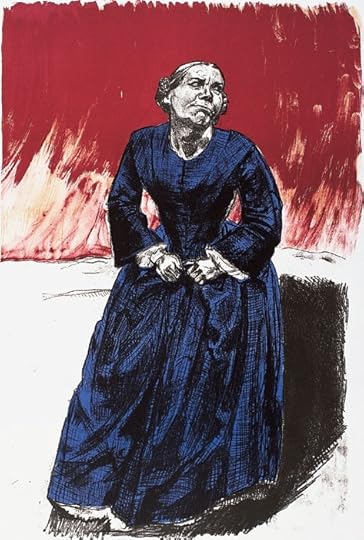
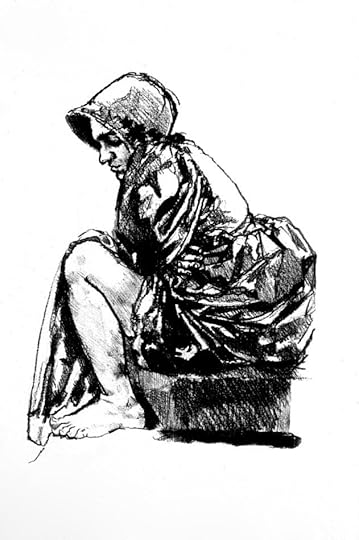
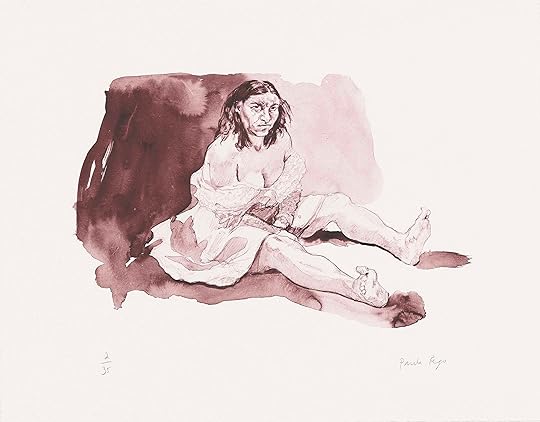
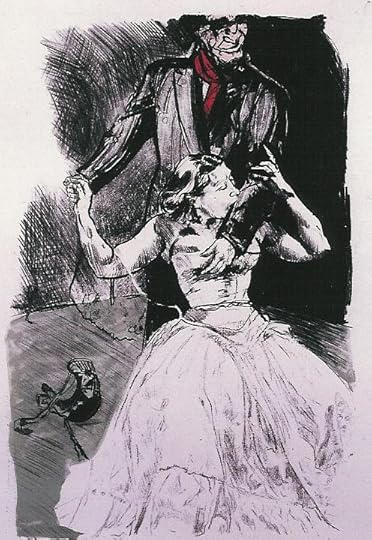
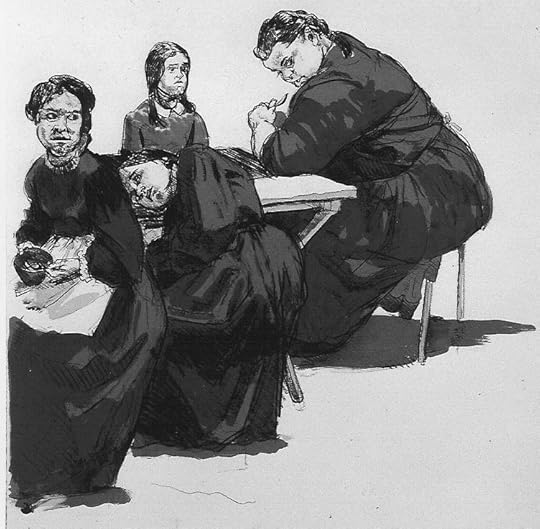
Paula Rego has long had a fascination with Charlotte Brontë’s Jane Eyre and Jean Rhys’s The Wide Sargasso Sea . In 2002 this culminated in the production of twenty-five lithographs, reproduced here in an artist’s book, along with excerpts from the novel. Marina Warner, in her eloquent and perceptive introduction, examines why Jane Eyre should have inspired Rego’s new Charlotte Brontë and Paula Rego share an imaginative ardor that abolishes the veil between what takes place in fact or in fantasy. As storytellers, they really are kith and Rego reproduces the psychological drama in the book through subjective distortions of scale, cruel expressiveness of gesture and frown, and disturbingly stark contrasts of light and welling shadows. Again and again in the story, Jane Eyre is closeted in a small, confined space, sometimes most terribly against her will, sometimes secluded of her own in an early piece of powerful scene-setting, she is locked in the dark chamber where John Reed died and is so terrified by the dead man’s presence that she has a fit. This is only the first of a sequence of experiences when, for better or worse, imagination takes over Jane’s being. Such an emphasis on the fire in the mind and the dark outside might perhaps reveal, without saying much more, how Paula Rego of all artists would respond to Jane Eyre. Paula Rego has been making images out of made-up stories since she herself was a child, and if anything can be said to offer a consistent thread through her astonishing, fertile and multi-faceted production it is she has been a narrative artist all along, and one whose stories are not reproduced from life as observed or remembered, but from goings-on in the camera lucida of the mind’s eye. Rego has not lost in adulthood the energy of the child’s make-believe "It all comes out of my head,’ she says, ‘All little girls improvise, and it’s not just I make it my own."
Paula Rego was born in Lisbon on 26 January 1935. She grew up in a republican and liberal family, linked to both English and French culture, and studied at St. Julian's School in Carcavelos, spending her childhood and adolescence in Estoril. In the 1950s, her father encouraged her to pursue her artistic career away from the Portugal of Salazar's dictatorship, and Paula Rego enrolled at the prestigious Slade School of Fine Art in London, aged just 17. She met several artists at the school, including her future husband, Victor Willing, whom she married in 1959 and with whom she would later have three children (Carolina, Victoria and Nicholas).
A painter and art critic, Victor Willing (1928, Alexandria - 1988, London) became one of the foremost critics of Paula Rego's work and, on several occasions, made what have proved to be some fundamental interpretations of her work. In fact, many of her pieces contain either explicit or implicit references to "Vic". These references are most noticeable in work produced from the mid-1980s, while her husband was in the final stages of the multiple sclerosis which eventually led to his death.
Having divided her time between Portugal and London throughout the 1960s, Paula Rego settled permanently in London in 1976. However, she continued to visit Portugal frequently, returning mostly to her family home in Ericeira. This house was to become a regular feature of her artistic work, since it held many memories and evoked images relating to a certain "Portuguese culture" she associated with her childhood. A further link to Portuguese culture would come later, in the form of Lila Nunes, Vic's former nurse, who is of Portuguese background and has been Paula's favourite model since 1988.
Paula Rego's work got her important recognition fairly early on in her career but it was in particular after the 1990s, when the artist was already in her fifties, that she became a fundamental reference not only in Portuguese and English art circles, but all over the world. She was regularly invited to produce work for galleries and specific exhibitions, often establishing a dialogue with their collections. In 1990, she was appointed the first Associated Artist of the National Gallery in London.
With her prodigious imagination, Paula Rego has explored many different techniques and artistic languages over the course of her career, while continuing to display surprising coherence throughout her work. She has held countless solo and retrospective exhibitions at leading international museums and galleries, as well as winning a host of awards and prizes.
She currently lives and works in London, and is represented by Marlborough Fine Art.
For many years, the artist Paula Rego has been fascinated with Charlotte Brontë's "Jane Eyre". In 2002 she produced twenty-five lithographs, and these are reproduced here in a largish book, along with excerpts from the novel. There is also an introduction by Marina Warner, which is a detailed analysis of the inspiration - both literary and artistic antecedents - in a rather overblown style which I did not care for. But the pictures are startling.
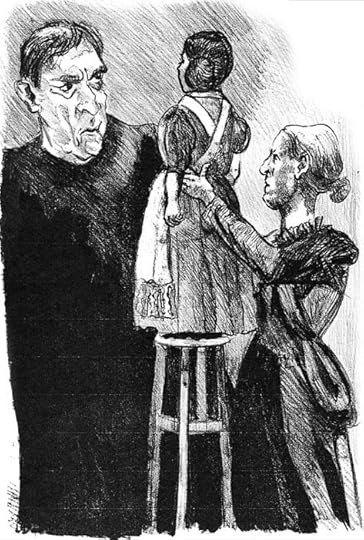
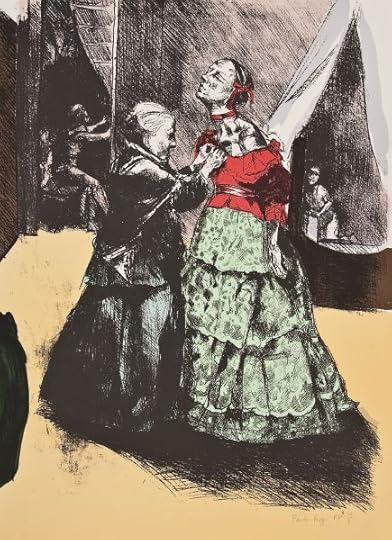
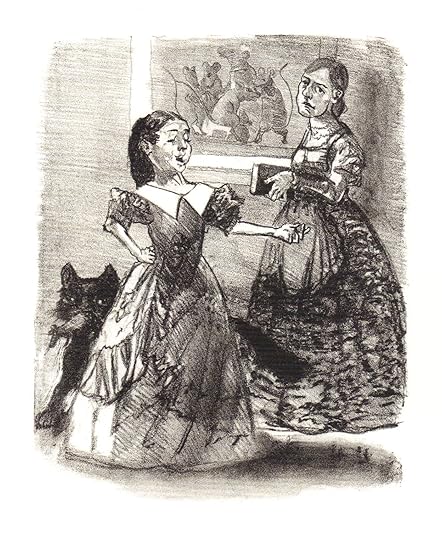
Paula Rego does not paint attractive pictures. If you are hoping for some conventional illustrations to a favourite Victorian novel, then this is not for you. She takes the gothic side, the horrific atmosphere underlying Brontë's work, as her starting point. Almost all Paula Rego's works feature people, and they are all breathtakingly direct. She has a very honest eye, and the ability to reproduce what she sees, and also impart her subjective emotional reaction within the work. Here she conveys the psychological drama in the book through distortions of scale, expressiveness of gesture and frown, and disturbingly stark contrasts of light and shade. On a first impression her work may seem ugly and cruel. The viewer may feel they are an interloper, watching a private moment, and want to look away. Paula Rego's works are not pretty, and they are often subversive, but they have a morbid dark truth.
Paula Rego was born in Lisbon in 1935. However in the 1950s, her father encouraged her to pursue her studies abroad, away from Portugal, and at only 17 years of age Paula Rego was accepted at the Slade School of Fine Art in London. She then divided her time between Portugal and London, finally settling in London in 1976. However, she continued to visit Portugal, saying that her family home in Ericeira held strong memories, and evoked images relating to her childhood. Many aspects of Portuguese culture continue to feature in and inform her work. She is now acknowledged to be one of the leading figurative artists working today. Her inspiration comes largely from fairy tales, myth, religious sources and literature. However her fairy tale worlds are not those ornamental pretty realms of Arthur Rackham or Edmund Dulac. They owe more to Gustav Doré and Max Klinger.
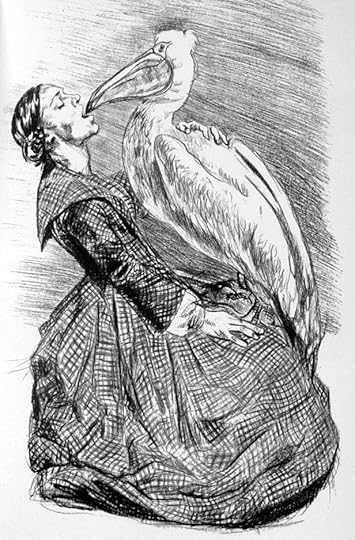
Paula Rego has been making images from stories since she was a child, and bringing her astonishing personal interpretations of stories to us. She has produced a startling set of illustrations for nursery rhymes, for instance, which perhaps one would think twice before showing a child. These are nightmarish visions, on the lines of one of these lithographs, "Loving Bewick", in which Jane Eyre appears to be kissing - or receiving - the pelican's beak with an expression of rapture. Marina Warner says,
"Rego has explored ... the conditions of her own upbringing in Portugal, her formation as a girl and as a woman, and the oscillation between stifling social expectations and liberating female stratagems."
These lithographs have a dark almost violent energy. They are almost reinterpretations of the stark gothic world of "Jane Eyre". Hers is the child's world of make-believe, the terror of the child's own imagination, the fear of the dark outside. It is a world steeped in claustrophobia. Again and again in the story, Jane Eyre is closeted in a small, confined space. Sometimes it is her own choice, but sometimes it is terrifyingly against her will. It is a bleak, and often a cruel world which Charlotte Brontë and Paula Rego share here. Paula Rego herself has said,
"It all comes out of my head. All little girls improvise, and it's not just illustration: I make it my own"
(Review Provisória) Sou altamente suspeita para avaliar esta obra uma vez que adoro a história e a personagem Jane Eyre, adoro a escrita de Charlotte Brontë e adoro a arte de Paula Rego...Como não poderia deixar de ser, adorei muito mesmo esta obra...
Que viagem emocional esta do regresso a passagens do livro descobrindo a arte que Paula Rego criou a partir das mesmas!...
Ainda para mais, algumas das passagens presentes nesta obra foram das que mais me marcaram aquando da leitura de Jane Eyre e que fizeram com que para mim ela seja uma das melhores personagens alguma vez criadas na literatura...São passagens em que Jane está vulnerável e a "lutar" com as suas emoções e medos. As imagens de Paula Rego potenciaram todo um reviver desses momentos de leitura, acrescentando aos mesmos aspectos que só os olhos e a mente de uma artista como ela, poderiam ver.
Foi também intrigante e motivo de reflexão encontrar passagens que não me haviam tocado particularmente durante a leitura de Jane Eyre ... Embora essas tenham ocorrido em menor número, a arte de Paula Rego juntamente com a releitura de Brontë trouxeram outra luz e aspectos únicos aos quais não tinha dado atenção.
Não se trata aqui de uma obra ilustrada ou de partes da obra ilustrada, isto é muito mais, é a obra interpretada, ou reinterpretada, pela imaginação, criatividade e talento de Paula Rego.
There is a major retrospective of Paula Rego's work currently showing in Edinburgh (Scottish National Gallery of Modern Art), and I've just read Jane Eyre so, this, obviously.
Rego is best known for her menacing, narrative paintings that confront viewers with uncomfortable truths about womanhood in general and womanhood under a fascist regime (Portugal 1970s) in particular. She also illustrates books, or rather she creates images based on particular stories, for this is not an edition of Jane Eyre but a series of vignettes.
It is interesting to note which scenes Rego has homed in on for depiction. The cover image is of 'the great girls' stealing food 'from the little ones' at Lowood School. Rego also gives us a terrified Jane shut in a room, an imposing Rochester, Jane homeless and, of course, the tragic Bertha Mason. Jane throughout is dumpy, short of stature and plain of face just as Bronte portrayed. We also have, of course, Jane balancing on a chamber pot, because this is Paula Rego.
Apesar de não gostar do estilo da Paula Rego, acho que a arte dela assenta que nem uma luva a Jane Eyre. Jane Eyre é o meu livro preferido e a minha personagem favorita, por isso adorei ver a história recreada pela pintura. No entanto, a minha interpretação da história faria com que eu escolhesse passagens diferentes para serem registadas.
Fascinating images to go with fragments of Charlotte Brontë's Jane Eyre. The introduction is also worth reading, though it is quite heavy on praise of the work.