

What do you think?

Somebody's Luggage
Charles John Huffam Dickens (1812-1870), also known as "Boz", was the foremost English novelist of the Victorian era, as well as a vigorous social campaigner. Considered one of the English language's greatest writers, he was acclaimed for his rich storytelling and memorable characters, and achieved massive worldwide popularity in his lifetime. The popularity of his novels and short stories has meant that not one has ever gone out of print. Dickens wrote serialised novels, the usual format for fiction at the time, and each new part of his stories was eagerly anticipated by the reading public. Among his best-known works are Sketches by Boz (1836), The Pickwick Papers (1837), Oliver Twist (1838), Nicholas Nickleby (1839), Barnaby Rudge (1841), A Christmas Carol (1843), Martin Chuzzlewit (1844), David Copperfield (1850), Bleak House (1853), Little Dorrit (1857), A Tale of Two Cities (1859), Great Expectations (1861) and Our Mutual Friend (1865).
56 pages, Paperback
First published January 1, 1862
About the author
Charles Dickens
13.6k books32.3k followersCharles John Huffam Dickens (1812-1870) was a writer and social critic who created some of the world's best-known fictional characters and is regarded as the greatest novelist of the Victorian era. His works enjoyed unprecedented popularity during his lifetime, and by the twentieth century critics and scholars had recognised him as a literary genius. His novels and short stories enjoy lasting popularity.
Dickens left school to work in a factory when his father was incarcerated in a debtors' prison. Despite his lack of formal education, he edited a weekly journal for 20 years, wrote 15 novels, five novellas, hundreds of short stories and non-fiction articles, lectured and performed extensively, was an indefatigable letter writer, and campaigned vigorously for children's rights, education, and other social reforms.
Dickens was regarded as the literary colossus of his age. His 1843 novella, A Christmas Carol, remains popular and continues to inspire adaptations in every artistic genre. Oliver Twist and Great Expectations are also frequently adapted, and, like many of his novels, evoke images of early Victorian London. His 1859 novel, A Tale of Two Cities, set in London and Paris, is his best-known work of historical fiction. Dickens's creative genius has been praised by fellow writers—from Leo Tolstoy to George Orwell and G. K. Chesterton—for its realism, comedy, prose style, unique characterisations, and social criticism. On the other hand, Oscar Wilde, Henry James, and Virginia Woolf complained of a lack of psychological depth, loose writing, and a vein of saccharine sentimentalism. The term Dickensian is used to describe something that is reminiscent of Dickens and his writings, such as poor social conditions or comically repulsive characters.
On 8 June 1870, Dickens suffered another stroke at his home after a full day's work on Edwin Drood. He never regained consciousness, and the next day he died at Gad's Hill Place. Contrary to his wish to be buried at Rochester Cathedral "in an inexpensive, unostentatious, and strictly private manner," he was laid to rest in the Poets' Corner of Westminster Abbey. A printed epitaph circulated at the time of the funeral reads: "To the Memory of Charles Dickens (England's most popular author) who died at his residence, Higham, near Rochester, Kent, 9 June 1870, aged 58 years. He was a sympathiser with the poor, the suffering, and the oppressed; and by his death, one of England's greatest writers is lost to the world." His last words were: "On the ground", in response to his sister-in-law Georgina's request that he lie down.
(from Wikipedia)
Dickens left school to work in a factory when his father was incarcerated in a debtors' prison. Despite his lack of formal education, he edited a weekly journal for 20 years, wrote 15 novels, five novellas, hundreds of short stories and non-fiction articles, lectured and performed extensively, was an indefatigable letter writer, and campaigned vigorously for children's rights, education, and other social reforms.
Dickens was regarded as the literary colossus of his age. His 1843 novella, A Christmas Carol, remains popular and continues to inspire adaptations in every artistic genre. Oliver Twist and Great Expectations are also frequently adapted, and, like many of his novels, evoke images of early Victorian London. His 1859 novel, A Tale of Two Cities, set in London and Paris, is his best-known work of historical fiction. Dickens's creative genius has been praised by fellow writers—from Leo Tolstoy to George Orwell and G. K. Chesterton—for its realism, comedy, prose style, unique characterisations, and social criticism. On the other hand, Oscar Wilde, Henry James, and Virginia Woolf complained of a lack of psychological depth, loose writing, and a vein of saccharine sentimentalism. The term Dickensian is used to describe something that is reminiscent of Dickens and his writings, such as poor social conditions or comically repulsive characters.
On 8 June 1870, Dickens suffered another stroke at his home after a full day's work on Edwin Drood. He never regained consciousness, and the next day he died at Gad's Hill Place. Contrary to his wish to be buried at Rochester Cathedral "in an inexpensive, unostentatious, and strictly private manner," he was laid to rest in the Poets' Corner of Westminster Abbey. A printed epitaph circulated at the time of the funeral reads: "To the Memory of Charles Dickens (England's most popular author) who died at his residence, Higham, near Rochester, Kent, 9 June 1870, aged 58 years. He was a sympathiser with the poor, the suffering, and the oppressed; and by his death, one of England's greatest writers is lost to the world." His last words were: "On the ground", in response to his sister-in-law Georgina's request that he lie down.
(from Wikipedia)
Ratings & Reviews
Friends & Following
Create a free account to discover what your friends think of this book!
Community Reviews
Displaying 1 - 28 of 28 reviews

April 18, 2023
"Somebody's Luggage" was originally published in the 1862 Christmas edition of the journal, "All the Year Round," edited by Charles Dickens. Dickens wrote a framing story about a waiter who discovers some manuscripts in the luggage left behind by an aspiring writer. The unpublished writer had stuffed his manuscripts into his umbrella and various traveling bags which he had left at the inn. The "found manuscripts" were written by Dickens, Charles Allston Collins, Arthur Lockes, John Oxenford, and Julia Cecilia Stratton. The Herperus version of the book also contains an excellent forward and introduction.
"Somebody's Luggage" was one of Dicken's better Christmas editions. While they were not holiday stories, most of the works had some humorous elements and feelings of good will. The stories ranged from the sentimental to the supernatural to a tall tale. The theme of writers, editors, and other creative people ran through some parts of the collection. This is a ten-part book written by five authors. Some of the online versions only contain the parts written by Dickens, and the reader would miss some good stories. I read "Somebody's Luggage" with the Dickensian group. 3.5 stars, rounded up.
"Somebody's Luggage" was one of Dicken's better Christmas editions. While they were not holiday stories, most of the works had some humorous elements and feelings of good will. The stories ranged from the sentimental to the supernatural to a tall tale. The theme of writers, editors, and other creative people ran through some parts of the collection. This is a ten-part book written by five authors. Some of the online versions only contain the parts written by Dickens, and the reader would miss some good stories. I read "Somebody's Luggage" with the Dickensian group. 3.5 stars, rounded up.

April 22, 2023
I got this for a group read, one chapter a week. Unfortunately, the edition I ordered did not have ALL the stories in it and that took away from the continuity & enjoyment of the interconnected stories. Dickens had invited other authors, such as Wilkie Collins, to write 3 of the 7 stories but my edition only had the ones that Dickens wrote. I usually love Dickens' writing, but these left me wanting. The second half of the first story was much more interesting than the first and set up how the following stories came about. Of the 4 Dickens' stories, I enjoyed "His Boots" the best. As usual the discussion by the Dickensians group was lively and robust and I wished I could have stayed engaged despite missing 3 of the stories.

February 28, 2024
Everybody knows that Charles Dickens wrote great stories, and his novels are well loved even now. Some of his shorter works are also immensely popular. Where would we all be without “A Christmas Carol”, for instance? But there are some lesser known stories which nowadays seem to disappoint his admirers. Often reviews for these attract low scores on Goodreads, and a puzzled comment amounting to the fact that the reader didn’t think much of them. Given how these are published, I’m not really surprised. This is not Dickens’s fault, nor was it the popular opinion when they were written; it is down to modern editors.
As time went on and Dickens found himself spread too thin with his editoral and speaking commitments, his theatrical pursuits and writing of all types, not to mention his significant family duties, his knowledge that the public expected a substantial Christmas story from him every year filled him with gloom. He had written 5 Christmas novellas, and quite a few stand-alone pieces at Christmas over the years. He confided to his friend and mentor John Forster that he did not know how he would manage to keep this up.
Then he had a brainwave. He did not need to write a long piece. He could ask those in his “stable” of authors to provide stories, and pick which he thought were the best of them. All he need do was to provide a frame story: a sort of linking structure. The stories would not necessarily be “Christmassy”, but would be stories which conformed to his stipulation for his magazines: first in “Household Words” and then “All the Year Round”. They would be stories which stressed the value of family, fellowship and friendship, which entertained and informed, and helped to stimulate the Christmas message of kindness and good cheer, especially at that time of year.
These “Christmas numbers” became a big hit, with sales approaching 300,000 at their peak. Dickens’s regular team of inhouse writers, Wilkie Collins, Elizabeth Gaskell, George Augustus Sala, Adelaide Anne Procter, Eliza Lynn, Harriet Parr and Percy Fitzgerald and others contributed to 8 annual works between 1858 and 1861. Charles Dickens envisioned and commissioned the stories, sometimes from outside his stable of authors too, and selected those he liked best. He expressed this in his magazine as “conducting” his Christmas number. In 1862 this issue cost 4d., which was double the price and double the length of a normal weekly issue. Published a few days before Christmas Eve, it was ideal for sharing. Each family member might read a different story aloud, around the fireside. Dickens’s Christmas Number became a new tradition, and was much anticipated each year.
However in 1862 there was a partial rift between Charles Dickens and Wilkie Collins, and Collins resigned from Dickens’s staff.
Somebody’s Luggage Dickens’s annual Christmas number for 1862 in “All the Year Round” was thus the first collaboration in which Wilkie Collins played no part. Including this one, there were to be a further 5 collections of portmanteau stories, before Wilkie Collins returned for their joint enterprise of a stage play and novel “No Thoroughfare” in 1867.
It is evident from this long list—which does not include all their dual collaborations—that portmanteau stories are a substantial component of the Dickens oeuvre. We can still read them now … but there is a big snag. The contributing authors were never credited in the original publication. Not mentioning the names of the authors as a byline, was in keeping with most Victorian periodicals and continued for a long time afterwards, in order to keep the “house style”. Most contributing authors accepted this anonymity, although Wilkie Collins, Elizabeth Gaskell and some others moved to publish on their own after a while.
Most editions of Charles Dickens’s collected—or selected—works will only include the part authored by him, i.e the first and last stories plus perhaps one or two from the middle (such as in this case). All the rest are ignored, despite the fact that the drastically reduced overall work is unbalanced. Sometimes, such as in “The Wreck of the Golden Mary” some characters and situations are carried over into another (missing) story, and as a consequence it does not even make sense! And in Somebody’s Luggage most editions title the first two pieces I and II, and then continue—often with no explanation—missing out all the rest but adding “III—His Brown-Paper Parcel by Charles Dickens” although it is not number 3 at all, but number 6 in the whole work.
Five years after this Christmas number, in 1867, responding to critics who had disliked the stories that he had not written himself, Dickens did publish an edition with just his own parts, but as the editor of the edition reviewed here points out, it makes Somebody’s Luggage far less remarkable:
“The excision of the other contributors dilutes the entire Christmas number, draining it of its tonal richness and regularising the quirky narrative rhythms created by the odd juxtaposition of such a diverse array of texts.”
Surely Charles Dickens would never have predicted that other people in the future, doing his job as editor, would ever produce such a hatchet job as the norm. Thankfully, just occasionally we can find the stories published in their entirety, and such is the case here. All credit is due to Hesperus Press for having the courage to print the stories as they were intended to be read.
Now we can see that Somebody’s Luggage, as a complete work, is a most enjoyable 5 star read, with stories which include ghost stories, humorous stories, travel and adventure and mystery stories. They may be poignant or ironic; they may touch on profound issues or be wickedly grotesque. They seem to have little in common, until you realise the common theme: of losing—and finding once again. There is even a sly joke in the subtext, as the whole work is self-reflexive. As Dickens said, in a way it was:
“a comic defiance of the difficulty of a Xmas No., with an unexpected end to it.”
Dickens’s frame story in Somebody’s Luggage is narrated by Christopher, the head waiter at a small hotel. We smile at Christopher, an amusing fellow who describes the life of a waiter as a “noble calling” which does not come naturally to everyone. He declares: “You must be bred to it. You must be born to it.”.
One day Christopher notices some items in room number 24B. The head chambermaid Mrs. Pratchett explains that this is “somebody’s luggage”, which had been left here more than five years ago. (The interchanges between these two are a delight, with Christopher: “[taking] Mrs. Pratchett down as many pegs as was essential to the future happiness of all parties.”) The owner of the luggage had occupied the room for a few nights, but has not yet returned to collect it—nor to pay his bill. The contents of the luggage are: a black portmanteau, a black bag, a desk, a dressing case, a brown-paper parcel, a hatbox, and an umbrella strapped to a walking-stick.
And every single item of luggage has pages of untitled and very inky pages of manuscript in it …
Christopher’s story is an extremely droll and whimsical piece by Charles Dickens. The head waiter has a florid way of speaking, full of protestations and prevarications. Plus, Charles Dickens is the master of the ridiculous and hilariously far-fetched analogy. We can well imagine him on stage, acting out the part of the cockney, slightly stuffy and very “proper” waiter. Christopher is a faithful and wise servant archetype, and also a cameo of a very amusing personality, whose air of being misunderstood make us think there is a little of Dickens himself here. Also of course his presenting of the stories is an exact parallel of Dickens “conducting” this compliation.
Christopher is going to share the stories with us, but he makes sure that we know he is not to blame for “somebody’s” stories: “If there should be any flaw in the writings, or anything missing in the writings, it is Him as is responsible—not me.” This sets the scene perfectly for what is to follow.
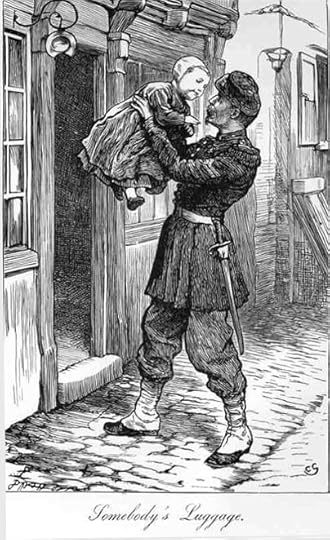
The end of this story has really primed us to want more, so we sit back and smile when we see that the next story, His Boots is also to be by Charles Dickens. It is set in a sleepy little town in France, and told by “Monsieur The Englishman”. (This is a play on words, as he is called Mr. Langley: i.e. “L’Anglais”.) It is an affecting bitter-sweet story about a soldier, Corporal Théophile, and a little girl; a neglected orphan, who calls herself “Bebelle” (Gabrielle). In time, Bebelle manages to break through all the anger, hurt and repressed memories of M. L’Anglais, and effect a reconciliation.
John Forster wrote that Dickens reported having: “made the story a camera obscura of certain French places and styles of people; having founded it on something he had noticed in a French soldier.” It is a melodramatic and sentimental but rather maudlin piece, which Victorian audiences would have loved. The message of how simple innocence is able to over overcome pride and vanity is still a strong one today.
The next one, His Umbrella is by John Oxenford. He was not often chosen for Dickens’s writing team, and Dickens “partly contributed” to it. We do not know specifically how, but perhaps it is significant that it is a supernatural tale told with a good bit of humour, which is Dickens’s trademark. It is difficult to think of another English author of the time who would invoke the supernatural, but at the same time include ludicrous elements alongside the terror, in such a daring way.
Or perhaps Dickens’s contribution lies in the choice of names. “Jack Slingsby, Yorick Zachary Yorke” and “Miss Catherine Crackenbridge” all have a sort of Dickensian ring about them. The focus on an umbrella is very Dickensian as well, remembering Mrs. Gamp in “Martin Chuzzlewit”, Mrs. Bagnet in “Bleak House”—and Mrs. Lammle with her parasol in “Our Mutual Friend” too. This is a clever story, because not only was the manuscript of this story found inside an umbrella, but a large omnipresent umbrella is the main motif. A troublesome umbrella as a plot device was a staple of 19th century comic writing.
Miss Catherine Crackenbridge is a mysterious woman who strolls along a beach: sometimes apparent, and sometimes disappearing from view. “Dressed as she was in light raiment, the lady, however rapidly she might have run away, ought to have been visible in some direction; but she was not visible in any direction.” There is a gingham umbrella, which appears to be haunted. Add a room filled with “Lumber, insignificant by day, […] ghastly at night, when illuminated by a single candle, and seen by a single spectator”, a many-armed bat, a human skeleton … Read that “A heavy weight rested on my arm, a cold breath was on my cheek, and close beside me was a pale face that moved its lips, as if speaking with the greatest earnestness; but it gave no sound” and we have a chillingly effective ghost story.
This intriguing ghost story very much embodies the feel of a story by the later author, M.R. James, who wrote the excellent essay “Some Remarks on Ghost Stories” in 1929. The Oxford academic M.R. James was a writer par excellence of short ghost stories, and influenced many authors who have come after him. Although he did not use humour, M.R. James often created an atmosphere of dread using solitary male characters, who were also sometimes on a deserted beach, for example: “A Warning to the Curious” and “ Oh, Whistle, and I’ll Come to You, My Lad.” Both these stories also feature artefacts with supernatural properties.
I would like to read more by John Oxenford.
The next two stories: His Black Bag and His Writing-Desk form a whole, and are by Charles (“Charlie”) Allston Collins . He had contributed to “A Message from the Sea” the previous year and would also add stories to “Doctor Marigold’s Prescriptions” three years later. “Charlie Collins” was about to marry Dickens’s favourite daughter Katey, (nicknamed by him “Lucifer Box” for her hot temper) who was also a painter. Dickens commented to a friend: “I do not doubt that the young lady might have done much better, but there is no question that she is very fond of him”.
In fact the marriage was not a success, and Katey was later to marry another artist, which is why we now know her as the painter Kate Perugini. Charles Allston Collins’s fame now is mostly as an artist who was attached to the Pre-Raphaelite Brotherhood, although he was not a founder member. Charlie was also the brother of Wilkie Collins, whom you will remember had temporarily just severed his connection with Dickens’s periodical. Since Dickens also famously disliked Pre-Raphaelite paintings at this time, one has to wonder about this inclusion.
The story is a kind of social comedy: a Victorian melodrama about money and social position. It takes place in Creel in the North of Scotland, and later Italy and Switzerland. The story centres on the vile, uncaring Lord Sneyd (what a great name!) who wants to marry the beautiful Miss Mary Crawcour. However she is loved by another. There is abrupt switch of tone and mood with a The first part of the story is hilarious in parts, but also tragic, until the sweetly ironic second story among the mountains resolves it. The message is that happiness counts for more than money and status.
His Dressing Case by Arthur Locker is a tall tale about a shipwreck, involving a sleepy walrus and steering an iceberg. Clearly a parody, its events feel outrageous and unbelievable. Is any of it credible? Is the narrator to be trusted? Was there even a ship at all? In the end we learn that Mr. Monkhouse, the Englishman at loggerheads with Herr Schlafenwohl, the humorously named German in the story, is probably none other than
In this Christmas number, Wilkie Collins was to have written the next part, but was ill, so Charles Dickens wrote His Brown-Paper Parcel.
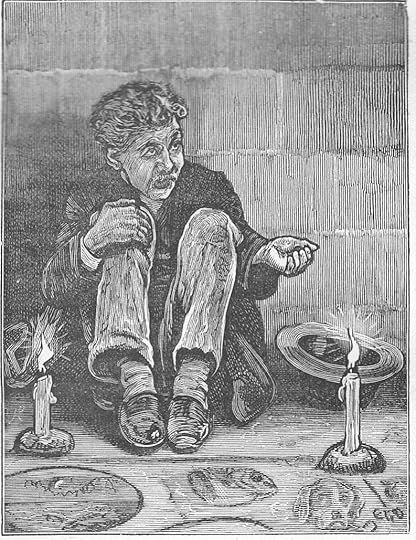
The tale is told by a mysterious narrator: “My works are well known” he says. He tells us his work is Fine Art; we know it is visual, creative expression, perhaps painting or sculpture rather than a craft or having a practical function. We have his name: “Tom”, which is an all-purpose name, and know that we could see his work (but not him) all over London. Tom feels very sorry for himself, and stays in bed a lot, lamenting that the world knows nothing of people who do not succeed in it. As the story goes on, we follow a successful pavement artist whose work Tom describes as “exquisite”, . It is a thoughtful, rather sad but beautiful tale.
The next two titles are both one long story, as before, and by Julia Cecilia Stretton, who wrote both children’s stories and novels for adults. The first is a cosy humorous story called His Portmanteau. We read a story of two brothers, Dick (later Mr. Blorage) and Billy. One is too nice for his own good, and one is a scoundrel. It features a , and is a droll story, with a fairy to grant wishes, a dream world and a clear message … Be careful what you wish for! His Hat-Box completes the story, when we see that this is indeed a morality tale: a warning about greed and corruption. But it has a happy ending as the modest and hard-working Mr. Blorage . This double story is very sweet and light, and perfectly fits Charles Dickens’s instructions for the contents of his Christmas numbers with its mood, its worthy theme, and its setting of hearth and home.
So Christopher sums up for us in the final story His Wonderful End by Charles Dickens. .
This is a perfect piece of metafiction, many years before the term was invented, since it is Charles Dickens himself who edited and published these short stories. And in addition we know just how hard he campaigned for copyright law. Dickens expresses himself as the aspiring writer, and acknowledges that random chance plays as much of a role in getting published, as any repeated efforts with the editors of the day.
Charles Dickens considered Somebody’s Luggage to be “a most signal hit”—and so do I! It is probably my favourite of all the group collaborative works. Indeed every story is so different, that every reader should find something to enjoy here.
Here are the complete contents:
His Leaving It ’Till Called For — Charles Dickens
His Boots — Charles Dickens
His Umbrella — John Oxenford
His Black Bag — Charles Allston Collins
His Writing-Desk — Charles Allston Collins
His Dressing Case — Arthur Locker
His Brown-Paper Parcel — Charles Dickens
His Portmanteau — Julia Cecilia Stretton
His Hat-Box — Julia Cecilia Stretton
His Wonderful End — Charles Dickens
As time went on and Dickens found himself spread too thin with his editoral and speaking commitments, his theatrical pursuits and writing of all types, not to mention his significant family duties, his knowledge that the public expected a substantial Christmas story from him every year filled him with gloom. He had written 5 Christmas novellas, and quite a few stand-alone pieces at Christmas over the years. He confided to his friend and mentor John Forster that he did not know how he would manage to keep this up.
Then he had a brainwave. He did not need to write a long piece. He could ask those in his “stable” of authors to provide stories, and pick which he thought were the best of them. All he need do was to provide a frame story: a sort of linking structure. The stories would not necessarily be “Christmassy”, but would be stories which conformed to his stipulation for his magazines: first in “Household Words” and then “All the Year Round”. They would be stories which stressed the value of family, fellowship and friendship, which entertained and informed, and helped to stimulate the Christmas message of kindness and good cheer, especially at that time of year.
These “Christmas numbers” became a big hit, with sales approaching 300,000 at their peak. Dickens’s regular team of inhouse writers, Wilkie Collins, Elizabeth Gaskell, George Augustus Sala, Adelaide Anne Procter, Eliza Lynn, Harriet Parr and Percy Fitzgerald and others contributed to 8 annual works between 1858 and 1861. Charles Dickens envisioned and commissioned the stories, sometimes from outside his stable of authors too, and selected those he liked best. He expressed this in his magazine as “conducting” his Christmas number. In 1862 this issue cost 4d., which was double the price and double the length of a normal weekly issue. Published a few days before Christmas Eve, it was ideal for sharing. Each family member might read a different story aloud, around the fireside. Dickens’s Christmas Number became a new tradition, and was much anticipated each year.
However in 1862 there was a partial rift between Charles Dickens and Wilkie Collins, and Collins resigned from Dickens’s staff.
Somebody’s Luggage Dickens’s annual Christmas number for 1862 in “All the Year Round” was thus the first collaboration in which Wilkie Collins played no part. Including this one, there were to be a further 5 collections of portmanteau stories, before Wilkie Collins returned for their joint enterprise of a stage play and novel “No Thoroughfare” in 1867.
It is evident from this long list—which does not include all their dual collaborations—that portmanteau stories are a substantial component of the Dickens oeuvre. We can still read them now … but there is a big snag. The contributing authors were never credited in the original publication. Not mentioning the names of the authors as a byline, was in keeping with most Victorian periodicals and continued for a long time afterwards, in order to keep the “house style”. Most contributing authors accepted this anonymity, although Wilkie Collins, Elizabeth Gaskell and some others moved to publish on their own after a while.
Most editions of Charles Dickens’s collected—or selected—works will only include the part authored by him, i.e the first and last stories plus perhaps one or two from the middle (such as in this case). All the rest are ignored, despite the fact that the drastically reduced overall work is unbalanced. Sometimes, such as in “The Wreck of the Golden Mary” some characters and situations are carried over into another (missing) story, and as a consequence it does not even make sense! And in Somebody’s Luggage most editions title the first two pieces I and II, and then continue—often with no explanation—missing out all the rest but adding “III—His Brown-Paper Parcel by Charles Dickens” although it is not number 3 at all, but number 6 in the whole work.
Five years after this Christmas number, in 1867, responding to critics who had disliked the stories that he had not written himself, Dickens did publish an edition with just his own parts, but as the editor of the edition reviewed here points out, it makes Somebody’s Luggage far less remarkable:
“The excision of the other contributors dilutes the entire Christmas number, draining it of its tonal richness and regularising the quirky narrative rhythms created by the odd juxtaposition of such a diverse array of texts.”
Surely Charles Dickens would never have predicted that other people in the future, doing his job as editor, would ever produce such a hatchet job as the norm. Thankfully, just occasionally we can find the stories published in their entirety, and such is the case here. All credit is due to Hesperus Press for having the courage to print the stories as they were intended to be read.
Now we can see that Somebody’s Luggage, as a complete work, is a most enjoyable 5 star read, with stories which include ghost stories, humorous stories, travel and adventure and mystery stories. They may be poignant or ironic; they may touch on profound issues or be wickedly grotesque. They seem to have little in common, until you realise the common theme: of losing—and finding once again. There is even a sly joke in the subtext, as the whole work is self-reflexive. As Dickens said, in a way it was:
“a comic defiance of the difficulty of a Xmas No., with an unexpected end to it.”
Dickens’s frame story in Somebody’s Luggage is narrated by Christopher, the head waiter at a small hotel. We smile at Christopher, an amusing fellow who describes the life of a waiter as a “noble calling” which does not come naturally to everyone. He declares: “You must be bred to it. You must be born to it.”.
One day Christopher notices some items in room number 24B. The head chambermaid Mrs. Pratchett explains that this is “somebody’s luggage”, which had been left here more than five years ago. (The interchanges between these two are a delight, with Christopher: “[taking] Mrs. Pratchett down as many pegs as was essential to the future happiness of all parties.”) The owner of the luggage had occupied the room for a few nights, but has not yet returned to collect it—nor to pay his bill. The contents of the luggage are: a black portmanteau, a black bag, a desk, a dressing case, a brown-paper parcel, a hatbox, and an umbrella strapped to a walking-stick.
And every single item of luggage has pages of untitled and very inky pages of manuscript in it …
Christopher’s story is an extremely droll and whimsical piece by Charles Dickens. The head waiter has a florid way of speaking, full of protestations and prevarications. Plus, Charles Dickens is the master of the ridiculous and hilariously far-fetched analogy. We can well imagine him on stage, acting out the part of the cockney, slightly stuffy and very “proper” waiter. Christopher is a faithful and wise servant archetype, and also a cameo of a very amusing personality, whose air of being misunderstood make us think there is a little of Dickens himself here. Also of course his presenting of the stories is an exact parallel of Dickens “conducting” this compliation.
Christopher is going to share the stories with us, but he makes sure that we know he is not to blame for “somebody’s” stories: “If there should be any flaw in the writings, or anything missing in the writings, it is Him as is responsible—not me.” This sets the scene perfectly for what is to follow.
The end of this story has really primed us to want more, so we sit back and smile when we see that the next story, His Boots is also to be by Charles Dickens. It is set in a sleepy little town in France, and told by “Monsieur The Englishman”. (This is a play on words, as he is called Mr. Langley: i.e. “L’Anglais”.) It is an affecting bitter-sweet story about a soldier, Corporal Théophile, and a little girl; a neglected orphan, who calls herself “Bebelle” (Gabrielle). In time, Bebelle manages to break through all the anger, hurt and repressed memories of M. L’Anglais, and effect a reconciliation.
John Forster wrote that Dickens reported having: “made the story a camera obscura of certain French places and styles of people; having founded it on something he had noticed in a French soldier.” It is a melodramatic and sentimental but rather maudlin piece, which Victorian audiences would have loved. The message of how simple innocence is able to over overcome pride and vanity is still a strong one today.
The next one, His Umbrella is by John Oxenford. He was not often chosen for Dickens’s writing team, and Dickens “partly contributed” to it. We do not know specifically how, but perhaps it is significant that it is a supernatural tale told with a good bit of humour, which is Dickens’s trademark. It is difficult to think of another English author of the time who would invoke the supernatural, but at the same time include ludicrous elements alongside the terror, in such a daring way.
Or perhaps Dickens’s contribution lies in the choice of names. “Jack Slingsby, Yorick Zachary Yorke” and “Miss Catherine Crackenbridge” all have a sort of Dickensian ring about them. The focus on an umbrella is very Dickensian as well, remembering Mrs. Gamp in “Martin Chuzzlewit”, Mrs. Bagnet in “Bleak House”—and Mrs. Lammle with her parasol in “Our Mutual Friend” too. This is a clever story, because not only was the manuscript of this story found inside an umbrella, but a large omnipresent umbrella is the main motif. A troublesome umbrella as a plot device was a staple of 19th century comic writing.
Miss Catherine Crackenbridge is a mysterious woman who strolls along a beach: sometimes apparent, and sometimes disappearing from view. “Dressed as she was in light raiment, the lady, however rapidly she might have run away, ought to have been visible in some direction; but she was not visible in any direction.” There is a gingham umbrella, which appears to be haunted. Add a room filled with “Lumber, insignificant by day, […] ghastly at night, when illuminated by a single candle, and seen by a single spectator”, a many-armed bat, a human skeleton … Read that “A heavy weight rested on my arm, a cold breath was on my cheek, and close beside me was a pale face that moved its lips, as if speaking with the greatest earnestness; but it gave no sound” and we have a chillingly effective ghost story.
This intriguing ghost story very much embodies the feel of a story by the later author, M.R. James, who wrote the excellent essay “Some Remarks on Ghost Stories” in 1929. The Oxford academic M.R. James was a writer par excellence of short ghost stories, and influenced many authors who have come after him. Although he did not use humour, M.R. James often created an atmosphere of dread using solitary male characters, who were also sometimes on a deserted beach, for example: “A Warning to the Curious” and “ Oh, Whistle, and I’ll Come to You, My Lad.” Both these stories also feature artefacts with supernatural properties.
I would like to read more by John Oxenford.
The next two stories: His Black Bag and His Writing-Desk form a whole, and are by Charles (“Charlie”) Allston Collins . He had contributed to “A Message from the Sea” the previous year and would also add stories to “Doctor Marigold’s Prescriptions” three years later. “Charlie Collins” was about to marry Dickens’s favourite daughter Katey, (nicknamed by him “Lucifer Box” for her hot temper) who was also a painter. Dickens commented to a friend: “I do not doubt that the young lady might have done much better, but there is no question that she is very fond of him”.
In fact the marriage was not a success, and Katey was later to marry another artist, which is why we now know her as the painter Kate Perugini. Charles Allston Collins’s fame now is mostly as an artist who was attached to the Pre-Raphaelite Brotherhood, although he was not a founder member. Charlie was also the brother of Wilkie Collins, whom you will remember had temporarily just severed his connection with Dickens’s periodical. Since Dickens also famously disliked Pre-Raphaelite paintings at this time, one has to wonder about this inclusion.
The story is a kind of social comedy: a Victorian melodrama about money and social position. It takes place in Creel in the North of Scotland, and later Italy and Switzerland. The story centres on the vile, uncaring Lord Sneyd (what a great name!) who wants to marry the beautiful Miss Mary Crawcour. However she is loved by another. There is abrupt switch of tone and mood with a The first part of the story is hilarious in parts, but also tragic, until the sweetly ironic second story among the mountains resolves it. The message is that happiness counts for more than money and status.
His Dressing Case by Arthur Locker is a tall tale about a shipwreck, involving a sleepy walrus and steering an iceberg. Clearly a parody, its events feel outrageous and unbelievable. Is any of it credible? Is the narrator to be trusted? Was there even a ship at all? In the end we learn that Mr. Monkhouse, the Englishman at loggerheads with Herr Schlafenwohl, the humorously named German in the story, is probably none other than
In this Christmas number, Wilkie Collins was to have written the next part, but was ill, so Charles Dickens wrote His Brown-Paper Parcel.
The tale is told by a mysterious narrator: “My works are well known” he says. He tells us his work is Fine Art; we know it is visual, creative expression, perhaps painting or sculpture rather than a craft or having a practical function. We have his name: “Tom”, which is an all-purpose name, and know that we could see his work (but not him) all over London. Tom feels very sorry for himself, and stays in bed a lot, lamenting that the world knows nothing of people who do not succeed in it. As the story goes on, we follow a successful pavement artist whose work Tom describes as “exquisite”, . It is a thoughtful, rather sad but beautiful tale.
The next two titles are both one long story, as before, and by Julia Cecilia Stretton, who wrote both children’s stories and novels for adults. The first is a cosy humorous story called His Portmanteau. We read a story of two brothers, Dick (later Mr. Blorage) and Billy. One is too nice for his own good, and one is a scoundrel. It features a , and is a droll story, with a fairy to grant wishes, a dream world and a clear message … Be careful what you wish for! His Hat-Box completes the story, when we see that this is indeed a morality tale: a warning about greed and corruption. But it has a happy ending as the modest and hard-working Mr. Blorage . This double story is very sweet and light, and perfectly fits Charles Dickens’s instructions for the contents of his Christmas numbers with its mood, its worthy theme, and its setting of hearth and home.
So Christopher sums up for us in the final story His Wonderful End by Charles Dickens. .
This is a perfect piece of metafiction, many years before the term was invented, since it is Charles Dickens himself who edited and published these short stories. And in addition we know just how hard he campaigned for copyright law. Dickens expresses himself as the aspiring writer, and acknowledges that random chance plays as much of a role in getting published, as any repeated efforts with the editors of the day.
Charles Dickens considered Somebody’s Luggage to be “a most signal hit”—and so do I! It is probably my favourite of all the group collaborative works. Indeed every story is so different, that every reader should find something to enjoy here.
Here are the complete contents:
His Leaving It ’Till Called For — Charles Dickens
His Boots — Charles Dickens
His Umbrella — John Oxenford
His Black Bag — Charles Allston Collins
His Writing-Desk — Charles Allston Collins
His Dressing Case — Arthur Locker
His Brown-Paper Parcel — Charles Dickens
His Portmanteau — Julia Cecilia Stretton
His Hat-Box — Julia Cecilia Stretton
His Wonderful End — Charles Dickens

April 19, 2023
Somebody’s Luggage is a collaborative work primarily by Charles Dickens and four other authors. These stories were published as the extra Christmas number of 1862 found in his magazine ‘All the Year Round’. These Christmas stories were vastly popular and provided a ton of fun for families at this special time of year. Charles Dickens wrote the framing story for the collection as well as two of the remaining 10 stories. The other authors were John Oxenford, Charles Allston Collins (son of Wilkie Collins), Arthur Locker, and Julia Cecilia Stretton.
The framing story premise is that of a waiter who discovers a collection of manuscripts that have been left behind in ‘Somebody’s Luggage’. A different story is found within each piece - His Boots, His Umbrella, His Black Bag, His Writing Desk, His Dressing Case, His Brown Paper Parcel, His Portmanteau, and His Hat-Box. The waiter tries unsuccessfully to identify the owner of the luggage but finds a diverse collection of stories each with a different theme and focus. Now with these in his possession, the waiter makes a decision pertaining to the lot that will greatly affect the aspiring author as well as himself. One of the major themes that Dickens sought to promote through these stories (as seen primarily in the framing story) is the importance of the work of editors in seeing an artist’s work come into being.
I read these stories with a group in the Dickensians! It’s always a pleasure to read Dickens in this way!
The framing story premise is that of a waiter who discovers a collection of manuscripts that have been left behind in ‘Somebody’s Luggage’. A different story is found within each piece - His Boots, His Umbrella, His Black Bag, His Writing Desk, His Dressing Case, His Brown Paper Parcel, His Portmanteau, and His Hat-Box. The waiter tries unsuccessfully to identify the owner of the luggage but finds a diverse collection of stories each with a different theme and focus. Now with these in his possession, the waiter makes a decision pertaining to the lot that will greatly affect the aspiring author as well as himself. One of the major themes that Dickens sought to promote through these stories (as seen primarily in the framing story) is the importance of the work of editors in seeing an artist’s work come into being.
I read these stories with a group in the Dickensians! It’s always a pleasure to read Dickens in this way!

April 28, 2023
'It's a blessed thing to want something, for then you can duly appreciate the favour of having it.'
I was the leader of the Dickensians! discussion of 'Somebody's Luggage', which lasted for two months, so obviously I could say a lot on the subject :)
This is the 1862 Extra Christmas Number of 'All the Year Round', and Dickens himself considered it to be one of the best.
But (at the moment) among printed editions, only the Hesperus one contains all the stories. They can be found online, though.
I chose this for our early Spring read because of its eclecticism. Each story is different, and for me, each of them has something funny, or touching, or exciting. There's the famous bit about a waiter (the Waiter, rather), a sentimental redemption story, a ghost story of sorts, a romantic story, an adventure story, and a fairy tale; all of them full of humour. There is also a story in a different, rather macabre, vein, which excites the critics because it looks like a hint at the Victorian publishing industry. The second part of the waiter frame story is also obviously concerned with the problems of authorship, and becomes exceedingly meta when it mentions 'All the Year Round' and Dickens himself.
Why is this a Christmas number? That's one of the questions we were discussing and we did not reach a consensus. In my personal opinion, this is a collection of stories about love and miracles, and being open to them, or maybe not. But not all of the stories have a happy ending (although most of them do).
An unusual, interesting read for the lovers of Victorian literature in general and Dickens in particular.
I was the leader of the Dickensians! discussion of 'Somebody's Luggage', which lasted for two months, so obviously I could say a lot on the subject :)
This is the 1862 Extra Christmas Number of 'All the Year Round', and Dickens himself considered it to be one of the best.
But (at the moment) among printed editions, only the Hesperus one contains all the stories. They can be found online, though.
I chose this for our early Spring read because of its eclecticism. Each story is different, and for me, each of them has something funny, or touching, or exciting. There's the famous bit about a waiter (the Waiter, rather), a sentimental redemption story, a ghost story of sorts, a romantic story, an adventure story, and a fairy tale; all of them full of humour. There is also a story in a different, rather macabre, vein, which excites the critics because it looks like a hint at the Victorian publishing industry. The second part of the waiter frame story is also obviously concerned with the problems of authorship, and becomes exceedingly meta when it mentions 'All the Year Round' and Dickens himself.
Why is this a Christmas number? That's one of the questions we were discussing and we did not reach a consensus. In my personal opinion, this is a collection of stories about love and miracles, and being open to them, or maybe not. But not all of the stories have a happy ending (although most of them do).
An unusual, interesting read for the lovers of Victorian literature in general and Dickens in particular.

April 21, 2021
Although I love Dickens, and still prefer his novels to that of his short stories, this was one of my favorites. A great little gem about a man at a hotel who finds some lost luggage and upon going through it, finds several stories he then has published. Later, the man returns to find his happiness in the published works. I loved these little stories and I loved the idea of the whole story. The idea that small items of wear and use can hold individual stories of a person is a brilliant notion, and so much fun. My favorite was boots, because I'm a sucker for an orphan finding a loving home type of story. Overall, one of my favorites from the Christmas Stories book.

April 23, 2023
"Somebody's Luggage" is a cycle of sharply contrasting stories, connected only by their supposedly having been found in manuscript form in a set of left luggage.
Dickens likes to construct analogies to illustrate his ideas; so do I.
It seems to me that “Somebody’s Luggage” might be compared with Elgar’s “Enigma Variations”, wherein the theme that connects the pieces together is deeply submerged under the startlingly original pictures that Elgar draws, as musical caricatures of each of his friends.
So, the book starts off with a set-up piece (an overture) that establishes the scenario and introduces Christopher, the Waiter. He is a recurring “type” of literary character: the “wise servant” or factotum (such as Beaumarchais’ Figaro or Wodehouse’s Jeeves). He understands the rules of society — and where and how to bend them to suit the situation.
In succession, we are treated to:
- An intensely atmospheric story set in a sleepy little town featuring inimitably French local characters
- A ghost story centering upon an iconic umbrella
- A grim little Victorian melodrama on the infernal question of money and social position
- An outrageously far-fetched seafaring yarn
- A sort of allegory, exploring the nature of human perception and value systems
- A morality play of sorts, presented as a parable about greed and corruption.
And, true to form, Christopher reappears at the end, having taken charge of the writings and brought matters to a satisfactory conclusion.
Dickens likes to construct analogies to illustrate his ideas; so do I.
It seems to me that “Somebody’s Luggage” might be compared with Elgar’s “Enigma Variations”, wherein the theme that connects the pieces together is deeply submerged under the startlingly original pictures that Elgar draws, as musical caricatures of each of his friends.
So, the book starts off with a set-up piece (an overture) that establishes the scenario and introduces Christopher, the Waiter. He is a recurring “type” of literary character: the “wise servant” or factotum (such as Beaumarchais’ Figaro or Wodehouse’s Jeeves). He understands the rules of society — and where and how to bend them to suit the situation.
In succession, we are treated to:
- An intensely atmospheric story set in a sleepy little town featuring inimitably French local characters
- A ghost story centering upon an iconic umbrella
- A grim little Victorian melodrama on the infernal question of money and social position
- An outrageously far-fetched seafaring yarn
- A sort of allegory, exploring the nature of human perception and value systems
- A morality play of sorts, presented as a parable about greed and corruption.
And, true to form, Christopher reappears at the end, having taken charge of the writings and brought matters to a satisfactory conclusion.

December 6, 2019
I have read all Dicken's 15 novels in the last two years and loved all but The Pickwick Papers.
Dickens is my second favorite novelist after Mark Twain.
In the last couple of months I have read the below five novellas:
1. The Chimes
2. The Cricket on the Hearth
3. The Battle of Life
4. The Haunted Man and the Ghost's Bargain
5. A Christmas Carol
And the below 14 Short Stories
1. Tom Tiddler’s Ground
2. To Be Read At Dusk
3. The Wreck of the Golden Mary
4. The Signal Man
5. The Trial For Murder
6. The Seven Poor Travellers
7. A Holiday Romance
8. George Silvermans Explanation
9. The Holly Tree
10. Sketches of Young Gentlemen
11. Doctor Marigold
12. American Notes
13. Sketches of Young Couples
14. Somebody’s Luggage
Honestly I didn't enjoy any of the novellas or short stories except "A Christmas Carol and "American Notes".
"Doctor Marigold" was passable as was "Sketches of Young Couples". George Silverman's Explanation, squeaked by, sort of.
What is really ugly is the many collaborations Dickens did in his short stories.
It was like Hendrix taking on the two percussionists and rhythm guitar player to perform at Woodstock.
Just plain poor judgement...
As in all criticism of Dickens' work though...you learn more about the reader than you do about Dickens
Dickens is my second favorite novelist after Mark Twain.
In the last couple of months I have read the below five novellas:
1. The Chimes
2. The Cricket on the Hearth
3. The Battle of Life
4. The Haunted Man and the Ghost's Bargain
5. A Christmas Carol
And the below 14 Short Stories
1. Tom Tiddler’s Ground
2. To Be Read At Dusk
3. The Wreck of the Golden Mary
4. The Signal Man
5. The Trial For Murder
6. The Seven Poor Travellers
7. A Holiday Romance
8. George Silvermans Explanation
9. The Holly Tree
10. Sketches of Young Gentlemen
11. Doctor Marigold
12. American Notes
13. Sketches of Young Couples
14. Somebody’s Luggage
Honestly I didn't enjoy any of the novellas or short stories except "A Christmas Carol and "American Notes".
"Doctor Marigold" was passable as was "Sketches of Young Couples". George Silverman's Explanation, squeaked by, sort of.
What is really ugly is the many collaborations Dickens did in his short stories.
It was like Hendrix taking on the two percussionists and rhythm guitar player to perform at Woodstock.
Just plain poor judgement...
As in all criticism of Dickens' work though...you learn more about the reader than you do about Dickens

December 17, 2023
I did not really vibe with this Charles Dickens story. I like some, not all, and this one was a little weird and all over the place. The waiter was kind of annoying, I have no idea what eventually happened, it was a bit messy. But can't like them all, I guess. On to the next!

December 17, 2014
I had no pre-conceived notions about this book, just that I had seen the title some time ago and wanted to read it. But I think I prefer Charles Dickens as a novelist rather than as a short story writer. This is the second in a row that I have to say I basically did not finish. The lengthy explanation of what it meant to be a Waiter was a bit of a struggle to get through, but it did reveal class distinctions and attitudes of the day.
The section of the story telling about what happened to Somebody's Luggage and what was in it was also okay, but after that boredom set in. I don't like boredom when reading. I have only experienced it with Dickens in various parts of Great Expectations, Mugby Junction, and now this book. I won't continue reading if I get bored, not even for such a world famous author as Dickens. Sorry, Charles!
The section of the story telling about what happened to Somebody's Luggage and what was in it was also okay, but after that boredom set in. I don't like boredom when reading. I have only experienced it with Dickens in various parts of Great Expectations, Mugby Junction, and now this book. I won't continue reading if I get bored, not even for such a world famous author as Dickens. Sorry, Charles!
October 30, 2023
3.84⭐
The story revolves around a waiter who discovers some luggage left behind and abandoned for six years in the hotel/coffee shop where he works. He pays the landlady the amount of the balance due on the room's surcharges left by the occupant and claims the luggage. He searches through the luggage's articles to identify its owner but fails to do so. However, he finds quite a number of story manuscripts secreted away in different parts of the luggage. Impressed by their quality, he succeeds in getting them published, although the identity of their author remains a mystery until a visitor comes calling. The book is a wonderful composite of tales and boasts contributions by eminent Victorian writers four of them by Dickens himself.
1. His Leaving It Till Called For by Charles Dickens 3.25⭐
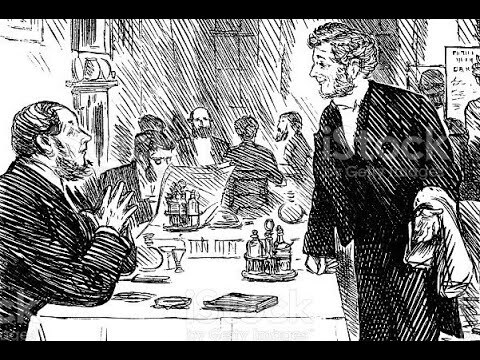
The introductory first part is told by a waiter who discovers a collection of forgotten luggage under a bed in the establishment where he works. Then follows a sequence of tales each connected very loosely to various items of the luggage.
2. His Boots by Charles Dickens 4⭐
A sentimental tale about a soldier and a little girl.
3. His Umbrella by John Oxenford 5⭐
A story about a ghost named Catherine Crackenbridge, in which a man is haunted by her ‘possessed’ gingham umbrella.
4. His Black Bag (Part I) and 5. His Writing-Desk (Part II) by Charles Alston Collins 4⭐
Two interconnected tales which begin as a rather good country house comedy which then turns tragic leading years later to a satisfactory conclusion.
6.His Dressing-Case by Arthur Locker 3.5⭐
A tall-tale in which shipwrecked passengers find themselves living on an iceberg.
7. His Brown-Paper Parcel by Charles Dickens 3.5⭐
The story of an unrecognized pavement artist.
8. His Portmanteau by Julia Cecilia Stretton (Part I) and 9. His Hat-Box (Part II) by Julia Cecilia Stretton 4⭐
Two connected whimsical stories about an enchanted chair which causes its occupants to tell the absolute truth.
10. His Wonderful End by Charles Dickens 3.5⭐
Tells how the above stories, assumed to have been written by the luggage-owner, are published by the Waiter when unexpectedly the owner of the luggage turns up when finding out his stories were finally to be printed.
The story revolves around a waiter who discovers some luggage left behind and abandoned for six years in the hotel/coffee shop where he works. He pays the landlady the amount of the balance due on the room's surcharges left by the occupant and claims the luggage. He searches through the luggage's articles to identify its owner but fails to do so. However, he finds quite a number of story manuscripts secreted away in different parts of the luggage. Impressed by their quality, he succeeds in getting them published, although the identity of their author remains a mystery until a visitor comes calling. The book is a wonderful composite of tales and boasts contributions by eminent Victorian writers four of them by Dickens himself.
1. His Leaving It Till Called For by Charles Dickens 3.25⭐
The introductory first part is told by a waiter who discovers a collection of forgotten luggage under a bed in the establishment where he works. Then follows a sequence of tales each connected very loosely to various items of the luggage.
2. His Boots by Charles Dickens 4⭐
A sentimental tale about a soldier and a little girl.
3. His Umbrella by John Oxenford 5⭐
A story about a ghost named Catherine Crackenbridge, in which a man is haunted by her ‘possessed’ gingham umbrella.
4. His Black Bag (Part I) and 5. His Writing-Desk (Part II) by Charles Alston Collins 4⭐
Two interconnected tales which begin as a rather good country house comedy which then turns tragic leading years later to a satisfactory conclusion.
6.His Dressing-Case by Arthur Locker 3.5⭐
A tall-tale in which shipwrecked passengers find themselves living on an iceberg.
7. His Brown-Paper Parcel by Charles Dickens 3.5⭐
The story of an unrecognized pavement artist.
8. His Portmanteau by Julia Cecilia Stretton (Part I) and 9. His Hat-Box (Part II) by Julia Cecilia Stretton 4⭐
Two connected whimsical stories about an enchanted chair which causes its occupants to tell the absolute truth.
10. His Wonderful End by Charles Dickens 3.5⭐
Tells how the above stories, assumed to have been written by the luggage-owner, are published by the Waiter when unexpectedly the owner of the luggage turns up when finding out his stories were finally to be printed.
May 28, 2013
I liked the concept of this book. The premise is that a head waiter finds someone's luggage that has been left behind in a hotel, and for each item there is a story, which are told in separate chapters.
The stories were originally published in a literary magazine edited by Dickens and are written by himself and several other writers. Unfortunately, the results aren't too impressive, as the stories are quite dull and plodding and there don't seem to be any connections between them which would have given the book structure.
I think this one is for Dickens completionists and those with an interest in obscure Victorian authors only (I hadn't heard of any of the other writers before).
The stories were originally published in a literary magazine edited by Dickens and are written by himself and several other writers. Unfortunately, the results aren't too impressive, as the stories are quite dull and plodding and there don't seem to be any connections between them which would have given the book structure.
I think this one is for Dickens completionists and those with an interest in obscure Victorian authors only (I hadn't heard of any of the other writers before).
October 4, 2025
This was full of the detail that I love in Dicken's writing, but felt like he threw some unfinished pieces into a short story that didn't really work. But there is a joke at the end. The meat of the story is that a tavern visitor left his luggage behind, for years, with instructions to hang onto it for when he returns. The headwaiter decides to do something with it. He sells most of the things, but finds a handwritten manuscript stuffed into a boot. (The substance is the second chapter of the story.) He decides to try to have it published.
The proofs are returned from the printer for his corrections. Then the man who left the luggage returns. The waiter confesses to submitting it, whereupon the writer expresses such joy at his work finally going into print after being rejected over and over through the years. I don't want to spoil it. That ending made this almost worth the read.
The proofs are returned from the printer for his corrections. Then the man who left the luggage returns. The waiter confesses to submitting it, whereupon the writer expresses such joy at his work finally going into print after being rejected over and over through the years. I don't want to spoil it. That ending made this almost worth the read.

March 29, 2023
Maybe I would have enjoyed this better if the person narrating had put some emotion in his voice. Sorry for saying something mean.

Read
July 10, 2013My first Dickens, which isn't even really a "pure" Dickens.
Christmas present from U., 2012.
Christmas present from U., 2012.

June 12, 2020
A book of short stories by Dickens and friends. The narrative is wrapped in a story by Dickens of a waiter working in a hotel who chances upon some left luggage. He is allowed to open the luggage but finds no great treasure there - just a series of short stories, each of which is loosely associated with the concept of luggage (so, for instance, one is called "His Boots" and another is "His Hatbox" and so on). The waiter successfully gets these stories published. At the end of the story the owne ro fthe luggage returns, and it turns out he is delighted to have the stories published - as he had failed to do so and thought himself cursed. He had left the luggage in just such a hope of some such happy outcome.
Within this framing narrative are the short stories themselves. Some are by Dickens and others by other Victorian writers. A clever selection of tales including sentimental, comedic and ghost stories. Although the different writers have different styles, the collection hangs together very well.
Within this framing narrative are the short stories themselves. Some are by Dickens and others by other Victorian writers. A clever selection of tales including sentimental, comedic and ghost stories. Although the different writers have different styles, the collection hangs together very well.

February 5, 2023
This one is very unlike other Dickens books I have read. There is no hint of misery or melancholy (can this be considered as a spoiler?)
A waiter notices that somebody has forgotten their luggage in an inn. They haven't even paid their bill while leaving. After a considerable wait for the owner to return, the waiter pays the due and takes the luggage. There are standard items belonging to an unidentified man but there is also one treasure, a manuscript. The waiter gets them published.
The stories in the manuscript itself are related to everyday items and make a very interesting read.
The owner of the luggage returns and therein lies the plot twist.
A waiter notices that somebody has forgotten their luggage in an inn. They haven't even paid their bill while leaving. After a considerable wait for the owner to return, the waiter pays the due and takes the luggage. There are standard items belonging to an unidentified man but there is also one treasure, a manuscript. The waiter gets them published.
The stories in the manuscript itself are related to everyday items and make a very interesting read.
The owner of the luggage returns and therein lies the plot twist.
December 14, 2023
The characters in this story were not as interesting to me and I found the plot to be too disjointed. One paragraph which Dickens wrote in the course of this novel was really good and I could connect with it immediately. "The windows of the house of Memory, and the windows of the house of Mercy, are not so easily closed as windows of glass and wood. They fly open unexpectedly; they rattle in the night; they must be nailed up. Mr. The Englishman had tried nailing them, but had not driven the nails quite home. So he passed but a disturbed evening and a worse night." Do the windows of the House of Memory ever fly open in your life as they do in mine?

January 17, 2020
Δε μου είχε τύχει ποτέ να διαβάσω πολλές short stories μαζί . Βρήκα πολύ έξυπνη την ιδέα να μπουν short stories μέσα σε μια άλλη short story . 3 αστέρια γι'αυτό και μόνο .
Επίσης μου άρεσε η φιλοσοφική προέκταση του τίτλου αλλά όχι σε βαθμό που θα το θυμάμαι μετά από χρόνια.
Κατά τα άλλα μου φάνηκε πολύ αδιάφορο . Άλλη μία φορά που η περίληψη δε συμπίπτει με το περιεχόμενο του βιβλίου. Το επόμενό μου βιβλίο θα το διαλέξω στην τύχη.
Επίσης μου άρεσε η φιλοσοφική προέκταση του τίτλου αλλά όχι σε βαθμό που θα το θυμάμαι μετά από χρόνια.
Κατά τα άλλα μου φάνηκε πολύ αδιάφορο . Άλλη μία φορά που η περίληψη δε συμπίπτει με το περιεχόμενο του βιβλίου. Το επόμενό μου βιβλίο θα το διαλέξω στην τύχη.

October 6, 2022
Dickens captures here the lot of the waiter and that of the writer. There is mystery too as we don't know whose luggage has been left for a long time at the hotel. Dickens really captures the waiter's voice. The whole story could be a comment on the publishing industry, as true today as it was then.

January 2, 2026
What is to become of luggage left long unclaimed? Find Charles Dickens’ take on the subject in these pages. Admittedly, I was a might confused as to what exactly was happening until the narrator revealed himself and his muse, so read away.
October 20, 2012
This tale concerns a set of luggage belonging to "somebody" that is left behind in an inn. After a long search for the owner and a decent stretch of waiting time, an inn worker takes ownership of the bags and finds a manuscript inside. The rest of the story is quite entertaining. I especially liked Dickens' one diversion when he said (regarding what I can't remember), "that is to say, namely, viz., i.e., as follows, thus." His word play is always choice. The ending was a bit of a pleasant surprise.
May 26, 2009
The main character in this book is a head waiter in a hotel. He finds some dust covered luggage that was left behind, in the luggage he found some writings that were left behind. The main character reads the writings and as a reader you too read the writings. I read this short story because I love A Christmas Carol but I would have liked the story better if i had known that the main character was reading the writings and read the second and fourth parts of the story.

May 18, 2013
Was glad this was a short story. When it starts, there's a lot of run-on sentences that were bugging me, but that got better. The narrator style was a little strange because he talks as if he is an impartial observer but talking about himself and it seemed a little awkward.

June 12, 2009
Confusing and might be too philosophical. Or is my brain deteriorating?
Sorry, Mr. Dickens, 2 stars it is since it makes me quite depressed!
Sorry, Mr. Dickens, 2 stars it is since it makes me quite depressed!
May 18, 2015
Thoroughly entertaining, expertly and cleverly written, amusing and witty, these 4 chapters kept me interested and wanting more.

April 21, 2016
This was a nice, short, read. It consists of a couple short stories tied together within another short story. Interesting characters and places come alive, as usual, in Dickens' work.

November 26, 2016
DNF I just couldn't get into this one!
Displaying 1 - 28 of 28 reviews