

What do you think?

Sister Kate
Kate Kelly grew up in a house of women: when the Kelly men were not in jail, they were outlaws. Kate's loyalty to her family becomes a bitter obsession: 'They were bent on destroying us - like a nest of rats the farmer comes on with his plough - not caring that they hurt women and children but only wanting to root us out completely.'
Inevitably the police take brutal revenge on the Kelly Gang at Glenrowan.
Kate must watch as the scorched body of her lover is strung up for public display.
Neither wandering nor marriage, time nor drink, can blot out this gruesome climax of her young life.
Until the ashes of their heroism turns her mind to darkness.
Inevitably the police take brutal revenge on the Kelly Gang at Glenrowan.
Kate must watch as the scorched body of her lover is strung up for public display.
Neither wandering nor marriage, time nor drink, can blot out this gruesome climax of her young life.
Until the ashes of their heroism turns her mind to darkness.
152 pages, Paperback
First published November 3, 1987
About the author
Jean Bedford
21 books10 followersJean Bedford's first book Country Girl Again, a collection of short stories, was published in 1979. This was followed by the novel Sister Kate in 1982, another collection of short stories (with Rosemary Creswell) and seven further novels. She has been widely anthologised and has also been commissioning editor for several collections of fiction and non-fiction.
She was born in England and came to Australia as a baby. She grew up on Victoria's Mornington Peninsula and went to university at Monash and UPNG.
She has worked as a teacher, journalist, editor and publisher, and has lectured in creative writing at several universities, most recently UTS. Her career has included being Literary and Arts Editor for the National Times and a literary consultant for Australian Film Commission. She has been the judge for many literary awards and prizes, including the Australian/Vogel Award, the NSW Premier's Literary Awards, the Australia Council and the Nita B Kibble Award for women's writing.
She is co-founder and co-editor, with Linda Funnell, of the online review journal the Newtown Review of Books and a Board member of the NSW Writers Centre.
She is married to writer Peter Corris and they have three daughters and six grandsons. She lives in Newtown, Sydney.
She was born in England and came to Australia as a baby. She grew up on Victoria's Mornington Peninsula and went to university at Monash and UPNG.
She has worked as a teacher, journalist, editor and publisher, and has lectured in creative writing at several universities, most recently UTS. Her career has included being Literary and Arts Editor for the National Times and a literary consultant for Australian Film Commission. She has been the judge for many literary awards and prizes, including the Australian/Vogel Award, the NSW Premier's Literary Awards, the Australia Council and the Nita B Kibble Award for women's writing.
She is co-founder and co-editor, with Linda Funnell, of the online review journal the Newtown Review of Books and a Board member of the NSW Writers Centre.
She is married to writer Peter Corris and they have three daughters and six grandsons. She lives in Newtown, Sydney.
Ratings & Reviews
Friends & Following
Create a free account to discover what your friends think of this book!
Community Reviews
Displaying 1 - 15 of 15 reviews

February 22, 2015
4.5 stars
Not being Australian, I haven’t grown up with the mythology of the Kelly gang, although I know the outline of the story. This novella approaches the myth from a different perspective. Jean Bedford has taken the story and told it from a female and feminist perspective. The Sister Kate of the title is Kate Kelly, Ned’s sister and lover of one of the gang (Joe Byrne). The first part of the novel is told in the first person and concerns the history up to the demise of the Kelly gang. The second part tells Kate’s story in the third person and takes the reader from the end of the first part to the end of Kate’s life.
The Kelly mythology taps into anti-British, anti-Empire, anti-imperialist themes and into centuries old tensions between the British and Irish. Added to this is the anti-authoritarian element of working class culture. Along with the bushranger mythology it all combines in a sort of romantic/revolutionary way to go into roots of Australian identity. Of course there are also other elements too, which are white male, heterosexual and also misogynist as Bedford shows.
Throughout Bedford’s retelling there is a clear focus on the notion of the outsider. This holds for all of the Kelly family male and female and they were aware that the police saw them as little better than vermin. Kate, however is aware of another level of being an outsider as a woman. Constable Fitzpatrick takes every opportunity to sexually harass Kate and to take advantage of his position.
Bedford, throughout the novel, looks at the construction of masculinity; through the gang, through the authorities and later through marriage; and looking at the way this construction excludes not only women but those who are non-white (who are even more invisible).
The second part of the novel charts Kate’s life after the violent end of the gang and her gradual decline into alcohol and laudanum. There are clear lessons. When Kate is living with two other women she is safer and less mentally unwell. They care for her when she is ill and they create space for each other; the development of women’s space was her only chance of survival. In the institution of marriage she is doomed.
This is a clear and convincing retelling from a female perspective. The change from first person to third person is very effective and illustrates Kate’s alienation and marginalisation and her decline.
Not being Australian, I haven’t grown up with the mythology of the Kelly gang, although I know the outline of the story. This novella approaches the myth from a different perspective. Jean Bedford has taken the story and told it from a female and feminist perspective. The Sister Kate of the title is Kate Kelly, Ned’s sister and lover of one of the gang (Joe Byrne). The first part of the novel is told in the first person and concerns the history up to the demise of the Kelly gang. The second part tells Kate’s story in the third person and takes the reader from the end of the first part to the end of Kate’s life.
The Kelly mythology taps into anti-British, anti-Empire, anti-imperialist themes and into centuries old tensions between the British and Irish. Added to this is the anti-authoritarian element of working class culture. Along with the bushranger mythology it all combines in a sort of romantic/revolutionary way to go into roots of Australian identity. Of course there are also other elements too, which are white male, heterosexual and also misogynist as Bedford shows.
Throughout Bedford’s retelling there is a clear focus on the notion of the outsider. This holds for all of the Kelly family male and female and they were aware that the police saw them as little better than vermin. Kate, however is aware of another level of being an outsider as a woman. Constable Fitzpatrick takes every opportunity to sexually harass Kate and to take advantage of his position.
Bedford, throughout the novel, looks at the construction of masculinity; through the gang, through the authorities and later through marriage; and looking at the way this construction excludes not only women but those who are non-white (who are even more invisible).
The second part of the novel charts Kate’s life after the violent end of the gang and her gradual decline into alcohol and laudanum. There are clear lessons. When Kate is living with two other women she is safer and less mentally unwell. They care for her when she is ill and they create space for each other; the development of women’s space was her only chance of survival. In the institution of marriage she is doomed.
This is a clear and convincing retelling from a female perspective. The change from first person to third person is very effective and illustrates Kate’s alienation and marginalisation and her decline.

November 13, 2012
Sister Kate is the first novel by Australian author, Jean Bedford. This short novel details some events in the life of Ned Kelly’s sister, Kate Kelly, as well as the Ned Kelly story from his sister’s perspective. Familiarity with the events in the lives Edward Kelly, his sister Kate and the Kelly family are helpful (hello, Wikipedia!) in following the story. The police brutality and hatred of the Irish immigrants, the persecution of the Kellys and the corruption are well conveyed, and Bedford gives these outlaws humanity, making them real. Part one, which covers the years from Ned’s release from jail up to his capture, is told in the first person; the remainder of the novel, which describes Kate’s life after the events at Glenrowan, her time in Adelaide, her marriage, motherhood and descent into alcoholism and insanity, switches back and forth from first person to third person narrative. This is an interesting look at an infamous life from a different angle. The cover of this edition is graced by art from the Sidney Nolan Ned Kelly series. Moving and thought-provoking.

September 18, 2016
A deeply affecting portrait of Kate Kelly (1863-1898), Ned Kelly's younger sister. So far as I know, nothing like Ned (Edward) Kelly's The Jerilderie Letter and the Cameron Letter survives for Kate, so Bedford has had to create a voice for her character from scratch. It isn't quite as breathtaking a ventriloquistic tour de force as Peter Carey's True History of the Kelly Gang, but Bedford's inhabiting of Kate is convincing enough.
Part Two tells of Kate's career as a stunt horse rider and barmaid in the third person; and Part Three, depicting her doomed attempt to make a respectable marriage and decline into alcoholism, uses both first and third person narration to show Kate from inside and out.
Kate continues to long for Joe Byrne all her life; and perhaps, as the interlocutor suggests in this interesting interview with Bedford (https://thevelvetnap.wordpress.com/20...), there are shades of Cathy and Heathcliff and Wuthering Heights here:
There is a kind of eucalypt that grows all round the district where I grew up, not a blue gum yet its leaves give off a shimmering haze of blue, and it is the blueness that stays in my mind when I remember the day my brother Edward came home from Pentridge.So begins Part One, in which Kate, aged twelve at the start of the novel, narrates her youth and passionate love for horses and for Joe Byrne, one of the Kelly gang. It's beautifully done.
Part Two tells of Kate's career as a stunt horse rider and barmaid in the third person; and Part Three, depicting her doomed attempt to make a respectable marriage and decline into alcoholism, uses both first and third person narration to show Kate from inside and out.
Kate continues to long for Joe Byrne all her life; and perhaps, as the interlocutor suggests in this interesting interview with Bedford (https://thevelvetnap.wordpress.com/20...), there are shades of Cathy and Heathcliff and Wuthering Heights here:
Joe, why did you leave me? Why did you let them take you and defile you? Why will you not leave me now? Must I drag myself after you burning in my brain for the rest of my life? (p. 147)Bedford never falls into the trap of explaining anything: readers must make their own sense of what Kate tells us. Such conviction is immensely impressive in what was the author's first published novel. I've already put another of her historical novels, If With A Beating Heart, about Claire Clairmont, on my to read list.

October 13, 2021
Sister Kate is about the life of Kate Kelly, sister to the infamous bushranger, Ned Kelly. You’ve heard of Ned Kelly, even if you aren’t from Australia and may not be familiar with other aspects of our culture and history; even if you haven’t heard of Kate Kelly, herself, or any of Ned Kelly’s other gang members like Steve Hart or Joe Byrne. There have been more books published and movies made about Ned Kelly than any other Australian. Even Mick Jagger portrayed Ned Kelly in the 1970 version by Tony Richardson. It was an odd bit of casting. Since then Ned Kelly has been portrayed by Heath Ledger as well as John Jarret (from the Wolf Creek films) and last year Justin Kurzel produced True History of the Kelly Gang based on Peter Carey’s Booker Prize winning novel. The Story of the Kelly Gang, produced in 1906, was the world’s first feature film. Today, Ned, pictured in his armour, beaten into shape from stolen ploughshares, is iconic. The story of the shootings at Stringybark Creek, of the raids on Jerilderie and Euroa, and the siege at Glenrowan, have become the stuff of legend and controversy. Ned Kelly’s enigmatic last words before his hanging: Such is life adorn the back of many pick-up trucks, as an emblem of independence and rebellion.
Kate Kelly, on the other hand, has largely been background to her brother’s story. Jean Bedford’s Sister Kate lifts her from the scenery. In Ned Kelly’s legend, the focus on Kate has been mostly limited to an incident with a police officer, Constable Fitzpatrick, who went to the Kelly house with a warrant for the arrest of Dan Kelly, Ned’s brother, for horse stealing. Dan wasn’t at home so the constable waited. When Dan returned, Fitzpatrick arrested him but agreed to let him have his dinner before departing. Upon returning home, Ned Kelly shot Fitzpatrick in the wrist. Naturally, there are conflicting stories. Ned Kelly denied being at home during the incident, saying he was two hundred kilometres away at the time. It was further alleged that Fitzpatrick had been drinking and had made a pass at Kate. The accusation became a further reason for the Kelly family’s hatred of the police who often watched them and their property. Sydney Nolan, who produced a famous series of paintings based on Ned Kelly, portrayed Fitzpatrick’s alleged attempt at seduction in these two paintings:
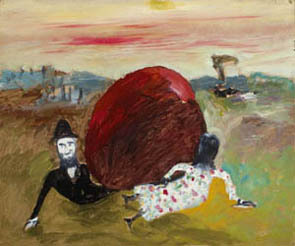
Kate Kelly Pursued by Constable Fitzpatrick (1945) Sydney Nolan
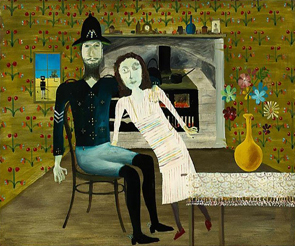
Constable Fitzpatrick and Kate Kelly (1946) Sydney Nolan
For these reasons, no matter how much Bedford wishes to tell the story of a woman from history who has received little attention, she can never really make Kate the star of her stage. In later life, after Ned and his gang were killed or executed (Ned Kelly was executed by hanging at Melbourne Gaol) Kate took to stage work. She was an accomplished horse breaker and rider, able to perform stunts on the backs of horses for audiences. But Bedford’s Kate first trades upon her notoriety and later finds it difficult to maintain a career when she seeks anonymity. She becomes a barmaid, a domestic worker and finally a wife.
And this is really the weakness of this novel. There have been many accomplished women in history who have been overlooked, but Kate Kelly wasn’t one of them. Divided into three parts, the novel uses over a third of its length to recount the events that lead to the siege at Glenrowan and the deaths of the Kelly gang. Kate remains a marginal figure. She takes some supplies and messages to the gang hidden away in the bush, but the most fundamental aspect of her character is that she becomes Joe Byrne’s lover. Her critical scene in the history – the alleged attempt at seduction by Fitzpatrick – does not happen. The closest Bedford is willing to go to this story prior to Dan’s arrest is when Kate expresses the belief, Fitzpatrick was said to have his eye on me. Other than that, the novel engages in character assassination: Constable Fitzpatrick was the scum of the earth. How people could say there was anything between us I do not know. Furthermore, Kate tells us he was, a drunk, a liar and a braggart… As in real life, the allegation against Fitzpatrick doesn’t happen until after the arrests, and is phrased in generalities: I never told Ned how Fitzpatrick would try to take my arm…; When he let go of me I would run sobbing, nearly choking, into the scrub… Neither time, place nor circumstances are specified. It is a real weakness of the novel that the incident remains ambiguous, given that we are in the hands of a first-person narrator. If we step back for a moment, forgetting that we are dealing with history and Kate Kelly, then it is not hard to draw a conclusion that we are in the hands of an unreliable narrator.
This would normally be fine, but attitudes about the Kellys remain divided in Australia. Some have called for Ned Kelly to receive a pardon. One man claimed to have Kelly’s skull – it has been missing for decades, even though the rest of Kelly’s remains have now been found and identified – saying he would return it if a pardon was granted. On the other hand, others argue Kelly was a vicious killer and was no hero. So, there is no escaping the fact that a novel like this is also political. Bedford's sympathies clearly lie with the Kellys. Yet her treatment of Kate Kelly’s story feels like vacillation ......
My review is too long for Good Reads. If you want to read the complete review, use the following link:
https://readingproject.neocities.org/...
Kate Kelly, on the other hand, has largely been background to her brother’s story. Jean Bedford’s Sister Kate lifts her from the scenery. In Ned Kelly’s legend, the focus on Kate has been mostly limited to an incident with a police officer, Constable Fitzpatrick, who went to the Kelly house with a warrant for the arrest of Dan Kelly, Ned’s brother, for horse stealing. Dan wasn’t at home so the constable waited. When Dan returned, Fitzpatrick arrested him but agreed to let him have his dinner before departing. Upon returning home, Ned Kelly shot Fitzpatrick in the wrist. Naturally, there are conflicting stories. Ned Kelly denied being at home during the incident, saying he was two hundred kilometres away at the time. It was further alleged that Fitzpatrick had been drinking and had made a pass at Kate. The accusation became a further reason for the Kelly family’s hatred of the police who often watched them and their property. Sydney Nolan, who produced a famous series of paintings based on Ned Kelly, portrayed Fitzpatrick’s alleged attempt at seduction in these two paintings:
Kate Kelly Pursued by Constable Fitzpatrick (1945) Sydney Nolan
Constable Fitzpatrick and Kate Kelly (1946) Sydney Nolan
For these reasons, no matter how much Bedford wishes to tell the story of a woman from history who has received little attention, she can never really make Kate the star of her stage. In later life, after Ned and his gang were killed or executed (Ned Kelly was executed by hanging at Melbourne Gaol) Kate took to stage work. She was an accomplished horse breaker and rider, able to perform stunts on the backs of horses for audiences. But Bedford’s Kate first trades upon her notoriety and later finds it difficult to maintain a career when she seeks anonymity. She becomes a barmaid, a domestic worker and finally a wife.
And this is really the weakness of this novel. There have been many accomplished women in history who have been overlooked, but Kate Kelly wasn’t one of them. Divided into three parts, the novel uses over a third of its length to recount the events that lead to the siege at Glenrowan and the deaths of the Kelly gang. Kate remains a marginal figure. She takes some supplies and messages to the gang hidden away in the bush, but the most fundamental aspect of her character is that she becomes Joe Byrne’s lover. Her critical scene in the history – the alleged attempt at seduction by Fitzpatrick – does not happen. The closest Bedford is willing to go to this story prior to Dan’s arrest is when Kate expresses the belief, Fitzpatrick was said to have his eye on me. Other than that, the novel engages in character assassination: Constable Fitzpatrick was the scum of the earth. How people could say there was anything between us I do not know. Furthermore, Kate tells us he was, a drunk, a liar and a braggart… As in real life, the allegation against Fitzpatrick doesn’t happen until after the arrests, and is phrased in generalities: I never told Ned how Fitzpatrick would try to take my arm…; When he let go of me I would run sobbing, nearly choking, into the scrub… Neither time, place nor circumstances are specified. It is a real weakness of the novel that the incident remains ambiguous, given that we are in the hands of a first-person narrator. If we step back for a moment, forgetting that we are dealing with history and Kate Kelly, then it is not hard to draw a conclusion that we are in the hands of an unreliable narrator.
This would normally be fine, but attitudes about the Kellys remain divided in Australia. Some have called for Ned Kelly to receive a pardon. One man claimed to have Kelly’s skull – it has been missing for decades, even though the rest of Kelly’s remains have now been found and identified – saying he would return it if a pardon was granted. On the other hand, others argue Kelly was a vicious killer and was no hero. So, there is no escaping the fact that a novel like this is also political. Bedford's sympathies clearly lie with the Kellys. Yet her treatment of Kate Kelly’s story feels like vacillation ......
My review is too long for Good Reads. If you want to read the complete review, use the following link:
https://readingproject.neocities.org/...

March 2, 2013
Sister Kate, by Jean Bedford, is a slim novella from 1982, fictionalising the life of Kate Kelly, the sister of the bushranger Ned Kelly. It is no accident that the cover is graced by Sidney Nolan’s painting ‘Constable Fitzpatrick and Kate Kelly‘: Fitzpatrick’s womanising is said to have been the catalyst for Ned Kelly’s life of violent crime.
But the exploits of the Kelly Gang are not the focus of this novel. It is the effects on the women of the family that is of interest. Kate is a wild child who hero-worships her brother and believes he can do no wrong, and when by page 61 it is all over for the gang, she is left with only a demoralised brother, a mother broken by the demise of her two sons and the memory of her first love, Joe Byrne, who was shot and killed in the shootout at Glenrowan.
With nothing left but bitter memories Kate tries to make a new life. She has a stint as a barmaid, becomes an assistant to a showman who breaks in horses, and finally meets her eventual husband Bill while she is working as a domestic. Throughout this period she has been supported by a sisterhood of sorts: they are tough women with problems of their own but they care for her when she succumbs to consumption (TB) and although they have always tactfully pretended not to know who she really is, it is they who get help from the remnants of her family when things reach crisis point.
Bill’s not a bad fellow but he’s entirely inadequate to support a woman suffering post-traumatic stress disorder and depression. Kate is haunted by the image of Joe’s burnt body on grotesque display at the Benalla Police Station, and she takes to drugs and drink to try to forget. And as she sinks further and further into a fantasy world where Joe has come back to her, her neglect of her little children shows how criminality impacts on one generation to the next.
To read the rest of my review please visit http://anzlitlovers.com/2013/03/09/si...
But the exploits of the Kelly Gang are not the focus of this novel. It is the effects on the women of the family that is of interest. Kate is a wild child who hero-worships her brother and believes he can do no wrong, and when by page 61 it is all over for the gang, she is left with only a demoralised brother, a mother broken by the demise of her two sons and the memory of her first love, Joe Byrne, who was shot and killed in the shootout at Glenrowan.
With nothing left but bitter memories Kate tries to make a new life. She has a stint as a barmaid, becomes an assistant to a showman who breaks in horses, and finally meets her eventual husband Bill while she is working as a domestic. Throughout this period she has been supported by a sisterhood of sorts: they are tough women with problems of their own but they care for her when she succumbs to consumption (TB) and although they have always tactfully pretended not to know who she really is, it is they who get help from the remnants of her family when things reach crisis point.
Bill’s not a bad fellow but he’s entirely inadequate to support a woman suffering post-traumatic stress disorder and depression. Kate is haunted by the image of Joe’s burnt body on grotesque display at the Benalla Police Station, and she takes to drugs and drink to try to forget. And as she sinks further and further into a fantasy world where Joe has come back to her, her neglect of her little children shows how criminality impacts on one generation to the next.
To read the rest of my review please visit http://anzlitlovers.com/2013/03/09/si...

December 5, 2016
As a married woman, Kate is left to tend to their children and the house alone while her husband seeks employment and money away from Forbes. But Kate is used to the men being away. Her father died when she was young and, as she grew into adulthood, her brothers were often away. At first gaoled, then off seeking their fortune and lastly outlaws on the run. Kate then must try to make a life in the aftermath of their tragedy and notoriety.
Sister Kate by Jean Bedford was published in 1982 and fictionalises the life of Kate Kelly, the sister of the infamous bushranger, Ned Kelly. Kate Kelly herself has become quite an iconic figure her own right, though I believe this has less to do with history and more to do with the folklore surrounding her. Regardless, the historical Kate is equally fascinating as the folkloric Kate.
I was excited about this book. I'm fascinated by Ned Kelly and always eager to get my hand on any books, fiction or non-fiction, that tell women's stories. Sister Kate, then, seemed to suit me to a T. The problem is it just wasn't very good.
The novel is divided into three sections, the first dealing with the Kelly Outbreak, the third with Kate's decline and eventual death, while the middle section serves as a bridge between those two points.
The first section, written in the first person, is ripe with potential, but instead Bedford constantly holds the readers at a distance, delivering most of the detail in exposition and information dumps. Bedford does render this exposition in beautiful prose, but as grand as the images she invokes are, it doesn't come close to immersing me in the story. I can acknowledge the difficulty in trying to retell the Outbreak from Kate's perspective when so often she was on the fringes of major events, but even when Bedford is writing about an invented scene, there's a distance, a vagueness.
This may be deliberate, meant to reflect the mental state of Kate as she looks back at her life in her last years, dampened and confused by opioids and alcohol, but regardless, it didn't work. I wanted to feel Kate experiencing these things in vivid detail, not be held at a distance.
The second section, made up of a few loosely connected chapters written in third person, suited my tastes better – finally I was getting detail, finally I was getting a strong sense of emotion. However, I did find the chapters disjointed. The final section is rendered in a mix of first and third person – which I did find a little confusing. Again, I felt that distance between Kate and the story, and I didn't really want to.
This was Bedford's first novel and while she shows some skill - some of the images she conjures up are beautiful – it also feels like the work of an author who's not confident with their own work. There is some awkwardness in the writing. As I mentioned above, the switching between first person and third person narration is confusing and strange. There's also the fact that Kate repeatedly referred to her brother as Edward, not Ned, which seems oddly formal given the context and the relationship they were meant to have, and seems odd given that he appears to have been best known as Ned (Joe Byrne, his best friend, reportedly even called him "Neddy").
I'm going to actually quote the worst offenders in Bedford's prose because some of them truly need to go in the hall of shame or something.
Location 568, Kate on losing her virginity:
Location 543, Kate on the loyalty of Ned's friends:

Onto historical accuracy. Bedford's portrayal of Kate, with her drug and alcohol addiction and presumed suicide, is not drawn from any reliable sources and upset Kate Kelly's descendants. The romantic relationship between Kate and Joe Byrne is fictional, but does help to bring a bit of spark to the novel, despite manifesting oddly towards the end, so I can't be too upset about it. Bedford also has Kate present on the fringes of the Stringybark Creek murders, which is not supported by any evidence and feels odd.
There are few clunkers, too. Kate has photos of the gang developed at a chemist, like she dropped off a roll of film, ignoring that photography and cameras simply didn't work like that in 1880. At one stage, her mother talks to Joe Byrne's mother about Aaron Sherritt being a traitor – despite the fact that Ellen Kelly was in gaol for the duration of the Kelly Outbreak. Bedford also indulges in the old chestnut of the gang being crossdressers – a distortion of some variant of folklore, not reality.
All up, Sister Kate is an interesting novel, but one that I admire the premise of far more than I do the execution.
Sister Kate by Jean Bedford was published in 1982 and fictionalises the life of Kate Kelly, the sister of the infamous bushranger, Ned Kelly. Kate Kelly herself has become quite an iconic figure her own right, though I believe this has less to do with history and more to do with the folklore surrounding her. Regardless, the historical Kate is equally fascinating as the folkloric Kate.
I was excited about this book. I'm fascinated by Ned Kelly and always eager to get my hand on any books, fiction or non-fiction, that tell women's stories. Sister Kate, then, seemed to suit me to a T. The problem is it just wasn't very good.
The novel is divided into three sections, the first dealing with the Kelly Outbreak, the third with Kate's decline and eventual death, while the middle section serves as a bridge between those two points.
The first section, written in the first person, is ripe with potential, but instead Bedford constantly holds the readers at a distance, delivering most of the detail in exposition and information dumps. Bedford does render this exposition in beautiful prose, but as grand as the images she invokes are, it doesn't come close to immersing me in the story. I can acknowledge the difficulty in trying to retell the Outbreak from Kate's perspective when so often she was on the fringes of major events, but even when Bedford is writing about an invented scene, there's a distance, a vagueness.
This may be deliberate, meant to reflect the mental state of Kate as she looks back at her life in her last years, dampened and confused by opioids and alcohol, but regardless, it didn't work. I wanted to feel Kate experiencing these things in vivid detail, not be held at a distance.
The second section, made up of a few loosely connected chapters written in third person, suited my tastes better – finally I was getting detail, finally I was getting a strong sense of emotion. However, I did find the chapters disjointed. The final section is rendered in a mix of first and third person – which I did find a little confusing. Again, I felt that distance between Kate and the story, and I didn't really want to.
This was Bedford's first novel and while she shows some skill - some of the images she conjures up are beautiful – it also feels like the work of an author who's not confident with their own work. There is some awkwardness in the writing. As I mentioned above, the switching between first person and third person narration is confusing and strange. There's also the fact that Kate repeatedly referred to her brother as Edward, not Ned, which seems oddly formal given the context and the relationship they were meant to have, and seems odd given that he appears to have been best known as Ned (Joe Byrne, his best friend, reportedly even called him "Neddy").
I'm going to actually quote the worst offenders in Bedford's prose because some of them truly need to go in the hall of shame or something.
Location 568, Kate on losing her virginity:
I did not realise how like a frog a person could become.Frogs: totally romantic and sexy.
Location 543, Kate on the loyalty of Ned's friends:
Also they loved my brother. They loved him as much as men can other men without it being the disgusting thing Aaron later suggested. I do not know what physical release men can find together, but I cannot believe it is the mockery that Aaron made it out. Not that I think they loved like that — yet, maybe they did. They had all been in prison where they such things are common and they lived without women for long stretches. It horrified me when Aaron suggested it, but now I hope there were times when they moaned away their need and their fear in each other's arms.I get the feeling that there was too much overthinking going on and not enough self-editing when this was written. I also get the sense that I was about to run smack bang into a wall of homophobia and oh god. But then the writing veers frantically away only to veer back and it's just a car crash of a paragraph. And then I start thinking about the incestuous undertones in it, about Kate hoping her brother and her lover "moaned away their need and fear in each other's arms…"
Onto historical accuracy. Bedford's portrayal of Kate, with her drug and alcohol addiction and presumed suicide, is not drawn from any reliable sources and upset Kate Kelly's descendants. The romantic relationship between Kate and Joe Byrne is fictional, but does help to bring a bit of spark to the novel, despite manifesting oddly towards the end, so I can't be too upset about it. Bedford also has Kate present on the fringes of the Stringybark Creek murders, which is not supported by any evidence and feels odd.
There are few clunkers, too. Kate has photos of the gang developed at a chemist, like she dropped off a roll of film, ignoring that photography and cameras simply didn't work like that in 1880. At one stage, her mother talks to Joe Byrne's mother about Aaron Sherritt being a traitor – despite the fact that Ellen Kelly was in gaol for the duration of the Kelly Outbreak. Bedford also indulges in the old chestnut of the gang being crossdressers – a distortion of some variant of folklore, not reality.
All up, Sister Kate is an interesting novel, but one that I admire the premise of far more than I do the execution.

Read
January 15, 2020"The others enjoyed it in a desperate way. In the end I think there were all relieved to see me go so that they could spring back into their hard, passionate struggle against the earth."
July 30, 2025
Classic, read in the back of the ute,, nightimes,,, travelling north with lily (left behind at the gorge with the ranger, don't worry she signed her name in it)

July 18, 2010
1/Bloody oath. Those coppers deserve to die.
Okay, Part 1 was pretty damn good. Kept you interested enough to read on. But from Part 2 it went downhill. She was all morbid and I found that I couldn't wait to just finish this book cause it kept dragging. But I found that it didn't wrap things up preperly. Leaves you wondering what happened to the others; Maggie, Bill, her kids. Meh. Overall, it was worth the read, even if Kate did become really infuriating as the book wore on.
Okay, Part 1 was pretty damn good. Kept you interested enough to read on. But from Part 2 it went downhill. She was all morbid and I found that I couldn't wait to just finish this book cause it kept dragging. But I found that it didn't wrap things up preperly. Leaves you wondering what happened to the others; Maggie, Bill, her kids. Meh. Overall, it was worth the read, even if Kate did become really infuriating as the book wore on.

November 4, 2011
I'm always surprised by how little attention this book seems to get. It's brilliant - better than Carey's "True History of the Kelly Gang" - although maybe I only think that because I identify more with the feminine perspective from which this book tells the Kelly story.
A cracking story, and (importantly for me) an extremely well written novel.
Highly recommended.

August 8, 2013
Taught as part of curriculum in Australian HS.

September 13, 2013
A wonderful book, so well written; Jean Bedford is a real talent

May 30, 2014
The 2/3 after Glenrowan better than first third, but harrowing.

May 12, 2016
Nice to re-read this one, found it on Mum's shelf and found all my notes in it from when I studied it in Year 9.

October 7, 2021
the fact this book was published with the line ‘By the rising juices of my desire’ is … something.
Displaying 1 - 15 of 15 reviews