I will be withholding a review until the Harper Collins union receives a fair contract.
But wowie will I have some things to say on this one.
UPDATE: I can finally review this! Let's do it.
2.5 stars.
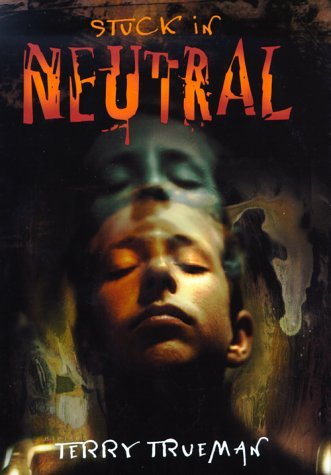
Stuck In Neutral is the story of a teenage boy named Shawn who has cerebral palsy and figures out that his father wants to end his life as an act of compassion.
Shawn was born with cerebral palsy and has no control over the muscles in his body -- he can't even control the focus of his eyes and swallowing. Because of this, he is unable to communicate to the the world and his caregivers that he has a rich inner world and understands everything going on around him. His mom, dad, and teachers are unsure of whether or not he understands things, but they have been assure by doctors that it is unlikely. Shawn is very perceptive, emotionally intelligent, and has a very good memory, so he has learned a lot of about the world from hearing conversations, TV, and even reading. So he very quickly picks up on the fact that he's pretty sure his father is wrestling with the idea of ending Shawn's life as a sort of mercy killing to end Shawn's "suffering."
Though Shawn's mother is Shawn's primary caregiver, Shawn's father is the focus of the story outside of Shawn. Shawn's dad is Sydney E. McDaniel, the Pulitzer Prize-winning author of a poem about his struggles with his son's disability...who also left Shawn and his mother because he couldn't handle the stress. He's around occasionally, but has been around more lately because of an investigative book he is writing about the highly public case of Earl Detraux, a father who is in jail for killing his two-year-old son to "do what he had to do" to "end his son's suffering" from a "terrible, terminal, inoperable seizure disorder, and irreversible medical condition, couple with profound mental retardation that made his existence insufferable." Sydney defends Earl's act as one of deep love, compassion, and personal sacrifice on behalf of his child. But Shawn can see the gears turning in Sydney's head and knows that Sydney is planning to do the same to him.
This is a very short book that packs a LOT of punch. There are a lot of difficult and triggering scenes, from the death of a dog to acts of violence against Shawn, in addition to examinations of the ableism and challenges Shawn faces. In researching this book, it does seem like it has made an impact on many readers in challenging to think about disability, ableism, and the humanity of people who may not be able to speak for themselves. There are a lot of positive reviews out there for this book. And, of course, it won a Printz honor in 2001 -- that's why I am reading and reviewing it.
HOWEVER, most of these reviews and positive accolades come from people outside of the disabled community. And let it be known that I also fall into this camp. But this book just didn't sit right with me -- it's literally about giving us empathy for why a father would want to end his son's life. So when I sought some perspectives from the Disability Studies community, I found the criticisms that seemed to echo some of my own concerns about this story.
I think it was a strange choices for Terry Trueman to write this book, considering the he himself is the father of a son with cerebral palsy. Thought he says in the end notes that he has not contemplated killing his son, it is clear that the real purpose of this book is to work out his own feelings and experiences (and struggles) being a father to his son. So the fact that he chose to write a YA book from the perspective of his son feels like an artificial way for Trueman to give himself forgiveness for feelings he's had. He's literally making up his own dialogue with his child in a way that feels far too speculative, even for fiction.
Trueman is trying really hard to advocate for people with disabilities here and change perspectives, and I do think he is somewhat successful at that. He uses the R-word a lot throughout this story and Shawn goes into a discussion of how and why he uses that word. And Trueman shows things like Shawn's experiences at school, with his family at home, with respite caregivers and with the narratives that people have about it.
I think Trueman gives Shawn a voice and helps him been seen. But the problem here is that this isn't actually Shawn's voice. The Shawn in this story is rational, compassionate, and understanding of his father's potential choices as an act of deep love. But it feels icky to read that rationalization coming from a fictional boy talking about his fictional father written by a real father for his own selfish purposes.
In short, I don't think this book would be published in 2023. It certainly speaks to a specific moment in YA literature -- a moment when the only way we saw "representation" of some marginalized voices was through stories written by the parents, siblings, children, teachers, and friends of individuals with those experiences, but rarely from those people themselves. That was a stepping stone, but in 2023 I expect more. So I'm glad I read this book as a cultural artifact and it was certainly thought-provoking (though I don't think it was particularly well-written...just shocking and "innovative" for the era). But I wouldn't recommend this book in the modern day.
Note: I'm on the fence about my own 2.5 star review. I am not one to shoot a book down to 1 stars just because of problematic representation -- there are other elements that contribute to storytelling that I'm also looking at here, too.