

What do you think?

Remember: The Journey to School Integration
Toni Morrison has collected a treasure chest of archival photographs that depict the historical events surrounding school desegregation. These unforgettable images serve as the inspiration for Ms. Morrison’s text—a fictional account of the dialogue and emotions of the children who lived during the era of “separate but equal” schooling. Remember is a unique pictorial and narrative journey that introduces children to a watershed period in American history and its relevance to us today.
Remember will be published on the 50th anniversary of the groundbreaking Brown v. Board of Education Supreme Court decision ending legal school segregation, handed down on May 17, 1954.
Remember will be published on the 50th anniversary of the groundbreaking Brown v. Board of Education Supreme Court decision ending legal school segregation, handed down on May 17, 1954.
80 pages, Hardcover
First published April 1, 2004
About the author
Toni Morrison
189 books26k followersChloe Anthony Wofford Morrison, known as Toni Morrison, was an American novelist and editor. Her first novel, The Bluest Eye, was published in 1970. The critically acclaimed Song of Solomon (1977) brought her national attention and won the National Book Critics Circle Award. In 1988, Morrison won the Pulitzer Prize for Beloved (1987); she was awarded the Nobel Prize in Literature in 1993.
Born and raised in Lorain, Ohio, Morrison graduated from Howard University in 1953 with a B.A. in English. Morrison earned a master's degree in American Literature from Cornell University in 1955. In 1957 she returned to Howard University, was married, and had two children before divorcing in 1964. Morrison became the first black female editor for fiction at Random House in New York City in the late 1960s. She developed her own reputation as an author in the 1970s and '80s. Her novel Beloved was made into a film in 1998. Morrison's works are praised for addressing the harsh consequences of racism in the United States and the Black American experience.
The National Endowment for the Humanities selected Morrison for the Jefferson Lecture, the U.S. federal government's highest honor for achievement in the humanities, in 1996. She was honored with the National Book Foundation's Medal of Distinguished Contribution to American Letters the same year. President Barack Obama presented her with the Presidential Medal of Freedom on May 29, 2012. She received the PEN/Saul Bellow Award for Achievement in American Fiction in 2016. Morrison was inducted into the National Women's Hall of Fame in 2020.
Born and raised in Lorain, Ohio, Morrison graduated from Howard University in 1953 with a B.A. in English. Morrison earned a master's degree in American Literature from Cornell University in 1955. In 1957 she returned to Howard University, was married, and had two children before divorcing in 1964. Morrison became the first black female editor for fiction at Random House in New York City in the late 1960s. She developed her own reputation as an author in the 1970s and '80s. Her novel Beloved was made into a film in 1998. Morrison's works are praised for addressing the harsh consequences of racism in the United States and the Black American experience.
The National Endowment for the Humanities selected Morrison for the Jefferson Lecture, the U.S. federal government's highest honor for achievement in the humanities, in 1996. She was honored with the National Book Foundation's Medal of Distinguished Contribution to American Letters the same year. President Barack Obama presented her with the Presidential Medal of Freedom on May 29, 2012. She received the PEN/Saul Bellow Award for Achievement in American Fiction in 2016. Morrison was inducted into the National Women's Hall of Fame in 2020.
Ratings & Reviews
Friends & Following
Create a free account to discover what your friends think of this book!
Community Reviews
Displaying 1 - 30 of 165 reviews

February 8, 2017
This is an outstanding book, whose images and words may haunt you, as they do me.
Remember: The Journey To School Integration is a beautiful oversize book of sepia toned photographs, covering the period of American history between the 1950s and 1960s, and concentrating on the racial tensions at that time. It would be straight photojournalism, except for one thing. The text is by Toni Morrison, the first black woman to win the Pulitzer Prize for Fiction with “Beloved”, in 1988, and she brings her unique perceptive commentary to these fifty photographs.
Toni Morrison’s writings are numerous and much acclaimed. As well as writing novels, she also works as an editor and professor. She won the Nobel Prize for Literature in 1993, one of only twelve Americans to win the Nobel Prize in this category.
In 2004 Toni Morrison wrote this, her first nonfiction book for young people. It was published on the 50th anniversary of the groundbreaking “Brown v. Board of Education Trial” Supreme Court decision to end legal school segregation. The photographs are incredibly powerful, as one review said at the time,
“The photos are electrifying. Beautifully reproduced in sepia prints, the archival images humanize the politics of the civil rights movement” and this is what we see at a first glance. Only then, do we read Toni Morrison’s insightful commentary.
The photographs are each of a snapshot in time. They have a immediacy, which Toni Morrison also captures. Skilfully and and poignantly, she imagines the possible inner thoughts of those portrayed. I am English, so how can I relate personally to these events? Yet I do, thanks to Toni Morrison's truthful gaze. I was at school during this time and the images I see here fill me with emotion. Britain too has a shameful past in various aspects to do with Nationality, but this is not one of them. My experience of schools as a pupil in the 1950s and 1960s, and as teacher in the 1970s and beyond, was thankfully nothing like this. To me it is almost unimaginable, that another English-speaking country, one which shared a culture in many ways, could have such different social attitudes. But the camera does not lie. The inner confusion she suggests also rings true, and makes me ashamed to be a member of the human race, irrespective of country.
The book begins with three pages of text giving an overview of the American Civil Rights struggle, bordered by details from the photos which are to come. At the end there is a page listing the key events by date, followed by an appendix with thumbnail versions of each of the images, with accompanying dates and locations, as well as factual information. My only difficulty with the book is the tiny size of print used for the introduction and appendix, which is unnecessarily small, and more akin to that found in a gazetteer. But it does not take even one point away from those five stars. The main body of the book is a photographic record, usually one blown-up photograph per page. There is very little commentary, in good size print. What is written is to the point, and incredibly moving.
The book is divided into three parts, to tie in with the main progression of the Civil Rights movement. Each section begins with Toni Morrison’s short information paragraph, to provide a context for the following pictures:
“A long time ago, some people thought that black people and white people should not be friends. In some places, black people were not allowed to live in the same neighborhoods as white people. In some places, black people were not allowed to eat in the same restaurants as white people. And in some places, black children and white children could not go to the same schools. This is segregation.”
This first section is entitled “The Narrow Path”, and the first photograph we see shows black children in a segregated school, as laid down in law in 1896, to be “separate but equal”. We gradually learn through these photographs what a vast travesty this ideal had become. This is a typical school for black children:

To the forefront of another picture a little girl stands and reads out loud. The text reads:
“The law says I can’t go to school with white children. Are they afraid of my socks, my braids? I am seven years old. Why are they afraid of me?”
Of course these are imagined thoughts. We see that clearly right from the start. But we sense the confusion, the squalor, and we sense the authenticity. Sparse words, simple words, but they have the ring of truth.
Another photograph shows the poignant image of a young black girl playing with her large white doll,
“She’s mine and I call her Jasmine.”
In the appendix, Toni Morrison’s notes refer to the “Brown vs. Board of Education trial”, presided over by the Supreme Court in 1952. Five lawsuits challenged the concept of segregated schools in the United States, and a child development expert was asked to present studies done on children’s play with dolls. This expert testified that the results had shown that black children preferred dolls with white skin, viewing these as of a higher status. This theme occurs in the author’s own novels. Of course it raises serious questions about self-image and the effects of racism.
How very poignant, then, is this image. At the same age I had three favourite dolls. One was an old-fashioned large “pot” doll, white with long black hair. Her eyes closed and she said “Mama”. My second was another white doll. She was special, because her blonde hair was rooted. And my third doll was black. She had a blue nylon dress and no hair at all. I loved her because she was pretty, and small, and just a baby. I was very young, but I do not remember thinking these dolls were any different from each other, in any important way.
There are three photographs of segregated classrooms, each more sobering than the previous one. And the final image is the one which tugs at my heartstrings the most. It is of two girls with their backs to the camera. They are walking along a railway track to school in Topeka, Kansas, and each of them holds a lunch bag:
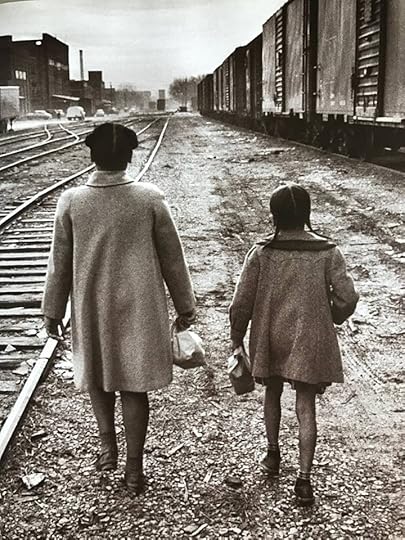
We know, with the benefit of our hindsight, what a depressing journey they have ahead of them. They think they are prepared. They want to learn. They are off to school, having little conception of the tumultuous times ahead of them in America. But we know the ordeal they will endure. It is an appropriate end to the raw and depressing section on segregated schools.
The second section is called “The Open Gate”, and this section deals with America’s attempts at school integration. When the ruling of the “Brown vs. Board of Education” was made, on 17th May 1954, the Supreme Court Justice said “it will be a day that will live in glory”. But Toni Morrison’s introductory paragraph explains that many people resisted the Supreme Court ruling.
The first picture is from the “New York Times’”s front page, with the article announcing “High Court Bans School Segregation”. On the facing page is a photo of the Supreme Court. It strikes a jarring note from a modern perspective, despite their momentous decision, for of course these are all elderly, white men.
Straight after this photograph, and guiding us through us the changing individual perceptions following the ruling, we have the intriguing photograph which features on the book’s cover:

There are two little girls in the foreground. One is black and one is white, and each sits at the head of a row of children. They are looking directly at each other, and it is very hard to read their thoughts. The text reads,
“I think she likes me, but how can I tell? What will I do if she hates me?”
Which girl is thinking which thought? History would suggest that these are the thoughts of those who have been oppressed or disadvantaged, but it could be either. It may even lead the reader to think that whichever girl is closer to their own ethnic identity is the one with the doubts and uncertainties. Everything is left deliberately ambiguous.
It was at this point that I realised how clever Toni Morrison has been here. Instead of filling in information, or conventionally reporting on the images, she resists, and makes us think. She makes us question, and also — like it or not — to identify with those in the photographs. As we look at all the photographs in this section, this makes us more and more uncomfortable. Faces contorted with rage. Such hatred, such viciousness. Were these people really so close to us in time, and in culture? It makes me want to weep.
We see youngsters from both groups holding placards. But who has placed these placards in their hands? Whose views are they, really? One photograph shows three white teenage boys holding anti-integration placards. Below this we read the following:
“I don’t know. My buddies talked me into this. They said it would be fun. It’s not, but these guys are my friends and friends are more important than strangers. Even if they’re wrong. Aren’t they?”
And then our eye is drawn to the facing page. This also shows children holding placards. In this case they are young black boys and girls. There is none of the suggestion of belligerence we see in the first group, but more a feeling of apprehension, or even unhappiness, about these children. Of course their messages are against the segregation:
“Our children play together. Why can’t they learn together?”
I cannot help feeling that all these children are victims in this war.
Another photograph makes my blood run cold. Here it is:
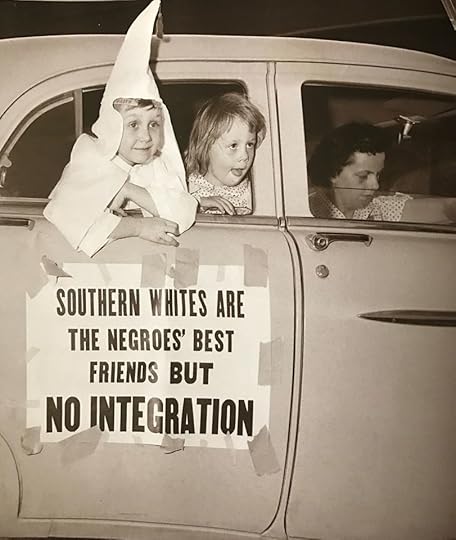
It needs no commentary, although the notes at the end provide the context. Increasingly we realise that these children are mere puppets.
Many of the pictures in this section are disturbing, showing naked aggression. We see three white men chasing a black man down a street. We see a few faces in a jeering white crowd, haranguing black students.
Sometimes Toni Morrison introduces a wry ironic note. There is a two-page spread with the words:
“Great! Now we can have some fun!”
But which photograph might this refer to? On the left hand side we see an integrated group of school children running out to play. Two boys — one black and one white — are smiling and laughing together at the front of the group. Then our eyes drift across to the opposite page, where we see a group of white teenagers trying to overturn a car driven by a black man.
Some photographs show instances of stolid bravery, as one individual, or perhaps a few brave individuals defy the vilification directed at them as they walk to their school or college. One example is of Elizabeth Eckford, being harassed while walking to her school in Little Rock, Arkansas. She is part of the now famous “Little Rock Nine”. Another is the iconic image of tiny little Ruby Bridges being escorted to her first day at school by U.S. Marshals. It gets me every time. Many more cases like this are on record and their names will be familiar to most Americans. One image shows a group of black children and adults, accompanied by Toni Morrison’s comment,
“No, no they said. You can’t come in here. Get away from the door. This school is for white children. Only them.”
Another shows a black teenage boy pushing a white boy off a pavement, after his sister had been “ordered” off it. Distorted ugly faces; faces full of fear and despair. We see them all.
But happily there are some images of hope. My favourite photograph in the whole journal is this one:

This is a photograph of two girls — one black and one white — smiling at each other. They are both at a party in Virginia, which was held just before their school was to become integrated, as a way of easing in the process. I just love it, that secret thrill, the shy expectations and excitement, the common bond of humanity. On the page facing we see two girls, again one black, one white, each standing separately before a bathroom mirror. Cleverly we can see their body language, but also because of the reflection we see their faces. They seem aware of each other, but have not yet bonded in any way:
“I see in her face just a girl. She sees in my face another girl. Maybe not friends, but simply girls together.”
They are still focused on themselves as individuals. Although they are sharing a space, they are still isolated from one another. Still “separate but equal”.
The third section of the book is entitled, “The Wide Road”. This still contains many upsetting images. We see a white owner of a cafe, his cigarette hanging from the corner of his mouth, throwing eggs and water on black protesters. We see Rosa Parks, sitting on the bus — such a brave individual — but lonely in her isolation. We see acts both of black protest and white counter-protest, which were part of the Civil Rights movement. But we can detect an increasingly hopeful note with Martin Luther King’s appearance, as we move towards the conclusion.
It dawned on me gradually that that these photos are not only of the Southern States. Some of these photographs were variously taken in New York, Illinois, California, Oregon and Massachusetts. Although in the main the book finishes with the passing of the Civil Rights Act in 1964, the final photograph is from later. It shows two girls holding hands through bus windows, and was taken in the early 1970s. At this time I myself was happily studying multicultural education, and a student teacher of very ethnically diverse classes. It was a shock to me to realise that Boston apparently had a controversy over the bussing of pupils — a sobering reminder perhaps, of how quickly incidents in American race relations can become inflamed.
Nevertheless, this third section is full of optimism. Martin Luther King is seen waving to the crowd by the Lincoln Memorial as he gives his famous speech. There are more images of black and white children playing together, and another of a small group of children reciting the “Pledge of Allegiance”. A very small black boy has to stand on a chair to hold the flag aloft for everybody to see. But both his stance and his demeanour show his sense of pride. He is taking his responsibility very seriously indeed. Another photograph shows two little boys— one black and one white —talking together shyly, the shot being almost a mirror image of the two little girls from earlier:

Things are moving forward.
This is an extraordinary achievement by Toni Morrison. Photojournalism is not new, but what she has created here is, I think, ground-breaking, perhaps building on something which had only been attempted before. There was an earlier book, in 1937, by Erskine Caldwell and Margaret Bourke-White’s called “You Have Seen Their Faces”. The text was written by Erskine Caldwell, to show the imaginary thoughts of the poor people, both black and white sharecroppers. Although their intentions were good, the book was quite controversial, and Toni Morrison is aware that her own use of such a device might make some people uneasy. She prefaces the book:
“The captions included in this book are not intended to be the actual thoughts of the people in the photographs. Rather, they represent the author’s notion of what an individual in the position depicted might have been thinking. Whatever views these individuals may have held at the time may well be different today.”
I have no qualms about the technique she uses. It is clear at all stages that what is said is ambiguous. We do not know with certainly what people are thinking, and this is true not only of a photographic image, but also when you are face to face with someone in real life.
The final page made the threatened tears spill over. Four little cameos of happy faces. Four girls killed in the bombing of the 16th Street Baptist Church, in Birmingham, Alabama. They were Denise McNair, Carole Robertson, Addie Mae Collins, and Cynthia Wesley. This book is dedicated to their memory:
“Things are better now. Much much better: But remember why and please remember us ... Their lives short, their deaths quick. Neither were in vain.”
This book is by turn devastating, heartbreaking, and shameful. The same book shows people who are courageous, determined, steadfast, hopeful — and ultimately inspiring.
It is simply unforgettable.
This is from Toni Morrison’s introduction:
“The demand to integrate public schools grew into a nationwide civil rights movement to eliminate all racist law: to have the right to vote, the right to choose the neighborhood you wanted to live in, to sit in any vacant seat in a public place. Marches, protests, countermarches, and counterprotests erupted almost everywhere. It was an extraordinary time, when people of all races and all walks of life came together. When children had to be braver than their parents, when pastors, priests, and rabbis left their altars to walk the streets with strangers, when soldiers with guns were assigned to keep the peace or to protect a young girl. Days full of loud, angry, determined crowds, and days deep in loneliness. Peaceful marches were met with applause in some places, violence in others. People were hurt and people died. Students and civil rights workers were hosed, beaten, jailed. Strong leaders were shot and killed. And one day a bomb was thrown into a church, killing four little girls attending Sunday school.”
“None of that happened to you. Why offer memories you do not have? Remembering can be painful, even frightening. But it can also swell your heart and open your mind.”

Remember: The Journey To School Integration is a beautiful oversize book of sepia toned photographs, covering the period of American history between the 1950s and 1960s, and concentrating on the racial tensions at that time. It would be straight photojournalism, except for one thing. The text is by Toni Morrison, the first black woman to win the Pulitzer Prize for Fiction with “Beloved”, in 1988, and she brings her unique perceptive commentary to these fifty photographs.
Toni Morrison’s writings are numerous and much acclaimed. As well as writing novels, she also works as an editor and professor. She won the Nobel Prize for Literature in 1993, one of only twelve Americans to win the Nobel Prize in this category.
In 2004 Toni Morrison wrote this, her first nonfiction book for young people. It was published on the 50th anniversary of the groundbreaking “Brown v. Board of Education Trial” Supreme Court decision to end legal school segregation. The photographs are incredibly powerful, as one review said at the time,
“The photos are electrifying. Beautifully reproduced in sepia prints, the archival images humanize the politics of the civil rights movement” and this is what we see at a first glance. Only then, do we read Toni Morrison’s insightful commentary.
The photographs are each of a snapshot in time. They have a immediacy, which Toni Morrison also captures. Skilfully and and poignantly, she imagines the possible inner thoughts of those portrayed. I am English, so how can I relate personally to these events? Yet I do, thanks to Toni Morrison's truthful gaze. I was at school during this time and the images I see here fill me with emotion. Britain too has a shameful past in various aspects to do with Nationality, but this is not one of them. My experience of schools as a pupil in the 1950s and 1960s, and as teacher in the 1970s and beyond, was thankfully nothing like this. To me it is almost unimaginable, that another English-speaking country, one which shared a culture in many ways, could have such different social attitudes. But the camera does not lie. The inner confusion she suggests also rings true, and makes me ashamed to be a member of the human race, irrespective of country.
The book begins with three pages of text giving an overview of the American Civil Rights struggle, bordered by details from the photos which are to come. At the end there is a page listing the key events by date, followed by an appendix with thumbnail versions of each of the images, with accompanying dates and locations, as well as factual information. My only difficulty with the book is the tiny size of print used for the introduction and appendix, which is unnecessarily small, and more akin to that found in a gazetteer. But it does not take even one point away from those five stars. The main body of the book is a photographic record, usually one blown-up photograph per page. There is very little commentary, in good size print. What is written is to the point, and incredibly moving.
The book is divided into three parts, to tie in with the main progression of the Civil Rights movement. Each section begins with Toni Morrison’s short information paragraph, to provide a context for the following pictures:
“A long time ago, some people thought that black people and white people should not be friends. In some places, black people were not allowed to live in the same neighborhoods as white people. In some places, black people were not allowed to eat in the same restaurants as white people. And in some places, black children and white children could not go to the same schools. This is segregation.”
This first section is entitled “The Narrow Path”, and the first photograph we see shows black children in a segregated school, as laid down in law in 1896, to be “separate but equal”. We gradually learn through these photographs what a vast travesty this ideal had become. This is a typical school for black children:
To the forefront of another picture a little girl stands and reads out loud. The text reads:
“The law says I can’t go to school with white children. Are they afraid of my socks, my braids? I am seven years old. Why are they afraid of me?”
Of course these are imagined thoughts. We see that clearly right from the start. But we sense the confusion, the squalor, and we sense the authenticity. Sparse words, simple words, but they have the ring of truth.
Another photograph shows the poignant image of a young black girl playing with her large white doll,
“She’s mine and I call her Jasmine.”
In the appendix, Toni Morrison’s notes refer to the “Brown vs. Board of Education trial”, presided over by the Supreme Court in 1952. Five lawsuits challenged the concept of segregated schools in the United States, and a child development expert was asked to present studies done on children’s play with dolls. This expert testified that the results had shown that black children preferred dolls with white skin, viewing these as of a higher status. This theme occurs in the author’s own novels. Of course it raises serious questions about self-image and the effects of racism.
How very poignant, then, is this image. At the same age I had three favourite dolls. One was an old-fashioned large “pot” doll, white with long black hair. Her eyes closed and she said “Mama”. My second was another white doll. She was special, because her blonde hair was rooted. And my third doll was black. She had a blue nylon dress and no hair at all. I loved her because she was pretty, and small, and just a baby. I was very young, but I do not remember thinking these dolls were any different from each other, in any important way.
There are three photographs of segregated classrooms, each more sobering than the previous one. And the final image is the one which tugs at my heartstrings the most. It is of two girls with their backs to the camera. They are walking along a railway track to school in Topeka, Kansas, and each of them holds a lunch bag:
We know, with the benefit of our hindsight, what a depressing journey they have ahead of them. They think they are prepared. They want to learn. They are off to school, having little conception of the tumultuous times ahead of them in America. But we know the ordeal they will endure. It is an appropriate end to the raw and depressing section on segregated schools.
The second section is called “The Open Gate”, and this section deals with America’s attempts at school integration. When the ruling of the “Brown vs. Board of Education” was made, on 17th May 1954, the Supreme Court Justice said “it will be a day that will live in glory”. But Toni Morrison’s introductory paragraph explains that many people resisted the Supreme Court ruling.
The first picture is from the “New York Times’”s front page, with the article announcing “High Court Bans School Segregation”. On the facing page is a photo of the Supreme Court. It strikes a jarring note from a modern perspective, despite their momentous decision, for of course these are all elderly, white men.
Straight after this photograph, and guiding us through us the changing individual perceptions following the ruling, we have the intriguing photograph which features on the book’s cover:
There are two little girls in the foreground. One is black and one is white, and each sits at the head of a row of children. They are looking directly at each other, and it is very hard to read their thoughts. The text reads,
“I think she likes me, but how can I tell? What will I do if she hates me?”
Which girl is thinking which thought? History would suggest that these are the thoughts of those who have been oppressed or disadvantaged, but it could be either. It may even lead the reader to think that whichever girl is closer to their own ethnic identity is the one with the doubts and uncertainties. Everything is left deliberately ambiguous.
It was at this point that I realised how clever Toni Morrison has been here. Instead of filling in information, or conventionally reporting on the images, she resists, and makes us think. She makes us question, and also — like it or not — to identify with those in the photographs. As we look at all the photographs in this section, this makes us more and more uncomfortable. Faces contorted with rage. Such hatred, such viciousness. Were these people really so close to us in time, and in culture? It makes me want to weep.
We see youngsters from both groups holding placards. But who has placed these placards in their hands? Whose views are they, really? One photograph shows three white teenage boys holding anti-integration placards. Below this we read the following:
“I don’t know. My buddies talked me into this. They said it would be fun. It’s not, but these guys are my friends and friends are more important than strangers. Even if they’re wrong. Aren’t they?”
And then our eye is drawn to the facing page. This also shows children holding placards. In this case they are young black boys and girls. There is none of the suggestion of belligerence we see in the first group, but more a feeling of apprehension, or even unhappiness, about these children. Of course their messages are against the segregation:
“Our children play together. Why can’t they learn together?”
I cannot help feeling that all these children are victims in this war.
Another photograph makes my blood run cold. Here it is:
It needs no commentary, although the notes at the end provide the context. Increasingly we realise that these children are mere puppets.
Many of the pictures in this section are disturbing, showing naked aggression. We see three white men chasing a black man down a street. We see a few faces in a jeering white crowd, haranguing black students.
Sometimes Toni Morrison introduces a wry ironic note. There is a two-page spread with the words:
“Great! Now we can have some fun!”
But which photograph might this refer to? On the left hand side we see an integrated group of school children running out to play. Two boys — one black and one white — are smiling and laughing together at the front of the group. Then our eyes drift across to the opposite page, where we see a group of white teenagers trying to overturn a car driven by a black man.
Some photographs show instances of stolid bravery, as one individual, or perhaps a few brave individuals defy the vilification directed at them as they walk to their school or college. One example is of Elizabeth Eckford, being harassed while walking to her school in Little Rock, Arkansas. She is part of the now famous “Little Rock Nine”. Another is the iconic image of tiny little Ruby Bridges being escorted to her first day at school by U.S. Marshals. It gets me every time. Many more cases like this are on record and their names will be familiar to most Americans. One image shows a group of black children and adults, accompanied by Toni Morrison’s comment,
“No, no they said. You can’t come in here. Get away from the door. This school is for white children. Only them.”
Another shows a black teenage boy pushing a white boy off a pavement, after his sister had been “ordered” off it. Distorted ugly faces; faces full of fear and despair. We see them all.
But happily there are some images of hope. My favourite photograph in the whole journal is this one:
This is a photograph of two girls — one black and one white — smiling at each other. They are both at a party in Virginia, which was held just before their school was to become integrated, as a way of easing in the process. I just love it, that secret thrill, the shy expectations and excitement, the common bond of humanity. On the page facing we see two girls, again one black, one white, each standing separately before a bathroom mirror. Cleverly we can see their body language, but also because of the reflection we see their faces. They seem aware of each other, but have not yet bonded in any way:
“I see in her face just a girl. She sees in my face another girl. Maybe not friends, but simply girls together.”
They are still focused on themselves as individuals. Although they are sharing a space, they are still isolated from one another. Still “separate but equal”.
The third section of the book is entitled, “The Wide Road”. This still contains many upsetting images. We see a white owner of a cafe, his cigarette hanging from the corner of his mouth, throwing eggs and water on black protesters. We see Rosa Parks, sitting on the bus — such a brave individual — but lonely in her isolation. We see acts both of black protest and white counter-protest, which were part of the Civil Rights movement. But we can detect an increasingly hopeful note with Martin Luther King’s appearance, as we move towards the conclusion.
It dawned on me gradually that that these photos are not only of the Southern States. Some of these photographs were variously taken in New York, Illinois, California, Oregon and Massachusetts. Although in the main the book finishes with the passing of the Civil Rights Act in 1964, the final photograph is from later. It shows two girls holding hands through bus windows, and was taken in the early 1970s. At this time I myself was happily studying multicultural education, and a student teacher of very ethnically diverse classes. It was a shock to me to realise that Boston apparently had a controversy over the bussing of pupils — a sobering reminder perhaps, of how quickly incidents in American race relations can become inflamed.
Nevertheless, this third section is full of optimism. Martin Luther King is seen waving to the crowd by the Lincoln Memorial as he gives his famous speech. There are more images of black and white children playing together, and another of a small group of children reciting the “Pledge of Allegiance”. A very small black boy has to stand on a chair to hold the flag aloft for everybody to see. But both his stance and his demeanour show his sense of pride. He is taking his responsibility very seriously indeed. Another photograph shows two little boys— one black and one white —talking together shyly, the shot being almost a mirror image of the two little girls from earlier:
Things are moving forward.
This is an extraordinary achievement by Toni Morrison. Photojournalism is not new, but what she has created here is, I think, ground-breaking, perhaps building on something which had only been attempted before. There was an earlier book, in 1937, by Erskine Caldwell and Margaret Bourke-White’s called “You Have Seen Their Faces”. The text was written by Erskine Caldwell, to show the imaginary thoughts of the poor people, both black and white sharecroppers. Although their intentions were good, the book was quite controversial, and Toni Morrison is aware that her own use of such a device might make some people uneasy. She prefaces the book:
“The captions included in this book are not intended to be the actual thoughts of the people in the photographs. Rather, they represent the author’s notion of what an individual in the position depicted might have been thinking. Whatever views these individuals may have held at the time may well be different today.”
I have no qualms about the technique she uses. It is clear at all stages that what is said is ambiguous. We do not know with certainly what people are thinking, and this is true not only of a photographic image, but also when you are face to face with someone in real life.
The final page made the threatened tears spill over. Four little cameos of happy faces. Four girls killed in the bombing of the 16th Street Baptist Church, in Birmingham, Alabama. They were Denise McNair, Carole Robertson, Addie Mae Collins, and Cynthia Wesley. This book is dedicated to their memory:
“Things are better now. Much much better: But remember why and please remember us ... Their lives short, their deaths quick. Neither were in vain.”
This book is by turn devastating, heartbreaking, and shameful. The same book shows people who are courageous, determined, steadfast, hopeful — and ultimately inspiring.
It is simply unforgettable.
This is from Toni Morrison’s introduction:
“The demand to integrate public schools grew into a nationwide civil rights movement to eliminate all racist law: to have the right to vote, the right to choose the neighborhood you wanted to live in, to sit in any vacant seat in a public place. Marches, protests, countermarches, and counterprotests erupted almost everywhere. It was an extraordinary time, when people of all races and all walks of life came together. When children had to be braver than their parents, when pastors, priests, and rabbis left their altars to walk the streets with strangers, when soldiers with guns were assigned to keep the peace or to protect a young girl. Days full of loud, angry, determined crowds, and days deep in loneliness. Peaceful marches were met with applause in some places, violence in others. People were hurt and people died. Students and civil rights workers were hosed, beaten, jailed. Strong leaders were shot and killed. And one day a bomb was thrown into a church, killing four little girls attending Sunday school.”
“None of that happened to you. Why offer memories you do not have? Remembering can be painful, even frightening. But it can also swell your heart and open your mind.”

January 16, 2020
Remember: A Journey to School Integration by Toni Morrison is my choice for read a book by a Nobel laureate for women’s bingo 2020. When I got the news of her passing, I realized that I have never completed one of her novels. I’ve tried but as one for the most part rooted to the here and now, I could not get past her poetry in motion and esoteric writing. Perhaps, when I had attempted Morrison’s writing for the first time, I was not an experienced enough reader to appreciate her writing. I have discussed reading classics at various stages of one’s life in other reviews so no need to go in depth here. Toni Morrison was a Nobel laureate and gifted writer; it is a must that I read her work. With African American history month fast approaching and a lineup planned, I decided to start small. Remember had been suggested to me because it had been written for children so that they could understand the complex subject, that of the history of school integration.
In the past year I have read many books on civil rights. Sadly, the quest for knowledge is never complete, especially on a subject that remains as timely and poignant as ever. Last year I read a memoir written by a member of the Little Rock Nine, and this year I have another book on school integration lined up. Morrison starts by explaining the basics on segregation to children in a way that they can understand. On each page, text is accompanied by photographs of people of all shades and ages. To close the introduction, Morrison urges children to remember. “Because you are a part of it. The path was not entered, the gate was not opened, the road was not taken only for those brave enough to walk it. It was for you as well. In every way, this is your story.”
If the body of the book only contained the first and last pages, the explanation would be enough for children. Morrison outlines the basics. In the days of Jim Crow prior to the passage of Brown v Board of education and the Civil Rights Act, children of different races could not go to school together. It was legal for school districts to segregate schools, with black schools being inferior to white schools in every way, shape, or form. Then the photographs begin- black children in a one room school house, often dilapidated, some children walking miles to get to the nearest inferior school. Following Brown v Board, the law changed. Legally, black and white children could attend school together. Many adults in the south who clung to the old way of life did not agree with the change to the law and tried to prevent integration from becoming a reality. Morrison gently tells her young readers that this was not the fault of the children who just wanted to go to school.
A telling photograph shows a black and white girl staring at each other from across an aisle of desks. The text reads “I think she likes me, but how can I tell? What will I do if she hates me?” Many of the photos are positive, depicting black and white children getting along in classrooms or in activities. Even if they were raised in fear or hatred of people who did not look like them, the children made the most of their opportunity to live a more open minded life than that of previous generations. There are some photographs of picket lines, empty classrooms save for a few African American students, and a few of the Little Rock Nine entering Central High School surrounded by a mob. The fact that these brave students fought for the basic right to go to equal schools as their peers, however, gave future generations of African American children hope.
Morrison’s last two photographs are of Rosa Parks on a bus and of Dr Martin Luther King, Jr on the dais about to deliver his “I Have a Dream Speech.” She says that all it takes is one person to give people a chance and hope for a better future. Knowing what has occurred in the last sixty five years since Brown v Board of Education, it easy to step back and say that things have gotten better. Schools are for the most part integrated and the United States is about to achieve a plurality with people a melding from all over the world, including children of all different colors who attend schools together. If anyone has a friend of a different color than their own, they can take the early battles for civil rights for granted; yet, integration was hardly easy, fraught with fear, threats, and even bombings. Integrationists have persevered, creating a more just society one step at a time. In remembering, Toni Morrison has told the story of school integration in a way that children can understand. Being exposed to her writing I can see what a gift she was, allowing me to slowly progress from here to her unique, complex novels.
5 stars
In the past year I have read many books on civil rights. Sadly, the quest for knowledge is never complete, especially on a subject that remains as timely and poignant as ever. Last year I read a memoir written by a member of the Little Rock Nine, and this year I have another book on school integration lined up. Morrison starts by explaining the basics on segregation to children in a way that they can understand. On each page, text is accompanied by photographs of people of all shades and ages. To close the introduction, Morrison urges children to remember. “Because you are a part of it. The path was not entered, the gate was not opened, the road was not taken only for those brave enough to walk it. It was for you as well. In every way, this is your story.”
If the body of the book only contained the first and last pages, the explanation would be enough for children. Morrison outlines the basics. In the days of Jim Crow prior to the passage of Brown v Board of education and the Civil Rights Act, children of different races could not go to school together. It was legal for school districts to segregate schools, with black schools being inferior to white schools in every way, shape, or form. Then the photographs begin- black children in a one room school house, often dilapidated, some children walking miles to get to the nearest inferior school. Following Brown v Board, the law changed. Legally, black and white children could attend school together. Many adults in the south who clung to the old way of life did not agree with the change to the law and tried to prevent integration from becoming a reality. Morrison gently tells her young readers that this was not the fault of the children who just wanted to go to school.
A telling photograph shows a black and white girl staring at each other from across an aisle of desks. The text reads “I think she likes me, but how can I tell? What will I do if she hates me?” Many of the photos are positive, depicting black and white children getting along in classrooms or in activities. Even if they were raised in fear or hatred of people who did not look like them, the children made the most of their opportunity to live a more open minded life than that of previous generations. There are some photographs of picket lines, empty classrooms save for a few African American students, and a few of the Little Rock Nine entering Central High School surrounded by a mob. The fact that these brave students fought for the basic right to go to equal schools as their peers, however, gave future generations of African American children hope.
Morrison’s last two photographs are of Rosa Parks on a bus and of Dr Martin Luther King, Jr on the dais about to deliver his “I Have a Dream Speech.” She says that all it takes is one person to give people a chance and hope for a better future. Knowing what has occurred in the last sixty five years since Brown v Board of Education, it easy to step back and say that things have gotten better. Schools are for the most part integrated and the United States is about to achieve a plurality with people a melding from all over the world, including children of all different colors who attend schools together. If anyone has a friend of a different color than their own, they can take the early battles for civil rights for granted; yet, integration was hardly easy, fraught with fear, threats, and even bombings. Integrationists have persevered, creating a more just society one step at a time. In remembering, Toni Morrison has told the story of school integration in a way that children can understand. Being exposed to her writing I can see what a gift she was, allowing me to slowly progress from here to her unique, complex novels.
5 stars

March 12, 2020
Why is there a month dedicated to rediscovering the bad past of black people in the United States? Why can't we try to learn and educate kids throughout their lives? Schools don't do a good job of implementing Black History Month anyway. I went to public school, I know. I can't remember anything but Martin Luther King and Rosa Parks. Two great pioneers but isn't there more people that should be remembered and congratulated as well? Lots of questions with no definable answers.
So I told my 10 year old to read this and come with me with questions. The first being "Why is there a kid wearing a white pointy Halloween costume?" So there I go explaining the terrible KKK and the word lynching. I am brutally honest with my kids, age appropriate honest. I feel it dawns on them that there are many things wrong with this world and we should try to be good everyday. Being good is hard. Being bad is easy.
This was a good introduction of school integration and history. There is lots of kindness in it too. Blacks and whites fighting to end segregation.
The pictures are great and many with an explanation to them in the back of the book.
So I told my 10 year old to read this and come with me with questions. The first being "Why is there a kid wearing a white pointy Halloween costume?" So there I go explaining the terrible KKK and the word lynching. I am brutally honest with my kids, age appropriate honest. I feel it dawns on them that there are many things wrong with this world and we should try to be good everyday. Being good is hard. Being bad is easy.
This was a good introduction of school integration and history. There is lots of kindness in it too. Blacks and whites fighting to end segregation.
The pictures are great and many with an explanation to them in the back of the book.

June 21, 2024
This is a photographic history of Black and white children’s experiences with school integration, before, during and after the 1954 U.S. Supreme Court decision that declared school segregation unconstitutional. It is a children’s book, but inspirational for everyone.
Photographs are powerful. It’s stunning to be able to gaze at both the fear and the hope in these children’s eyes. And it’s notable that when you look at the nine members of the Supreme Court who ruled 9-0 on the Brown vs Board of Education decision, you see nine old, white, male faces staring back at you.
Morrison gives words to the children in the pictures. “Walking through a crowd of people who hate what we are--not what we do--can make us hate them back for what they are and what they do. A lot of courage and determination are needed not to. We try …”
In her introduction, Morrison says, “This book is about you. Even though the main event in the story took place many years ago, what happened before it and after it is now part of all of our lives.” She says the book will “take you on a journey through a time in American life when there was as much hate as there was love; as much anger as there was hope; as many heroes as cowards.”
We are experiencing a similar time of hate and divisiveness in America, and I found this book a helpful way to see “As with any journey, there is often a narrow path to walk before you can see the wide road ahead.”
Photographs are powerful. It’s stunning to be able to gaze at both the fear and the hope in these children’s eyes. And it’s notable that when you look at the nine members of the Supreme Court who ruled 9-0 on the Brown vs Board of Education decision, you see nine old, white, male faces staring back at you.
Morrison gives words to the children in the pictures. “Walking through a crowd of people who hate what we are--not what we do--can make us hate them back for what they are and what they do. A lot of courage and determination are needed not to. We try …”
In her introduction, Morrison says, “This book is about you. Even though the main event in the story took place many years ago, what happened before it and after it is now part of all of our lives.” She says the book will “take you on a journey through a time in American life when there was as much hate as there was love; as much anger as there was hope; as many heroes as cowards.”
We are experiencing a similar time of hate and divisiveness in America, and I found this book a helpful way to see “As with any journey, there is often a narrow path to walk before you can see the wide road ahead.”

July 12, 2021
"Years ago, children of different races could not go to school together in many places in the United States. School districts could legally segregate students into different schools according to the color of their skin."
The heck.
If you come across this book, just get it. The real pictures are so powerful in telling a part of history that the younger generation would find it difficult to believe.
The heck.
If you come across this book, just get it. The real pictures are so powerful in telling a part of history that the younger generation would find it difficult to believe.

December 5, 2010
This book walks the reader down history's hallway-- back to the day's of school integration. This book MUST be included in any upper-elementary American History unit because it gives a photographic account of what the civil rights movement looked like and felt like for both black and white Americans. Truly inspirational. Truly captivating. Our journey continues.
August 13, 2013
This thoroughly stunning book breathes life into that not too distant period of enormous change in our country. The large photos make the experiences these children had resonate powerfully with young readers, and Morrison's voice maneuvers itself gracefully to encompass the many different young people represented in this book.
Suggest to patrons looking for non-fiction on civil rights in America, books with stunning visuals, fans of Toni Morrison.
Suggest to patrons looking for non-fiction on civil rights in America, books with stunning visuals, fans of Toni Morrison.

May 27, 2012
The black and white pictures in this book told a captivating story. This really, and very simply, brought home what it was like for black kids trying to go to newly integrated schools. It also showed the white kids - and how some were genuinely angry, and some were led by their parents behavior. Thanks Toni Morrison for reminding us how the freedoms African Americans enjoy today have been won by tremendous battles.

January 20, 2017
4.5 stars
I took this out of the library for my child to read. I wanted to read it too, because Toni Morrison. The book is mostly comprised of photos, which are in some cases pretty scary, in others, amazing. The photos and Toni Morrison's text help put faces on the facts in a visceral way.
I took this out of the library for my child to read. I wanted to read it too, because Toni Morrison. The book is mostly comprised of photos, which are in some cases pretty scary, in others, amazing. The photos and Toni Morrison's text help put faces on the facts in a visceral way.

January 20, 2013
No matter how immersed you have been in the research behind school integration, this book will add to the emotional impact from this piece of US history. Pulitzer award winning author, Tori Morrison uses narration from a first person perspective, that adds to real black and white photographs. The readability of the text is straightforward (around 2nd-3rd grade) yet involves well chosen words.The photographs capture oppressed environments and deep reactions from both sides to the movement of school integration during the Civil Rights Movement. Throughout this picture book, readers follow a "journey" quite literally by the text being organized in chronological order. At the end of this picture book, there are captions that provide more information about the details behind the pictures. I would use this picture book as a read aloud or small group activity in upper elementary or secondary classrooms for various purposes. Students can read the text to analyze events or students can study the photographs to study the meaning behind them. A must have!

September 29, 2014
Such a beautiful book. Simple, but powerful. Brought me to tears. Morrison reminds us that these were children. Somehow these photographs transcend time. Maybe it's the expressions on the faces, but somehow instead of being distracted by old cars and kids wearing ties to school, this book really brought home how important and timeless the issue of school integration is.
It was interesting to read the photo information in the back of the book and see how the integration issues continued for decades after the Brown decision. It is easy to think of the snapshot of Elizabeth Eckford (1957) and feel the situation was remedied in the picture of two girls holding hands while riding a school bus. It was only when I saw the date of the second picture (1975) that it really hit me how long a process integrating schools was... and is.
It was interesting to read the photo information in the back of the book and see how the integration issues continued for decades after the Brown decision. It is easy to think of the snapshot of Elizabeth Eckford (1957) and feel the situation was remedied in the picture of two girls holding hands while riding a school bus. It was only when I saw the date of the second picture (1975) that it really hit me how long a process integrating schools was... and is.

August 31, 2017
Remember: The Journey to School Integration is a beautiful portrait of a challenging point in modern history. Toni Morrison's writing and storytelling is as on point as ever.
Morrison has created a tender narrative to explain school segregation to children with honesty, poise, and an ever present sense of hope. The photography accompanying this narrative is well chosen, and displays the story of school integration to maximum effect for a younger audience. She also includes a timeline of desegregation, and descriptions of each photograph's background all in the back of the book.
Overall, this is a touching book that brings us through the journey of segregation, the process of desegregation, and the final results of school integration. This is a perfect introduction of a complex topic for any child. As always, Morrison has created a must read on the topic for children and adults.
Morrison has created a tender narrative to explain school segregation to children with honesty, poise, and an ever present sense of hope. The photography accompanying this narrative is well chosen, and displays the story of school integration to maximum effect for a younger audience. She also includes a timeline of desegregation, and descriptions of each photograph's background all in the back of the book.
Overall, this is a touching book that brings us through the journey of segregation, the process of desegregation, and the final results of school integration. This is a perfect introduction of a complex topic for any child. As always, Morrison has created a must read on the topic for children and adults.

December 4, 2010
This book really touched my soul. The text is about segregation and intergration within schools of the United States. The pictures in this text are amazing because they embody the emotions, mental state, and actions of this time. This piece of literature is a great way to implement literature into a social studies lesson about segregated schools for 4th or 5th graders.

November 16, 2014
Everyone must read this book. If you read it, you will need to own your own copy.
I take a day to read it to each of my classes in middle school. They are speechless. There is a clarity spoken by real pictures that cannot be topped by any other form of media.
I take a day to read it to each of my classes in middle school. They are speechless. There is a clarity spoken by real pictures that cannot be topped by any other form of media.

January 24, 2013
Toni Morrison's "Remember: The Journey to School Immigration" is a book told through photographs and quotes. It tells the story of the desegregation of public schools in the 1950's. The chosen photos are vivid and honest. They show the anger of southern whites, the brave faces of the African American students and eventually the friendships formed between the children. I would recommend using this book in a 5th - 8th grade classroom. It is often difficult to explain to children about a time when everyone was not treated as equals. It is hard for them to envision a world where whites and blacks had to use separate entrances, water fountains and schools by law. Morrison's book lends itself nicely to beginning that conversation. I would also recommend reading this book out loud in small groups so students get a good chance to look at the photographs closely.
One of my favorite parts about this book is that the quotes are written from a child's point of view. It will really help students take a walk in the shoes of the first African American children to enter the previously all white schools. One quote in particular really stood out to me, "They are trying to scare me. I guess they don't have any children of their own. But didn't grownups used to be little kids who knew how it felt to be scare?" (45). It really demonstrates how these children had to face adults screaming at them day after day as the children tried to walk to school.
I would use this book in my classroom by having students make inferences using the pictures. How might the students (both black and white) be feeling? What about their parents? And the teachers? I think it would open up dialogue that would reveal some of the sentiments felt by those living during the Civil Rights Movement.
The back of the book contains a Civil Rights timeline as well as a caption for each of the pictures in the book. It also won the 2005 Coretta Scott King award for best author because of its accurate portrayal of African American culture and for representing the ideals that Dr. Martin Luther King fought for.
One of my favorite parts about this book is that the quotes are written from a child's point of view. It will really help students take a walk in the shoes of the first African American children to enter the previously all white schools. One quote in particular really stood out to me, "They are trying to scare me. I guess they don't have any children of their own. But didn't grownups used to be little kids who knew how it felt to be scare?" (45). It really demonstrates how these children had to face adults screaming at them day after day as the children tried to walk to school.
I would use this book in my classroom by having students make inferences using the pictures. How might the students (both black and white) be feeling? What about their parents? And the teachers? I think it would open up dialogue that would reveal some of the sentiments felt by those living during the Civil Rights Movement.
The back of the book contains a Civil Rights timeline as well as a caption for each of the pictures in the book. It also won the 2005 Coretta Scott King award for best author because of its accurate portrayal of African American culture and for representing the ideals that Dr. Martin Luther King fought for.

January 26, 2013
Toni Morrison’s book Remember is a picture book that uses photographs of the segregated South and some that are more contemporary. It uses the images along with beautifully tailored text that explains the story of the desegregation of our schools. This book could be used in various themes within a text set. If a teacher were to be working in a unit on understanding, friendship, freedom, or integrity, the book would fit them all.
The stark and at times slightly disturbing pictures correspond well with the text on each page. You can see the anger, ridicule, on many white people. However, you can also see the fortitude, fear, joy, and pride on many of the young black children as well. The photos foster a powerful response at times that children will truly understand as quickly as an adult.
I believe a 5th or 6th grade class would be well served by this book. The text is very approachable but the subject is rather intense and would invoke some basic control of emotions. I think this may be a way to introduce a unit on the Civil Rights Movement. It gives students a basic background on the historical timeline of it and also makes it personal. Students would be considering how different things might be if they didn’t have some of their friends with them in their classroom; in their school.
This book is a Corretta Scott King Award winner. I agree that it meets the criteria of appreciating African-American culture and common humanity. It provides all young children with an opportunity to see how far we have come and maybe think about how far we can be.
I thoroughly appreciated this book. Although I don’t have a use for it in my high school classroom, I would happily pass this on to a middle school teacher. As someone who teaches the Civil Rights Movement, I thought it was an insightful way to portray the struggle for equality. The combination of photographs and text weaves together to imbue a sense of fear, sadness, and ultimately triumph.
The stark and at times slightly disturbing pictures correspond well with the text on each page. You can see the anger, ridicule, on many white people. However, you can also see the fortitude, fear, joy, and pride on many of the young black children as well. The photos foster a powerful response at times that children will truly understand as quickly as an adult.
I believe a 5th or 6th grade class would be well served by this book. The text is very approachable but the subject is rather intense and would invoke some basic control of emotions. I think this may be a way to introduce a unit on the Civil Rights Movement. It gives students a basic background on the historical timeline of it and also makes it personal. Students would be considering how different things might be if they didn’t have some of their friends with them in their classroom; in their school.
This book is a Corretta Scott King Award winner. I agree that it meets the criteria of appreciating African-American culture and common humanity. It provides all young children with an opportunity to see how far we have come and maybe think about how far we can be.
I thoroughly appreciated this book. Although I don’t have a use for it in my high school classroom, I would happily pass this on to a middle school teacher. As someone who teaches the Civil Rights Movement, I thought it was an insightful way to portray the struggle for equality. The combination of photographs and text weaves together to imbue a sense of fear, sadness, and ultimately triumph.

October 2, 2016
If you're not already familiar with this book, it is a collection of photographs from the time surrounding school and other integration, paired with Ms. Morrison's imaginings of what the subjects of those photos were thinking.
My library had it listed as YA, and I checked it out intending to read and discuss it separately with my fourth-grader and my second-grader -- but after going through it with the older one, decided to hold off with the younger. For the fourth grader, however, this was perfect - it did not pull any punches about the reality of our nation's past, but was written not to be scary, but to be serious - and paired with a proper discussion was a perfect jumping-off point for empathy and real learning. Ms. Morrison's imaginings, predictably, were also perfect for stimulating real, meaningful discussion and exploration. And although many of the events pictured are deeply troubling - they should be - Ms. Morrison's presentation of the story is uplifting and encouraging, and leaves the reader feeling hopeful and inspired.
A word of caution - if you are not already familiar with the history of these events, and the people involved, you may want to prepare yourself (there's a helpful glossary in the back, but you may want to do some separate research, as well) before using this as a teaching tool. We were able to have a much richer time with this book *because I was able to tell him the stories of the children in the photos, what happened before and after, etc.
My library had it listed as YA, and I checked it out intending to read and discuss it separately with my fourth-grader and my second-grader -- but after going through it with the older one, decided to hold off with the younger. For the fourth grader, however, this was perfect - it did not pull any punches about the reality of our nation's past, but was written not to be scary, but to be serious - and paired with a proper discussion was a perfect jumping-off point for empathy and real learning. Ms. Morrison's imaginings, predictably, were also perfect for stimulating real, meaningful discussion and exploration. And although many of the events pictured are deeply troubling - they should be - Ms. Morrison's presentation of the story is uplifting and encouraging, and leaves the reader feeling hopeful and inspired.
A word of caution - if you are not already familiar with the history of these events, and the people involved, you may want to prepare yourself (there's a helpful glossary in the back, but you may want to do some separate research, as well) before using this as a teaching tool. We were able to have a much richer time with this book *because I was able to tell him the stories of the children in the photos, what happened before and after, etc.

September 9, 2015
Naomi and I read this aloud as an expansion of a lesson about Ruby Bridges. This title was quite informative; Naomi was deeply moved by the photographs and Toni Morrison's skillful text.
Naomi asked if Toni Morrison wrote more non-fiction, "learning" books for kids. I told her that Toni Morrison is a wonderful author and most likely, there are more "learning books for kids" at the library. "Remember: The Journey to School Integration" is a book that captured a child's imagination and heart. This is especially evident when she wants to read more from the author. I am grateful to Toni Morrison for lighting a "spark" within Naomi. :)
Naomi asked if Toni Morrison wrote more non-fiction, "learning" books for kids. I told her that Toni Morrison is a wonderful author and most likely, there are more "learning books for kids" at the library. "Remember: The Journey to School Integration" is a book that captured a child's imagination and heart. This is especially evident when she wants to read more from the author. I am grateful to Toni Morrison for lighting a "spark" within Naomi. :)

May 5, 2015
This was an incredible book. I will definitely use it when teaching TKAM. I literally got goosebumps while reading. It would work even better paired with Roll of Thunder Hear My Cry for middle school or elementary students.

October 26, 2012
SIX WORD REVIEW: Saving this for my unborn child.

September 16, 2013
Wow! Moving, touching, and so much impact in few words. The photographs literally speak louder than words. Remember forever.

Read
March 19, 2016I didn't realize this was a young adult book, but the photographs, and text, of course, are second to none. The book finishes on a positive, uplifting note, which is necessary.

April 19, 2021
In this powerful book, Toni Morrison uses pictures from the civil rights era and provides a narrative as to what each child or adult in the book was thinking as the picture was taken! In doing so, Toni provides a different perspective as to what different people were thinking during the civil rights era. My story with this story begins on the very first page of the book, when Toni Morrison writes about how this story is about "all of us." With these words, Toni reminds us that the civil rights movement was not a black vs white issue, it was an issue that involved all of us against white supremacy, hatred, ignorance, and racism. Those three words deeply resonated with me, and reminded me that although we are still seeing many parallels from the 60s (and prior to that) today the fight against bigotry involves all of us. With every picture, every line, and every page I found myself overcome with different emotions, questions, and admiration of the strength of the Black students fighting for an equal education. For those reasons, I categorize this book as a WOW book! I also categorized this book as a (historical) nonfiction book, and I would introduce it to students in grades 3-5 (possibly even 2nd)! As a teacher, I would have my students analyze and notice the differences between the schools Black students attended compared to White students. I would want my students to think critically about these differences and ask "Why?" as well as look for desegregation in our schools today and why schools are still segregated. To follow up with this activity, I think I would have my students write letters to representative, school board members, and other government officials urging them to abolish the school desegregation still evident in many of our schools today. Lastly, I would have them think about why our schools need to be segregated! Using the book, I would show pictures of different people in the text and have my students reflect on the importance of integrated schools.

November 11, 2024
“What makes it worth it is we are going to change things; what helps is doing it with a friend.”

April 1, 2025
Simple, yet powerful look at the ramifications of and reasons for the Brown vs the Board of Education landmark decision to desegregate schools during the civil rights movement. Kids learn good or bad behavior from their parents.
February 12, 2022
Morrison captions a collection of historical photographs taken around the time when schools were being desegregated.

December 8, 2022
Short and powerful, Morrison's text resonates in the soul.
June 1, 2026
Even though I’m not from the US, this book is essential history for all of us. As Toni Morrison says in the book: “This book is about you. Even though the main event in the story took place many years ago, what happened before it and after it is now part of all our lives.” This was both an educational and emotional read and I really enjoyed it.
April 9, 2019
The book, Remember the Journey to School Integration, is a nonfiction text intended for students in grades 3-5. This book seeks to tell the story of the struggle to integrate the public school in the United States through vivid images, descriptive words, detailed stories, and different points of view.
This book was a WOW book for me from the moment I read the first few sentences when it says, “This book is about you. Even though the main event in this story took place many years ago, what happened before it and after it is now part of all of our lives.” These first few sentences are so powerful to me because it sets the stage for the reader to identify with the people, stories, and events that took place during that time in history and how they have shaped our educational experience today.
I would use this book in a 3-5 classroom to integration social studies with literacy. This is really important as there is minimal time for social studies in school. I would read this book as a read aloud to students and then have the students create a timeline of the events that occurred throughout the book using the digital resource, Timetoast!
I would also use this book in a 3-5 classroom to integrate reading and writing. After students read the book, Remember the Journey to School Integration, I would have students write their own few paragraphs about what it would have been like to be a student during the fight for school integration. I will encourage them to use their five senses and evidence from the text when writing this piece.
This book was a WOW book for me from the moment I read the first few sentences when it says, “This book is about you. Even though the main event in this story took place many years ago, what happened before it and after it is now part of all of our lives.” These first few sentences are so powerful to me because it sets the stage for the reader to identify with the people, stories, and events that took place during that time in history and how they have shaped our educational experience today.
I would use this book in a 3-5 classroom to integration social studies with literacy. This is really important as there is minimal time for social studies in school. I would read this book as a read aloud to students and then have the students create a timeline of the events that occurred throughout the book using the digital resource, Timetoast!
I would also use this book in a 3-5 classroom to integrate reading and writing. After students read the book, Remember the Journey to School Integration, I would have students write their own few paragraphs about what it would have been like to be a student during the fight for school integration. I will encourage them to use their five senses and evidence from the text when writing this piece.
November 12, 2018
While looking for a Coretta Scott King book I came across this one and had to get it. This book takes you back in time where schools were segregated. You will follow along the journey to school integration. The photographs in this book are powerful. If I were to teach upper elementary, I would definitely use this book in my classroom. The photographs in this book will give a glimpse into what the Civil Right's Movement was like for African American and Caucasian children. The text is written by Toni Morrison and it is truly amazing. I would definitely recommend this book to everyone.
Displaying 1 - 30 of 165 reviews