A “warm, energetic memoir” (Publishers Weekly, starred review) and an impassioned study of the profound connection between humans and whales, from an award-winning marine researcher “[Morton’s] descriptions of [the whales’] lives and their haunting underwater communications are so vivid that they will remain with you long after you have read the last eloquent page.”—JANE GOODALL ONE OF THE CHRISTIAN SCIENCE MONITOR’S BEST BOOKS OF THE YEAR
For over three decades, Alexandra Morton has been at the forefront of whale and dolphin research, dedicating her life to the study of orcas (also known as killer whales). In Listening to Whales, she shares spellbinding stories about her career and what she has learned from and about these magnificent mammals.
While working at Marineland in California in the late 1970s, Alexandra pioneered the recording of orca sounds by dropping a hydrophone into the tank of two killer whales. She recorded the varied language of mating, childbirth, and even grief after the birth of a stillborn calf. At the same time she made the startling observation that the whales were inventing wonderful synchronized movements, a behavior that was soon recognized as a defining characteristic of orca society.
In 1984, Alexandra moved to a remote bay in British Columbia to continue her research with wild orcas. Her recordings of the whales have led her to a deeper understanding of the mystery of whale echolocation, the vocal communication that enables the mammals to find their way in the dark sea.
Affecting and surprising, Listening to Whales will open your eyes anew to the wonders of the natural world.
Some nights I hear whales in my dreams. They start off distant like the sound of wind in the trees but gradually pick up to the point where they’re all I can hear. Most times I can make out which pod is calling—the sisters, transients, G clan, or any of a dozen other orcas I’ve spent nearly a quarter of a century listening to. On a good night it’s the exquisite dialect specific to the family of the fifty-four-year-old matriarch Tsitika, a series of rippling harmonics so perfect it imparts a deep sense of peace in me, like a shuddering sigh.
Some nights I wake from one of these dreams and find it hasn’t been a dream at all.
I trundle downstairs in stocking feet, put my ear to the hydrophone speaker, and hear Tsitika calling to her children.
Alexandra Morton is one of my heroes. Her continuous fight for Northern Resident killer whales and Canadian wild salmon is incredibly inspiring.
When Mrs. Morton started working with John C. Lilly in 1977, the profession of marine science was predominantly male. But that didn't deter her from pursuing her dreams. She has worked with orcas in captive and wild settings - a feat very few cetologists accomplish so early into their career.
This is the story of one woman's journey from the picturesque town of Lakeville, Connecticut, through sunny Los Angeles, to the untamed, savage beauty of Canada's wilderness. It's a story of perseverance, tragedy, triumph, and survival. Listening to Whales is amazingly accurate, considering it was published in 2002 (research on marine mammals is constantly evolving).
*spoilers*
Alexandra Morton has dedicated her life to studying Northern Residents. Listening to Whales is a must-read - whether you’re a marine biologist, ethologist, or simply someone who loves cetaceans. I thoroughly enjoyed this re-read.
She tackles many important issues, such as captivity and its devastating impact on the wild Resident killer whale population. Marine parks hired fishermen to steal calves from their mothers and imprison them in small tanks. The consequences are still felt to this day. Their numbers were decimated, and a combination of trauma, very low birth rates, and a limited number of reproductive-age males and females meant that the Resident orca pods never managed to recover.
Alexandra began her career at Marineland of the Pacific in California, where she analyzed the sounds of captive orcas and bottlenose dolphins. It was during her time at Marineland that she met Corky.
Corky (also known as Corky II) is a special lady. Corky is the longest-held orca in captivity and the last surviving captive Northern Resident. On December 11th, 1969, members of the A5 pod were corralled in the waters of Pender Harbour, British Columbia. A23 ‘Stripe’ was released, but her four-year-old daughter, Corky, was taken and sold to Marineland in California. There, she met Orky II, a fellow Northern Resident taken from the same harbor a year before her capture.
Corky became pregnant seven times (five births, two miscarriages), but none of her calves survived past 47 days.
A crane reached out over the tank, carrying the baby whale in a sling. As her baby’s body left the water and entered the air, the mother threw her enormous body against the tank walls, again and again, causing the entire stadium to shake. I burst into tears. Corky slammed her body for about an hour. While this appeared to be an expression of rage, she never rose to strike any of the people working near the edge of the tank.
Corky didn’t know how to nurse her calves. Orca society is strictly matriarchal. Matriarchs pass down their skills and knowledge to their daughters and granddaughters. Older females act as teachers and babysitters. Corky didn’t have anyone to show her how to care for an infant. Cramped living conditions may have also been a significant factor. The staff tried to force-feed the babies with a tube but to no avail.
Corky with her mother
I had learned a few orca calls while recording Corky’s labor, but the sound that Corky repeated the night she lost her baby was new to me. This wasn’t a sweet rising and falling riff. This was strident, guttural, and urgent, like a dog yelping at the end of a chain. After each breath Corky returned to the bottom of the tank. As her delicately curved face grazed the cement bottom, she resumed her lament. Orky circled slowly above her, his moonlit shadow darkening the wailing mother. He responded to her occasionally with the staccato retort of bullet shots in an old Western. The whale stadium remained closed. I stayed with the orcas and listened to their vigil of grief stretch on for three days and nights. Corky’s calls grew hoarse as the hours continued, and I began feeling the grief as if it were my own.
As the third night crossed into day, the California sky lightened with pastel streaks of pink. Orky’s short, sharp call rang out once again, but this time Corky fell silent. With a powerful downstroke, she lifted herself off the tank floor to fill her lungs, then answered her mate with the same resounding pituuuuuuuu. Orky swirled to her side and answered her in kind. The two whales moved together in perfect unison. Their blowholes opened at the same instant, their dorsal fins broke the surface simultaneously, and their calls rang out one after the other through the dawn.
Corky spent most of her nonperforming hours staring at the tiny stuffed orcas stacked against the window. Alexandra spent the summer of 1979 observing wild orcas. Not just any wild orcas, but Corky's family. She could fool herself no longer. Each time she visited Corky, she was haunted by guilt.
Alexandra left California to study wild killer whales in British Columbia. Corky and Orky were moved to SeaWorld San Diego in 1987. Orky died the following year. As much as I hate to admit it, Seaworld was much bigger and better equipped than Marineland. San Diego proved to be a blessing and a curse for Corky. Her quality of life improved exponentially. But she was an outcast from the start. The orcas at Seaworld were Icelandic. Each orca ecotype has its own unique culture, language, food preferences, and rituals. The Icelandic females weren't about to welcome the Canadian with open fins. Tragedy was on Seaworld’s doorstep.
Her Icelandic tankmate, Kandu V, had given birth to Orky's daughter in 1988. It was Seaworld San Diego's first healthy 'baby Shamu.' The staff was overjoyed. Orkid was named after her father, who died three days after her birth – 'Orky's kid' aka Orkid. Corky, who had lost all her babies, was very attached to the little whale. Kandu was frustrated with Orkid's close relationship with Corky. Tensions came to a head on the afternoon of August 21st, 1989. Kandu attempted to ram Corky but instead collided with the pool wall. The impact shattered her upper jaw and severed multiple major arteries. She slowly bled to death in front of her little daughter. Traumatized Orkid was raised by Corky. They still live together at SeaWorld San Diego. Orkid is the only North Atlantic Type 1/Northern Resident hybrid in the world. Her trainers affectionately call her ‘the rocket scientist’ due to her exceptional intelligence. Kasatka took Kandu's place as the park's dominant female. Corky became a surrogate mother to many orphans, including Orkid, Splash, Sumar, Ikaika, and Makani (Sumar and Ikaika are the sons of the infamous bull orca Tilikum)
Corky’s mother, A23 Stripe, died in 2000. Her younger brother Okisollo died in 2001. Ripple, Corky's younger sister, is currently leading the pod. Other members include Corky’s younger brother Fife, niece Midsummer, great-nephews Fern and Ne'nakw, and great-niece Eliot. They often travel with orcas from the A25 matriline.
Corky is many things. She is gentle, caring, nurturing, and protective. Forgiving. Gracious. Above all else, she is resilient.
Famous Northern Residents (wild and captive) :
Namu (wild-born male orca, member of the C1 Pod, captured in 1965)
Tsitika (wild female orca, matriarch of the A30 matriline, A1 pod)
Corky (pod: A5, matriline: A23)
Eve (wild female orca, matriarch of the A9 matriline, A5 pod)
Top Notch (iconic wild male orca, pod: A5, matriline: A9)
Sharky (wild female orca, pod: A5, matriline A25)
Springer (the only orca to have been successfully re-integrated back into the wild, member of the A4 pod, A24 matriline). There's a great video on youtube called Orphan Orca, Saving Springer Documentary
Resident killer whales and wild salmon are intricately connected. How do the two correlate? If wild salmon populations continue to decrease, Southern and Northern Resident killer whales could face extinction. The Salish Sea would be unimaginable without the iconic Residents.
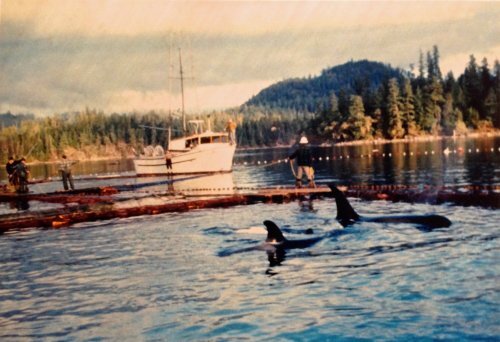
Corky's relatives, the A5 pod
Across the bay I spotted silver plumes erupting from the water. Proud gloss-black fins cut through the reflection of the fading sun. Adrenaline rushed through my body. I felt for the first time a mixture of feelings that would mark my relationship with killer whales for the next quarter century: instinctive fear mingled with magnetic attraction.
I put on the headphones and pressed the record button. The familiarity of the calls made me suck in a shock of cold air. Echoing in the vastness of the deep, numbing water were the melancholy calls of Corky’s family. These were exactly the whales I had traveled 2,000 miles to find—and they had found me. Darkness crept over the strait, and we bobbed in the swells set off by the plump youngsters nuzzling their mothers and squirming playfully on the surface. As their calls rolled on and on, echoing in the undersea canyon they filled, I couldn’t dodge the thought that Corky should be here instead of me.
P.S. There's an old video on YouTube called Corky Hears Her Family - ABC Nightline 1993. Corky's family made an appearance in Realm Of The Killer Whales, which is available on YouTube (Midsummer was mislabeled as male, just a small nitpick on an otherwise great documentary). In June 2022, a new documentary about Corky's life, titled "Corky," was released on Vimeo. It is narrated by Holly Marie Combs.
This is the autobiography of a woman researching killer whales. I am not a great fan of biographies, and didn't enjoy reading about her childhood.....it got more interesting once she got into whales, and I found the romance of her life on the coast of British Columbia attractive. She relished her life on the edge of the ocean, and her enthusiasm is catching. Most of all I was interested to learn about the whales, and her final chapters on salmon farming were fascinating too, if rather repulsive.
The following notes are simply for my own reference, so I don’t forget some of the details I found interesting.
Re Whales...................
*Wales, dolphins and porpoises came from a group of animals (yes, animals), which were on the earth about 57-67 million years ago. About 10 million years later they returned to the aquatic environment. Once back in the ocean their bodies adapted to their new surroundings.
They then split into two types, baleen whales and toothed whales. The latter term encompasses sperm whales, beaked whales, dolphins and porpoises. Killer whales are the largest of the dolphins.
They are further split into killer whales which eat fish, and killer whales which eat mammals (things like other dolphins, sea lions and birds.) The latter are ferociously predatory hunters. They probably existed long before the fish eating killer whales.
* Breathing isn’t an involuntary response in whales and dolphins – they must consciously draw every breath. An unconscious whale will sink and drown. They sleep with half a brain at a time..... surfacing periodically for air, then diving again. Pods of whales all sleep together.
* Whales don’t have a sense of smell, but they are extremely sensitive when it comes to taste.
*Whale ‘pods’ form round the mothers, comprising juveniles, then adult males, then adult daughters and their offspring. The whales in these pods form close bonds. “If a male killer whale loses his mother, he’ll take up company with his sister. If he doesn’t have a sister, he and his brothers wander among their closest relatives. If he has no siblings, his prospects for survival are poor”. They communicate by touch as well as sound, “As they passed beneath my boat, I watched them touch one another constantly. Their pectoral fins grazed lightly along the side and fins of kin. Diving whales rolled toward one another, bringing their entire bodies in contact. These gentle touches spanned all ages and members.” Whilst females mate outside their pod, they nevertheless tend to stick to whales within the same area.
* They do not respond well to capture, and life in oceanariums like Seaworld. The author notes that six whales from a pod she was following were captured for oceanariums in 1969, this not only decimated the pod, but of the six whales captured only ONE survived. (Some of them lasted for some years – but for nothing like the natural lifespan of a killer whale – in the sea males live up to 40, and females to 80.) This was particularly concerning because killer whales do not rear their young easily. “Killer whales average on successful birth every ten years. Some whales may give birth more often, but calves often die during their first year for reasons that are still fairly unknown.” Canada thank goodness is now pretty strict about about not letting these marine parks remove whales, or at least limiting their quotas (I am not absolutely sure about their stance over this, but I know they have reduced whale captures considerably....) The author has pointed out in various places in the book that it is a very cruel practice to keep such huge mammals, who naturally have a large territory, in the sort of small enclosures found in marine parks. They are intelligent too, and what could be more boring than life in a cement pool. There are various campaigns against whale /dolphin captivity. Here is one.
* The author spent many years analysing whale ‘talk’, and concluded their use of sounds was highly flexible and not easily codified or described.
*It is a mystery why male killer whales have tall dorsal fins (much taller than the females), and bigger pectoral fins too....which they then have to drag through the water, but the author thinks this is to attract the females ;-)
*The author did an enormous amount of research listening to whales ‘talking’ under water, using a microphone. ”Wild whale voices can easily fill 100 square miles of water. Their voices are as loud as a trumpet played 3 feet from your ear....The calls are broadcast with enough energy to radiate for 10 miles, hit a rock wall, and travel back to the whale, letting her know where the sea ends and the coast begins.” But none of this can be heard above water. The noise of ships underwater can also be deafening, especially cruise ships. The author wonders how “a species that had taken millennia to evolve such a sophisticated sense of hearing could adapt to humanity’s sonic onslaught.”
* Whale watching is common nowadays, but it needs to be done with sensitivity. Boat owners need to follow protocols so the whales are not too badly disturbed.
*Commercial fishermen can be hostile to whales. 25% of the whales which die in captivity (after being captured from the wild) are found to have bullets inside them.
Re salmon farms................
*The growth of salmon farms has been phenomenal . In 1994 more than 3000,000 tons of domesticated Atlantic salmon were harvested. By 1999 that figure had more than doubled. The noise devices they use to drive seals away from the farms drives away killer whales too. On the West coast of Canada, the numbers of natural Pacific salmon are being reduced by the introduction of salmon farms. The domestic Atlantic salmon often escape and mate with the wild Pacific salmon, or they just take over their grounds.
*They have many of the nauseating problems that are associated with other forms of factory farming. They are prone to disease, and they can create unpleasant algae like Heterosigma carterae which flourish under salmon pens. It kills native fish. Dammit they are not even naturally pink. They have to eat dye in order to get them looking that way.
*The heroes standing up to salmon farms best seem to be Greenpeace.
I loved this book! It's basically the life story of Alexandra Morton, how she came to be a killer whale (orca) researcher, the difficult life of living in the wild on the British Columbia coast, and the environmental concerns as fish farms and forestry services began to invade the area. Really this book is so much more than just about whale research. Reading this inspired me in a different kind of way than when reading Jane Goodall's books because different environmental nightmares are brought to light here. I learned so much from this book; much being about the horrors of fish farming in the archipeligo, and how it has done so much damage to the local fish, coastline, seals, whales, and more. I already knew it was better to buy wild caught salmon and other fish, but reading about the fish farms makes me want to NEVER eat farm raised salmon, EVER! And what's scary is the fact that so often, we aren't sure where our food is coming from. I would recommend this book to anyone who loves wildlife and/or cares at all about our impact on the environment.
Fascinating and must-know history, science, and environmental issues, but with a focus on animals.
It is also, incidentally, an engrossing memoir with such a shocking event in the author’s life that I had to stop reading to absorb it.
Chapters 19 and 20, in particular, are MUST-READS. Everybody in this country, without exception, should carefully read and ponder these two chapters--they contain crucial information about salmon that everybody must be made aware of as soon as possible.
Okay. Whales might be the neatest thing on the face of the earth. And I might have to abandon my life to go watch them play in Blackfish Sound or Echo Bay or wherever they may wander…
The books that led me to orcas were all about SeaWorld and the inhumanity of captivity. Listening to Whales supports the anti-captivity argument by showing us what orca lives should look like; who orcas are without trainers and tanks and years of mindless, psychosis-inducing imprisonment.
My first and only sufficient response to wild orca life is WOW. These creatures are unreal. They have their own languages, they can use echolocation to tell how fast your heart is beating and whether or not your belly is full, they choreograph elaborate dance routines just for the hell of it, rescue drowning dogs, and create family bonds that put the Osmonds to shame.
Learning about the natural lives of orcas (and other cetaceans) really puts the SeaWorld debate into perspective– it highlights the stark contrast between the spiritless confinement of captivity and the sensible, soulful brilliance of Mother Nature.
There are no collapsed dorsal fins or stress-induced stomach ulcers in the wild. There is no infighting or inbreeding. Mother orcas don’t reject or unintentionally neglect their babies in nature because their own mothers and grandmothers are around to teach and support. Miles and miles of ocean function as playground, classroom, kitchen, and boudoir. Death and grief still happen, of course, but they happen in a way that harmonizes with the world around them. You know, all that Circle of Life mumbo jumbo (as I always remind my clients: there’s truth to be found in the fluffy, cliche bullshit).
But not only do we watch the orcas play in this book, Morton ups the ante with cool news about dolphins and humpback whales and the impact of salmon farms on delicate ecosystems. Not a good kind of impact, in case you’re wondering… This book is filled with fun (and not so fun) facts about oceans and the lives within them, and embodies the memoir-esque narration that makes complex information so wonderfully accessible.
“Listening to Whales” is the beautiful story of one woman’s quest to study the mysterious apex predator of the deep: Orcas, otherwise known by the misnomer “killer whales” and pejorative “blackfish.” Her research takes her on an adventure to an isolated cove north of Vancouver Island where she uncovers the secret life of these smart and exquisite creatures.
It is not an exaggeration to call Alexandra Morton the Jane Goodall of orcas. Both enter forbidding environments alone to undertake pioneering research with no academic training, marry cinematographers, raise sons alone in the field, and become conservationists.
Orcas are actually a variety of dolphin, not whale. Most are content to eat fish, but a subset known as “transients” only eat other mammals. The fact that these two groups coexist makes orcas unique in the animal world. Their brains are second only to whales in size and their lifespan is similar to that of humans. Like elephants, theirs is a matrilineal society of pods with 6 - 20 family members. Like chimpanzees, the orcas’ broader communities develop their own unique “cultures” of learned behaviors, like headstands. Family ties are paramount, which leads orcas to engage in their most magical behavior: Synchronized movements and even breathing.
Morton discovers that the sounds the orcas make are not so much a language as they are a means of letting others know where they are. Just as importantly, calls are used for echolocation. As Morton eloquently puts it, “To us, the undersea world is a dark, impenetrable place; to whales each sound might illuminate it in three-dimensional flashes of detail. Vision doesn’t penetrate most surfaces, but sound does. Echolocation is like running your hands over your lover’s face in the dark” (p. 90). Each family has its own unique calls, which amazingly leads Morton to track down the family of one of the orcas she had been studying in captivity at Marineland. Individuals can be discerned by the unique shape and coloring of their dorsal fins.
Morton “settles down” on a floating house in the aptly-named Echo Bay where her orca family spends the winter. Her life is not without tragedy, but the tiny tight-knit community helps her pull through. Like Kim Heacox of the “Only Kayak,” Morton shifts her focus to protecting the coastline as the rise of fish farms drive away her beloved orcas and threaten the cornerstone of the coastal ecosystem and the non-transient orcas’ favorite food--salmon.
Given the similarities between whales and elephants, I will next read Caitlin O’Connell’s “The Elephant’s Secret Sense” (2007). Jane Goodall’s “Through a Window” (1990) will follow. So many smart and brave women are doing cutting-edge research on animal cognition.
An absolute must read for anyone interested in killer whales or mankind’s impact on our world, especially in our oceans. This book was just powerful and passionate. If it lacked a little in hardcore scientific fact, it more than made up for it in heart. I definitely learned things about whales, marine parks, and fish farming history that I had never known before.
Listening to Whales: what the Orcas have taught us by Alexandra Morton, Ballantine Books 2002
I picked this book up because I’m a bit of a dolphin and whale geek, and because I’d seen the documentary, Black Fish, a few months previously and wanted to learn more about Orcas, but reading this book was like opening a treasure chest full of surprises.
Morton’s writing style is warm and friendly and easy to understand. She weaves her life story seamlessly into the text, more so because her life’s work has been studying dolphins and whales.
Early in her career Morton had a chance to work with early dolphin communication researcher, John Lilly. She also had a chance to study dolphin communication at Marineland, which led her to study Marineland’s two resident orca, Corky and Orky. The poignant story of the female orca, Corky, falling pregnant at least three times, but none of her calves surviving due to the configuration of their tank, eventually led Morton to study orca in the wild and find Corky’s family pod in the bays and inlets of British Columbia. She eventually moved there permanently so she could continue to study the language of the different pods of whales in the area.
Through this book I learned that there are two forms of orca in the area – the resident pods, family groups comprising generations and led by matriarchs, who have a diet of fish, and transients – orcas that roam the seas in smaller groups and eat other mammals. I was saddened to read that at one time there were resident (non-migrating) humpback whales around British Columbia, and possibly other areas in the world that have all now been hunted to extinction. As the differences between transient and resident orcas is so vast, one wonders what we lost in never being able to study and compare migratory and resident humpbacks.
I was surprised when the narrative drifted away from orcas and on to wild salmon and salmon farms that sprung up in the area. When I visited Alaska in 2006 (to see whales) I didn’t understand the sentiment – mostly observed through bumper stickers and graffiti - that fish farming was wrong and the industry should be banned. Courtesy of Listening to Whales I now understand the fuller story; how the by-products of fish farms pollute the local waters, how escapees can either mate with or drive out the local fish stock, or spread disease, and how acoustic deterrents used by fish farms to keep marauding seals away from their stock disrupted the whole eco-system. The whales left the area, and only returned many years later.
The author is also an accomplished artist, and I enjoyed her renditions of whales and other sealife dotted through the book. The photos were also very informative and a good compliment to the text.
While Alexandra Morton doesn’t overstate the case, she does leave you wondering what we’re doing to this planet. An excellent read that I’d recommend to anyone.
Currently re-reading this book, partly because, well, I want to, and partly because I have an English project and it has to be on something nonfiction. I remember why I love this memoir. It's scientific nonfiction written with a novelist's flair. Morton has talent. 'Course, her descriptions of incredibly difficult fieldwork make me wonder if I'll ever be up to doing the same kind of research- because marine mammal communication is what I want to study- but at the same time, her obvious reverence for the animals she studies and their world is infectious. If my parents don't let me take the family copy when I go off to college, I'll be very sad. This book needs to be read on a rocky Pacific Northwest coast on a misty morning, and I suffer from an unfortunate lack of ocean at my current location.
***
After second re-read: All I need to add to this is- if you've ever eaten salmon and you're not sure where it came from; if you're ever going to eat salmon; if you're ever going to buy salmon even for the consumption of someone else: you need to read this book. You'll watch your fish sources very carefully afterwards. I promise.
Alexandra Morton started studying dolphin and orca vocalizations in captivity, but soon moved on to observe orcas in the wild. The memoir covers her studies of both residents and transients, but there's also quite a bit about fish farming and living in the remote parts of British Columbia. 4.5*
"I do have hope. Nature is enormously resilient. Humans are vastly intelligent, the energy and enthusiasm that can be kindled among young people seems without limit, and the human spirit is indomitable. But if we want life, we will have to stop depending on someone else to save the world. It is up to us - you and me, all of us. Myself, I have placed my faith in the children." - Jane Goodall to Alexandra Morton at a conference when Morton asked her if there was any hope for these animals
I'm an animal lover. A deep, deep, animal lover. Daily I receive updates from several international animal welfare organizations. Of all the animals I love, dolphins and orcas are on a degree much higher for me, so reading this book was perfect for me in so many ways.
Alexandra Morton writes a book that is a combination of her biography with the science and lives of these beautiful and incredible creatures. After working with a renowned dolphin researcher she decided to study the sounds of the orcas to try to learn as much as could about their language.
She began this process with the killer whales at a California marine park, but after watching and learning so much about the way the two orcas reacted to lives in a small tank Morton decided to travel to the small bays off the British coast to study them in the wild. Morton was the first to research their language, using a special microphone she could drop into the water from her zodiac when she caught the sight of them from her various camps and residences in Canada. As she learned, she shared with other ocean researchers throughout the world, developing quite a reputation in the field.
Alexandra Morton describes the deep, deep attachment orcas have to their family, "more than marriage, more than food, more than home territory, its family around which a killer whale's world revolves." Orcas "breathe together, move together, vocalize together, stay together" in every moment of their lives.
I know from my own involvement with the fight in Puget Sound regarding wild salmon and the current orcas that are literally starving to death in that area and how critical salmon are. Morton discusses all the animals and even trees that grow and survive by salmon who move freely back to their spawning fields to lay more eggs. Morton goes into deep discussion about the effect salmon cages placed into water to raise them in are having on the entire environment, and it angers me. (Personally salmon is forever off my menu now). Even if you read this book for those chapters I would highly recommend this book.
Amazing book!!! Orcas are fascinating animals and can really teach us a thing or two. Such an inspiring and terrifying tale, the Orcas are resilient but we are truly doing our best to kill them.
The last few chapters should be required reading for everyone on the planet! The harm that salmon farms are doing is disturbing! I have sworn off farm raised salmon for quite awhile now, but after this I can GUARANTEE I will never eat it again. It is diseased and disgusting and destroying the natural populations and everything else dependent on them.
We're killing our oceans. Many don't think that's their problem...but it is. Without a healthy ocean ecosystem we are looking at our own extinction. Open your eyes people!! (And by people I mean big corporations and government even more than the public...but the public needs to wake up too.)
This is a beautiful book full of ups and downs and moments that are chilling at times and magnificent at other times or both. Alexandra Morton's memior is unique and revealing of the earlier days of both captivity of orcas and dolphins, notably Orky & Corky, and of the early days in orca research. Then came salmon farms and everything changed. If you follow Alexandra Morton beyond the pages of this book you will find her as a salmon warrior lobbying the Canadian government against salmon farms. The start of salmon farming and its destructiveness on wildlife on BC's coast is detailed in her book. This is such a wonderful book, it had me crying at times and it gave me much insider knowledge. I have nothing but respect for both her and the orca whales. I read this in the fall and its still very much on my mind.
Wow. This book is absolutely amazing. If you enjoy reading about Orcas at all, then this book is for you. Morton has an excellent sense of style in her writing that makes it easy to read and easy to connect with the struggles she faces in trying to preserve the very land and ecosystem she loves. The more non-fiction I read, the most horrified I am at the terrible things we've allowed to happen to the only place we have to live. We may be the so-called dominant species on the planet, but man, we are really bad at making sure this planet lasts. It's a shame these amazing creatures may not be around for future generations to enjoy all because someone is trying to make a profit, truly shameful. This book also features a lot of hope, so don't think it's all doom and gloom because it's definitely not. in summary, read it, it's awesome!
Rtc, but wow! This was so good. What an intimate look at the life of a whale researcher. Alexandra Morton has been through so much and has done so much. A new hero of mine, for sure.
Wonderful, fascinating and in parts hearth-wrenching memoir of a field biologist working with killer whales.
Two take-aways from this book for everyone: - Boycott SeaWorld and any other park that hold dolphins and whales captive. While you're at it, don't drink (American) Budweiser, cause the owner of the brewery also owns SeaWorld. - Don't eat fish coming from aqua farms. I already knew that the feces of the fish pose problems for the sea with algae blooms etc., but I had NO IDEA how bad the farms were in terms of unbalancing the ecosystem, diseases that jump over to wild fish, chemicals, antibiotics, keeping other fish (like herring) from spawning, killing off whole sub-species of local fish that can't use their migration routes up the rivers anymore etc. etc.
Some fun facts I learned from the books, whithout giving too much away about the fascinating observations Alexandra Morton makes in her book: - Orcas are cosmopolitans, they occur in every ocean on Earth and eat different things, depending on where they are. Even in the same area (in the book's case British Columbia) the residents eat fish while the transients eat mammals - Orcas have different cultures. Different types of whales (for example resident whales vs. transients) have different dialects and speech patterns. Transients talk much less and swim differently than the resident whales (probably so as not to alert the mammals they're trying to catch) - Orcas have summer time fads. Every year a new thing is "in fashion" that the whole pod will do, the next year this behaivor can't be observed anymore. For example: Headstands in the water.
My second-hand edition is from 2002 and I'm anxious to know how the situation is nowadays in BC and before Vancouver Island. I had never considered whale watching to be harmful for example (noise pollution, whales being harrassed), so I'm curious to know if they established routines in the industry that benefit whales more than harm them (raising awareness for environmental issues etc.).
All in all, an absolutely fascinating read I won't forget in a long time to come. Five stars, fully recommended!
I started reading this book as something to fill my time, a book I could read a bit to go to sleep quickly. But Alexandra Morton's adventures and experiences with the whales ended up keeping me up half the night trying to finish the book! Even though it starts off as a biography, I was quickly swept into the world of underwater animals: dolphins, porpoises, whales, salmon, seals! The sights and sounds that she describe are thrilling, and in entering her world, we're confronted with questions about intelligence, awareness, and what it means to have consciousness.
Alexandra's love of the ocean is infectious, and after reading this book, I really can't wait to make a trip to British Columbia and visit the pods that she talked about (in a safe, respectful way, ofcourse!) Highly recommended reading for anyone interested in marine life, and the impact humans have on it.
Excellent!! A thoughtful account with a good mixture of heart and humility that makes for a fascinating story. The author introduces the reader to an unfamiliar species in an unfamiliar environment that has evolved to a place at the top of world's oceans. Highly recommended.
My only gibe is that Morton refers to "Gulls" - of which there are many species - as "Seagulls" of which there are None!! Could it be like me referring to her orcas as fish?? I guess that's just the Birder in me.
Alexandra Morton does an excellent job relaying the knowledge she has gained on orca's through the telling of her life's story. This book is an easy read and continues to reveal knew information through out the whole book instead of pounding in the same information and stories over and over. I higly recommend this book to any whale lover, and anyone looking for information on the effects of salmon farming in Canadian waters.
Listening to Whales is insightful account of orcas along the coast of British Columbia, along with some of Morton's personal experiences. Morton also includes information on dolphins and salmon, amongst some other species. Overall I enjoyed Listening to Whales, but at times I felt it needed a better editor and a tighter focus on orcas.
The personal stories and some of the specific details of orca life were new to me but not the evils of SeaWorld and other places like it. Nor was the tragedy that is fish farming, which continues to wreak havoc in our rivers and oceans (pollution, disease and non-native species driving out vital native species, amongst other issues). In terms of SeaWorld and companies/facilities like it, please avoid them. Much like zoos, these places are simply jails for species that deserve to be in the wild. An orca should not be subjected to sitting in a bathtub equivalent for the rest of their lives (which can near 80 years naturally). These companies may no longer take their "Shamus" from the sea, but entire families and genetic lines have been wiped out by the careless greed to display these intelligent beings. Corky, one of the orcas noted many times in the book, is still forced to perform for SeaWorld even today (this book is over 10 years old) as one of their many "Shamus". She has been subjected to such things for more than forty years. http://en.wikipedia.org/wiki/Corky_%2...
Some interesting and important details found in Listening to Whales:
Page 3: "Not long before I first arrived here, people shot orcas for sport. They were considered predators, wolves of the deep. Small children were encouraged to throw rocks at them from shore. Marine parks paid fishermen to steal infant whales from their mothers, move them across the continent in trucks, and imprison them in concrete tanks. The government tried to cull their population with machine guns."
"Their intelligence has yet to be adequately analyzed; indeed, their powers of cognition may be too complex for us to accurately quantify. In brainpower they may surpass us."
Page 56: "By the late 1970s orcas had become Disney-fied. They were considered obedient, cute, tongue-wagging performers, tame enough for petting, and the children I observed were learning that it was a human right to enslave, harm, and ridicule another creature just for fun. In a single generation the human memory of orcas as dangerous predators had faded away-and with it the respect that predators command."
Page 70: "Orky, he told me, had been one of seven whales netted for oceanarium trade. Six were sent to captive tanks; the surviving wild male had never been seen again. From what we know now, the loss of an entire family would have been enough to kill him."
Page 83: "When killer whales swim together, they reveal their family tree with nearly every breath. In general juveniles surface closest to mom; adult males are the next farthest out; then come the adult daughters and their offspring. As the young whales mature, the females form satellite groupings with their own babies, but the adult males continue to flank their mother. Older mothers are the center of the pod, never abandoned or alone."
Page 86: "Female orcas live up to eighty years, much longer than males, which have a life span of about forty years." --Still accurate today?
Page 97: "Decades later a film crew at SeaWorld did play a recording of Corky's family back to her. While her Icelandic pen mates ignored the sounds, Corky's whole body began shuddering terribly. If she wasn't "crying," she was doing something painfully similar."
Page 237: "In 1983 A10 and her youngest calf were shot by a boater. [...] 'A10 pushed her wounded calf to my side of the boat,' Dave later told me.'We could see the wound oozing blood. It really seemed that she was showing us: Look what you humans have done.' [...] A10 and her baby both died that winter."
Page 251: "Fishermen shot whales, didn't they? They talked about it on the radio. "Not sure if I'm gonna take a nap or dust a few sea lion pups." I'd heard one fishermen tell another just a few days earlier." --Any wonder the seal hunts continue?
Page 267: "Minister of Fisheries and Oceans [...] replied nonchalantly that it was okay to displace porpoises because they would come back when the devices were turned off. I wondered how he would feel if he was kicked out of his home for a few years onto the streets of Ottawa. Would he be "okay" when allowed to return?" ---Oh speciesism...isn't it grand.
Page 267: "At the whim of this corporate-controlled industry, eight thousand years of whale history in the archipelago came to an end." ---Speaking of the salmon farming in the waters.
Page 296: "Fat-binding molecules of polychlorinated biphenyls (PCBs) and dioxins have surpassed benign levels in most of the whales of this coast. The biopsy darting [...] revealed a horrifying pattern of contamination. While the transient orca are not the most contaminated mammals on record, the southern resident whales are threatened with extinction. Toxin loads begin at birth, coming from the mother's milk. In female babies this level rises until they give birth, at which time they pass toxins to their own offspring. The males, however, show a steady rise and are dying so rapidly now that soon there may not be any breeding males. While much of these toxins are airborne, the waters off Seattle, Vancouver, and Victoria are also contaminated. Any who believe our poisons only affect whales and other animals are missing the truth. Our bodies are collecting them too." ---Has further study found orcas to be surpassed by any other species now in terms of contamination/bioaccumulation?
Page 300: "In the summer of 2001 researchers found 10,000 gallons of the oil still buried beneath the beaches." --From Exxon Valdez spill in 1989
Page 303: "In Norwegian rivers farmed salmon outnumber wild salmon by as much as four to one."
"In the year 2000, British Columbia's fish-farming industry dumped the same amount of raw sewage as a city of a million people, every day of the year."
Page 308: "Based on what we know now, we'd be less than truthful if we said that the cornerstones of human consciousness have not been found in this species. Have we matured to the capability of recognizing awareness in someone who does not look or act like us? Are we human enough to extend the rights of humanity to another sentient species?"
Alexandra Morton is like the Jane Goodall of Orcas. She herself was inspired by Jane Goodall at a very early age and subsequently followed her passions and interest, which led her to leave school early, cross from the east coast of the US to the west in a quest to study dolphins - which ultimately led her to the study of Orcas, first those kept in tanks in captivity at Marineland in San Diego and soon after, their brethren in the wild, which then leads to a life in the far northwest of Canada’s British Columbia and Broughton Archipelago, becoming an expert on the Orcas who live and travel through those waters and learning to identify hundreds of different individuals over the years - not just by their flukes and markings but also by their vocalisations - which she studies and has researches intently for decades. When Alexandra first moved to the area in the early 80’s it was a pristine wilderness - but over the years salmon farms were set up all along the coastline and one day all the whales left - the farms were blaring out intensive, underwater, screeching sonic alarms, to chase away salmon eating seals, noises which the whales with such developed and sensitive heating could not bare. This eventually leads her to switch from studying whales full time to investigating the issue of farmed salmon and the way the intensive farming is threatening the whole eco-system and delicate balance in the waters where these magnificent whales live, with the pollution, disease and a whole host of other issues that salmon farming brings. However, don’t be put off if it all sounds very “science-y” and you think that’s not your thing. This book is not just about whales - although by reading the book you will learn an awful lot about whales, other sea mammals and fish, especially salmon - it is also a fascinating account of what can happen when you follow your dreams. It is about the bonds of family, the possibilities which exist for things which we as humans can only begin to imagine. It’s about the fragile eco-system and the intricate balances which nurture life on this planet. It’s about relationships, love, birth, death, heartache, integrity, grit and determination. It’s about communities living in far away places and how they help each other to survive in these unforgiving environments. It’s a remarkable story of a woman’s life - her work and her personal life - how she raised her children while also pursuing her passions, how she coped after a terrible tragedy and about a stunning part of the World which few of us will ever see, but which by reading the book I felt extremely enthralled with and somehow connected to.
"Listening to Whales" is a carefully observed, delightful, and heartbreaking work of research, science essays, and memoir braided into one. As a whale nut, this book introduced me to a deeper level of cetacean education (classification and observational methods, behavior & communication, relationships between & within a variety of species, and a history of research findings and individuals).
Morton also shares a shocking-- albeit emotionally restrained-- insight into the intelligence and profound family ties of cetaceans, and the living hell we've created for them through hunting, salmon farming, and "marine theme parks".
I didn't know much about Sea World before (with the exception of a visit when I was seven, when I watched a woman nearly drop her two-year-old into a walrus tank-- intentionally, 'to get a better view of the walrus')... but after reading "Listening," I will *never* set foot inside of one again. I was horrified and heartbroken to learn about the history of marine parks and whale capture between the US, Canada, and places like Iceland that cashed in on the Shamu frenzy. I was so shocked to learn about the history of captive whale treatment that I literally had to put the book down and leave the room. Little-known fact: captive animals at Sea World never "die"-- people are told that the animal was "sent to a facility in Ohio". Little-known fact: The treatment of Orcas at Sea World is the most depressing thing I've ever read about. (And guess what became of the Orcas that killed or nearly killed their trainers... oh, they're still performing for that whistle for the 10am, 12pm and 2pm shows!)
While I wish that "Listening" had a better team of editors behind it, it does have an endearing 'self-published' feel to it, and the occasional storytelling and grammar issues I winced at paled in comparison to Morton's inspiring devotion to research, her moving and deeply educational orca observations, and unabashed love of science.
Utterly fascinating. Listening to Whales is part personal memoir of a life far removed from what most of us will ever experience, part natural history of the areas around British Columbia, and part disquisition on the relationship between human beings and the ecosystems with which we share the planet. All of these various stories are vastly interesting in their own right. But most of all, this is the story of cetaceans - especially the orcas. And this story is amazing.
In 1995 I had the opportunity to swim with some dolphins. I came away from the experience convinced that those dolphins were every bit as sentient and smart as we were. The only thing we have is opposable thumbs, and quite honestly, I didn't think the dolphins minded or cared. The this past summer on a trip to the San Juan Islands in Washington State, I had the incredible good fortune to watch a pod of transient orcas and to see them feed and then play(the naturalist on the boat was beside herself at this opportunity). Taking in this sight reinforced my earlier feelings that I was witnessing equals. Morton's tales enriched my knowledge and helped bring my impressions into context.
I recommend this engaging, moving and thoughtful book to anyone curious about marine mammals or even just about life outside the more conventional parameters of modern urban existence.
Ms Morton, I envy you. You have the life I have dreamed of my entire life. There's nothing I'd rather do than to learn everything I can from whales. And she learned so much in the years she has spent with them. From her time spent researching dolphins and killer whales in captivity to her revelatory work done in the waters around Vancouver Island, Morton weaves a story of science with her life story. Well written, personal, and poignant. I loved every minute of my time with this book. As I was reading it, I was following Northern Resident Orcas on Tumblr. It was great to see pictures of the whales I was reading about. Though she ends with the tragic story of the destruction of her research area by the Atlantic salmon fish farming, this book gives me hope that we as a race will realize that many animals (whales, apes, and elephants to name a few) are intelligent, sentient beings. They deserve our respect and they should never be forced to perform for our amusement. In fact, the more we study animals, the more we learn about ourselves. When it comes to our search for intelligence in the universe, we need look no further than the jungles, the savannahs, and the waters around us.
A good portion of the joy in reading this book, was in recognising many of the locations Morton researched from. It was wonderful to see my Vancouver Island (and surrounding islands) through her eyes.
Morton's voice is engaging and honest, and her lifetime of listening is very well laid out and easy to follow. I loved how she intertwined personal hurdles with the research, it made the memoir almost feel like it was written in real-time. I cannot really describe the reasons for enjoying this book to the extent that I did.
I strongly feel that every BC resident should read this, and begin to understand how we are not fighting the fish farming industry that is turning our spectacular coastline into a toxic wasteland.
i read this on a rubbing beach at the Johnstone Straight, BC, while taking a break from kaying with orcas. We had a hydrophone with us and could hear the ecolocation clicks...stunning. Reading this book and studying them up close proves how intelligent and social these mammals are, and how misunderstood. Awesome book to learn about Orcas with photos identifying the resident Orca families that migrate to the Johnstone Straight every summer.