A Los Angeles Times Bestseller New York Times best-selling author Brian Fagan explores the world of the Cro-Magnons--the mysterious, little-known race, famous for its cave paintings, that survived the Ice Age and became the ancestors of today's humans. They survived by their wits in a snowbound world, hunting, and sometimes being hunted by, animals many times their size. By flickering firelight, they drew bison, deer, and mammoths on cavern walls- vibrant images that seize our imaginations after thirty thousand years. They are known to archaeologists as the Cro-Magnons-but who were they? Simply put, these people were among the first anatomically modern humans. For millennia, their hunter-gatherer culture flourished in small pockets across Ice Age Europe, the distant forerunner to the civilization we live in now.
Bestselling author Brian Fagan brings these early humans out of the deep freeze with his trademark mix of erudition, cutting-edge science, and vivid storytelling. Cro-Magnon reveals human society in its infancy, facing enormous environmental challenges from glaciers, predators, and a rival species of humans-the Neanderthals. Cro-Magnon captures the adaptability that has made humans an unmatched success as a species. Living on a frozen continent with only crude tools, Ice Age humans survived and thrived. In these pages, we meet our most remarkable ancestors.
Brian Murray Fagan was a British author of popular archaeology books and a professor emeritus of Anthropology at the University of California, Santa Barbara.
CRO-MAGNON may be categorized as a brief history of human pre-history, at least that portion of the world's pre-history that was peopled by what anthropologists call "modern" man - from 150,000 years ago up to approximately 12,000 years ago. Of course, modern science now tells us that man came in two flavours - Cro-Magnon and Neanderthal - two species that were definitely genetically different and, almost certainly, sexually incompatible.
CRO-MAGNON suffers from a rather drab exposition style and won't win any literary awards for its ability to compel readers to breathlessly turn pages at high speed. But, that said, for any lay readers interested in human paleontology and cultural anthropology, CRO-MAGNON is certainly interesting and informative and touches on a wide variety of topics - weaponry, technology, art, culture, migration, population, the harsh living conditions caused by the rapid ebb and flow of ice ages and, of course, the slow but steady extinction of the Neanderthal and the rise of modern Cro-Magnon, now known as Homo Sapiens to the top of the world food chain.
Definitely recommended for the non-scientific amateur that wishes he could someday be part of an archeological dig!
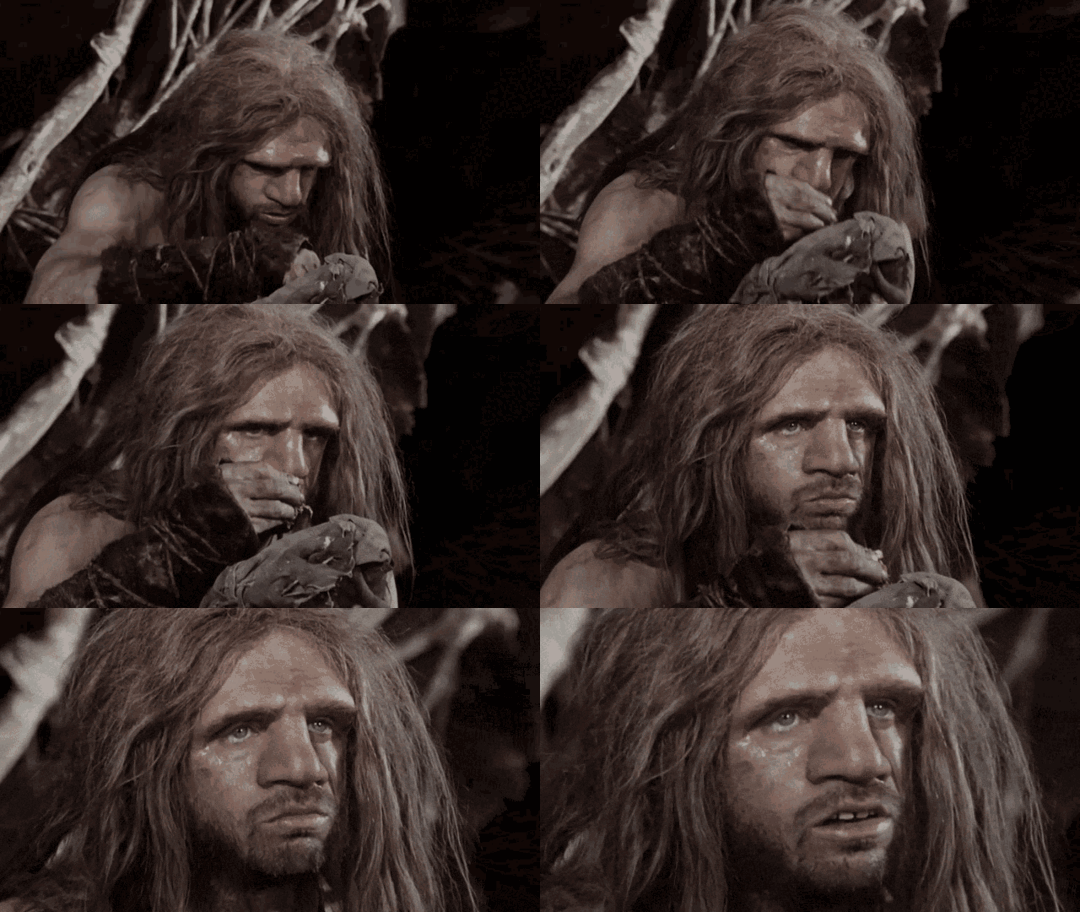
A heavy-browed, hirsute hunter crouches among the undergrowth frozen still...
…silently observing an encampment of creatures much like himself…
…yet decidedly different in their features, the very shape of their heads, their more intricate tools, sharper and finer weaponry, their almost tailored clothing, the utterly foreign sounds they speak, so different are they in fact that the hunter does not recognize them as kindred beings.
He is Neanderthal, a dying race that survived mostly unchanged for hundreds of thousands of years. And these "others"? They are Cro-magnon, the forefathers of modern man. And DNA evidence suggests there may be no link between the two, and yet they seem to have interbred.
In such a manner begins Brian Fagan's Cro-Magnon: How the Ice Age Gave Birth to the First Modern Humans, diving into the face to face meeting of the past and future, of who we could have been descended from and who we did draw our heritage from. Then he goes into the whys, why did this new breed of human survive while the other died out. Many fascinating topics covering our birth as a people are discussed here in, and made possible by recent and ongoing research, new techniques of which are unearthing truths and dashing away old myths.
That last point was my reason for picking up this book. So much of this information is new and replaces a lot of faulty info foisted upon me in school. I wanted to fill in the gaps of my less than stellar educational efforts back in elementary school, as well as to correct some of the misinformation I picked up when I was paying attention.
Fagan provides a great history lesson, using relatively lively scenes depicted now and then between his lectures, and though it's like any other nonfiction book, lectures they essentially are, for lecturing is what Fagan does at the University of California at Santa Barbara, my sort of second home (the town, not the school).
Historians and history lovers are going to gobble this up from cover to cover, but for those with a lower threshold for a dry history lesson there are sections of Cro-Magnon that will range from "late August in Arizona" dry to "Sahara desert on a hot tin roof" dry.
I love me some history big time and I really liked this book, however, I feel like I know more now about Cro-magnon man than I'll ever need to know. And it's the kind of knowledge that's probably only going to come in handy at pub quizzes.
This is an embarrassingly bad book. The last sentence of the book sums up the whole sorry mess: "My [white European] DNA tells me I'm one of them, and I'm proud of it." The book is laden with the author's romantic adolescent male fantasies about what it was like being a cro-magnon man-- emphasis on "man." His typical fantasy involves a young man shooting birds with arrows while his "sister" (Fagan's choice of word) retrieves them. Another: "The man paddling in the bow, his wife in the stern..." My favorite is his assertion that all the women remained in the camp while the men are off hunting, a place redolent of the smell of urine, used to tan hides (which he believes the women spent all day crouched on their haunches, bent over pelts, tirelessly toiling the livelong day to keep the family in shoes & furs). Basically, he assumes a 1950s sit-com set of family & gender relations prevailed during the Paleolithic. (I kept thinking his imagination didn't rise much above the Flinstones.) All the wise elders are, of course, men, handing down their accumulated knowledge & wisdom to the boys. Apart from that, the author is unable to talk about technology without using modern anachronisms-- his favorite being the "swiss army knife" the men all possessed for undertaking their sophisticated feats of hunting. Seriously, give this one a miss if you're really interested in the Paleolithic.
I may come back to this one? I was a little off-put by the author describing a meeting between Cro-Magnon & Neanderthals. The Cro-Magnon child plays happily by the river until her father notices the eyes of the Neanderthals across the way. He calls his child to him and they head home from the hunt. Ect., etc, etc. That's not a quote, btw. But I think that sort of thing is cringy. We don't know how they interacted, stop pretending we do. I just wanted the facts without the fairytale. And maybe I didn't give the book enough of a shot, so it's possible I'll swing back around and try it again someday.
When I was a student at Washington State University (back in the days of the Oregon Trail and Cholera), the term Cro-Magnon was passé. In general, we used “early modern humans” instead. In fact, I have several college textbooks on human evolution that don’t mention the term Cro-Magnon at all. Why?
At least two reasons come to mind. First, the nomenclature that is/was Cro-Magnon had become associated with the oft ridiculed and grossly inaccurate “caveman” cliché—dim witted and highly aggressive. Secondly, Cro-Magnon was/is sort of an arbitrary classification. Technically, Cro-Magnon is us. If you dressed him in jeans and a Taylor Swift t-shirt, gave him a haircut and sneakers and then seated him on the subway, he’d be totally indistinguishable from the rest of us. “Early Modern Human,” with all its syllables, seems more appropriate.
Is the term Cro-Magnon making a comeback? For the title of a book, it certainly seems more impactful and more attention-grabbing than the alternative. Author Brian Fagan writes that he likes the way it “rolls off the tongue.” I agree. But seriously, it’s been ages since I sat in Professor Krantz’s physical anthropology class. Someone tell me (PLEASE!) is it back in vogue or is Fagan going all retro for the sake of expanding his book’s demographic? I honestly don’t know.
Cro-Magnon is reasonably informative, albeit perhaps a little out of date and about as focused on the Neanderthals as on the Cro-Magnons. It had fairly similar information to a lot of other books I’ve read about human evolution, not really managing to make the Cro-Magnons stand out as a specific group worth a whole book. The recreations were mostly pretty uninspired, and the assumption that gender roles would be something straight out of a 50s sitcom (as someone else put it) was pretty eyeroll inducing.
There is some interesting info here, but in the end… I got a little bored, I guess. Not much of it is sticking with me, except my eyerolling at the idea that women were subordinate to men from the start.
Published in 2010, this book is unfortunately showing it's age. Much of the discussion of Neanderthals seems very dated, with Fagan adhering to an outdated view of Neanderthals non-verbal, relatively cognitively impaired hunters; who were out-hunted by smart, more social Homo sapiens. Fagan states unequivocally that Neanderthals and Homo sapiens never interacted, which is obviously contradicted by the average of 2% Neanderthal DNA in modern European populations.
As suggested by the title, the bulk of the book details the lives of Homo sapiens in Europe. However, I found writing style relatively boring; with seeming interminable variations of (male) hunter life described in romantic detail again and again for each chapter (no discussion of the gather life), combined with dry descriptions of the important sites. The descriptions are so speculative, that one suspects they match much more with Fagan's own fantasies, than anything to do with the actual paleolithic.
Once upon a time, long, long ago, musicians Stephen Stills and Judy Collins enjoyed a romance. Then, Judy sailed away and broke his heart. Stephen wrote Suite: Judy Blue Eyes, which I recently heard again. One line made my head spin: “Don’t let the past remind us of what we are not now.” Why not? Remembering the past sounds like an excellent idea. What we are not now is wild and free human beings — normal & authentic.
I just finished Brian Fagan’s book, Cro-Magnon, which describes an important segment of my family history. The happy news is that there have been three studies of the mitochondrial DNA of modern Europeans, and their genes are primarily indigenous. The invading farmers from the Fertile Crescent did not exterminate the natives. The genes of the eastern immigrants are somewhere between 15% and 28% of the modern European DNA.
It staggers the imagination to contemplate the astonishing wildness, beauty, and vitality of Ice Age Europe. It’s heartbreaking — and illuminating — when these grand memories remind us of what we are not now. After reading the book, I feel a much stronger connection to the ancient cave paintings. Those artists were my ancestors, and their images belong in the family album. My people once lived in lands inhabited by wooly mammoths, aurochs, bison, and vast herds of reindeer. They lived beside streams that thundered during salmon runs. This gave me a sense of homecoming, a powerful remembering.
Fagan does a nice job of describing the world of the Ice Age, and the wild swings of the climate — growing glaciers & melting glaciers. When the climate warmed, the hunters and their game moved north, and when frigid times returned, they moved south. The hunters followed the meat, and the meat followed the grass.
“There were at least fifteen to twenty short-term events when temperatures were up to 44.5 degrees Fahrenheit (7 degrees Celsius) warmer than during the intervening colder intervals.” The climate could swing from pleasant to freezing over the course of a lifetime. Siberia was once a tropical forest, the Sahara once had lakes and grasslands, and there was a time when you could walk from France to England.
The sad news is that the hunting tribes of Europe became farmers. This may have been similar to the spread of corn from Mexico to the tribes of the north — an amazing innovation that bit us on the ass, and cast wicked shadows on the unborn generations. Fagan helped me to better understand the transition to agriculture, in which ongoing innovation in hunting technology played a leading role.
All hominids have African ancestors. Some of them migrated to Asia, where Neanderthals first walked onto the stage. Some Neanderthals moved to Europe maybe 300,000 years ago, where they hung out in cool temperate forests. Their primary weapon was a heavy thrusting spear with a sharp fire-hardened tip. These were great for killing large slow-moving animals.
Fagan believes that the Neanderthals were luckless dullards, because they displayed almost no innovative cleverness over vast spans of time. They were simple and stable, and their dance on this planet may have been far longer than ours will turn out to be — and they didn’t destroy paradise. What dreary boors!
“Cro-Magnon” refers only to the Homo sapiens clans that inhabited Europe, but our species originally emerged in Africa, maybe 170,000 years ago. Around 45,000 years ago, some moved into Europe, and within 5,000 years, they lightly inhabited much of the continent. Cro-Magnons left us the gorgeous painted caves, magic peepholes into fairyland. Neanderthals went extinct about 30,000 years ago, for unknown reasons.
The trademark weapon of Cro-Magnons was the lightweight throwing spear, tipped with stone or antler. It was excellent for hunting on open land, and it could kill from a distance. It made it easier to kill a wider variety of prey, like deer and reindeer. Thus, there was more meat on the table, more bambinos in the nursery, and more spear-chuckers running around the bloody countryside. Even during warm eras, European summers were short, and plant foods were limited, so meat was the core source of nourishment. Homo sapiens have been purebred hunters since day one in Africa.
Later, the bow and arrow arrived. Bows may have been used 18,000 years ago, based on circumstantial evidence, but the oldest bow found so far was from 10,800 BC. The bow was an awesomely powerful weapon. It could be fired from any angle, and quickly reloaded. It could kill critters large and small from a long distance. It was great for forest hunting. Nets, traps, and barbed fish spears also came into use. Rabbits, birds, and rodents now appeared on the menu — more meat, bambinos, and hunters — and less and less wildlife. Our consumption of plant foods and shellfish increased.
Around 12,900 years ago, the Younger Dryas period brought frigid weather back again, for a thousand years. It brought severe droughts to the Near East, and the humans adapted by harvesting and planting grass seeds. And the rest, as they say, is history. The combination of excess cleverness, deficient family planning, and climate change put us on a bullet train to global catastrophe.
“Within a surprisingly few generations, the people of the Near East and southeastern Turkey were entirely dependent on farming. When wetter conditions returned at the end of the Younger Dryas, the new economies spread like wildfire across Anatolia and into southeast Europe, where they were well established before eight thousand years ago.”
What we know about human evolution and Ice Age Europe is quite fragmentary. Time, glaciers, rising sea levels, and civilization have taken a big toll on the meager evidence. The timeline is full of holes, the dates are controversial, the theories are controversial, and the research continues.
Annoyingly, Fagan inserted a number of ideas unsupported by hard evidence, based on speculation. For example, Neanderthals probably didn’t have complex language because they persisted in living in a simple manner. Their primitive brains may have lacked the advanced neural circuits necessary for feverish innovation and pathological ecocide.
Fagan is the captain of the Homo sapiens cheerleading squad. He gushes with praise for our unbelievably clever species. “Effective technology, an acute self-awareness, and an intimate relationship with the environment made the Cro-Magnon personality practically invincible.” In frigid regions of Europe, they “adapted effortlessly to the ever-colder conditions.”
I’m glad that I read this book, because I learned a lot from it, and I will not forget it. The entire era of civilization has existed during an unusually long period of warm and stable weather. Our food production system is fine-tuned for this climate, and it’s going to have tremendous problems as the planet gets hotter and hotter. Fagan helps us remember the scary patterns of climate history, and how it mercilessly hammered the unlucky, over and over again, big brains and all.
Given the fact that we’re currently beating the stuffing out Big Mama Nature, the gushing praise for human intelligence and innovation emits a noxious cloud of stinky funk. Where is the line between brilliant innovation and idiotic self-destruction? Are they the same? Is it possible that simple and stable does not mean stupid? These questions should not be swept under the rug. We really, really need to remember what we are not now. We need to discover the long lost treasure.
I always sit up and take notice when a non-fiction book is enjoyable and a pleasure to read; having to read through so many of them as part of what I do, finding those rare few that are enjoyable reads into the bargain are something of a treat. I expected Brian Fagan's work to be authoritative - his name has been mentioned many times in the academic circles I move in as an established, solid professional - but the delight of the read was something unexpected; a real bonus. Cro-Magnon is a smooth, easy read, with fluid prose and clearly presented concepts and information, but Fagan also "sets the scene" at the beginning of each chapter, in engaging interludes that paint a real picture of each era he address (as well as being solidly fact-based, though the scenarios are imagined, they undoubtedly occurred). In all seriousness, Fagan's Stone Age story-telling excerpts were more compelling than Jean Auel's fictional Earth's Children series has been for the past few installments, and I can't help but think that Fagan himself would be capable of writing a far more interesting, accurate and succinct Stone Age saga than Auel. For my money, the reindeer hunt was the high point of these vividly imagined scenarios.
Cro-Magnon is pretty solid and accurate in terms of its factual grounding, though new discoveries have been made since its publication, which Fagan does take the time to discuss in his prelude to the paperback edition - that said, the book itself is not that old, having been published in 2010, so much of it is still relevant. However, on the down side, occasionally Fagan carries on the style of writing he uses for his story-telling interludes and begins stating certain matters as fact in the information-delivering sections of the book, when in fact they're very much up for discussion - a key example of this is the question that revolves around whether or not Neanderthals were capable of speech and language. Fagan only touches briefly on the alternative views surrounding this issue, but then appears to whole-heartedly lump for the notion that the Neanderthals existed largely without speech, relying on a limited range of sounds and otherwise physical gestures - the "quiet people" he describes in his story-telling. Fagans interpretation is a possibility, but in the face of evidence that Neanderthals were certainly physically capable of speech it's not the interpretation I would go with, and it would have been preferrable if there had been more discussion around the controversies. That said, Fagan does take the time, through handy boxes scattered throughout the text, to explain some of the technical and scientific background behind the archaeology and expain why this places some of the archaeology in question - a very handy device for any non-archaeologists out there. However, I did disagree with yet a couple more of Fagan's interpretations. Cro-Magnon appears to assume a rough date for the "Out of Africa" migration of Homo sapiens at around c. 55,000 BCE. This seems strange to me as the artefacts on the ground clearly tell a different tale - for example, artefacts demonstrating continued occupation at sites in India both before and after the Toba eruption between 67,000 and 75,000 BCE - and having read geneticist Stephen Oppenheimer's Out of Eden the DNA evidence is fairly convincing for an Out of Africa event c. 85,000 BCE. Fagan also appears to suggest that Homo sapiens left Africa in anatomically modern form but later underwent some form of mental revolution - resulting in the explosion of culture and art that one finds in Cro-Magnon societies in Europe c. 40,000 BCE... but the "mental revolution" theory is disputed, and close examination of the evidence rather suggests to me that the Homo sapiens that migrated out of Africa did so with all the mental faculties and agility that we possess today. But essentially what all that boils down to is that I would advice fellow readers to beware not to take Fagan at his word and support their reading with other works on the subject.
8 out of 10. All in all, a pretty solid work and a rather good read to boot.
While some of the information in this book is out of date ( ex. we know now that Neanderthals did mate with Cro Magnons and were apparently smarter than we had given them credit for), it was still a worthwhile read. He paints a good picture of the daily lives of the prehistoric peoples in Europe. They faced amazingly difficult climactic changes and managed to survive for thousands of years.
I didn't think this one was as good as his one on climate change in history (the only other book of his I've read). It concentrated almost entirely on hunting, which is understandable since that's pretty much the evidence left behind, but got a little boring. And there were made up scenes which were so conjectured I didn't think that they added much, and just served as filler to make the book long.
Most annoyingly, he ascribes rather modern traditions and gender roles without any sort of discussion as to why he assumes the men did all the hunting/the women did all the cooking and sewing. That division of labor may very well have existed, and there's plenty of anthropological evidence about how women traditionally do roles that allow them to be closer to home, but there's no discussion about any of this. But he just seemed to take it for granted, with no discussion at all. Similarly he made a few references to marriage and to nuclear family living arrangements that I don't see how there's any way to really know about... he just kind of seems to assume things with no discussion about that assumption... and then another 20 pages about hunting.
I love early human history, evolution, and culture. This book gave us a wide view of Cro-Magnon, and even bonus about our cousins the Neanderthals. While the book lacked the focus, I enjoyed all the avenues Fagan explored. The only thing that took away were short bits of historical fiction, but by the end it was sometimes interesting to make the connections to the stories and the content.
A must read for Cro-Magnon and Earth’s Children fans
Great read. Brought me up to date on lots of new discoveries since my undergraduate days. The author has an engaging narrative style that breaks up the scientific information.
Rank speculation of the most patriarchal kind. This book gave me a serious case of the heebee-geebies. Gotta run, my man needs me to pee on something for him.
An enjoyable and well-written book about the Cro-Magnon (first European Homo Sapiens) people, their probable relationships with Neanderthals, and their eventual blending with pastoral-agricultural immigrants from west Asia. This is my second reading.
The author occasionally launches into imagined action scenarios of Cro-Magnons encountering Neanderthals, hunting large animals, etc. These are enjoyable and probably more credible than the novels set in these time periods.
A couple of negatives: 1) several color plates are referenced in the text, but are missing from the Kindle version. There are, however, numerous black and white images scattered throughout. 2) There are several instances where the author states as fact that Cro Magnons had a spiritual relationship with the animals that they hunted and painted on cave walls like those at Chauvet and Lascaux. How can we know this?
Maybe, like a lot of hunters, they just wanted to preserve images of their trophies. Naturally, a lot of paleoanthropology is subjective and probably has to be based on analogies with extant hunter-gatherer peoples, but I felt there needed to be more allowance for alternative explanations.
If you're planning to visit the Dordogne region of southern France and visit any of the caves you should definitely read this.
Disappointing. Carbon dating as first used was less accurate than today's methods. Cro Magnon man appears in Africa around 70,000 years ago and coexisted with Neanderthals until the end of the last great ice age when Cro Magnon pushed them out and into extinction. Cro Magnons hunted, gathered, sewed clothing out of animal skins and fur, and painted cave walls - it was fun! The really impressive thing is that this went on over tens of thousands of years. I had imagined this book might spread new light on what changed to transition into modern times. What started the agricultural revolution and the establishment of communities of modern man. While Fagan points to the ebb and flow of climatic changes, there is no revelation here. This is a long winded ramble through early human history.
Fagan clarifies many issues and gives interesting details, but he could have done it in half the time by saying "this was a pattern that we see throughout..." Unfortunately, Fagan needs to repeat the same things about Cro-Magnon man in each place they have been found while emphasizing that we can never know for sure about an alarming amount of conjecture. He does illustrate patterns and explains how archeologists know, but he also creates speculative scenarios to illustrate how things might have been which are just silly. I'll paraphrase: Imagine, a stream. A father looks lovingly at his child. The child is confused. "What is that giant wooly mammoth daddy?" The father fits an arrow, he forgot his sharpened throwing sticks. "Will we eat tonight?" the boy says. The father says "yes - Mommy will be busy cooking"... I know Fagan was trying to make a story and help us imagine scenes that were likely, but it made the book seem speculative rather than scientific.
Again, some interesting insight, but did I mention it was repetitive?
Cro-Magnon chronicles the arrival and activity of modern humans into Europe during what is popularly known as the Ice Age, and speculates -- based on factual data, inferences drawn from observing the Inuit, and ordinary imagination -- what their lifestyles were like during different phases of the'ice age'. Although regular readers tend to think of there being a distinct period called The Ice Age, one filled with mammoths and saber and short-faced bears, the evidence of ice cores indicates that during the early human tenure of Europe, cold and warm spells alternated every fifteen hundred years or so, This was good for early Homo Sapiens, as our forebears proved more adaptable to the climate than did the first inhabitants of Europe, the Neanderthals. They seem to have huddled around the rim of the Med, and it was in Spain that the last of them disappear from archaeological records. Humans, meanwhile, built up a diverse kit of tools for surviving -- all manner of stone-and bone-ware for cutting meat, sewing furs into clothes, and creating traps and weapons. Fagan discredits speculation that Neanderthals could use language, and points to their persistent stagnation as evidence: he believes language has had a quickening effect on human populations, allowing for the accumulation of knowledge and the creation of more complex societies. This argument strikes me as weak given that humans had language a long time before the explosion of civilizations around the Fertile Crescent. I enjoyed the passages in which Fagan tried to convey a sense of what it was like to live in ice-age Europe, following reindeer and working in the snow to trap foxes. His sections on Cro-Magnon cave art stir the imagination.
I started reading this book. Then at 50 pages mark I decided to abandon it. The premise of the book sounded promising and interesting. But that’s all! The book is not interesting to read.
1. The prose is very bad. It is boring and also pretty bad. 2. The ideas about Neanderthals in this book are outdated. Author based his whole book on the idea that Neanderthals were not as smart as modern humans and never mated with Homo sapiens. This is an outdated theory. So the book falls apart. 3. This book seems like the author’s sexist fantasy about Cro Magnon era. According to him, even 50,000 years ago, women knitted and men hunted. That’s when I decided to say Good bye to this book!
I was hoping more new information. I took a course on human anthropology in college and I have a degree in geology so I am very familiar with the ice ages and early humans. There was a lot of repetition and imagined scenarios of people that I found hard to believe without knowing the social structures that the bands would have. Lastly, the book was a very European centred. There was virtually no mention of Asian or Middle Eastern sites. I am not sure if there is a lack of archaeological sites or the author ignored those sites.
I've long hoped that we can dispel the false image in pop culture of the 'caveman' wielding a rough club and dragging a woman along by her hair. I think we have an obligation to seriously address that image, which is used to justify so much faulty reasoning and research. Unfortunately, that's not going to happen here.
If you are interested in knowing the prehistory and the peopling process of Europe by Neanderthals and archaic & modern humans, then look no further . Just pick up this book. Brian's passion and knowledge on the subject combined with his easy to read writing style makes this book very engrossing otherwise what would be a very dry read.
I especially enjoyed the chapters on arrival of early hominids to Europe , evolution of Neanderthal, arrival of modern humans and five different cultures (Mousterian, Chatelperronian, Aurignacians, Gravettians, Solutreans and Magdalenians) and their technological advancements.
This book is for anybody interested in learning about Europe's Paleolithic history.
Kitap, Neandertallerle başlamış ancak esas konusu modern insanlar olarak tanımladığı cro magnonlar. Kullandıkları aletler, silahlar, avlandıkları hayvanlar, yaptıkları sanat eserleri, bulunan mağaraları, kullandıkları teknolojiye göre yapılan dönem tanımları anlatılmış. Tarihleme için kullanılan karbon-14 yönteminden bahsedilmiş.Buzul çağı ile mücadeleleri anlatılırken, tarım toplumunun gelmesine kadar olan zaman konu alınmış. Antropoloji okumaya merak salanlar için iyi bir kaynak
Review by Paul R. Fleischman This book provided me an opportunity to wonder about the origin of the human condition, embedded for approximately 37,000 years in Ice Age Europe. Brian Fagan’s writing is clear and easy to follow, and the author’s authority, as a long time Professor of Anthropology at the University of California, Santa Barbara, shines through. The best thing about this book is the author’s effort to stick to the anthropological and archeological data, while also allowing himself to imagine into historical conditions. Therefore, the writing combines science with thoughtful, modulated speculation. The title term, Cro-Magnon, is a generic term that Brian Fagan uses to refer to Homo sapiens, the anatomically modern humans who migrated out of Africa and began to leave artifacts in Europe after 50,000 years ago. Before our species arrived in Europe, there had been a previous migration of different species of human beings out of Africa. These earliest, non-Homo sapien humans, culminated in the Neanderthals, so that when our species first entered Europe, the continent was already inhabited by other kinds of human beings. Brian Fagan leads us on a journey that follows both the artifacts left by early human beings in Europe, and also follows his reasonable suppositions and deeply tutored imaginings about what life was like for both the Neanderthals and the Homo sapiens, as they occupied similar spaces, hunted similar animals, and endured under similar conditions. However, the Neanderthals disappeared, while our species has spread to seven billion people covering every continent. Fagan tries to find in the earliest traces left by these two groups an explanation for their startlingly different pathways, extinction vs. proliferation. Fagan focuses our attention on the idea that Neanderthals were smart, tough and resilient, but neither verbal nor innovative. Their culture was stagnant for hundreds of thousands of years. Our direct ancestors, Homo sapiens, were not as strong, but possessed speech that enabled education and the transmission of culture across space and time. Homo sapiens were also innovative, and even the rare artifacts that they left in caves and in hunting sites tell us that over time their tools changed and they expressed themselves with artistic forms, most famously the cave paintings of Lascaux, Chauvet, Altamira and elsewhere. Language, culture, constantly expanding social and trading networks, symbolic expression, and innovative response to challenge: these are the hallmarks that Brian Fagan finds in the thin residue of archeological remains from early Homo sapiens. This book also emphasizes the important relationship of our human mind to our animal kin. For almost the entire length of the existence of our species, the main thing that we Homo sapiens have done to survive was to constantly watch and study the animals around us. During the Ice Age, animals were our main source of food and clothing. The only way to kill animals was to approach them closely. The bow and arrow was not invented until late in the Ice Age, and for the previous tens of thousands of years, human hunters spent their entire life making close approaches to animals like mammoths, herds of reindeer, herds of wild horses, and many other prey. Only with a thorough knowledge of the prey species’ behavior and reactions could a human hunter survive. Fagan traces Ice Age human beings through cycles of climate change, cultural changes, and variation in animal prey, providing the reader with a sense of dynamism and change even among the earliest people. This book helped me understand the compelling fascination that wild animals exert upon all of us still, whenever we encounter a deer in Massachusetts, a moose in Maine, or a bear in Virginia. The 2010 paperback edition that I have also includes an updated Preface that reminds us that although Neanderthals and Homo sapiens were different species, recent DNA studies show us that some interbreeding occurred. The scientific knowledge and the wise tone of voice with which Brian Fagan writes, will make you feel proud to be partly Neanderthal, delighted to be a Homo sapien, and intrigued by the wonder of how fur clad predators hunted with spears for tens of centuries in Ice Age Europe, and emerged as car driving, book reading people like us. Paul R. Fleischman is the author of Wonder: When and Why the World Appears Radiant.
I really wanted to like this book, but found it very difficult to finish; I got more and more irritated the further I got. The book covers the origins of Cro-Magnons in Europe, and aspects of their way of life up to the Last Glacial Maximum (about 21000 years BCE). The origin and extinction of Neanderthals are also covered. Some of the material is now out of date (e.g. does not take account of the recent discovery via mitochondrial DNA that there was interbreeding between Cro-Magnons and Neanderthals); nevertheless there is interesting content here. The things that really rubbed me the wrong way were
- the insistence on 'story-telling', including a kind of 'text-fade' ellipsis to imagined scenarios in Cro-Magnon life (disproportionately involving men hunting). I found these scenarios intrusive, irritating, fanciful, not useful as illustration, and thematically repetitive (did I mention the HUNTING?). They also depended a lot on Fagan's obviously unquestioned assumptions about, especially, gender roles and spiritual beliefs. There are also numerous self-indulgent anecdotes about his field work experience (once he was caught in a storm on an inland sea! This is relevant to... exactly nothing).
- the tendency to go FAR beyond the available evidence. To be fair, much of the time Fagan at least lets us know this is what he is doing (e.g. saying he 'makes no apology' for extrapolating Cro-Magnon behaviours from those of the Inuit), but sometimes he doesn't even seem to realise that is what he is doing, and even when he is aware the evidence is equivocal, he notes this and then proceeds to treat his preferred view as fact. He frequently talks about the Cro-Magnons' spiritual beliefs (e.g. in relation to cave paintings) not only in terms of there being a spiritual motivation for behaviours/artifacts, but also in terms of the content of those beliefs. He refers throughout to women (and only women) sewing the clothes. He talks a lot about how the men had to do a lot of physical work outside, referring to hunting - and assumes the women all stayed at home, sewing the clothes and doing other stereotypical women's work (although they went out to trap small animals). One thing I wondered, and which doesn't seem to be on Fagan's radar at all, is: how did they get water to their camps? They would have needed this for drinking, washing, and also to soak bone and wood before further processing. If we are extrapolating from present-day communities, this is a hard physical task which is almost exclusively performed by women. Likewise, how did the firewood or other material for fires get to the camp? For all we know, Fagan's assumptions may be correct. My point is that we don't know this - the evidence does not exist to tell us that only women ever did the sewing, or that Cro-Magnons believed that putting a handprint on a cave wall allowed them to derive strength from the rock. Fagan is fond of saying that there are only so many ways people can survive in these environments. But this doesn't cover either gender roles or spirituality. Moreover, the reason for insisting on evidence is that we all wear cultural blinders - something that seems to us obvious, or natural, or necessarily universal, may be none of these things.
- the sheer repetitiveness of much of the material. Some things just seem to come up again and again and again (the aforementioned spiritual beliefs, the need to know a lot about the animals you hunted, etc etc). Because of this, and also because of the padding due to the fictional scenarios and the time spent talking about what (he assumes) must have been true (even though there is no evidence), the actual amount of information in this book is quite small.
I would still like to find a reliable, evidence based, book on the origins of modern homo sapiens which doesn't continually swerve off into self-indulgent irrelevancies.
I found the material in this book fascinating despite the author's limitations.
I am new to this subject, so I say with all humility that the most frustrating part for me was Fagan's repetitive obsession that Neanderthals did not have speech or language. He points out that Neanderthals had the same FOXP2 gene (which contributes to speech and language) that modern humans do, the same hypoglossal canal (which carries the nerves from the brain to the tongue), and the same thoracic vertebrae canal (houses nerves for diaphragm and breathing). Yet, he says Neanderthals didn't have language! What reason does he give? He says they had little change in their stone technology and left behind little evidence of art for thousands of years. To me, a technologically and artistically conservative culture is more a sign of life on the very edge of survival, and not a good reason to ignore all the scientific evidence that Neanderthals were probably downright chatty.
Overall, this was a good introduction on the subject of early man. I look forward to reading more about it, perhaps from a different author, one less rambling and repetitive.
This is a very good overview of current knowledge about the Stone Age peoples of Europe and their origins, both Cro-Magnon and Neanderthal. Fagan punctuates the book with vignettes of imagined "daily life" from different times and places, then goes on to explain what is known, how it is known, what is probable, etc. - and thus, how he came up with the vignette. It is very readable. There is a certain repetitiveness, as Fagan returns to the same themes over and over again - and occasionally makes a general statement which isn't explored in depth until many chapters later - but such deficiencies are tolerable in an otherwise enjoyable narrative. Unfortunately, I expect this book will be out of date within about 5-10 years, as new discoveries are made and new theories formed (e.g., Fagan follows the opinion that Neanderthals and modern humans have not interbred; however: http://www.newscientist.com/article/d...). So read it now!
I really wanted to like this book, as early human evolution is of particular interest to me. However, between the outdated information regarding Neanderthals, the large amount (maybe ~20%?) of overt speculation and descriptions of what hunting may have been like, and the insidious sexist through-lines (women and daughters sewed, men and sons hunted and created art) I can’t recommend it.
However, the biggest problem is the racism. It’s a book about Cro-Magnon, so it ignores everything outside Europe. But that not so subtly implies that non-European anatomically modern humans were not equally human, a disturbing viewpoint that is in retrospect consistent with the book’s tagline. The author literally ends this book with the line “I am descended from Cro-Magnon, and I’m proud of it.” Is it possible I’m misreading the author’s intent? Maybe, but there are enough little things like that that add up to something I can’t ignore.
When it sticks to the science, it’s interesting. Unfortunately, it rarely does.
A very good book that evokes and explains the environment that created early modern humans, focusing especially on Europe. He covers the Neanderthals early in the book and uses them to make comparisons throughout. The book drew me in with a clever use of small vignettes depicting the probable lives of particular people in the prehistoric world. In all cases he explains why scientists think the interpretation he is giving is correct. Where there is disagreement in scientific circles he deals with it briefly and then explains why he thinks one side of the other is the correct one. I have never felt so close to my early human ancestors as I did while reading this book. I was ready to do my part making obsidian blades and needles for my Cro Magnon band. Highly recommended.
Fagan takes the scientific evidence of the migration of Neanderthal and Cro-Magnon humans from Africa into Europe and their endurance through the ice age and then paints vivid imaginative scenes of their hunts, tool making, art and ceremonies. For him, the Cro-Magnon relationship with the supernatural, as evidenced by their art, was also evidence of their imagination. And he credits them, the direct ancestors of modern humans, with an imagination that led to innovations, making them better able to survive and thrive in during a time of climactic change than their Neanderthal kin.